Meta advertising 12 min read
What Is Meta Advertising: A Local Business Guide
Learn what is Meta advertising and how Facebook and Instagram ads drive local leads. Compare formats, targeting, and real results for service businesses.
On this page
Meta advertising is a paid promotion system across Facebook, Instagram, Messenger, and other Meta apps that uses audience targeting and an auction process to deliver ads to specific users. In 2025, Meta generated $200.97 billion in total revenue, with advertising responsible for about $196.18 billion of it.
You may be sitting in your van between jobs, checking your phone while wondering why last month's Facebook promotion produced messages but no booked work. Or you may have a good offer, a service area, and strong customer reviews, yet no clear idea which campaign settings are helping you reach serious local buyers. The confusing part isn't creating an ad. It's understanding why Meta shows one ad instead of another, how it decides whether a lead is valuable, and why reported results may not match the calls your business receives.
Understanding Meta Advertising for Local Businesses
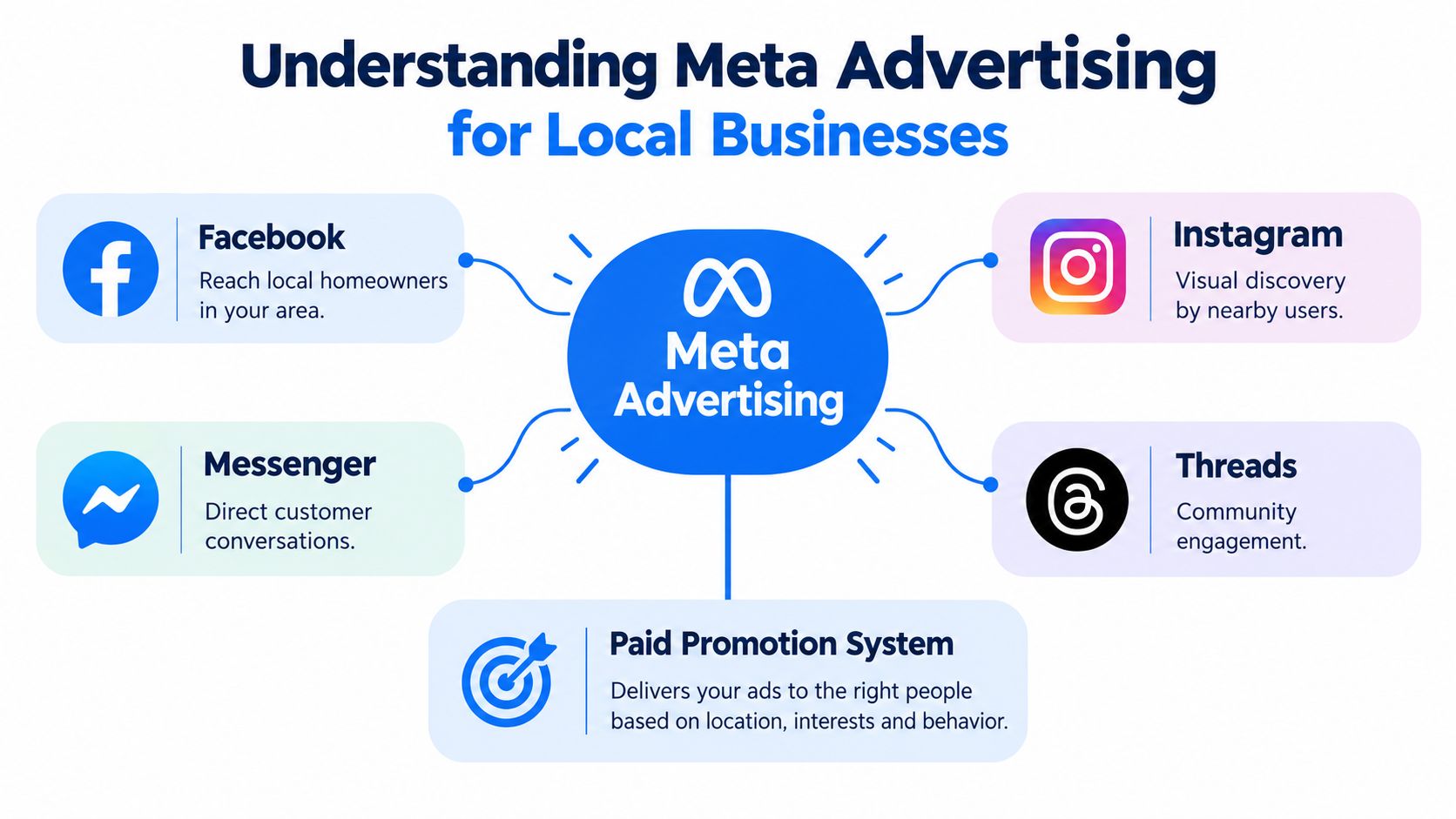
Meta advertising lets a business pay to promote messages to selected audiences across Facebook, Instagram, Messenger, and Threads. You manage these promotions through Meta's advertising tools, where you choose a business goal, define or guide the audience, provide creative assets, and set delivery preferences. Meta then uses its auction system to decide when and where an ad appears.
For a local service business, the basic process looks like this:
- You identify the service and location you want to promote.
- You create an offer, such as a quote request, consultation, seasonal service, or emergency call.
- You supply an image, video, written message, or lead form.
- Meta delivers the ad to people it predicts may respond.
- You follow up and determine whether the inquiry becomes a qualified opportunity or booked job.
Why local services need a different approach
A national retailer can measure a purchase directly on a website. A plumber, electrician, dentist, or lawn-care professional often gets value from a phone call, text conversation, estimate request, or appointment that happens outside the ad platform. That difference changes how you should build and judge a campaign.
The ad must do more than attract attention. It needs to set the right expectation about the service, make the service area clear, and give the prospect an easy next step. A dramatic image may earn engagement, but a plain explanation of availability and response time may produce better inquiries.
Meta advertising also differs from a boosted post. A boosted post promotes existing content with relatively simple controls. A structured campaign gives you more deliberate control over the objective, audience signals, placements, creative variations, lead collection, and measurement. Businesses comparing channels can use this overview of online advertising platforms to place Meta within a broader acquisition strategy.
Practical rule: Define the customer action before choosing the ad. “Get more attention” is vague. “Request an estimate for a local roof repair” gives the campaign a clearer job.
The Evolution and Scale of Meta Advertising
Facebook Ads began in November 2007 with 12 major partner brands. The original system allowed businesses to create pages, target specific users, and distribute messages through the social graph. Meta presented the product as more than ordinary display advertising because it combined audience targeting, trusted social referrals, and marketer insights in one environment. Meta's 2025 full-year results show how far that starting point has developed.
By 2025, Meta reported $200.97 billion in total annual revenue, up 22% year over year. Advertising impressions across its Family of Apps rose 12%, while the average price per ad increased 9%. Those figures describe a mature advertising marketplace, not a small feature attached to a social network.
What scale means for a local owner
A large system creates both opportunity and competition. Your ad can reach people interested in a nearby service, but it competes with other businesses for the same attention and placements. A local company doesn't need the budget of a national brand to participate, but it does need an offer and creative that make sense for the people Meta is trying to reach.
The financial concentration is even clearer in Meta's advertising results. Advertising revenue reached about $196.18 billion in 2025, representing 97.6% of total revenue and 98.7% of Family of Apps revenue, according to Meta's reported advertising results. In the fourth quarter, advertising revenue was about $58.14 billion, up 24.3% year over year, while ad impressions increased 18% and average price per ad rose 6%.
| What changed | What it means for a local campaign |
|---|---|
| More available impressions | Meta has more opportunities to deliver ads across its apps and placements. |
| Higher average ad prices | Demand from advertisers can affect the cost of competing for attention. |
| Broader delivery systems | A campaign may reach people in different environments, not just the Facebook Feed. |
| More automated optimization | The platform increasingly decides where and to whom delivery should move. |
This scale explains why Meta Ads Manager remains important for local acquisition. It also explains why old rules such as “just target homeowners in your town” aren't enough. Your campaign participates in a large auction that evaluates the likely value of each impression.
How the Meta Advertising Auction Works
Suppose two electricians want to reach people in the same service area. One submits a large budget but uses a blurry stock image and a vague headline. The other uses a clear photo, names the service, and offers a straightforward way to request help. The first business may be willing to spend more, but that doesn't automatically make its ad the winner.
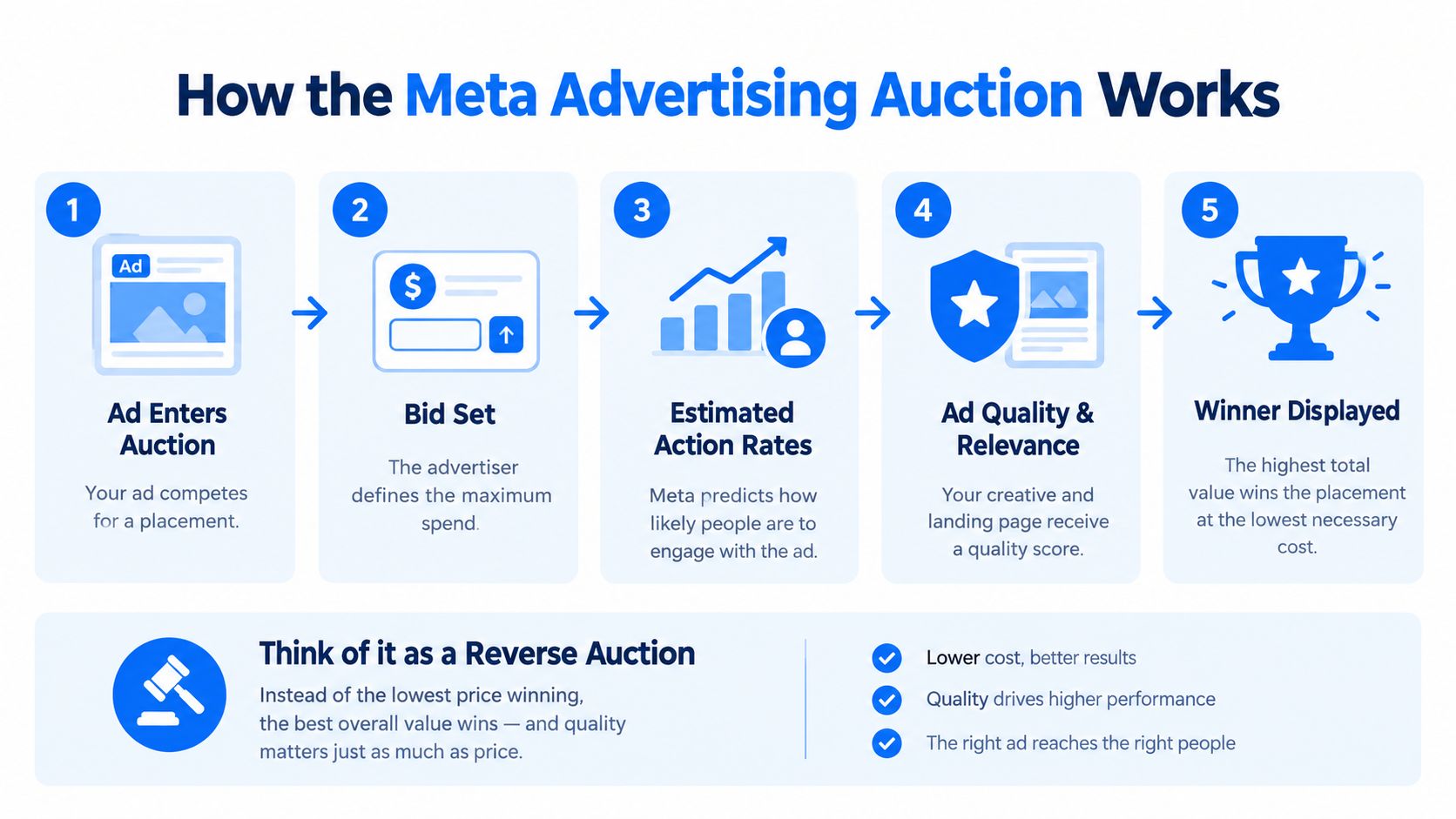
Meta describes the auction as an evaluation of competing ads using predicted quality, expected engagement rate, and expected conversion rate. Its auction quality guidance explains why delivery depends on more than the advertiser's bid.
Think of it as a reverse auction
In a normal auction, the highest bidder usually has the strongest chance of winning. Meta's process is closer to a reverse auction where the platform also asks, “Which ad is most likely to create a useful experience and the intended result for this person?”
The system considers three practical questions:
- Will the person respond? Meta predicts the likelihood of an engagement, such as a click, message, or other interaction.
- Will the person complete the desired action? A campaign optimized for leads needs an ad that appears likely to generate a lead, not merely a reaction.
- Will the ad create a good experience? Creative clarity, perceived relevance, and the destination after the click affect the ad's quality.
That doesn't mean a beautiful image guarantees cheap leads. It means creative is part of the economic equation. If your message attracts the wrong people, creates confusion, or leads to a disappointing form or page, the campaign can struggle even when the audience and budget look sensible.
What local businesses should improve first
Start with the promise. A heating company should distinguish emergency repair from replacement quotes. A landscaper should show the type of finished work it wants to sell. A dental practice should make the next step clear without relying on broad claims.
Then examine the handoff. If the ad says “Request a quote” but the landing page hides the form, the ad and destination send conflicting signals. If the ad invites a message but nobody responds promptly, the campaign may generate activity without producing useful opportunities.
A larger budget can buy more opportunities to enter the auction, but it can't repair weak relevance. Improve the offer, creative, and conversion path before assuming that spending more will solve delivery.
Choosing the Right Ad Format for Your Service
The right format depends on what the prospect needs to understand before making contact. A single image can communicate a service quickly. A video can show workmanship and process. A carousel can organize several proof points. A collection experience can help businesses with multiple products or services guide people through a broader selection.
Match the format to the buying question
| Format | Useful when the prospect is asking | Local example |
|---|---|---|
| Single image | “What service do you provide?” | An electrician shows a clean panel upgrade with a concise explanation of the work. |
| Video | “Can this business handle a job like mine?” | A landscaper shows the progression from an overgrown yard to a finished outdoor space. |
| Carousel | “What options or proof should I compare?” | A roofing company presents inspection, repair, replacement, and cleanup as separate cards. |
| Collection | “Which related services or products are available?” | A home improvement business groups seasonal services into a browsable experience. |
Photos work well when the result is easy to recognize. Use real work, real equipment, and a setting that feels local rather than a generic image that could represent any company. A caption can add the details the image can't show, including service area, qualification, or the action you want the viewer to take.
Video doesn't need elaborate production. A short walkthrough, technician introduction, or before-and-after explanation can answer doubts that a static image leaves unresolved. Keep the opening focused on the customer's problem, not on a long company introduction.
Carousels are useful when each card adds a distinct reason to trust the business. Don't repeat the same photograph with slightly different captions. Give each card a job, such as explaining a service step, showing a result, or addressing a common concern.
Collection formats make more sense when a business has several related offerings. A single-service contractor may get a clearer message from a strong image or video than from a format designed to help people browse multiple items. Meta's automation may distribute formats and placements broadly, but you still need creative that works in each environment.
Industry coverage also points to changing format preferences, including Collection Ads reaching 39% of surveyed advertisers, up nearly 15% year over year, as reported by Stackmatix's Meta advertising overview. Treat that as market context, not a reason to copy another advertiser. Your format should follow the customer's decision process.
Navigating Measurement Changes and Attribution
A local campaign can appear weak inside Ads Manager while producing valuable phone calls or text conversations. The reverse can also happen. A campaign may report many conversions that never become qualified opportunities. The difference comes from what Meta can observe, what you configure it to receive, and what happens after the lead leaves the platform.
Recent coverage describes attribution changes that narrow click-through reporting to link clicks, a wider rollout of Andromeda, and greater reliance on automated budget and placement controls. The same 2026 Meta advertising update analysis reports Meta Sales ROAS declining from 5.48 in 2025 to 4.57 in 2026, while average spend per Meta campaign rose 47% to $718.45. These figures are external benchmark context, not a forecast for your business.
Use a wider performance view
Don't judge a local service campaign by one platform metric. Review the path from impression to revenue:
- Delivery: Did Meta find enough relevant opportunities to show the ad?
- Response: Did people click, submit a form, call, or start a message?
- Qualification: Did the inquiry match the service, location, and timing?
- Outcome: Did the team book an estimate, appointment, or job?
- Economics: Did the resulting work justify the advertising and fulfillment costs?
A click-through conversion isn't the same as a booked job. For a business that closes sales by phone, the CRM, call log, or booking system must sit beside Ads Manager in the review process. Record the source of each inquiry and mark its stage, even if the final sale happens offline.
The technical setup matters too. Server-side tracking for marketing measurement can complement browser-based tracking when a website event isn't fully available to the ad platform. Meta's Conversions API documentation describes a server-side connection that can send website, app, offline, and business messaging events from a server or CRM. Sending corresponding web events through both browser and server connections can improve event coverage and measurement reliability.
Measurement habit: Compare platform-reported results with actual lead quality every week. If the two views disagree, investigate the handoff instead of immediately changing the audience.
Automating Local Lead Capture and Follow-up
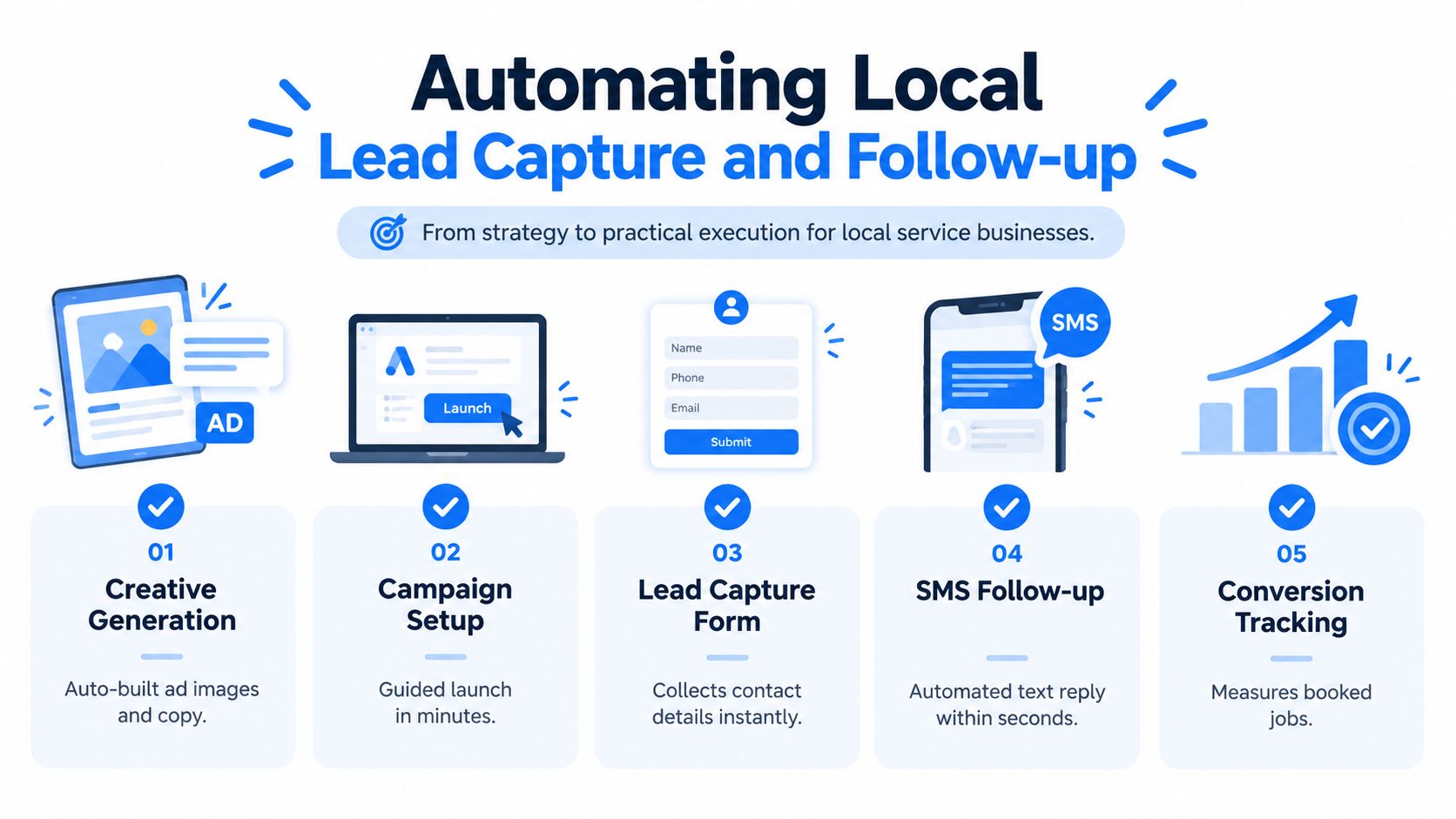
A local business can lose a good inquiry while the owner is driving, serving a customer, or handling another job. Automation keeps the response moving by preparing creative, organizing campaign settings, collecting contact details, sending an immediate reply, and recording what happened next. The owner still approves the offer, service area, claims, and budget.
A practical operating sequence
Creative generation can produce several service-specific ideas, while a person checks that the images and wording match the business. An electrician, for example, should reject an ad showing equipment the company does not install.
Campaign setup can standardize objectives, audiences, placements, and approval steps. This cuts repetitive configuration while keeping a review point before the campaign goes live.
Lead capture should request only the details needed for a useful response. Too many questions can discourage a prospect, while too few may leave the team unable to identify the job.
SMS follow-up acknowledges the inquiry while its details are still fresh. The message should name the business, confirm receipt, and offer a clear next step. See this guide to lead nurturing automation for sequencing ideas. Automated messages should sound clear, not pretend to be a human conversation or promise what the team cannot deliver.
Conversion tracking links the first inquiry to later outcomes, such as a qualified call, booked appointment, or completed job. That feedback helps the campaign seek more useful inquiries instead of optimizing for submissions alone.
One option is benjiads, a software platform that prepares Facebook and Instagram creatives and campaigns, provides landing and lead-capture funnels, supports SMS follow-up, and combines client-side and server-side tracking with an approval workflow. Businesses can also assemble these functions through separate advertising, CRM, messaging, and reporting tools. The requirement is an owner-approved process from ad to booked work.
Start with one service, one defined service area, and one measurable customer action. Review the first inquiries, adjust the offer and follow-up, then expand after the process consistently captures and manages real opportunities.
If you want to simplify Meta advertising for a local service business, visit benjiads to review software combining ad creative, campaign setup, lead capture, tracking, and SMS follow-up. The prepared campaign can be reviewed before approval, while lead and booking data can guide later decisions.
- Meta advertising
- Facebook ads
- Instagram ads
- local business
- digital marketing
Done for you
Ads that text you customers.
- ✓ Ads created for you
- ✓ Every lead texts your phone
- ✓ Free to use, no credit card
748+ local businesses run ads with benjiads