ad creative 12 min read
What Is Ad Creative: A Local Business Guide
What Is Ad Creative. Discover what ad creative is and why it matters for local service ads. Learn the key components, performance impact, and best practices
On this page
- Why Local Business Owners Confuse Ad Creative
- The Three Core Components of Ad Creative
- How Creative Quality Impacts Cost Per Lead
- The Hidden Technical Layer of Ad Creative
- Why Testing Multiple Creative Variants Matters
- Creative Best Practices for Local Service Ads
- Putting It All Together for Better Campaigns
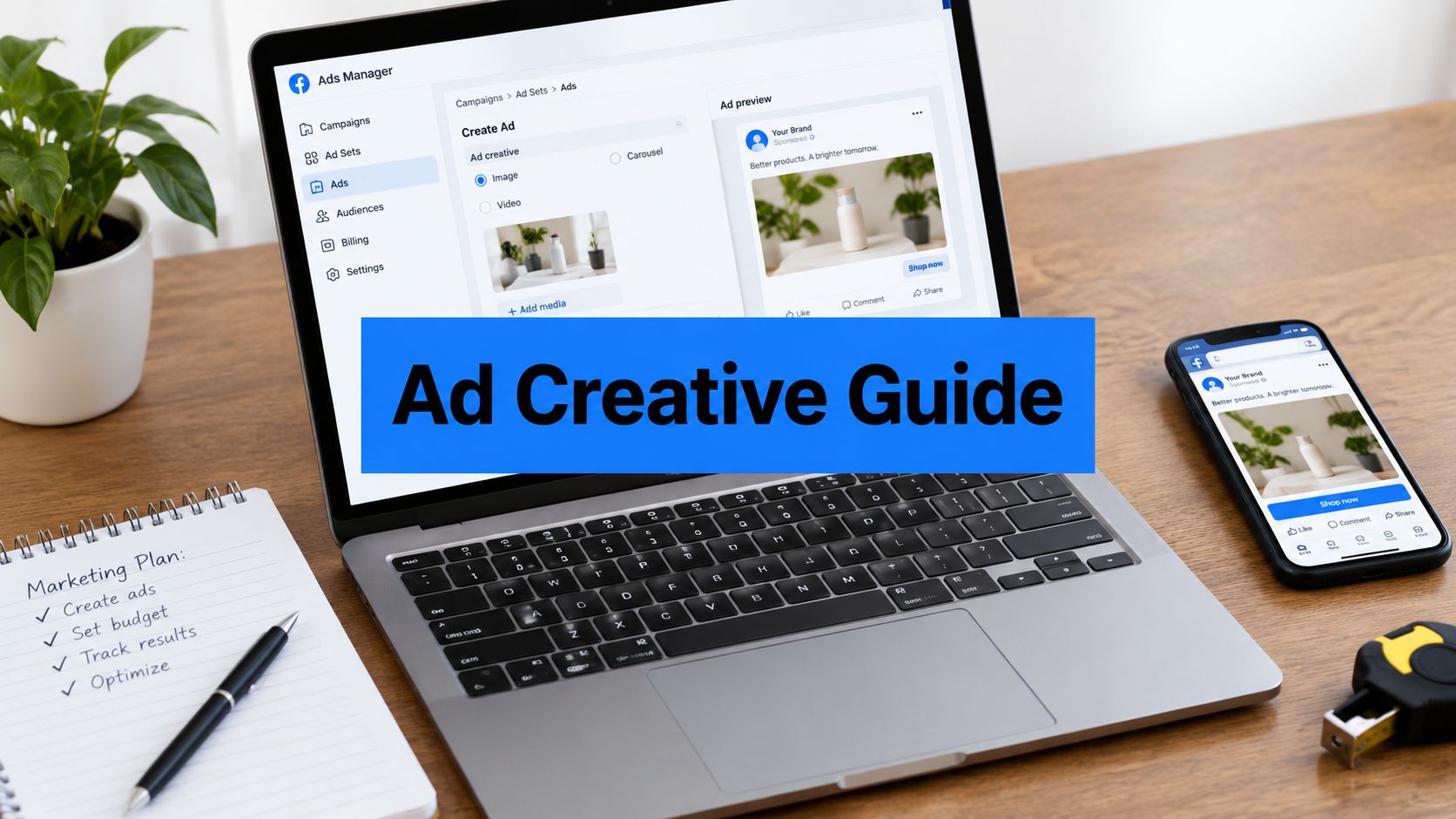
You've opened Meta Ads Manager to promote your electrical, plumbing, or landscaping business. The screen asks for primary text, a headline, a visual, and a call-to-action button. You upload a photo of a finished job, write “Call today,” and wonder why the platform still calls all of it a creative.
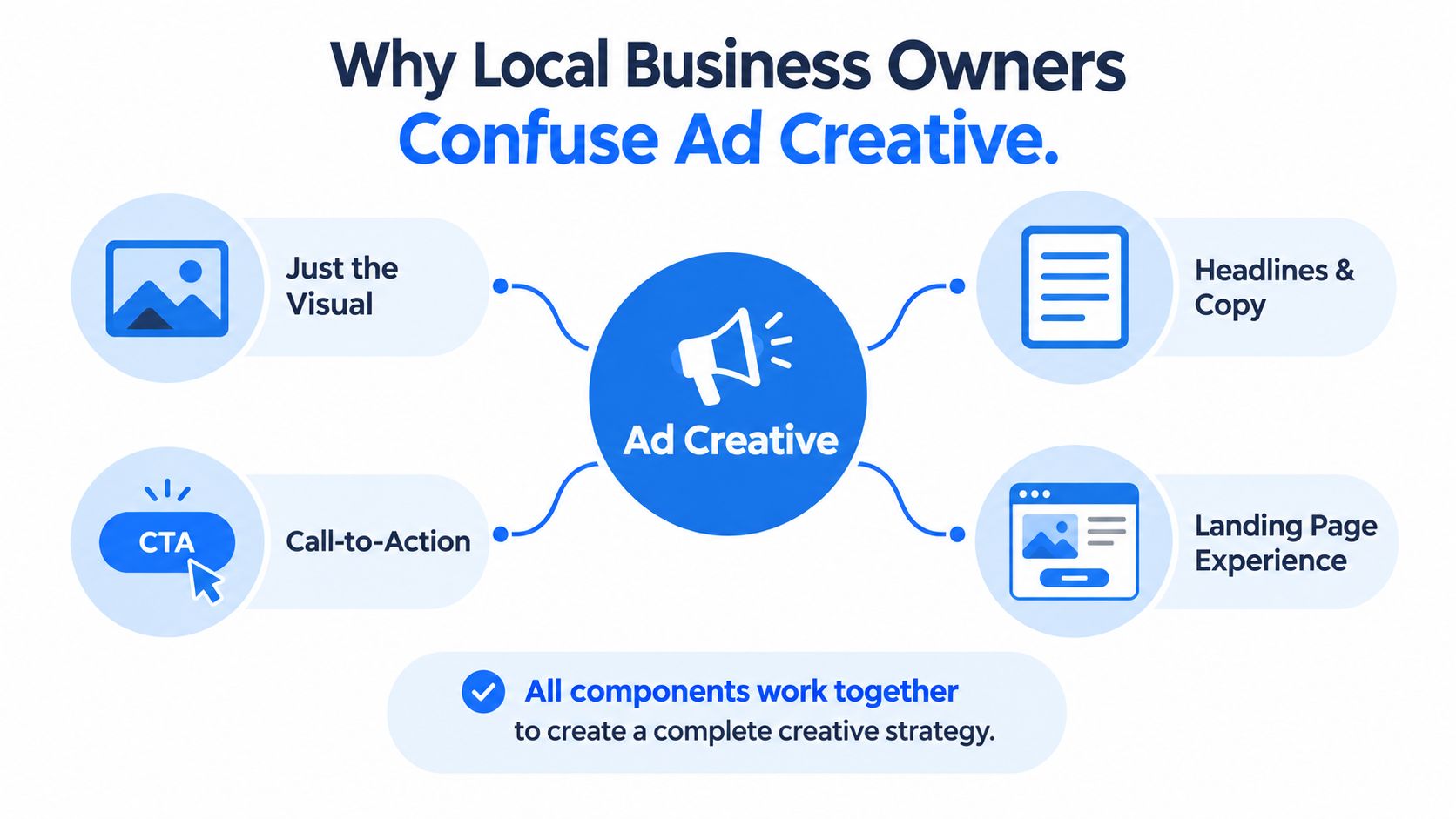
That confusion is common because people use “creative” to mean the image or video. In paid advertising, ad creative is the complete communication and delivery package. It includes what people see, what they read, the action they're invited to take, and the technical settings that determine whether the ad can run, be tracked, and be improved.
Why Local Business Owners Confuse Ad Creative
A local electrician might create an ad with a photo of a new breaker panel, a headline saying “Electrical Services,” body copy listing several services, and a button that says “Learn More.” Each part may look acceptable on its own. Together, though, the message is vague, the button may not match the customer's urgency, and the landing page might ask the visitor to figure out what to do next.
The photo is only one piece. The creative is the entire experience from the first impression to the next action.
The term has changed as advertising has changed. During the 1960s creative revolution, advertising moved away from formula-driven copy toward work designed to stand out and persuade emotionally. In 1994, the first banner ad introduced the need to design advertising specifically for digital screens, as described in this history of advertising's creative development.
The difference between an asset and a creative
An asset is an individual file or component, such as a photograph, logo, video, headline, or button label. A creative combines those assets into an ad that has a specific purpose.
For a dentist, a creative might pair a calm treatment-room image with copy about booking an evaluation and a “Book Now” button. For an emergency plumber, a photo of a technician may be less important than direct wording about the service problem and a button that starts a call or lead form.
Practical rule: Judge the complete path, not the prettiest part of the ad.
This distinction changes how you test campaigns. If an ad receives attention but few leads, the visual may be doing its job while the message, offer, form, or landing page creates friction. If people never stop scrolling, changing the form won't fix the first problem. Separating the parts helps you identify what needs improvement instead of replacing everything at once.
The Three Core Components of Ad Creative
Most local service ads rely on three practical components: visuals, copy, and the call to action. They work in sequence, but they also need to agree with one another.
Visuals earn the first look
The visual can be a photograph, video, animation, product image, or interactive element. Its job is to make the right person pause long enough to notice the message.
A landscaping business could show a real before-and-after yard, while an auto repair shop might show a technician diagnosing a vehicle. Authentic local imagery often gives the viewer useful context faster than a generic stock image. The visual should support the claim in the copy, not distract from it.
Copy gives the ad meaning
Copy includes the primary text and headline, and it may also include text inside the image or video. It answers the questions the visual cannot answer on its own:
- What problem does the business solve?
- Who is the service for?
- Why should the person take action now?
- What will happen after the click or call?
“Full-service home solutions” says very little. “Replace a faulty outlet before it becomes a bigger electrical problem” gives the reader a recognizable situation and a reason to respond. Clear copy also filters out people who aren't a good fit, which can matter more than attracting a large number of casual clicks.
The call to action directs the next move
The call-to-action button turns attention into an instruction. “Get Quote,” “Call Now,” “Book Now,” and “Learn More” create different expectations.
A dentist offering consultations may use a booking-focused action. An emergency locksmith may need a direct call. A landscaper selling a planned project may send prospects to a quote form. The right button depends on the customer's decision stage and the business's ability to respond.
Industry definitions describe ad creative as a combination of copy, visuals, motion, sound, and interactive elements, rather than only a picture or a sentence, as outlined in this TikTok guide to ad creative. The strongest ads align these elements around one promise and one clear next step.
How Creative Quality Impacts Cost Per Lead
Creative quality affects more than appearance. It can influence how efficiently an advertising platform delivers an ad, which means a better message may reduce waste before you change the audience or bidding settings.
A cross-brand analysis found that a 10% increase in Creative Quality Score was associated with a 2% decrease in CPM. The same analysis reported that ads in the top third of the score range, from 67% to 100%, delivered a 15% cheaper CPM than ads in the bottom third, from 0% to 33%, according to this analysis of creative quality and media efficiency.
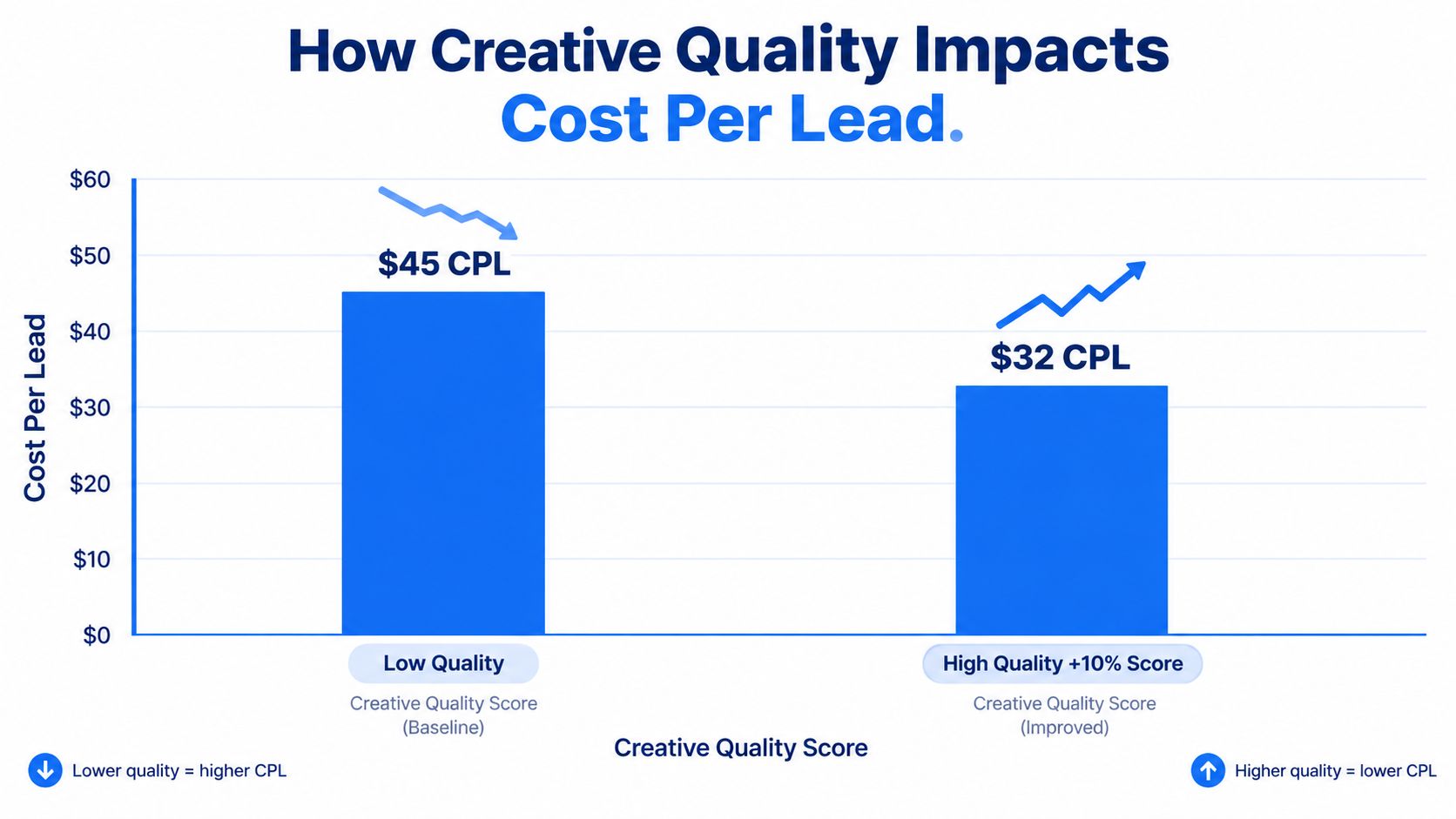
CPM is the cost to show an ad, not the final cost of a lead. Still, lower delivery costs can create more room for a local campaign to generate inquiries, especially when the business operates with tight margins. The practical lesson isn't that a polished image automatically produces cheap leads. It's that relevant, clear, platform-compatible creative can help the ad earn more efficient delivery.
What this means for a local campaign
Suppose an electrician's ad makes a strong promise but uses a confusing image and sends people to a page with no obvious contact option. Improving the image alone may not solve the problem. Creative quality includes the relationship between the message, the format, the destination, and the user's expected next step.
A useful review asks:
- Does the first frame or image identify the service clearly?
- Does the copy describe a real customer problem?
- Does the button match the requested action?
- Does the landing page continue the same promise?
- Can the business track the resulting call or form submission?
For a practical explanation of how to calculate and interpret lead acquisition costs, use this cost per lead formula guide. The calculation matters, but the diagnosis matters more. A lead can become expensive because the ad attracts the wrong audience, because the landing page loses interested visitors, or because the business responds too slowly.
The Hidden Technical Layer of Ad Creative
A design file becomes an advertising creative only after a platform can use it. In an ad-tech system, the creative is a structured delivery object, not merely a visual concept. It carries information that tells the platform what the asset is, where it belongs, how it should appear, and whether it is allowed to serve.
That object can include the media file, text fields, destination URL, format, account association, approval state, tracking parameters, and serving rules. A platform may also store variations for different placements or devices. Google Ad Manager's documentation describes creatives as items that can be configured and served within an advertising system, as shown in this Google Ad Manager creative documentation.
Why approval status matters
A local business can have a finished image and persuasive copy, yet still have no running ad. The asset may be awaiting approval, violate a policy, use an unsupported format, point to an unavailable destination, or remain paused until someone authorizes publication.
That's why a useful workflow separates four stages:
- Preparation: The business supplies its service area, offer, branding, and contact details.
- Assembly: The system combines approved text, visuals, destinations, and tracking fields.
- Review: The platform checks policy and technical requirements, while the owner checks accuracy.
- Serving and iteration: The approved creative runs, records results, and can be paused or replaced.
The distinction becomes important when a business uses automated campaign software. Automation can generate several headlines or resize media, but it still needs reliable business information, a valid destination, clear approval controls, and consistent tracking.
Tracking is part of the operating system
If a person clicks an ad, submits a form, and becomes a customer, the campaign needs a way to connect those events. Client-side tags, server-side events, phone tracking, and form records can all contribute to that picture. This is why server-side tracking for advertising is not just a technical add-on. It helps a business understand which creative produced a meaningful response, rather than judging an ad only by clicks.
The operational definition is simple: a creative must be attractive enough to earn attention and structured enough to run, measure, pause, and improve.
Why Testing Multiple Creative Variants Matters
Relying on one ad gives you one interpretation of your business, service, and customer problem. If it performs poorly, you won't know whether the issue was the image, opening line, offer, button, or audience expectation.
Multiple variants give the campaign more useful comparisons. An electrician might test a safety-focused message against a convenience-focused message. A dentist might compare a treatment-room video with a simple team photograph. A cleaning company could test a room transformation against a message about recurring service.
Performance often concentrates around a small number of assets. A 2025 industry summary reported that the top 2% of creatives accounted for 53% of total ad spend in gaming and 48% for non-gaming advertisers on Meta and related platforms, as reported in this summary of Meta's creative testing guidance. The same source reported an 18% year-over-year increase in overall creative output.

The lesson for a local owner isn't to produce an enormous library of ads. It's to avoid treating the first version as a final answer. A small, deliberate set of meaningful variations can reveal which promise attracts qualified prospects.
Test one meaningful difference
Change one major idea at a time when possible:
- Visual angle: Technician at work versus finished project.
- Problem angle: Preventive maintenance versus urgent repair.
- Offer angle: Free estimate versus fast appointment availability.
- Format: Static image versus short video.
- Action: Request a quote versus call the business.
Interactive formats also deserve consideration. One independent benchmark reported that interactive ads such as quizzes and polls produced a 40% higher click-through rate than static ads, though a local service business should still judge success by qualified inquiries and booked work, not clicks alone. A quiz can help a roofing company identify a project type, while a poll may help a landscaping business learn what improvement a homeowner wants.
A test should answer a business question. If you change the image, headline, offer, and landing page at the same time, the result won't tell you which decision made the difference.
Review each variant against the same business outcome. A high click-through rate with weak lead quality isn't necessarily a winner. A quieter ad that generates relevant calls may deserve more attention.
Creative Best Practices for Local Service Ads
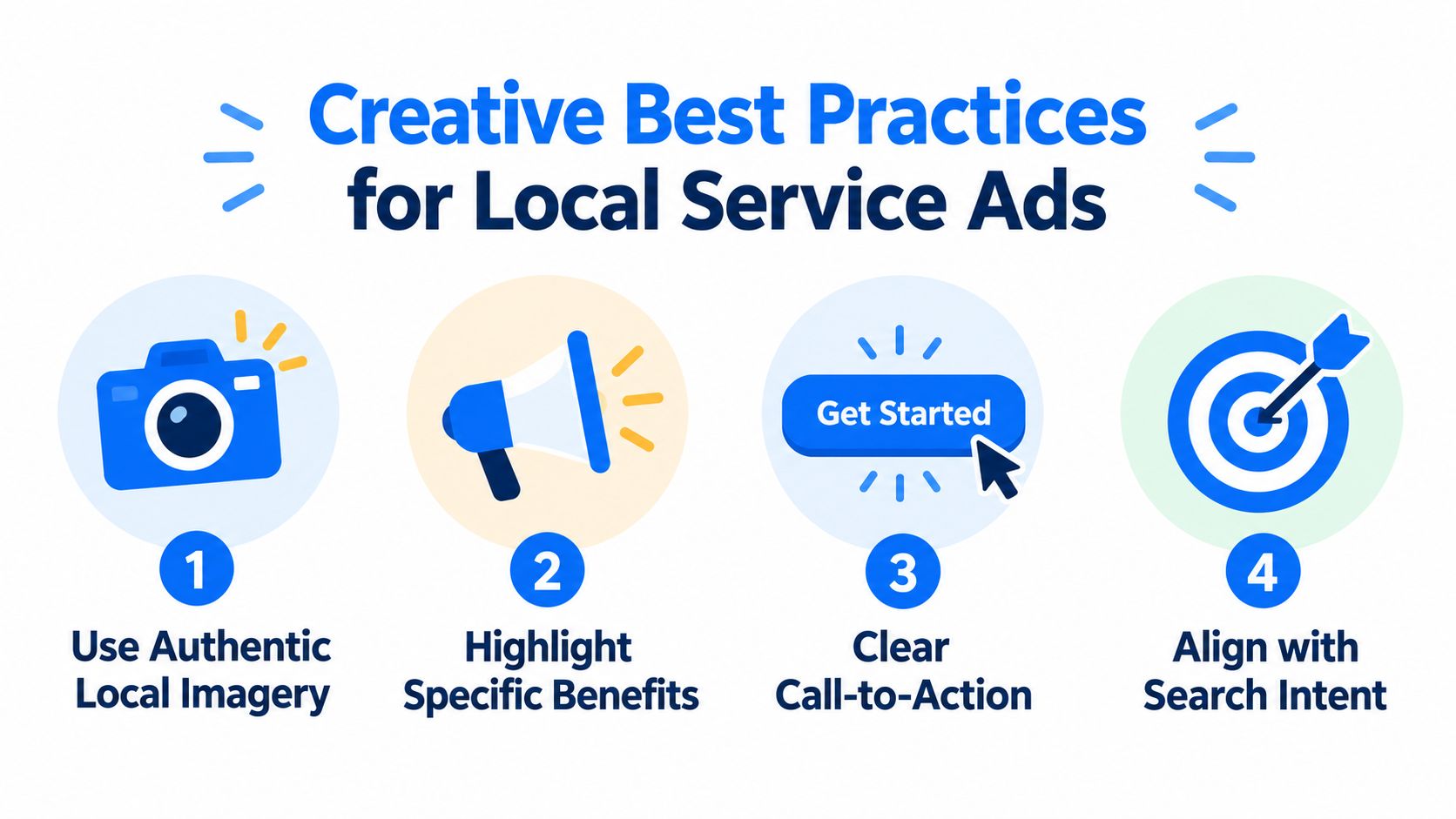
Local advertising works best when the creative feels specific to the service and the decision facing the customer. A homeowner looking for an emergency electrician doesn't need the same message as someone planning a kitchen renovation.
Start with recognizable evidence
Use a real technician, vehicle, workspace, finished project, or service situation when the image can show it clearly. An electrician can show a safe installation in progress. A dentist can show a welcoming treatment room and team member. An auto repair shop can show the inspection process rather than a generic sports car.
Stock photography isn't automatically wrong, but a generic smiling person holding a tool rarely proves that the business understands the customer's problem.
Write for the immediate decision
Use plain language that names the service and its relevant benefit. “Licensed plumbing help for leaks and water pressure problems” is more useful than “Complete home solutions.” Keep the headline focused, then use the primary text to add service area, qualification details, or the next step.
Your CTA should reflect the timeline:
- Urgent services: Use a call-focused action and explain who will respond.
- Planned projects: Use a quote or consultation action.
- Appointment services: Use booking language and set expectations.
- Diagnostic services: Ask the visitor to schedule an assessment rather than promise a result you can't guarantee.
The landing page should repeat the same service, location, and action. If the ad promises a quote for a local roofing project, the page shouldn't lead with unrelated company history.
For businesses that need help producing trade-specific variations and connecting creative to campaign setup, an AI ad creative generator can support the production workflow. The owner still needs to review claims, service details, imagery, and compliance before approval.
A short demonstration can also clarify how creative production fits into a broader advertising workflow.
Before launch, check every element as a customer would experience it. Confirm that the phone number works, the form asks only for useful information, the destination loads properly, and the business can respond when a prospect submits an inquiry.
Putting It All Together for Better Campaigns
The answer to what is ad creative has two parts. It's the customer-facing message, made from visuals, copy, format, and a call to action. It's also the structured asset that a platform approves, serves, tracks, pauses, and compares against other versions.
That definition gives local owners a better way to diagnose campaigns. If people don't notice the ad, inspect the opening visual or frame. If they notice but don't understand, improve the promise and supporting copy. If they click but don't contact the business, examine the CTA and landing page. If results can't be connected to the ad, inspect the tracking and delivery setup.
Build creative around a real service problem, produce several purposeful variations, and judge results by qualified leads and business outcomes. You don't need to become a full-time media buyer, but you do need a clear approval process and a willingness to replace assumptions with evidence.
The next useful step is to review one active ad as a complete system. Check the visual, message, CTA, destination, approval status, tracking, and follow-up process. Then choose one meaningful variation to test rather than changing everything at once.
BenjiAds offers local service businesses automated ad creative and copy generation, campaign setup, landing funnels, tracking, reporting, and SMS-based lead follow-up with ads kept under the owner's approval control. Visit benjiads to see how the platform can connect creative production with the rest of a local lead campaign.
- ad creative
- local ads
- advertising guide
- digital marketing
- ad performance
Done for you
Ads that text you customers.
- ✓ Ads created for you
- ✓ Every lead texts your phone
- ✓ Free to use, no credit card
748+ local businesses run ads with benjiads