window washing advertising 12 min read
Window Washing Advertising That Books Real Jobs
Practical window washing advertising strategies that turn local leads into booked jobs, from ad creative to fast SMS follow-up and seasonal offers.
On this page
- What Window Washing Advertising Has to Do to Book Jobs
- The Market You Are Advertising In
- Building Campaigns That Match Real Service Categories
- Seasonal Promotions and Local Targeting That Actually Convert
- Follow-Up That Turns Leads Into Booked Jobs
- Reviews, Retargeting, and the Next Campaign
- Measurement, Common Mistakes, and Your Next 30 Days
You can buy clicks and still end up with an empty schedule. In window washing, the core issue usually isn't traffic, it's that the job gets treated like a lead instead of a booked, completed cleaning, then a review that helps the next one close faster. The businesses that stay busy connect the whole chain, ad, landing page, fast response, estimate, booking, completion, and fresh proof.
If you're choosing photos, offers, and follow-up scripts without that loop in mind, you're probably paying for a lot of curiosity and not enough revenue. A useful place to start is to browse marketing material ideas that fit small local services, because the right visual proof often does more work than clever copy, especially for a trade where the result is obvious at a glance, like browse marketing material ideas.
What Window Washing Advertising Has to Do to Book Jobs
The first mistake is treating a quote request like the finish line. In this trade, the finish line is a completed clean that turns into a review, a repeat booking, or both. Ads only earn their keep when they move a prospect from first click to a real appointment, with enough trust and speed to stop them from taking the next quote.
The four-step loop that actually matters
A strong campaign follows a simple sequence, ad, qualified estimate, completed service, review-driven next lead. The ad creates interest, the landing page filters out bad-fit traffic, the follow-up converts serious prospects, and the completed job creates proof for the next round of acquisition. If one of those steps is weak, the whole system leaks money.
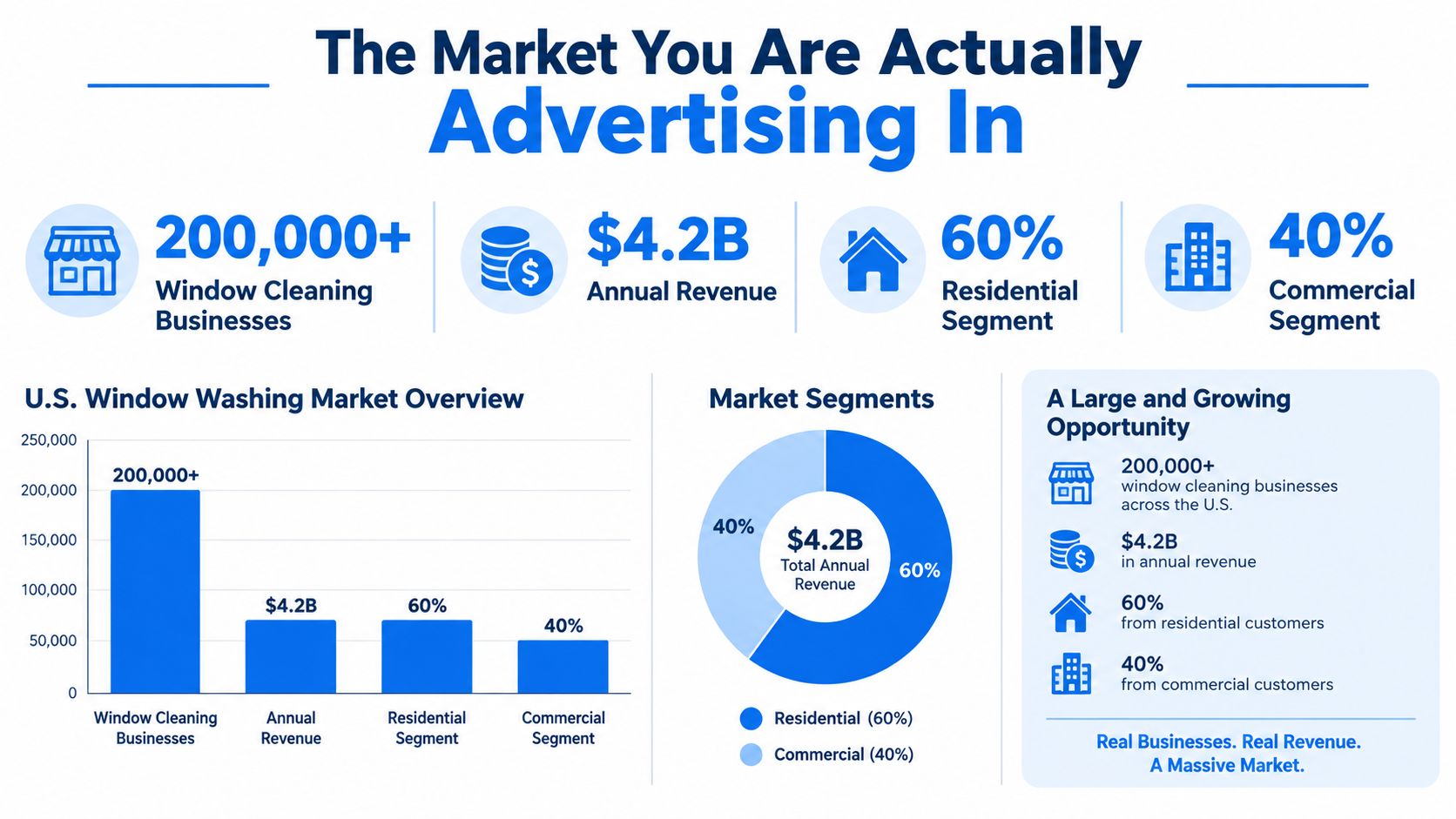
That's why speed, proof, and pricing transparency matter more than flashy lines. A homeowner doesn't need a poetic headline when they're comparing three local cleaners and wants to know whether you handle ladders, screens, interior glass, or higher windows. A property manager wants reliability and clarity, not vague promises.
Practical rule: if the campaign can't clearly answer who you serve, how you price, and how fast you respond, the lead is probably going elsewhere.
The ad-to-job loop also changes how you judge creative. A post that gets attention but sends people to a weak page is wasted spend. A plain ad with clear service detail, a tight service area, and fast contact handling often outperforms because it keeps qualified prospects moving instead of stalling them.
For operators who want a better filter, the goal is to reduce noise before the phone rings. That means showing the service area, the type of building you handle, and the conversion path in a way that feels concrete. Good window washing advertising doesn't just generate inquiries, it sets the expectation that the company is ready to quote, schedule, and show up.
The Market You Are Advertising In
Window washing is large enough to support paid acquisition, but it does not behave like a few national brands fighting for broad awareness. IBISWorld estimated U.S. window-washing revenue at approximately $2.9 billion in 2024, after average annual growth of 2.3% from 2019 through 2024, and projected about $3.2 billion by 2029 IBISWorld's industry estimate. That scale supports real ad demand, while the work still gets won locally.
A fragmented local-services market
The better read on the category is highly distributed local competition. A directory-based 2026 analysis counted 32,859 U.S. window-cleaning service locations, with 29,285, or 89.12%, single-owner operations, and 24,093 businesses having their own websites directory analysis. That matters because buyers usually compare nearby providers, then choose the one that answers fast and looks trustworthy.
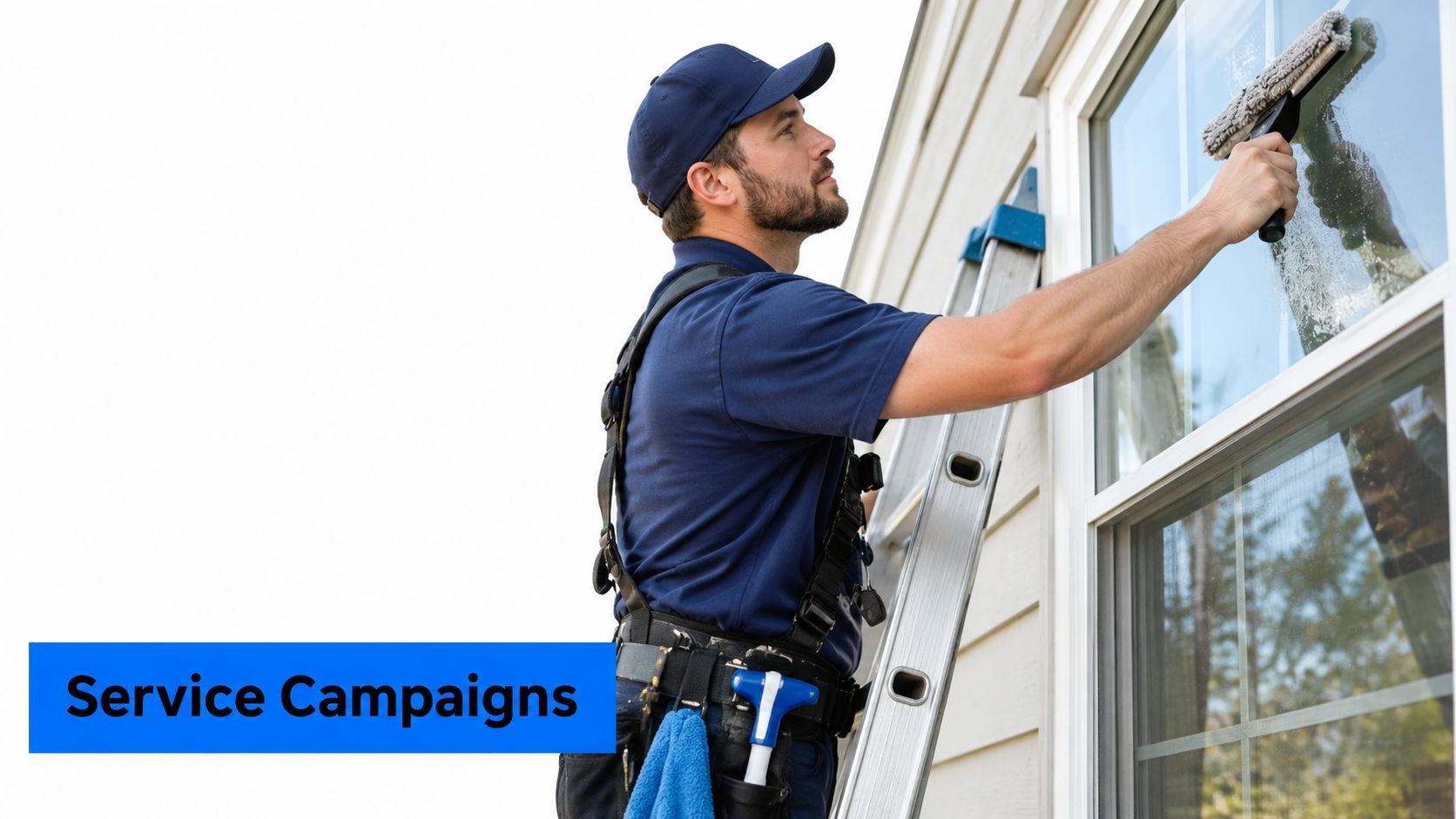
That leaves roughly 26.7% without a dedicated web presence. A solid local site with service-area copy, proof photos, and a direct quote path can stand out in many markets without outspending everyone else.
For operators building a local plan, that fragmentation is the opportunity. Searchers want a nearby provider more than a famous one. A smart strategy ties ads to city, neighborhood, service radius, and building type, then uses the landing page to confirm that you handle the job they have in mind. For a broader view of how local service categories fit into paid media, this breakdown of local service ads categories is a useful complement.
The takeaway is simple. The market is large enough to matter and scattered enough that local relevance still wins.
Building Campaigns That Match Real Service Categories
A lot of window washing ads waste budget because the campaign is built around one generic idea, “window cleaning near me.” That phrase is too blunt for a market where a small home, a storefront, and a post-construction cleanup all imply different crews, equipment, access concerns, and close rates. The ad account needs to mirror the service the buyer wants.
Segment by job type, not by guesswork
Start with separate groups for residential exterior, interior glass, storefront and commercial routes, and post-construction cleaning. Then add location layers so each group speaks to a real service area instead of a broad metro. Search terms should be tightly controlled, and the negatives should cut out research traffic like jobs, supplies, DIY, and squeegee.
A useful landing page should not try to do everything at once. Give each service type one page with one action, usually call or quote request. That page should show the service area, building-height limits, insurance or safety credentials if they matter, and before-and-after images that prove the work is real. If the job requires site inspection, say so plainly instead of pretending every price can be fixed instantly.
For campaign planning, home-services search benchmarks give a directional baseline of approximately 6.47% click-through rate, 8.05% conversion rate, and $90.92 cost per lead, though actual results vary by market, device mix, season, and intent home-services search benchmarks. Treat those as planning numbers, not promises. The right move is to calculate allowable CPL from your own gross profit per job, not from a random average.
If you want a deeper buildout on the mechanics, this Google Ads setup guide pairs well with the structure above. The same principle applies to window washing as to any local trade, the campaign should follow the service, not the other way around.
Creative should match the sale
A storefront route ad can lean on reliability and regular service. A residential ad should feel cleaner, more visual, and faster to understand. Post-construction ads need to communicate cleanup complexity and the ability to handle dusty, messy glass without overpromising a fixed price before someone sees the site.
For a practical comparison, carpet cleaning marketing guide shows the same pattern in another cleaning trade, specific service pages beat broad, catch-all messaging because buyers want to know you handle their exact problem. Window washing works the same way.
Operator note: one landing page per service type usually beats one “services” page that tries to sell every job to every visitor.
Seasonal Promotions and Local Targeting That Actually Convert
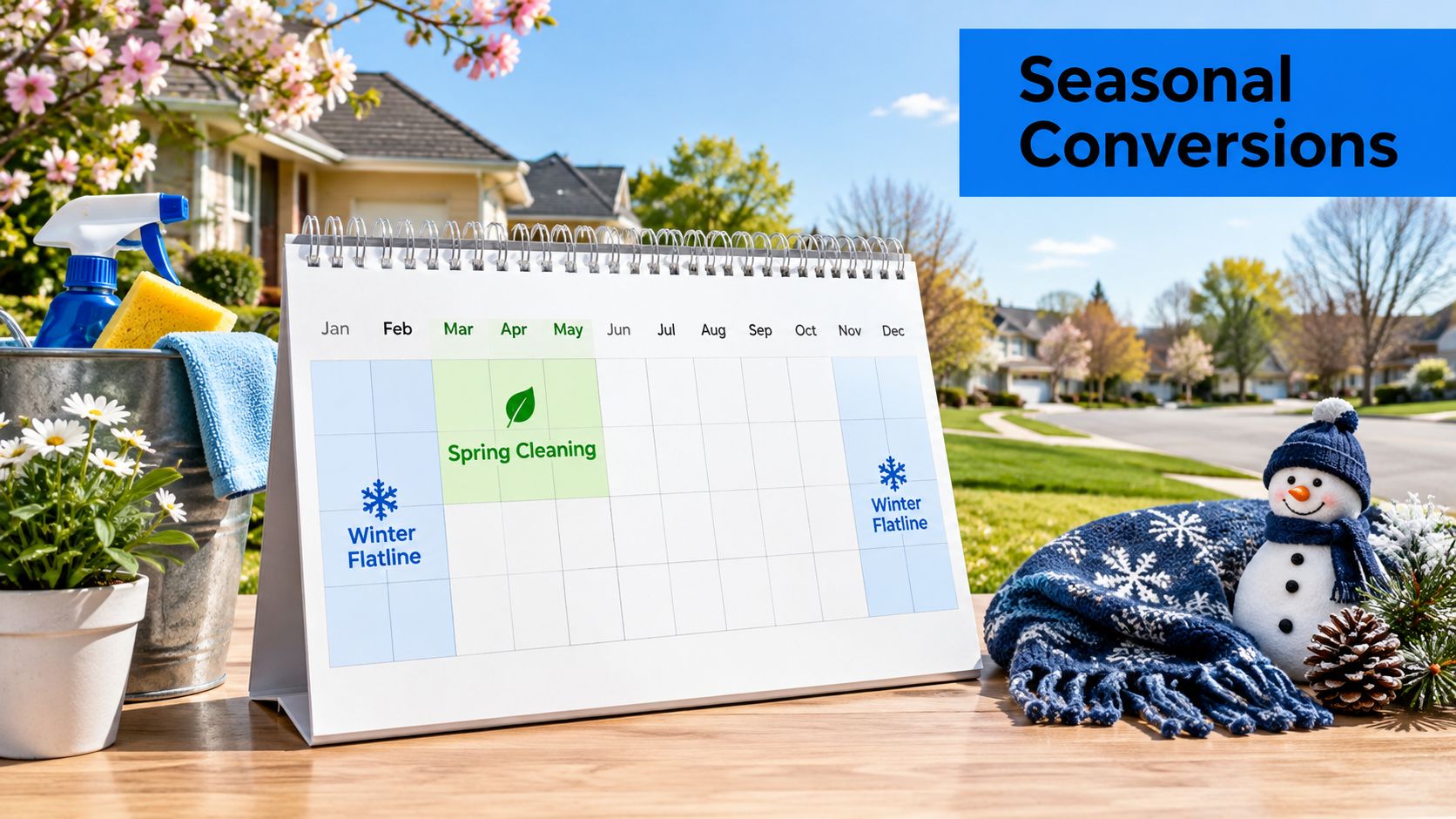
Window washing demand doesn't behave evenly across the calendar. In many markets, spring cleanup and late-season exterior refreshes are easier sells than deep winter outreach, so ad spend should follow demand instead of pretending every month deserves the same budget. The best promotions justify a click because they match timing, property type, and a real reason to buy now.
Tight geography beats broad geography
Local targeting should be narrower than most owners think. Use zip codes, neighborhood boundaries, and commercial districts that your crew can serve profitably. If a route gets stretched too far, response time suffers, travel eats margin, and the campaign starts winning jobs that look good in the ad account but aren't good for the business.
The 2026 directory analysis found that 29,285 of 32,859 locations were single-owner operations directory analysis. That kind of ownership pattern usually means routing discipline matters as much as media buying. Owner-operators can win fast if they target a tight area and build offers around convenience, not just discounting.
Good offers are specific. First-time exterior clean, interior and exterior bundle, post-construction quote, and recurring maintenance for storefronts or property managers all give the prospect a reason to engage. Blanket discounts are a blunt tool, and they often attract price shoppers who won't repeat.
Later in the day, the targeting question gets even more specific. Commercial districts deserve different messaging than residential neighborhoods because the buyer is usually a manager, not a homeowner. A storefront owner cares about curb appeal and frequency. A property manager cares about consistency and low friction. The ad should reflect that.
Match the audience to the offer
A seasonal promo is useful only if it still protects margin. The point isn't to throw out deals, it's to create urgency around a service the buyer already needs. In practice, the best local ads often look less like a coupon and more like a timely invitation with a clean next step.
That's especially true for building types that need recurring visits. Property managers, HOAs, and storefront owners respond better when the message is about dependable turnaround, route scheduling, and visible results. The tighter the fit between audience and offer, the less the campaign has to work to close the gap.
Follow-Up That Turns Leads Into Booked Jobs
Most window washing leads aren't exclusive. The prospect is likely comparing several providers at once, which means the first good response gets a head start on the sale. In that environment, the business that responds fast can shape the conversation before price becomes the only issue.
The first hour decides more than most owners think
The right sequence starts with an immediate confirmation text, followed by a call within five minutes. That first conversation should collect the address, pane count or rough glass area, access and elevation requirements, interior access, timing, and whether the job is residential or commercial. If height or access creates risk, give a provisional range and schedule an on-site estimate instead of guessing.
Home-service research reports that contacting a lead within five minutes makes qualification 21 times more likely than waiting 30 minutes, while only 37% of companies responded to a web lead within an hour and 23% never responded speed-to-lead research. Those aren't window-cleaning-only numbers, but they explain why slow follow-up destroys paid traffic.
A lead that sits for an hour becomes a comparison shopper, not a conversation.
The process should keep moving, but it should also stop when the prospect books, opts out, or becomes unreachable. No one wants repeated pings after they've already hired someone else. Permission-based follow-up keeps the brand professional and protects the phone number from becoming a nuisance.
Track the right outcome
Raw form fills are a weak metric if many of them are incomplete, duplicate, or unqualified. Report cost per qualified estimate, cost per booked job, and cost per completed job alongside CPL. That gives you a real picture of what the campaign is producing, not just how many people clicked a button.
If you need a cleaner message flow, text message templates for local service leads can help standardize the first reply without making it sound robotic. The best version still sounds human, because the job is often won by the first competent voice the prospect hears.
The owner who wins this stage isn't the one who sends the most messages. It's the one who sends the right one fast, asks the right questions, and moves the lead toward a real visit or booked slot without making the process feel heavy.
Reviews, Retargeting, and the Next Campaign
Most ad guides stop after the lead lands. That leaves money on the table, because the next campaign starts with whatever proof the last job created. In window washing, that usually means reviews, recent responses, and a visible record that the business still pays attention after the invoice is sent.
Completed jobs should feed fresh proof
Recent U.S. consumer research found that 92% of consumers view owner responses as part of customer service, and 63% expect a response within roughly two to seven days consumer review research. That makes review handling part of marketing, not just reputation maintenance. If a company finishes work and then goes silent, it weakens trust right when the next prospect is checking social proof.
Ask for a review shortly after completion, while the work is still visible and the customer is still looking at the result. Then respond to every review within a few days, especially when the review mentions service area, glass condition, access, or safety practices. Those details make the response feel real and useful to the next buyer.
The underused advantage here is that proof compounds. A polished ad can pull clicks, but a recent review with a thoughtful owner response can close the hesitation. That's why an average ad with active social proof often beats a flashy ad sitting next to stale feedback.
For retargeting, a useful reference point is b2b retargeting ads, because the same idea applies to local services. People who asked for a quote but didn't book, or past customers due for seasonal cleaning, are usually warmer than cold traffic and easier to bring back with a relevant reminder.
The strong pattern is simple. Finished job, review request, owner response, then a seasonal reminder or reactivation message. That loop gives the next campaign better proof before a prospect ever clicks.
Measurement, Common Mistakes, and Your Next 30 Days
A 2025 benchmark covering 3,211 U.S. home-service search campaigns reported window-cleaning medians of $9.12 per click, 13.58% conversion rate, and $66.69 per lead 2025 benchmark. Those numbers are useful, but only if you compare them to booked jobs, not just form fills. A cheap lead that never closes is still expensive.
What drains budget fastest
The most common mistake is optimizing to the cheapest inquiry. That often favors low-value jobs, poor-fit traffic, or people who only wanted a ballpark. The next mistake is blending clicks, calls, form fills, estimates, and booked jobs into one “lead” bucket, which hides where the funnel is breaking.
A short checklist keeps the account honest:
- Separate services: build distinct campaigns for residential, commercial, and post-construction work.
- Match each landing page: give each service one page, one offer, and one conversion action.
- Respond fast: confirm immediately, then call within minutes.
- Track real outcomes: measure estimates, booked jobs, and completed jobs separately.
- Refresh proof: ask for reviews after completion and reply promptly.
- Review the source: break reporting out by keyword, zip code, and service type.
For budget setting, calculate your maximum allowable CPL from contribution margin and close rate, not from a generic benchmark. If the math says a lead can't turn into profit at your current close rate, the campaign needs better targeting or better follow-up, not more spend.
If you want the ads, landing pages, and lead follow-up handled as one system instead of a pile of disconnected tools, visit benjiads. It's built for local service operators who want paid campaigns that connect creative, tracking, and SMS follow-up to booked jobs, not just form fills.
- window washing advertising
- window cleaning ads
- local service ads
- lead follow up
- Facebook ads
Done for you
Ads that text you customers.
- ✓ Ads created for you
- ✓ Every lead texts your phone
- ✓ Free to use, no credit card
748+ local businesses run ads with benjiads