pressure washing marketing 13 min read
Pressure Washing Marketing Playbook That Books Jobs
Pressure washing marketing strategies that turn ad spend into booked, profitable jobs. Learn local ads, service pages, follow-up flows, and seasonal offers.
On this page
- Why Pressure Washing Marketing Is More Crowded Than It Looks
- Building the Local Search Foundation
- Segmenting Campaigns by Service and Intent
- Ad Creative and SMS Intake That Actually Qualifies
- Measuring What Actually Pays the Crew
- Seasonal Offers That Match the Calendar
- Your 30-Day Pressure Washing Marketing Plan
You've paid for the click, answered the phone, and sent the quote. Then the customer disappears. Meanwhile, your crew still has open space on the schedule, so you lower the offer, chase cheaper leads, and convince yourself the problem is advertising. Usually, it isn't. The problem is that your pressure washing marketing is measuring inquiries instead of profitable, collected jobs.
A lead is only useful when the property fits your service area, the surface is safe to clean, the job clears your minimum charge, and someone follows up fast enough to book it. This playbook treats advertising, qualification, follow-up, and fulfillment as one system.
Why Pressure Washing Marketing Is More Crowded Than It Looks
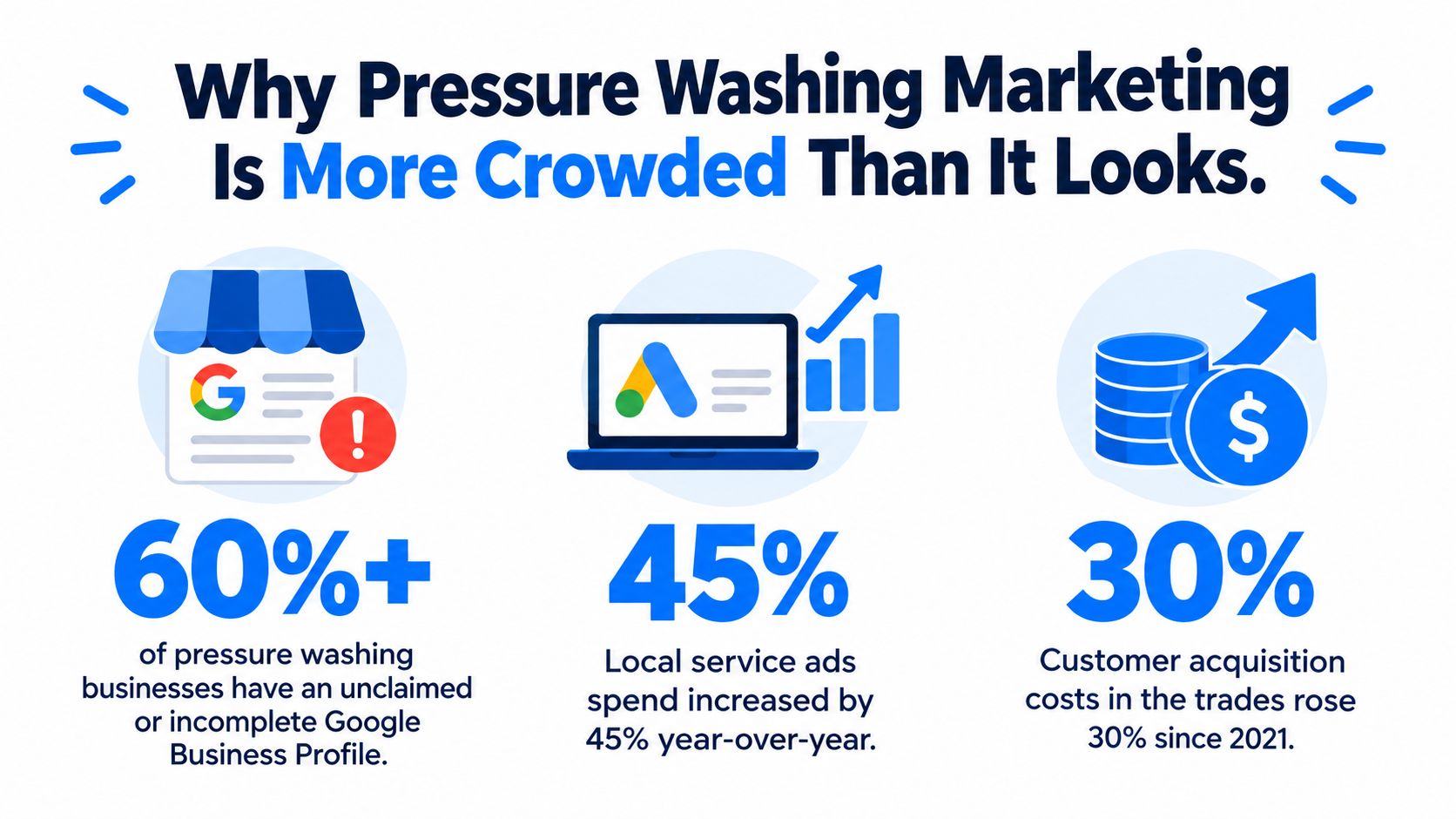
Pressure washing looks like a simple local service, but the competitive math is tougher than most owners expect. The U.S. pressure-washing services industry generated approximately $1.2 billion in revenue in 2024, while the number of businesses reached 32,193, according to IBISWorld's pressure-washing industry data. Revenue grew at a compound annual growth rate of 0.6% from 2019 through 2024, while the number of businesses grew at an average annual rate of 5.8% over the same period.
That gap matters. More operators are entering the market faster than total revenue is expanding, so each company has to fight harder for map visibility, calls, quote requests, and repeat work. Employment also reached 41,799 people in 2024, with employment growing at an average annual rate of 4.1% between 2019 and 2024, reinforcing the picture of a growing but highly fragmented trade. The competitive threat isn't only a regional company with polished branding. It's the owner-operator two neighborhoods away bidding on the same driveway search.
The customer rarely uses one channel
Local buyers increasingly research across several touchpoints before contacting a provider. A 2026 summary citing BrightLocal's U.S. consumer research reported that 52% of respondents began their latest local search on Google Search, while 9% began on Google Maps, 9% on social media, and 8% on an AI tool. The same summary reported that 73% searched on a mobile device and 75% used more than one channel before deciding. These figures cover local services broadly, not pressure washing specifically, but the buying behavior fits a visual, location-based trade where trust and surface safety affect the decision. See the local home-services search behavior summary for the full context.
A homeowner may find you in search, check your map profile, inspect reviews, look at before-and-after photos, and then text instead of calling. A commercial buyer may review your website, compare service coverage, and ask for proof that you handle similar properties. Your campaign fails if any important step creates doubt.
Practical rule: Don't optimize for the cheapest inquiry. Optimize for the inquiry that can become a profitable job.
That means your dashboard should connect ad spend to qualified estimates, booked work, collected revenue, and gross profit. General home-service marketing guidance can help with the broader channel mix, but pressure washing requires a tighter filter. A low-cost lead for a distant, tiny, unsafe, or highly price-sensitive job can be worse than a more expensive lead for recurring commercial work.
Building the Local Search Foundation
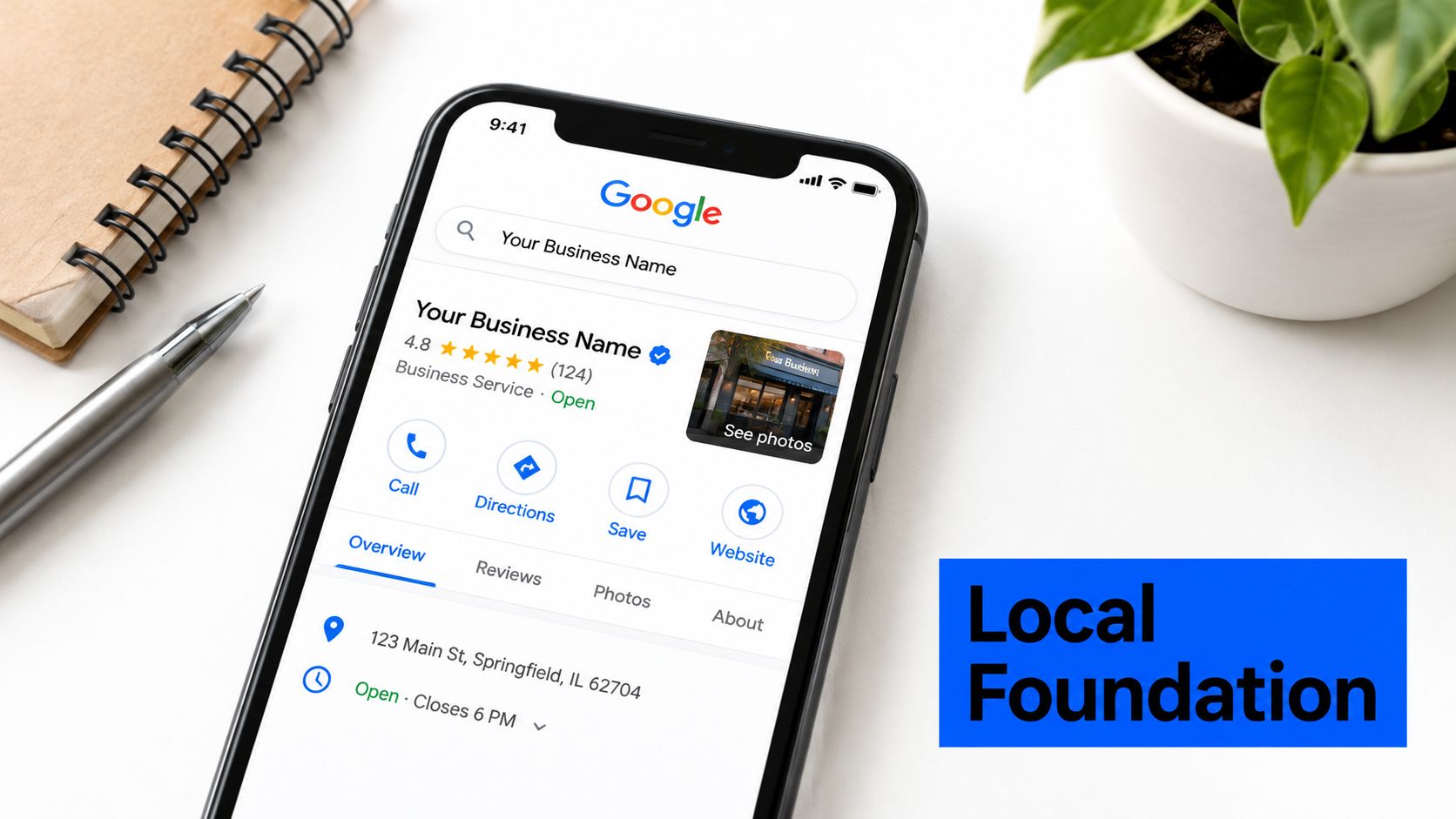
Before you buy traffic, make sure your business can convert attention into confidence. Start with your Google Business Profile. Select the primary category that most accurately describes the company, then add each major service individually, such as driveway cleaning, house washing, roof soft-washing, deck cleaning, gutter cleaning, fleet washing, and commercial exterior cleaning.
Use the service-area settings carefully. List the communities you can serve profitably, not every town within driving distance. Add recent project photos that show the surface before cleaning, the finished result, and enough surrounding context for a prospective customer to understand the property. Your profile should also make it easy to call, message, request an estimate, and verify that the business is insured and professional.
Build pages around buying decisions
Don't send every visitor to a homepage with a generic “pressure washing near you” headline. Create a dedicated page for each core offer:
- Driveway cleaning: Show concrete results, explain stains you can address, and make the minimum service area or minimum charge clear.
- House washing: Explain the difference between pressure washing and soft-washing, especially around siding, windows, landscaping, and painted surfaces.
- Roof soft-washing: Set expectations about inspection, access, materials, runoff control, and when a manual review is required.
- Deck and patio cleaning: Address wood, composite materials, pavers, furniture movement, and sealing as separate considerations.
- Commercial and fleet washing: Lead with scheduling, access, recurring service, documentation, and property protection.
Each page needs a mobile-first layout, a prominent phone button, an obvious SMS option, service-area language, real project photos, review proof, and a clear next step. Put surface-safety information near the form instead of hiding it in a footer. Customers want to know what you can clean, what you won't clean blindly, and what happens after they submit an inquiry.
The Google Business Profile guide is useful for auditing the profile layer, while this small business marketing guide by revid.ai offers broader guidance on keeping your website and local presence aligned.
A short walkthrough can make the profile audit easier to execute:
Finally, connect every inquiry to a source. Use a tracking number for calls, record the landing page that generated the request, and tag the service selected. If your receptionist or estimator can't tell whether a lead came from a driveway ad, a map listing, or an organic service page, you won't know what deserves more budget.
Segmenting Campaigns by Service and Intent
One campaign for every service is convenient to set up and expensive to operate. A person searching for driveway cleaning has a different urgency, budget, property type, and risk profile from a facilities manager looking for recurring storefront washing. Give each service lane its own ad group, landing page, qualification path, and follow-up language.
Search intent gives you useful signals. “Driveway stain removal” suggests a specific surface problem. “Roof cleaning” raises safety and inspection questions. “Commercial pressure washing” points toward property access, scheduling, insurance, and recurring service. Your creative should answer the concern behind the search, not merely repeat the word “pressure washing.”
Match the message to the job
Residential driveway cleaning
- Primary Intent
- Solve visible stains or restore curb appeal
- Qualifying Question
- What is the driveway surface, and can you send a photo?
- Typical Job Value
- Depends on size, access, condition, and minimum charge
House washing
- Primary Intent
- Improve exterior appearance before an event, sale, or seasonal cleanup
- Qualifying Question
- What siding material and number of stories does the property have?
- Typical Job Value
- Depends on home size, height, surface, and access
Roof soft-washing
- Primary Intent
- Remove organic growth while avoiding surface damage
- Qualifying Question
- What roof material is it, and can the roof be inspected safely?
- Typical Job Value
- Depends on roof type, access, treatment requirements, and risk
Deck and patio cleaning
- Primary Intent
- Refresh outdoor living areas
- Qualifying Question
- Is the surface wood, composite, concrete, pavers, or another material?
- Typical Job Value
- Depends on material, area, furniture, and restoration needs
Commercial storefront washing
- Primary Intent
- Maintain appearance and meet a recurring schedule
- Qualifying Question
- What is the property address, access window, and service frequency?
- Typical Job Value
- Depends on frontage, access, frequency, and property requirements
Fleet washing
- Primary Intent
- Keep vehicles presentable and operating on schedule
- Qualifying Question
- How many vehicles need cleaning, and where are they parked?
- Typical Job Value
- Depends on fleet size, vehicle type, location, and cadence
A generic landing page hides these differences. It also makes it easy for a buyer to request the wrong service. A roof owner may expect blasting when the correct process is soft-washing. A commercial prospect may need recurring service while your form only asks for a name and phone number.
Use distinct creative for each lane. A driveway ad can show a tight before-and-after and a simple estimate request. A commercial ad should show clean storefronts, organized service, and a conversation about scheduling. Don't force a low-ticket residential promotion into a campaign designed to attract property managers.
The key decision is not “Which ad gets the most leads?” It's “Which campaign produces work my crew can complete efficiently and collect payment for?”
Ad Creative and SMS Intake That Actually Qualifies
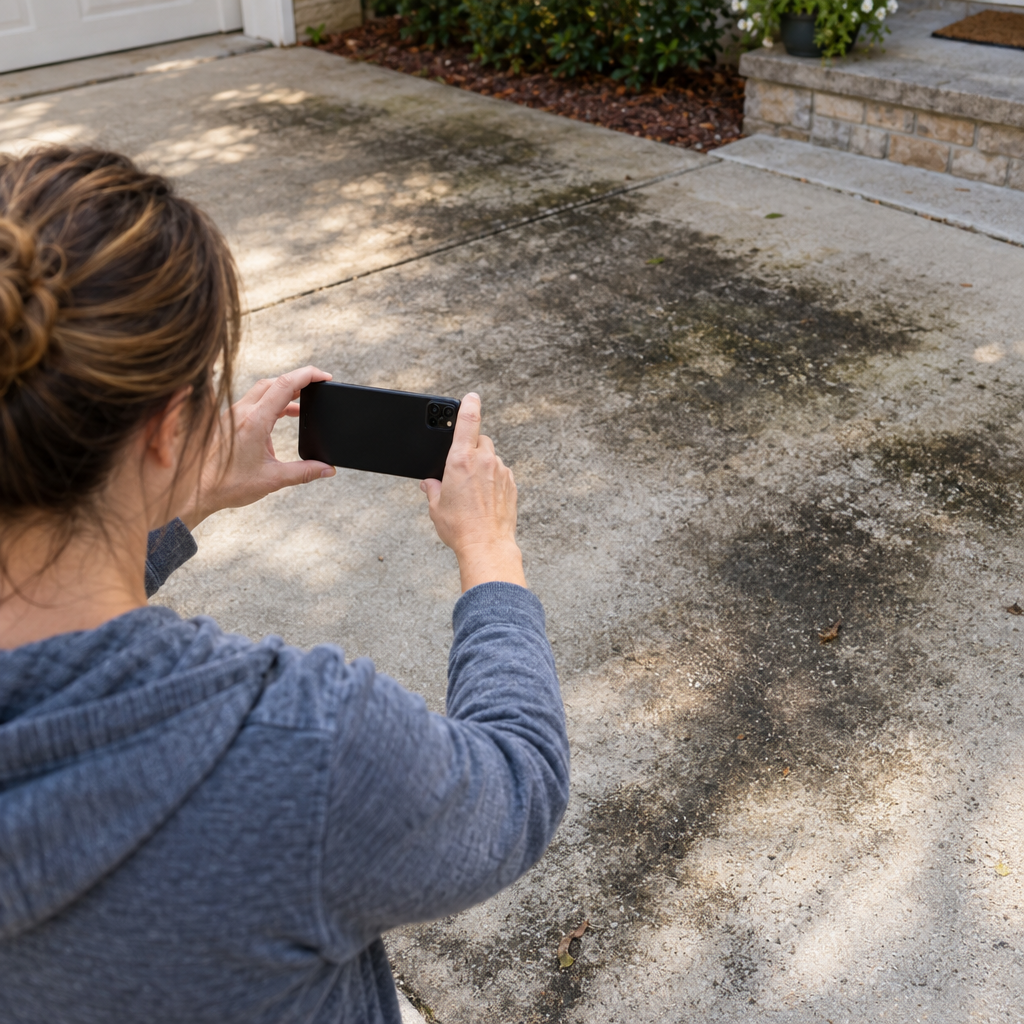
Good local-service creative gets specific fast. Lead with the surface, the problem, and the next step. “Driveway cleaning for stained concrete in [service area]” is more useful than “Professional pressure washing.” Show a real before-and-after image or short video, state the offer clearly, and ask for one action, such as sending photos for an estimate.
Don't make the ad promise a result you haven't inspected. Roofs, oxidized siding, painted wood, delicate finishes, and heavily damaged surfaces need honest qualification. Strong creative builds trust by explaining what happens next, not by pretending every job is straightforward.
Make the first message do useful work
Long forms create friction, but an empty form creates bad leads. SMS intake gives you a middle path. The first message should confirm the request and ask for the information needed to decide whether the job belongs on the schedule:
- Property address: Confirm the service area before discussing price.
- Surface type: Identify concrete, siding, roof material, wood, composite, pavers, or storefront glass.
- Approximate size: Ask for dimensions, number of stories, vehicle count, or a property description.
- Photos: Request clear wide shots and close-ups where stains, growth, oxidation, or damage are visible.
- Timing: Find out whether the customer has an event, closing, inspection, or preferred service window.
The sequence should tell the customer what happens after the photos arrive. For example, explain that the team will review the surface, confirm whether an on-site inspection is needed, and provide the next available estimate window. If the customer stops responding, send a brief reminder that adds value, such as a request for one missing photo, rather than sending repeated “Are you still interested?” messages.
Route risky jobs to a human. Automation can gather details, but it shouldn't approve an ambiguous roof, guarantee removal of a stain, or send a booking link for a surface the crew may damage. A good system recognizes when the right next step is a callback.
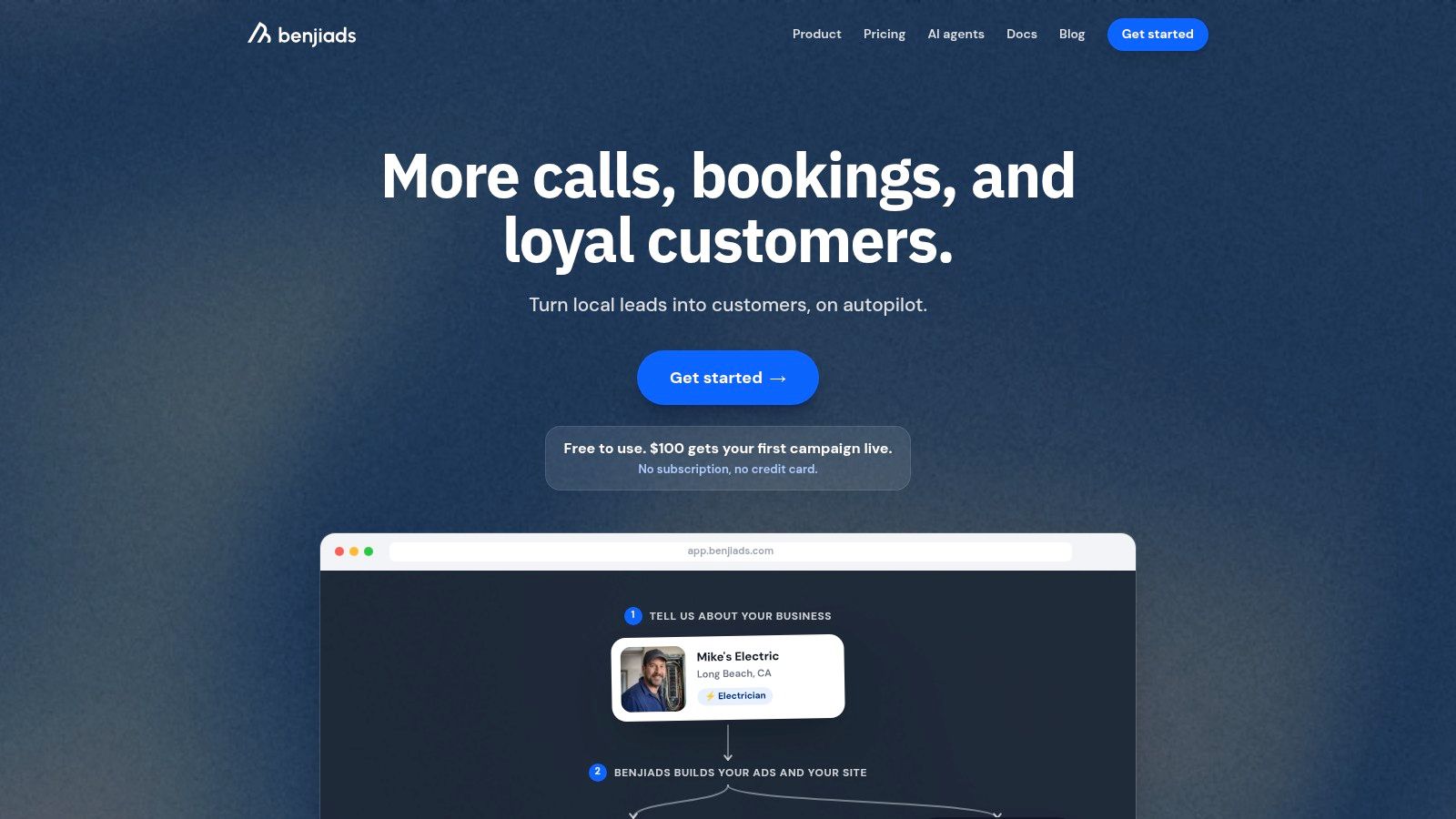
A pressure-washing campaign may be built with Google, Meta, a CRM, or a specialized platform. benjiads creates trade-specific ads, a branded landing page, SMS intake, tracking, and an approval workflow that keeps campaigns paused until the owner approves them. Its publisher reports an average cost of around $7 per phone-verified lead across local campaigns, but that figure varies by trade and market, so use it as context rather than a promise. The relevant benchmark is still the cost per profitable booked job.
The lead nurturing automation guide covers the follow-up layer, but the operating principle is simple: respond quickly, ask only useful questions, set expectations, and escalate anything that needs judgment.
Measuring What Actually Pays the Crew
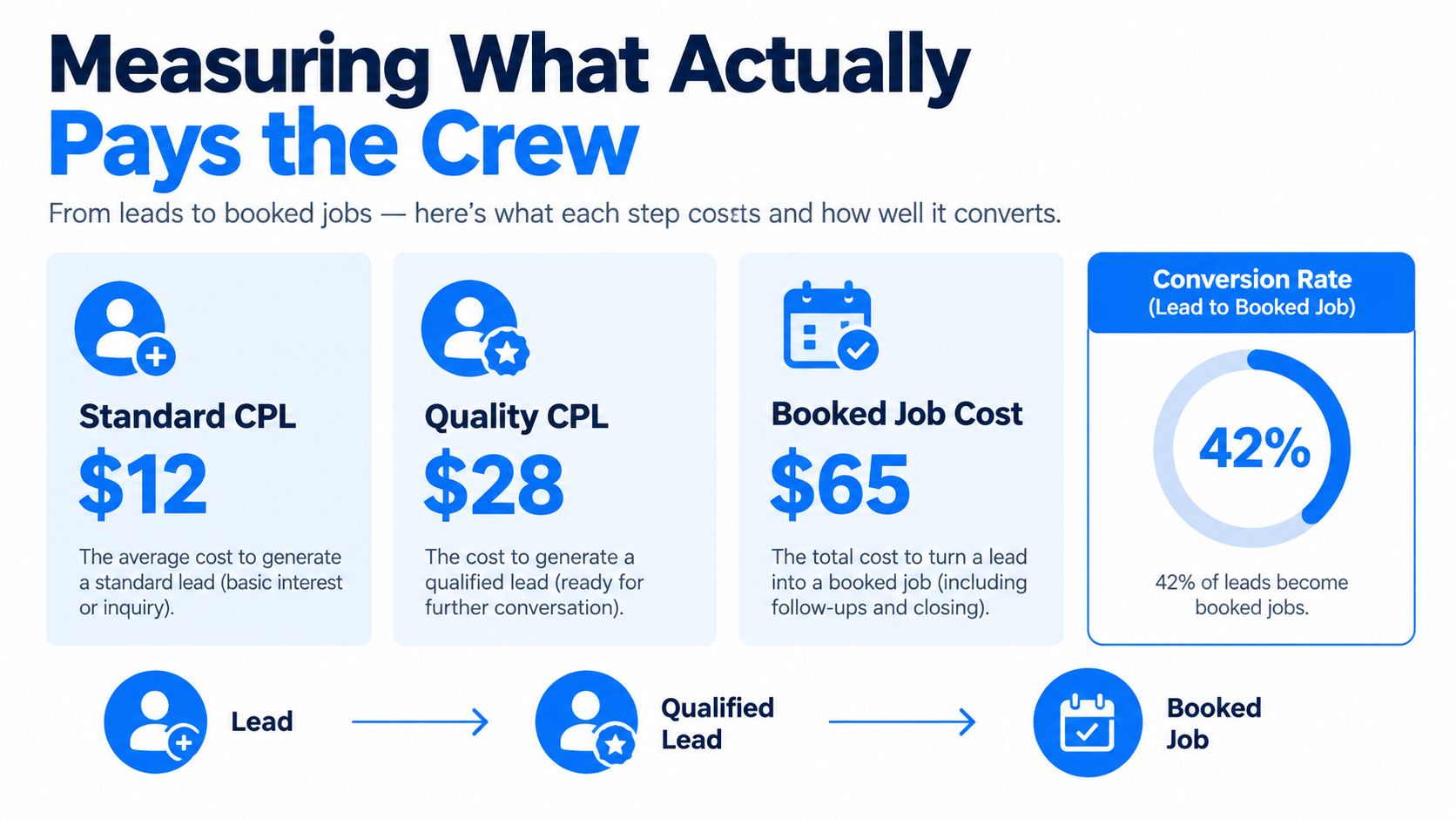
Cost per lead is an incomplete number. It tells you what the platform charged for an inquiry, not whether the inquiry matched your service area, cleared your minimum, booked, paid, or consumed more crew time than expected.
Track the full path from source to bank account:
- Cost per qualified estimate: Ad spend divided by inquiries that meet your location, service, surface, and minimum-job criteria.
- Estimate-to-book rate: The share of qualified estimates that become scheduled work.
- Average collected revenue: Money collected per completed job, not the amount initially quoted.
- Gross profit per job: Collected revenue minus labor, travel, chemicals, equipment use, rework, and other direct fulfillment costs.
- Revenue by service area: Compare nearby neighborhoods with distant zones that consume drive time.
- Repeat or recurring revenue: Separate one-time residential work from commercial accounts and repeat customers.
The home-services advertising environment makes this discipline more important. Across 16 home-service categories, conversion rate declined in 10, with an average year-over-year decrease of 14.96%, while average cost per click reached $7.85 in 2025, according to LocaliQ's home-services search advertising benchmarks. Those figures cover home services broadly, not pressure washing alone, but they show why a click or form submission can't be your final success metric.
Put job economics before platform metrics
Set a minimum charge that accounts for setup, travel, water access, chemical use, crew hours, equipment wear, and cancellation risk. If a job cannot produce acceptable gross profit after those costs, no amount of cheap lead volume fixes the offer. Change the targeting, service area, or offer instead of sending the crew farther for work that looks busy but pays poorly.
Review the numbers weekly by campaign and service lane. A driveway campaign may produce many inquiries but weak collected revenue. A commercial campaign may generate fewer conversations but create a stronger schedule and repeat opportunity. Keep the campaign that supports the business you want to operate, not the one with the prettiest cost-per-lead column.
Seasonal Offers That Match the Calendar
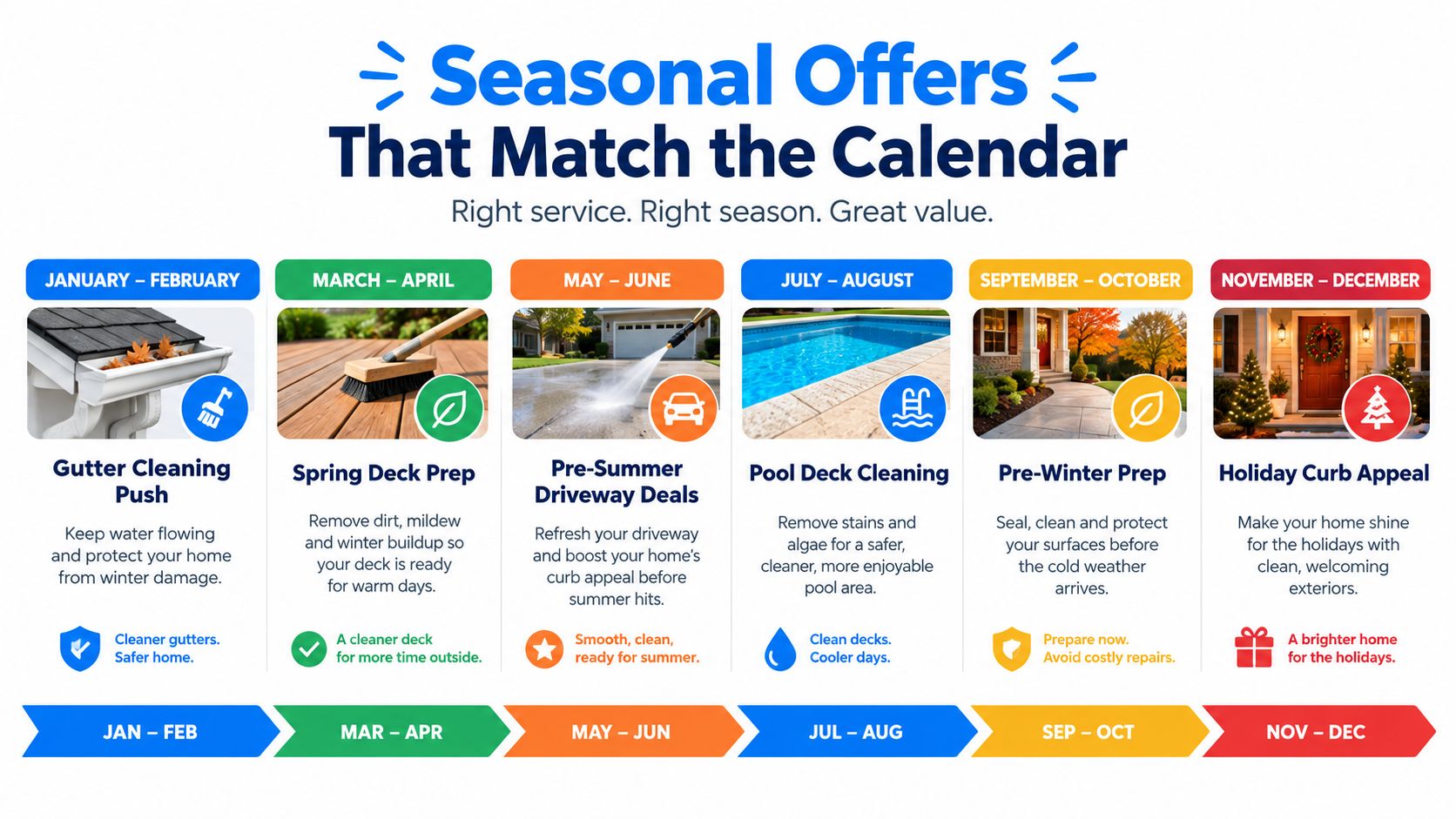
Seasonal demand gives pressure-washing marketing a natural reason to contact customers. Build the offer around the maintenance problem people recognize at that point in the year, then adjust the creative, landing page, and follow-up accordingly.
Use a practical campaign calendar
- January and February: Focus on commercial storefronts, fleet washing, and recurring property maintenance. Contact past commercial prospects with a direct scheduling message and show clean, accessible work areas.
- March and April: Promote spring house washing, driveway cleaning, and exterior cleanup. Use pollen, grime, algae, and curb appeal as the creative angle, but keep surface limitations visible.
- May and June: Shift toward pre-summer driveway, patio, deck, and pool-area cleaning. Show outdoor spaces ready for gatherings and ask for photos so you can sort simple jobs from restoration work.
- July and August: Sell maintenance for patios, decks, pool areas, and high-traffic concrete. Follow up with earlier customers who may want the same service for a second outdoor area.
- September and October: Combine siding, gutters, walkways, and pre-winter exterior preparation where those services fit your equipment and crew capability. Use deadlines carefully, without promising work that weather may prevent.
- November and December: Prioritize commercial contracts, storefront appearance, and spring pre-bookings. Past customers who bought before can receive a short message offering an early place in the next service window.
The best reactivation message is specific. Mention the previous service, the surface, and the current reason to schedule. A customer who already trusts the result needs less explanation than a cold prospect, but still needs a clear next step.
Don't run the same offer year-round. The offer should reflect what the customer is trying to protect, prepare, or enjoy now.
Your 30-Day Pressure Washing Marketing Plan
Week one, audit the Google Business Profile, service-area settings, tracking number, reviews, photos, and mobile landing pages. Week two, split campaigns by service lane and remove vague “all pressure washing” messaging. Week three, launch SMS intake that asks for address, surface, size, photos, and timing. Week four, review cost per qualified estimate, estimate-to-book rate, collected revenue, and gross profit by campaign.
Stop optimizing for lead volume. Optimize for collected job revenue.
Use the same operating discipline recommended in broader plumber lead generation tips, while adapting the questions and safety rules to pressure washing. If building ads, landing pages, tracking, and follow-up yourself is slowing you down, a software platform with trade templates and approval-based campaign controls can be faster than learning Ads Manager alone or paying an agency before your economics are clear.
benjiads builds trade-branded landing pages, local ad creative, tracking, and SMS follow-up for pressure-washing campaigns, with ads held for your approval before they run. Visit benjiads to set up a funnel that measures qualified opportunities and booked work, not just form fills.
- pressure washing marketing
- pressure washing leads
- local service ads
- pressure washing SEO
- lead follow-up
PRESSURE WASHING QUOTES BY TEXT
Pressure washing quotes by text
Free estimates
Ads created · live on FB & IG
For pressure washing companies
Your pressure washing company ads, live in 2 minutes.
- ✓ Ads created for you
- ✓ Every lead texts your phone
- ✓ Free to use, no credit card
748+ local businesses run ads with benjiads