ai advertising platform 12 min read
AI Advertising Platform: How It Works for Local Services
Learn how an AI advertising platform automates creative, targeting, and bidding for local service businesses to generate qualified leads at lower cost.
On this page
- What a Local Service Owner Faces Without One
- The Building Blocks of an AI Advertising Platform
- How AI Generates Creative and Learns From Leads
- Tracking That Survives Cookies, Browsers, and Consent
- From Ad Click to Booked Job in One Inbox
- Proving the Ads Drove the Job
- Trust, Approval, and Data Use in 2026
- Choosing a Platform and Your First 30 Days
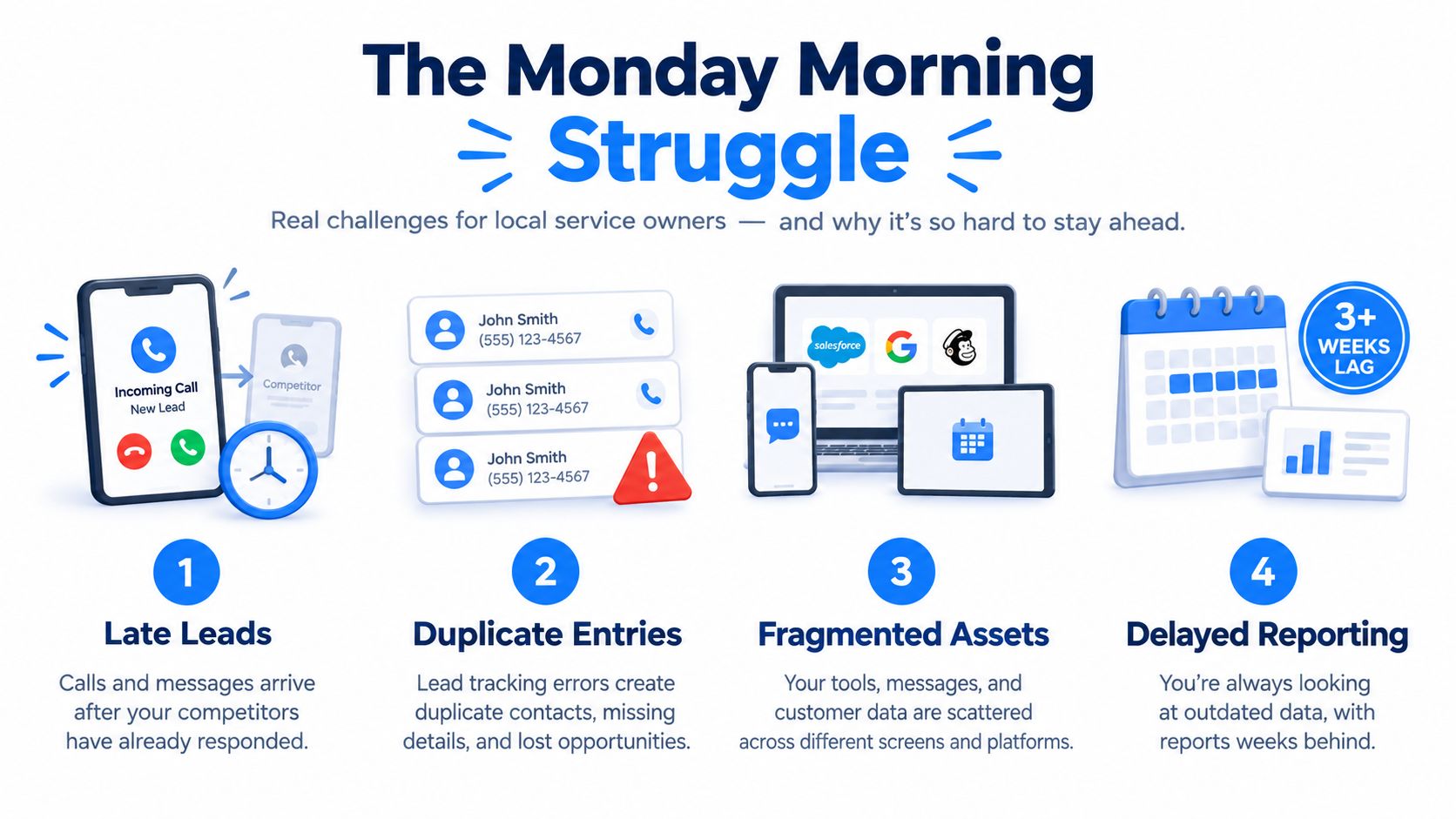
You're on a Tuesday morning call with a plumber, a dentist, or a cleaning company owner, and the same complaints keep coming up. Leads show up late, some get duplicated, the ads were approved in one tool and the images live in another, and by the time the report lands, the money is already spent.
That's where an AI advertising platform matters. It's not just a copy generator or a smarter bid button, it's an automation layer that connects creative, targeting, bidding, tracking, and follow-up so a local business can move from “we ran ads” to “we got booked jobs.”
What a Local Service Owner Faces Without One
A contractor usually doesn't start the day thinking about auction systems or conversion APIs. They start with missed calls, unread texts, and an inbox full of screenshots from different tools that don't agree with each other.
The Monday morning mess
One lead came in after business hours. Another filled out the form twice because the page refreshed. A third one was technically captured, but the phone number was wrong, so nobody followed up in time. The owner ends up asking the same question every week: which ads brought work, and which ones just produced noise?
An AI advertising platform is supposed to reduce that sprawl. It bundles the parts that usually live in separate places, ad copy, images, audiences, budgets, landing pages, lead capture, and reporting, then ties them to the same outcome, a real customer conversation.
Practical rule: if a platform only helps you make ads but can't show how those ads became calls, appointments, or jobs, it's only solving half the problem.
That matters because AI advertising has already moved past experimentation in the market. A Forrester study reported in June 2024 found that 61% of U.S. advertising agencies were already using generative AI and another 30% were exploring use cases, so 91% were either using or evaluating it, and an American Marketing Association survey of more than 1,000 marketers found that nearly 90% had used generative AI at work (Forrester and AMA reporting). For a local business, that doesn't mean “AI will replace your marketer.” It means the software layer behind advertising is changing fast, and the owners who benefit are the ones who can keep the whole pipeline connected.
The Building Blocks of an AI Advertising Platform
An AI advertising platform for local services typically handles four core functions: creative generation, audience targeting, bidding, and optimization.
Creative, targeting, bidding, optimization
Creative generation writes and designs the ad. For a plumbing business, that can mean turning “leaky water heater repair” into several variations that reflect how homeowners search and complain. In dentistry, the same system might produce separate headlines for emergency visits, whitening, or family cleanings.
Audience targeting is the neighborhood map. It learns from the kinds of inquiries that tend to become customers, then shifts spend toward those patterns. That is how a campaign stops shouting into an entire city and starts speaking to the right block.
Bidding handles the auction. Programmatic buying took shape when real-time bidding became established from roughly 2009 onward, which let exchanges and demand-side platforms auction individual impressions in milliseconds instead of negotiating placements manually (historical overview). Modern AI advertising platforms still sit on that same auction layer.
Optimization is the feedback loop. It watches what happened after the click, then moves budget toward the combinations that produced better outcomes. Meta's Advantage+ campaigns, introduced in 2022 and expanded with more AI-supported creative capabilities in 2023 and 2024, show how this kind of automation is now built into mainstream ad systems (historical overview).
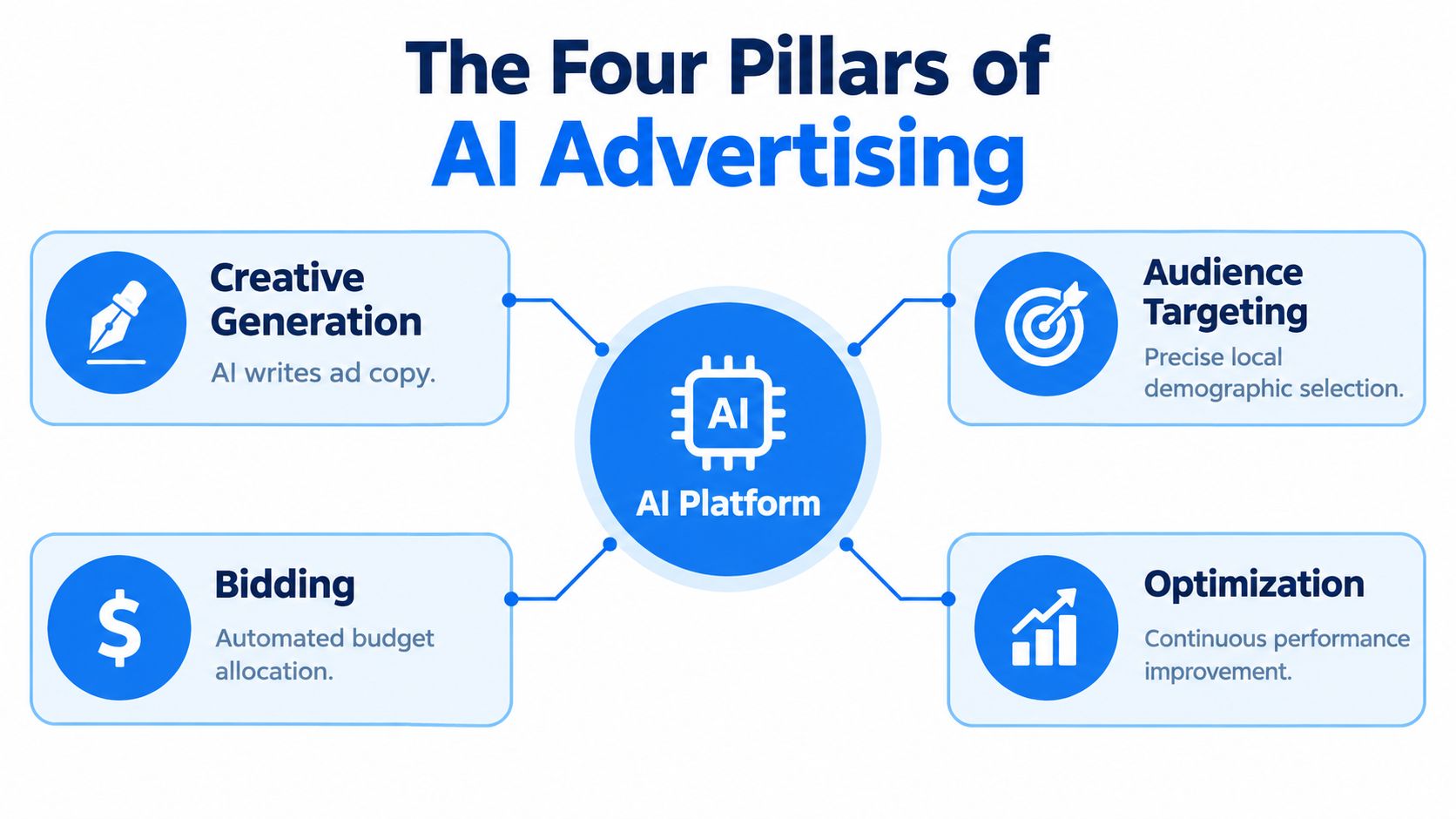
The value comes from the handoff between those parts. A better headline fails if the audience is wrong, and a perfect audience still falls short if the follow-up is slow or the conversion data never reaches the system. For local services, that handoff is the difference between guesswork and a platform that learns which ads lead to real jobs.
How AI Generates Creative and Learns From Leads
A local service owner usually wants one thing from creative, ads that sound like the business speaks. That's why good AI ad systems don't just spit out generic marketing copy. They take the trade, the offer, the service area, and the desired action, then turn that into several versions the platform can test against one another.
Creative isn't one ad, it's a set of testable options
A plumber might need one version for burst pipes, one for clogged drains, and one for water heater replacement. A dentist needs different angles for emergency care, cosmetic work, and family visits. The platform learns faster when it can compare those options against real conversion signals instead of waiting for a human to guess which headline sounds best.
A Forrester study reported that 54% of respondents using or exploring generative AI cited faster and higher-volume creative ideation and production as a motivation, and 59% used AI to organize audience data into insights (Forrester and AMA reporting). That lines up with how local-service teams work. They don't need “AI art.” They need a weekly rhythm that produces enough useful variations to learn from.
What the loop looks like in practice
A strong prompt structure usually includes the service, the location, the pain point, and the desired response. From there, the platform can generate copy and images, push them into active campaigns, and watch which versions lead to verified contacts and booked appointments. The next creative round should use what the leads taught the system, not just what sounded clever in the first draft.
The best creative loop is short. Write, launch, measure, revise.
If you want a deeper look at how the copy side gets built, this guide to an AI ad creative generator is a useful companion. The bigger lesson is that creative only becomes valuable when it's tied to lead outcomes, because that's what lets the platform stop guessing and start learning.
Tracking That Survives Cookies, Browsers, and Consent
A single browser pixel used to cover a lot of ground for advertisers. That assumption no longer holds when browsers block tracking, users reject cookies, or a lead starts on mobile and finishes elsewhere.
Why dual tracking exists
Client-side events still matter because they capture what happens in the browser. Server-side conversion APIs matter because they keep working when the browser signal is lost or degraded. Meta's conversion lift method compares an exposed test group with an unexposed control group, and its machine-learning optimization can use data from sources including the Conversions API, Meta Pixel, and App Events API (Meta conversion and tracking guidance).
That is why a modern platform should send both browser and server events, then deduplicate them with stable event IDs. A phone verification event can fire first, then a qualified conversation event, then a booked appointment or completed job event. The deeper the event, the better the signal, as long as the volume stays reliable enough for the system to learn from it. A plumbing lead that becomes a booked repair tells you more than a simple page view, just as a dentistry inquiry that reaches a scheduled cleaning tells you more than a form submit.
What to ask before you launch
If a vendor cannot explain what each event means, the reporting will be fuzzy from day one. Ask how many events fire, how they are matched, where consent is recorded, and whether the platform passes campaign and landing-page identifiers through the funnel.
This server-side tracking overview explains why server events, browser events, and deduplication should work together instead of competing with each other. For local services, the goal is simple, make sure the ad system learns from the lead quality you care about, not just the cheapest click.
From Ad Click to Booked Job in One Inbox
A click is not the win. For a local service business, the win is a conversation that becomes a booked job.
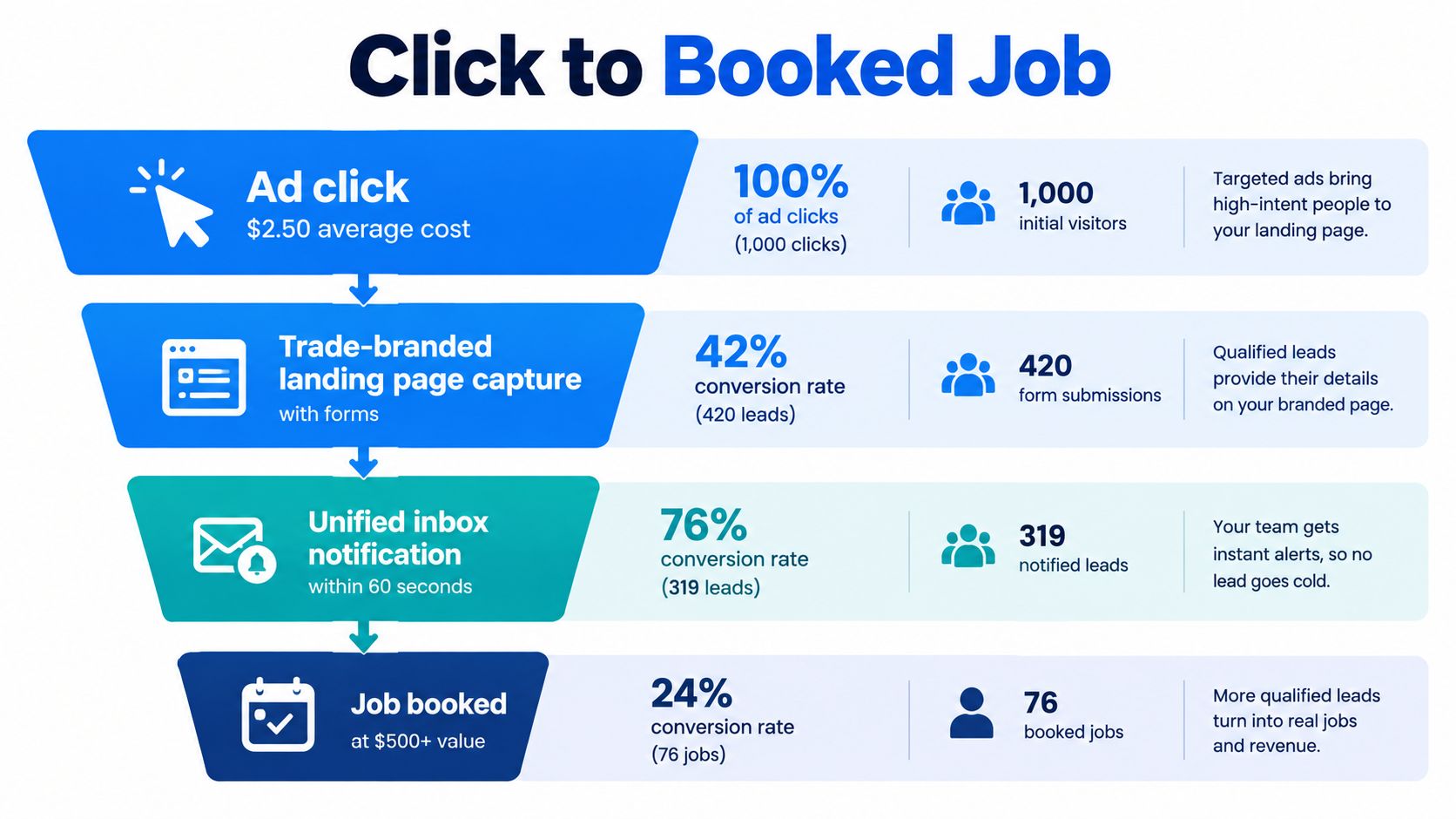
When someone taps an ad, the landing page should feel like the business they meant to contact, not a generic form. The page should collect the basics quickly, verify the phone number, and move the lead into a single inbox where the owner or office staff can see the name, number, and service request in one thread. A lead management workflow like this helps because speed matters, and the conversation shouldn't die while somebody is checking three tabs.
The handoff that keeps leads alive
SMS or iMessage intake is useful because it meets people where they already reply. If the system sends an immediate acknowledgement and keeps the thread moving after hours, the contractor doesn't lose the lead just because the office is closed. That matters most for trades and practices where the buyer is comparing a few options and will move on fast if nobody answers.
The built-in follow-up should also be plain. Ask for the service, the address or area, and the preferred time. Then route the lead into daily reporting so the owner can see which ads, audiences, and messages created booked work instead of just form fills.
A lead platform such as BenjiAds' lead management software fits into this category because it combines ad intake, follow-up, and reporting around one inbox. The idea is not fancy, it's practical. If the phone rings, the message should land quickly, and the business should know what happened next.
Proving the Ads Drove the Job
A dashboard can make a campaign look healthy even when it only captured demand that was already there.
Analysts in a Marketing Science analysis looked at 663 randomized Facebook experiments and found that randomized lifts for upper-, middle-, and lower-funnel outcomes were 29%, 18%, and 5%. By comparison, double or debiased machine-learning estimates were 83%, 58%, and 24%. The gap shows how modeled numbers can overstate the effect at every funnel stage.
Why attribution is not the same as causation
Local businesses run into this all the time. A homeowner may already have been searching for a plumber, or a patient may have seen a dentist's name on a van, then clicked an ad later. The ad can help, but it may not be the reason the lead arrived.
Practical rule: optimize with attribution, but validate with lift.
That means using holdout audiences, geo splits, or time-based comparisons when volume allows. It also means looking past the click and checking the outcomes that matter after the lead comes in. Verified contact rate, qualified-lead rate, booked-job rate, and revenue per lead give a clearer picture than cost per lead alone. A campaign that looks efficient on paper can still send weak leads to the office.
What the platform should learn toward
If software only learns from raw form fills, it can drift toward cheap leads that never turn into work. If it can learn from booked jobs, or another deeper event once there is enough volume, it can shift spend toward outcomes that pay the bills.
The deepest reliable event should guide optimization. The reporting layer should still show the full funnel, so the owner can see where quality drops off, from ad click to booked job.
That is the difference between traffic and growth. One fills a spreadsheet. The other fills the schedule.
Trust, Approval, and Data Use in 2026
AI advertising can make a local business more responsive, but it can also make the process feel more opaque if the customer doesn't understand what's happening with their data. That's not a side issue. For a contractor, dentist, or cleaner, trust is part of the product.
The Advertising Research Foundation's 2025 privacy study found that AI ranked among the least-trusted technologies for safeguarding privacy, and a separate 2025 survey of 5,000 consumers across the U.S., U.K., Canada, and Australia found that only 33% trusted companies with data collected through AI, even though that figure had improved slightly year over year (ARF privacy report).
What trust means operationally
A confusing landing page can kill a good campaign. So can an SMS opt-in that feels hidden or a reply sequence that looks like spam. If the business asks for permission clearly and explains why it needs a phone number, the lead is more likely to stay in the funnel.
A practical checklist is simple:
- Clear disclosure: say when copy or replies are AI-assisted.
- Explicit consent: ask before SMS follow-up starts.
- Data limits: collect only what the sales process needs.
- Retention rules: know what gets kept and what gets deleted.
- Approval gates: don't launch campaigns until the owner signs off.
For teams navigating compliance questions, the EU AI Act and GDPR obligations overview is a helpful reference point. The broader point is that approval-based control and transparent data use aren't just legal hygiene. They help close more leads because people are more willing to respond when the process feels honest.
Choosing a Platform and Your First 30 Days
Pick the platform the same way you'd pick any business tool, by asking what happens before launch, not just what the dashboard looks like after launch.
Questions worth asking
Who approves the creative before it goes live? How many conversion events fire, and what does each one mean? Does the system hand leads into SMS fast enough to keep the conversation alive? How are booked jobs measured, and does the platform show which ad produced them?
A platform that only talks about impressions or cheap clicks is leaving out the part that matters to a local business. If it can't connect the ad to the inbox and the inbox to the schedule, it's only partly useful.
A simple first month
Week one should focus on onboarding, intake, and approval. Week two should launch campaigns and gather clean data. Week three should review verified contact rate and booked-job rate instead of vanity metrics. Week four should scale the creative that earned the best real outcomes and tighten the holdout or comparison method.
If you're comparing tools and want a lightweight way to start creating assets, this way to start making AI videos can be useful as a separate creative reference point. For ad operations, though, the bigger win is tighter control over the full chain, from creative to tracking to follow-up.
If you want a system built around local-service ads, lead handling, and approval-based control, benjiads is designed for that workflow. It connects ad creation, campaign setup, tracking, and SMS follow-up so you can see what turned into real conversations and booked jobs.
- ai advertising platform
- local service ads
- automated ad creative
- lead generation
- programmatic bidding
Done for you
Ads that text you customers.
- ✓ Ads created for you
- ✓ Every lead texts your phone
- ✓ Free to use, no credit card
748+ local businesses run ads with benjiads