cost per lead 14 min read
Cost Per Lead Formula: A Complete Guide for 2026
Learn the cost per lead formula to measure your marketing spend. This guide helps local businesses track ROI and optimize ad budgets effectively.

On this page
A plumbing company owner checks two reports at the end of the month. Google Ads shows a $42 cost per lead, while a lead vendor reports $28 for the same period. Neither report is necessarily wrong. One may count paid form fills from a specific campaign, while the other includes a different lead definition, attribution window, or source mix.
That's the problem with treating CPL as a verdict instead of a measurement. The cost per lead formula is simple, but the decisions around spend, bidding, lead quality, and follow-up aren't. For local trades, a cheap lead that never answers the phone can cost more than an expensive lead that books a profitable job.
What Cost Per Lead Actually Tells You
Cost per lead, or CPL, is total marketing or campaign spend divided by the number of leads generated during the same period. The standard formula is:
CPL = Total Marketing Spend ÷ Number of Leads
For example, a campaign that spends $2,000 and generates 100 leads has a CPL of $20, as explained in this cost per lead formula guide from Wall Street Prep.
That number gives an owner a common unit for comparing channels. Google Search, Meta, referrals, SEO, and a lead marketplace may all have different budgets and operating mechanics, but CPL puts each source into a per-lead format. It's why the metric became a standard line in marketing dashboards and CRM reports.
Where CPL helps operators
CPL is useful when you're trying to answer practical questions:
- Which channel deserves more testing? A source with a lower channel-level CPL may be more efficient at producing the defined lead action.
- How much budget is required? If your historical CPL is stable, you can estimate the spend needed to produce a desired volume of inquiries.
- Is a vendor's price plausible? A lead provider's charge becomes easier to evaluate when you compare it with your own acquisition cost.
- Where is performance changing? A rising CPL can signal stronger competition, weaker creative, poor targeting, or tracking problems.
The metric also helps separate media cost from operating cost. Some definitions include more than ad spend, including creative production, software, and agency fees. That produces a fully loaded acquisition view instead of a media-only number, a distinction that matters when a local business compares an advertising platform with an outside vendor.
Where the number stops being useful
CPL doesn't tell you whether a caller needs your service, lives inside your service area, answers the phone, or can afford the work. It doesn't show your lead-to-booked-job rate, average job value, cancellation rate, or customer lifetime value.
A channel can report an attractive CPL while sending unqualified forms. Another channel can look expensive while producing homeowners who book estimates quickly. The operator's job is to keep CPL as an early efficiency signal, then connect it to the downstream numbers that determine profit.
Practical rule: Never approve a budget increase from CPL alone. Check the lead definition, source, qualification rate, and booked-job outcome first.
The Cost Per Lead Formula in Practice
Start with the uncomplicated version:
CPL = Total Campaign Cost ÷ Number of Leads
Suppose a roofer spends $3,200 in one month across Google Local Services Ads and Google Search campaigns. The campaigns generate 74 form submissions and 28 booked estimates.
The headline media CPL is:
$3,200 ÷ 74 = $43.24
That is the correct CPL for the raw form-submission definition. It isn't $31.36, because the stated spend and lead count produce $43.24. The $31.36 figure would require a different denominator or cost base, so putting it in the report would create a false sense of efficiency.
The same campaign can still have a second, valid metric if you define the lead as a booked estimate:
$3,200 ÷ 28 = $114.29 per booked estimate
Neither number replaces the other. They answer different questions.
Media-only versus fully loaded
The numerator needs a consistent cost policy. A media-only report might include only the $3,200 paid to Google. A fully loaded report could add:
- Creative and landing-page fees
- CRM or marketing automation costs
- Call-tracking charges
- Agency or campaign-management costs
- A reasonable allocation of internal labor
If those additional costs total $800, the fully loaded spend becomes $4,000. The resulting numbers would be:
| Measurement view | Calculation | Result |
|---|---|---|
| Media CPL per raw form | $3,200 ÷ 74 | $43.24 |
| Fully loaded CPL per raw form | $4,000 ÷ 74 | $54.05 |
| Media cost per booked estimate | $3,200 ÷ 28 | $114.29 |
| Fully loaded cost per booked estimate | $4,000 ÷ 28 | $142.86 |
The formula isn't where most reporting fails. The discipline lies in choosing what belongs in the numerator and what qualifies for the denominator. Guidance from Mailchimp on calculating CPL also emphasizes matching the spend and lead periods, separating channels, and avoiding inconsistent lead definitions.
For local trades, report both views when necessary, but label them clearly. “Google media CPL,” “fully loaded raw CPL,” and “cost per booked estimate” shouldn't appear as interchangeable figures in the same dashboard.
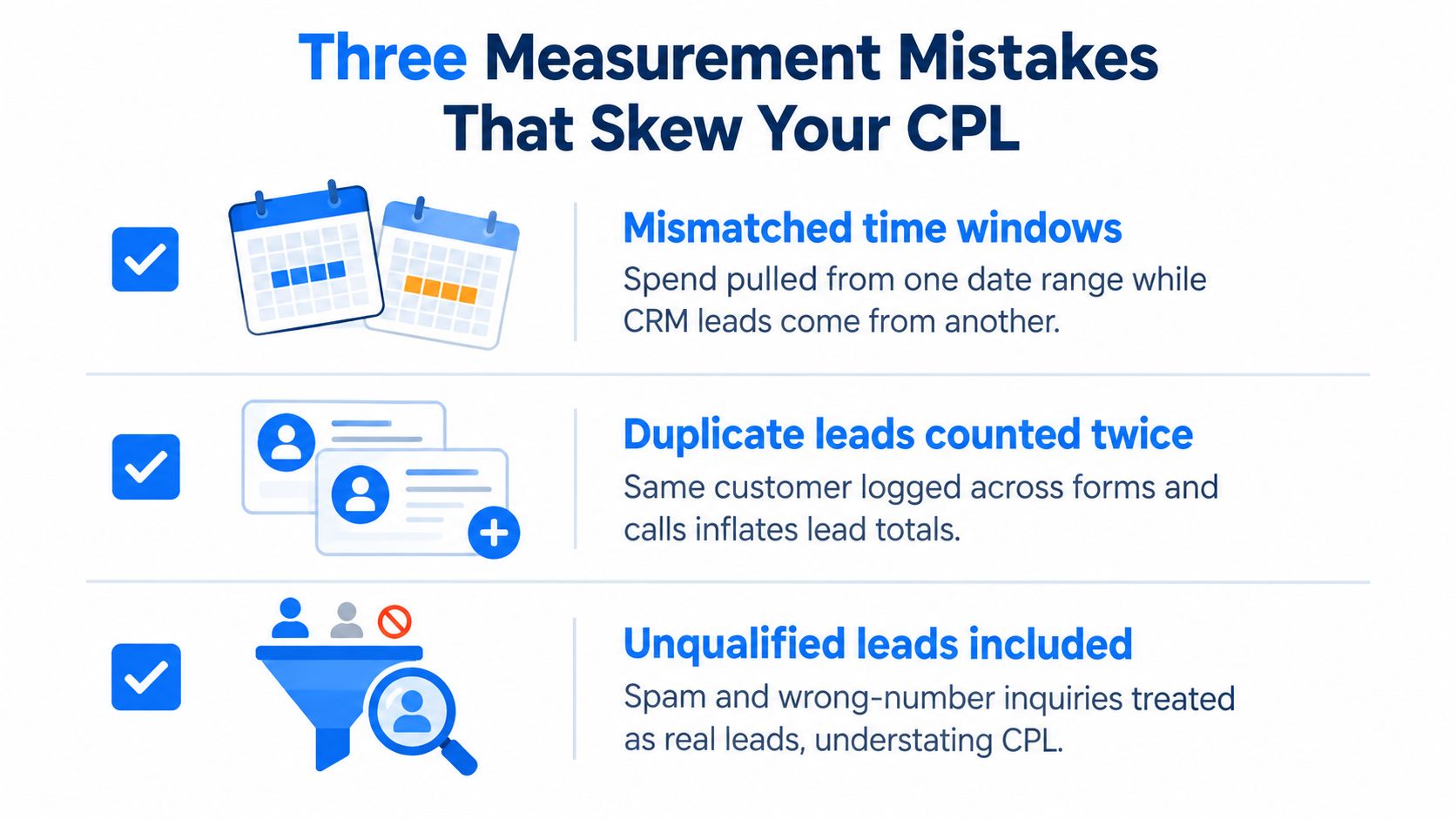
Three Measurement Mistakes That Skew Your CPL
A CPL report can look precise while measuring the wrong activity. Local service businesses usually run calls, forms, chats, and third-party leads at the same time, so small data inconsistencies can change the conclusion.
Mismatched time windows
The first check is date alignment. If ad spend covers the first day through the last day of a month, the lead count must cover that same window, using the same attribution rule.
A CRM may assign a lead to the date it was created, while an ad platform reports the date of the click or conversion. Delayed imports, offline calls, and late form processing can make one report lag behind the other. Pulling spend from one window and leads from another can either inflate or understate CPL.
Blended channels hide weak sources
A blended average combines different acquisition paths. If organic calls and paid leads sit in the same denominator, the resulting figure may make paid media appear cheaper than it is.
Track each source separately with consistent UTMs, call-source data, landing-page identifiers, and CRM fields. Calculate Google Search CPL, LSA CPL, Meta CPL, organic CPL, and vendor CPL independently before calculating any blended figure. The ad tracking software guide from BenjiAds covers the role of source tracking in connecting campaign activity with lead outcomes.
Diagnostic: If one channel has no source value, don't quietly assign it to “paid” or “organic.” Put it in an unclassified bucket until the tracking is fixed.
Raw leads aren't verified leads
Every submission isn't a sales opportunity. Spam, duplicate requests, wrong numbers, job seekers, out-of-area inquiries, and incomplete forms can all lower reported CPL by increasing the denominator.
Set a lead definition before reporting. A raw lead might be any form submission or inbound call. A verified lead might require a valid phone number, a service-area match, and a real service request. A qualified lead might also require the right job type and a reasonable likelihood of booking.
Use one definition for the primary dashboard, then show the progression from raw inquiry to verified lead to booked estimate. That exposes whether a low CPL comes from efficient acquisition or from counting noise.
CPL Benchmarks by Trade and Channel
CPL benchmarks are sanity checks, not universal targets. Published benchmark summaries show an average CPL of $198 across industries, with examples ranging from about $35 in ecommerce to $516 in legal, while local services such as home, auto, and medical are often reported in the $15 to $60 range. The Ringy CPL benchmark summary also notes that market, channel, geography, and competition can materially change the number.
The useful comparison is between a channel's acquisition cost and the value of the work it produces. Search and Local Services Ads often capture explicit service intent, while Meta lead forms can create more volume with a broader audience. Organic leads may carry lower direct media cost, but SEO still requires content, technical work, tools, and labor if you're calculating fully loaded CPL.
A single global table can't responsibly assign precise ranges to HVAC, plumbing, roofing, electrical, dental, legal, and other trades without verified trade-level data. Use your own channel history as the operating baseline, and use published ranges only to spot an obvious outlier.
HVAC
- Google Search CPL
- Varies by market and intent
- Google LSA CPL
- Varies by market and intent
- Meta Lead Form CPL
- Varies by audience and offer
- Organic/SEO CPL
- Varies by investment and ranking
Plumbing
- Google Search CPL
- Varies by market and intent
- Google LSA CPL
- Varies by market and intent
- Meta Lead Form CPL
- Varies by audience and offer
- Organic/SEO CPL
- Varies by investment and ranking
Roofing
- Google Search CPL
- Varies by market, season, and competition
- Google LSA CPL
- Varies by market and intent
- Meta Lead Form CPL
- Varies by audience and offer
- Organic/SEO CPL
- Varies by investment and ranking
Electrical
- Google Search CPL
- Varies by market and service type
- Google LSA CPL
- Varies by market and intent
- Meta Lead Form CPL
- Varies by audience and offer
- Organic/SEO CPL
- Varies by investment and ranking
Dental
- Google Search CPL
- Varies by procedure and geography
- Google LSA CPL
- Varies by availability and intent
- Meta Lead Form CPL
- Varies by audience and offer
- Organic/SEO CPL
- Varies by investment and ranking
Legal
- Google Search CPL
- Often materially higher in competitive categories
- Google LSA CPL
- Varies by practice area and market
- Meta Lead Form CPL
- Varies by audience and offer
- Organic/SEO CPL
- Varies by authority and competition
Home services
- Google Search CPL
- Varies by service and geography
- Google LSA CPL
- Varies by market and intent
- Meta Lead Form CPL
- Varies by audience and offer
- Organic/SEO CPL
- Varies by investment and ranking
Seasonality also changes the read. HVAC demand can shift sharply with weather, roofing inquiries can change after severe storms, and broader home-service demand can soften during slower periods. Don't reset bids after one unusual week. Build a channel history, compare similar demand periods, and use a rolling operating baseline.
For channel selection, compare intent, qualification, and follow-up requirements rather than CPL alone. The Google Ads versus Meta Ads comparison is useful when deciding how each platform fits into a local acquisition mix.
Turning CPL Into a Real Ad Budget
A target CPL should come from job economics, not from a platform recommendation. Start with the revenue represented by one lead:
Average Revenue per Job × Lead-to-Job Close Rate = Revenue per Lead
Using the requested example, an average job worth $4,500 and a 25% close rate produce:
$4,500 × 25% = $1,125 revenue per lead
That is a revenue ceiling, not a safe advertising target. You still have labor, materials, vehicle costs, overhead, refunds, and sales time. A practical fully loaded CPL target might sit around $300 to $450 for this example, depending on margin and operating capacity. The range is an operating decision, not a universal benchmark.
Convert booked-job goals into lead volume
Work backward from the jobs you need. If you want a certain number of booked jobs, divide that goal by your observed lead-to-job close rate. Then multiply the required leads by your target CPL to estimate campaign spend.
For example:
- Set booked jobs: Choose the number of jobs your team can complete.
- Apply close rate: Divide booked jobs by your measured lead-to-job rate.
- Apply CPL: Multiply required leads by the target fully loaded CPL.
- Divide by operating days: Convert the monthly budget into a daily budget that matches your service schedule.
Don't use a close rate from a different lead definition. A raw form-to-job rate and a verified-call-to-job rate are different inputs.
Set bids from observed delivery
A max CPC should reflect the number of clicks required to generate one lead:
Target CPL ÷ Expected Clicks per Lead = Approximate Max CPC
If your landing page needs more clicks to produce a lead, the affordable CPC falls. If the page converts efficiently and the calls are qualified, you can tolerate a higher CPC while staying inside the same CPL ceiling.
Google campaigns can use automated approaches such as Maximize Conversions or target CPA once conversion tracking is trustworthy. Meta campaigns may need tighter audience, placement, and budget controls when lead quality varies. Neither platform can optimize toward a useful outcome if it receives duplicate, unverified, or poorly defined conversions.
When a campaign beats its target by 25%, don't immediately double the budget. Confirm lead quality, capacity, and tracking, then increase exposure in controlled steps. When it misses by more than 40%, inspect search terms, audience, landing-page friction, call handling, and attribution before deciding whether to reduce bids or pause the source.
Why Cheaper Leads Can Still Lose You Money
A low CPL often reflects a low-friction action, not a valuable customer. A broad Meta audience may submit a form after seeing a convenient offer, then ignore the first call. A shared-lead marketplace may sell the same inquiry to several contractors. An unverified form may contain a bad number that looks like a successful conversion in the ad account.
The better operating metric is often cost per qualified opportunity or cost per booked job. Those measures force the team to connect acquisition spend with the outcome that produces revenue.
Consider two campaigns:
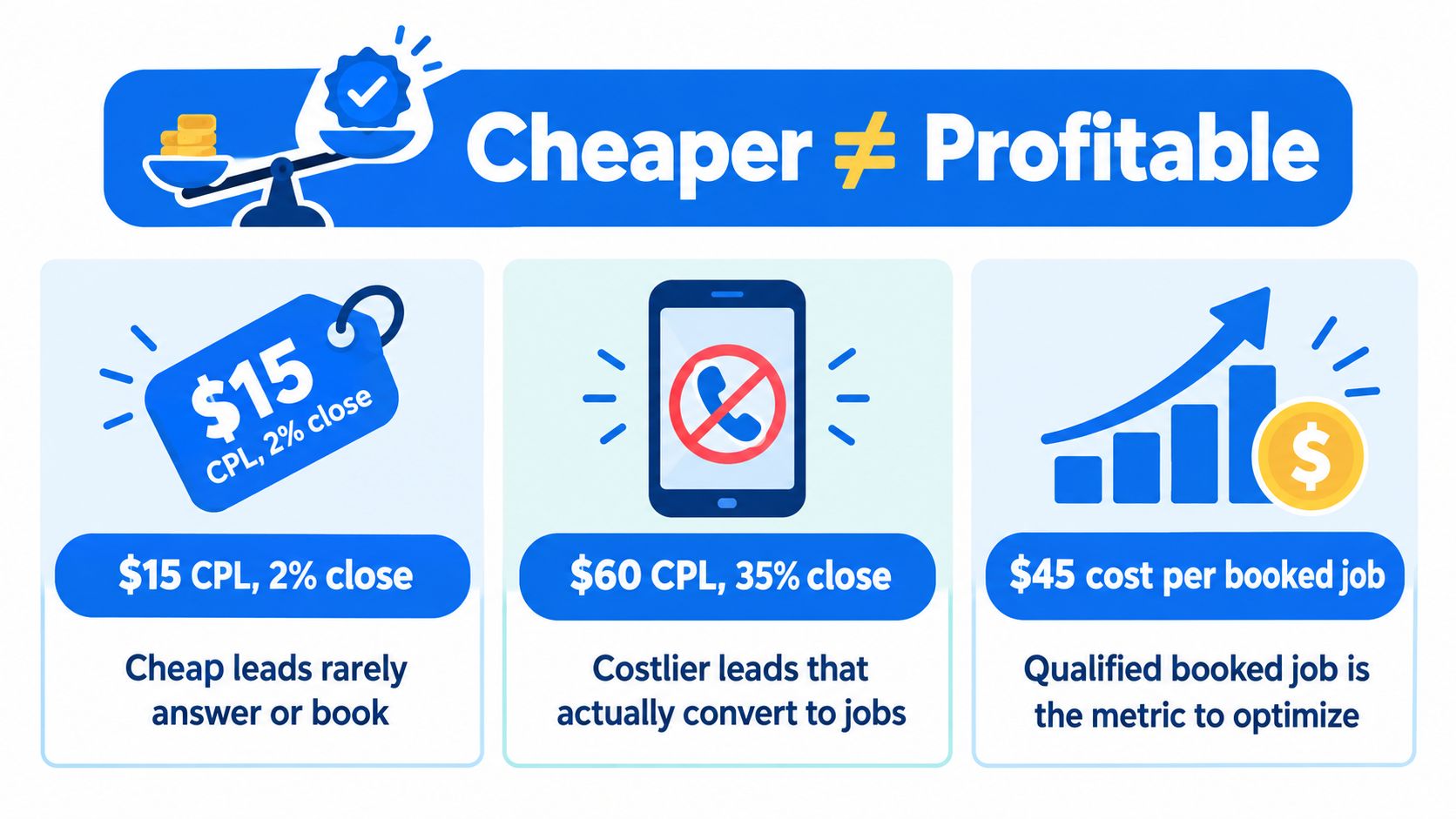
- Campaign A: $20 CPL with a 5% booking rate.
- Campaign B: $55 CPL with a 35% booking rate.
Campaign B costs more per raw lead, but each lead is far more likely to become a booked job. On the stated assumptions, it produces seven times the booked-job rate of Campaign A. That makes the cheaper headline number a poor basis for reallocating budget.
The lead isn't the economic unit. The booked job is.
Count the cost of handling junk
Qualification has a labor cost. Someone answers, calls back, filters out duplicates, checks the service area, confirms the job type, and follows up with people who may never respond. A raw CPL report hides that work unless you allocate it to the acquisition process.
Don't use an unsupported universal uplift for that labor. Measure it directly by tracking time spent per source and assigning a reasonable internal cost. Your fully loaded CPL should reflect the actual process required to turn an inquiry into a usable opportunity.
A channel that appears profitable on paper but produces a very low booking rate deserves investigation before expansion. Check recording quality, response time, offer clarity, lead routing, and sales capacity. If the source still produces weak downstream results after those checks, move budget toward the channel that generates fewer but more actionable inquiries.
The speed-to-lead workflow guidance is relevant here because response handling can determine whether a valid inquiry becomes a conversation or disappears from the pipeline.
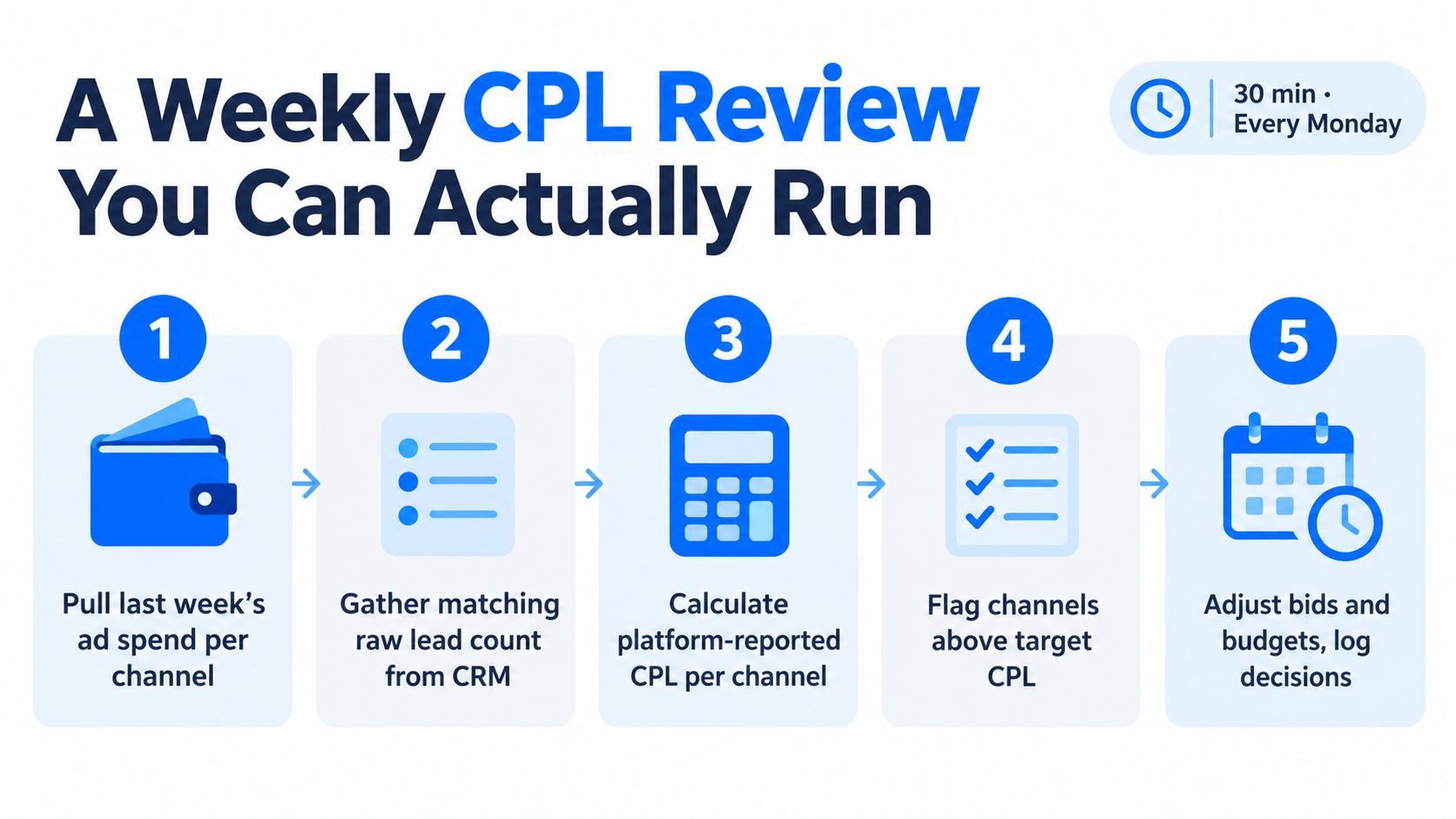
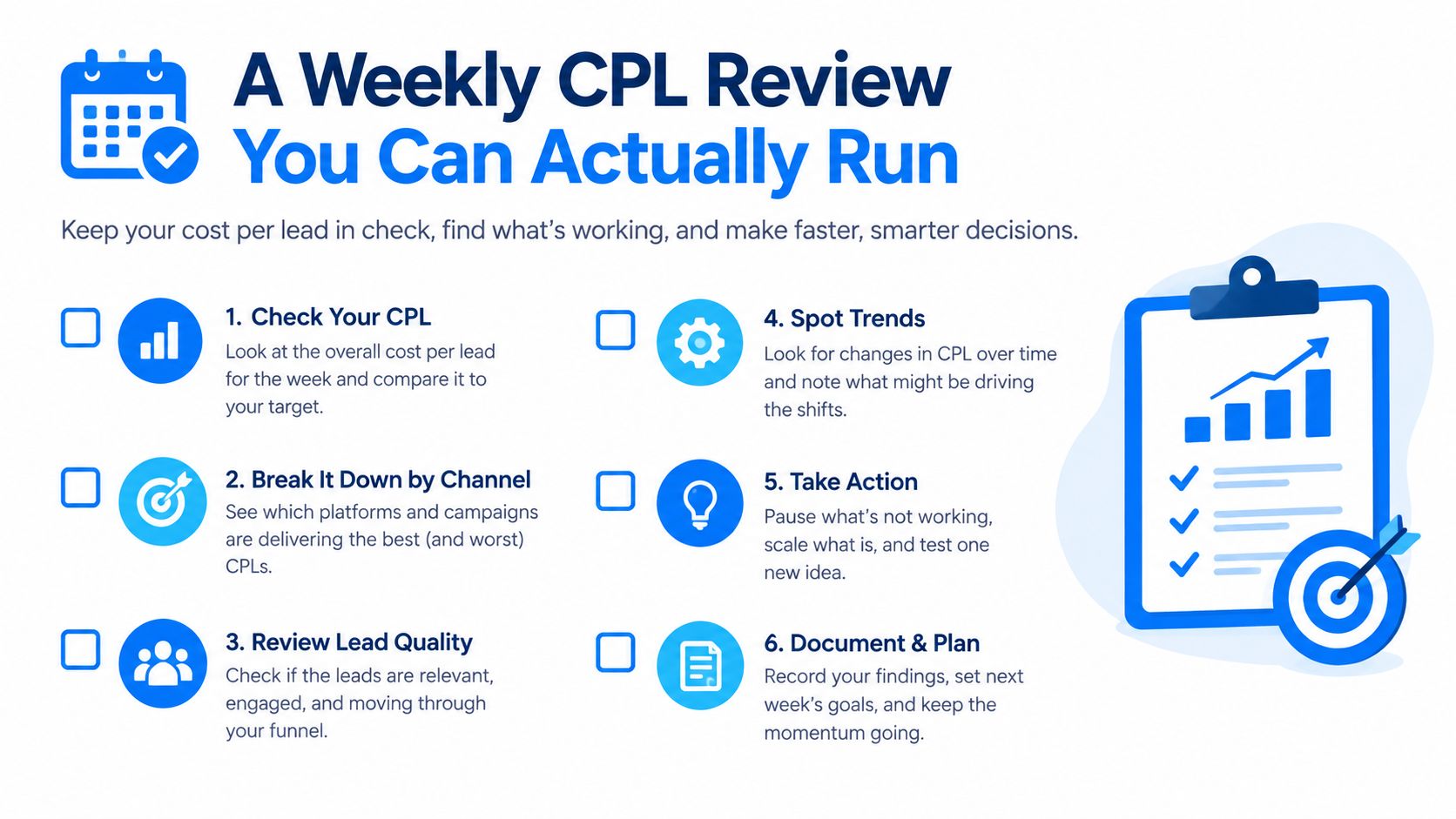
A Weekly CPL Review You Can Actually Run
A useful review doesn't need a large dashboard. It needs matching dates, consistent definitions, and one decision at the end.
Run this routine at the start of each week:
- Pull channel spend. Export the prior period's Google Search, LSA, Meta, vendor, and other acquisition costs.
- Pull matching lead counts. Use the CRM and call records for the same dates and the same attribution rules.
- Calculate two views. Report media-only CPL and fully loaded CPL, keeping the numerator and denominator visible.
- Check lead integrity. Remove duplicates from the analysis, identify spam and wrong-number inquiries, and calculate the verified share.
- Review downstream movement. Compare verified leads with booked estimates, completed jobs, close rate, and job value.
- Make one controlled change. Adjust a bid, reallocate budget, revise an offer, improve follow-up, or pause a channel that fails the agreed criteria.
Use benchmark context as a warning signal, not as an automatic budget command. Published data shows that CPL differs substantially by industry and channel, including examples around $25 for referrals, $142 for paid Facebook, $408 for paid LinkedIn, and $840 for trade shows, as summarized in B2B CPL benchmark guidance from LeadSpot. Those figures describe different acquisition environments, so your own qualified-lead and booked-job history should carry more weight.
A clean weekly sheet should show source, spend, raw leads, verified leads, booked jobs, media CPL, fully loaded CPL, and cost per booked job. Add a short notes column for bid changes, weather, staffing limits, tracking issues, or offer changes. After several review cycles, patterns become more reliable than any single platform screenshot.
benjiads provides local service businesses with automated ad creation, campaign setup, landing funnels, tracking, and SMS-based lead follow-up, with campaigns kept under the owner's approval. If you want to connect ad spend with verified inquiries and clearer CPL reporting, visit benjiads and review how the platform fits your acquisition process.
- cost per lead
- lead generation
- marketing budget
- CPL benchmarks
- local advertising
Done for you
Ads that text you customers.
- ✓ Ads created for you
- ✓ Every lead texts your phone
- ✓ Free to use, no credit card
748+ local businesses run ads with benjiads