campaign launches 9 min read
Local Business Campaign Launches: A Practical Guide
Master campaign launches for local businesses with a proven preflight checklist, approval workflow, and tracking setup that turns leads into booked jobs.
On this page
- Why Most Local Campaign Launches Fail Before They Start
- The Essential Campaign Launch Checklist
- Setting Up the Technical Foundation on Ad Platforms
- Wiring Tracking That Actually Measures Business Value
- Engineering Speed-to-Lead into the Launch Process
- Finalizing the Approval Workflow and Go Live Sequence
You've probably seen it happen. The ads go live, leads start coming in, the dashboard looks busy, and the phone still doesn't ring enough to matter. That gap usually isn't caused by weak creative or bad targeting, it's caused by a launch that treated the ad account as the whole job and ignored what happens after someone fills out a form.
Local businesses lose money here all the time. A contractor, clinic, or service company can generate interest and still miss revenue if the team can't verify the lead, answer fast, or route the inquiry into a real conversation. Campaign launches only work when the intake process, follow-up rules, and measurement are ready before spend starts.
Why Most Local Campaign Launches Fail Before They Start
A plumbing company can launch a perfectly decent ad set, get a stack of form fills, and still end the week with an empty schedule. The owner blames the ads because the dashboard says leads arrived, but the actual break is downstream. The inquiry came in, then nobody confirmed the number, nobody called fast enough, and nobody owned the next step.
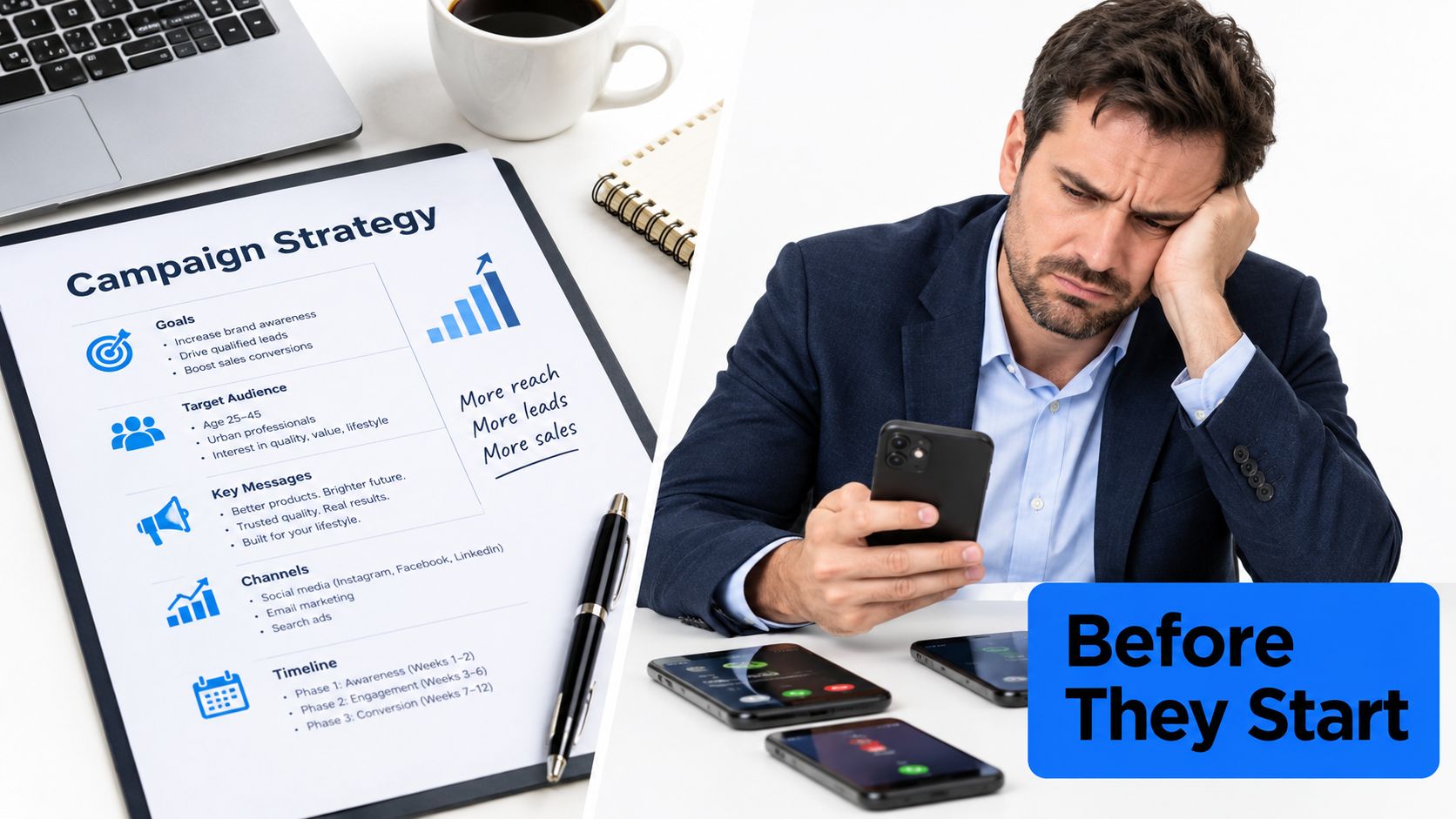
Most launch guides obsess over audience size, copy angles, and bidding tactics. Those matter, but they don't rescue a business that can't answer the phone, validate contact info, or keep one lead from getting contacted three different ways. That's why so many campaigns look healthy on the surface and still fail to produce booked work.
The hidden failure point is the response system
A launch is not only a media event. It's a workflow that starts at the ad impression and ends at a booked job, and every handoff in between has to be designed on purpose. If the business can't respond inside the window when intent is highest, the click becomes expensive noise.
A lead that isn't answered is not “pending.” It's already decaying.
That's the part many teams miss. They spend days polishing the offer, then give the follow-up stack almost no attention. A better launch starts by assigning ownership, setting response rules, and deciding what qualifies as a real outcome, not just a submitted form.
If you want a practical comparison of how to automate some of that prep work, AI tools for local businesses is a useful resource to scan before you build your own process. The point isn't to automate everything. The point is to stop treating intake as an afterthought.
The Essential Campaign Launch Checklist
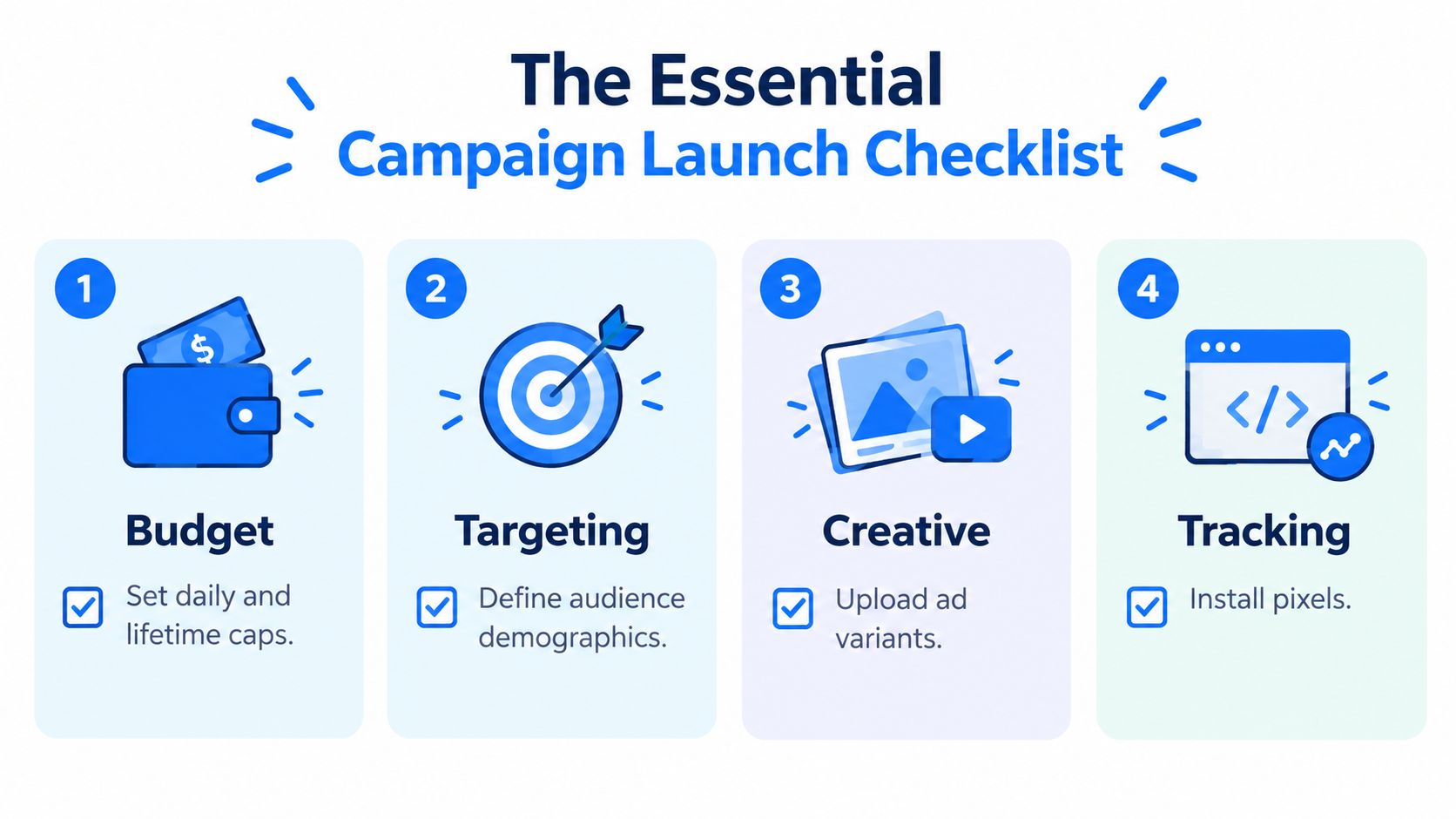
Before budget goes live, the business needs a primary outcome. That might be a qualified call, a booked estimate, or a completed inquiry that reaches a working phone number. If that isn't defined first, the team ends up optimizing for cheap activity instead of useful activity.
Build the launch around decisions, not guesses
The next step is to create the conversion action and wire the sitewide tag before anyone expects reporting to be accurate. Google's own conversion setup guidance says to create at least one conversion action and configure website tagging before relying on campaign data, which is the right order for any serious launch. The counting method should match the business model, and for lead generation, one conversion per real lead is usually the cleaner approach when duplicate submissions don't create extra value. See the setup sequence in Google Ads local campaign guidance.
Then handle consent and phone validation before launch day. If SMS follow-up is part of the funnel, it needs to be permission-compliant from the start, and the business should know exactly who receives the lead, who replies, and what happens when a number is invalid or a contact opts out. A campaign that breaks privacy rules or spams the same person from multiple automations is not a growth system, it's a liability.
A simple readiness gate keeps the process honest:
- Outcome defined: The team agrees on the one result that matters most.
- Tracking in place: The platform action, browser event, and lead record can all be reconciled.
- Follow-up owned: A person or system is responsible for the first response.
- Approval granted: Nothing spends until the business has reviewed the build.
That checklist sounds basic because it is. The hard part isn't knowing the steps. It's refusing to launch before every step is actually ready.
Setting Up the Technical Foundation on Ad Platforms
The technical build should reflect how local services sell. A single campaign structure can work if it maps cleanly to the service, the geography, and the destination page, but messy account architecture makes learning slower and reporting harder to trust. That's especially true when the landing page is generic and disconnected from the offer the ad promised.
A dedicated trade-branded landing page usually gives the cleaner path because the visitor sees a specific service, a specific location, and a specific next step. When the click lands on a page that looks unrelated, a lot of the intent leaks away before the form even appears. Ad platforms can only optimize what they can observe, so the destination has to be built to capture the right signal.
Treat tracking as part of the site build
The sitewide tag should be installed before launch, then the conversion event should fire only when the actual business action happens. If the page view, button click, or partial form fill is all that gets counted, the account will learn the wrong lesson. Dual tracking, using both client-side and server-side signals, helps reduce blind spots when privacy restrictions and browser limits interfere with clean attribution.
For teams comparing setup options, best practices for ad integration is worth reading because the core challenge is rarely one tool. It's making sure the tag, destination, event, and reporting path agree with each other.
One more thing matters here: don't launch a campaign with a tracking stack you can't explain to the owner. If the business can't tell whether a lead came from a form, a call, or an SMS reply, it'll be impossible to judge whether the campaign is producing work. The account can look active and still be structurally unfit.
Wiring Tracking That Actually Measures Business Value
A lot of teams count every form fill as a win and call it reporting. That creates a fake sense of momentum, especially when the same person submits twice or the lead never answers the phone. Real measurement has to distinguish between raw activity and outcomes that matter to the business.
The cleanest pattern is simple. A real submission should create exactly one recorded conversion in the systems that matter, then the lead should be tracked all the way through contact, qualification, booking, and revenue. That means the ad platform, CRM, call log, and internal ledger need to reconcile, not just coexist.
Reconcile daily, not monthly
If the platform says one thing and the lead ledger says another, the discrepancy should be investigated right away by event ID, timestamp, and source. That's how you catch duplicate browser and server fires, broken forms, or offline outcomes that never made it back to the ad account. Conversion values and counting rules matter too, because they tell the algorithm which outcomes deserve more budget.
Practical rule: if the business wouldn't pay for the lead twice, don't count it twice.
That's also where shallow optimization gets dangerous. If a team optimizes toward a micro-event because it's easy to measure, the campaign can get cheaper while the pipeline gets worse. If a platform supports modeled or aggregated conversions, those can still help with optimization, but they shouldn't be confused with proof that every lead was observed.
Conversion tracking software guidance is useful if you're trying to compare tooling, but the bigger issue is discipline. The account should answer one question cleanly, what did the ad spend produce in verified business terms?
Engineering Speed-to-Lead into the Launch Process
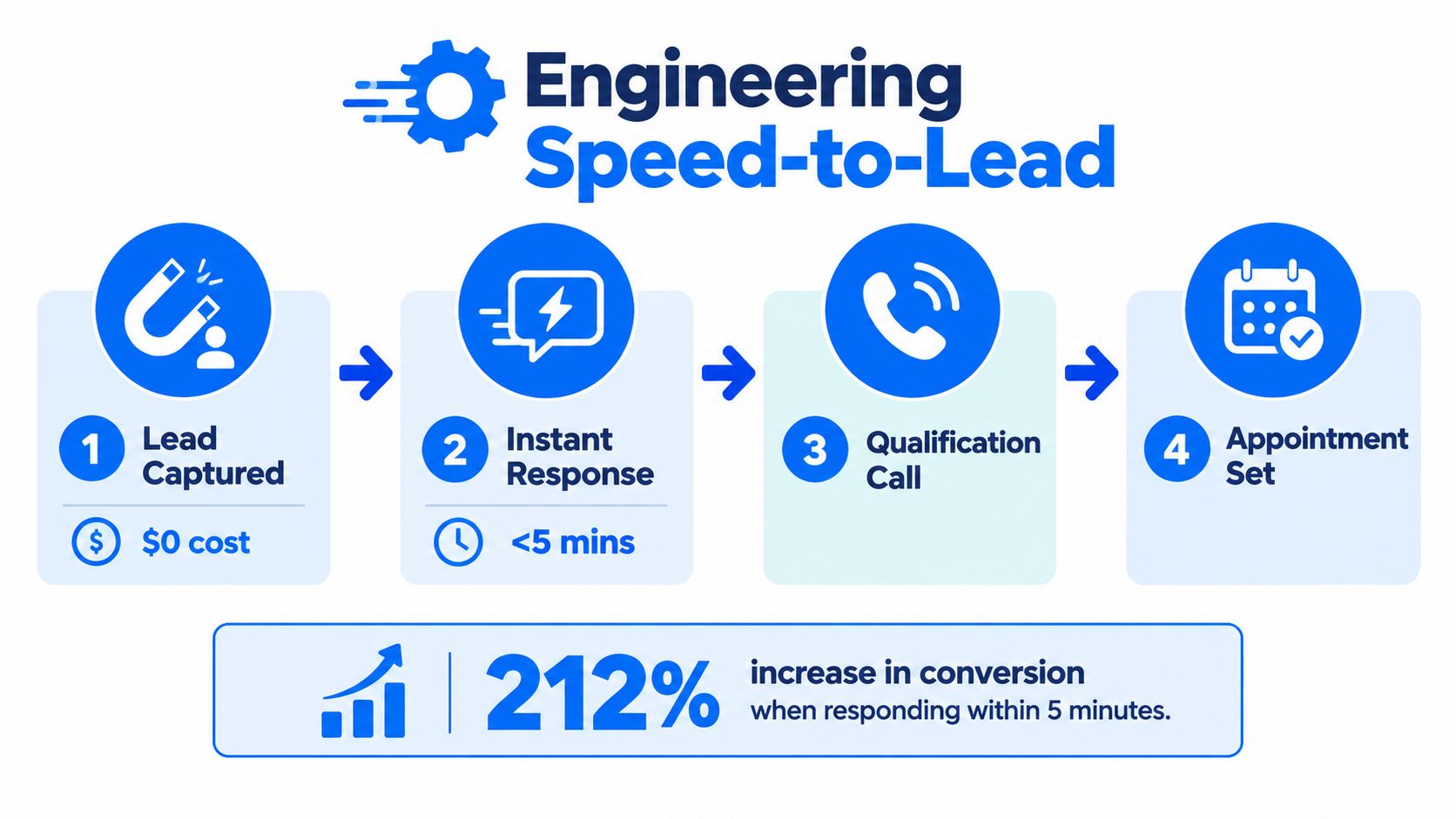
A lead can cool off before the first rep sees it. Harvard Business Review's analysis of 15,000 leads and 100,000 call attempts found that moving response time from 5 to 10 minutes reduced the odds of qualifying a lead by 400%. Response time is a launch variable, made before the first ad spends.
The response sequence needs to be wired before spend starts. Capture and validate the number immediately, send an acknowledgement within seconds, and place a human call while the lead is still warm. If the call is missed, a short permission-compliant SMS sequence keeps the conversation alive without turning into spam. For a full walkthrough of response-time workflows, see our speed-to-lead guide.
Separate acquisition problems from follow-up problems
High lead volume with weak contact rates does not automatically mean the ads are the problem. Bad phone data, weak consent handling, slow replies, duplicate automations, and poor timezone routing can all suppress contact rates after the lead is already won. Launch reviews should check opt-outs, invalid numbers, duplicate suppression, timezone scheduling, and human escalation before spend scales.
A proper follow-up stack stops when someone replies or opts out. It also carries the lead through qualification and appointment setting instead of dumping the contact into a generic nurture sequence. Local businesses do not need more messages. They need fewer missed conversations.
The video below shows the logic of a tighter handoff from lead to appointment.
If a business wants to reduce response friction without stitching together five tools, BenjiAds is one option that builds ads, landing funnels, tracking, and SMS-based follow-up into one workflow. That matters because the lead does not care which tool owns the problem. The customer cares whether someone answers.
Finalizing the Approval Workflow and Go Live Sequence
A controlled launch should end with a go or no-go decision, not with the account spending in the background without oversight. The owner or operator needs to approve the build, confirm the tracking, and understand what will happen in the first hours after launch. That approval gate protects budget and forces accountability before the campaign becomes active.
Once the ads are live, watch the first wave of data with a skeptical eye. Platform-reported leads, verified leads, qualified conversations, and booked jobs should all be visible separately so the business can see where the funnel is leaking. If one number looks good and the others don't, that's not a success story, it's a diagnostic clue.
A launch is really a sequence of checks. The ad account has to be ready, the landing page has to be aligned, the phone and SMS workflow has to be active, and the reporting has to tell the truth. When those pieces are in place, spend stops being a gamble and starts behaving like an operating system.
If you want a team that builds the ads, wires the tracking, and sets up the SMS follow-up before a campaign ever spends, visit benjiads. It's built for local businesses that need launch infrastructure, not another dashboard to babysit. If your current campaigns are getting clicks but not booked work, that's the problem worth fixing first.
- campaign launches
- local ads
- lead generation
- ad tracking
- business growth
Done for you
Ads that text you customers.
- ✓ Ads created for you
- ✓ Every lead texts your phone
- ✓ Free to use, no credit card
748+ local businesses run ads with benjiads