lawn care marketing 15 min read
Marketing Lawn Care Business
Marketing lawn care business. Learn proven strategies for marketing your lawn care business, from local ads and service bundles to retention and lead follow-up
On this page
- Why Most Lawn Care Marketing Wastes Money
- The Market You Are Actually Selling Into
- Building Local Ads That Match How Homeowners Search
- Service Bundles That Lift Average Ticket and Route Density
- The Lead Follow-Up Sequence That Books the Job
- Retention Marketing That Turns One Cut Into a Season
- Your 30-Day Launch Plan and What to Watch
The most impactful move in marketing a lawn care business usually isn't a bigger ad budget. It's responding fast enough to convert the inquiries you already receive, especially when home-service leads contacted within 5 minutes are reported as 100 times more likely to connect and 21 times more likely to qualify than leads contacted after 30 minutes. Pipelineon's home-service lead-response benchmark also reports roughly 28% average inbound-lead conversion at about 42 minutes, compared with about 62% for companies responding within 2 minutes.
Most lawn care marketing advice starts with more posts, more flyers, more keywords, and more impressions. That advice skips the expensive part: what happens after a homeowner requests a quote while you're on a mower, driving between properties, or finishing a job at 7 p.m.
A lead that sits unanswered isn't a marketing asset. It's a paid opportunity cooling off while the homeowner contacts another provider.
The better approach is to build four connected systems:
- A local offer that matches the service a homeowner wants now.
- Fast response that confirms the inquiry and creates a next step.
- Route-aware acquisition that brings jobs into profitable neighborhoods.
- Post-job retention that turns the first cut into recurring service.
That's how you market a lawn care business without confusing activity for growth.
Why Most Lawn Care Marketing Wastes Money
The standard playbook is familiar. Post before-and-after photos, print door hangers, boost a Facebook post, create a generic “request a quote” form, then wait for the phone to ring. None of those tactics are automatically bad. They become wasteful when the business treats lead generation as the finish line.
A homeowner doesn't pay you because your ad received an impression. They pay after they trust the company, confirm that it serves their address, understand what happens next, and get a response while the need is still urgent.
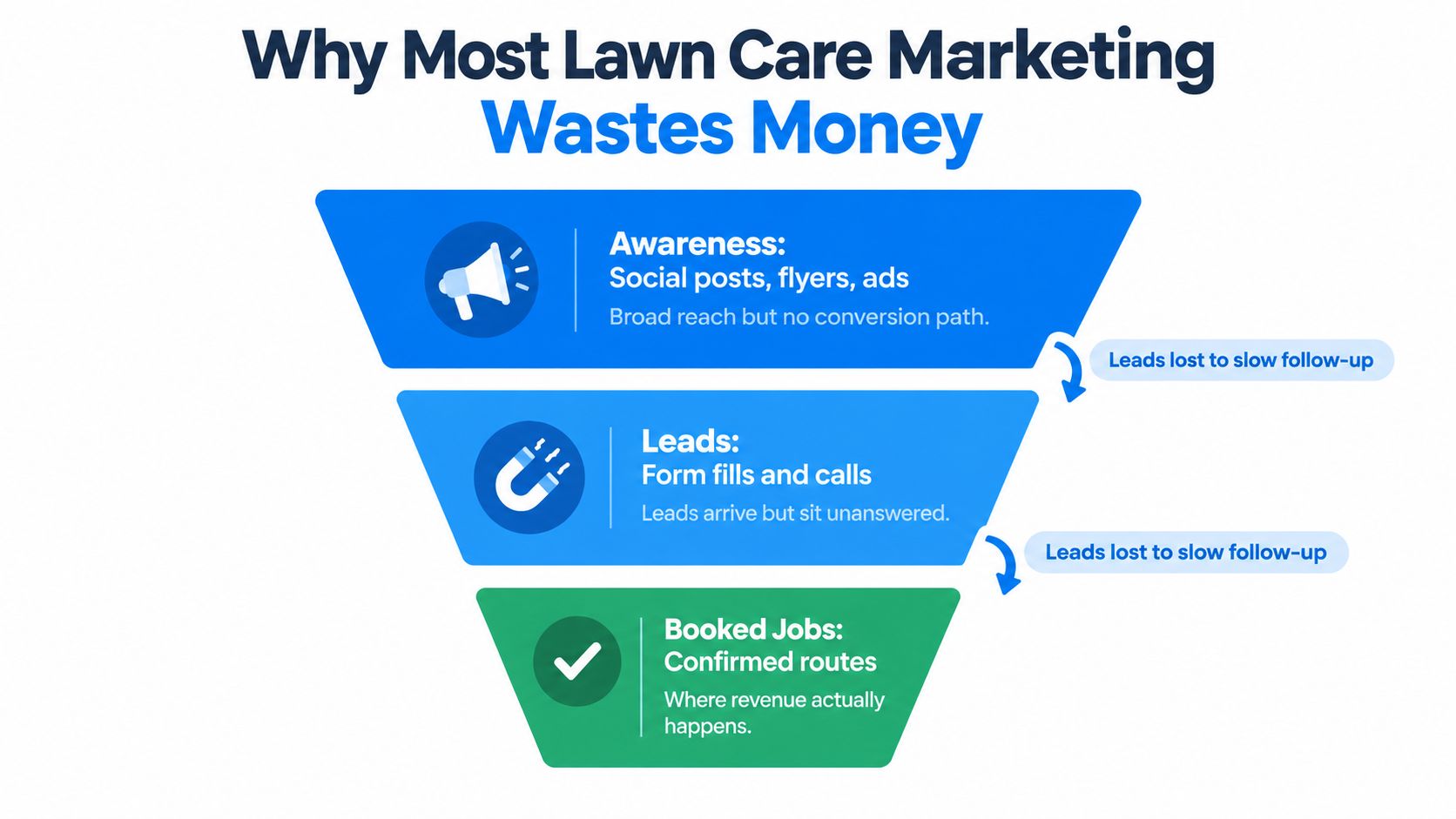
Traffic is only the top of the funnel
The useful question isn't “How do I get more leads?” It's “How many qualified inquiries become booked work, and why do the rest disappear?”
A campaign can produce cheap form fills while sending the crew outside its service area, attracting customers who want a service you can't schedule, or generating requests that nobody answers until the next morning. Tracking only cost per lead hides those leaks. A practical cost per lead formula should sit beside contact rate, qualified-lead rate, estimate-booking rate, booked-job rate, and revenue per lead.
The response benchmark matters because lawn care buyers can compare providers quickly. The slower company often loses before it has explained its quality, pricing, or service process.
Practical rule: Don't increase traffic until every new inquiry has an owner, a response sequence, and a measurable path to a scheduled estimate.
Four levers control the economics
Local offer. “Professional lawn care” is too broad for an ad. “Recurring mowing for homes near your existing route” gives the homeowner a clear reason to respond and gives you a way to judge whether the job fits.
Response speed. Send an immediate acknowledgment, then call while the request is fresh. If you can't make that attempt consistently, automate the first touches and assign a human handoff.
Route density. A profitable job isn't just a job with acceptable gross margin. It's a job that fits the geography, timing, equipment, and crew capacity of the route.
Retention. The first visit should trigger the next conversation, whether that means recurring maintenance, fertilization, aeration, cleanup, or a review request. Acquisition pays for attention once. Retention gives that attention somewhere to compound.
Marketing fails when operators optimize the first lever and ignore the other three. More clicks can increase the number of unanswered inquiries. More inquiries can increase administrative chaos. A larger top of funnel won't repair a broken booking process.
The Market You Are Actually Selling Into
Lawn care is a recurring-service business before it's a landscaping project business. Industry research estimated the U.S. lawn-care market at $60.0 billion in 2025, projected $62.91 billion in 2026 and $79.68 billion by 2031, with an implied 4.85% compound annual growth rate from 2026 through 2031. The same U.S. lawn-care market reference identifies maintenance as the dominant category, at 91.55% of market share in 2025, with projected growth at a 5.18% compound annual rate through 2031.
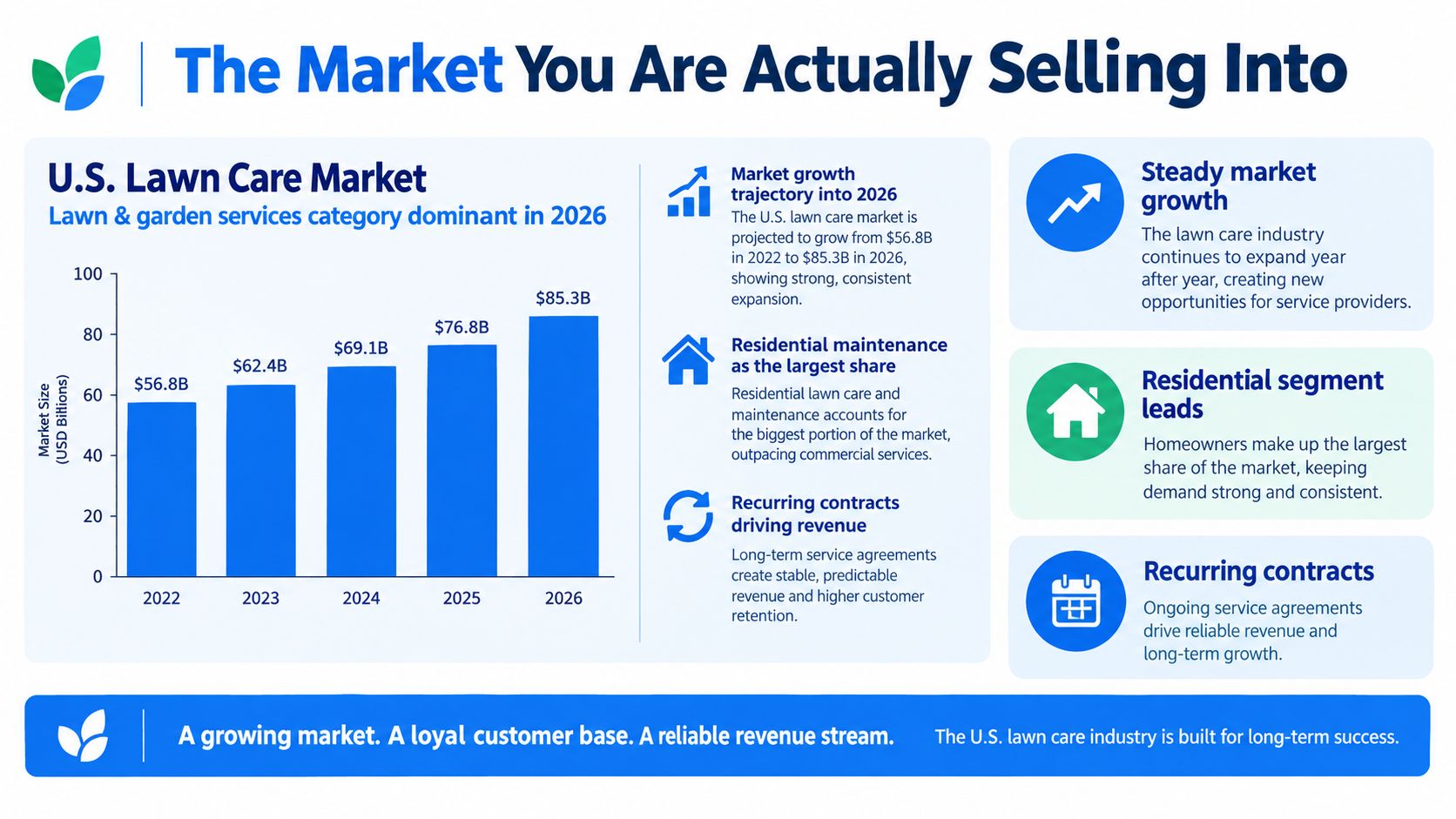
Those figures are a U.S. benchmark, not a global total, but the business implication is clear. The core offer should usually be repeat mowing, fertilization, weed control, aeration, overseeding, and seasonal maintenance. A one-time cleanup can start the relationship. A route of recurring properties makes the operation predictable.
Seasonal intent should control spend
Search demand doesn't arrive evenly across the year. U.S. searches for “lawn care near me” rise from about 60,000 in February to 165,000 in March, remain near 135,000 in April, and decline toward 33,000 in December, according to ServicePro's lawn-care marketing data. Searches for “lawn mowing near me” move from roughly 14,000 in February to 60,500 in March and stay high through May.
Aeration needs its own campaign calendar. Reported searches reach about 201,000 in March to April and again in September, so treating aeration as a generic add-on to a year-round mowing campaign leaves demand untapped.
Build separate campaigns for mowing, fertilization, aeration, overseeding, and cleanup. Shift budget 2 to 4 weeks before the local demand peak, then validate performance against your search-term reports, weather, turf conditions, service area, and actual crew capacity.
Route density beats broad coverage
A broad radius can make a campaign look busy while turning every job into a scheduling problem. Start with neighborhoods where you already have customers, then expand only when the new work improves the route rather than stretching it.
That means the offer should include service-area language, a clear service type, and a qualification step for address, lawn size, and preferred timing. The right lead is not just anyone who wants lawn care. It's someone whose property fits the route you can serve profitably.
Building Local Ads That Match How Homeowners Search
Generic lawn-care advertising forces one message to do too much work. A homeowner searching for mowing shouldn't land on a page dominated by mulch installation, landscaping design, or commercial maintenance. Match the campaign, ad, form, and follow-up to the service request.
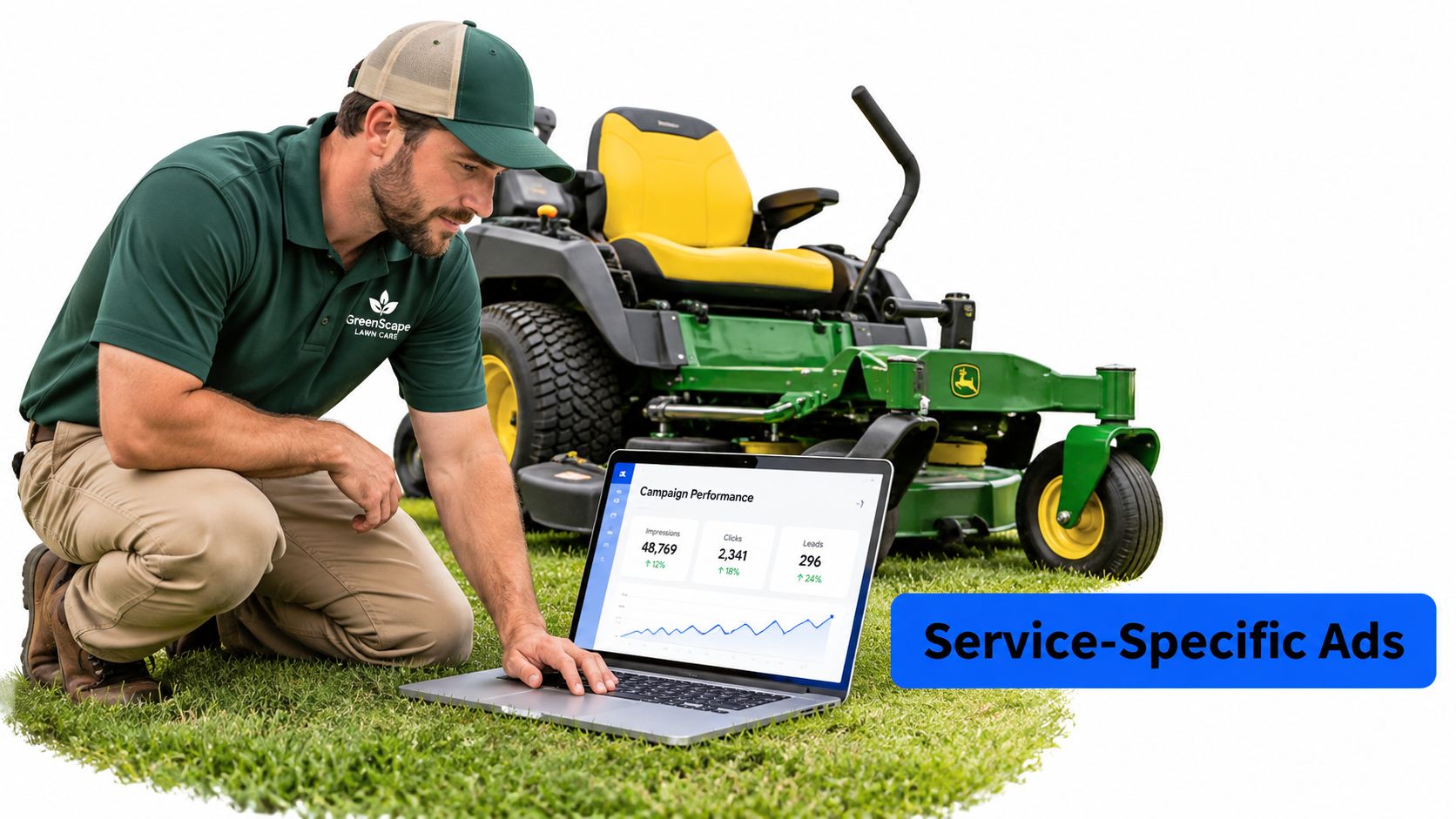
Build campaigns around services and seasons
Use one campaign structure for recurring mowing, another for fertilization and weed control, another for aeration and overseeding, and another for cleanups. Each campaign should answer four questions immediately:
- What service is available?
- Which neighborhoods or ZIP codes do you serve?
- When can the crew begin?
- What information is needed for an accurate estimate?
For mowing, emphasize route availability and recurring service. For aeration, emphasize the seasonal window. For cleanup, use urgency tied to the property condition and scheduling availability. Don't send all three audiences to the same homepage.
A service-specific quote page should collect the address or ZIP code, lawn size, requested service, mobile number, and preferred timing. That information helps you reject out-of-area requests before a salesperson spends time chasing them.
Use local intent layers
Google Business Profile and Local Services Ads deserve separate attention from Facebook and Instagram. Recent benchmark reporting says homeowners made faster decisions in 2025 and often compared Google Business Profiles or Local Services Ads before clicking paid-search ads. The 2026 marketing benchmark report also identifies response speed, review quality, proximity, category accuracy, and consistent follow-up as factors affecting visibility and conversion.
Keep the profile accurate. Use the correct service category, define the service area precisely, add current work photos, and answer reviews professionally. These are not decorative profile improvements. They reduce uncertainty before the homeowner calls.
Paid social can still work, particularly when the creative shows a recognizable local property problem and the offer is easy to understand. But don't use it as an excuse to ignore high-intent local search. The lawn care ads guide should help you think in terms of the entire path from ad to booked estimate, not just the visual asset.
Pause the right thing first
When cost per qualified estimate rises, don't immediately shut down every campaign. First inspect the search terms, service-area fit, response time, landing-page match, and appointment availability.
Pause ads that produce requests your crew can't fulfill. Keep ads that bring qualified properties near active routes, even if their raw lead count looks smaller. Your scoreboard is cost per qualified estimate, estimate-booking rate, and booked route, not impressions.
Service Bundles That Lift Average Ticket and Route Density
A single visit creates a fragile relationship. A maintenance plan creates a schedule, a renewal point, and more opportunities to serve the same property efficiently.
The bundle should be built around the route, not around an arbitrary discount. If a crew already works nearby, an adjacent property can improve utilization even when the offer includes a modest incentive. If the property requires a special trip, the same discount can destroy margin.
Start with one residential offer and one commercial offer
Residential customers need a simple decision. Give them a recurring maintenance plan with defined visit frequency, service boundaries, communication expectations, and a clear way to pause or renew.
Light commercial customers need reliability and documentation. HOAs, office parks, and property managers may fill weekday gaps, but they also expect consistent scheduling, billing, and communication. Don't chase commercial work merely because the contract looks larger. Take it when the property improves crew utilization and fits the equipment and labor you already have.
Recurring mowing plan
- Best Customer
- Homeowners who want predictable upkeep
- Avg Ticket
- Recurring
- Route Impact
- Builds repeat stops in nearby neighborhoods
Fertilization plus weed control
- Best Customer
- Customers focused on lawn appearance
- Avg Ticket
- Recurring
- Route Impact
- Adds planned visits to existing maintenance routes
Aeration plus overseeding
- Best Customer
- Homeowners preparing for seasonal recovery
- Avg Ticket
- Seasonal
- Route Impact
- Creates a timed upsell around existing properties
Cleanup plus maintenance conversion
- Best Customer
- One-time cleanup customers
- Avg Ticket
- Mixed
- Route Impact
- Turns a project lead into a recurring route stop
Light commercial maintenance
- Best Customer
- HOAs and office properties
- Avg Ticket
- Contract-based
- Route Impact
- Fills weekday capacity when geography is favorable
The Avg Ticket column should be based on your actual service economics, not a copied industry price. Calculate labor, travel, materials, equipment wear, payment costs, and the value of the crew's available time.
Make the offer concrete
“Save on lawn care” is weak. “Recurring mowing with scheduled service, text updates, and a seasonal review” is specific. Add a clear next step, such as requesting an estimate or confirming property details.
Bundle the service conversation around the customer's problem. A neglected lawn may need cleanup first, then recurring mowing. A healthy lawn may be ready for a maintenance plan plus fertilization. A thin lawn may need aeration and overseeding at the appropriate seasonal window.
Use the first completed visit as the renewal moment. Confirm what was done, explain the next recommended service, and invite the customer into a recurring plan before the relationship becomes another forgotten quote.
The Lead Follow-Up Sequence That Books the Job
More lawn care leads will not fix a follow-up process that leaves homeowners waiting. The bottleneck sits between the form submission and the first conversation. Build a sequence that runs on every inquiry, then let a person take over as soon as the prospect responds.
Start with the form. Ask for the customer's name, mobile number, address or ZIP code, lawn size, requested service, and preferred timing. Those details let the team qualify the lead and offer a realistic appointment instead of spending the first call collecting basics.
The first two minutes
Send an immediate SMS confirming that the request arrived. Identify the business, repeat the requested service, and explain the next step in a few words.
Call within 2 minutes. The goal is contact, not a perfect estimate from the driver's seat. Confirm the property address and service need, then offer a clear scheduling option that fits the crew's route.
If the customer misses the call, send two appointment windows by text. “When are you free?” creates another round of messages. Two realistic options make the decision easier and help fill nearby route capacity.
Industry research confirms the value of speed: responding within 2 minutes doubles conversion compared with the 42-minute average, according to the lead-response research summary.
Continue without becoming annoying
A missed call is a follow-up problem, not a dead lead. Use a controlled sequence:
- At 15 minutes: Send a concise reminder and repeat the two available windows.
- Several hours later: Clarify the service area, estimate process, or information still needed.
- The next day: Ask whether the customer still wants an estimate and include an opt-out option.
- After an estimate: Follow up according to the requested service and timing, rather than sending generic reminders.
Tag each outcome as unreachable, unqualified, estimate scheduled, won, or lost. Record why a lead is unqualified, such as an address outside the service area, unavailable timing, wrong service, or price mismatch. Without those tags, you will keep paying for poor-fit inquiries and blaming the ads.
Track contact rate, qualified-lead rate, estimate-booking rate, booked-job rate, revenue per lead, and response-time percentiles. Cost per lead is a weak measure if the inquiry never reaches a person.
The lead nurturing automation workflow provides a useful model for organizing intake and follow-up. Platforms like BenjiAds automate this workflow, but the sequence itself is what matters. A CRM, texting platform, or configured scheduling system can handle the same operating steps when manual response is unreliable.
Retention Marketing That Turns One Cut Into a Season
The first completed cut is the beginning of the customer relationship, not the end of the sale. A lawn-care operator who communicates clearly after the visit has more chances to earn the next service, the seasonal add-on, and the review.

Consider a customer who requests recurring mowing in spring. Before the first visit, send the arrival window and any access instructions. After the cut, send a completion message with a property photo when appropriate, then ask whether anything needs attention before the next visit.
Midseason is a natural time to review the lawn rather than wait for a complaint. If the grass looks thin or weeds are appearing, recommend the relevant service and explain why it fits the property. Don't dump a catalog of add-ons into one message. Make one useful recommendation tied to what the crew observed.
Time seasonal conversations correctly
Aeration is a strong example of timing. Reported U.S. searches for the service reach about 201,000 in March to April and again in September, according to the previously cited seasonal search research. For an existing customer, that demand window can become a timely reminder rather than a cold sales pitch.
The sequence can look like this:
- Before arrival: Confirm timing and property access.
- After the first visit: Confirm completion and invite feedback.
- After a successful visit: Request a review through a direct, low-friction link.
- Midseason: Recommend one relevant improvement based on the lawn's condition.
- Before the fall window: Offer aeration or overseeding where appropriate.
- At season end: Present renewal options and ask for a referral or off-season service conversation.
Recent benchmark reporting says homeowners made faster decisions in 2025 and compared Google Business Profiles or Local Services Ads before paid-search ads. It also connects review quality, proximity, category accuracy, response speed, and consistent follow-up with visibility and conversion. That means review generation belongs in the service workflow, not in a once-a-year marketing meeting.
Ask after a completed visit when satisfaction is most visible. If the customer reports a problem, route that response to the team before asking for public feedback. A review request should reinforce good service, not try to cover for unresolved work.
Your 30-Day Launch Plan and What to Watch
A lawn care marketing system doesn't need to launch with every channel. It needs a focused offer, a reliable response process, and enough tracking to show where inquiries stop moving.
Days 1 through 7
Choose one recurring residential offer and one seasonal add-on. Define the service area, route priorities, qualification questions, estimate process, and available appointment windows.
Update the Google Business Profile with accurate categories, service areas, contact details, hours, and current photos. Create one service-specific landing page instead of sending every visitor to the homepage.
Days 8 through 14
Launch the campaign around one service and one local audience. Build the response sequence before increasing spend. Test the form, SMS confirmation, call notification, appointment options, tags, and human handoff from a real phone.
Set a baseline for contact rate, qualified-lead rate, estimate-booking rate, booked-job rate, revenue per lead, and response-time percentiles. Don't judge the campaign by clicks alone.
Days 15 through 30
Review search terms and lead quality. Remove requests outside the service area or outside crew capacity. Shift attention toward neighborhoods that strengthen existing routes.
Ask satisfied customers for reviews after completed work. Start one retention sequence for upcoming seasonal services and one renewal sequence for recurring maintenance.
Watch for four warning signs:
- Leads rise while booked estimates stay flat: Fix response speed, qualification, and follow-up.
- Cost per qualified estimate rises: Inspect service fit, geography, landing-page relevance, and available capacity.
- Contact rate remains low: Validate phone numbers, simplify the form, and make the first message clearer.
- Customers sign up but don't renew: Improve the service experience, post-visit communication, and renewal timing.
If you're still relying on memory to call new leads between jobs, the problem isn't discipline. The process is badly designed. Automate the first response, keep the owner in control of the handoff, and measure booked route revenue instead of celebrating cheap inquiries.
BenjiAds builds and manages online ads, landing funnels, tracking, and SMS-based lead follow-up for local service businesses, with campaigns prepared for approval before they run. If your lawn care business needs a faster path from inquiry to booked estimate, visit benjiads and review how the platform fits your acquisition and follow-up workflow.
- lawn care marketing
- local ads
- lead follow-up
- service retention
- small business growth

LAWN CARE QUOTES BY TEXT
Lawn care quotes by text
Free estimates
Ads created · live on FB & IG
For lawn care companies
Your lawn care company ads, live in 2 minutes.
- ✓ Ads created for you
- ✓ Every lead texts your phone
- ✓ Free to use, no credit card
748+ local businesses run ads with benjiads