used car dealership 13 min read
Used Car Dealership Business Plan: A Complete Guide
Learn how to write a used car dealership business plan that covers market analysis, costs, and marketing to launch or grow your dealership.

On this page
- What Makes a Used Car Dealership Business Plan Actually Work
- Analyzing Market Conditions and Positioning Your Dealership
- Building Your Inventory Model Before Revenue Projections
- Sourcing Strategy and Acquisition Channel Mix
- Financing the Operation and Measuring Real Returns
- Marketing That Converts Leads Into Verified Inquiries
- Putting Your Plan Into Action and Avoiding Common Traps
You're staring at a lot, a lender packet, and a rough idea of what you want to sell, but the plan still has holes where the money leaks out. That's normal. The dealers who stay profitable don't just “buy cheap and sell high,” they build around affordability-band inventory and the lead funnel that turns shoppers into verified buyers.
A good used car dealership business plan has to do more than describe the business. It has to show how the lot will stay stocked, how fast vehicles will move, how capital will recycle, and how leads will become sales before your competitors answer the phone.
What Makes a Used Car Dealership Business Plan Actually Work

A plan that survives contact with the market starts with the numbers buyers and lenders actually use. If a dealership cannot show how each unit fits an affordability band, how long it should sit, and how lead costs turn into verified inquiries, the rest of the document is just decoration. Data from the National Automobile Dealers Association shows that new-vehicle dealerships sold approximately 13.1 million used vehicles in 2025, with average retail selling prices reaching $28,680, so the plan has to account for both price and volume from the start. That baseline matters because it frames what a lot can realistically support.
The five moving parts that have to fit together
A viable plan connects market positioning, inventory modeling, acquisition strategy, financing and capital, and lead-to-sale economics. If one piece is vague, the rest becomes guesswork. A store survives by deciding which price bands it can move, how it will source them, and what each vehicle must earn before it ages out.
Practical rule: if your plan cannot explain why a specific car belongs on your lot at a specific price, a plan that cannot justify each vehicle is only a wishlist.
Lot size comes later. A smaller lot can outperform a larger one if the inventory matches local affordability and the response process is tight. A big lot full of the wrong vehicles only adds carrying cost and creates false confidence.
The web side deserves the same discipline. Shoppers compare inventory before they ever visit, so small business website design affects how many leads arrive and how many of them are worth a salesperson's time.
What separates a working plan from a template
A working plan shows conservative, base, and optimistic cases for units sold, average selling price, gross profit per vehicle, inventory funding, and days to sale. It also says what happens when the market shifts, because used-car retail is cyclical and uneven. If the plan cannot absorb a change in supply, pricing, or financing conditions, it is not ready for capital.
A template usually stops at “we'll advertise and sell cars.” A real plan answers a harder question, which vehicles will move, through which channels, at what turn, and with what return on capital. That is the difference between a dealership and an expensive parking lot.
Analyzing Market Conditions and Positioning Your Dealership
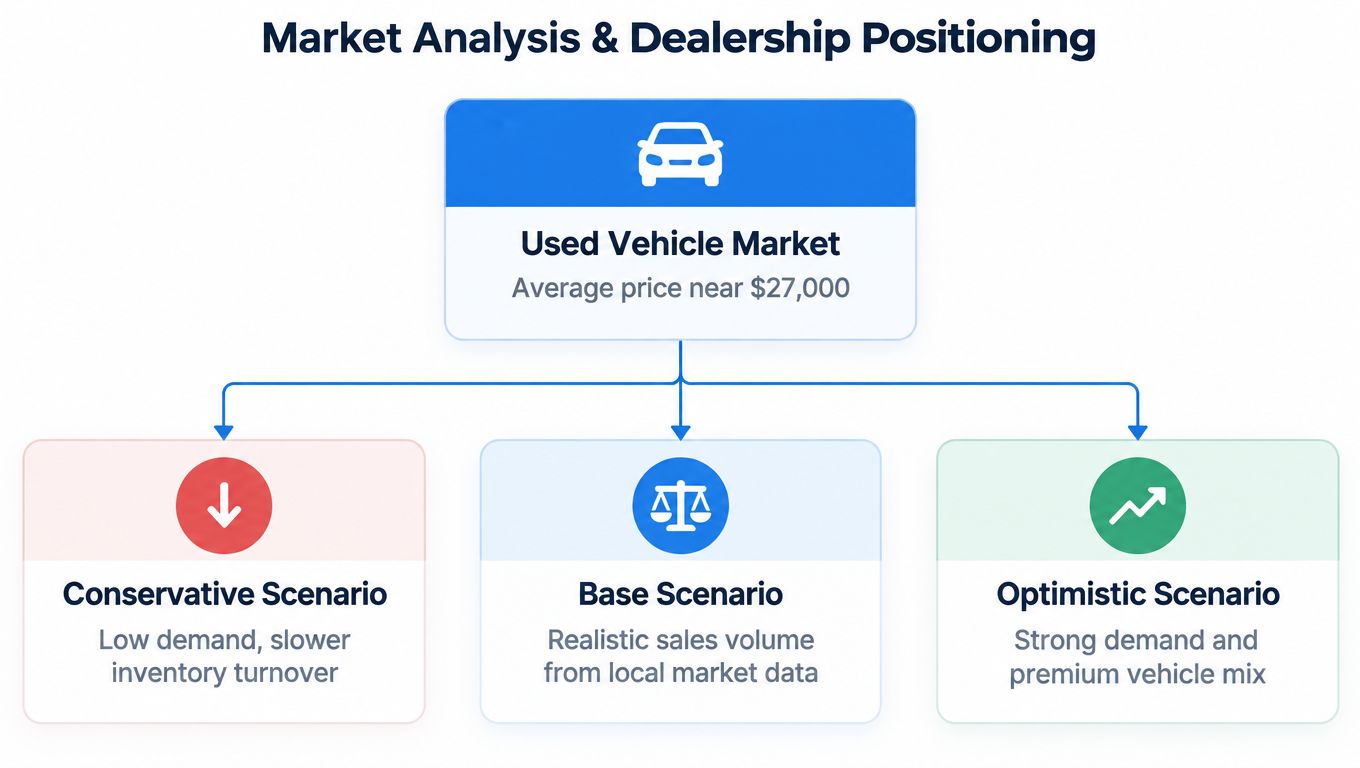
A lot can look busy and still miss the mark. Recent U.S. market data shows average used-vehicle listing prices reached $26,918 in May 2026, up 6% year over year, while retail sales fell 3.9% and days' supply rose to 45. That mix means inventory may sit on the lot even when the showroom traffic looks decent. A chart showing market analysis and dealership positioning for used cars, including conservative, base, and optimistic business scenarios.
Build scenarios from local demand, not national headlines
A conservative scenario assumes slower turn and tighter financing. A base scenario assumes steady local demand and normal inventory refresh. An optimistic scenario only belongs in the plan if your location, sourcing, and advertising can support a stronger vehicle mix without stretching cash.
The hard part is local fit. Demand may be measured in broad market totals, but your store lives on what buyers in your trade area can afford and finance. Many startup plans copy market averages, then stock cars that look fine on paper and sit because the local payment range does not support them.
Position the lot around payment affordability
Positioning begins with what local buyers can finance each month. Which vehicles can they insure, maintain, and put money down on without hesitation? That answer should shape inventory by payment range, cash-price band, credit tier, term, and down-payment tolerance.
The positioning statement should be plain and specific. “We focus on late-model, financeable vehicles in the price bands our local buyer base can realistically support” gives a lender and a manager something real to work with. “We sell quality used cars” does not explain how the store earns.
A dealership that ignores affordability can still generate leads, but too many of them will be the wrong leads. The stronger store is the one that sells fewer, better-matched units at a steady pace, with shoppers who can move from inquiry to funded deal without constant friction.
Building Your Inventory Model Before Revenue Projections
Revenue comes after inventory math, not before it. If you start with lot size, you usually overbuy. If you start with monthly unit targets, you can work backward into the stock you need and avoid tying up cash in cars that age out.
Start with sales velocity, then calculate stock
Use this sequence, monthly unit target, then days' supply, then average inventory units. The formula is average inventory units = monthly unit sales × target days' supply ÷ 30.5. It keeps the plan tied to how fast cars move instead of assuming the lot can absorb whatever arrives.
Cox Automotive reported that U.S. used-vehicle days' supply was 45 days in early June 2024 (Cox Automotive), and vehicles priced below $15,000 were moving faster, at 34 days' supply. Its dealer KPI framework also treats 12 turns as good and 16 as great. Lower-priced inventory often behaves differently from the market average, so a single lot-wide target can hide where the business is really strong or weak.
| Inventory Segment Performance Benchmarks | |
|---|---|
| Price Band | Days' Supply |
| Market average | 45 |
| Below $15,000 | 34 |
| Turn Target | Interpretation |
| 12 turns | Good |
| 16 turns | Great |
Use segment-level rules, not one blended average
One blended inventory target hides too much. A bargain car, a mid-price sedan, and a higher-ticket SUV do not age the same way on the lot. Demand, recon risk, and markdown pressure differ by segment, so your plan needs acquisition limits and age limits by price band.
That also changes how you manage cash flow. A useful outside reference on managing cash flow and stock can help frame turnover because every week a car sits is interest, insurance, and recon carry accruing against the deal. Slow stock ties up money twice, first at acquisition, then again as it ages.
Weekly aging reviews should force action at 30, 45, and 60 days. Reprice, wholesale, or stop pouring recon dollars into a car that is already outside its economic window.
The plan should also set reconditioning budget limits and markdown triggers before a vehicle hits the lot. If those rules are not written down, every deal turns into an emotional decision. Good operators decide in advance when a unit has earned its place and when it needs to move.
Sourcing Strategy and Acquisition Channel Mix
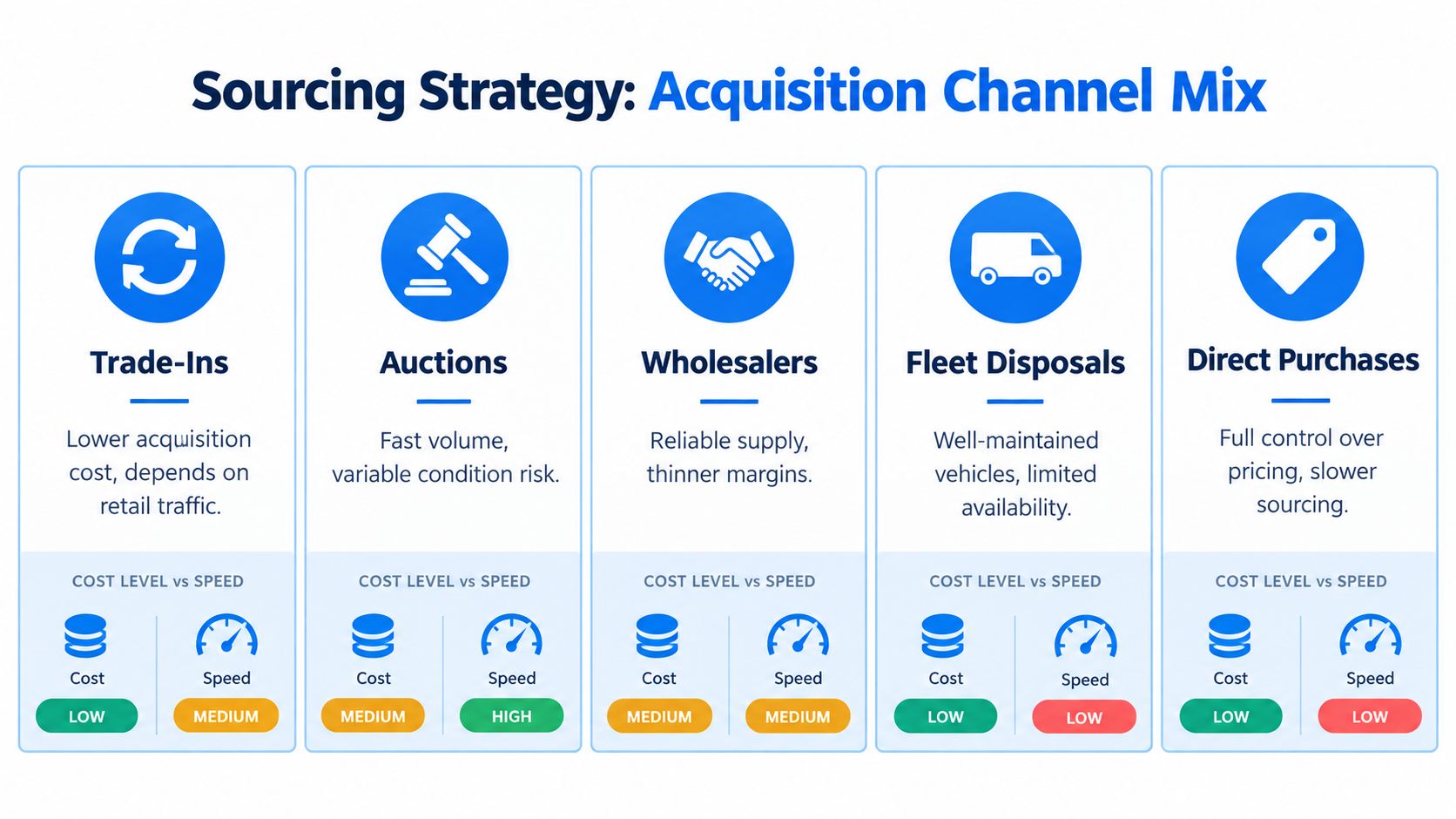
A lot can look healthy on paper and still be badly sourced. The channels you choose shape recon spend, front-end gross, and how quickly inventory fits the price bands your market buys. In dealership sourcing, the hard question is not whether a car is available. It is whether you can buy it, recondition it, and retail it inside the target affordability band without tying up cash in the wrong unit.
Trade-ins remain a major source for used-car dealers, and dealership sales staff who work those deals still depend on showroom traffic to feed the pipeline. Auctions provide scale, but they reward tight inspection discipline and punish sloppy buying. Wholesalers can help fill gaps when retail demand shifts, though the margin is usually thinner. Fleet disposals often bring cleaner histories and more predictable condition, yet supply is limited and timing is less flexible. Direct purchases give the most control, but they also take more time and more underwriting.
Compare sources by reliability, control, and risk
The right mix changes with the store's stage and local demand. A startup that depends on trade-ins before it has steady traffic is betting on volume it does not control. A store that buys only at auction may keep the lot full, but it can also load the yard with units whose recon cost cannot be recovered inside the target price band.
The useful way to model this is by fallback path. If trade-in supply slows, the plan should say which channels replace it. If a unit comes in too close to market risk, the decision should already be set, retail it, wholesale it, or pass. That keeps acquisition decisions tied to the inventory model instead of to whatever happens to be on offer that week.
The most expensive mistake is paying retail confidence for wholesale inventory risk.
Supplier terms matter for the same reason. Purchase agreements should leave room to adjust when market conditions shift, especially on units that may need heavier recon or that sit outside the affordability bands your leads convert in. A dealer who locks up too much capital in the wrong channel loses the ability to react when the market moves.
Financing the Operation and Measuring Real Returns
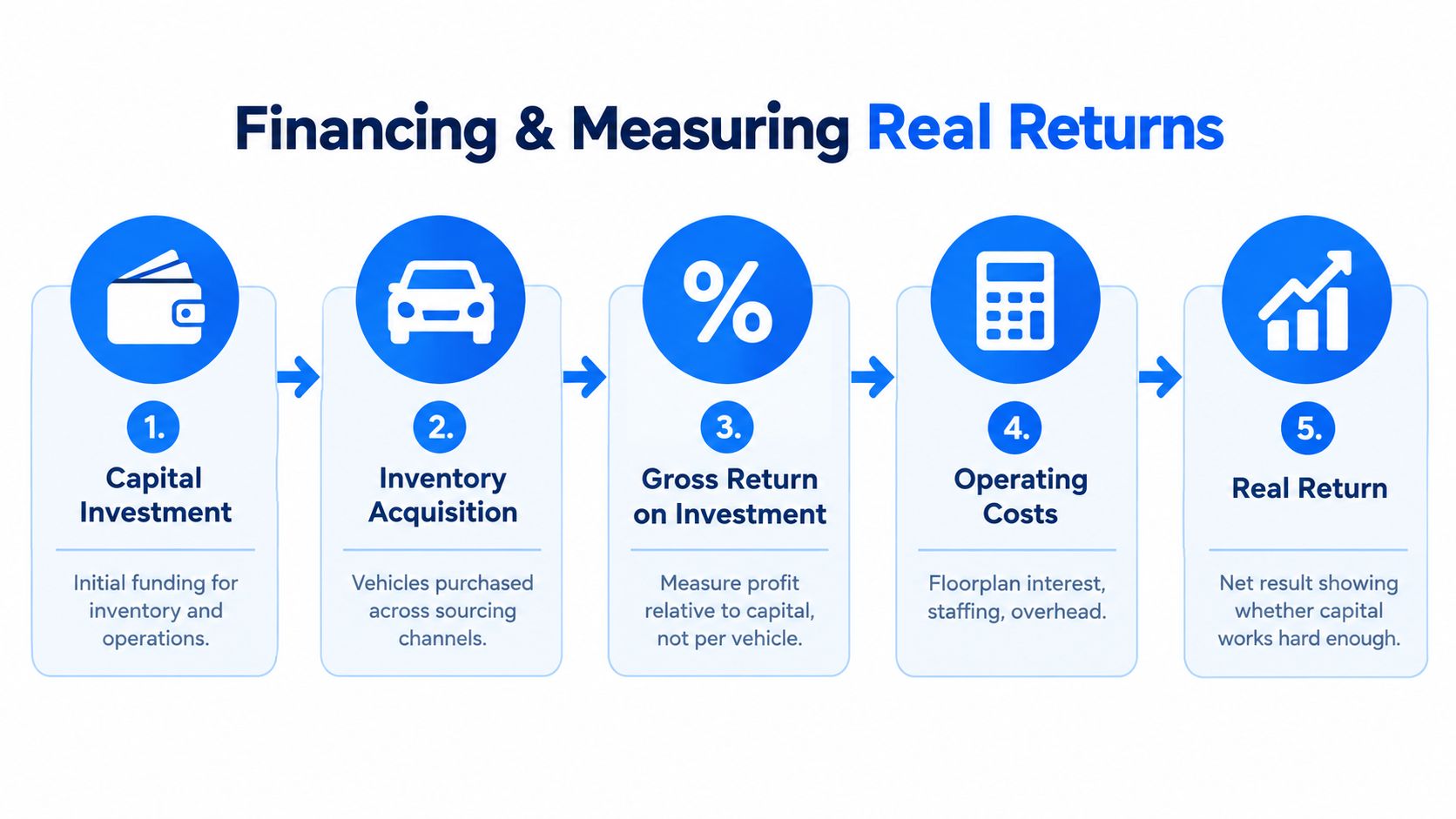
A used car lot can look profitable on paper and still starve for cash. One unit moves fast, another sits, recon keeps climbing, and floor-plan cost keeps working against you. The plan has to show how each car earns its keep, not just how much gross it prints at sale.
Underwrite each car before you buy it
Start with the unit itself. Compare it to independent market prices, inspect it, estimate recon from that inspection, set a maximum all-in cost, calculate the retail price needed to hit your target gross, and decide the wholesale exit before you approve the purchase.
That discipline needs a clear appraisal standard. Cox Automotive's dealer KPI framework defines GROI as gross as a percentage of sale multiplied by inventory turn rate, and it sets 120% as a minimum financial target and 160% as a strong benchmark; it also uses roughly plus or minus $150 in immediate wholesale profit or loss per vehicle as a control objective for appraisal accuracy. The point is simple. If the numbers do not support the buy, pass on the unit.
Measure capital efficiency, not just margin
A lower-priced car that turns quickly can beat a higher-margin unit that lingers. Startup dealers feel this first when they overpay for inventory in the wrong affordability band and then have to discount their way out of it.
The money is made by recycling capital repeatedly, which beats chasing the biggest sticker spread on one isolated deal.
For a closer look at the math behind returns, measuring dealership marketing ROI is useful because the same discipline applies to inventory, overhead, and advertising. If the store cannot connect spend to cash return, it is guessing.
The plan should report gross profit, gross percentage, days in stock, recon variance, price to market, and GROI by buyer, source, salesperson, and segment. If those numbers live in separate spreadsheets, the true answer gets buried. If they sit in one weekly review, the dealership can see where capital is working and where it is leaking.
I also keep the internal math tied to acquisition cost from the start, and this cost per lead formula helps connect ad spend to dealership response economics.
Marketing That Converts Leads Into Verified Inquiries
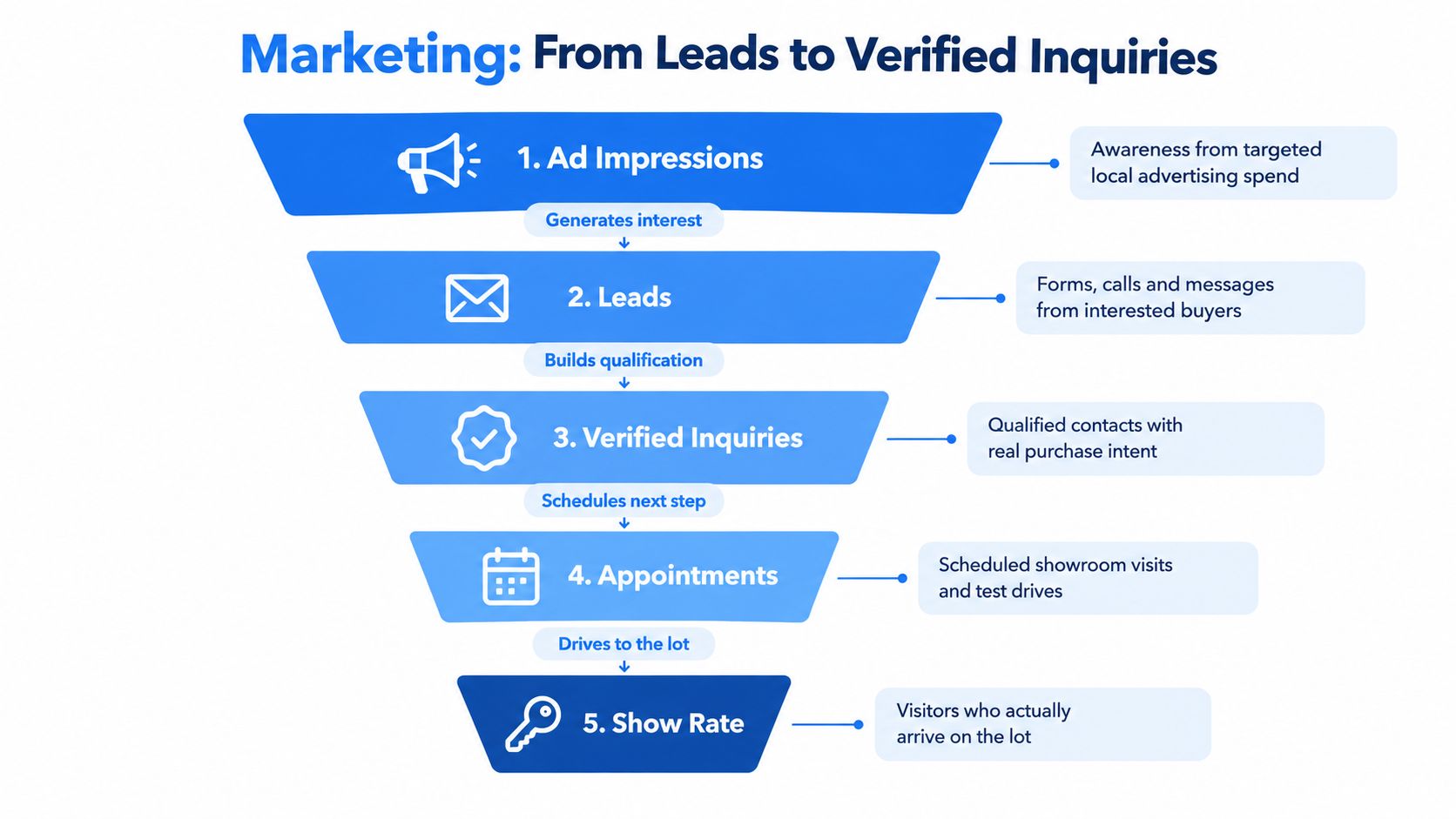
Marketing is a pipeline, and every leak in that pipeline costs real cars sold. When used inventory swells and shoppers have more choices, weak follow-up becomes expensive fast. Lead quality matters more than raw traffic because a dealership can buy clicks all day and still miss the sale if the team never turns those clicks into verified inquiries.
Track the full funnel, not just lead volume
A dealership plan should measure cost per inquiry, valid phone numbers, median response time, conversations started, appointments booked, appointments shown, test drives, finance applications, and sold units. That chain matters because a lead has no value until someone starts a shopping conversation and keeps it going.
The mistake is celebrating volume before you know whether the inquiries are real. A campaign that creates more contacts but fewer showroom visits is not working, it is just generating noise faster than staff can answer it.
Separate channels and assign ownership
Organic traffic, marketplace leads, referral traffic, and paid leads behave differently. The plan should assign each source its own conversion expectation, gross profit contribution, and inventory-aging cost. Otherwise, a source that looks cheap can become expensive once you count the deals it never closes.
Speed wins the first conversation, but consistency wins the month.
Automated sequences are the cheapest way to get that consistency, and lead nurturing automation shows how to build one.
Compliance has to live in the funnel too. Consent for SMS, opt-out handling, truthful pricing, vehicle-history disclosure, and transparent fees protect trust and close rate. If the ad says one thing and the lot says another, shoppers leave before the conversation gets serious.
Video helps when it supports the funnel, not vanity. A short walkaround or a clear inventory update can move shoppers from browsing to verified inquiry when the content matches the actual stock.
The practical rule is simple. Don't buy traffic until you know how quickly the team responds and what happens after the first contact. A fast but sloppy process burns budget. A measured process creates appointments that show.
Putting Your Plan Into Action and Avoiding Common Traps
A strong launch sequence keeps the business from stepping on the same rakes most new dealers hit. Secure the floor-plan line, lock in initial inventory rules, build the website and lead follow-up process, and set a weekly review rhythm before the first sale closes. If those pieces wait until after launch, the dealership learns in public.
Three traps destroy good plans fast. The first is forecasting sales from lot size instead of sales velocity. The second is ignoring opportunity cost when calculating vehicle economics. The third is treating advertised market prices as if they were achieved prices.
The plan should also include a liquidity stress test for rising rates, lender tightening, unexpected reconditioning costs, and a 30-, 60-, and 90-day aging policy. That's the part that keeps optimism from becoming expensive. The weekly dashboard should show gross profit, gross percentage, days in stock, recon variance, price-to-market, and GROI by segment.
If a dealer reviews those numbers every week, the plan stays honest.
That habit matters more than fancy projections. Market conditions change, buyers change, and lenders change their appetite. The dealership that survives is the one that watches its own inventory and lead economics closely enough to react before cash gets trapped.
If you want a dealership plan that connects inventory, lead follow-up, and paid traffic into one operating system, benjiads can help you build the acquisition side around real response economics instead of guesswork. It's built for owners who need leads that turn into verified inquiries, not just clicks and inbox noise.
- used car dealership
- business plan
- car dealer
- dealership financing
- auto retail
Done for you
Ads that text you customers.
- ✓ Ads created for you
- ✓ Every lead texts your phone
- ✓ Free to use, no credit card
748+ local businesses run ads with benjiads