car dealership 14 min read
How Do You Own a Car Dealership: Real Capital and Strategy
Learn how do you own a car dealership by exploring licensing, floorplan financing, facility setup, and fixed-ops strategy for long-term profitability.

On this page
- Understanding Dealership Ownership and Market Scale
- Navigating Licensing, Zoning, and Compliance
- Mastering Inventory Financing and Floor-Plan Risk
- Building Profitable Fixed Operations and Unit Economics
- Comparing Franchise and Independent Dealership Models
- Creating a Launch Roadmap and Measuring Resilience
You own a car dealership by building a licensed, capitalized, compliant operating business with real estate, inventory funding, a surety bond, insurance, and a plan that separates gross sales from carrying costs. In the United States, franchised light-vehicle dealers averaged about $36.2 million per dealership in the first half of 2024, but that revenue sat inside a business that also has payroll, floorplan interest, facility costs, advertising, taxes, and compliance to pay.
Those asking how to own a car dealership are often starting from the wrong angle. They focus on the dealer license because it feels concrete. Fill out forms, get approved, start selling cars.
That mindset ruins people.
A dealership rarely fails because the owner couldn't move metal at all. It fails because the owner confuses sales activity with cash-flow strength. Unsold inventory keeps costing money. Reconditioning isn't free. Staff has to get paid before the next deal closes. Service capacity doesn't magically appear after the ribbon cutting.
If you want to own a dealership, think like an operator of a regulated finance-heavy retail business, not like a car flipper with a bigger parking lot.
Understanding Dealership Ownership and Market Scale
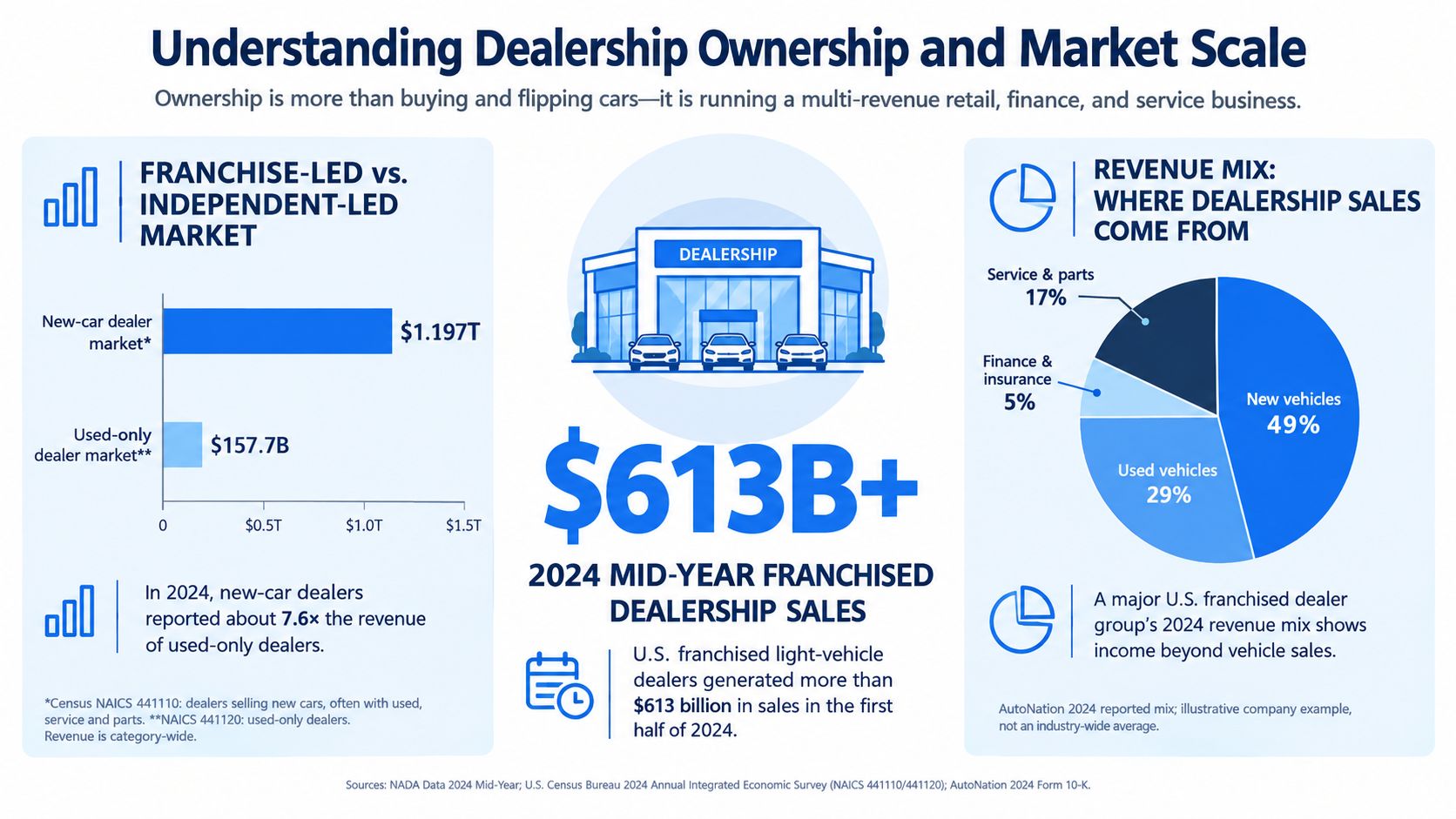
U.S. franchised light-vehicle dealers generated more than $613 billion in total sales across 16,936 franchised dealers while selling 7.8 million light-duty vehicles in the first half of 2024, according to NADA's first-half 2024 dealership data. The average dealership produced about $36.2 million during that period. Treat those figures as market scale, not as a startup forecast.
Gross sales and owner income are different numbers
A dealership's reported revenue can include vehicle sales, parts, service, finance, insurance, and other activities. The same NADA report shows the scale of those combined operations, but gross sales do not show what the owner takes home.
Inventory carrying costs, floorplan interest, payroll, facility expenses, advertising, taxes, warranty obligations, and compliance consume that revenue. Build forecasts by department and show how each one contributes gross profit and fixed-cost coverage. A top-line sales target cannot tell you whether the store can survive a slow month.
Practical rule: Underwrite a dealership from departmental gross profit and fixed-cost coverage, never from sales volume alone.
Independent and franchised ownership are different businesses
An independent dealership usually sells used vehicles and may carry multiple brands. That model gives you more control over sourcing and merchandising. It still requires a licensed location, accurate title processes, required disclosures, inventory capital, reconditioning, staffing, and sufficient local demand.
A franchised dealership operates under a manufacturer agreement. Manufacturer standards can determine facility requirements, territory expectations, performance obligations, brand presentation, and access to new-vehicle allocation under the franchise structure described in the same NADA report.
Choose the model based on your capital, operating experience, and ability to support the departments that produce dependable gross profit. The badge on the building will not repair weak cash management.
Ownership means operating discipline
Front-end unit sales attract attention, but back-shop execution often determines whether the business lasts. Service capacity, parts performance, reconditioning control, and finance processes need clear ownership and daily measurement. A few strong months of sales cannot compensate for uncontrolled fixed costs or aging inventory.
After the operation is sound, use local business internet marketing to reach customers in the surrounding market. Marketing can increase inquiries, but it cannot make weak dealership economics work.
Navigating Licensing, Zoning, and Compliance
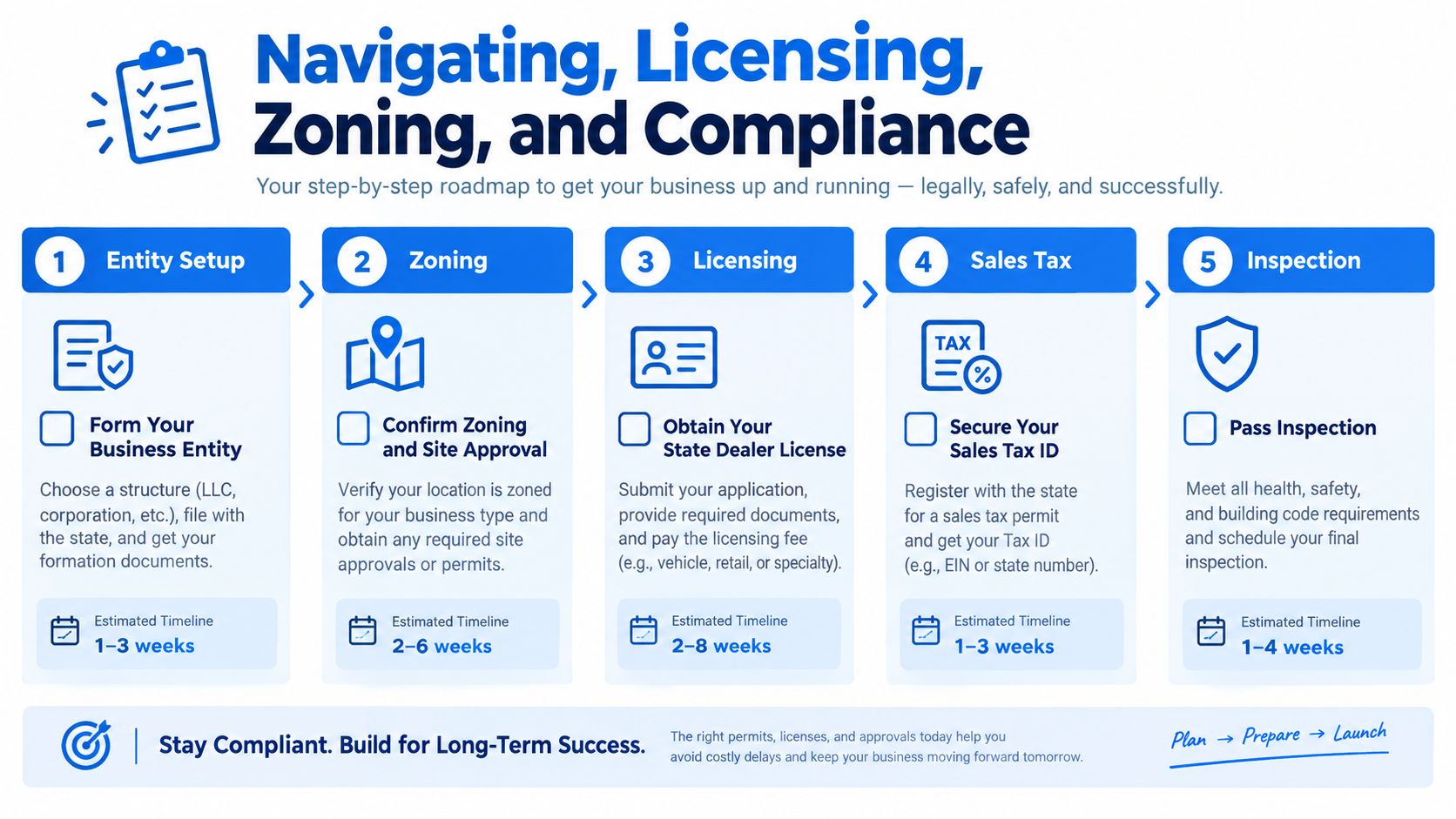
A dealership can lose months of cash before selling its first vehicle if the site fails approval. Treat licensing as a compliance project with dependencies, deadlines, and clear failure points. The sequence matters. Signing a long lease before confirming zoning can leave you paying for a property that cannot receive a dealer license.
Start with the site, not the logo
Before ordering signs, hiring a designer, or buying inventory, confirm that the property can support dealership operations. A dealer location typically needs a customer-accessible commercial office, a vehicle display area, and zoning that permits dealership activity, according to this dealer-license compliance guide.
Obtain written zoning confirmation before committing to a long lease. Verbal assurances offer little protection when an inspector or licensing agency reviews the application.
Build the application package like an auditor will read it
Prepare the file around the requirements listed in the same compliance guide:
- Business formation documents: Legal entity records must match the applicant name, address, and tax registration.
- Premises documentation: Include the lease, photographs, and a site plan identifying the office and display area.
- Bond and insurance proof: Most applicants need a surety bond and garage-liability insurance before approval.
- Personal compliance items: Some states require education, background checks, or both.
- Consumer process documents: Establish title procedures, odometer disclosure workflows, and used-vehicle disclosure steps.
Approval can take weeks to months, so budget for rent, insurance, and pre-opening payroll before revenue begins. A bad address can stop the business before branding matters.
Know the recurring rules before opening day
Licensing approval starts the work. Daily processes protect the dealership afterward.
The FTC Used Car Rule generally applies to businesses selling or offering five or more used vehicles in a 12-month period. It requires a Buyers Guide on each used vehicle before inspection, as explained in the same compliance guide. Odometer disclosure must also accompany each title transfer.
New owners create avoidable exposure when they assume every state uses identical thresholds, treat title records as administrative cleanup, train staff after opening, or buy inventory before documenting compliant sales handling.
These mistakes are preventable with a written process before opening day. Assign responsibility, retain the required records, and audit each transaction before the vehicle leaves the lot.
Mastering Inventory Financing and Floor-Plan Risk
A dealership can sell plenty of vehicles and still fail if its inventory consumes more cash than operations can replace. Inventory is not your trophy. It's your financed liability.
A full lot represents principal outstanding, interest accruing, recon costs, and markdown exposure. The operating question is not how impressive the lot looks. It is whether each unit can be titled, repaired, financed, and sold before carrying costs weaken the deal.
Floor-plan financing changes how you think
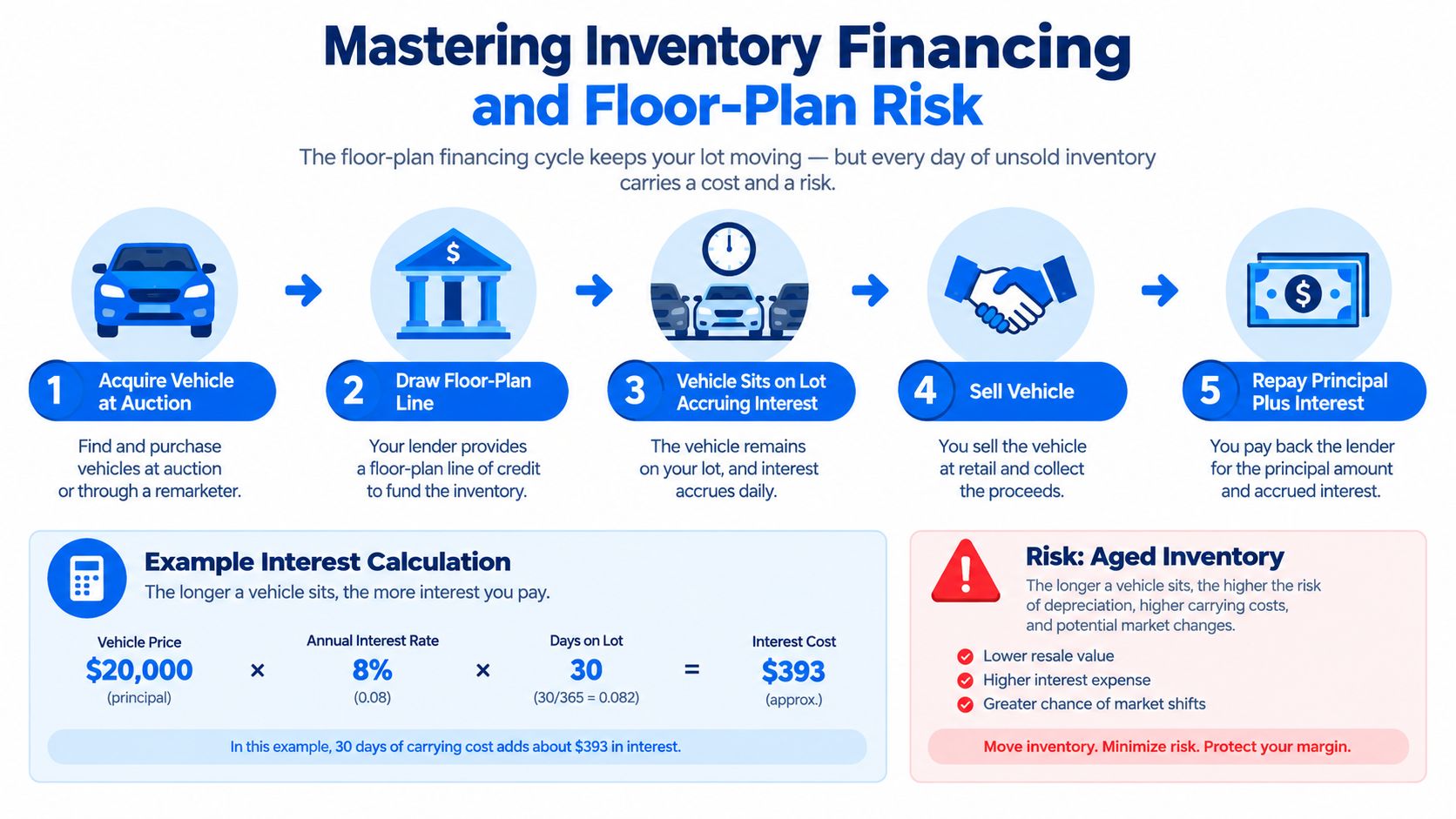
Dealers often use floor-plan financing, borrowing against inventory and paying interest while vehicles remain unsold. That structure makes inventory control a core ownership skill. Unit sales alone cannot show whether the business is healthy.
According to BCG's analysis of U.S. auto dealer profitability and inventory pressures, average days to sell a vehicle rose from about 30 in early 2023 to nearly 60 in 2024. At 60 days to sell, a floor-planned unit can accrue more interest than the margin you planned to keep, so pricing discipline has to start on day 30, not day 60.
The same analysis reported that in Q2 2025, average dealership revenue reached about $22 million, with average gross profit around $2,128 per new vehicle and $1,567 per used vehicle. Those figures do not protect a store when inventory slows and cash remains trapped in unsold units. Track carrying cost and aging alongside gross profit for every vehicle.
Aging inventory can choke a growing store
Aging units create four operating pressures:
- Interest keeps accruing: Every additional week increases the cost of holding a vehicle.
- Curtailments show up: Lenders may require periodic principal reductions on older units.
- Audits aren't optional: Floor-plan lenders check whether financed vehicles are present and properly accounted for.
- Discounting eats gross: As a unit ages, preserving speed often requires sacrificing margin.
Use managing dealership cash flow as a practical reference for treating floor-plan financing as an operating discipline, not merely a lending product. Set age-based actions before buying inventory. Review pricing, recon status, title progress, and lender obligations on a fixed schedule.
Don't buy inventory to look established. Buy inventory you can turn, title, recon, and finance without strain.
New and used inventory create different problems
Franchised and independent dealers face different inventory risks. A franchised store may receive new vehicles, factory programs, parts support, and warranty work, but it also carries manufacturer requirements and exposure to new-vehicle allocation decisions. An independent dealer has more sourcing freedom and must control used-car acquisition, recon consistency, pricing, and title execution without factory support.
Cox Automotive's Q3 2024 dealer sentiment release reported a profitability index of 34, down from 40 a year earlier and below 60 in Q3 2021, while the cost index reached a record 77. The release also estimated about 37.4 million used-vehicle sales in 2024, including 19.9 million retail sales.
Demand does not rescue a badly structured store. Build a cash model that tracks every unit by age bucket, expected turn time, recon stage, and lender obligation. If those fields are missing, management is guessing, not controlling risk.
Building Profitable Fixed Operations and Unit Economics
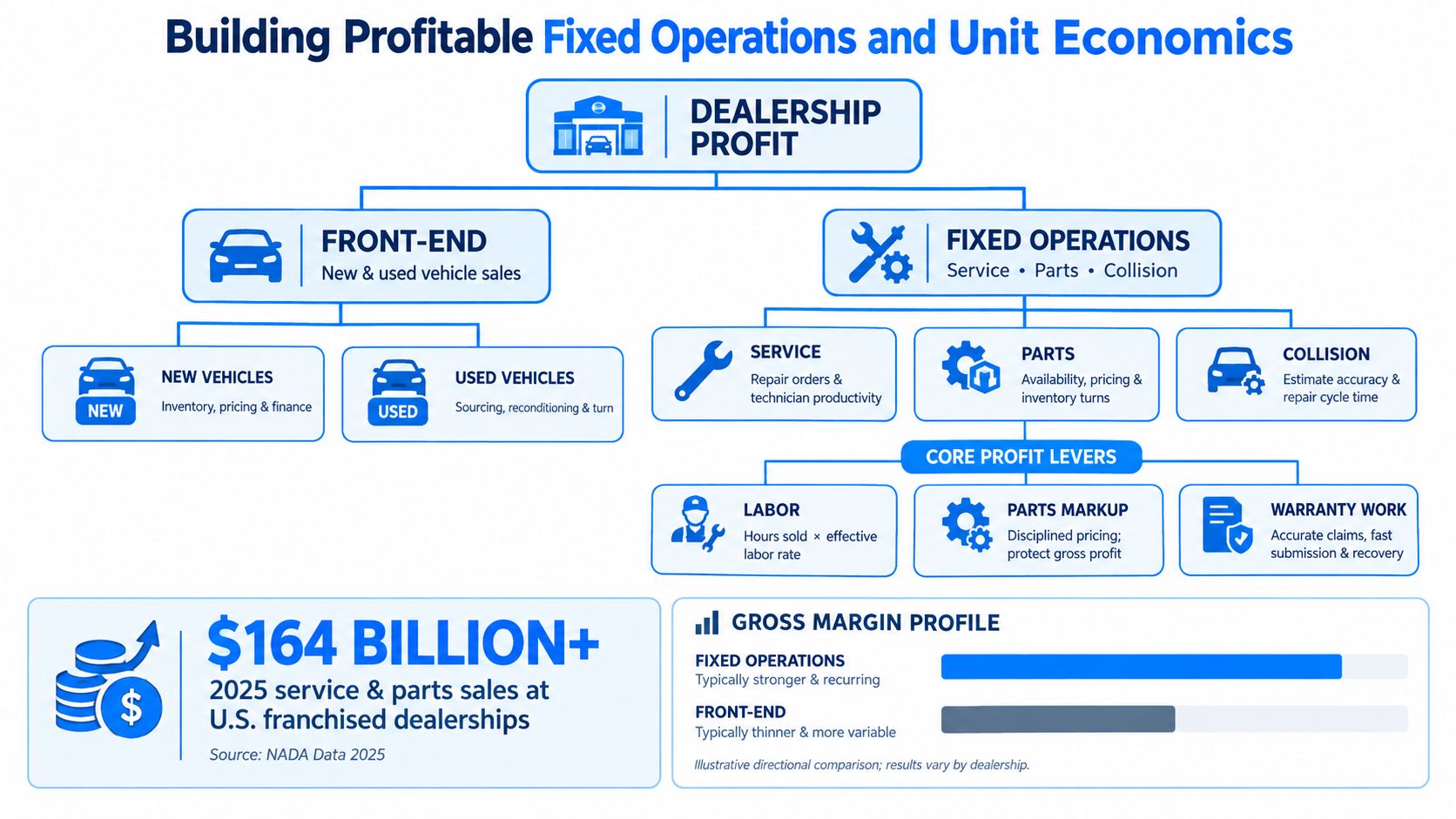
Fixed operations determine whether a dealership can withstand tighter front-end margins. A store built around vehicle gross alone starts with a fragile cash-flow model.
Weak operators often know how to desk deals and advertise price. They still struggle to produce stable earnings because service is underbuilt, parts are ignored, and the shop is treated as a secondary department. Service carries the store when front-end margins tighten.
According to NADA and Cox fixed-operations benchmarks summarized here, U.S. franchised dealerships generated more than $164 billion in service and parts sales from over 276 million repair orders in 2025. The same source reported that 58% of high-performing dealers described service profits as strong, compared with 28% of other dealers. It also cited fixed operations as producing 53.8% of total dealership gross profit and average F&I income of about $1,727 per retail vehicle.
Resilience lives in the service drive, technician productivity, parts fill, and customer retention. Monthly unit volume is a weak vanity metric if the store cannot convert service demand into completed work and repeat business.
Underwrite each department separately
A usable dealership model separates the store into departments:
| Department | What to track |
|---|---|
| Front-end vehicle sales | Unit volume, gross per unit, aging, pricing discipline |
| F&I | Product penetration, income per retail unit, lender mix |
| Service labor | Effective labor rate, hours sold, bay utilization |
| Parts | Availability, gross contribution, fill rate |
| Overhead | Payroll, occupancy, advertising, compliance, interest |
Departmental accounting exposes problems that a strong used-vehicle month can conceal. Track each area independently, then connect the results to total cash flow.
From the first month, monitor:
- Inventory turn: How quickly stocked units convert into cash.
- Recon days: How long acquired vehicles take to become sale-ready.
- Appointment-to-repair-order conversion: Whether service appointments produce completed work.
- Technician hours sold: A direct measure of shop output.
- Service absorption: Whether fixed-operations gross profit covers total fixed costs.
The same benchmark set treats service absorption above 100% as a resilience target. Use that standard to test whether the store can carry its fixed expenses through a weaker sales cycle.
This video gives useful context on dealership economics and operations before you commit capital.
Marketing should support the right economics
Startup dealers often spend heavily on vehicle advertising while underfunding service retention. That allocation leaves profitable repeat business undeveloped. Service customers stabilize the store and create future vehicle opportunities.
Local acquisition for service and repair traffic should support appointment flow into the department that can carry the business through tighter front-end margins. A focused auto repair marketing strategy can help direct demand toward that operating base.
A store that repairs vehicles well can survive a rough sales market. A store that only sells cars is exposed much sooner.
Comparing Franchise and Independent Dealership Models
The model you choose determines your capital burden, operating complexity, and margin profile. It also determines how much inventory risk you carry and how quickly fixed operations must become productive. Treat the choice as an operating decision, not a branding exercise.
I have seen buyers choose a franchise for its prestige, then stall under facility standards, manufacturer obligations, and working-capital demands. I have also seen independent operators underestimate the cost of inconsistent inventory, weak reconditioning, and poor title controls. Neither model protects an owner from weak cash management.
What each path really requires
| Requirement | Franchised Dealership | Independent Dealership |
|---|---|---|
| Manufacturer relationship | Required. Operates under a franchise agreement with brand standards and performance obligations | Not required |
| Vehicle mix | New vehicles plus used vehicles, depending on operations | Used vehicles and possibly multiple brands |
| Facility demands | Typically substantial real estate, showroom and service facilities | Compliant lot, office, and display area |
| Inventory funding | Required for new and used stock | Required for used stock |
| Service operation | Usually expected and strategically important | May be smaller, outsourced, or built gradually |
| Compliance burden | State dealer rules plus manufacturer requirements | State dealer rules, title and disclosure discipline |
| Sourcing | Factory allocation plus used acquisition | Auctions, trade-ins, wholesalers, direct purchase |
| Flexibility | Lower. More standards to follow | Higher. More freedom, less manufacturer support |
A franchised store usually needs greater infrastructure from the start. It gains access to new vehicles, factory programs, brand recognition, parts, and warranty work. Those advantages come with facility requirements, performance obligations, and less control over how the business operates.
An independent store avoids the franchise agreement and can adjust its vehicle mix, sourcing, and pricing faster. It still needs a licensed site, accurate title and disclosure systems, inventory funding, staffing, reconditioning capacity, and consistent advertising. Lower entry requirements do not make poor controls affordable.
The cost structure should guide the decision. A franchise can support stronger brand demand, but its fixed commitments leave less room for a sales slowdown. An independent store can start with a narrower footprint, yet every aged unit, delayed title, and unfinished repair consumes cash directly. As shown in the Cox sentiment data cited earlier, cost pressure makes capitalization and inventory discipline more important than headline revenue potential.
A smaller independent store with disciplined buying and real service capacity beats a glamorous, underfunded franchise attempt.
A practical decision filter
Answer these questions before choosing:
- Can you fund inventory without relying on immediate turns?
- Can you staff compliance, reconditioning, and service support before opening?
- Can the business carry its fixed commitments through slower sales and rising costs?
- Do you want manufacturer oversight and support, or sourcing flexibility and direct control?
- Which model gives you enough cash for inventory aging, repairs, titles, and operating expenses?
If you prefer structured support, compare the obligations and benefits involved in buying a franchise instead of a business. Choose the model whose fixed costs and inventory exposure you can fund, not the one that looks more impressive from the road.
Creating a Launch Roadmap and Measuring Resilience
A real launch plan starts with the premises and ends with repeatable operating control. Anything else is theater.
Build in the right sequence
Use this order:
- Confirm zoning and form the entity: Don't spend on branding or inventory first.
- Secure the site and compliance package: Lease terms, bond, insurance, licensing file, inspection prep.
- Set up inventory funding and recon workflow: Know how units will be bought, transported, repaired, titled, and aged.
- Staff the store before opening: Salespeople alone won't save you. You need service capacity, title discipline, and management oversight.
- Open with reporting by department: Watch unit economics weekly, not just sales count.
If you're drafting the operating model, this guide to a used car dealership business plan is a practical companion because it forces you to think through costs, market fit, and go-to-market decisions together.
Measure resilience, not vanity
Founders love vanity metrics. Website traffic. Lead count. Unit count. Gross sales.
I care more about whether your store can take a punch.
Track whether inventory is aging too long, whether recon is backing up, whether service appointments turn into repair orders, and whether fixed operations are covering fixed costs. Watch for the common mistakes called out across the sources above: overbuying slow inventory, undercapitalizing floorplan interest and reconditioning, and opening without enough licensed technicians or service bays.
You do not own a car dealership in any meaningful sense just because the LLC exists and the sign is up. You own one when licensing, financing, premises, staffing, inventory control, service throughput, and compliance work together every day.
That is the standard.
If you're launching or growing a dealership, benjiads can help you build the demand side without cobbling together separate ad, landing page, tracking, and follow-up tools. Visit benjiads if you want a practical system for local paid acquisition and SMS lead follow-up that fits an operator who cares about measured results, not vanity traffic.
- car dealership
- auto dealer license
- dealership business plan
- floorplan financing
- used car dealership
Done for you
Ads that text you customers.
- ✓ Ads created for you
- ✓ Every lead texts your phone
- ✓ Free to use, no credit card
748+ local businesses run ads with benjiads