home service companies 16 min read
Home Service Companies: A Complete Marketing Guide
Learn how home service companies acquire customers, overcome marketing challenges, and win leads using modern digital strategies that drive growth.
On this page
- Why Home Service Companies Are Winning Big in 2026
- The Four Types of Home Service Companies
- The Three Marketing Challenges That Kill Home Service Businesses
- Speed to Lead Is the Single Biggest Revenue Lever
- DIY Marketing vs Agencies vs Automated Platforms
- How to Build a Profitable Acquisition System
- The Review Revenue Multiplier Most Owners Miss
- Your Next Move as a Home Service Business Owner
A lead that arrives after hours can be worth just as much as one received during the day, yet 41% of booked online home service jobs can arrive outside normal operating hours according to Housecall Pro's home service industry trends research. If nobody answers the phone, replies to the form, or follows up by text, your advertising hasn't failed. Your response system has.
That distinction matters because home service companies rarely lose business only because competitors have better workmanship. They lose it because another contractor responds first, answers the call, explains the next step clearly, or stays in contact after the initial inquiry. Marketing creates the opportunity. Speed, trust, and disciplined follow-up turn it into booked work.
Why Home Service Companies Are Winning Big in 2026
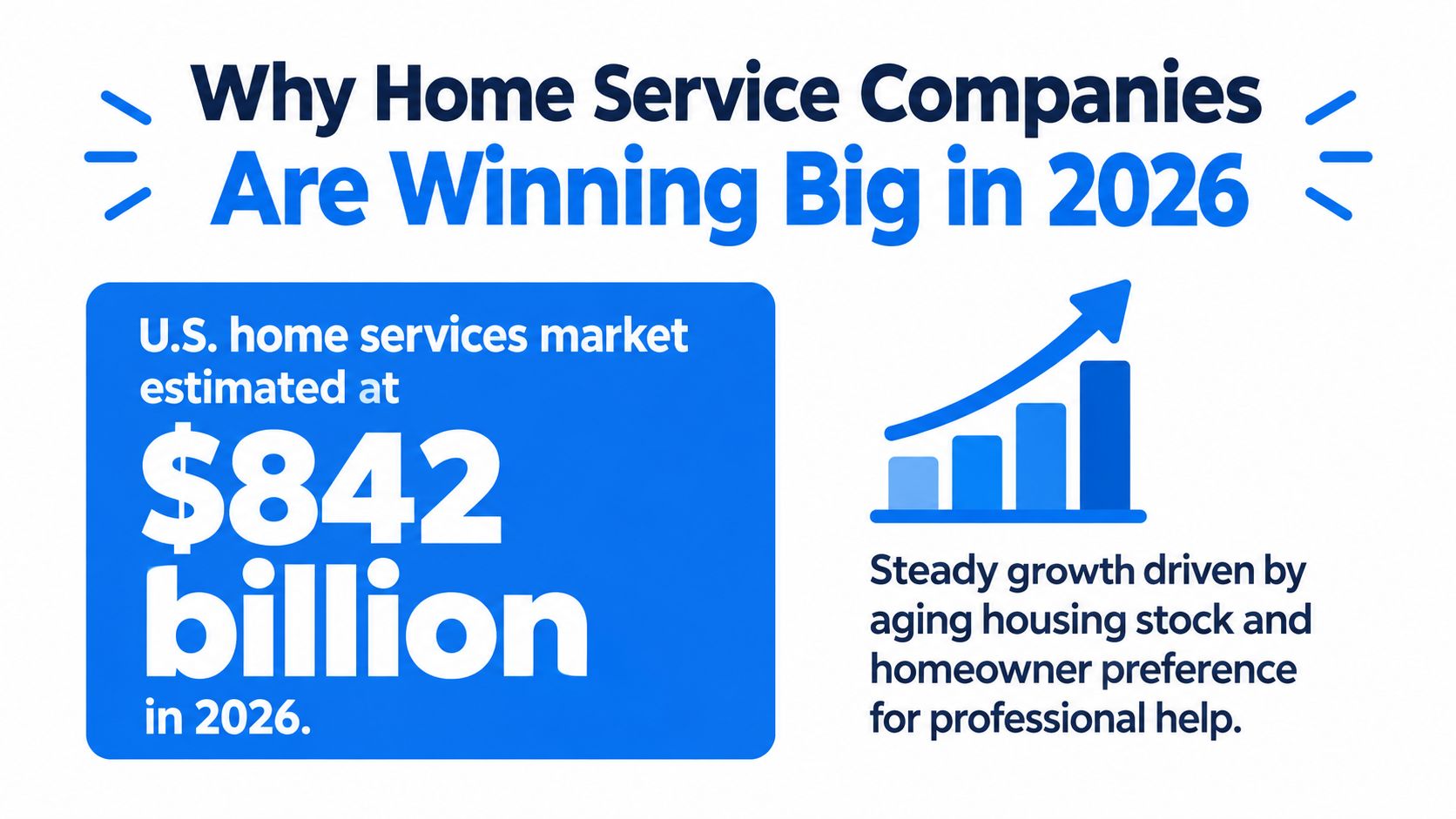
The U.S. home services market is estimated at $842.04 billion in 2026 and projected to reach $989.22 billion by 2031, implying a 3.27% CAGR over that period, according to Mordor Intelligence's U.S. home service market analysis. That scale matters because it covers electricians, plumbers, HVAC contractors, cleaners, outdoor maintenance specialists, roofers, handymen, and the many businesses that solve problems homeowners cannot, or do not want to, handle themselves.
Demand is broad, but it isn't identical
Maintenance and repair represented 37.82% of U.S. home services market share in 2025, while family owner-occupied properties represented 76.35% of the market, according to the same Mordor Intelligence analysis. The practical takeaway is simple. A large share of demand comes from ordinary residential upkeep, not just major remodels or high-end projects.
The market still works through familiar channels. Offline and traditional booking channels accounted for 65.13% of market size in 2025, which means many customers still choose providers through phone calls, referrals, neighborhood recommendations, and local brands they already know. Digital acquisition does not replace that behavior overnight. It gives a company another way to get into the shortlist before the homeowner asks a neighbor.
McKinsey's market history, summarized in this home services market report, describes a category that behaves differently by service type. Frequent optional services, including pest control, cleaning, landscaping, lawn care, and pet services, grew by more than 5% per year between 2019 and 2023, while HVAC, painting, and roofing grew by 3% to 5% per year during that period. Those differences affect how you spend, when you follow up, and what kind of offer you make first.
For a broader look at how local businesses build demand, see this small business lead generation guide.
Practical rule: Don't market every home service company as if it sells the same product. Emergency plumbing, recurring lawn care, and replacement HVAC need different promises, response times, and follow-up.
A plumbing business can win on immediate availability. A yard care professional may win through seasonal reminders and recurring agreements. An HVAC contractor may need education, financing conversations, and trust signals before the homeowner is ready to buy. The opportunity is large, but profit comes from matching the message and response process to the job.
The Four Types of Home Service Companies
A solo electrician, a 24-hour plumbing operation, a landscaping company with annual contracts, and a house-cleaning franchise all sit under the same broad label. Their customers behave differently, their capacity constraints differ, and a campaign that works for one can waste money for another.

The local specialist
Consider a one-truck electrician handling panel repairs, lighting work, EV charger installations, and smaller service calls. The owner may know the trade inside and out but have limited time for marketing, dispatch, and callbacks. A short, location-specific campaign can work well, but only if the owner can pause work long enough to answer or return inquiries.
For this model, broad awareness is less useful than clear intent. The landing page should state the service area, common jobs, qualifications, and the next step. A form that asks too many questions can lose a customer who just needs to know whether someone is available.
The emergency operator
A plumbing company offering 24/7 response sells availability as much as technical skill. A burst pipe customer isn't comparing long-form educational content at leisure. They want a credible provider who answers quickly, confirms the service area, and gives them a clear expectation for arrival and pricing discussion.
That company needs a phone process built around urgency. Calls should route to someone trained to identify the problem, location, safety concern, and scheduling need. Missed calls require immediate recovery, not a callback whenever the owner finishes the current job.
The recurring service business
Landscaping and cleaning companies often have a different economic engine. An annual landscaping contract or a cleaning subscription can create predictable work, but the sale may involve timing, household preferences, property details, and service frequency.
A house-cleaning franchise, for example, can use a landing page to collect home size, preferred schedule, and service type. A landscaping company may use seasonal creative and follow-up reminders to turn a one-time inquiry into a maintenance relationship. Their marketing should emphasize consistency and convenience, not only emergency availability.
| Business model | Customer expectation | Marketing emphasis |
|---|---|---|
| Local specialist | Skilled help for a defined job | Service clarity, local proof, easy booking |
| Emergency operator | Immediate human response | Phone coverage, availability, rapid qualification |
| Recurring service business | Reliable ongoing service | Plans, scheduling, retention, repeat contact |
| Multi-truck operator | Capacity and dependable dispatch | Coverage area, operational credibility, consistent lead handling |
The key question isn't which model is superior. It's whether your marketing promise matches the way your team delivers work. A campaign that generates demand for a solo operator can become a liability if the phone rings while the owner is under a sink and nobody else can respond.
The Three Marketing Challenges That Kill Home Service Businesses
Most home service companies don't have a lead problem in isolation. They have a conversion and operating problem that becomes visible through marketing. More inquiries expose weak response systems, unclear ownership, and poor measurement.
Chasing volume instead of velocity
Owners often celebrate lead volume before checking whether anybody contacted those prospects. That reverses the order of importance. A smaller number of inquiries handled immediately can produce more booked work than a larger number left in a shared inbox.
The reason is straightforward. Homeowners can contact several providers with little effort, especially for urgent repairs. If your company waits, another contractor gets the conversation, establishes trust, and fills the appointment slot.
The speed-to-lead benchmark from PipelineON reports an average contractor conversion rate of 28% at an average response time of 42 minutes. The same benchmark reports 62% conversion when teams respond within 2 minutes, and says a response within 5 minutes makes teams 21 times more likely to qualify a lead than waiting 30 minutes. These figures don't mean every business will reproduce the same result. They do show why response time deserves a place in the revenue plan, not only the customer-service checklist.
Treating referrals as the whole strategy
Referrals are valuable, but they aren't a complete acquisition system. A referral channel depends on previous customers remembering your company, encountering someone with the right need, and choosing to recommend you at the right moment.
That makes referrals a channel to strengthen, not a reason to avoid active acquisition. A business can ask satisfied customers for reviews, build relationships with property managers, and advertise its highest-margin services while still benefiting from word of mouth. The mistake is assuming referrals will provide consistent demand when the owner stops networking or the local market changes.
Buying tools without building attribution
A phone number, contact form, CRM, ad account, and scheduling system don't create attribution by themselves. Someone has to define what counts as a qualified lead, record the outcome, and connect the initial inquiry to the booked job.
Without that discipline, owners compare raw clicks or calls and call the highest number the winner. That can send budget toward cheap inquiries that never become appointments. Track at least the source, service requested, contact status, qualification result, appointment status, and revenue outcome. The system doesn't need to be complicated. It needs to reflect what happened after the lead arrived.
Speed to Lead Is the Single Biggest Revenue Lever
The first job of a lead system is not to collect contact details. It's to create a fast path to a real conversation.
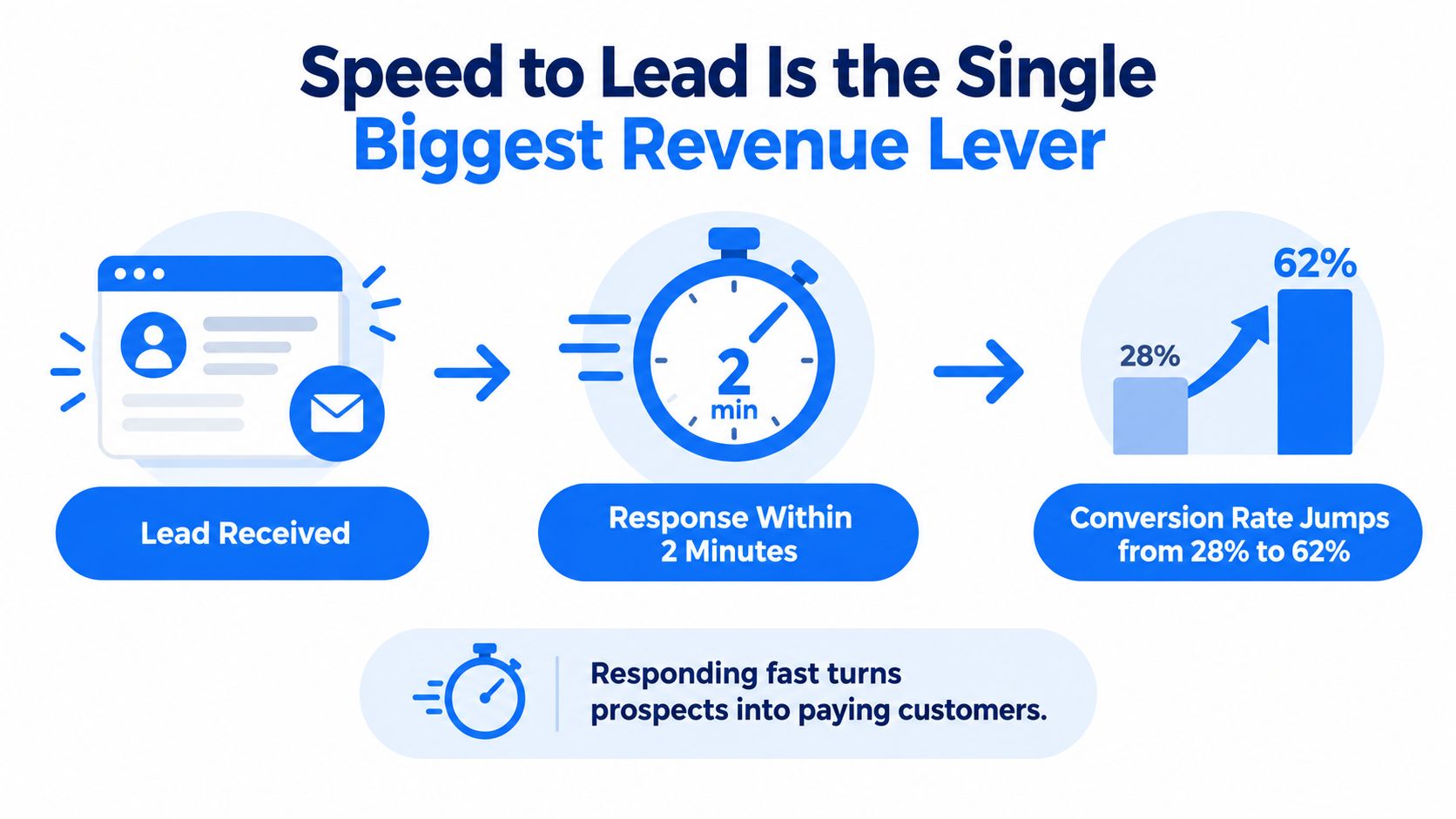
The benchmark already cited shows the difference between a 28% average contractor conversion rate and 62% when responding within 2 minutes. The important lesson isn't that two minutes is a magical threshold for every trade. It's that a prospect's willingness to engage declines while competitors continue calling, texting, and answering.
Why delay changes the economics
A lead arrives with a temporary concentration of intent. The homeowner has identified a problem and is willing to take action. Each unanswered call or delayed form response gives that intent time to disperse.
Two forces drive the decline:
- Competitive displacement: another provider reaches the homeowner first and becomes the active option.
- Contact probability decay: the prospect becomes harder to reach as they get busy, solve the issue elsewhere, or stop answering unfamiliar numbers.
That makes a two-minute service-level agreement more valuable than another round of ad-copy revisions once lead volume is already sufficient. Better creative can improve the quality of incoming demand. It can't recover every prospect who has already hired someone else.
Watch the practical mechanics in this short video before changing your workflow.
Build a response process that survives the workday
Start with ownership. Decide who answers during business hours, who covers evenings, and what happens when the primary person is on a job. Then define the first response for every channel:
- Phone: Answer live whenever possible, identify the service need, confirm location, and set the next appointment step.
- Web form: Send an immediate confirmation, then assign a person to call or text.
- Text inquiry: Use a short qualification sequence, but move to a human conversation when the customer asks a detailed question.
- Missed call: Return it promptly and record the outcome, including no answer, wrong service area, booked appointment, or follow-up required.
Call quality determines what happens after pickup. A 2026 home services benchmark from Invoca reports that 38% of calls answered by a person are qualified leads, and 45% of those leads convert on the call. That makes call handling a revenue gate. A rushed greeting, no service-area check, or failure to ask for the appointment can waste a high-intent opportunity even when the phone was answered.
This guide to speed-to-lead systems is useful for turning the principle into an operational checklist. The technology matters, but ownership and disposition codes matter just as much. If nobody knows what happened to an inquiry, you can't improve the process.
DIY Marketing vs Agencies vs Automated Platforms
The right choice depends on who can protect marketing time without slowing sales or operations. A capable owner can run campaigns, but the work competes with answering calls, dispatching technicians, ordering materials, and supervising jobs. That trade-off becomes expensive when a missed call or delayed response sends a ready-to-book customer to another company.
Three paths with different trade-offs
DIY marketing offers the most control and the lowest direct management expense. It also requires the owner to learn ad setup, creative testing, landing pages, tracking, and follow-up. DIY campaigns often break through disconnected tools. An ad lives in one system, a form in another, calls somewhere else, and booked revenue never connects the pieces. The result is activity without a reliable view of which leads produce work.
An agency supplies outside expertise and removes much of the daily campaign workload. The trade-off includes management cost, communication delays, and the risk that an account manager misunderstands the service area, margins, dispatch limits, or seasonal demand. An agency can execute an unsuitable strategy efficiently if the owner has not defined which jobs qualify.
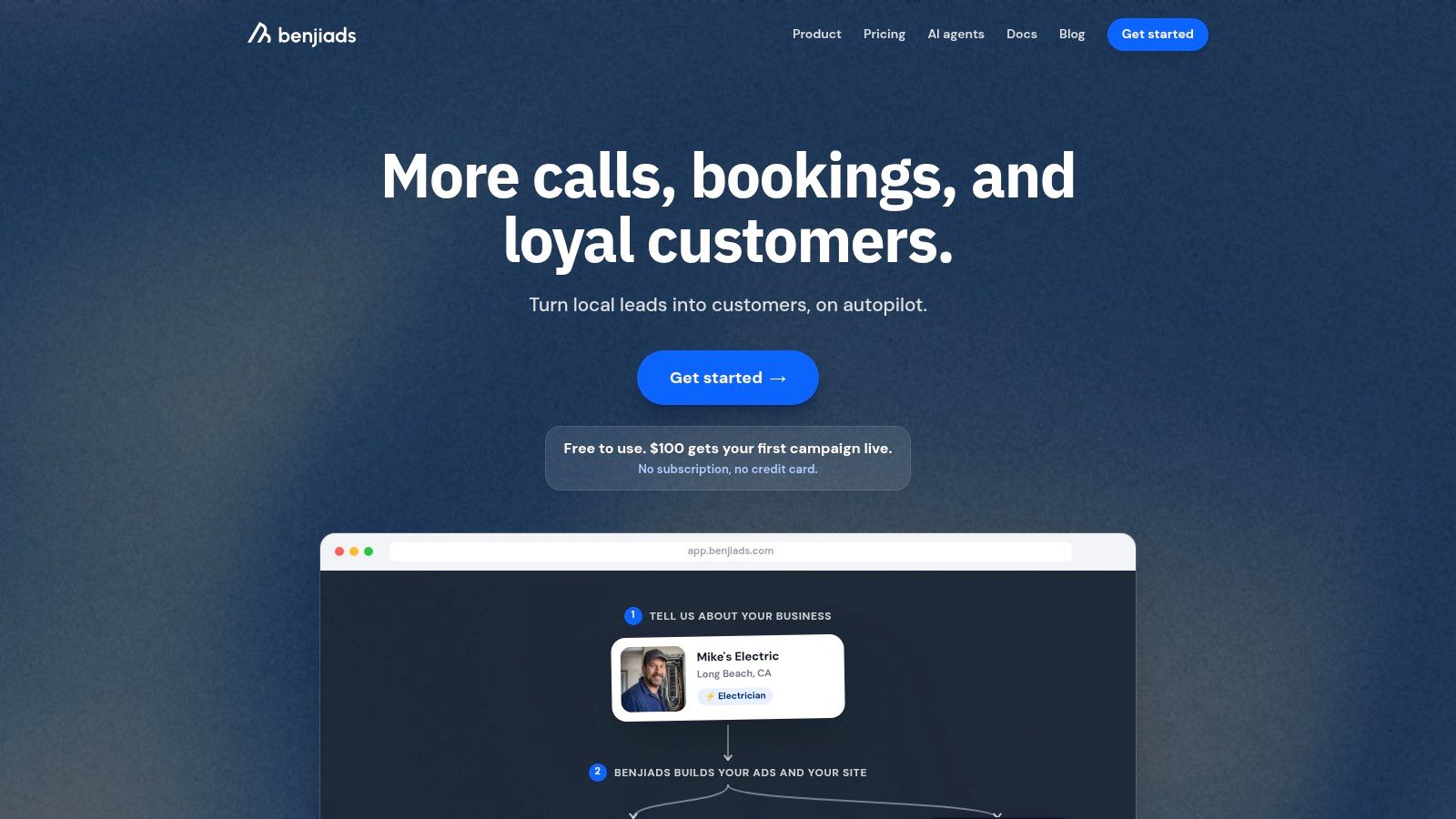
An automated platform handles recurring campaign tasks while leaving business decisions with the owner. BenjiAds provides automated ad creative generation, prebuilt Facebook and Instagram campaign structures, hosted landing pages on trade-branded subdomains, SMS lead intake with follow-up sequences, daily reporting, dual conversion tracking, and an approval workflow that keeps ads paused until approval. Its published pricing uses a flat 20% management fee on ad spend with no subscription, and the platform reports an average cost per phone-verified lead of around $7 across local campaigns, with results varying by trade and market, as described on the BenjiAds pricing and platform overview.
DIY
- Setup time
- Owner-led and dependent on learning curve
- Monthly cost
- Tools and ad spend selected by the owner
- Control level
- Highest hands-on control
- Best for
- Operators with time and patience
Agency
- Setup time
- Outsourced onboarding and implementation
- Monthly cost
- Retainer structure varies by agency
- Control level
- Shared control
- Best for
- Businesses wanting managed execution
Automated platform
- Setup time
- Guided setup with prebuilt components
- Monthly cost
- No subscription, plus the stated management fee on ad spend
- Control level
- Approval-based control
- Best for
- Owners needing execution without a full marketing team
Automation does not replace judgment. The owner still approves the offer, defines service areas, answers calls, prices work properly, and decides which jobs fit current capacity. Its value is reducing repetitive campaign administration, so lead capture, follow-up, and reporting stay connected while the owner focuses on fulfillment.
For a practical explanation of that middle option, this guide to automated marketing platforms covers how campaign setup, landing pages, tracking, and follow-up can work together.
How to Build a Profitable Acquisition System
A profitable acquisition system has four connected parts. If one part is missing, the others become harder to evaluate.
1. Choose one primary channel
Start with the way customers already buy your service. Emergency plumbing and urgent HVAC repair usually need strong phone coverage and fast response. Recurring cleaning or landscaping can use lead forms, scheduled consultations, and follow-up that explains service plans.
Don't spread a small budget across every platform because competitors appear everywhere. Pick the channel where you can respond and fulfill the resulting work. Expand only after you understand lead quality and operational capacity.
2. Create a capture path that qualifies
A landing page should answer the questions that block action: what you do, where you work, what type of problem you handle, and what the customer should do next. Keep the form focused on useful details such as service type, location, urgency, and contact preference.
The page and phone number must be tracked together. Otherwise, you may see calls and forms as separate campaigns even though they came from the same customer journey.
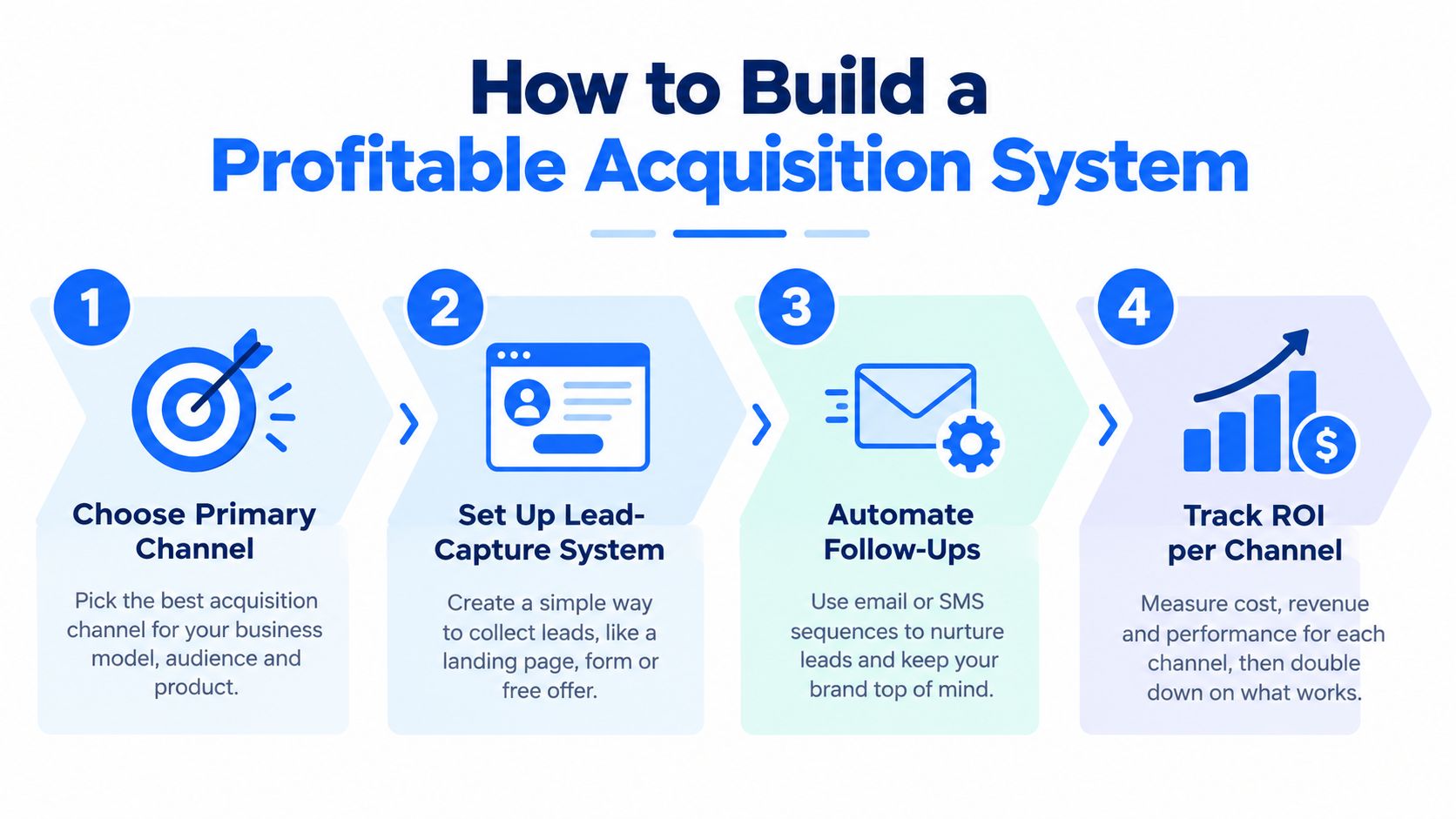
3. Automate the first follow-up
Automation should acknowledge the inquiry, confirm that someone is reviewing it, and make it easy to continue the conversation. It shouldn't pretend to be a technician or make promises your team can't keep.
Use a short SMS sequence for unanswered inquiries, appointment reminders, and requests for missing details. Stop the automated sequence when a person replies or the lead is marked closed. Good automation protects the handoff. Bad automation creates another obstacle.
4. Measure qualified outcomes
Cost per click is a campaign diagnostic, not a business result. Track cost per qualified lead, booked appointments, completed jobs, average job value, and revenue by channel. Record why a lead was disqualified so you can improve targeting instead of merely accepting lower volume.
A simple weekly review should answer:
- What produced qualified work: Which campaign and service generated viable opportunities?
- Where leads stalled: Did the failure happen at response, qualification, scheduling, estimate, or close?
- What the team can fulfill: Can technicians handle more of the advertised service without damaging response quality?
The Review Revenue Multiplier Most Owners Miss
Reviews are often treated as a public-relations chore handled after the main marketing work. That view misses the moment when a prospect compares two similar providers and looks for evidence that either one can be trusted.
Research summarized in ReviewWheel's 2026 home service review report found that reviews grew 24.5% in a single year, 43.7% of customers asked left a review, and replying to at least one in four reviews was associated with 35% more revenue. The association doesn't prove that replying alone caused the revenue difference. It does show that review activity and business performance belong in the same conversation.
Build reviews into the job workflow
Ask after a successful service moment, not randomly. The office can send a review request after payment, a scheduler can follow up after a completed appointment, and a technician can remind a satisfied customer before leaving. Make the request specific and easy to complete.
Respond to negative reviews without arguing about facts in public. Acknowledge the concern, move the conversation to a private channel, and document the resolution internally. For positive reviews, a brief, human response reinforces that a real team is paying attention.
More leads won't solve a trust problem. A prospect who sees unanswered complaints or an old, thin review profile may never call, regardless of how well the ad is written. Review management strengthens the conversion path after acquisition has done its job.
Your Next Move as a Home Service Business Owner
Start with the leak closest to revenue. If calls and forms go unanswered, improve coverage before increasing ad spend. If your team responds quickly but receives poor-fit inquiries, revise the offer, targeting, or qualification questions. If leads become appointments but jobs don't close, inspect pricing communication, estimates, and follow-up.
Your decision path can stay simple:
- You have time but little budget: Choose one channel, create a focused offer, and personally master rapid response and follow-up.
- You have budget and want hands-off management: Evaluate an agency, but require clear reporting on qualified leads, appointments, and revenue.
- You need execution without adding a full marketing team: Consider an automated platform that connects campaigns, landing pages, tracking, and follow-up under an approval-based workflow.
- Your work is good but trust is weak: Build review requests and thoughtful responses into every completed job.
The three fundamentals are hard to avoid. Respond before competitors do. Match the marketing path to your actual capacity. Treat reviews as part of revenue generation, not decoration. Home service companies that fix those basics usually get more value from every future campaign and every future customer conversation.
If missed calls and delayed follow-up are limiting your growth, visit benjiads to see how its automated ads, landing pages, SMS lead intake, tracking, and approval workflow can support your acquisition process. Use the platform to prepare a connected campaign system, then keep control over when your ads go live and how your team handles the resulting leads.
- home service companies
- home services marketing
- local service businesses
- service company growth
- digital marketing for contractors
Done for you
Ads that text you customers.
- ✓ Ads created for you
- ✓ Every lead texts your phone
- ✓ Free to use, no credit card
748+ local businesses run ads with benjiads