commercial cleaning 12 min read
How to Get Commercial Cleaning Leads: A Practical Guide
Learn how to get commercial cleaning leads fast. Explore proven tactics from local SEO and Google Ads to SMS follow-up and strategic partnerships.
On this page
18% of smartphone searches with local intent lead to a purchase within one day, compared with 7% of non-local searches, so the commercial cleaning lead you answer first can be worth more than the lead source itself. Respond immediately, qualify the building and contract fit, then make the next step a walkthrough or quote.
Most advice on how to get commercial cleaning leads starts with a list of channels: Google Business Profile, referrals, cold email, paid ads, and social media. Those channels matter, but they don't solve the problem I see most often in the field. A cleaner pays for attention, receives an inquiry, and lets it sit until the estimator is available tomorrow.
That isn't lead generation. It's lead leakage.
Facility managers, office administrators, property managers, and business owners often contact several vendors while a need is active. They want to know whether you cover their area, understand their building type, carry the required insurance, and can provide a credible plan. Your funnel must answer those questions quickly, then put a real person in front of the prospect while the request is still fresh.
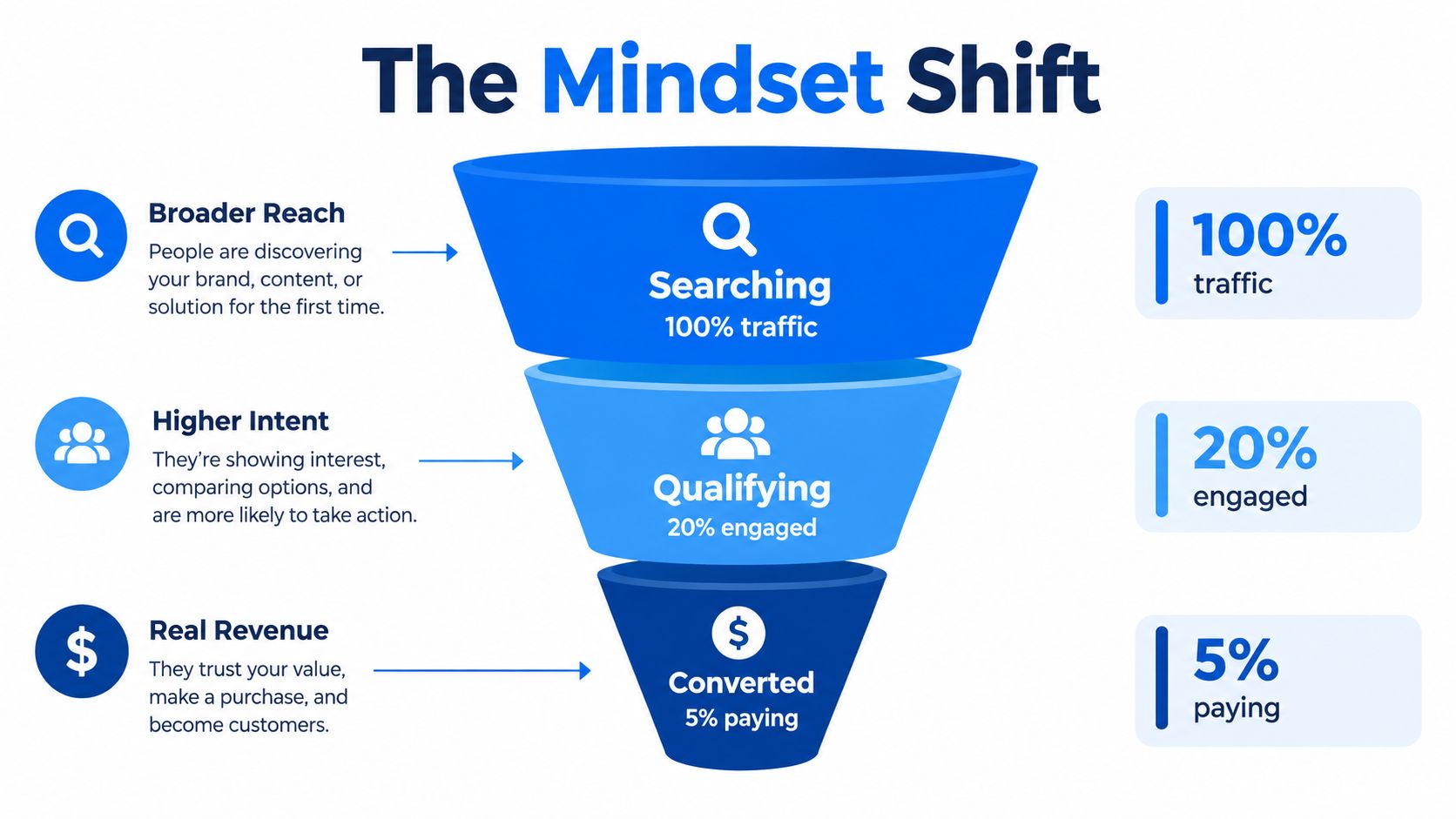
The Mindset Shift From Searching to Qualifying
A name, phone number, and email address aren't yet a commercial opportunity. A useful lead has a service need, a building that fits your operating model, a realistic start date, and access to someone who can approve or influence the contract.
That distinction changes how you judge marketing. Raw form volume can look healthy while your team spends evenings chasing residential requests, tiny one-off jobs, or facilities that require compliance resources you don't have. A smaller pipeline of qualified walkthroughs can be more valuable than a crowded inbox.
Define the account before you buy traffic
Start by writing an ideal customer profile that your operations team can serve. Include:
- Facility type: Separate offices, medical facilities, industrial sites, schools, hospitality properties, and property managers.
- Service scope: Identify recurring janitorial work, floor care, deep cleaning, post-construction work, and specialist requirements.
- Geography: List the cities, neighborhoods, and travel limits that preserve margin.
- Contract fit: Record the minimum acceptable frequency, access conditions, staffing needs, and likely duration.
- Decision path: Find out whether the contact is the owner, facilities manager, property manager, office administrator, or another stakeholder.
A facilities manager requesting a recurring office program isn't equivalent to a homeowner seeking a move-out clean. Use separate campaigns, forms, and qualification language so the first conversation starts with the right expectations.
Ask questions that protect capacity
A commercial cleaning lead should provide enough information for a sensible next action. Ask for the company name, facility type, approximate square footage, location, cleaning frequency, access constraints, desired start date, current contract end date, and decision-maker status.
Large-contract procurement can also involve site audits, staffing and supervision records, safety documentation, chemical records, quality assurance, environmental reporting, audited accounts, and comparable references. If your company can't support those requirements, filtering earlier protects both sides from a wasted proposal.
Practical rule: Don't optimize for the cheapest lead. Optimize for the opportunity your crews can mobilize, service reliably, and retain profitably.
Mastering Local Search for Facility Managers
Commercial local search starts with a complete Google Business Profile, but completion alone won't distinguish a serious B2B cleaner from a residential operator. A facility manager needs immediate evidence that your company works in commercial environments and serves the relevant area.
Claim and verify the profile, then make the service category and description precise. Name the commercial services you provide, the locations you cover, and the building types you understand. Don't stuff the description with every nearby town. A narrow, accurate service area creates clearer expectations for both searchers and your dispatch team.
Build proof into the profile
Upload current photographs of uniformed teams, commercial equipment, floor-care work, supply rooms, and finished spaces where you have permission. Avoid generic stock photography. A property manager is assessing whether your business looks organized enough to enter a client building, manage keys, follow a schedule, and supervise staff.
Use the services area to separate offerings such as office cleaning, medical facility cleaning, industrial cleaning, carpet care, restroom programs, and post-construction cleanup. Add business hours that reflect when someone can answer, not only when crews are working. Keep the phone number, website, address or service-area details, and business name consistent across relevant directories.
Turn reviews into commercial evidence
Ask satisfied commercial clients for reviews that describe reliability, communication, scheduling, scope, and building type. Don't ask anyone to make claims they can't support. Respond to every review professionally, including criticism, and explain how your team handles service issues without revealing private client information.
Connect the profile to a website with dedicated pages for each important service area and vertical. A page titled “commercial office cleaning in [city]” should explain scope, coverage, proof of insurance, staffing and supervision, and the next step. It shouldn't send a facilities manager back to a generic homepage.
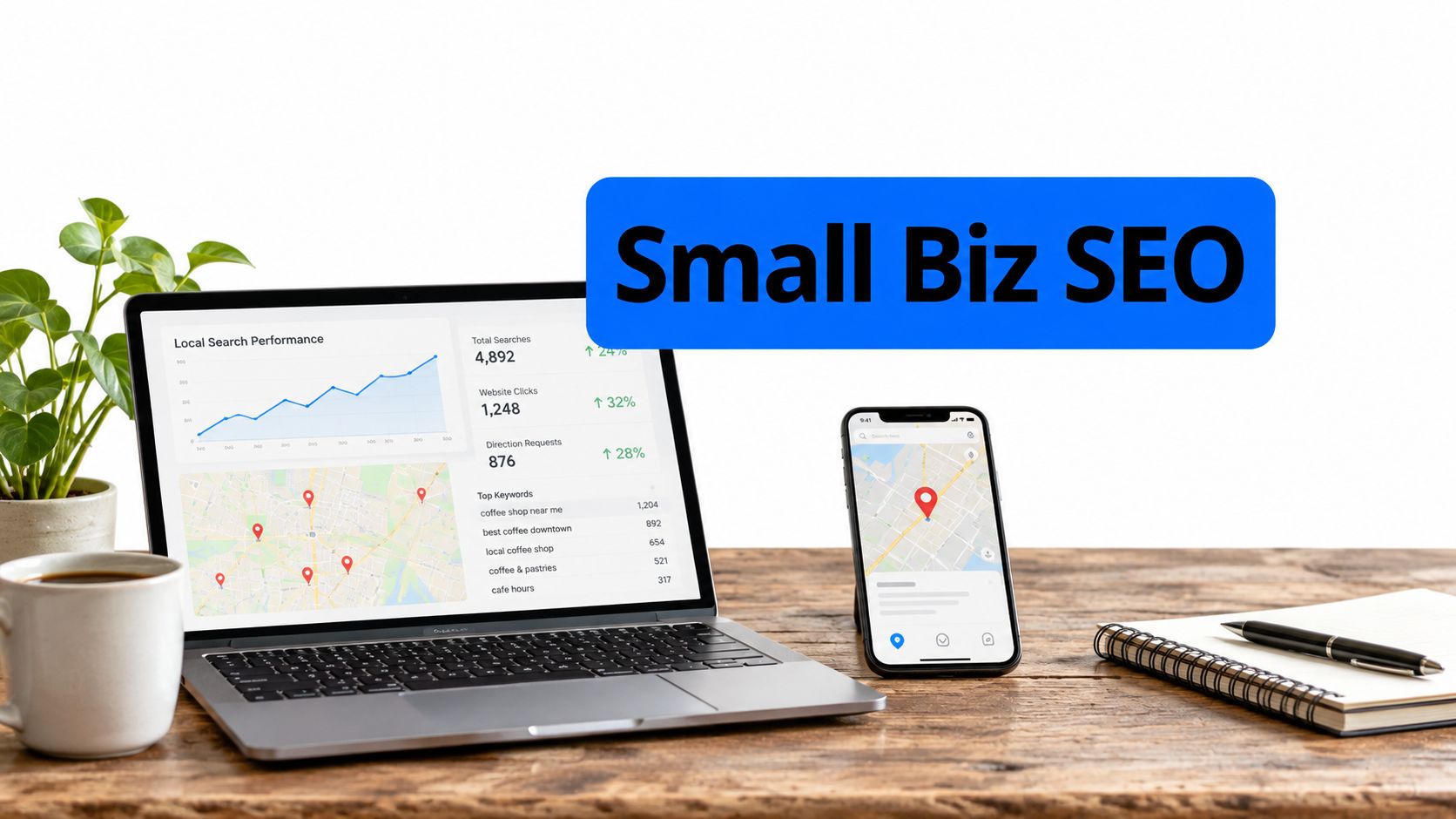
For a broader technical foundation, use this small business SEO guide to support local page structure, business information consistency, and search visibility.
Building a High-Converting Acquisition Funnel
A generic homepage forces every visitor to translate your business into their own situation. A segmented funnel does that work before the conversation. The page for a medical facility should speak to controlled procedures, documentation, and dependable scheduling. The page for an office should emphasize appearance, recurring service, communication, and minimal disruption.
Separate campaigns for offices, medical facilities, industrial sites, schools, and property managers. Use commercial-intent terms such as “commercial office cleaning,” “janitorial services,” and “medical cleaning company,” while excluding residential terms that consume budget and estimator time.
Design one page around one decision
Send each ad to a vertical-specific landing page with one primary action, such as requesting a site walkthrough or written quote. Put the service area, relevant credentials, insurance and bonding information, testimonials, service scope, and a short explanation of the process near the form.
Your form should qualify without becoming an interrogation. Ask for:
- Company and contact details.
- Facility type and location.
- Approximate square footage.
- Cleaning frequency and desired start date.
- Access or scheduling constraints.
- Specialist services or compliance requirements.
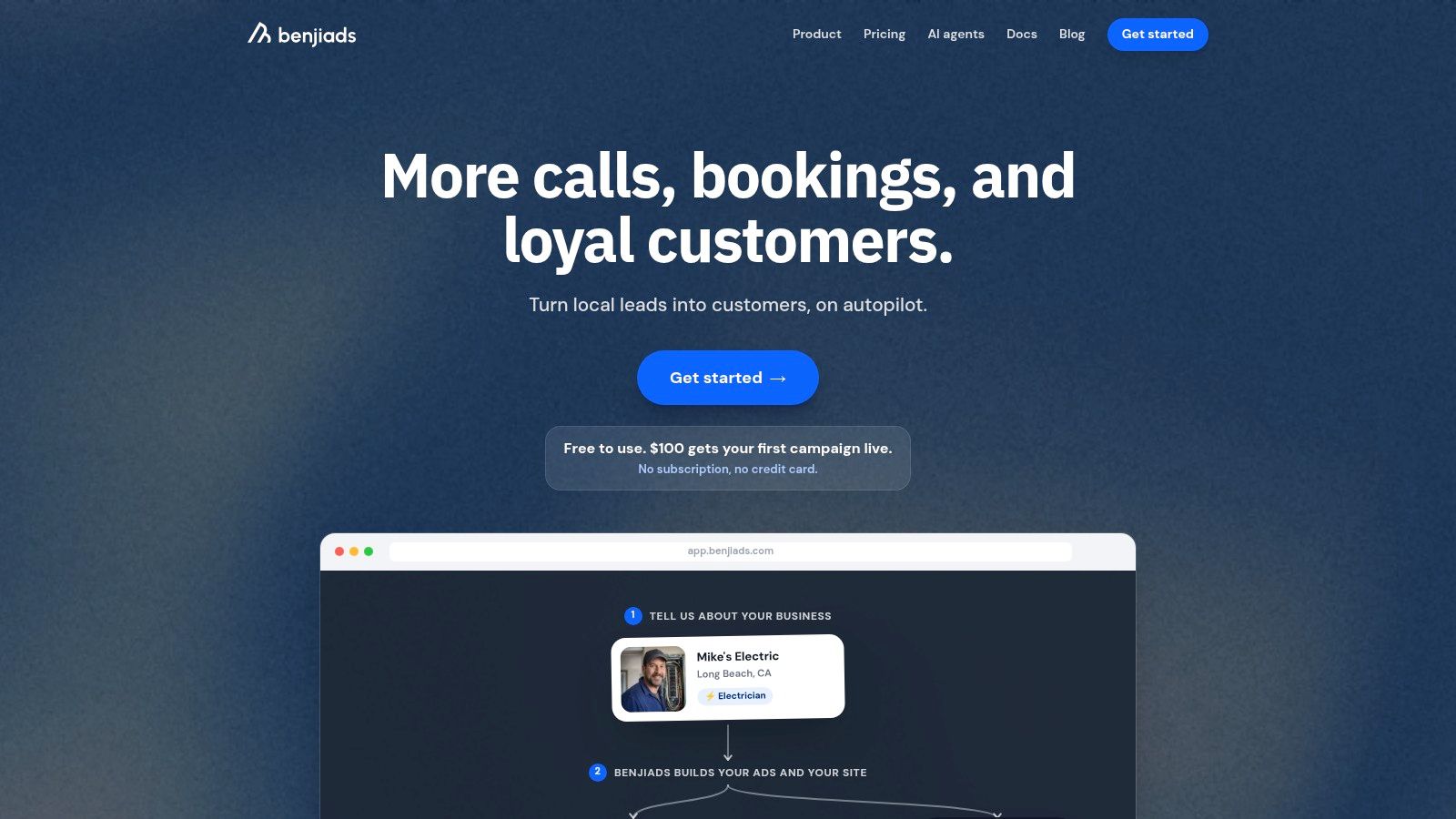
Among other advertising options, a tool such as benjiads can serve this purpose. Its platform prepares local ad creative, landing funnels, conversion tracking, and SMS-based lead follow-up, with campaigns held for business approval before they run.
Use benchmarks as planning assumptions
A published commercial-cleaning benchmark reports the following ranges for segmented campaigns and B2B landing pages:
| Metric | Benchmark |
|---|---|
| Google Ads cost per lead | Approximately $30 to $80 |
| Google Ads monthly leads | 15 to 40 |
| LinkedIn cost per lead | Approximately $40 to $100 |
The commercial cleaning benchmark also describes LinkedIn as better suited to facility-manager targeting and warns against judging performance by raw form volume. Calculate allowable CPL from contract gross margin and expected retention, then measure cost per qualified walkthrough and signed annual contract.
Implementing Instant SMS Response Systems
The form submission is the start of sales work, not the finish line. A Harvard Business Review audit of 2,241 U.S. companies found that only 37% responded within one hour, while 23% never responded. Companies that contacted a lead within one hour were nearly seven times more likely to have a meaningful conversation than companies that waited an additional hour, and waiting at least 24 hours made qualification roughly 60 times less likely. The audit findings and response analysis make the operating lesson clear: an inquiry needs an immediate acknowledgment and human ownership.
Make the first message useful
An automated text shouldn't say only, “Thanks, we'll be in touch.” Confirm the request, identify the company, verify the phone channel, and ask one easy question that moves qualification forward.
A practical sequence looks like this:
- Immediate acknowledgment: Confirm that the request arrived and state what happens next.
- Contact verification: Ask the prospect to confirm the best number for the estimator.
- Fit question: Request the facility type, location, or approximate size if the form missed it.
- Scheduling option: Offer a walkthrough time or a direct call during business hours.
- Human handoff: Stop automation when the prospect replies and assign the record to an owner or estimator.
The underlying response study analyzed more than 15,000 leads and over 100,000 call attempts across six companies. It found that successful-contact odds fell 100-fold when response occurred at 30 minutes rather than within five minutes, while qualification odds fell 21-fold. The response-speed research supports a simple standard: automate the first touch, but don't automate the relationship.
Protect trust and compliance
Use consent-based messaging, identify your company, and provide a clear way to stop texts. Automation should support a real call, not pretend to replace one for a complex facility. Keep a record of response time, message status, qualification outcome, walkthrough, proposal, and contract stage.
After a successful job or a positive inspection, the same communication discipline can help request feedback. A resource for teams that want to send review requests via text can support that process without mixing review collection into the initial sales sequence. For broader nurture logic, review this guide to lead nurturing automation.
Strategic Partnerships and Referral Networks
Paid search reaches buyers who are already looking. Partnerships reach people before they search, especially when a trusted property manager, contractor, or commercial real estate contact introduces your company.
The strongest partners already sit inside the building decisions you want to influence. Property management firms manage multiple sites and need dependable vendors. General contractors need post-construction cleaning. Commercial real estate agents need buildings prepared for occupancy or handover. Facility managers know when a provider is failing, a contract is ending, or a new site is opening.
Sell reliability, not a referral arrangement
A partner won't risk their reputation for a cleaner who misses shifts, arrives without supplies, or can't explain service failures. Give partners a compact proof pack that makes referring you easy:
- Service profile: The building types, locations, schedules, and specialist work you handle.
- Operational proof: Insurance, bonding, supervision approach, safety procedures, and quality checks.
- Response promise: Who receives a referral, how quickly they acknowledge it, and how they report progress.
- Walkthrough process: What information you collect before quoting and how you manage access.
- Communication standard: How you handle complaints, schedule changes, and escalation.
Don't promise every partner a vague “special deal.” Agree on the kind of opportunity you can accept and the information needed before you quote. A referral involving a facility outside your route or beyond your staffing capacity isn't a win for anyone.
Build a repeatable local rhythm
Choose a small group of property managers, building operators, contractors, and commercial agents in your service area. Visit their offices when appropriate, attend relevant business gatherings, and follow up with a useful asset such as a site-assessment checklist or prequalification summary. Keep a simple record of introductions, active buildings, contract dates, and next conversations.
The relationship becomes more valuable when you help before asking. Share a practical observation about restroom supply control, floor maintenance, turnover cleaning, or vendor handoffs. When a partner sees that you understand the pressures of occupied buildings, your company becomes a safer recommendation than a cleaner competing only on price.
Referrals also expose expansion opportunities. One account can lead to another building, additional floor care, day porter service, periodic deep cleaning, or a related location. Present those options during performance reviews and contract planning, not as an aggressive add-on immediately after the first inquiry.
Creating Your Speed-to-Lead Operating System
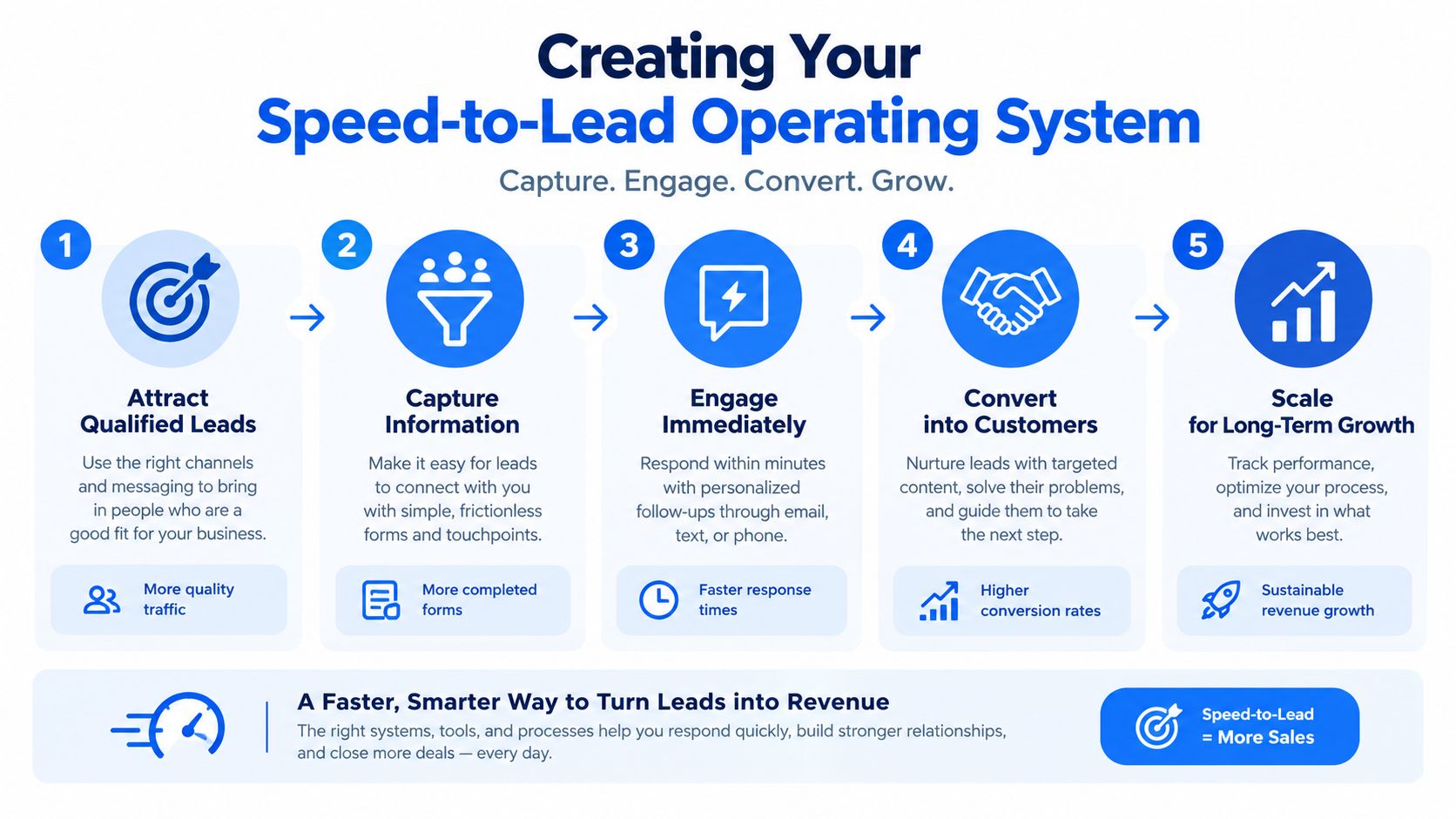
A reliable acquisition system connects visibility, capture, response, qualification, and retention. Google Business Profile creates local discovery. Vertical campaigns create relevance. The form captures commercial context. SMS confirms the inquiry. A human estimator decides whether the opportunity deserves a walkthrough.
Assign ownership before launch
Every channel needs a named owner and a backup. If a lead arrives during an evening shift, the system should acknowledge it, collect missing details, and create a task for the next available person. During business hours, the assigned estimator should call promptly, confirm the building facts, and offer a site visit.
Track the operating measures that reveal where revenue is being lost:
- Response time: Time from form or call submission to automated acknowledgment and human attempt.
- Qualification rate: Share of inquiries that match your service area, building type, capacity, and decision path.
- Walkthrough rate: Qualified inquiries that schedule and attend a site assessment.
- Proposal progression: Quotes that advance to review, revision, and decision.
- Contract economics: Expected gross margin, mobilization burden, staffing requirements, and retention potential.
- Source attribution: Whether the opportunity came from local search, paid social, referral, partnership, or reactivation.
Set operational benchmarks of under five minutes for the first automated touch, under 15 minutes for a human attempt, and at least six to eight documented follow-ups across multiple channels, using the speed-to-lead advantage as an operating principle rather than a slogan. The figures are process targets, not guaranteed close rates.
Improve the system from outcomes
A lead source that produces many inquiries but few qualified walkthroughs needs a message, targeting, or form change. A source that produces strong walkthroughs but weak proposals may reveal a pricing, scope, proof, or capacity problem. Review the CRM from inquiry through quote, walkthrough, proposal, and won contract instead of stopping at the first form.
Use this speed-to-lead workflow to keep response ownership, automated messages, and human follow-up connected. Then revisit existing accounts for expansion and reactivation. Industry survey data reports that 53% of commercial-cleaning revenue comes from ongoing work, repeat customers account for 40% of sales, and customer retention is a primary concern for 57% of companies. The commercial cleaning survey benchmarks reinforce why acquisition and retention belong in the same operating system.
The companies that keep their calendars full don't merely generate more inquiries. They make it easy for the right buyer to identify fit, receive a fast response, schedule a walkthrough, and trust the team that arrives.
BenjiAds helps local service businesses prepare and manage paid campaigns, landing funnels, tracking, and SMS-based lead follow-up without requiring an agency retainer or a complex marketing stack. Visit benjiads to see how its approval-based system can support faster commercial cleaning lead response.
- commercial cleaning
- lead generation
- local SEO
- cleaning business
- how to get commercial cleaning leads
OFFICE CLEANING QUOTES BY TEXT
Office cleaning quotes by text
Free estimates
Ads created · live on FB & IG
For commercial cleaners
Your commercial cleaner ads, live in 2 minutes.
- ✓ Ads created for you
- ✓ Every lead texts your phone
- ✓ Free to use, no credit card
748+ local businesses run ads with benjiads