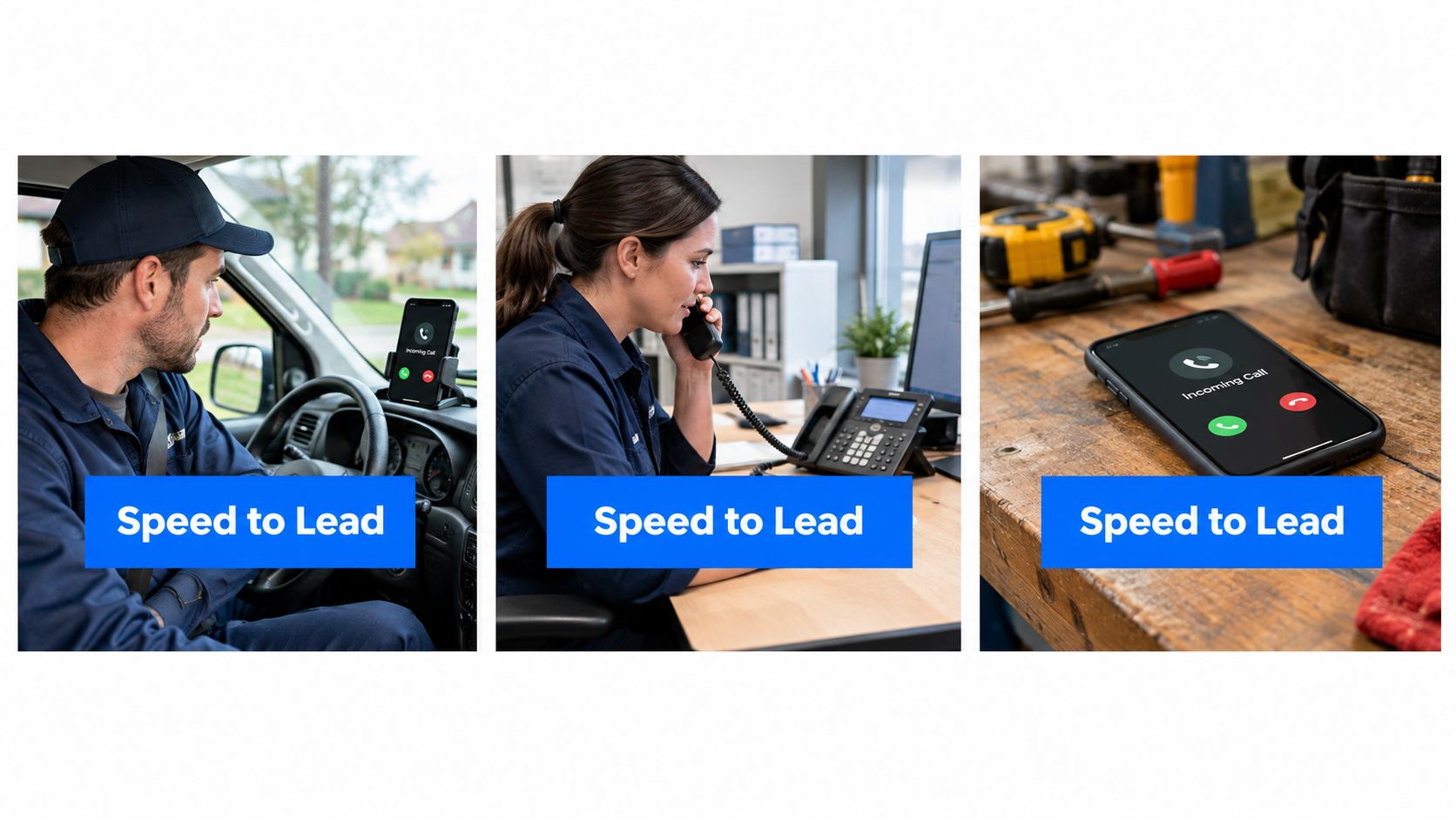
speed to lead 22 min read
Speed to Lead: A Missed Conversion Lever for Local Brands
Discover why speed to lead is the conversion lever most local businesses miss and learn how to capture more sales by responding faster.
On this page
- What Speed to Lead Really Means in 2026
- The Anatomy of a Modern Lead Response Chain
- Why Buyer Expectations and Business Reality Are Worlds Apart
- The MIT and InsideSales Findings Local Businesses Should Care About
- Where Local Businesses Actually Lose Leads
- Beyond the First Touch, Designing a Multi-Touch Follow-Up Cadence
- How SMS Automation Closes the Speed to Lead Gap
- Putting Speed to Lead Into Practice This Week
Responding to an inbound lead within 5 minutes makes that lead about 21x more likely to qualify than waiting 30 minutes, according to a widely cited benchmark summarized by Pipes.ai on speed-to-lead benchmarks. Yet the average company response time still sits around 42 hours, a gap so large it explains why so many paid leads never turn into booked jobs, consults, or estimates.
I've audited enough local-service funnels to know the problem usually isn't ad volume. It's that leads come in while the owner is on a ladder, under a sink, in a treatment room, or driving between jobs. The ad account gets blamed. The failure happened after the click.
Most articles stop at “respond in 5 minutes.” That's not wrong. It's just incomplete. For a trades owner, speed to lead is an operating system. It starts when the phone rings or the form hits your inbox, and it keeps running through pickup time, missed-call recovery, after-hours coverage, and the follow-up sequence over the next several days.
What Speed to Lead Really Means in 2026
A lead contacted within 5 minutes is far more likely to qualify than one contacted 30 minutes later. Analysts at MIT and InsideSales found a roughly 21x difference, a result summarized earlier in this article. The benchmark is familiar by now. The part many local businesses still miss is what the clock should measure.
In 2026, speed to lead is not one timestamp in a CRM. It is the total time between buyer intent and a real interaction that moves the job forward. For a plumber, HVAC shop, med spa, roofer, or dental office, that means asking a harder question than "How fast did we call back?" It means measuring how long it took for someone to answer, text, confirm availability, or recover a missed call before the prospect hired someone else.
That distinction changes the math.
A shop can claim a fast median response time and still lose the lead if paid calls ring too long, voicemail sits unchecked, or form fills wait until the next office block. Across local-service accounts, the leak usually shows up before the scheduled estimate. It starts in the first few minutes, across several small delays that owners do not always track.
The real benchmark is operational, not just tactical
The market has not gotten more patient. If anything, buyers have become less tolerant of silence. Industry roundups continue to show that many businesses still respond far later than buyers expect, often measured in hours instead of minutes, as noted by Lead Connect on speed to lead statistics. That gap explains why ad platforms get blamed for weak lead quality when the larger problem is response handling after the click or call.
For local businesses, speed works like a chain of dependencies:
- How fast the phone is answered
- How fast a missed call gets a text or callback
- How fast after-hours inquiries get an acknowledgment
- How consistently no-contact leads get follow-up over the next several days
If one link breaks, the rest of the funnel has to work harder to recover conversion rate.
Practical rule: If your process only works when one specific person is available, your lead handling is unstable.
Speed to lead now includes the moments owners used to ignore
The old definition focused on first response. That is too narrow for call-heavy local businesses.
A better definition includes ring-to-pickup time, missed-call rate, after-hours coverage, and whether the business has an SMS-first recovery path when nobody answers live. Those are not support metrics. They are sales inputs. A lead who gets an immediate text after a missed call often stays in play. A lead who hears voicemail at 7:12 p.m. and gets nothing until morning usually does not.
This is the shift owners should make this week: stop treating speed as a sales advice slogan and start treating it as an operating metric. Audit every handoff between inquiry and conversation. If you can measure where minutes are lost, you can usually fix the leak without spending more on ads.
The Anatomy of a Modern Lead Response Chain
A local lead does not convert on response time alone. It converts or dies across a sequence of handoffs, and each handoff adds delay, failure risk, or both.
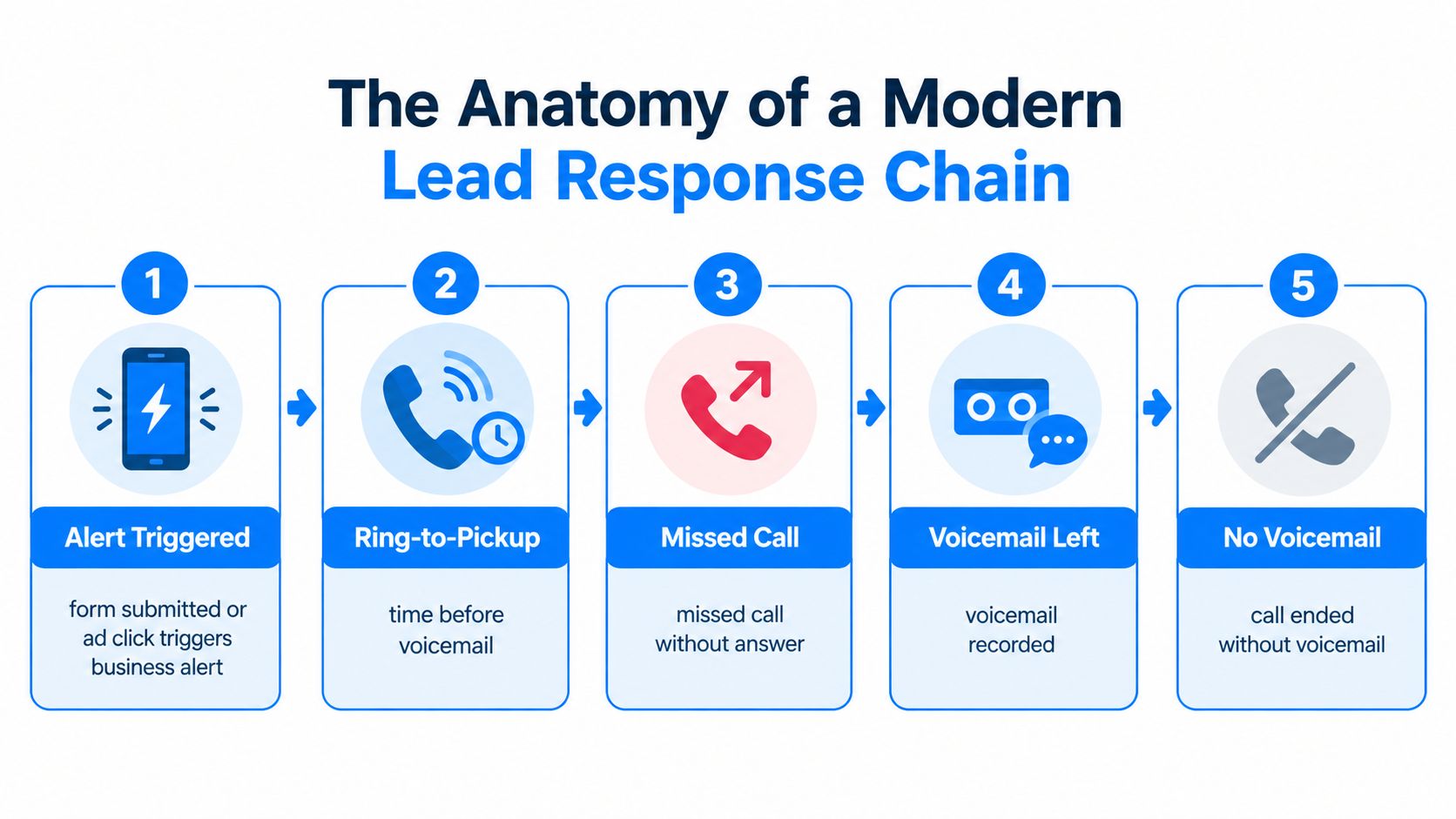
Five stages, one revenue outcome
Owners usually track lead count and cost per lead. The harder question is what happens between inquiry and conversation. That gap is where a large share of paid leads stop being usable.
A modern lead response chain has five stages:
Lead triggered
A web form is submitted, a Local Services Ads call routes in, or a landing page sends an alert to the team.Ring-to-pickup window
The first conversion decision often happens before anyone speaks. Long ring time raises abandonment and pushes more callers to voicemail.Missed-call recovery
If the call is missed, the business needs an immediate fallback. Usually that means a text, a callback, or both.After-hours intake
Evening and weekend demand still needs acknowledgment, routing, and a path to booking.Multi-touch follow-up
A lead that does not connect on the first attempt still has value, but only if the business follows up in a repeatable sequence over the next several days.
Measure chain speed, not just callback speed
The common reporting mistake is simple. A business logs a callback later that day and marks the lead as handled. That misses the operational reality.
If a prospect called at 6:14 p.m., hit voicemail after a long ring, received no text, and got one callback at 8:30 the next morning, the issue was not just a slow callback. The business failed at pickup, recovery, and after-hours coverage. Looking at one timestamp hides three separate leaks.
That is why speed to lead should be measured as cumulative latency across the full chain. Owners should ask four questions on every inbound path: How fast was the call answered? What happened if it was missed? What happened after hours? How many follow-up attempts happened before the lead went cold?
What to instrument this week
Start with the fields that expose operational waste fast.
Pickup time by source
Break out Google Ads calls, LSAs, website calls, and organic calls. Call intent and answer rates often differ by source, so blended averages hide the problem.Missed-call recovery rate
Count how many inbound calls did not reach a human, then check whether each one received a same-session text or callback attempt.After-hours lead volume
Review call logs and form timestamps for nights and weekends. Many owners learn that a meaningful share of demand arrives outside staffed hours.Time to first text
For missed calls and web leads, this is often the fastest process improvement because it does not depend on a rep being free at that exact moment.Follow-up completion by day
Check whether no-contact leads received the second, third, and fourth attempts your team assumes are happening.
One pattern shows up in audit after audit. Owners say the team responds quickly, but the logs show a process that works only when the right person sees the alert, is available to answer, and remembers to follow up later. That is not a fast system. It is a fragile one.
Why Buyer Expectations and Business Reality Are Worlds Apart
Harvard Business Review reported that 82% of customers expect an immediate response when they contact a company with a marketing or sales question. Many local operators still treat lead handling like an inbox task that can wait until the current job ends. That gap is the problem.
For a homeowner with a leak, a parent booking care, or a driver stranded in a parking lot, “fast” does not mean later today. It means now. The buyer is not grading your team against another contractor's staffing chart. They are comparing your response speed to every other service interaction on their phone.
Expectation runs on consumer time, but many shops still run on shop time
Local businesses usually do not lose trust because the service is bad. They lose it because the first minutes feel uncertain.
A lead comes in. The phone rings while a tech is on a ladder. A form arrives after hours. A voicemail sits until someone checks it between jobs. From the owner's side, each delay has a reasonable explanation. From the buyer's side, it looks like unavailability.
That difference matters because local intent is fragile. Many searches happen at the moment the problem becomes urgent. If one business does not answer, the buyer keeps moving down the results page. Speed is not just a sales courtesy. It is part of marketability.
Where the expectation gap actually shows up
The usual advice reduces speed to lead to one clock: time to first response. In local service, buyers experience a chain.
| Step in the chain | What the buyer experiences | What often happens operationally |
|---|---|---|
| Ring to pickup | “Can I reach a person right now?” | Call rolls to voicemail during jobs or lunch |
| Missed-call recovery | “Did they notice I tried?” | No callback or text until hours later |
| After-hours coverage | “Are they available when I need them?” | Nights and weekends have no response path |
| Early follow-up | “Are they helping me book?” | One reply goes out, then the lead stalls |
This is why owners can believe the team is responsive while lead conversion still underperforms. They may be measuring only the first visible reply, not the full response chain the buyer feels.
The field constraint is real, but the fix is operational
A plumber in a crawl space cannot answer on the second ring. A dentist with a patient cannot stop to return a form lead. A two-person HVAC shop cannot manually clear every missed call on a summer Monday.
Those are operating constraints, not personal failures. The mistake is treating them like discipline issues instead of system design issues.
A workable setup has to assume interruptions, missed calls, and after-hours demand will happen every week. That means coverage has to exist before the lead arrives. If it depends on memory, spare time, or someone noticing a notification, it will break under load.
The practical question for an owner is simple: where does your response system require perfect timing from a busy human? That is usually where your leads are leaking.
The MIT and InsideSales Findings Local Businesses Should Care About
Researchers at MIT found that firms that contacted web leads within 5 minutes were far more likely to reach and qualify them than firms that waited longer. Another widely cited sales-response study, summarized earlier in this article, reported that many companies still took days to respond, and a meaningful share never responded at all. That gap is the point local owners should care about.
For a plumber, roofer, dentist, or HVAC shop, this is not sales trivia. It is conversion math.
The expensive step already happened. You paid for the click, the call, or the form submission. If the lead sits for 20 minutes because no one saw the notification, the loss does not show up inside Google Ads or LSAs. It shows up later as weaker booking rates, lower technician utilization, and an owner who thinks lead quality dropped.
What the research means at the local level
The usual takeaway is “reply within 5 minutes.” That is too narrow for a local-service business.
A buyer does not experience your business as a stopwatch tied to one form fill. They experience a chain. Did someone answer the call? If not, did a text go out right away? If the request came in at 8:30 p.m., was there any response path at all? If the first touch missed, did the business try again while intent was still high?
That is why two companies can generate the same number of leads and get very different revenue from them. One business treats speed as a system. The other treats it as a rep habit.
A better way to calculate your own loss
Do not rely on industry averages alone. Segment your own leads by response window and compare outcomes.
| Response window | What usually changes | What to check in your numbers |
|---|---|---|
| Within 5 minutes | Highest chance of live contact and qualification | Contact rate, booked-job rate |
| 5 to 30 minutes | More buyers continue shopping | Contact rate by source and time of day |
| 30 to 60 minutes | Reach rate drops sharply | Appointment rate after first touch |
| Same day but delayed | Interest cools, competitor contact rises | Close rate from delayed callbacks |
| Next day or later | Many leads are already gone | Recovery rate on aged leads |
Start with four fields from your CRM or call log:
- lead source
- timestamp of inquiry
- timestamp of first human or automated response
- final outcome, reached, booked, sold, or lost
Then calculate:
- average job value
- multiplied by close rate from booked appointment
- multiplied by booking rate from contacted lead
- compared across response-time bands
That will show you whether your problem starts at contact, booking, or close. Many owners assume ad quality is the issue because that is the visible cost. In local accounts, the larger problem is often the lag between inquiry and first useful touch.
If you know cost per lead but cannot break out booking rate by response time, you are measuring acquisition spend and ignoring response efficiency.
The management mistake behind slow follow-up
Owners often put marketing under a microscope and leave response operations largely unaudited. The research points to a different conclusion. Once the lead comes in, performance depends less on ad targeting and more on whether the business has coverage, routing, and follow-up rules that work during a normal busy week.
That makes speed-to-lead more fixable than many owners think. You may not reduce click prices this week. You can usually measure first-response lag, missed-call recovery time, and after-hours gaps this week, then decide which failure point is costing the most booked work.
Where Local Businesses Actually Lose Leads
Three leaks usually do more damage than ad targeting errors: slow pickup, no missed-call recovery, and weak after-hours coverage. In local-service accounts, those are the points where response speed turns from a marketing metric into lost revenue.
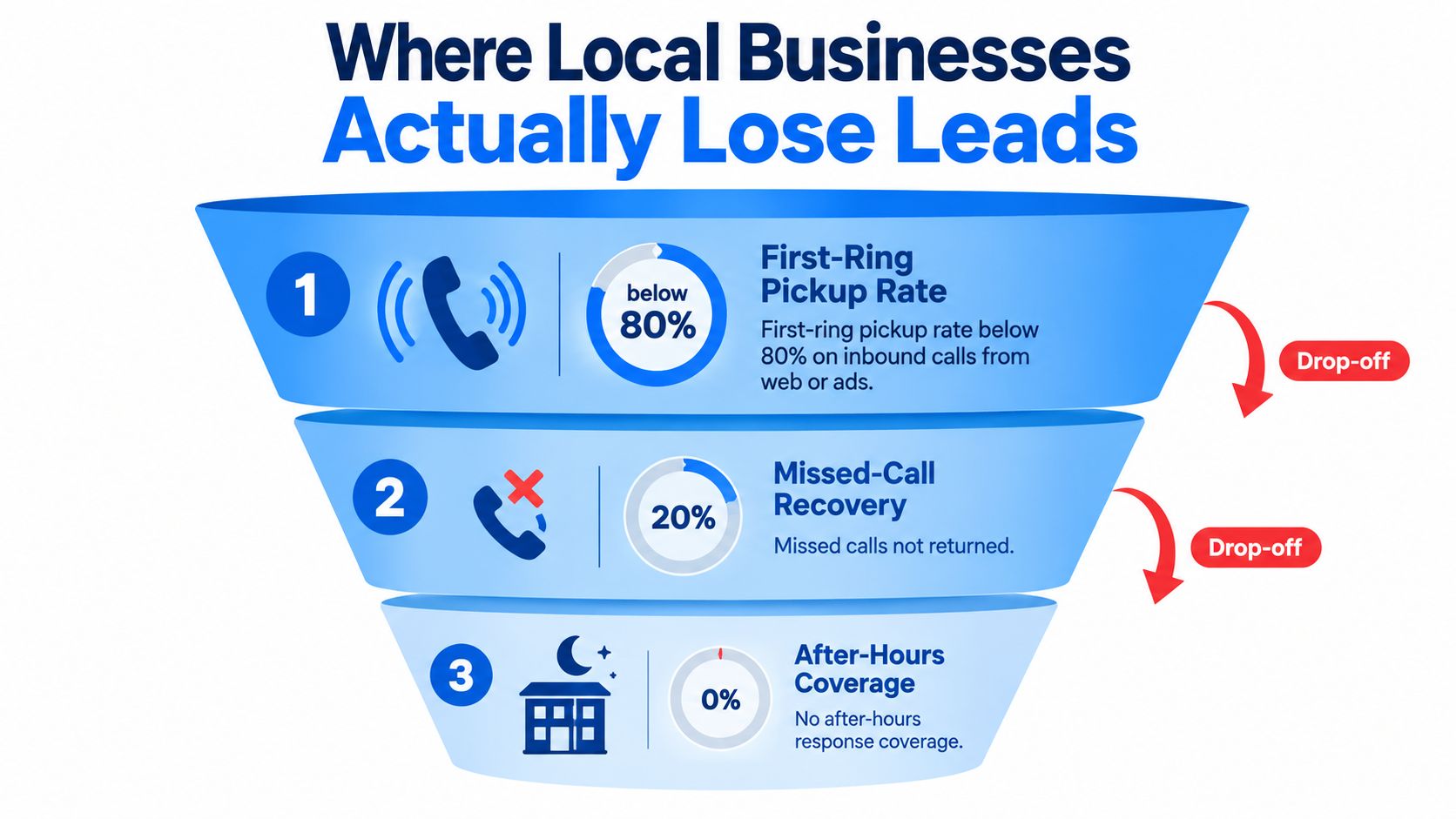
First-ring pickup problems
The first failure often happens before anyone has a chance to follow up. A paid call comes in, rings too long, hits voicemail, or lands on a line nobody owns during busy hours. From the buyer's side, that does not feel like a delay. It feels like the business is unavailable.
In trades accounts, the cause is usually operational. Front-desk staff are handling in-person traffic. Calls route to a main office line instead of the person who can book. Overflow rules are missing, so the phone keeps ringing while the lead opens the next contractor tab.
That is why ring-to-pickup belongs inside speed-to-lead, not outside it. If the call is never answered, your response time is already measured in callbacks and recovery attempts instead of live conversations.
Missed-call recovery is usually weak or nonexistent
A missed call can still convert. Silence after the missed call is what kills it.
Review your log for a simple pattern: inbound call, no answer, no callback, no text, no booking attempt. That sequence shows up more often than owners expect, especially on evenings, lunch hours, and job-site heavy days.
The practical fix is not complicated. Every missed call needs an immediate response path with clear ownership.
Pull unanswered inbound calls Check how many received a callback or text within the same session, not just later that day.
Measure recovery speed Separate callbacks made in a few minutes from callbacks made after the lead has likely contacted someone else.
Check the message “Sorry we missed your call” is weak. A better recovery text identifies the business and offers a next step, such as a booking link or a fast callback option.
Measurement matters here because weak attribution hides weak operations. If you cannot reliably tell which campaign produced the call or form fill, you cannot tie missed-call loss back to spend. This primer on server-side vs. client-side tracking for lead attribution explains why local businesses often misread that connection.
After-hours leads are the silent leak
After-hours demand is where the gap between buyer behavior and business behavior gets expensive. Many local-service businesses still operate as if demand pauses when the office closes. It does not.
A homeowner who submits a form at 8:30 p.m. is still shopping. A property manager calling before 7 a.m. is still trying to solve a problem. If your first response waits until mid-morning, speed-to-lead has already slipped from immediate acknowledgment to next-day follow-up.
Owners should audit three time stamps together:
- Ring-to-pickup time
- Missed-call recovery time
- After-hours first-response time
Those three numbers show where the response chain breaks. They also tell you what to fix first. If pickup is weak, adjust routing and coverage. If missed calls sit untouched, assign recovery ownership and automate the first text. If after-hours leads wait until morning, add acknowledgment coverage outside office hours.
That is the operational version of speed to lead. Not just how fast someone replies, but whether the business is reachable across the full lead-response chain.
Beyond the First Touch, Designing a Multi-Touch Follow-Up Cadence
One fast reply helps. A structured sequence closes the gap between contact and booking.
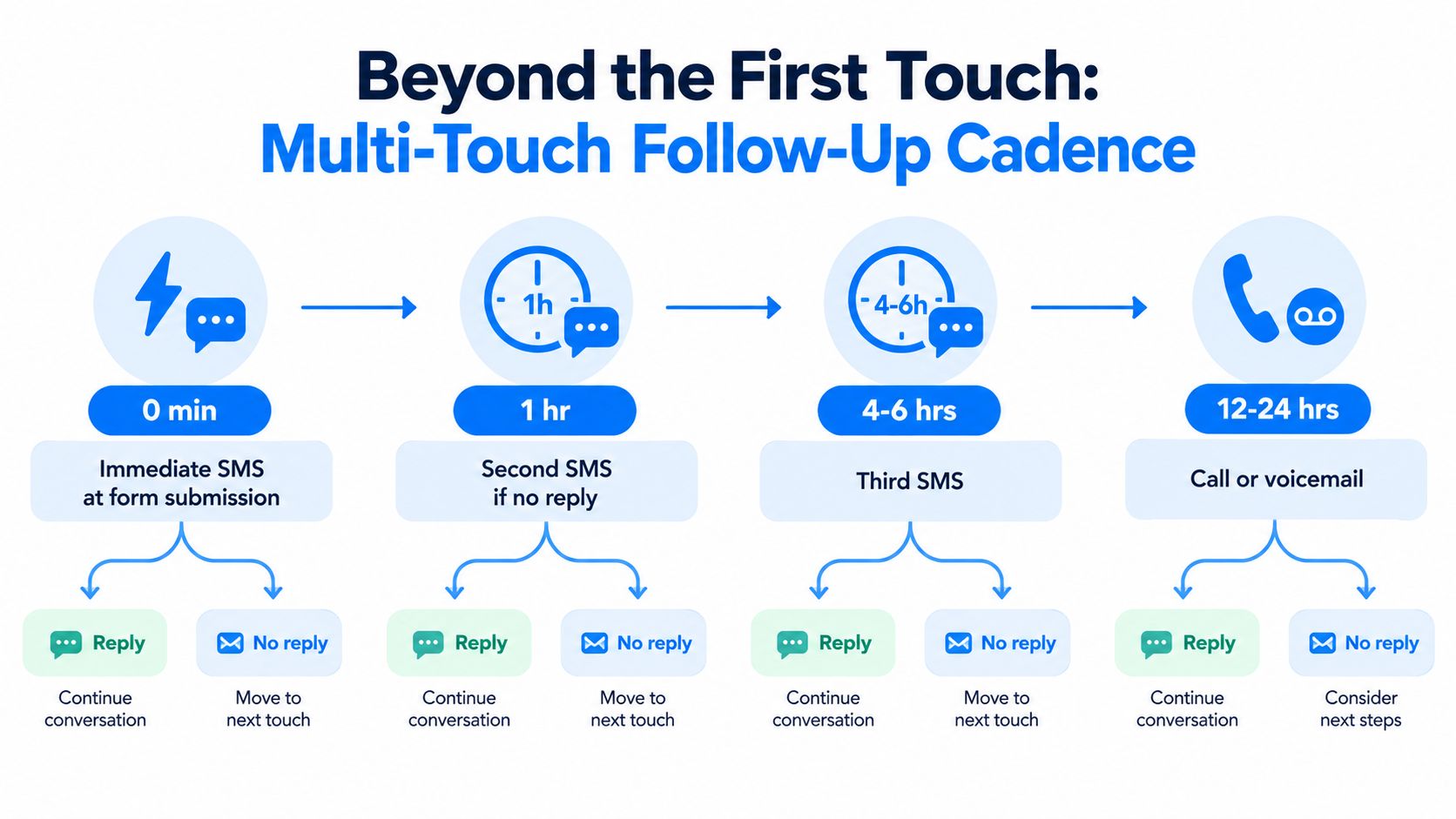
The underused insight in current speed-to-lead research is that speed shouldn't be measured only at first touch. Contemporary benchmark summaries describe cadences that start immediately, then continue at 1 hour, 4 to 6 hours, next business day, 2 days, 4 days, and 1 week, as outlined by GreetNow's speed-to-lead statistics article. That's much closer to how real local lead conversion works.
Single-touch follow-up versus real sequencing
A single call or one text assumes the buyer is available, attentive, and ready at that exact moment. Many aren't. They're at work, comparing options, or dealing with the reason they submitted the lead in the first place.
A sequence performs better because it gives the lead more than one chance to engage. It also lets your business vary the message instead of repeating the same ask.
Here's a practical cadence:
Immediate SMS
Confirm receipt, identify the business, and offer a simple next step.One-hour follow-up
Re-open the conversation if there's no reply. Keep it short.Four to six hours later
Add useful context such as scheduling availability or what to expect next.Next business day
Place a call or leave a voicemail if the lead still hasn't engaged.Day two and day four
Continue with short, useful follow-ups rather than copy-pasted nudges.Week one
Send a final check-in that gives the lead an easy way to re-engage.
For owners comparing software options, automated marketing platforms for local follow-up start to matter. The question isn't whether a tool sends texts. It's whether it can move leads through a timed sequence without someone manually remembering every touch.
A quick visual walk-through helps show how timing and channel work together:
What each touch should add
The mistake in many sequences is sameness. Every message asks “just checking in” and adds no reason to respond.
Better follow-up changes the value of each touch:
- Availability when speed matters
- Specificity about service area or next steps
- Reassurance about what happens after reply
- Urgency only when it's real, not manufactured
That's the difference between persistent follow-up and noisy follow-up.
How SMS Automation Closes the Speed to Lead Gap
If I had to fix one thing first in a local lead funnel, I'd start with SMS automation. Not because calls don't matter, but because text is the fastest way to acknowledge intent when humans are busy.
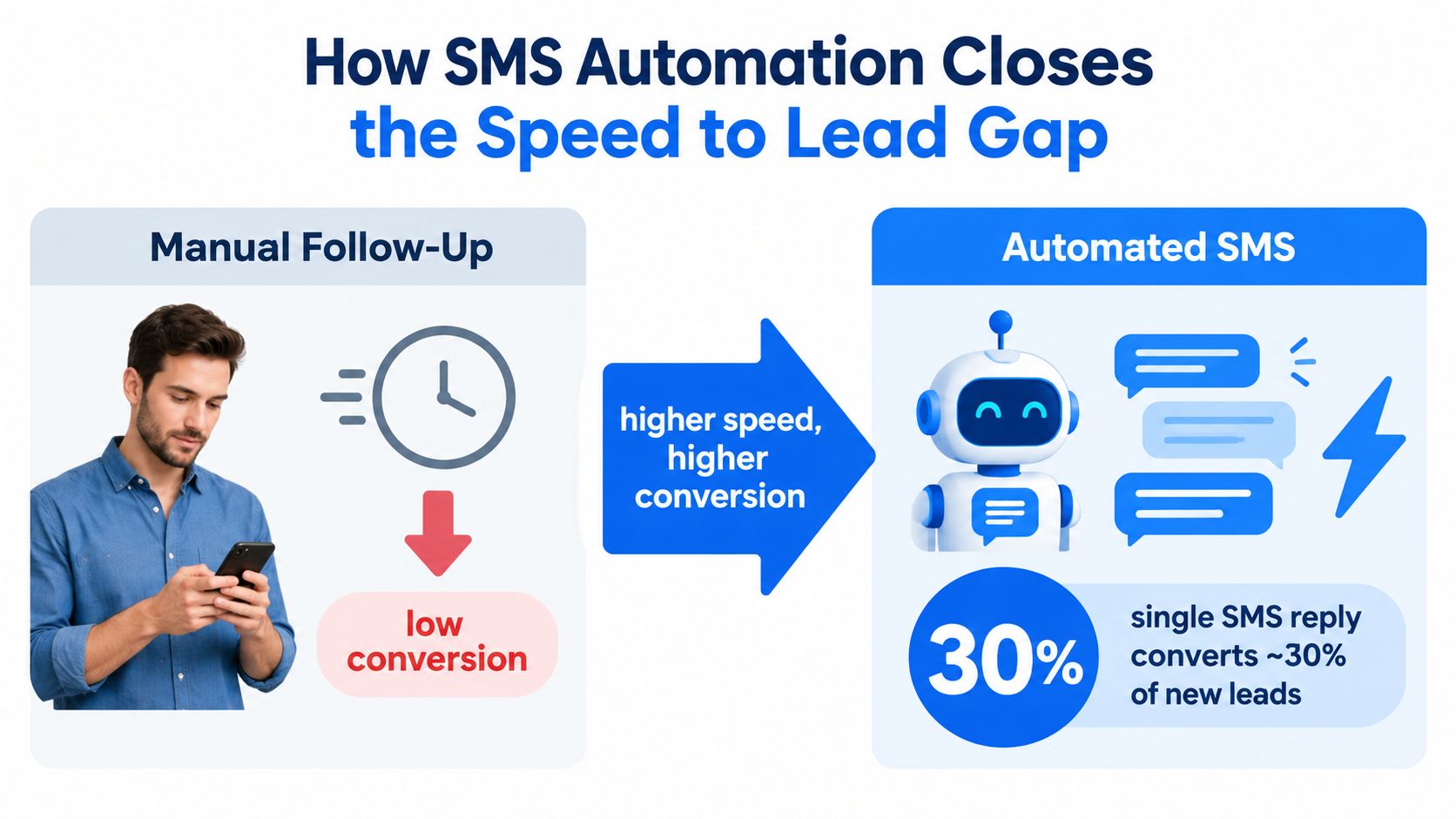
Why text solves the structural problem
The speed-to-lead gap exists because owners and front-desk staff can't be available every second. Text automation removes that dependency from the first response. It can acknowledge the inquiry immediately, ask a qualifying question, and route urgency before the lead cools off.
This matters most in businesses where the operator is the technician, estimator, or provider. In those shops, manual follow-up is always competing with service delivery. Automation handles the opening seconds so the owner can handle the work.
What a useful system must do
Not every SMS setup is worth installing. The minimum viable system should have three capabilities:
Immediate acknowledgment
The first text should confirm the inquiry was received and set a clear next step.Second-touch logic
If there's no reply, the system should send another useful message soon after, not wait until someone remembers.Routing and tagging
A message containing words like “quote,” “urgent,” or “emergency” should trigger the right person fast.
Quiet hours matter too. After-hours response should still acknowledge the lead without creating a bad experience. You want the lead to feel seen, not spammed.
Objections that block adoption
Most hesitation falls into three buckets.
First, owners worry about compliance and opt-outs. That's a valid implementation issue, but it's manageable when consent language and unsubscribe handling are built into the workflow.
Second, they worry the texts will sound robotic. They will, if the copy is generic. They won't if the messages reflect the service, timing, and next step clearly.
Third, they think software can't replace a real person. It doesn't need to. It only needs to close the dead zone between lead submission and human engagement. Tools such as CRM-triggered texting systems, call-tracking platforms, and all-in-one options like benjiads, which combines ad management with automated text follow-up for local service businesses, exist for exactly that handoff.
Automation shouldn't replace judgment. It should remove silence.
Putting Speed to Lead Into Practice This Week
If you cannot answer three questions by Friday, your speed-to-lead process is still guesswork: What was your median first response time last month, what share of calls went unanswered, and how many leads arrived after hours? Local owners usually feel the problem before they can measure it. The fix starts with a simple operating baseline.
Your week-one checklist
| Step | What to verify this week | Good first target |
|---|---|---|
| Audit first-touch speed | Pull form fills, inbound calls, and texts from the last 30 days. Record a timestamp for lead received and first human or automated reply. If you cannot produce both, your median first response time is unknown. | A timestamped log exists for at least 90% of inbound leads |
| Review after-hours lead volume | Count leads that arrived before opening, after closing, on weekends, and during lunch gaps. Separate calls from forms. | You can state the share of leads arriving when nobody is available to respond |
| Measure missed-call leakage | Export total inbound calls, answered calls, missed calls, and callbacks completed within 15 minutes. | You know your missed-call rate and your 15-minute callback recovery rate |
| Assign weekly ownership | Name one person to review response speed, missed calls, and booked jobs by source every week. If no owner is attached, drift is guaranteed. | One owner reviews the same report on the same day each week |
| Connect source to outcome | Tie each lead source to contact rate, booked estimate, and closed job. “Bad leads” is usually a reporting problem until proven otherwise. | You can compare lead source, response speed, and booking rate in one report |
That audit matters even more for companies spending on Google Ads for local service companies. Paid traffic increases lead volume faster than handling improves, so weak follow-up turns directly into wasted spend.
The shortest useful implementation plan
Start with visibility. Software comes second.
Pull the last month of form submissions, inbound calls, missed calls, and booked jobs into one sheet. Add five columns: lead timestamp, first response timestamp, response channel, after-hours yes or no, and booked yes or no. Most owners have this data somewhere. Very few have it in one place.
Next, sort for leakage. Look for leads with no response logged, calls missed during business hours, and after-hours inquiries that waited until the next afternoon for a reply. Those are not edge cases. In many local-service accounts, that is where conversion loss sits.
Then set one operating rule for each failure point. Missed calls get an immediate text-back. After-hours forms get a confirmation and next-step message. New leads without a reply after the first touch get a second outbound attempt on a fixed timer.
Keep the first version simple. A CRM-triggered workflow, a call-tracking platform, or a system such as benjiads that combines ad management with automated text follow-up can cover the handoff between inquiry and human contact without forcing a full process rebuild.
The rollout mistakes that keep the numbers flat
Fast acknowledgment without human follow-through creates a prettier dashboard, not more revenue. If a qualified lead gets an instant text and then waits three hours for a callback, you improved speed on paper while leaving the sales bottleneck untouched.
Generic replies create a second problem. A plumbing emergency, an HVAC replacement quote, and a non-urgent electrical inquiry should not all receive the same message. Response speed affects contact rate. Relevance affects whether the customer replies at all.
The last mistake is treating this as a one-time setup. Routing changes, seasonality, staffing gaps, and owner availability all change response performance month to month. Review it weekly. Local businesses that win here usually do four boring things consistently: they answer more calls, recover missed calls quickly, cover after-hours demand, and keep following up after the first unanswered touch.
If your ads are generating leads but too many of them die in the gap between click and conversation, benjiads is built for that exact problem. It helps local service businesses run Google and Meta campaigns, track what turns into real leads, and automate fast text follow-up so inquiries don't sit untouched while the owner is on the job. If you want to see how that works in practice, visit benjiads.
- speed to lead
- lead response
- SMS automation
- conversion rate
- local services
Done for you
Ads that text you customers.
- ✓ Ads created for you
- ✓ Every lead texts your phone
- ✓ 3 days free · $29.90/mo
748+ local businesses run ads with benjiads