electrician ads 12 min read
Advertising for Electricians That Actually Books Jobs
Practical advertising for electricians that turns ad spend into booked jobs. Covers channels, creative, targeting, budgets, and follow-up.
On this page
- Why Most Electrician Ad Spend Leaks Before the Phone Rings
- Cost Numbers Across Electrician Ad Channels
- Building Campaigns That Match How Homeowners Hire
- Crafting Ads and Landing Pages That Convert
- Follow-Up Sequences That Turn Leads Into Booked Jobs
- Your Weekly Operating Rhythm for Electrician Advertising
A two-truck electrical company can have a full inbox and still lose money on advertising. The owner sees leads arriving, calls being logged, and a campaign dashboard reporting activity. Yet the schedule remains thin because many inquiries are unqualified, missed, delayed, or too expensive to turn into paying work.
That distinction matters in a crowded local market. The U.S. electricians industry includes about 252,000 businesses and roughly 1 million workers, with more than $233 billion in market activity, according to industry data on electrician marketing. Advertising for electricians only works when it connects the first impression to a completed job, not when it produces attractive click and lead totals.
Why Most Electrician Ad Spend Leaks Before the Phone Rings
Consider a familiar month. A two-truck owner spends $4,200 on Google Ads, watches 280 leads enter the system, and finishes with only 11 booked jobs. The campaign looks busy, but after labor, materials, fuel, and wasted lead costs, the month ends in a negative margin.
The leak usually starts before anyone evaluates the ad account. Some form fills come from renters, job seekers, students, or people looking for DIY instructions. Some calls arrive when the office is unattended and go to voicemail. Other leads sit untouched for hours, by which time the homeowner has called another electrician.
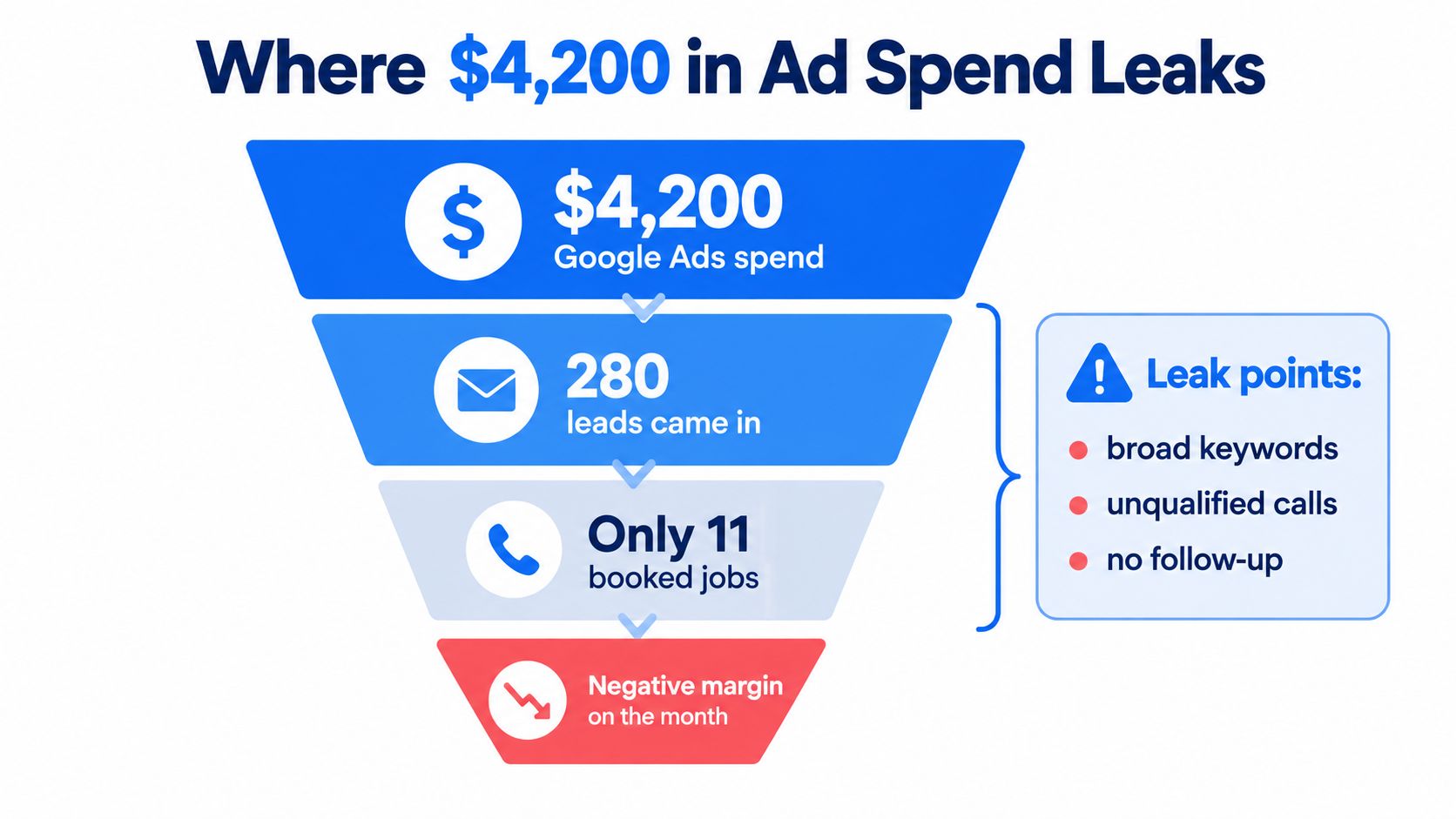
The dashboard can hide the real failure
A lead isn't a booked appointment. A booked appointment isn't necessarily a completed job, and a completed job isn't automatically profitable. The owner needs to know which campaign produced a real customer, what service that customer requested, and whether the gross margin justified the acquisition cost.
Track at least these stages:
- Inquiry: A call or form submission enters the system.
- Contact: Someone at the company reaches the prospect and confirms the request.
- Qualified opportunity: The service, location, timing, and customer fit the business.
- Booked job: The homeowner commits to an appointment or service visit.
- Paying customer: The job is completed and produces acceptable margin.
Practical rule: Optimize advertising for electricians around cost per paying customer, not cost per click or raw lead count.
The fix isn't just “buy better traffic.” It's a connected revenue loop. Channel choice determines the intent and price of the inquiry. Creative and targeting determine whether the right homeowner responds. Intake and follow-up determine whether the opportunity becomes a booked call.
Call tracking and conversion tracking should connect those stages inside the CRM or reporting system. A useful starting point is conversion tracking software for service businesses, provided the data is tied to booked and completed jobs rather than treated as a lead counter.
Cost Numbers Across Electrician Ad Channels
Channel costs reflect different types of demand. Google Search captures an active problem, Local Services Ads can generate verified calls, Meta can create interest before a homeowner searches, and referral aggregators may provide volume with less control over exclusivity or lead quality.
A recent electrician advertising benchmark found that Google Search Ads averaged $12.18 per click, while standard search leads averaged $93.69 per lead. In the same benchmark, Local Services Ads averaged about $39 per verified lead, roughly 58% lower than standard Google Ads in that dataset. Local Services Ads also showed a 43.4% booking rate and an average ticket of $1,434.
Those figures are useful for planning, but they do not decide profitability. A verified lead can sit outside the service area, require work the crew does not offer, or go unanswered. Judge each channel by the cost of acquiring a paying customer and the value of the job that follows.
Use a conversion model, not a channel stereotype
A channel comparison needs more than CPL. Track what happens after the inquiry, then compare actual spend with booked and completed work. For Meta and referral aggregators, treat the cost and conversion fields below as local planning guidance rather than universal market benchmarks.
Google Search Ads
- Avg CPL
- $93.69 average search lead in the cited benchmark
- Booking Rate
- Varies by campaign and intake
- Cost Per Booked Job
- Divide actual spend by booked jobs
- Notes
- High intent, with potentially expensive clicks and leads
Google Local Services Ads
- Avg CPL
- About $39 per verified lead in the cited benchmark
- Booking Rate
- 43.4% in the cited benchmark
- Cost Per Booked Job
- About $90 before other qualification or service costs when using that benchmark
- Notes
- Pay per verified lead, with a call-centric workflow
Meta lead generation
- Avg CPL
- Often cheaper than high-intent search, but quality varies
- Booking Rate
- Usually lower intent and must be measured locally
- Cost Per Booked Job
- Depends heavily on contact and booking performance
- Notes
- Useful for planned work and retargeting
Angi or HomeAdvisor
- Avg CPL
- Can be expensive and inconsistent by market
- Booking Rate
- Often weaker when leads are shared or poorly matched
- Cost Per Booked Job
- Calculate from actual booked work
- Notes
- Check lead quality, duplication, and dispute policy
The cost per lead formula is only the first calculation. Add contact rate, qualification rate, booking rate, and show rate. A campaign that produces many inquiries but few answered calls can make its CPL look efficient while its customer-acquisition cost remains high.
The cheapest lead can become the most expensive when the crew cannot turn it into a job.
Assign every lead a status and a service value. Emergency troubleshooting, panel work, EV charger installation, and inspection requests should be evaluated separately when their margins and close rates differ. Creative, targeting, and follow-up belong in the same revenue loop. Keep funding the channel that produces an acceptable cost per paying customer, and reduce the one that produces inexpensive contacts without booked work.
Building Campaigns That Match How Homeowners Hire
Homeowners don't describe every electrical need the same way. Someone with a burning smell wants immediate help. Someone planning an EV charger wants confidence, compatibility, and a clear estimate. Someone arranging an inspection wants availability and credentials.
Build campaigns around those buying situations rather than placing every service inside one general ad group.
Separate urgency from planned work
Create an emergency campaign with its own call tracking number, hours, messaging, and negative keywords. Use service terms such as:
- [emergency electrician near me]
- [electrical repair near me]
- "breaker panel repair"
- "power outage electrician"
Keep daytime service campaigns separate for panel upgrades, EV chargers, generators, rewires, lighting, and inspections. A homeowner searching for an EV charger shouldn't land on an emergency repair page, and an emergency caller shouldn't have to browse a general services menu.
Start with exact match and phrase match for the highest-intent terms. Add negatives for employment, training, courses, salary, parts, diagrams, and DIY research. Open broad match only after search-term data shows that the account can filter irrelevant demand reliably.
Give each audience a reason to act
For Meta, use distinct creative for emergency education, planned projects, and proof of completed work. A short panel-upgrade video can speak to safety and organization. An EV charger ad can show the installation process and explain that the electrician will confirm electrical capacity before quoting. Retarget people who viewed a services or financing page with reviews, project photos, and a direct booking option.
Keep targeting close to the actual operating area. A radius of 15 to 25 miles can be a sensible starting framework, but the right boundary depends on travel time, local competition, and job value. Exclude areas the crew won't serve, and be cautious with renter or DIY-oriented audiences where the offer doesn't fit.
A focused test envelope of $1,500 to $3,000 per month can be divided between emergency, planned service, and retargeting campaigns, provided the business has the capacity to answer and complete the work. Don't spread a small budget across every service at once. Fund the service line with the clearest margin and strongest fulfillment capacity, then expand after the tracking proves it can produce paying customers.
Crafting Ads and Landing Pages That Convert
A paid click is a short job interview. The homeowner wants an answer to two questions immediately: Can this electrician solve my specific problem, and will someone answer the phone?
Lead with the service, not a generic claim. “EV Charger Installation in [City]” is more useful than “Trusted Electrical Experts.” Pair it with proof such as licensed and insured work, real project photos, a clear service area, and a realistic same-day or next-day response statement if the business can keep that promise.
Create three to five ad variations per service and send each service to a dedicated landing page. The page for panel upgrades should explain panel work, show relevant photos, and make the next action obvious. It shouldn't force the visitor to search through emergency repair, lighting, and commercial pages.
Put friction in the right places
The landing page needs to make calling easy while collecting enough information for qualification. Put a click-to-call button above the fold, keep the form to five fields or fewer, and state the towns or ZIP codes served. Add a photo of the owner or technician, relevant reviews, and trust marks that the business can substantiate.
| Element | Typical Impact |
|---|---|
| Click-to-call button above the fold | Removes friction for urgent and mobile visitors |
| Service-specific headline | Confirms relevance immediately |
| Local service area statement | Filters out-of-area inquiries |
| Real technician or project photo | Builds familiarity and credibility |
| Short qualification form | Captures demand without creating unnecessary work |
| Local customer reviews | Supports trust at the decision point |
| Clear response expectation | Sets an operational promise the team can meet |
Test call-first layouts against form-first layouts, but judge them by booked calls, not click-through rate. A higher CTR can be a warning if the ad attracts curiosity without producing qualified conversations. Replace weak creative based on cost per booked call, search-term quality, and service fit.
Landing pages also need an operational handoff. The moment someone submits a form, the office should know the requested service, address, preferred timing, and source campaign. If the page collects information that the dispatcher never uses, it adds friction without improving qualification.
Follow-Up Sequences That Turn Leads Into Booked Jobs
Speed-to-lead is an operating discipline, not a marketing slogan. A homeowner with a failed circuit or urgent installation request often contacts several companies, so a delayed response gives the next contractor an advantage.
Route every new lead to a call attempt within two minutes whenever staffing allows. Follow with an SMS that names the service, confirms the address, and offers a realistic arrival window.
Use a timed sequence
The first message should sound like a person, not an automated receipt:
SMS: Hi, this is [Name] with [Company]. We received your request about [service] at [address]. Are you available for a call now, or would a [time window] appointment work better?
If the prospect doesn't answer, call again at 10 minutes and leave a concise voicemail. Send a second SMS that confirms the team is still available. At 60 minutes, send a message with a booking link or a clear invitation to reply with a preferred time.
At 24 hours, follow up without pressure. Reference the original request and mention a genuine scheduling opening if one exists. Avoid manufactured urgency. The message should help the homeowner restart the conversation, not make them defend why they didn't respond.
Make missed opportunities visible
Log the first-touch response time, call outcome, service requested, qualification status, and booking result. Review recordings for recurring objections, such as unclear pricing, unavailable appointment windows, or uncertainty about whether the company serves a particular town.
A non-responder can enter a 30-day remarketing audience featuring completed work, technician introductions, and service-specific proof. Keep the audience separate from active booked customers so the message remains relevant.
The speed-to-lead workflow should connect the ad platform, landing page, phone system, SMS, and CRM. If those tools don't share status information, the owner may keep paying to reach people who already booked or repeatedly contacting leads who were never qualified.
Your Weekly Operating Rhythm for Electrician Advertising
Advertising accounts drift when nobody owns the routine. Search terms accumulate, old creative keeps spending, missed calls disappear into voicemail, and the owner judges performance from platform-reported leads instead of completed work.
Treat the account like a service truck. It needs scheduled checks, documented faults, and parts replaced when they stop doing their job.
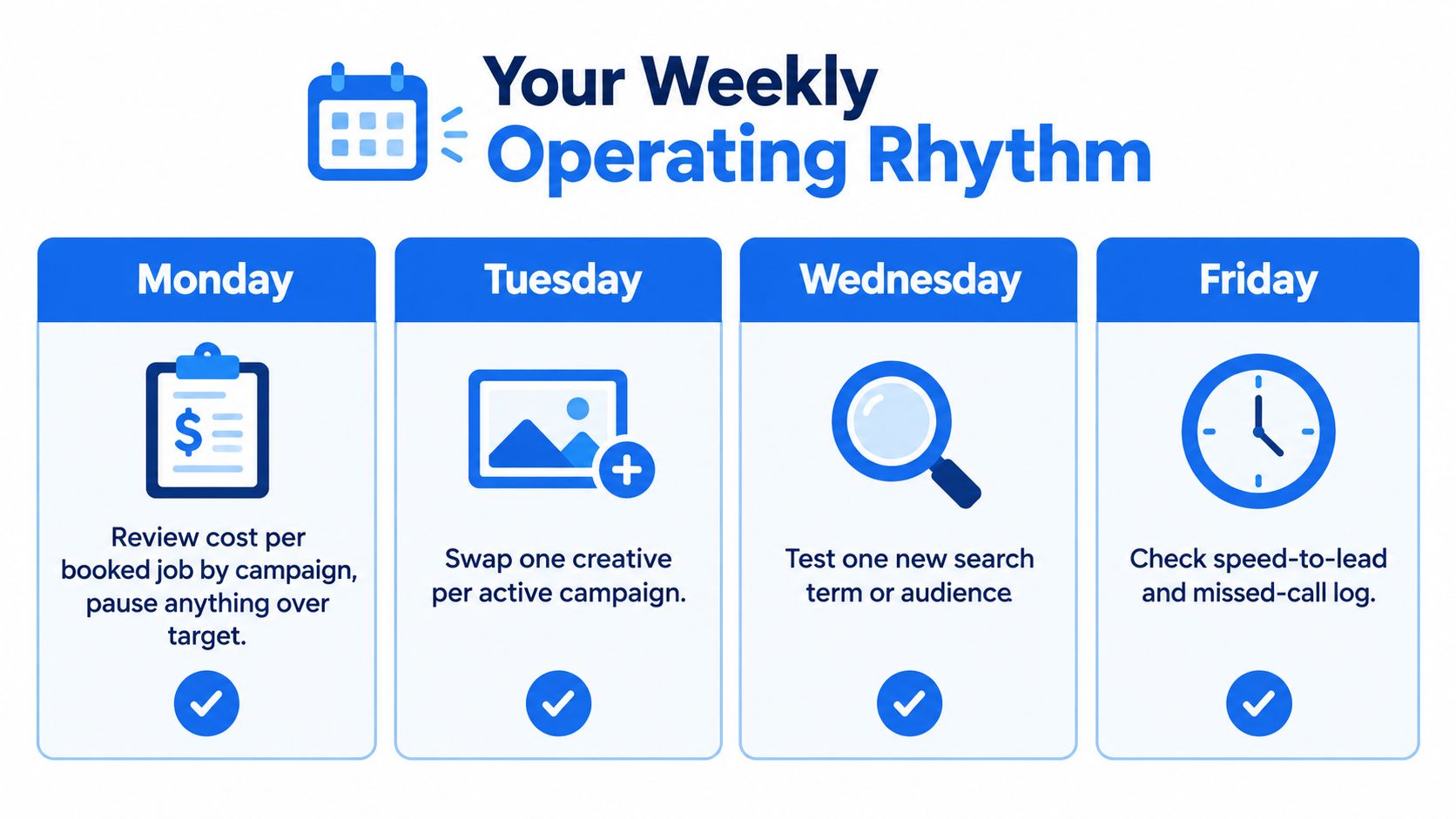
Monday starts with booked-job economics
Review cost per booked job by campaign and service line. Pause or reduce anything above the business's acceptable target, but first check whether the problem came from targeting, poor contact handling, or weak fulfillment. Cutting a profitable campaign because the phone team missed calls only hides the core issue.
Tuesday and Wednesday are for controlled testing. Swap one creative per active service, test one new search term or audience, and keep the losing versions in a backup folder. Change one meaningful variable at a time so the result can be interpreted.
Thursday is reconciliation day. Compare the prior week's ad spend with booked revenue and then inspect completed-job margin where the data is available. A campaign that produces emergency calls may look different from one selling planned installations, so compare like with like.
Friday belongs to intake quality
Listen to call recordings, check landing page speed on a mobile phone, review form notifications, and inspect the missed-call log. Mark every lead that went cold with a reason, such as no answer, outside service area, price objection, unclear service, or slow response.
Use those objections to improve the next round of ads and pages. If homeowners repeatedly ask whether financing is available, address that question in the planned-project campaign. If many callers need work outside the service area, tighten the geographic settings and page copy.
At month-end, move budget toward the campaign with the lowest cost per paying customer, not the lowest CPL. A channel that can't clear the booked-job threshold after two full budget cycles needs a structural change or a pause, not another vague optimization.
BenjiAds offers automated ad creative, campaign setup, landing funnels, tracking, and SMS-based lead follow-up for local service businesses, with campaigns prepared for owner approval before launch. If your electrician business needs a tighter path from inquiry to booked work, visit benjiads and evaluate whether its workflow fits your current advertising process.
- electrician ads
- advertising for electricians
- electrician leads
- local service ads
- electrician marketing
GET AN OUTLET REPAIR QUOTE
Get an outlet repair quote
Upfront pricing
Ads created · live on FB & IG
For electricians
Your electrician ads, live in 2 minutes.
- ✓ Ads created for you
- ✓ Every lead texts your phone
- ✓ Free to use, no credit card
748+ local businesses run ads with benjiads