social media ads for dentists 12 min read
Social Media Ads for Dentists: A Practical Guide
Learn how to run social media ads for dentists with effective targeting, compliant creative, and conversion tracking. Start attracting patients today.
On this page
- Understanding How Dental Patients Find Care Online
- Setting Up Audience Targeting by Treatment Intent
- Building a Controlled Funnel from Ad Click to Booking
- Testing Consent-Safe Creative Angles Over Aggressive Claims
- Implementing Privacy-Safe Tracking and Follow-Up Workflows
- Next Steps for Running Your First Controlled Campaign
A prospective patient moves to town, opens Instagram while waiting for coffee, and sees three nearby dental practices. One has an outdated profile. Another posts polished treatment photos but offers no clear way to ask a question. The third explains what a first visit involves, introduces the clinical team, and sends visitors to a simple consultation page. The third practice has reduced the distance between seeing an ad and feeling ready to book.
That distance is where most dental advertising succeeds or fails. Social media ads for dentists can generate attention, but attention alone doesn't fill a schedule. The campaign needs a credible destination, privacy-safe measurement, fast follow-up, and creative that earns trust without treating patient information as marketing material.
Understanding How Dental Patients Find Care Online
A prospective patient may begin with a local search, a recommendation, or an insurance question. Social media often becomes the next checkpoint. They look at the practice profile, scan recent posts, watch a short explanation from the dentist, and decide whether the office feels current, approachable, and credible before making contact.
A 2023 study of 503 dental patients found that 208 respondents, or 41.4%, had visited a dental practice's social-media profile. Only 118 people, or 23.5%, said they had used dental-practice social media the last time they changed practices. Yet 102 of those 118 patients, or 85.6%, said the experience influenced their decision. The study doesn't prove that advertising alone caused patients to switch, but it does show that social content can influence provider selection after a patient starts evaluating options. The peer-reviewed study in BMC Oral Health provides the relevant context.
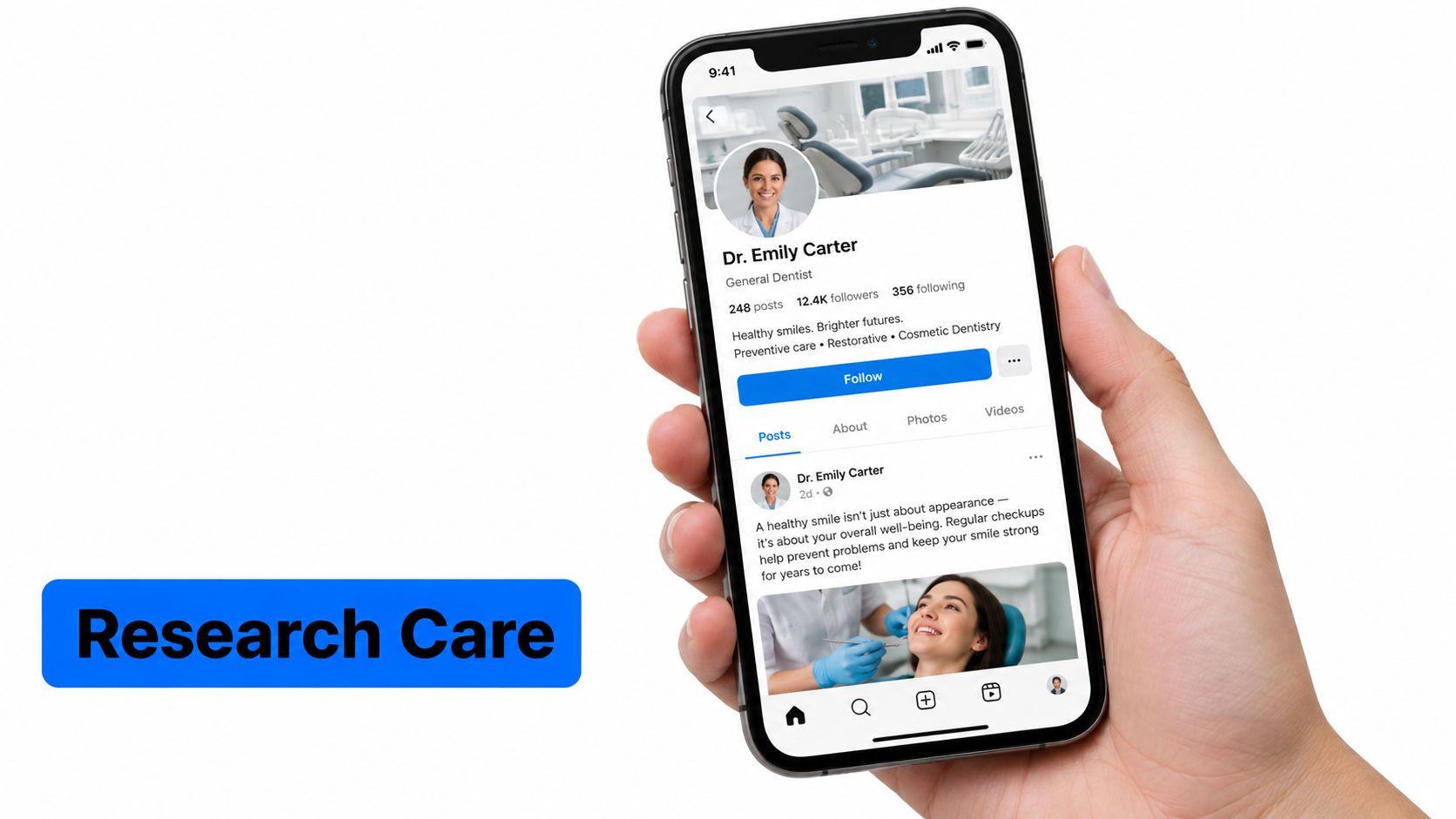
The profile is part of the funnel
Treating a social profile as a bulletin board misses its role in the patient journey. An ad may create the first impression, while the profile confirms whether the practice looks trustworthy. The landing page then answers practical questions, such as what treatment is offered, where the practice is located, and how to request an appointment.
A 2018 study reported that 290 of 532 sampled dentists, more than 55%, maintained social-media accounts for their practices. Among patients in that research, 238 of 508 had visited a dental surgery's Facebook page or website, 164 of 460 had searched for their dentist on social media, and 207 of 470 were comfortable being contacted by dentists through social platforms. The samples came from specific settings, so these figures aren't universal benchmarks, but they show that patients and practices were already using social channels for research and communication. The later review of dental social-media use also reports that a 2025 study of 265 dental professionals found social-media use in practice among 179 respondents, or 67.5%.
Your ad should therefore lead to one credible next step, not a generic homepage packed with competing links. A practice-branded landing page, booking form, or verified phone channel gives the patient somewhere clear to go. For broader positioning and campaign planning, practices can also review guidance on marketing built for dentists.
The same principle applies to local search. Your social ad and profile should reinforce the information patients find on your Google Business Profile, including the practice name, location, phone number, services, and booking path.
Practical rule: An impression is not a conversion. Build the ad, profile, landing page, and follow-up as one patient-facing experience.
Setting Up Audience Targeting by Treatment Intent
A dental campaign becomes easier to manage when each ad set represents a clear reason for contacting the practice. General dentistry, cosmetic dentistry, implants, and orthodontics attract different questions, motivations, and expectations. Combining them under one message usually forces the creative to become vague.
Start with four treatment paths
Create separate campaign paths for:
- General dentistry: Focus on new-patient exams, preventive care, convenience, and a welcoming team.
- Cosmetic dentistry: Explain consultation options, treatment planning, and the questions patients commonly ask before changing their smile.
- Implants: Address evaluation, planning, candidacy, and the steps involved, without implying a guaranteed result.
- Orthodontics: Speak to the treatment process, consultation, suitability, and the needs of adults, teens, or families where relevant.
Each path should have its own creative, offer, landing-page headline, form questions, and follow-up language. Someone responding to an implant consultation shouldn't receive the same message as someone looking for a routine examination.
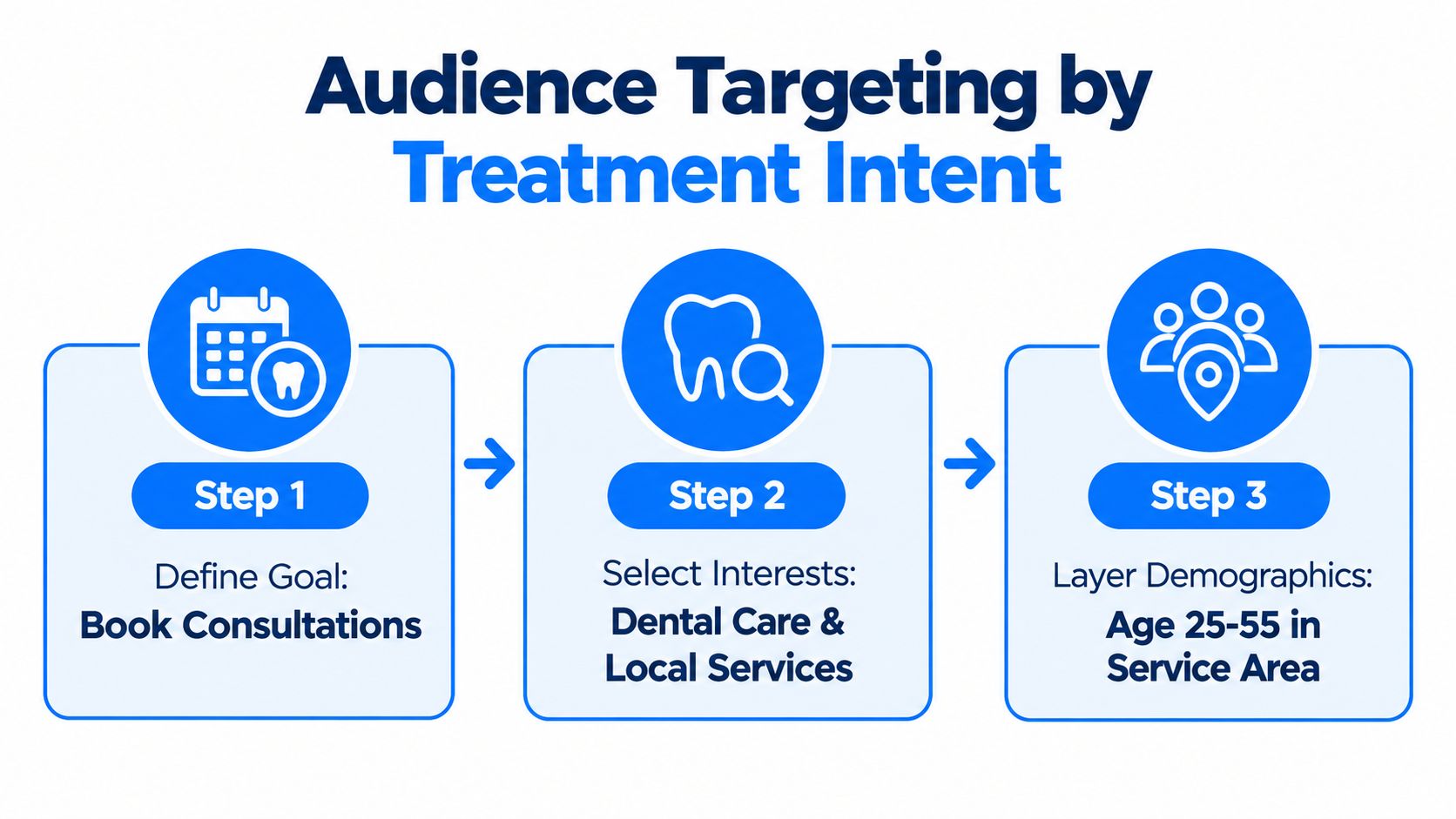
Keep the test controlled
Meta targeting can become overcomplicated quickly. Start with the practice's service area, an appropriate local audience, and treatment-specific messaging. Don't pile on every available interest or demographic filter before you know whether the offer and creative are working.
For a controlled test, hold the geography, budget, offer, and audience structure steady. Change one creative variable at a time:
- Change the opening hook while keeping the image and call to action.
- Change the image while keeping the copy and offer.
- Change the call to action while preserving the rest of the ad.
- Compare a clinician-led explanation with a team or office image.
- Test testimonial-led creative only when the practice has documented authorization.
This discipline matters because a small test can produce noisy results. The latest WordStream and LocaliQ benchmark, covering 726 U.S. Facebook lead campaigns, reported dental-services CTR of 1.05%, CPC of $9.78, conversion rate of 6.38%, and CPL of $76.71. These figures are reported in the dental Facebook advertising benchmark, not as a promise for any individual practice. At that CTR, 10,000 impressions would produce roughly 105 clicks, and applying the conversion rate would yield approximately seven leads, so early conclusions can be unstable.
Cheap clicks don't prove that the campaign is healthy. A qualified lead who answers the phone and books is more valuable than an unresponsive form submission. Judge each treatment path by lead quality, contact rate, booked appointments, and kept appointments.
Building a Controlled Funnel from Ad Click to Booking
The most reliable dental funnel has one job at each stage. The ad earns the click, the landing page earns the inquiry, the front desk qualifies the opportunity, and the practice records whether the appointment was booked and kept.
Send paid traffic to a mobile-first page with one primary action. That action might be a consultation request, a call, or a short form that asks only what the office needs to begin a conversation. A homepage usually offers too many exits, while a long form can make a nervous patient abandon the process.
Separate marketing signals from clinical records
The advertising platform needs an anonymous conversion signal. The practice needs an operational record for follow-up. Those systems should connect through carefully defined events, not through unnecessary clinical details.
A practical sequence looks like this:
- The patient clicks an ad with campaign and treatment-intent parameters.
- The landing page records an anonymous page view and conversion event.
- The patient submits a form or calls the practice.
- The practice verifies the contact details and asks only the questions needed for scheduling.
- The booking system records appointment status in the practice's controlled environment.
- A qualified or booked outcome can be sent back as an offline conversion signal, subject to the practice's privacy review and authorization process.
Use both browser and server-side conversion events where the implementation has been reviewed. Browser events help the platform understand activity in the session. Server-side events can provide a more dependable signal when browser restrictions interfere with measurement. This doesn't mean sending diagnoses, treatment histories, or other protected health information to an ad platform.
| Metric Type | What It Shows | How It Guides Optimization |
|---|---|---|
| Landing-page conversion rate | Whether the page turns relevant visits into inquiries | Improve the headline, proof, form length, or call to action |
| Contact rate | Whether staff can reach the person who inquired | Review phone verification, response speed, and lead details |
| Qualified lead rate | Whether inquiries match the treatment and service area | Refine targeting, forms, offers, and qualification questions |
| Booked appointment rate | Whether qualified conversations become appointments | Improve scheduling availability and front-desk handling |
| Kept appointment rate | Whether bookings become real visits | Strengthen reminders, expectations, and confirmation workflows |
| Cost per booked appointment | Acquisition cost tied to a meaningful outcome | Shift budget toward campaigns that produce viable appointments |
Measure cost per qualified lead and cost per booked appointment, not platform-reported leads alone. For a deeper look at the mechanics, see this guide to conversion funnel optimization.
A dental funnel is healthy when the practice can explain what happened after the form submission.
Testing Consent-Safe Creative Angles Over Aggressive Claims
Before-and-after images are visually persuasive, but they aren't automatically the strongest or safest creative. They require documented permission, careful handling, and ongoing control over where the material appears. A practice that collects patient content casually may have attractive ads today and an unusable library tomorrow.
The consent gap is visible in recent research. A 2025 study of 265 dental professionals found that 56.98% recognized that sharing patient data can infringe privacy, while only 46.04% consistently obtained patient consent. The study indexed by PubMed also found that marketing was a primary reason professionals used social media. That combination creates a practical problem: the desire for proof can move faster than the practice's consent process.
Build a creative portfolio that doesn't depend on patient exposure
A practice can test strong messages without making patient transformations the center of every campaign. Useful alternatives include:
- Educational: A dentist explains what happens during an initial consultation.
- Clinician-led: The provider addresses a common concern in plain language.
- Team-focused: Staff introduce the people who answer calls and welcome patients.
- Process-focused: The ad explains how the practice handles consultations, planning, and follow-up.
- Convenience-focused: The message highlights location, communication options, or appointment access without making unsupported promises.
- Community-focused: The practice shows its local involvement and culture.
- Treatment-focused: The ad explains who may want to explore a service, without guaranteeing an outcome.
Compare those angles with testimonial-heavy creative only when the practice can document authorization. The American Dental Association says written consent, authorization, waiver, and release are needed before publishing a patient testimonial, photograph, radiograph, or name. Its marketing and advertising guidance for dental practices also addresses the risk of revealing someone's patient status or responding to a public disclosure as though the practice can confirm it.
Ask for documented permission after the appointment, make participation optional, store the approval where the marketing team can verify it, and maintain a revocation process. Don't imply that a particular result is guaranteed. Measure qualified calls and kept appointments rather than optimizing for likes or inexpensive engagement.
The video below can help teams think about the relationship between dental content, trust, and patient-facing communication. It should support, not replace, the practice's own consent and review process.
Implementing Privacy-Safe Tracking and Follow-Up Workflows
Privacy-safe measurement starts by deciding what the advertising system doesn't need to know. Meta doesn't need a patient's diagnosis, treatment plan, radiograph, insurance information, or detailed reason for seeking care. It needs a reliable, minimized signal that an eligible person completed a marketing action.
The American Dental Association warns that revealing someone is a patient, responding to a negative review, or handling information through social platforms can create privacy risks. A patient's public disclosure doesn't remove the dentist's obligation to protect that information. Staff should treat comments, direct messages, forms, call notes, and SMS conversations as separate operational surfaces that require clear rules.
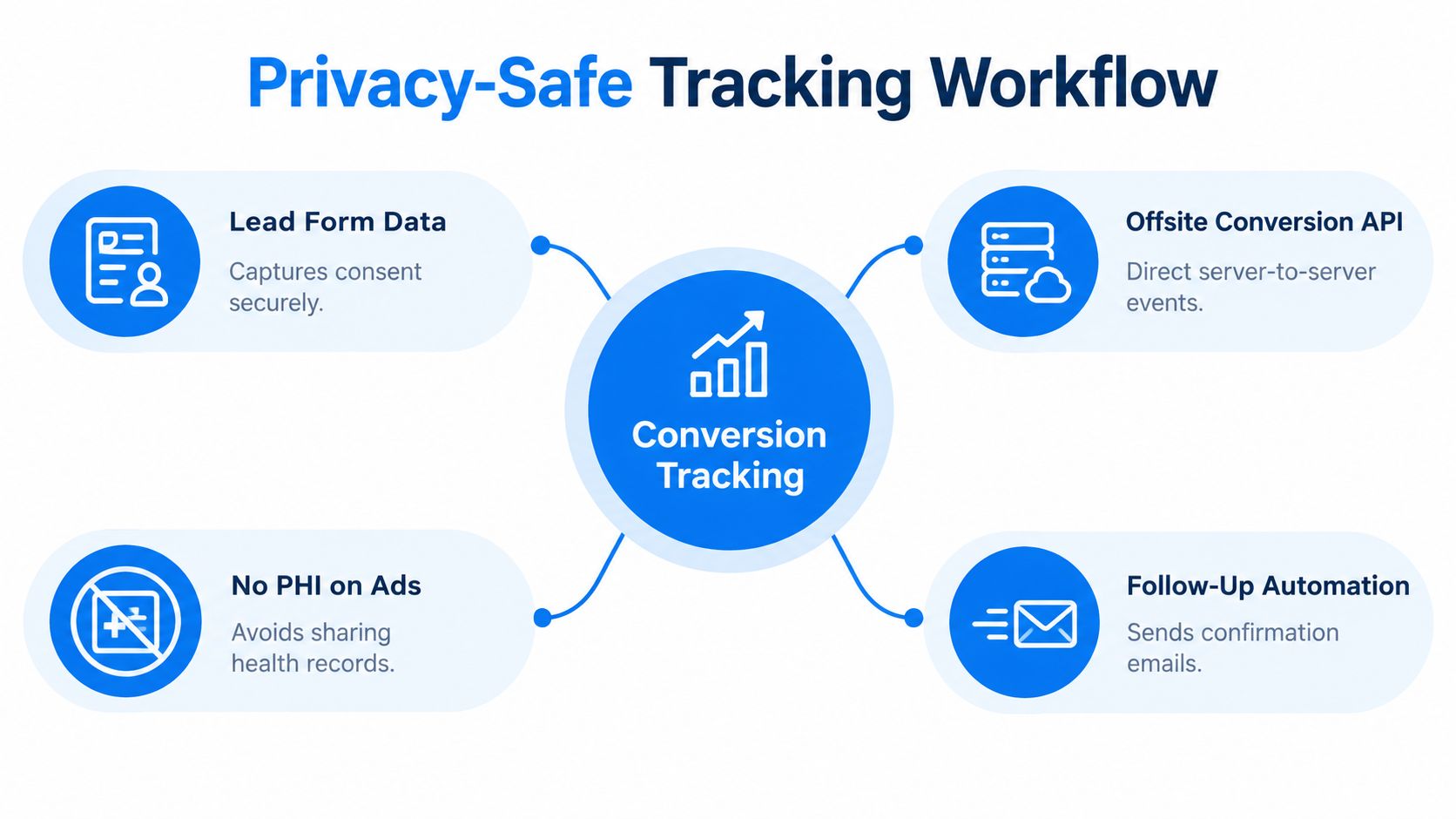
Use an event map with clear boundaries
A practical event map can include:
- Anonymous landing-page events: Page view, form start, form completion, and click-to-call. Keep the event name and campaign context separate from clinical data.
- Phone verification: Confirm that the number is usable before staff spend time on follow-up. Avoid placing clinical details in advertising-platform fields.
- Booking signals: Record requested, scheduled, confirmed, cancelled, and kept status inside the practice's approved systems.
- Offline conversion imports: If the practice uses them, send only the minimum information required for attribution and review the implementation with the appropriate privacy and compliance professionals.
- Follow-up automation: Send a neutral confirmation and clear next step. Don't include sensitive treatment details in an unprotected text message.
Server-side tracking can strengthen attribution when browser data is incomplete, but it isn't a permission slip to transmit more information. This explanation of server-side tracking is useful for understanding the technical distinction between browser events and server-to-server signals.
Give the front desk an escalation path
A lead workflow needs people, not just pixels. Staff should know what to say when someone asks a clinical question in a direct message, mentions a diagnosis in a comment, or requests treatment details by SMS. A neutral response can move the conversation to a private, approved channel without confirming patient status publicly.
For general social-media governance, practices may also consult the PostPulse social media compliance guide. The practice's own legal and compliance review still controls the final process.
A workable operating sequence is:
- Capture the anonymous marketing conversion.
- Send a neutral confirmation.
- Route the inquiry to trained staff.
- Verify contact details through the approved process.
- Record scheduling outcomes in the practice system.
- Feed back only the reviewed conversion signal.
- Remove or correct data when authorization is withdrawn or retention rules require it.
The goal isn't maximum tracking. It's useful tracking with minimum identifiable health data.
Next Steps for Running Your First Controlled Campaign
Start with one treatment intent, one service area, one offer, and one conversion action. Prepare two or three creative variations, but change only one meaningful element between versions. Build the landing page, phone or form workflow, consent language, and staff response script before spending money.
Set a test budget the practice can evaluate without needing immediate certainty. The benchmark data above shows why a small number of clicks or leads can produce volatile results, so don't judge the campaign from one afternoon of platform reporting. Wait until staff can compare qualified leads, booked appointments, and follow-up quality.
Use an approval-based workflow if you want software to prepare creatives, landing pages, tracking, and follow-up while the practice retains control over publishing and budget changes. BenjiAds is one option that combines those functions with SMS-based lead follow-up and client-side and server-side conversion tracking. For practices that need help handling inbound inquiries, front-desk coverage for dental clinics can also be evaluated as a separate operational resource.
Review the campaign on a fixed schedule:
- Message quality: Are inquiries about the advertised treatment?
- Contact quality: Can staff reach the person?
- Scheduling quality: Does the conversation produce a viable appointment?
- Privacy quality: Are messages, forms, and events staying within approved boundaries?
Once the workflow is reliable, expand to another treatment intent and test a new creative angle.
BenjiAds helps dental practices prepare and manage Facebook and Instagram campaigns, dedicated landing funnels, conversion tracking, and SMS follow-up without requiring the team to operate every advertising tool manually. Visit benjiads to review how an approval-based, privacy-conscious campaign workflow could fit your practice.
- social media ads for dentists
- dentist marketing
- dental advertising
- healthcare marketing
- patient acquisition

NEW PATIENT APPOINTMENTS
New patient appointments
Text about your visit
Ads created · live on FB & IG
For dentists
Your dentist ads, live in 2 minutes.
- ✓ Ads created for you
- ✓ Every lead texts your phone
- ✓ Free to use, no credit card
748+ local businesses run ads with benjiads