social media marketing dentist 10 min read
Social Media Marketing Dentist Guide That Books Patients
Social media marketing dentist guide with content ideas, ads, and funnels that turn followers into booked patients. Get practical steps to grow your practice.
On this page
You can post three times a week, boost a few smile photos, and still wonder why the phone isn't ringing. That's the trap many practices fall into, the feed looks active, but the schedule doesn't move. Social Media Marketing for Dentists works only when it behaves like a booking system, not a popularity contest.
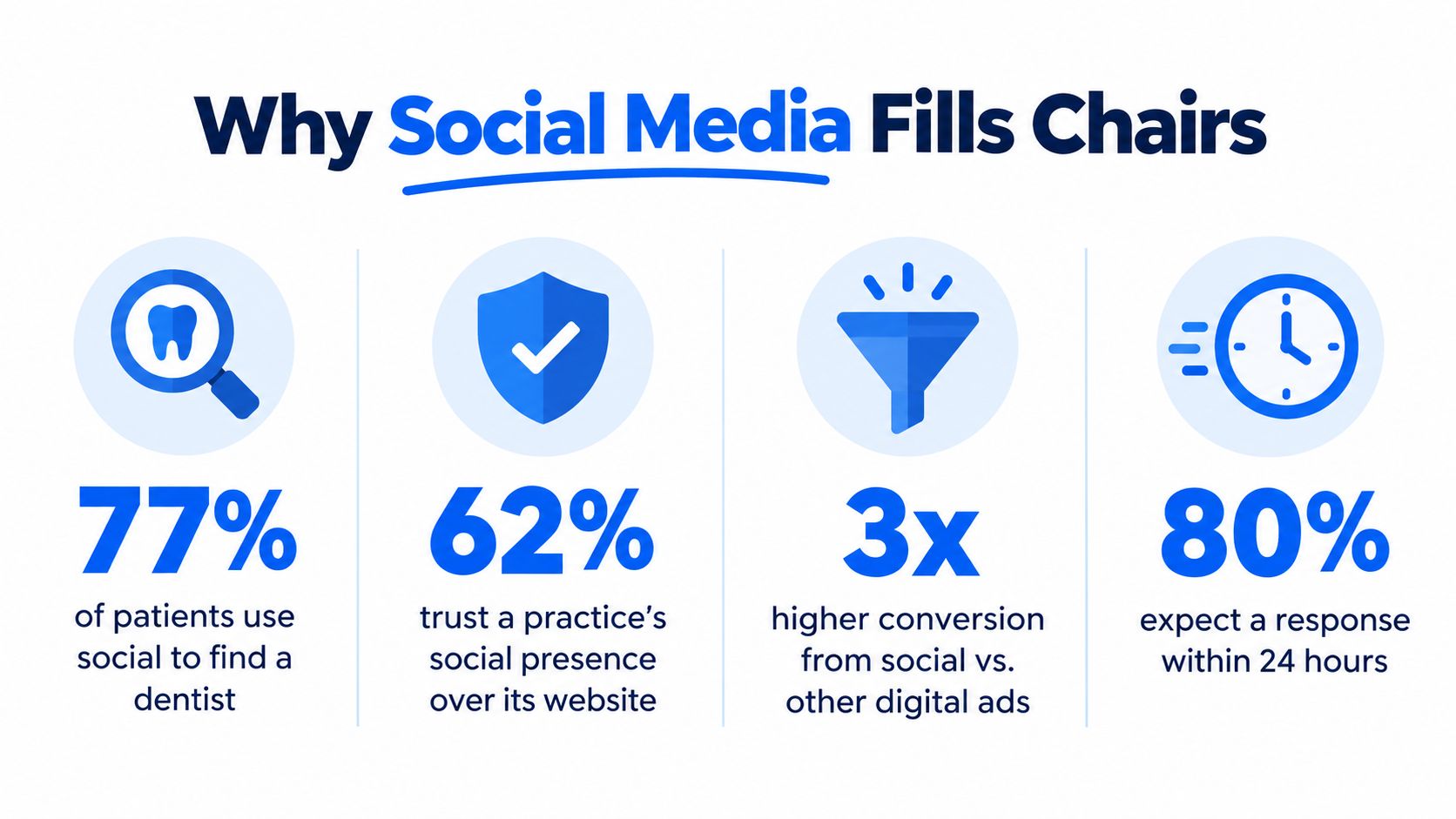
Why Social Media Fills Dental Chairs
Many practices start with the wrong question, “What should we post?” The better question is, “What makes a patient trust us enough to book?” That shift matters because people rarely choose a dentist after one touchpoint. They compare options, check reviews, scan the website, and then look at social proof before they decide.
Dental practices have been using social media for years because it supports that trust-building process. A 2016 survey found 88.8% of dental practices used Facebook to promote services, 58.9% said social media helped them gain new patients, and 73.4% said it strengthened relationships with current patients, according to the compiled statistics in the dental social media report (WebTonic dental social media statistics). That kind of use makes sense. Social posts give nervous patients a quick view of the team, the office, and the tone of care before they ever call.
What social media does well and what it doesn't
Social media works best when it shortens the trust gap. It helps a patient see the people behind the practice, the environment, and the kind of care they can expect. It is weaker as a standalone discovery channel if the profile looks stale or there is no clear path from post to booking.
Practical rule: If a post gets attention but does not make it easier to call, message, or book, it is not doing practice-building work.
That is why many practices waste time chasing reach. They post generic tips, celebrate holidays, and collect likes, but nothing on the profile helps a patient move forward. The system that works connects social proof to a website visit, a booking link, a form fill, or a call. Tracking matters here too. If you cannot tell which posts lead to inquiries, you are guessing, and guessing is expensive.
Setting Up Profiles That Build Trust and Get Found
A profile has about ten seconds to answer three questions, who are you, what do you do, and can I trust you with my teeth? That means the basics matter more than most practices admit. The handle, bio, hours, booking link, and review visibility all have to work together, or the account feels half-finished.
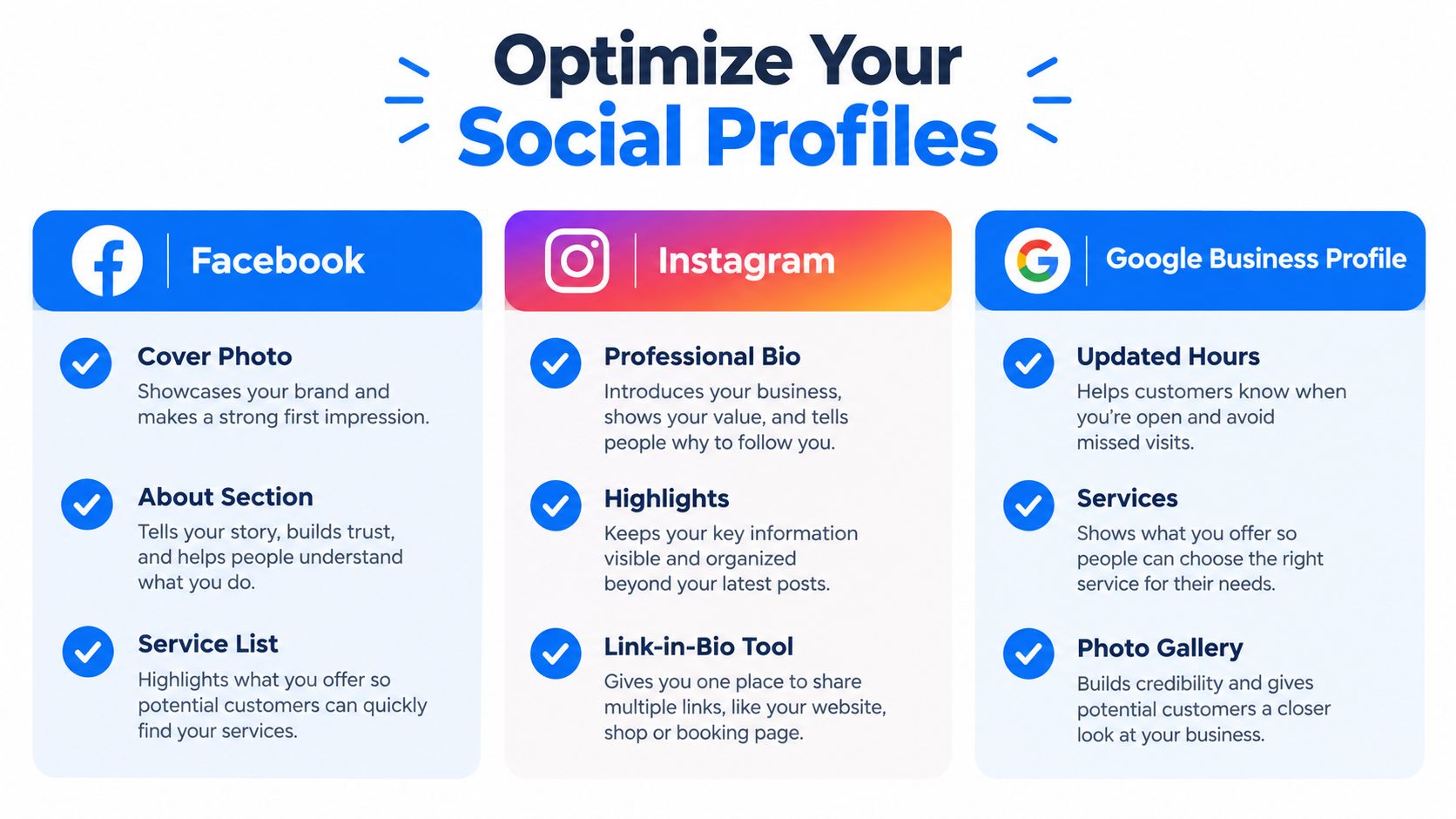
For Facebook, use a clear cover photo, complete the About section, and keep the service list current. For Instagram, write a professional bio, organize highlights around treatments and team trust, and use a link-in-bio tool that sends people to the right page fast. For Google Business Profile, update hours, services, and the photo gallery so the social visitor sees the same practice they'd find in Maps or search.
Fast audit checklist
- Consistent naming: Use the same practice name across platforms so patients don't wonder if they found the right office.
- Clear booking path: Put a booking link where it's obvious, not buried under extra taps.
- Real service language: List treatments the way patients search for them, not the way your internal software labels them.
- Recent photos: Show the office, team, and treatment spaces so the account doesn't feel abandoned.
- Visible reviews: Let the profile support trust, not hide it behind a maze of clicks.
The other piece is local consistency. The practice name, address, and phone number need to match across profiles and the website, because inconsistencies create friction before anyone gets to the booking step. If the profile looks polished but the details don't line up, people hesitate.
A profile audit takes less time than a content brainstorm, and it usually has a bigger effect. Fix the path first, then put effort into posts that send people there.
Content That Turns Scrollers Into Patients
A feed full of nice photos does not book chairs. Dentists usually lose people at the handoff from interest to action, so the content has to do more than look polished. It should build proof, explain care clearly, show the people behind the practice, and point to a next step that is easy to take.
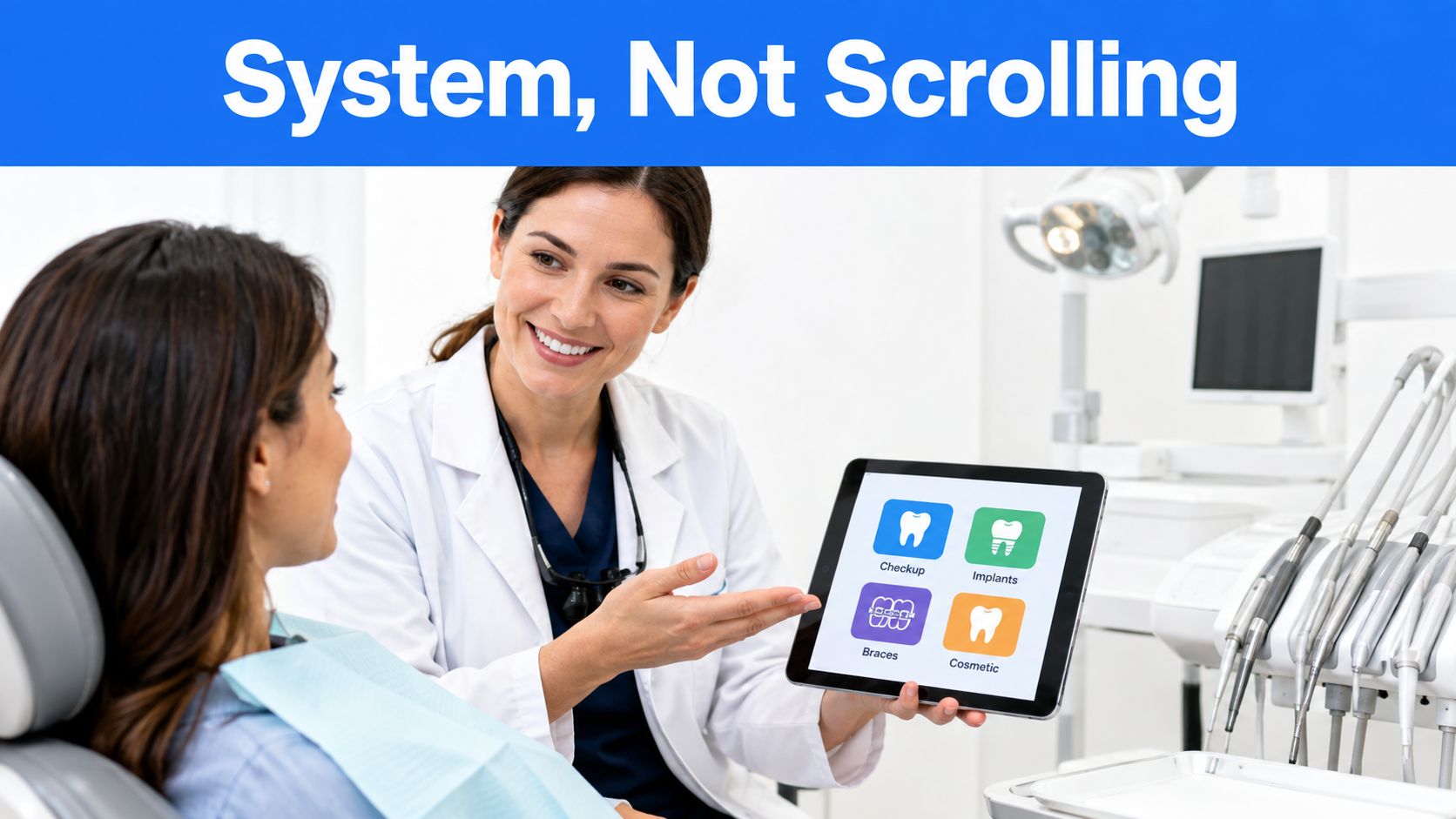
Four content pillars that support bookings
Proof. Before and after posts, patient testimonials, and treatment outcomes work because they make results concrete. Keep them compliant, keep them specific, and make the booking path obvious.
Education. Short explainers, oral health myths, and FAQ clips help patients understand what happens next. A quick answer often works better than a long caption because people can absorb it fast.
Personality. Team introductions, office culture, and community moments make the practice feel human. Patients choose people, not just services.
Promotion. New patient offers, whitening specials, consult invitations, and seasonal campaigns should all lead somewhere. If a post has no action step, it is content, not marketing.
Short-form video usually carries the most weight because it shows tone, confidence, and clarity at once. Patients do not need polished production. They need a reason to keep watching and a clear next step.
Captions should ask for the action you want, whether that is a message, a website visit, or a consult request. Keep the language direct and do not bury the offer under filler. If you want help turning raw ideas into content workflows, this guide on choosing AI tools for marketing workflows is a useful adjacent read.
A steady posting rhythm beats bursts of activity. A practice that posts consistently with a booking intent will usually outperform one that posts more often but leaves people hanging at the end of each post.
Running Paid Social That Lowers Cost Per Booked Patient
Organic content builds familiarity. Paid social lets you choose who sees the message and how hard you push the offer. That matters because the right local audience, paired with a clear offer, is a lot more useful than a broad post that hopes for attention.
A practical starting point is to separate three decisions. First, whether the goal is awareness, lead capture, or a website booking. Second, whether the offer is high intent, like whitening or an Invisalign consult. Third, whether the landing flow is ready to convert interest into a real inquiry.
Choosing Your Paid Approach by Goal
| Goal | Best Tactic | When to Use |
|---|---|---|
| Local awareness | Boost a strong organic post | When the content already earns comments or saves |
| Lead capture | Lead ads | When the practice wants quick inquiries with a simple form |
| Booked visit | Site traffic to a dedicated landing page | When the offer has a clear booking path and follow-up is ready |
Meta campaigns can work well for dentists, but weak offer-to-audience fit will burn budget fast. One industry comparison cited in the brief pointed to a roughly $77 dentist Facebook lead benchmark, a best-case cost per qualified lead near $58, CTR around 3.06%, and CPM around $15.68, while also warning that poor landing conversion can push costs up even when clicks look cheap (Delmain Meta ads for dentists). Those numbers are useful as a direction check, not a promise, because the issue is whether the campaign turns traffic into booked patients.
If you want a full comparison of paid channel trade-offs, this breakdown of Google Ads vs Meta Ads is worth keeping nearby.
Cheap clicks don't matter if the landing page doesn't carry the conversation forward.
For dentists, the winning structure is simple, local targeting, one clear offer, one clean landing page, and a follow-up path that contacts the lead quickly. That's better than running everything through a generic homepage and hoping people sort it out themselves. If the page asks too much effort, cost per lead climbs, even when the ad is doing its job.
From Click to Chair With Tracking Retargeting and Follow Up
Social media only pays off when you can connect the click to the appointment. Without that link, the practice sees likes, comments, and maybe some message requests, but no reliable picture of what filled chairs. That's where tracking, retargeting, and fast follow-up change the game.
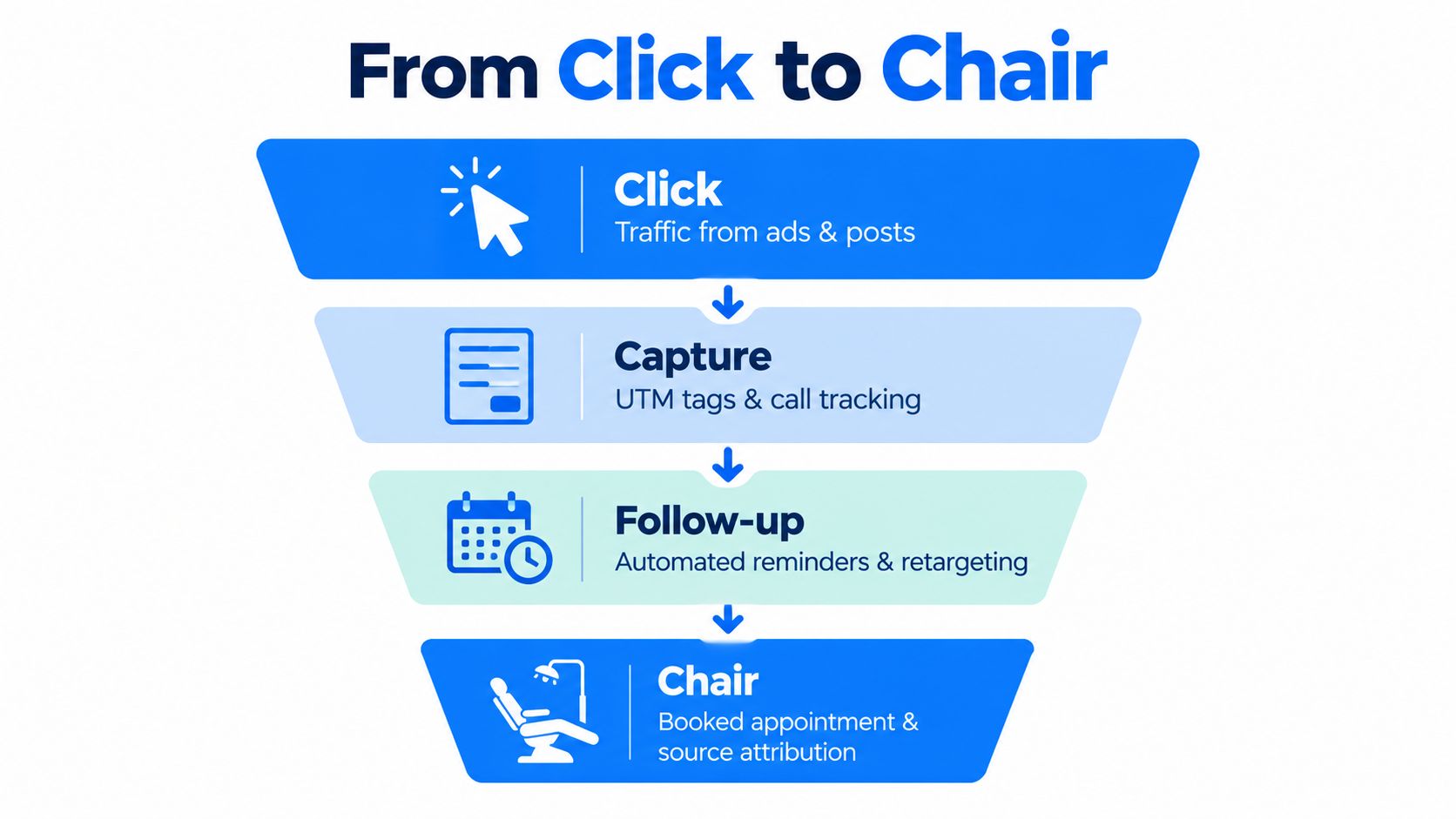
Make every lead traceable
Use UTM parameters on social links, call tracking on ad-driven numbers, and intake-form source capture so the front desk can see where the patient came from. That gives you a cleaner answer than “I think Instagram helped.” It also lets you calculate ROI as (revenue from social-media patients − total social-media spend) / total social-media spend × 100, which is the only math that matters once a campaign is live (Dental Reviewed social media marketing guide).
Follow up before the lead goes cold
The fastest practices respond while interest is fresh. Automated SMS follow-up keeps the conversation moving, and retargeting brings back people who clicked but didn't book on the first pass. If the creative and the landing page are aligned, the reminder sequence becomes a second chance instead of a repair job.
For teams that want a single stack for ad creation, tracking, and lead follow-up, benjiads is one option that runs Facebook and Instagram ads for dental practices and routes interested patients toward text-based follow-up.
What to watch in reporting
- Bookings, not impressions: A post can look healthy and still fail to create appointments.
- Source capture quality: If the front desk can't tell where the lead came from, attribution is broken.
- Retargeting response: People often need a second touch before they book.
- Lead speed: Slow follow-up lowers the odds that a curious prospect becomes a patient.
The biggest mistake is measuring social media like a brand page instead of a pipeline. When booking data, ad data, and front-desk notes line up, you can see what earns production instead of guessing.
Your 30 Day Plan to Launch and Keep Improving
The first month should be about building a system, not chasing volume. Week one, clean up the profiles and make the booking path obvious. Week two, publish a few content pieces that show proof, explain a service, and introduce the team. Week three, launch a small paid test with one offer and one landing page. Week four, review what produced inquiries, not what attracted the most reactions.
A sensible starting budget from the brief is $300 to $800 per month for solo practices, $800 to $2,000 for small practices, and $2,000 to $5,000+ for multi-location groups (Dental Reviewed social media marketing guide). Keep the review focused on three things, booked appointments, cost per lead, and whether the right sources are being captured by the front desk. Everything else is secondary.
Common mistakes show up fast. Practices optimize for followers, let follow-up lag, or post patient photos without handling consent and privacy correctly. Fix those problems early, and the rest of the system has a chance to work.
If you want social media to produce appointments instead of noise, treat every post, ad, and message like part of the same booking path. Keep the content useful, keep the tracking honest, and keep the response time short.
If you want a practical setup for paid social, tracking, and follow-up without juggling separate tools, visit benjiads and see how it handles dental ad creation, launch, tracking, and SMS lead follow-up in one workflow. It's built for local practices that want social media marketing to connect to booked visits, not just engagement.
- social media marketing dentist
- dentist social media
- dental marketing strategy
- dental Facebook ads
- patient acquisition

NEW PATIENT APPOINTMENTS
New patient appointments
Text about your visit
Ads created · live on FB & IG
For dentists
Your dentist ads, live in 2 minutes.
- ✓ Ads created for you
- ✓ Every lead texts your phone
- ✓ 3 days free · $29.90/mo
748+ local businesses run ads with benjiads