pest control marketing 14 min read
Pest Control Marketing That Turns Ad Spend Into Jobs
Build pest control marketing that books real jobs, not just leads. Learn channels, messaging, budgets, and tracking that turn ad spend into verified revenue.
On this page
- Why Pest Control Marketing Runs on Different Physics
- The Market Reality Operators Are Marketing Into
- Choosing Channels by Emergency Versus Preventive Demand
- Winning the DIY-to-Professional Handoff
- Response Window and Follow-Up That Books Jobs
- Budgets, Benchmarks, and a Worked Monthly Plan
- Tracking That Measures Booked Jobs, Not Just Forms
- A 90-Day Operating Cadence for Local Pest-Control Marketing
A homeowner notices scratching behind the wall on Monday morning. They search for “rodent control near me,” click the first credible result, and submit a form while getting ready for work. By lunch, the lead is still sitting in an inbox. Meanwhile, a different homeowner has spent several weekends applying store-bought treatment, the problem keeps returning, and they're finally searching for an inspection rather than another product.
Those two prospects need different messages, different landing pages, and different follow-up. Treating them as one “local service” audience is how pest-control ad accounts generate attractive lead counts but disappointing schedules.
Why Pest Control Marketing Runs on Different Physics
A pest-control operator can have campaigns active, a healthy-looking click-through rate, and a full CRM while the dispatcher still has empty slots. The failure usually happens between interest and action. An urgent searcher wants to know whether someone can help quickly. A homeowner with a recurring issue wants confidence, diagnosis, and a sensible next step. Neither wants to decode a generic homepage.
Pest control marketing behaves differently because the purchase window can be short, the problem is often emotional or urgent, and a first treatment can lead to an ongoing service relationship. The campaign must therefore answer four operational questions:
- What is the intent? Emergency infestation, species-specific treatment, inspection, or prevention.
- Who responds, and how quickly? A lead that waits in a shared inbox is not equivalent to a lead reached by a dispatcher.
- What is the commercial value? A recurring customer should not be evaluated like a one-time nuisance call.
- What happened? A form submission is only an early signal. The meaningful outcome is a qualified conversation, booked job, completed service, or plan start.
Practical rule: Optimize the funnel around the event your office celebrates, not the event an ad platform makes easiest to count.
On a busy Monday, this distinction matters more than another round of headline tweaks. The owner needs to know which query produced the call, whether the caller was in the service area, how long it took to respond, and whether the appointment became revenue. A measurement resource such as BenchKey can help teams organize marketing benchmarks, but no benchmark replaces the operator's own booked-job and retention data.
The strongest programs align intent-led channel selection, response-window discipline, recurring-value economics, and verified booking attribution. Miss one, and the account may look efficient in a report while the schedule tells a different story.
The Market Reality Operators Are Marketing Into
The U.S. structural pest-control market reached approximately $13.416 billion in service revenue in 2025, compared with $12.654 billion in 2024, according to market data summarized by MoonSauce. The same source counts 16,565 pest-control firms, and 81.4% operate one or two locations.
That structure changes the marketing brief. You're usually not competing against a single national brand with identical coverage everywhere. You're competing in a tight geography against small operators whose reputation, response time, service-area accuracy, and treatment specialization can decide the call.
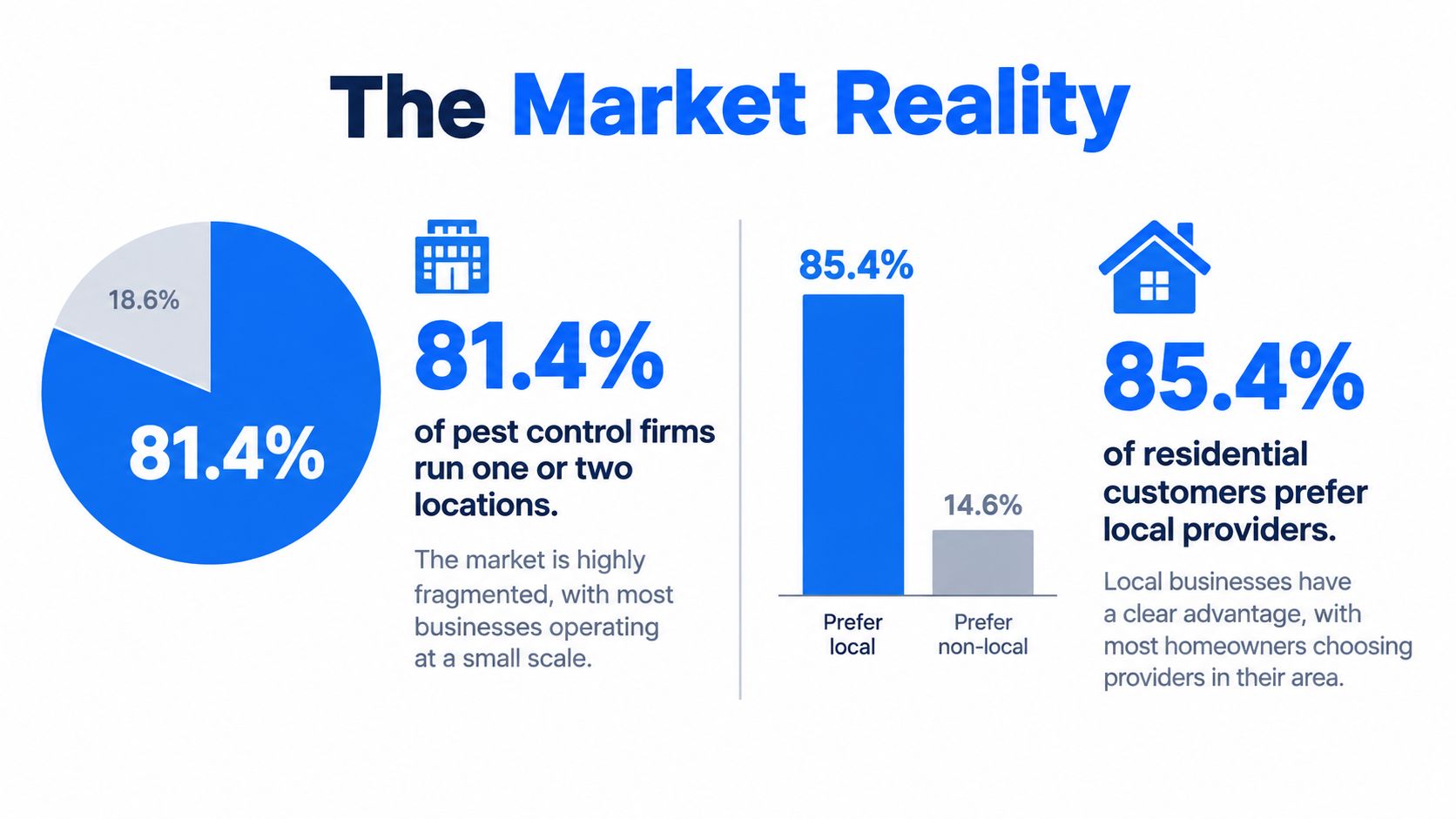
The addressable customer pool is also substantial. Residential providers served nearly 13.29 million customers in 2025, creating room for campaigns segmented by geography, pest type, property need, and urgency rather than one broad “pest control” message. A page for termite inspections should not be forced to sell the same proposition as a page for a wasp nest or a quarterly general pest plan.
Recurring revenue changes the acquisition math
Residential service plans generated 85.4% of residential pest-control revenue in 2025, up from 85.2% the previous year, based on the same market source. That doesn't mean every lead should be pushed immediately into a recurring plan. It does mean the marketing team should ask whether the first job creates a credible path to ongoing protection.
The right campaign brief includes more than cost per lead. It should include:
- First-job economics: Can the service be delivered profitably in the target area?
- Plan potential: Does the problem naturally lead to monitoring, prevention, or seasonal treatment?
- Follow-up quality: Does the office contact, educate, and schedule the prospect properly?
- Review and referral opportunity: Can a good service experience produce trust signals for the next local searcher?
The wrong objective is “be the cheapest call.” The better objective is to acquire a customer who can be served well, retained appropriately, and measured from first contact through renewal.
Choosing Channels by Emergency Versus Preventive Demand
Start with the problem the customer is trying to solve, not the platform you happen to manage. Emergency demand is explicit and immediate. Preventive demand is broader, slower, and more education-led.
Search and Local Services Ads usually deserve priority when someone is actively looking for bed bug treatment, rodent removal, termite help, or a nearby inspection. The query already contains a problem and often a location. The landing page should match that wording, show service-area proof, make the next step obvious, and avoid sending the visitor through a generic navigation maze.
Preventive demand needs a different engine. Local SEO, a complete Google Business Profile, useful species and seasonal content, review generation, email, retargeting, and referral relationships help the business become familiar before the homeowner reaches a crisis point. Meta can support education and retargeting, but it's a weak substitute for search when the prospect is actively trying to hire someone now.
Google Search
- Best fit demand
- Emergency and species-specific
- What it carries
- High-intent calls, forms, and inspection requests
- Weakness
- Competitive clicks and expensive broad terms
Local Services Ads
- Best fit demand
- Immediate local hiring
- What it carries
- Calls and direct service inquiries
- Weakness
- Lead quality varies, and availability affects value
SEO and Google Business Profile
- Best fit demand
- Preventive and local discovery
- What it carries
- Trust, map visibility, education, and branded demand
- Weakness
- Takes time and requires consistent upkeep
Meta ads
- Best fit demand
- DIY education and retargeting
- What it carries
- Visual explanations, offers, and follow-up audiences
- Weakness
- Users may not be shopping when they see the ad
Referrals and direct mail
- Best fit demand
- Preventive and community demand
- What it carries
- Introductions from partners and neighborhood awareness
- Weakness
- Attribution can be incomplete without disciplined intake
Use separate ad groups for emergency, species, inspection, and preventive terms. Younger homeowners often discover providers through search, with 33% of Gen Z and 24% of millennials identifying search engines as their primary discovery method, according to directional industry-association data from PestWorld's homeowner marketing guidance. The source is not an independent academic population study, so use those figures as planning signals rather than universal rules.
A blended account average can hide the opportunity. Report impression share, qualified-call rate, booked-job rate, and revenue per click by intent class and service area.
Winning the DIY-to-Professional Handoff
Most pest-control funnels ask for the recurring plan too early. That pitch makes sense to an experienced buyer who already trusts professional treatment, but it can feel like a large commitment to someone who has just tried a store-bought spray, trap, bait, or online recommendation.
A 2025 homeowner-expectations survey found that 54% of respondents still handle pest control themselves, while only 10–14% subscribe to recurring services, as reported in the survey's homeowner takeaways. The useful conclusion isn't that DIY is always wrong. It's that many prospects enter the professional market only after uncertainty, recurrence, safety concerns, or failed results.
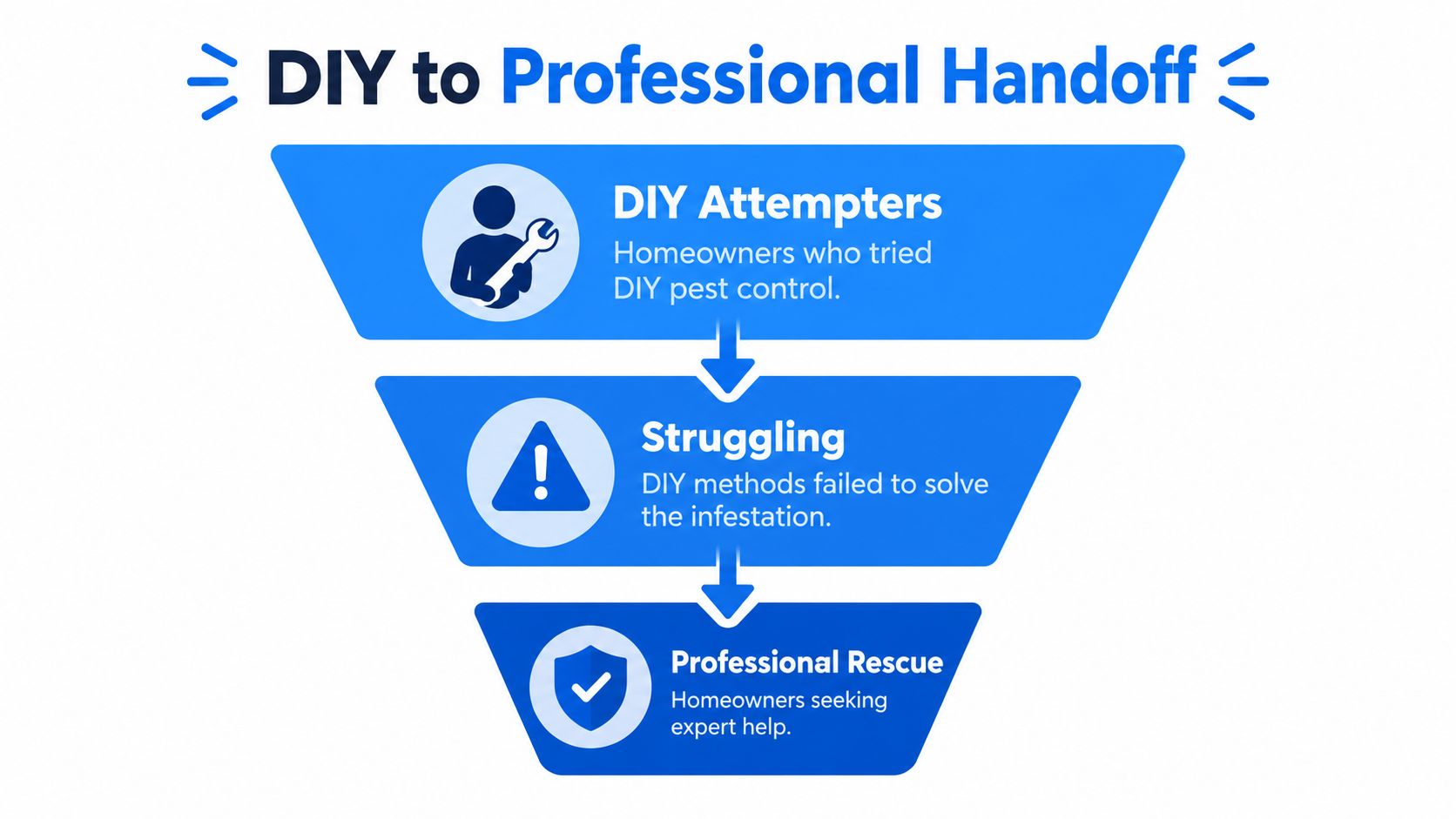
Build the first conversion around diagnosis
A homeowner who says, “I've tried everything,” may not be ready to buy quarterly service. They may be ready to identify the pest, send a photo, describe where they're seeing activity, or book a transparent inspection.
Useful entry points include:
- Species-identification guide: Help the visitor distinguish common signs and explain what evidence matters.
- Photo-based assessment: Let the prospect submit an image with explicit consent for follow-up.
- Clear inspection offer: State what the technician will assess, what the visit includes, and what happens afterward.
- Text consultation: Give the homeowner a low-friction way to explain the issue before choosing a service.
The landing page should acknowledge the failed DIY attempt without shaming the customer. “Still seeing activity after treatment?” is more relevant than “Protect your home all year.” The follow-up should ask what they tried, when they applied it, where activity continues, and whether there's a health, structural, or immediate safety concern.
That handoff also improves the sales conversation. The technician isn't starting with an abstract plan pitch. They're responding to a specific problem and can explain whether a one-time treatment, exclusion work, monitoring, or recurring prevention makes sense. Guidance on booking more home service jobs is useful here because the conversion depends on reducing friction between inquiry, qualification, and scheduling, not merely increasing traffic.
Response Window and Follow-Up That Books Jobs
Response speed is an operating variable, not a slogan. PipelineON's pest-control marketing guidance cites emergency pest keywords at roughly 15–20% conversion, compared with approximately 5–8% for preventive-service keywords. It also cites research claiming that contacting a lead within five minutes makes conversion 100 times more likely than waiting 30 minutes. Because the publication attributes that response claim to MIT and InsideSales research without showing the underlying study design, use the figures as directional rather than as a forecast.
The reliable operating conclusion is straightforward: urgent inquiries need an immediate, engineered response.
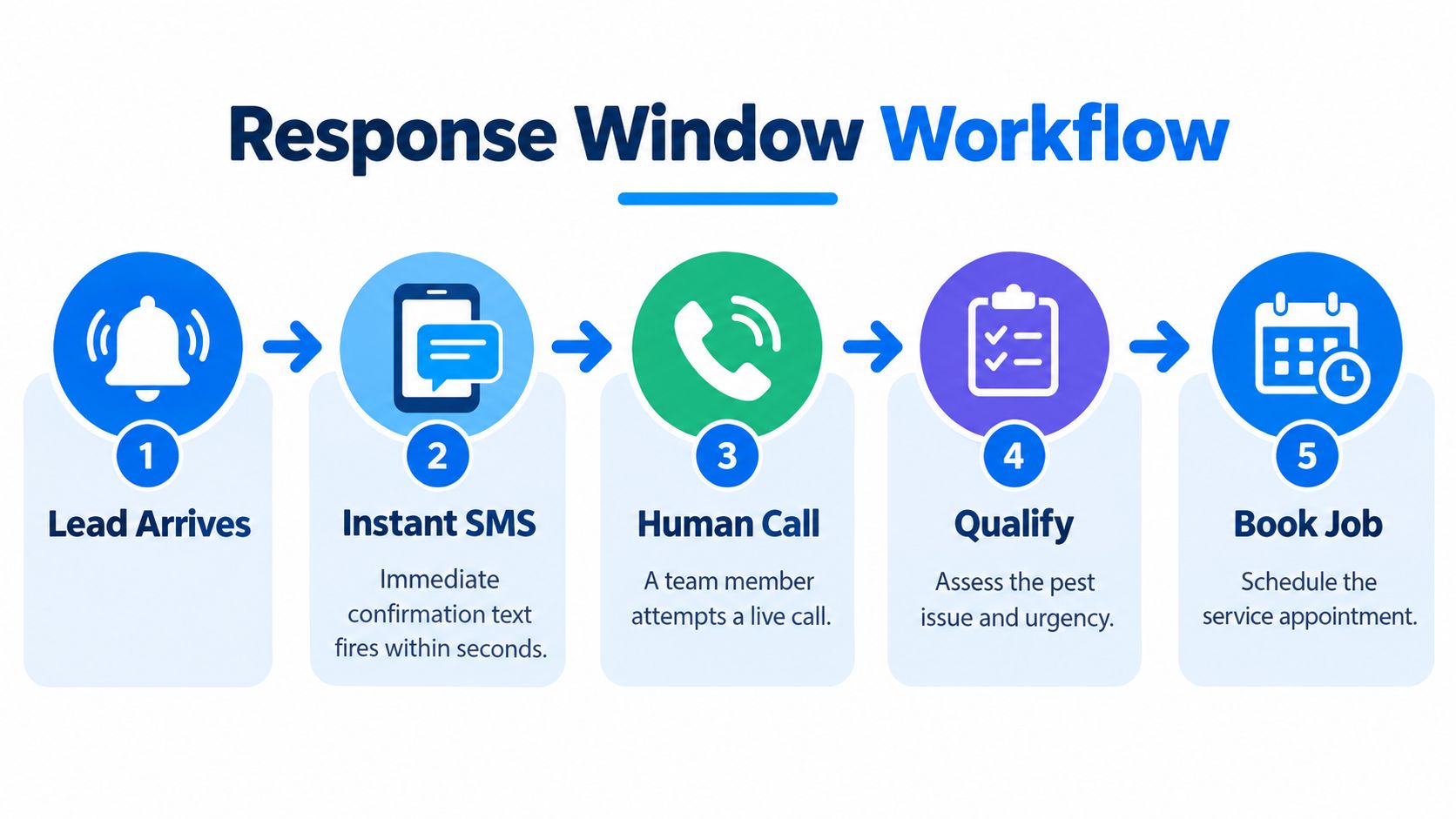
A dispatcher-ready protocol should work like this:
- Lead arrives: Capture the source, query or campaign, location, service type, and consent status.
- Confirmation SMS fires: Send the business name, expected next step, and opt-out instructions immediately.
- Human call follows: During operating hours, attempt a live call within five minutes. Automation should support the conversation, not replace it.
- Issue gets qualified: Identify the pest, urgency, property type, prior DIY treatment, access constraints, and service-area fit.
- Appointment gets booked: Record the scheduled service, rather than counting the conversation as a conversion.
Urgent infestation leads need a faster route than inspection or maintenance inquiries. Set up priority escalation, use an on-call dispatcher when available, and give staff scripts that check for immediate conditions. Preventive inquiries can receive a more educational sequence, but each lead still needs an assigned owner, defined retry schedule, and clear stopping point.
The dashboard should record delivery, reply, connection, qualification, appointment, completion, and revenue. A low-cost form has no commercial value if the office cannot reach the homeowner or the homeowner never schedules. For implementation detail, this guide to speed-to-lead workflows provides a useful reference.
Judge the system by cost per booked job, booking rate, and revenue, not cost per form. SMS follow-up must be consent-based, identify the business, respect opt-outs, and stop once the customer has been reached or booked.
Budgets, Benchmarks, and a Worked Monthly Plan
Paid search gives operators useful reference points, but benchmark averages are not targets. LocaliQ's home-services data reports 4.31% click-through rate, $6.55 average cost per click, and $39.25 cost per lead for pest and rodent-control search campaigns. The same benchmark reports an average lead value of $1,250 and a pest-control search lead-conversion rate of 15.52%, compared with 10.22% across home-services search advertising overall, as summarized by Click Vision's home-services marketing benchmarks.
For a local operator working with a $3,000 monthly media budget, I'd treat those figures as a planning model, not a promise. One workable starting allocation is to put the largest share into high-intent Google Search, a meaningful but controlled portion into Local Services Ads, and the remainder into Meta campaigns aimed at DIY education, retargeting, and local awareness. The exact split should follow service capacity, pest mix, and verified booked-job performance.
A practical allocation logic
Start Search with separate campaigns for urgent species, general service, inspection, and preventive terms. Give urgent campaigns the strongest protection because their intent is clearer, then cap geography tightly enough that the dispatcher can serve the calls profitably.
Use Local Services Ads only where the business can answer and schedule consistently. A lead that arrives outside practical coverage is not a win. Meta belongs lower in the funnel hierarchy at first, unless the operator already has strong creative, a useful DIY handoff offer, and a functioning retargeting audience.
If cost per booked job rises, don't immediately raise the budget to “buy more data.” First inspect search terms, service-area leakage, missed calls, qualification quality, and landing-page relevance. Cut the campaign or ad group that produces unserviceable or unbooked demand before cutting a channel based only on raw lead cost.
| Metric | Benchmark figure | What it means for your account |
|---|---|---|
| Search click-through rate | 4.31% | A reference for ad and query relevance |
| Average cost per click | $6.55 | A planning input, not a local bid guarantee |
| Cost per lead | $39.25 | Useful only when lead quality and booking rate are known |
| Average lead value | $1,250 | Consider recurring potential, not just first-ticket revenue |
| Pest-control search conversion | 15.52% | A directional category benchmark for landing-page performance |
| Home-services search conversion | 10.22% | A broader comparison point |
Pricing content can also improve qualification. When a homeowner is comparing options, a local resource such as compare Miami pest control estimates can help frame the questions prospects ask before they call. Don't hide every pricing conversation behind a form. Explain what changes the estimate, what an inspection determines, and what the next step includes.
Tracking That Measures Booked Jobs, Not Just Forms
A serious pest-control marketing account needs an event trail from first exposure to retained customer. The minimum useful sequence is impression, click, call or form, qualified lead, appointment, completed service, plan sold, and plan renewed.
Client-side tags help ad platforms learn from page visits, calls, and form activity. Server-side or CRM-based events return the outcomes the browser cannot reliably see, such as a dispatcher's qualification decision, a completed treatment, or a recurring plan sale. Use both where practical, then reconcile them instead of treating either platform's dashboard as the final ledger.
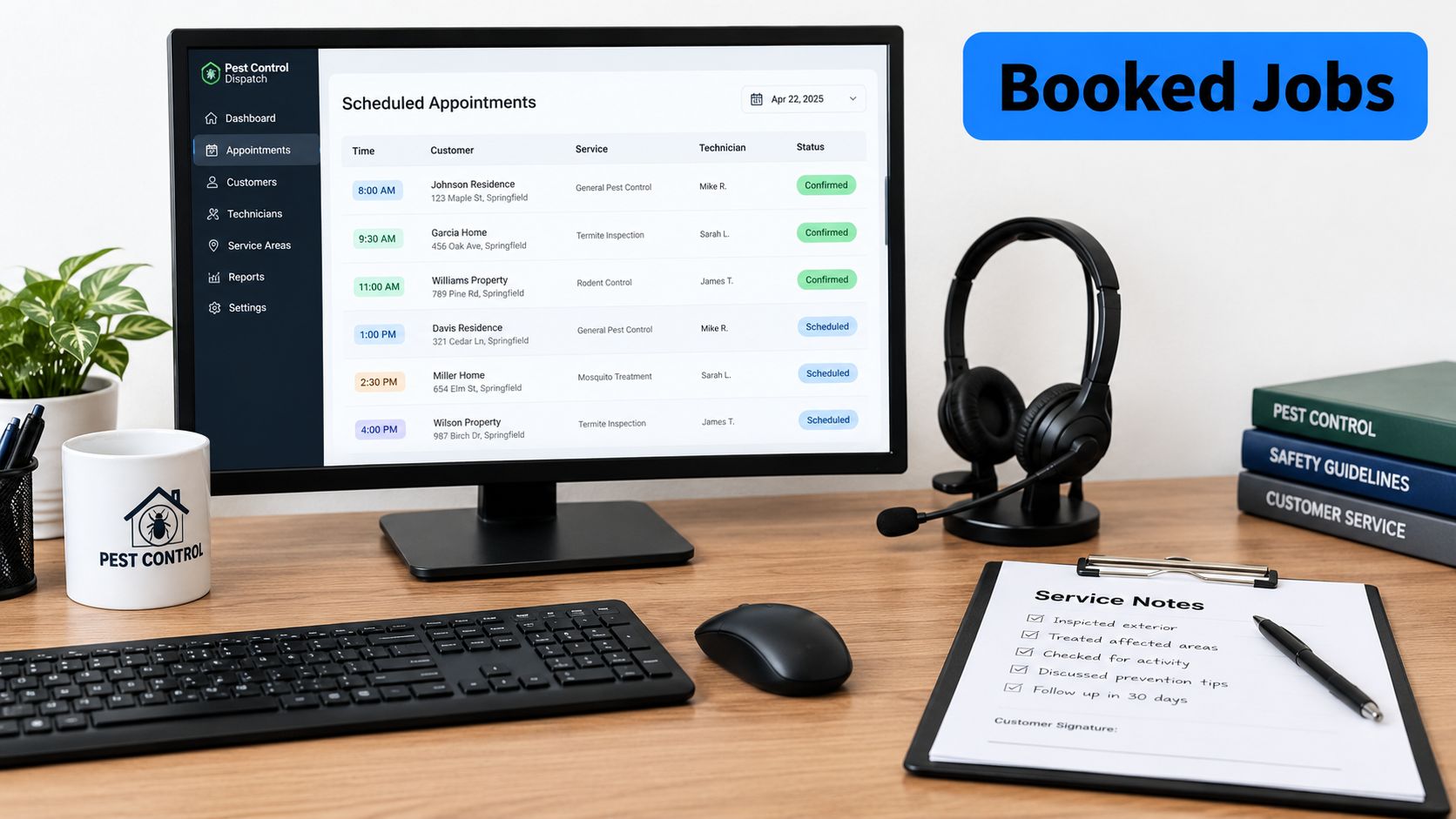
Dynamic number insertion and call-tracking numbers can associate calls with campaigns and landing pages. The CRM should preserve the source, campaign, service line, location, disposition, appointment status, and revenue outcome. Upload qualified and closed-won events back to advertising platforms when the systems support it, while protecting consent and customer privacy.
Resolve attribution disagreements operationally
Google and Meta may both claim credit for the same customer. That doesn't necessarily mean one is broken. Their attribution windows and reporting rules differ, and a person can see an ad, search the business later, and call from a branded result.
Use a consistent internal source of truth for budget decisions. The office disposition and completed-job record should outrank a platform's modeled conversion when deciding whether to expand a campaign. If a campaign generates many forms but few qualified calls, the mismatch is a sales and tracking signal, not a reason to celebrate the form count.
For a deeper implementation reference, review conversion tracking software for lead attribution. The practical standard is straightforward: if you can't connect spend to a verified booked job and understand whether that customer entered a recurring relationship, you're measuring activity rather than acquisition.
A 90-Day Operating Cadence for Local Pest-Control Marketing
A 90-day plan should make the account easier to manage, not create another calendar nobody follows. Assign one owner to marketing, one to lead handling, and one to the booking and revenue record. Review the same scorecard every time.
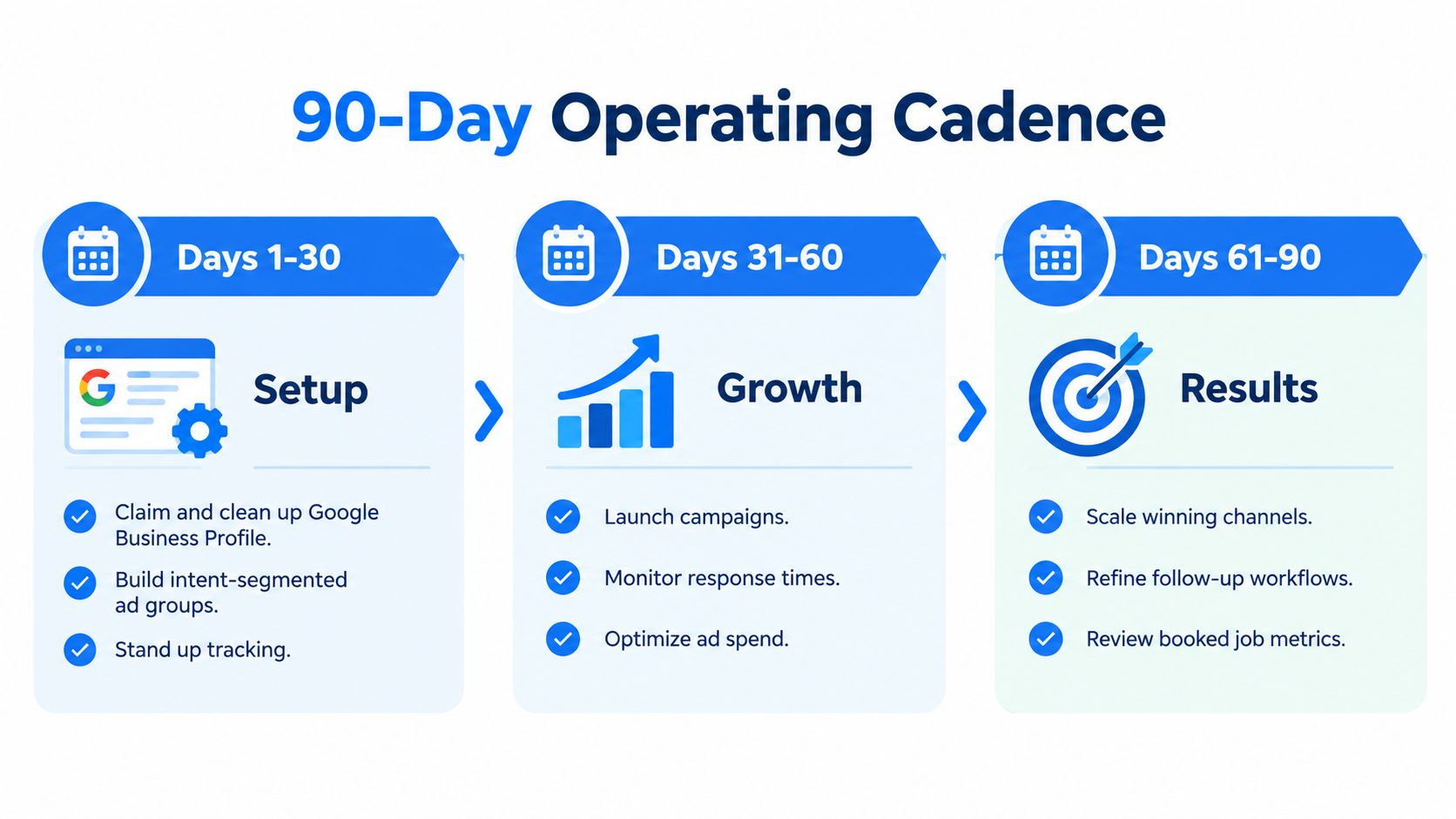
Days 1 to 30, establish control
Clean up the Google Business Profile, confirm service areas and hours, and make sure the website has distinct pages for priority pest types and locations. Build intent-segmented search campaigns instead of one broad ad group. Create the DIY-to-professional offer, install consent-based SMS intake, and train the dispatcher on the urgent and inspection scripts.
Before spending aggressively, verify that calls, forms, appointment events, and revenue statuses reach the reporting system. Use the campaign-launch guidance as a checklist for approvals, but keep the final stop and start decisions tied to operational readiness.
Days 31 to 60, improve the handoff
Compare emergency, species-specific, inspection, and preventive performance separately. Test one meaningful variable at a time, such as the offer, headline, service-area proof, form length, or call-to-action. Pause search terms that attract irrelevant pests, locations, jobs, or expectations.
Launch the DIY handoff through search and Meta retargeting. Ask whether prospects are submitting useful information and whether dispatchers can reach them quickly. If response times slip or the team cannot service the geography, reduce exposure before adding new channels.
Days 61 to 90, scale what survives contact with operations
Move budget toward campaigns that produce completed jobs and credible recurring-plan starts, not merely low-cost inquiries. Ask completed customers for honest reviews through a consistent process, and build referral prompts into the post-service experience. Review cancellations and missed appointments alongside acquisition data, because a campaign that fills the calendar with poor-fit work can damage capacity.
Pause scaling when source data is missing, urgent leads remain unanswered, service areas are unprofitable, or the booked-job rate is falling while form volume rises. Scale only after the dispatcher, technician capacity, and measurement system can support the next increment of demand.
BenjiAds helps local service businesses build and manage paid campaigns, landing funnels, SMS lead follow-up, and client-side and server-side conversion tracking without requiring owners to operate every advertising tool manually. If your pest-control team wants to turn DIY handoff campaigns into a measurable booked-job workflow, visit benjiads to review the platform and decide whether it fits your operation.
- pest control marketing
- pest control advertising
- local pest control leads
- pest control SEO
- pest control funnel
Done for you
Ads that text you customers.
- ✓ Ads created for you
- ✓ Every lead texts your phone
- ✓ Free to use, no credit card
748+ local businesses run ads with benjiads