marketing a salon 15 min read
Marketing a Salon: A Practical Plan to Get More Bookings
Learn how to approach marketing a salon with a local-first plan for ads, creative ideas, retention, and simple automation that turns inquiries into booked
On this page
- Why Salon Marketing Is Really a Conversion Problem
- What the Numbers Say About Local Salon Discovery
- Building Your Local Conversion Foundation
- Running Local Ads That Fill Chairs, Not Just Feeds
- Recovering Bookings You Have Already Paid For
- Retention and Rebooking Without Training Clients to Discount
- Your 30-Day Marketing Plan and Weekly Operating Rhythm
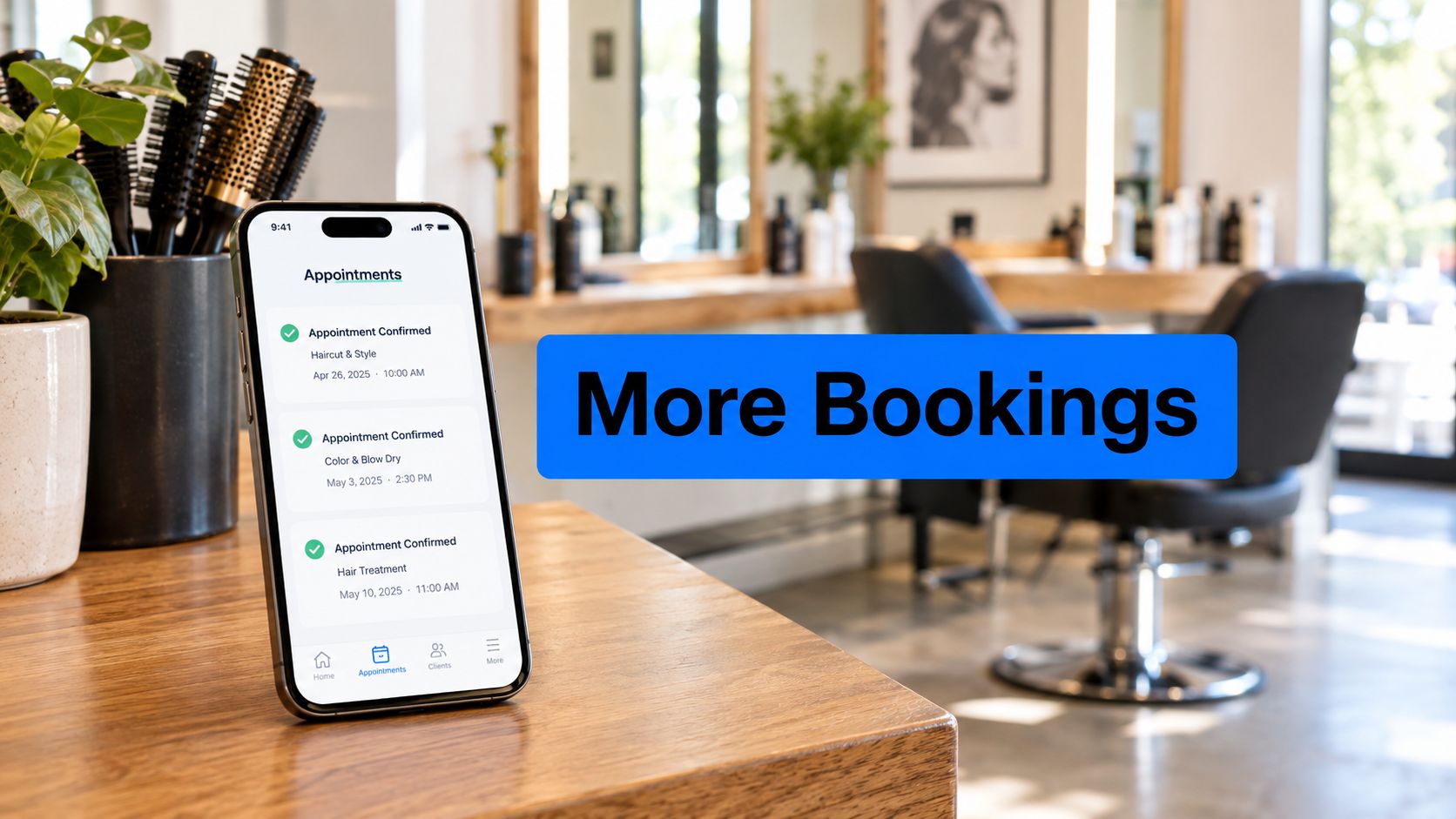
Marketing a salon works best when you treat it as a local conversion system, not a content hobby. Drive nearby traffic to a mobile-first booking page, answer fast, and rebook before the client leaves, because 71% of salon regulars say they've abandoned a booking when reaching the business or using the online system was too difficult, and 73% say easier booking and communication would increase loyalty.
Most salon owners are getting bad advice. They're told to post more, polish their Instagram grid, and chase engagement, while the leak sits in plain sight: missed calls, slow replies, abandoned booking forms, weak follow-up, and no rebooking process at checkout. That's not a content problem. It's an operations problem disguised as marketing.
If you want more booked appointments, stop judging your marketing by likes, reach, or whether a Reel “did well.” Judge it by whether a local prospect found you, trusted you, contacted you, got a fast answer, booked on mobile, showed up, and came back again. That's what fills chairs.
Why Salon Marketing Is Really a Conversion Problem
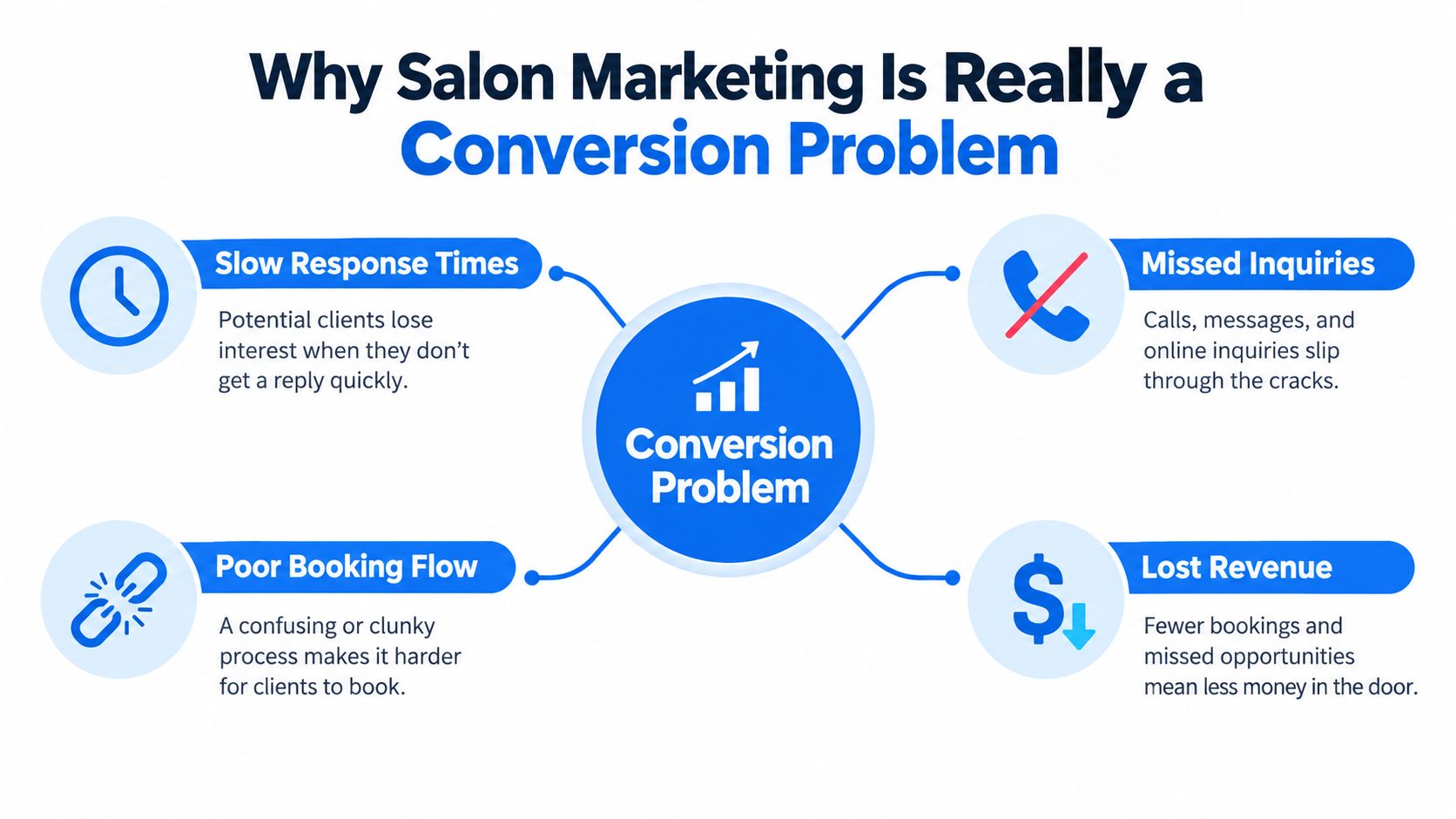
Salon marketing wastes money when visibility comes before conversion. Starting with content puts the cart before the horse: the funnel behind the post decides whether visibility pays.
A salon can publish strong before-and-after work all week and still lose revenue when prospects meet a clumsy booking page, wait too long for an answer, or leave without a rebooking prompt. Treat marketing a salon as a conversion and follow-up system before treating it as a creative exercise. Weak back-end operations turn every new impression into another chance to lose an interested customer.
Empty chairs usually come from friction
Booking friction wastes demand that already exists. 71% of salon regulars reported abandoning a booking because reaching the business or using its online system was too difficult, while 73% said easier booking and communication would increase loyalty, according to Zenoti's salon booking survey findings. A large share of weak marketing performance therefore comes from conversion failure after interest already exists.
Practical rule: If someone already tried to book, recovering that intent comes before any new awareness campaign.
That principle applies beyond beauty. Local business marketing strategies for transactional search prioritize prospects ready to act, rather than audiences who may enjoy a post and disappear. Build your process around the moment of intent: answer promptly, remove booking obstacles, and give undecided visitors a clear next action.
What owners should measure instead
Track the path from click to chair:
- Qualified local traffic: nearby visitors reaching a booking page, rather than random impressions
- Speed to response: how quickly the team answers calls, texts, and form submissions
- Booking completion: whether interest becomes a confirmed appointment
- Follow-up and second visit: whether the first appointment produces repeat revenue
Use this guide to optimize the conversion funnel if you need a practical framework for moving prospects from inquiry to sale. The point is simple: measure actions that create appointments, not vanity metrics that only make a report look busy.
A strong salon marketing system creates demand, captures it, and recovers the opportunities that would otherwise leak away.
What the Numbers Say About Local Salon Discovery
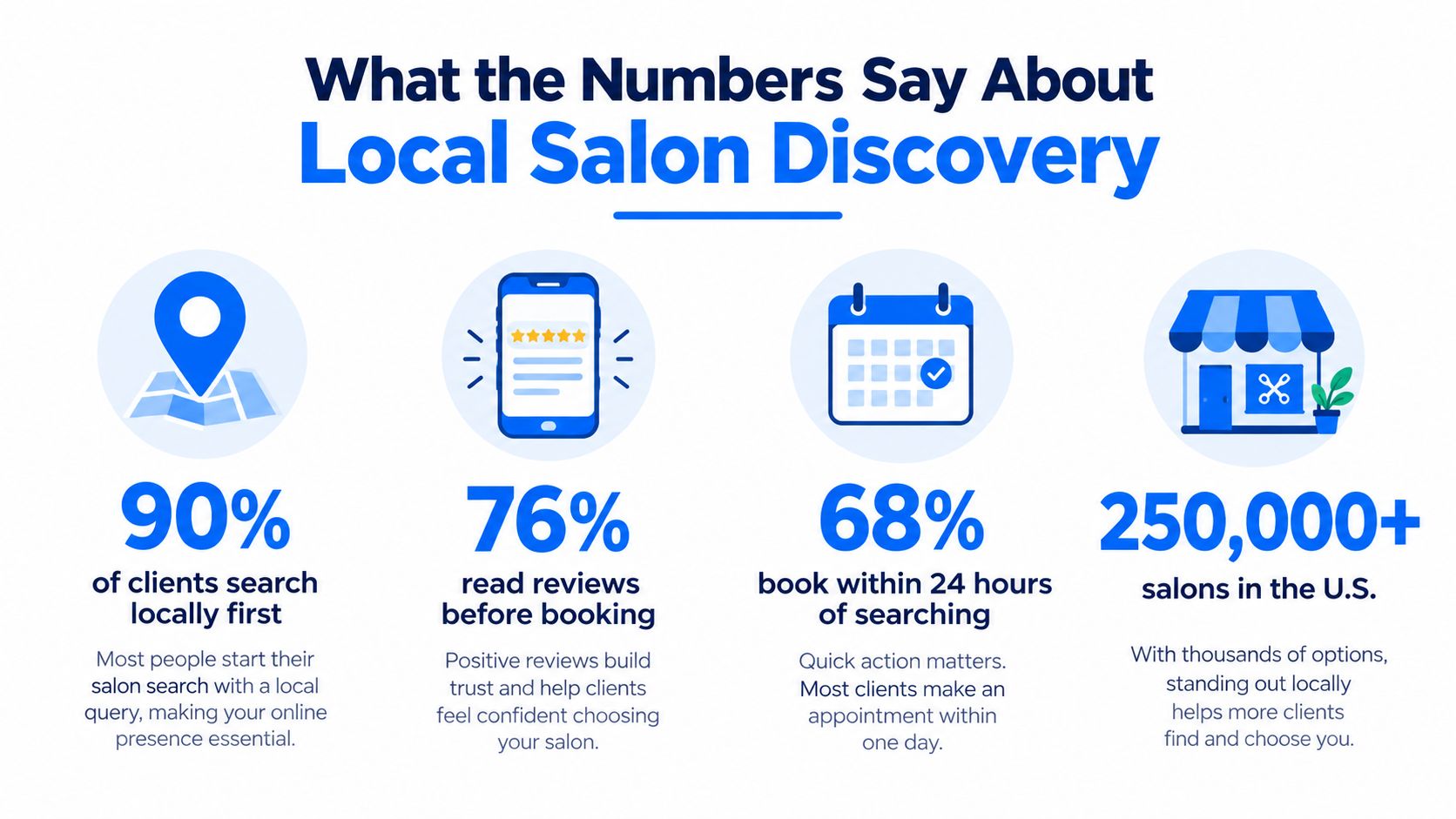
Salon demand is local, so marketing must win the nearby comparison. Clients searching for a haircut, color refresh, facial, or manicure usually compare salons close to home. They check proof, assess convenience, and decide quickly.
The market is large, but local competition remains fragmented. Statista's U.S. salon revenue summary reports that the beauty-salon category took a sharp hit during the pandemic and had not fully returned to its pre-pandemic size in the latest summary. Its source set also cites an industry estimate of roughly $49.3 billion in U.S. beauty-salon sales in 2025, with average annual growth of 9.8% over the previous five years. For an owner, the takeaway is practical: improving acquisition and retention can matter because every booking is won in a crowded local market.
Discovery starts with proof, not persuasion
Prospects rarely contact a salon without checking it first. Reviews, photos, service details, and booking access determine whether your business makes the shortlist.
An industry compilation reports that 70% of salon clients read reviews before booking, cites 90% of salon customers as review readers, and says 49% of Americans report that online reviews influence their choice of hair salon, according to salon marketing statistics collected by Marketing LTB. The percentages differ across sources, but the decision pattern is consistent: reviews filter who gets considered at all.
The same compilation says 78% of salon clients discover new salons through Instagram or Facebook, while 64% prefer booking hair services on mobile devices. A typical customer path looks like this:
- Social content or a local ad creates awareness
- Google Business Profile, reviews, and photos build trust
- A mobile booking page or text conversation turns interest into an appointment
The metrics that matter
Follower count and reach can make a report look healthy without filling a chair. Track the actions that connect local attention to revenue.
If a campaign brings attention but the booking path loses people on mobile, the campaign is not working, regardless of how polished the creative looks.
Use a compact scoreboard:
- Profile actions
- Booking-page visits
- Completed bookings
- Response time
- Review generation
- Repeat visits
This is the operating logic for marketing a salon. Local visibility earns consideration. Proof earns trust. A fast, mobile-friendly path turns that consideration into a booking, and repeat visits make the acquisition cost worthwhile.
Building Your Local Conversion Foundation
Before you spend another dollar on ads, fix the parts that make prospects hesitate. Most salons don't need a marketing overhaul first. They need a conversion foundation.
Start with your Google Business Profile. If the profile has the wrong hours, weak service categories, old photos, or no booking link, you're making prospects work too hard. The same goes for inconsistent contact info, slow response coverage, and vague service descriptions. Industry guidance on reputation systems for salons stresses auditing your profile, booking link, service categories, photos, and review velocity before scaling paid acquisition, because those assets shape whether local traffic converts in the first place, according to ZipDo's salon marketing statistics summary.
Fix your profile before you touch ad spend
Your profile and landing page should answer a prospect's basic questions in seconds.
- Who is this for: list clear service categories, not broad fluff
- Can I trust them: show recent photos, reviews, and clean service descriptions
- Can I book right now: add a direct booking link and visible text or call options
- Will someone answer: make sure inquiry coverage exists during business hours
That's the minimum standard. Anything less creates drag.
Build a page for one action
Most salon websites try to do too much. They tell the brand story, introduce the team, display every service, and bury the booking button. Strip that down.
A solid salon landing page should be mobile first, load fast, show a focused service offer, display recent trust signals, and end in one obvious action, either book now or text us. Don't send ad traffic to a generic homepage. Send it to a page built for a single decision.
Use one intake path for inquiries from Google, Instagram, and ads so the front desk doesn't have to hunt through DMs, voicemail, and scattered form fills. If you're using a tool to centralize that flow, choose one that handles phone verification, SMS follow-up, and clear reporting. One option in this category is benjiads, which combines hosted landing funnels, text-based lead intake, tracking, and approval-based ad workflows for local service businesses.
A salon doesn't need more software chaos. It needs one clean path from interest to booked appointment.
If you fix this foundation in one focused working session, every later tactic gets cheaper and easier.
Running Local Ads That Fill Chairs, Not Just Feeds
Paid ads work for salons when they're narrow, service-specific, and tied to actual appointment capacity. They fail when owners boost posts, target too wide, and send traffic to a homepage that asks people to figure things out for themselves.
Run local ads like a chair-filling tool. If you need balayage consults, color maintenance clients, bridal trials, or slow midweek haircut slots filled, build campaigns around those needs. Don't run “brand awareness” because it sounds fancy. Most single-location salons don't need broad awareness. They need nearby people with purchase intent.
What good salon ads look like
Your best ad angles are usually visual and specific. A clear service, a believable outcome, and an obvious next step beat generic branding every time.
| Creative Type | Best For | Primary Metric |
|---|---|---|
| Before-and-after transformation | Color, extensions, corrective work | Booking-page visits |
| Stylist-on-camera service explainer | Higher-consideration services | Qualified inquiries |
| Limited-availability creative | Filling slow days or last-minute gaps | Booked appointments |
| Offer-led first-visit creative | New client acquisition | First-time bookings |
| Social proof creative with review snippets | Building trust for colder audiences | Landing-page conversion |
Keep the targeting tight
Use a small geographic radius around the salon, matched to how far clients realistically travel for your services. A neighborhood haircut audience is not the same as a premium color audience, but both should stay local and practical.
Send every click to a service-specific landing page, not your homepage and not your Instagram profile. The page should match the ad. If the ad promotes highlights, the page should continue that exact conversation.
A useful companion read on this side of the stack is Google Ads for local service demand, especially if you're balancing search intent with paid social discovery.
What to watch in the first week
Don't obsess over every platform metric. Watch operational signals:
- Which ad gets qualified inquiries, not just cheap clicks
- Whether leads are reachable and responsive
- How many inquiries become bookings
- Whether one service line fills faster than another
Good salon ads don't “go viral.” They produce bookable conversations from people close enough to show up.
Also, protect your budget with approval before launch. If you use automation or outside help, keep campaigns paused until the owner reviews the copy, images, offer, and landing page. That one habit prevents a lot of dumb spend.
Recovering Bookings You Have Already Paid For
The leak in most salons appears in the minutes after a prospect raises a hand.
A prospect clicks an ad, visits your Google profile, opens Instagram, or calls between clients. Then the call goes unanswered, the form sits untouched, or the DM disappears beneath appointment photos. By the time someone replies, the prospect may have booked elsewhere. Faster response and cleaner follow-up can recover demand you already paid to generate.
Separate abandoned from unanswered
These require different fixes.
An unanswered inquiry means the salon failed to respond. An abandoned booking means the prospect began the process and quit. Staff coverage, alerts, and SMS intake address unanswered inquiries. Shorter forms, clearer steps, and follow-up address abandoned bookings.
Create one tracking view for inquiries from ads, Google, Instagram, and phone calls. Label every missed opportunity by cause, such as missed call, delayed reply, unclear service, or incomplete booking. Review those labels weekly. Without them, owners guess at the problem and blame “the algorithm.”
Use a permission-based follow-up sequence. Confirm the requested service, offer a specific next step, and make booking easy. A concise text can recover more appointments than another generic promotional post. These text message templates for lead follow-up provide useful starting points for the wording.
Use post-visit follow-up to protect reputation
Recovery continues after the appointment. Your review request and response process affects whether future prospects trust the salon.
Industry guidance recommends sending a personalized review request within two hours of a completed appointment and responding to every review within 24 hours, according to ZipDo's review and response benchmarks for salons. The guidance also recommends routing dissatisfied feedback into private service recovery rather than leaving it unmanaged in public. It reports that only half of salons meet that review-response timing benchmark.
Fast follow-up is marketing. A salon that answers promptly, confirms the next step, and addresses problems quickly keeps more of the demand its campaigns already created.
Use a simple operating routine:
- Track every inquiry source
- Tag missed opportunities by reason
- Send fast, permission-based reminders
- Request reviews shortly after completed visits
- Handle unhappy feedback privately and quickly
Review the numbers each week. Fix the slowest response point first, then test whether more inquiries reach a completed booking. That turns marketing from a stream of clicks into a system that recovers revenue between first contact and checkout.
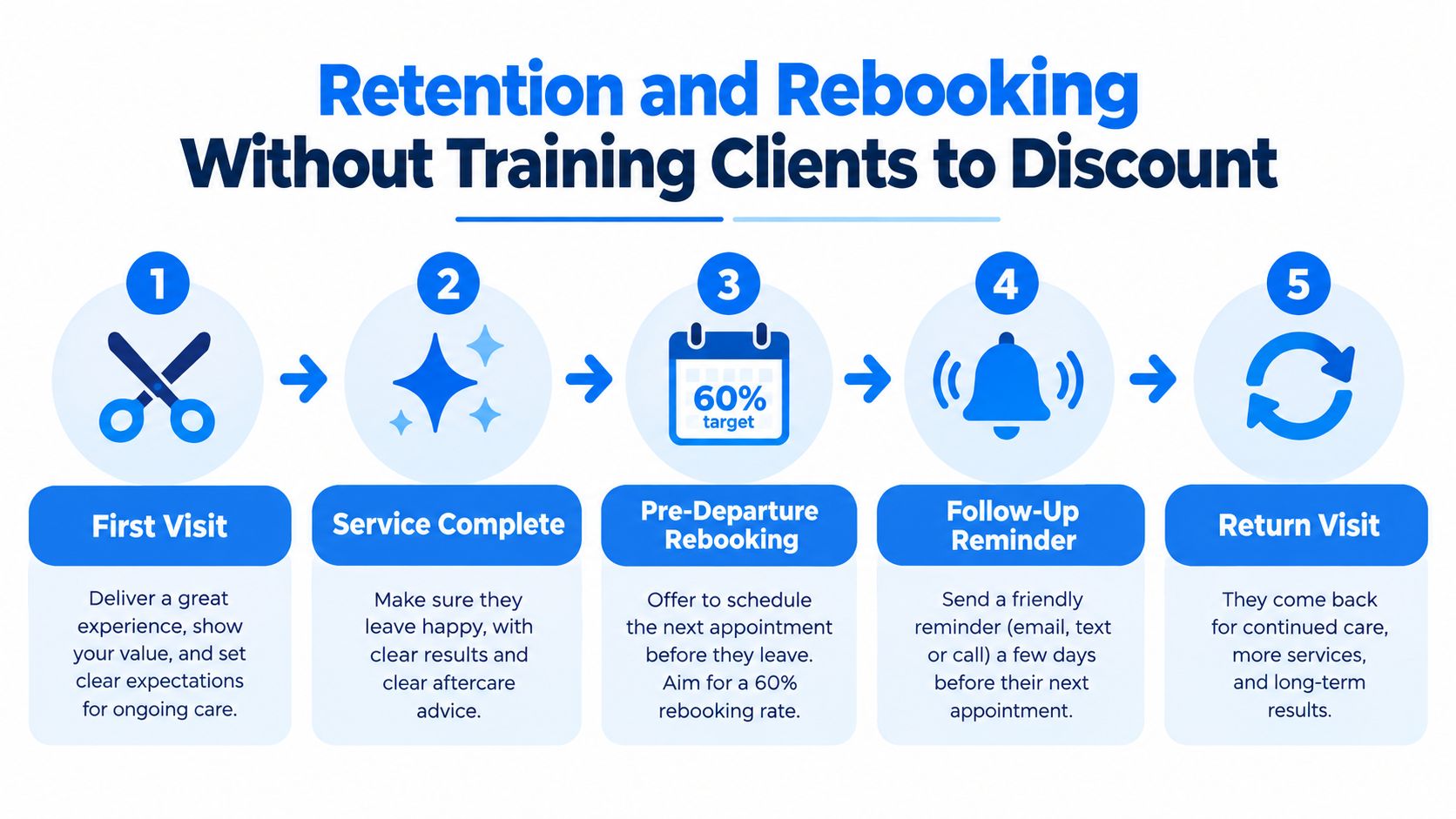
Retention and Rebooking Without Training Clients to Discount
The second appointment is where a salon makes money on acquisition spend.
Too many salons spend heavily to get a new client, then treat checkout like an afterthought. Checkout is the cheapest moment to sell the next visit, and most salons waste it. The right model is a two-stage acquisition-and-retention funnel. Bring the client in, then secure the next booking before they leave.
The benchmark is blunt. Aim to rebook at least 60% of clients before departure. Uncontrolled salons can also run into 20% to 30% no-show and late-cancellation rates, according to CalcStack's salon client retention guide. That guide also recommends tracking four weekly cohorts separately, first-time bookings, completed first visits, second-visit rate, and rebooking rate. That dashboard tells you more than follower growth ever will.
Rebook by service need, not by habit
Retention works better when follow-up matches the service. The same framework recommends automated reminders at booking, 48 hours before the appointment, and right after the visit, then segmenting follow-up by service interval, such as four weeks for color maintenance and six to eight weeks for haircuts. Adults respond to relevance, not noise.
Use prompts like these:
- Color clients: remind them before roots or tone become a problem
- Haircut clients: give a realistic timing window for shape maintenance
- Lapsed clients: use a limited, service-specific incentive only when the relationship needs repair
Stop blasting discounts at everyone
Blanket promotions are lazy marketing. They train good clients to wait for a deal and cut into margin.
Clients value personalization and trust more than cheapness. In a UK and Ireland survey of 716 salon guests, 50% wanted personalized rewards or offers, 61% relied on word of mouth when choosing a new salon, 45% preferred digital booking, and cleanliness and hygiene were the top reason customers would pay more for a premium experience, according to Phorest consumer survey reporting in HJI. The same report cites Square's 2025 cross-market research showing 63% of beauty consumers preferred one-to-one communication by email, compared with 23% for Facebook and 19% for Instagram.
That is the point. Personalization beats noise.
For service businesses outside salons, the same logic appears in retention strategies for South African clinics. Different category, same pattern. Timely reminders, personalized communication, and trust signals usually beat broad discounting.
Your 30-Day Marketing Plan and Weekly Operating Rhythm
You do not need a six-month rebrand. You need one month of disciplined cleanup, then a weekly rhythm you can keep.
Start with a scorecard and review it every week. Track first-time bookings, completed first visits, second-visit rate, and rebooking rate. The gap between completed first visits and second visits is the one to watch. If it is wide, the problem is usually not ad volume. It is slow follow-up, weak next-service recommendations, or avoidable friction in scheduling. That matters because platform-based salon data shows returning guests made up 42% of clients in Zenoti's 2024 U.S./Canada beauty-and-wellness data, cited in CalcStack's retention analysis.
Week-by-week plan
Week 1, fix the basics
- Audit your Google Business Profile: hours, categories, booking link, photos, contact details
- Tighten your booking path: one mobile-first page per core service line
- Unify inquiries: calls, forms, DMs, and texts need one response workflow
Week 2, build the campaign assets
- Create service-specific offers: focused reasons to book, not storewide discounts
- Prepare ad creative: before-and-after visuals, simple copy, one clear action
- Set follow-up rules: define what happens if someone inquires and does not book
Week 3, launch small and watch behavior
- Turn on local campaigns: keep geography tight and the offer specific
- Monitor booking quality: track reachable leads and confirmed appointments, not just clicks
- Review response speed daily: if leads sit untouched, fix that first
The operating rhythm that keeps it working
The owner or manager should review performance once a week, not stare at the ad account all day.
- Check new inquiries and whether anyone was missed
- Review completed first visits and whether those clients rebooked
- Look at review requests sent and responses received
- Pause weak creative and keep winners running
- Flag lapsed clients for a targeted comeback message
A salon with a plain system and fast follow-up will usually outperform a salon with prettier content and sloppy intake.
Keep automation on a leash
Automation helps when it removes delay. It hurts when it replaces judgment. Use it for reminders, review requests, intake routing, and reporting. Keep approval in human hands for campaign changes, offer decisions, and anything that affects brand positioning.
That is how marketing a salon stops feeling like a second job. It becomes a weekly operating habit tied directly to booked chairs and repeat visits.
If you want a simpler way to run this without juggling ad tools, landing pages, and text follow-up yourself, benjiads handles the ad setup, hosted funnel, tracking, and SMS lead intake for local service businesses, including salons. It fits the approach in this article because the focus is on booked conversations, owner approval, and measurable follow-up, not vanity marketing.
- marketing a salon
- salon marketing
- salon advertising
- salon retention
- salon booking funnel

ARRANGE YOUR COLOR APPOINTMENT
Arrange your color appointment
Text to discuss your appointme
Ads created · live on FB & IG
For hair salons
Your hair salon ads, live in 2 minutes.
- ✓ Ads created for you
- ✓ Every lead texts your phone
- ✓ Free to use, no credit card
748+ local businesses run ads with benjiads