lawn care marketing 17 min read
Marketing a Lawn Care Business That Actually Books Jobs
Marketing a Lawn Care Business. Learn proven ways to grow your lawn care business with local SEO, seasonal ad campaigns, and follow-up automation that turns
On this page
- What Marketing a Lawn Care Business Really Looks Like in 2026
- The Demand Picture You Are Marketing Into
- Building the Local Foundation Before You Spend a Dollar on Ads
- Running Seasonal Ad Campaigns That Match the Calendar
- Turning More Leads Into Booked Routes With Fast Follow-Up
- Measuring What Matters and Knowing When to Scale
- Your 90-Day Marketing Rollout Plan
You've just finished a mowing estimate when the phone starts buzzing. One homeowner wants a spring cleanup, another is asking about weekly service, and a third has already sent a second message because nobody answered the first one. Your route board still has gaps, but the problem isn't always a lack of demand. Often, the work is arriving faster than the business can capture and convert it.
Marketing a lawn care business now requires more than putting a phone number on a truck or hanging signs in finished yards. You need a connected system that helps local customers find you, receive a prompt response, choose the right service, and stay on the route after the first visit. The practical framework is simple: get found, get booked, and get renewed. The details determine whether your marketing fills profitable routes or only creates more quote requests to chase.
What Marketing a Lawn Care Business Really Looks Like in 2026
A solo operator in mid-March may be watching the route board fill in unevenly. One neighborhood is nearly full, another has too many gaps, and the phone is buzzing with quote requests while the owner is driving between properties. A door hanger might generate interest, but it won't answer the lead, qualify the yard, schedule an estimate, and remind the customer to renew later in the season.
That's the difference between older lawn care promotion and modern acquisition. Yard signs, referrals, trucks, and door hangers still support local recognition, but customers increasingly compare businesses through local search, review profiles, landing pages, and text conversations. A prospect may find several nearby providers, submit requests to more than one, and choose the company that responds clearly while the need is still urgent.
A useful small-business lead generation framework treats every channel as part of one operating loop:
- Getting found: Make your Google Business Profile, service pages, reviews, and paid campaigns visible for the services and neighborhoods you serve.
- Getting booked: Give the prospect a low-friction quote path, respond quickly, qualify the property, and make the next step obvious.
- Getting renewed: Move one-time customers toward recurring maintenance, seasonal add-ons, and reminders before the next service window arrives.
Practical rule: Never judge a marketing channel by leads alone. Judge it by whether the channel produces profitable, geographically sensible work that can be renewed.
The route is the economic unit that matters. A single cut can help fill a gap, but a recurring customer near several existing properties can improve travel time, crew utilization, and future sales efficiency. That means your offer, ad targeting, and follow-up should all encourage customers to think beyond one visit.
Seasonality makes the system more demanding. Spring creates a rush of attention, while the operator still has to protect capacity, answer every inquiry, and set expectations for ongoing service. A business that only chases immediate jobs may look busy during the peak and exposed when demand softens. A business that builds contract conversations into every estimate has a better chance of carrying a stable route into the shoulder season.
The Demand Picture You Are Marketing Into
Lawn care marketing operates inside a large, recurring, and seasonal service market. One U.S. estimate places landscaping services revenue at about $188.8 billion in 2025, while another estimates the U.S. lawn care market at $60.0 billion in 2025 and projects it to reach $79.68 billion by 2031. These are different market definitions, so they shouldn't be treated as interchangeable, but both point to substantial demand for outdoor maintenance services. The figures are documented in LawnStarter's 2026 lawn care and landscaping statistics.
The more useful point for an operator is the service pattern. Maintenance represented 91.55% of the U.S. lawn care market in one 2025 breakdown, and 72.9% of mowing jobs in 2025 were reported as biweekly in another industry source, according to the same market reference. Recurring work should therefore shape the offer, the landing page, and the follow-up sequence, not sit as an afterthought beneath one-time cleanup promotions.
Search demand also moves sharply through the year. The phrase “lawn care near me” was reported at 74,000 monthly searches on average, rising to 165,000 in March and 135,000 in April before tapering later in the year. That pattern favors early preparation. A campaign launched after the spring rush has already peaked may still produce work, but it misses the moment when homeowners are actively comparing providers.
Use timing to choose the offer
The table below turns that demand pattern into an operating decision. Demand levels are qualitative except where the verified search figures are shown.
January
- Demand Level
- Low and planning-led
- Top Service to Promote
- Pre-season maintenance
- Marketing Focus
- Build landing pages, collect past-customer lists, and prepare renewal messages
February
- Demand Level
- Rising
- Top Service to Promote
- Spring cleanup and recurring mowing
- Marketing Focus
- Publish offers before homeowners begin requesting estimates
March
- Demand Level
- Peak, with 165,000 reported average monthly searches for “lawn care near me”
- Top Service to Promote
- Cleanup, first mow, and maintenance plans
- Marketing Focus
- Capture high-intent searches and respond immediately
April
- Demand Level
- Very high, with 135,000 reported average monthly searches
- Top Service to Promote
- Recurring mowing and fertilization
- Marketing Focus
- Convert one-time requests into route-based plans
May
- Demand Level
- Strong
- Top Service to Promote
- Maintenance and weed control
- Marketing Focus
- Protect capacity and promote contract continuity
June
- Demand Level
- Strong but more selective
- Top Service to Promote
- Maintenance add-ons
- Marketing Focus
- Increase average customer value without overloading routes
July
- Demand Level
- Retention-led
- Top Service to Promote
- Ongoing mowing and problem-lawn services
- Marketing Focus
- Reduce churn and reactivate unbooked estimates
August
- Demand Level
- Retention-led
- Top Service to Promote
- Aeration planning and lawn recovery
- Marketing Focus
- Build the fall pipeline before the next seasonal peak
September
- Demand Level
- Seasonal opportunity
- Top Service to Promote
- Aeration and overseeding
- Marketing Focus
- Use existing customer lists before buying cold demand
October
- Demand Level
- Seasonal opportunity
- Top Service to Promote
- Fall cleanup and overseeding
- Marketing Focus
- Fill shoulder-season capacity and secure next-season interest
November
- Demand Level
- Tapering
- Top Service to Promote
- Final cleanup and renewal planning
- Marketing Focus
- Confirm service expectations and retain customers
December
- Demand Level
- Low
- Top Service to Promote
- Renewal and planning
- Marketing Focus
- Review results and prepare the next campaign calendar
Before approving campaigns, calculate what a lead must be worth after labor, travel, materials, and follow-up. The cost-per-lead formula guide can help organize that calculation, but the decision should ultimately rest on cost per booked route and expected retention, not an attractive lead count.
Building the Local Foundation Before You Spend a Dollar on Ads
Paid traffic exposes weaknesses quickly. If the profile has old information, the website doesn't explain the service area, or the quote form makes people work, more clicks only create more leakage. Build the local foundation in this order.
Start with the profile customers see first
Complete the Google Business Profile with the correct primary category, relevant services, service areas, hours, holiday information, phone number, website, and recent job photos. Use accurate service descriptions instead of stuffing every city name into the profile. Customers should understand whether you handle mowing, cleanup, fertilization, mulching, or other services before they call.
Ask for reviews at the moment the customer has a clear reason to be satisfied. A short text with a direct review link after a completed visit creates less friction than a general request sent weeks later. Respond professionally to both positive and negative feedback, and use recurring service interactions to maintain a steady stream of current proof.
Build pages for actual service areas
Your website should have a clear page for each important city or neighborhood you serve. Each page needs original local information, the relevant services, useful property or access details, a visible quote form, and a phone number that works on mobile devices. Don't publish dozens of interchangeable pages with only the city name changed. That creates a poor customer experience and gives search engines little reason to distinguish one page from another.
A practical small-business website design guide can help you evaluate the structure, calls to action, and mobile experience before traffic arrives. The page doesn't need to be elaborate, but it must answer three questions quickly: Do you serve my area, can you solve my lawn problem, and how do I request a quote?

Make business information consistent
Check the business name, address, phone number, website, hours, and service description across Yelp, Apple Maps, Bing Places, Nextdoor, and other relevant directories. Inconsistencies confuse prospects and can weaken local trust. A customer who finds two phone numbers shouldn't have to guess which one reaches the office.
Use a simple weekly foundation checklist:
- Profile accuracy: Confirm the primary category, service area, hours, services, and contact details.
- Review activity: Send requests after completed work and respond to new reviews.
- Local pages: Publish useful service-area pages with a form above the fold.
- Citation consistency: Audit major listings after any name, phone, or address change.
- Visual proof: Add recent photos that show real crews, equipment, properties, and completed work.
Ads should come after these pieces work together. Otherwise, the campaign may succeed at generating attention while the business fails to convert it.
Running Seasonal Ad Campaigns That Match the Calendar
An always-on campaign with one generic “professional lawn care” message wastes the strongest advantage in this category, which is timing. Build separate campaigns around the service a homeowner is most likely to need now, then change the offer as the calendar changes.
Start with high-intent Google traffic, including Local Services Ads where available and search campaigns for specific services. Use distinct ad groups and landing pages for mowing, spring cleanup, fertilization, aeration, and other priority services. A person searching for cleanup should land on a cleanup page, not a generic homepage that asks them to find the right service themselves.
Meta can play a different role. Facebook and Instagram campaigns can introduce the company to households in feeder neighborhoods, show before-and-after work, and promote seasonal services before the homeowner searches. Keep the geographic radius tight enough to protect route density. A wide audience may produce inexpensive inquiries from properties the crew can't serve profitably.
Match the message to the service window
February
- Lead Service
- Spring preparation
- Offer Angle
- Reserve a recurring maintenance estimate early
- Google Budget %
- Not specified
- Meta Budget %
- Not specified
March
- Lead Service
- Cleanup and first mow
- Offer Angle
- Get the property ready for the season
- Google Budget %
- Not specified
- Meta Budget %
- Not specified
April
- Lead Service
- Recurring mowing
- Offer Angle
- Convert the first visit into ongoing service
- Google Budget %
- Not specified
- Meta Budget %
- Not specified
May
- Lead Service
- Fertilization and weed control
- Offer Angle
- Improve lawn condition during active growth
- Google Budget %
- Not specified
- Meta Budget %
- Not specified
June
- Lead Service
- Maintenance add-ons
- Offer Angle
- Add relevant services to existing routes
- Google Budget %
- Not specified
- Meta Budget %
- Not specified
July
- Lead Service
- Mowing retention
- Offer Angle
- Keep the schedule reliable through summer
- Google Budget %
- Not specified
- Meta Budget %
- Not specified
August
- Lead Service
- Aeration planning
- Offer Angle
- Join the fall service list early
- Google Budget %
- Not specified
- Meta Budget %
- Not specified
September
- Lead Service
- Aeration and overseeding
- Offer Angle
- Prepare the lawn for the next growth cycle
- Google Budget %
- Not specified
- Meta Budget %
- Not specified
October
- Lead Service
- Fall cleanup
- Offer Angle
- Clear leaves and protect shoulder-season capacity
- Google Budget %
- Not specified
- Meta Budget %
- Not specified
November
- Lead Service
- Renewal
- Offer Angle
- Confirm next-season service interest
- Google Budget %
- Not specified
- Meta Budget %
- Not specified
The brief doesn't provide a verified budget percentage split between Google and Meta, so don't treat a preset allocation as a rule. Start with the channel that captures the strongest intent, then expand awareness spend only when the business can answer and book the resulting inquiries.
Use call-focused ads during the hours when someone can answer. Add negative keywords for services, areas, or job types you don't provide. Review performance by neighborhood each week, and pause areas that generate inquiries but not profitable work. The objective isn't to buy the most traffic. It's to buy enough qualified demand to fill a route without creating a service radius that crews can't maintain.
Turning More Leads Into Booked Routes With Fast Follow-Up
Fast follow-up is not an administrative detail. It is part of the advertisement's return. When several local operators receive the same request, the business that responds clearly while the homeowner is still comparing options has a practical advantage.
Analysis cited by Harvard Business Review found that responding within 1 minute can produce a 391% higher conversion rate than responding within 1 hour, and that the odds of qualifying a B2C service lead fall by more than 80% when the first response moves from 5 minutes to 30 minutes, according to this speed-to-lead analysis for lawn care companies. The same source reports that slow response can cost average lawn care companies 15% to 30% of leads, with peak-season voicemail rates reaching 30% or even 40% to 50% on high-volume days.
Design the first five minutes
The first response should acknowledge the request, identify the service, and provide a direct next step. A useful sequence looks like this:
- Immediate SMS: “Thanks for reaching out about lawn service in [area]. Are you looking for recurring mowing, a one-time cleanup, or another service? You can reply here with the property address and a preferred estimate time.”
- Personal call: Call as soon as the lead arrives, ideally within minutes. If the customer doesn't answer, leave a voicemail that names the service and gives a specific callback window.
- Same-day confirmation: Send an email or text summarizing what you still need, such as lot size, access instructions, photos, or the preferred service frequency.
Keep the qualification short. Ask where the property is, what the customer wants done, whether the need is recurring or one-time, and when they want the work started. Don't turn the first contact into an interrogation. The purpose is to determine fit and move the person toward an estimate.
Google says Local Services Ads may display estimated messaging response times ranging from a few minutes to one day once a business has enough message leads, as described in Google's Local Services Ads messaging guidance. That range should prompt an operational question: can your team answer during busy routing periods, or should the campaign pause when nobody can respond?
Continue after the missed call
Not every lead is ready to book immediately. Use a restrained follow-up cadence for people who requested information but didn't schedule:
- Later the same day: Confirm that the request was received and repeat the next available action.
- A few days later: Ask whether the customer still needs the service and offer a clear estimate path.
- Before the next seasonal window: Reintroduce the relevant service instead of sending a generic promotion.
- Before a recurring plan ends: Ask about renewal, changes to the property, and additional service needs.
Track contact rate, quote-to-book ratio, time to first response, and renewal rate. If leads are arriving but quotes aren't being accepted, inspect the offer, qualification, pricing presentation, and service radius before increasing ad spend.
Measuring What Matters and Knowing When to Scale
A campaign can produce a healthy stream of inquiries and still lose money. Lawn care operators should compare channels using the full path from lead to booked work, then connect that booking to route quality and future retention.
The lawn care advertising benchmarks from Benchmarketing report that one 2026 benchmark set showed Google Ads at an 8.24% click-through rate, $1.84 cost per click, 9.8% conversion rate, and $22.00 cost per acquisition. The same source reports Meta Ads at a 2.04% click-through rate and 3.4x return on ad spend. A separate 2025 local-services report cited lawn care Google Ads leads at $29 to $101 each, with an average of $87.80 across 61 landscaping accounts. These figures are reference points, not promises for a specific market.
Use one dashboard for every channel
Record the same fields for Google, Meta, Local Services Ads, referrals, direct mail, and organic search:
| Field | What It Tells You |
|---|---|
| Source | Which channel created the inquiry |
| Lead count | How much demand the channel generated |
| Contact rate | Whether the team reached the prospect |
| Quote rate | Whether inquiries became viable estimates |
| Close rate | Whether estimates became booked work |
| Cost per lead | Acquisition efficiency before sales follow-up |
| Cost per booked job | The real price of acquiring work |
| Route fit | Whether the job improves or complicates service density |
| Contract value | Whether the customer can become recurring revenue |
| Renewal status | Whether the acquisition continues paying back |
Local Services Ads home-services benchmarks report a $44 median cost per lead, a 52% qualified rate, and a 31% booked rate. Broader home-services Google Ads benchmarks report a 4.58% click-through rate, $2.94 cost per click, $54.20 cost per acquisition, and 6.84% average conversion rate, according to Benchmarketing's home-services Local Services Ads and Google Ads benchmarks. Use these figures as comparison points, while recognizing that local competition, service mix, response speed, and qualification rules change the outcome.
Scale only after the bottleneck is clear
If a campaign has clicks but few leads, inspect the keyword, creative, offer, and landing page. If it has leads but few conversations, inspect response speed and contact details. If it has quotes but few bookings, inspect pricing, trust signals, scheduling friction, and whether the work is a poor geographic fit.
Pause or reduce a campaign when it repeatedly produces unqualified inquiries or booked work that strains the route. Increase spend only when the team can explain why the campaign works and can handle additional demand without degrading response time. Impressions are useful for diagnosing reach, but signed contracts and route contribution should decide the budget.
Your 90-Day Marketing Rollout Plan
A lawn care operator doesn't need to launch every channel at once. The first ninety days should create a reliable base, test seasonal demand, and install the follow-up process that turns inquiries into route growth.
Days 1 through 30 build the foundation
Start Monday by claiming or auditing the Google Business Profile. Correct the service area, hours, phone number, categories, and service descriptions. Add real job photos and create a review request process that the office or crew can trigger after completed work.
During the same block, identify the cities and neighborhoods that fit the current route. Publish service-area pages for those locations, place a quote form prominently on each page, and audit major directory listings for consistent business information. Don't expand the service radius in marketing until the existing area produces enough density to support reliable routing.
Days 31 through 60 launch focused campaigns
Choose one immediate service and one recurring service. For spring, that may be cleanup paired with maintenance. Build separate landing pages, write ads that match each service, and use creative showing the actual work customers can expect.
Review performance every week. Record leads, contacts, estimates, booked jobs, cost per booked job, and neighborhood. Replace weak creative with a clearer offer rather than just raising the budget. If a campaign produces good inquiries but the team can't answer them, fix intake before adding traffic.
Days 61 through 90 improve conversion and retention
Install the response sequence at every lead source. The inquiry should trigger an immediate text, a call task, and a same-day reminder. Add estimate follow-ups for people who haven't booked, then create seasonal messages for customers who may need the next service.
Use the final weeks to reactivate old estimates and past customers. A warm contact who already knows the company may be more valuable than a new cold lead, particularly when the offer matches the upcoming season.
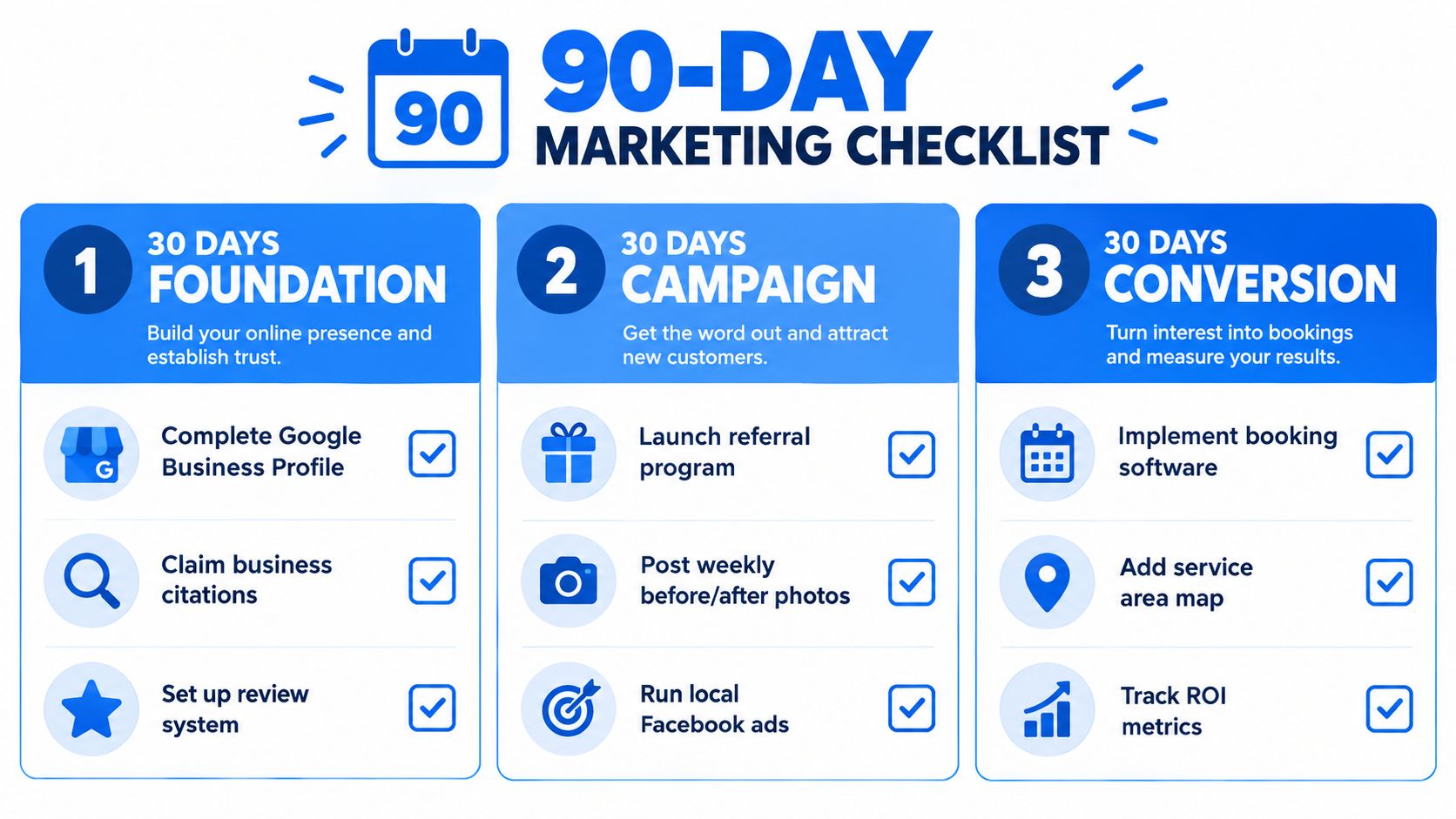
Review these items every week:
- Demand: Which services and neighborhoods are producing current inquiries?
- Conversion: How many leads were contacted, quoted, and booked?
- Economics: What did each booked job cost to acquire?
- Capacity: Can the crew serve the new work without excessive travel?
- Retention: Which customers need a renewal, reactivation, or seasonal offer?
The final pivot should follow the service calendar rather than a fixed slogan.
| Season | Primary Marketing Move | Customer Group |
|---|---|---|
| Pre-season | Promote estimates and recurring plans | Past customers and early searchers |
| Spring ramp-up | Capture cleanup and mowing demand | High-intent new prospects |
| Summer | Protect recurring schedules and add relevant services | Current customers |
| Late summer | Build interest in aeration and overseeding | Existing customers and local prospects |
| Fall | Promote cleanup and next-season planning | Route neighborhoods and past leads |
| Off-season | Review performance and prepare renewal campaigns | Entire customer database |
The operating target is not a full calendar of disconnected promotions. It's a route book supported by accurate local visibility, timely conversations, and reminders that keep good customers from disappearing between seasons.
If you want the ads, landing funnel, tracking, and SMS follow-up connected in one workflow, visit benjiads to see how its software supports local service campaigns. Use it as one option for reducing setup work and keeping new lawn care inquiries in an active text-based follow-up process.
- lawn care marketing
- local SEO
- seasonal promotions
- lead follow-up
- small business ads

LAWN CARE QUOTES BY TEXT
Lawn care quotes by text
Free estimates
Ads created · live on FB & IG
For lawn care companies
Your lawn care company ads, live in 2 minutes.
- ✓ Ads created for you
- ✓ Every lead texts your phone
- ✓ Free to use, no credit card
748+ local businesses run ads with benjiads