junk removal advertising 12 min read
Junk Removal Advertising: A Practical Guide
Master junk removal advertising with practical strategies for local ads, high-converting landing pages, and automated SMS lead follow-up workflows.
On this page
You can feel it the moment the phone rings. A garage is packed, a tenant has moved out, or a homeowner has finally decided that the sofa, drywall, and broken treadmill need to disappear today, not next week. That's why junk removal advertising lives or dies on urgency, trust, and speed to response, not on clever branding alone.
The businesses that win don't just buy clicks. They choose channels that match immediate intent, write ads that answer pricing and disposal questions before the lead even calls, and build a follow-up system that texts back fast enough to catch the job while the customer is still comparing options. In this category, lead cost is only half the story, because a cheap lead that sits untouched is just wasted budget.
Choosing the Right Channels for High-Intent Leads
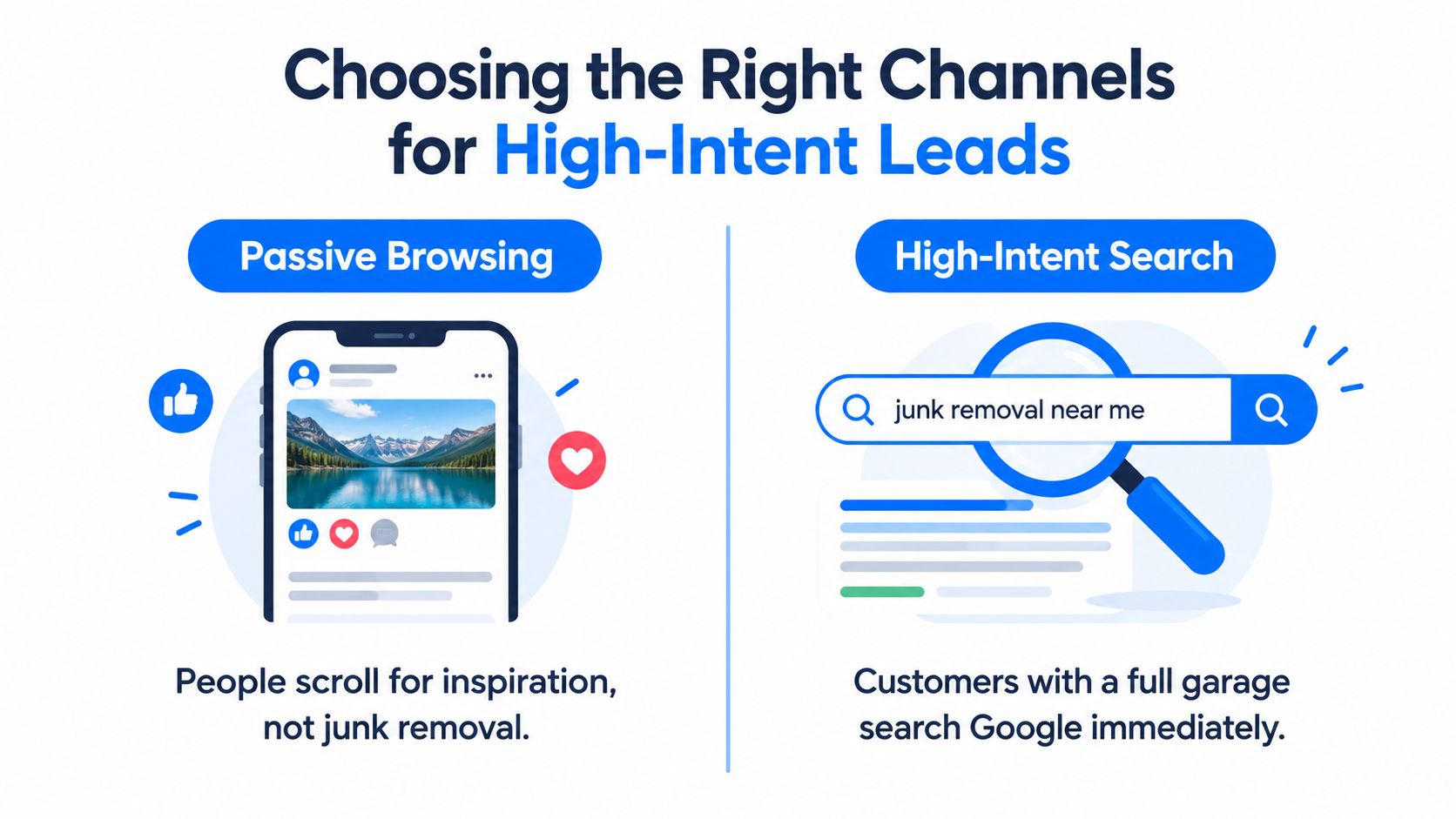
A junk removal customer usually isn't in research mode. They're in problem-solving mode, and the search starts when the mess becomes urgent enough to act on. That's why broad awareness plays tend to underperform for this category, while search-led and pay-per-lead formats keep showing up in the mix for operators who need booked pickups, not vanity traffic.
Where intent actually shows up
The market backdrop matters. The U.S. junk removal market has been estimated at roughly $11.0 billion in annual revenue, with growth described at about 5% to 7% per year, and one 2026 industry summary said search interest for “junk removal near me” had grown 55% since 2020 (Clicks Geek). That doesn't mean every channel deserves equal budget. It means the customer journey is increasingly happening in search, where people are already trying to book a truck.
Google-based channels line up with that behavior better than passive feed ads. Search and local-service formats catch people when they're actively asking for a pickup, not just scrolling past a before-and-after photo. The practical result is simple, high-intent traffic can be more efficient than broad local reach, because the ad is meeting an existing need instead of trying to create one.
Practical rule: if the job is urgent, the channel should be urgent too.
Why pay-per-lead formats keep winning
A 2026 benchmark for junk removal paid acquisition said Google Local Services Ads typically delivered leads at about $30 to $65 each, while traditional Google Ads often landed around $35 to $80 per lead once non-converting clicks were included (PushLeads). That gap matters less as a bragging point and more as an operating clue. Lead-based pricing forces discipline, because you're thinking in terms of booked jobs, not just traffic volume.
LSAs also changed expectations by rewarding fast response and trust signals. The Google Guaranteed badge and top-of-page placement help, but they don't replace the need for a tight intake process. If your team can't answer quickly, the lead cost doesn't matter much, because someone else will call or text first.
A useful comparison is this, search is demand capture, while social is demand shaping. Both can help, but junk removal rarely needs a long brand story before the phone rings. It needs a visible offer, local relevance, and a clean path to quote.
See how local service channels compare in practice
Crafting Ad Copy That Builds Instant Trust
Ads from three national junk removal franchises reviewed in August 2026 all led with some version of “fast, cheap, friendly,” then sent people to a homepage that did little to explain pricing or disposal. That kind of copy may win a click, but it does not answer the questions that decide whether a lead turns into a job. Customers worry about hidden fees, how estimates are handled, and whether the load is disposed of properly.
Say what buyers are already wondering
Strong ad copy answers those concerns before the click. It should name volume-based pricing, explain whether estimates are upfront, and make disposal practices visible instead of implied. Major operators already point customers toward those questions, because buyers want to know how price is determined and what happens after pickup (1800-GOT-JUNK?).
“Fast and cheap” still gets attention, but it also pulls in the wrong calls. Pure price shoppers often want a vague quote, create friction on the phone, and disappear once the scope gets real. Clear wording screens those leads earlier, which helps both close rate and crew time.
A stronger angle sounds like this:
- Upfront pricing by volume, not surprise fees.
- Donation and recycling handled when possible.
- Same-day pickup for garages, basements, and cleanouts.
- Text a photo for a fast estimate.
Turn transparency into qualification
Transparency does more than build trust. It qualifies the lead before the first call. Customers who click after reading about pricing structure and disposal practices usually have fewer surprises on the phone, so the sales conversation stays shorter and cleaner.
That matters even more when lead costs are high. A junk removal operator does not need every visitor, only the ones who are ready to book and willing to share enough detail to price the job properly. The ad should do part of that filtering.
Trust density is the other payoff. A customer comparing three companies may not remember the exact headline, but they will remember which one sounded clear about pricing and disposal. That often beats a cheaper offer that only shouts “cheap” and leaves the rest vague.

Designing Landing Pages That Convert Clicks to Bookings
Sending paid traffic to a homepage is a fast way to leak money. Homepages are built to explain the business, not to close a hurried lead who's standing next to a pile of debris with a phone in one hand and another contractor's number in the other. The page has to behave like a stripped-down booking desk.
Build for mobile first, not desktop comfort
The first element should be a sticky click-to-call button that stays visible as the visitor scrolls. If someone is on mobile, they shouldn't have to hunt for a phone number or hunt through a menu. The second element should be a short form, ideally asking only for the details needed to estimate the truck size and service area.
A good junk removal landing page also needs real photos, not stock images. Before-and-after images of actual jobs do more than decorate the page, they prove that the crew handles the kind of mess the customer is trying to remove. That's especially important when the ad promised transparency, because the landing page has to keep that promise.
Reduce friction, but don't remove clarity
The page should explain what you accept and what you don't. Customers don't want to guess whether you'll take old drywall, appliances, or mattresses, and they definitely don't want to fill out a form only to learn that their job is outside your scope. Clear service boundaries save everyone time.
Practical rule: every extra form field should earn its keep.
Keep the booking flow short enough that a person can finish it while walking through the garage. Ask for the address, the item type, and a photo upload if possible. Add reviews or trust badges near the booking button, and state the local service area plainly so the user knows they're in range before they commit.
Review a landing page builder approach built for this kind of funnel
The page doesn't need to be fancy. It needs to answer the customer's three questions fast, what do you take, what does it cost, and how soon can you come?
The same principle shows up in the embedded video below, where the structure matters more than decorative polish.
Automating the Lead Response and Follow-Up Workflow
In junk removal, the first company to answer clearly usually gets the job. That matters because ad clicks are expensive, and a slow reply turns paid traffic into dead lead volume. Once a homeowner has described the garage cleanout, attic pile, or eviction job, they are usually comparing the next company that texts back with enough detail to feel real.
Make the first text do real work
A good SMS workflow starts the moment the lead arrives. The first text should confirm receipt, ask for a photo if one was not uploaded, and give the customer one simple next step. That cuts down on back-and-forth and tells the dispatcher quickly whether the job is a small pickup or a full truck route.
The sequence should be plain:
- Instant alert to the team. A new lead triggers a notification, so nobody finds it later.
- Automated text reply. The customer gets a fast confirmation and a request for photos or job details.
- Preliminary estimate path. The reply should point toward a quote, callback, or booking link while intent is still hot.
- Follow-up for silence. If the customer does not answer, the system keeps the conversation alive without manual chasing.
Operators consistently report that fast replies improve win rates, because the customer is still comparing options and has not moved on yet. The workflow has to make speed the default, not something the office only manages when someone is free.
Use automation to protect the dispatcher
A dispatcher should not spend the day typing the same opening questions. The workflow should collect the basics, phone number verification, job photo, service type, timing, and address range, before a human ever steps in. That keeps the conversation clean and filters out leads that never had enough detail to quote properly.
See how automated follow-up can be wired into the intake flow
The value here is practical, not flashy. Automated follow-up reduces missed replies, keeps the lead warm, and gives the team a tighter handoff when a real job is worth pursuing. It also forces the business to be honest about pricing and scope early, which matters in junk removal because vague answers create wasted trips and wasted labor.
The best follow-up sounds like it belongs to the request the customer already made. If someone asked about sofa removal, the next text should continue that conversation, not read like a broad marketing blast.
Comparing Management Models for Local Ad Campaigns
Running junk removal ads takes attention, but not every owner has the time or appetite to live inside ad platforms all week. The actual decision isn't whether to market, it's whether to manage campaigns yourself, hand them to an agency, or use software that handles the repetitive work while you keep approval control. Each model has trade-offs that hit margins differently.
DIY
- Typical Cost Structure
- Your own time, plus media spend
- Time Required
- High
- Best For
- Owners who like testing and can watch leads closely
Traditional agency
- Typical Cost Structure
- Monthly retainer, plus media spend
- Time Required
- Low for the owner
- Best For
- Companies that want a hands-off relationship
Automated software
- Typical Cost Structure
- Platform fee tied to spend, plus media spend
- Time Required
- Moderate
- Best For
- Owners who want systemized setup and follow-up without full DIY
DIY sounds cheap until you count the time spent learning bidding, fixing landing pages, and sorting through bad leads. It can work well if you know what good looks like and can respond to performance changes quickly, but it becomes expensive when campaign management steals hours from dispatch, sales, and crew coordination.
Agency retainers shift the labor burden off your desk, but they can create distance from the actual lead quality and close rate. That matters in junk removal, because a campaign can look healthy in platform metrics while still producing poor phone conversations or slow dispatching. If the agency isn't tied closely to booking outcomes, the reporting can feel disconnected from revenue.
Software models sit in the middle. They're useful when you want the ads, landing flow, and follow-up to be connected without hiring a full-time operator to stitch them together. For owners who want to keep control over approvals and budgets, that structure is often easier to manage than a traditional outsourced stack.
Tracking Performance and Scaling Profitable Routes
If you can't see which leads turn into booked jobs, scaling just means spending more on confusion. Junk removal campaigns need measurement that connects ad source, lead quality, and route profitability, because not every ZIP code, service type, or creative angle produces the same kind of work. The platform dashboard alone usually isn't enough.
Measure the path from click to truck
Dual tracking, meaning server-side and client-side measurement together, helps reduce blind spots. It gives you a better shot at understanding which ads generated the lead, which leads were answered, and which jobs were completed. That matters because a lead is only valuable if it turns into a route that fits the crew schedule and the day's margins.
At the operational level, the important metrics are straightforward. You want to know which ads produce the most qualified inquiries, which calls get booked, and which neighborhoods fill trucks with the least drag. You also want to know where the customer drops off, because that tells you whether the issue is the ad, the landing page, or the follow-up.
Scale what the crew can actually serve
The best scaling decisions in junk removal are route-based, not just lead-based. If one area produces bigger cleanouts with less friction, it may deserve more spend even if the lead volume looks similar elsewhere. If another area generates a lot of low-value tire-kickers, pausing it can protect both dispatch time and crew morale.
A simple weekly rhythm works better than constant tinkering:
- Review lead source quality. Look at where booked jobs came from, not just where forms were filled out.
- Check response speed. Confirm that every new lead got a text and a human follow-up quickly.
- Audit the winning creative. Keep the ads that attract qualified load sizes and clear intent.
- Trim weak geographies. Shift budget away from neighborhoods that don't produce profitable routes.
BenjiAds is one option that connects ad creation, landing pages, tracking, and SMS follow-up for local service businesses, so the intake and response pieces stay in one workflow. That kind of setup matters in junk removal because the handoff from ad click to booked truck is usually where the money is won or lost.
If you want a tighter junk removal advertising system, BenjiAds can help you build the ad, route the lead, and keep the follow-up moving without forcing your team to juggle extra tools. Visit benjiads if you want to see how a single workflow can turn high-intent clicks into booked pickups more reliably.
- junk removal advertising
- local service ads
- lead generation
- home service marketing
- SMS follow-up

FURNITURE HAUL-AWAY QUOTES BY TEXT
Furniture haul-away quotes by text
Free estimates
Ads created · live on FB & IG
For junk removal companies
Your junk removal company ads, live in 2 minutes.
- ✓ Ads created for you
- ✓ Every lead texts your phone
- ✓ Free to use, no credit card
748+ local businesses run ads with benjiads