ai landing page builder 14 min read
AI Landing Page Builder Guide: Benefits for 2026
Discover the best AI landing page builder for 2026. Learn key benefits, best practices, and how to create high-converting pages with ease.
On this page
- Why Local Businesses Are Turning to AI Landing Page Builders
- What an AI Landing Page Builder Actually Does
- Key Benefits for Local Service Businesses
- Core Features Worth Comparing
- Connecting Pages With Ad Campaigns and Tracking
- Best Practices That Lift Real Conversion Rates
- Common Misconceptions About AI-Generated Pages
- Putting It All Together With the Right Workflow
You turned on ads because you needed more booked jobs, not more busywork. Then the clicks started coming in, the homepage looked fine on your phone, and the leads still didn't move. That gap is where an AI landing page builder earns its keep, because it helps turn a traffic source into a page that matches the offer, captures the lead, and sends the right signals back into your ad stack.
For local businesses, that matters more in 2026 than it did a few years ago. The market for AI website builders is still young, but it's scaling fast, with projected growth from USD 3.24 billion in 2026 to USD 17.43 billion by 2035 and a 20.55% CAGR over 2026 to 2035 (Hostinger AI website builder statistics). A lot of that demand comes from small and medium businesses, which are estimated to account for 49% of market revenue in that category, while cloud-based deployment sits at about 81% of the market, a strong sign that buyers want hosted systems they can launch quickly (Hostinger AI website builder statistics).
Why Local Businesses Are Turning to AI Landing Page Builders
A plumber runs Google Ads for “water heater repair,” but the ad click lands on a general homepage with a menu, blog links, and no clear service promise. A roofer does the same with Meta ads, then wonders why people scroll a bit and leave. In both cases, the business isn't really missing traffic, it's missing a focused page that keeps the promise the ad made.
That's why an AI landing page builder is becoming the missing piece for local lead gen. It lets a business owner build a page around one offer, one audience, and one next step, without waiting on a designer or a developer. The AI part matters because the page can be drafted quickly, then adjusted for the exact service, location, and call-to-action before the ad budget gets burned.
The real problem is usually mismatch
The wrong page doesn't just look generic, it behaves like a dead end. Landing page benchmark data shows why this matters. Across 41,000 pages, the median landing page conversion rate was 6.6%, and pages converting at 10% or higher were considered good performance (Founden market map). In another 2025 benchmark set of more than 50,000 landing pages across 27 industries, the global average conversion rate was 2.35% (Founden market map).
Those numbers don't tell a plumber how to write a headline, but they do show why the page itself can't be an afterthought. If a builder helps a business launch faster, test more variations, and tighten the message match between ad and page, it's doing conversion work, not just design work.
Practical rule: if the ad talks about one service, the landing page should talk about that same service first, not the whole company story.
Why the category keeps growing
The local lead world is also changing around the page itself. Ad platforms are stricter about tracking, owners need faster testing, and the page has to connect cleanly to calls, forms, and follow-up. That's why the strongest use case for an AI landing page builder isn't “make something pretty,” it's “make something launchable, measurable, and editable.”
The most useful tools now sit inside the rest of the marketing stack, not outside it. They're closer to campaign infrastructure than to a one-off design toy.
What an AI Landing Page Builder Actually Does
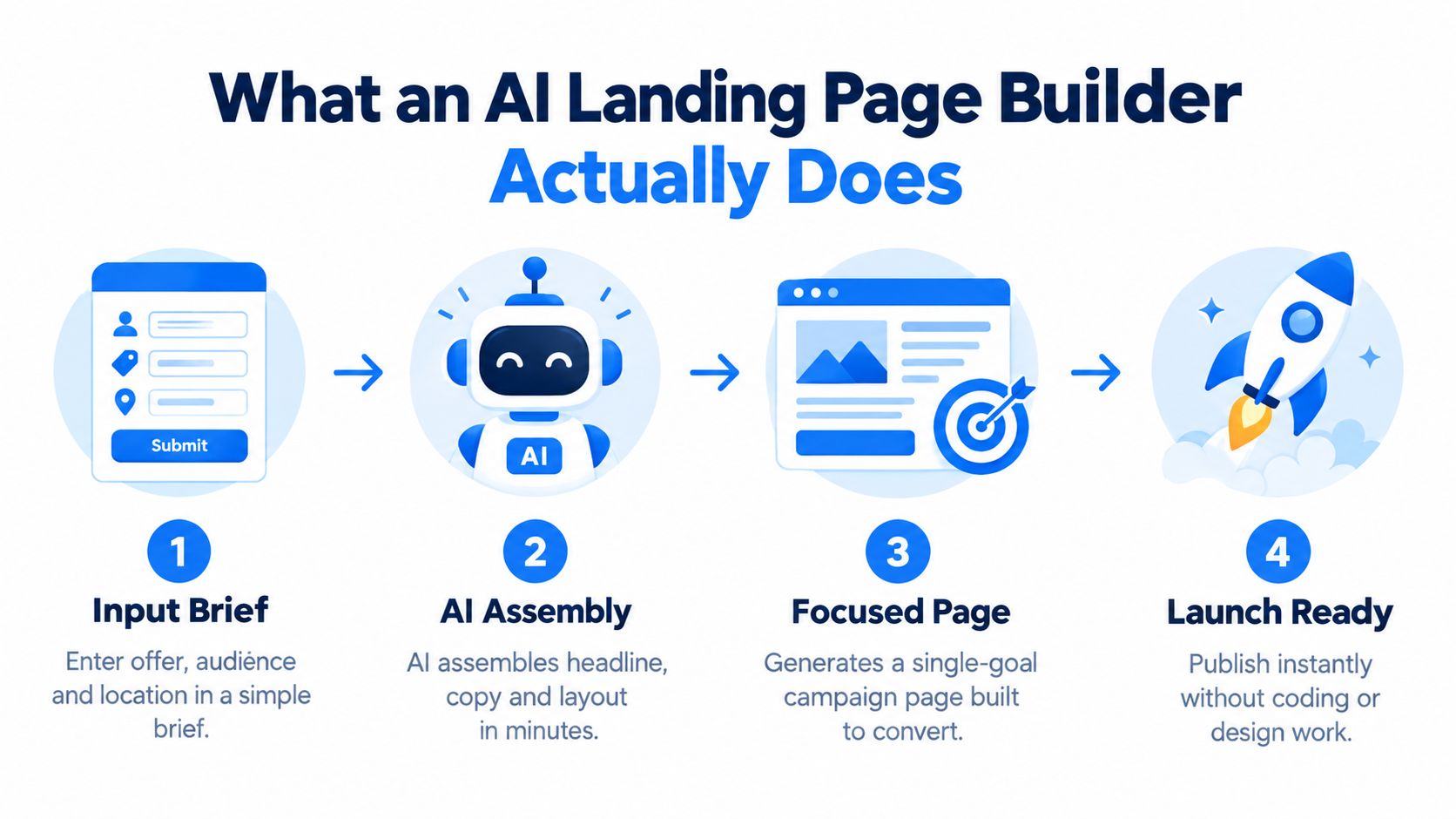
Think of an AI landing page builder as a smart assistant that takes a few plain-English inputs and assembles a campaign page around them. You tell it the offer, the audience, and the location. It then drafts the first version of the page, including the headline, the hero section, the supporting copy, and the lead form, so you're editing a working page instead of starting from a blank canvas.
That's the key difference from a traditional drag-and-drop builder. In a classic tool, the marketer has to plan the structure, write the copy, choose the layout, and decide what to test. In an AI builder, the system does more of the first draft work, which saves time when a business needs a page for a specific campaign, a seasonal promotion, or a new service area.
The core blocks it usually assembles
A useful builder doesn't just spit out a headline. It usually creates the pieces that make a landing page work together:
- Headline and subhead, which frame the offer in one glance.
- Hero image or visual block, which supports the promise instead of distracting from it.
- Benefit copy, which explains why someone should act now.
- Social proof, such as reviews, testimonials, or trust markers.
- Lead form or booking widget, which turns interest into a hand-raiser.
- Thank-you page or next step, which confirms the action and keeps the lead moving.
Dynamic text replacement is also common in stronger systems. That means the page can swap words based on the keyword, ad group, or audience segment that sent the click. A person who searched for “emergency plumber near me” shouldn't see the same wording as someone who clicked a brand ad for routine maintenance.
Why variant creation matters
AI also helps create page variants faster. Instead of rebuilding the whole page for each test, a marketer can try different headlines, offers, or CTA buttons. That matters because the landing page isn't just a static asset, it's a place where messaging gets sharpened through testing.
If the builder can quickly produce the first version and the variants, the team spends less time on production and more time on the question that matters most: which page turns more clicks into leads.
Key Benefits for Local Service Businesses
For a local service business, the biggest win isn't abstract automation, it's removing friction between the ad and the booked job. The page gets built faster, the message stays tighter, and the owner can adjust it when the lead data starts telling a different story. That's why these tools are less about novelty and more about operational speed.
What changes in practice
A good AI landing page builder helps in six practical ways. It speeds up launch, improves message match, supports location-specific wording, makes testing easier, helps with tracking setup, and keeps the design mobile-friendly without extra work. Those benefits stack because the page doesn't sit still after launch, it keeps getting tuned as campaign data comes in.
| Benefit | Practical Impact | Typical Benchmark |
|---|---|---|
| Faster page creation | A campaign page can go live without a design queue | Faster launch, with less manual production |
| Better message match | The page mirrors the ad promise and service offer | Stronger conversion focus on the landing page itself |
| Dynamic personalization | Copy can shift by service area or audience | More relevant page experience |
| Continuous testing | Headlines and CTAs can be swapped without rebuilding | Easier variant testing |
| Built-in tracking setup | Leads can be measured against the source campaign | Cleaner attribution |
| Responsive design | The page works on mobile without a separate build | Better fit for mobile traffic |
The benchmark context explains why this matters. Across the datasets in the brief, landing page performance varies widely, from a median conversion rate of 6.6% in one large set to a global average of 2.35% in another (Founden market map). That spread tells you the page itself still has room to win or lose the lead.
Why speed and relevance beat polish alone
Another dataset from 2026 shows a sharp drop when pages load slowly, with pages loading in about 1 second converting around 3.05% or higher, while pages at 4 to 6 seconds fall to roughly 1.08% to 1.7% (CartFlows landing page statistics). For a local business, that means a beautiful page that drags can still underperform a simpler page that loads cleanly and matches the ad.
A faster page helps, but a relevant page converts the click into the next step.
That's the core lesson. The value compounds when the page keeps getting updated from real ad data, booking data, and lead quality, instead of being treated like a one-time design project.
Core Features Worth Comparing
Not every tool that calls itself an AI landing page builder is built for paid acquisition. Some are good at creating a nice-looking page. Others are built to support traffic, tracking, and conversion testing. If your clicks come from Meta or Google, the second group usually matters more.
AI copy generation
- Basic AI Builders
- Drafts generic page text
- Ad-Focused AI Builders
- Writes offer-specific copy
- Why It Matters
- Better message match
Dynamic text replacement
- Basic AI Builders
- Limited or absent
- Ad-Focused AI Builders
- Built for campaign-based variations
- Why It Matters
- Keeps the headline aligned with the ad
Mobile-first templates
- Basic AI Builders
- Sometimes available
- Ad-Focused AI Builders
- Standard expectation
- Why It Matters
- Most local traffic lands on phones
Form and booking widgets
- Basic AI Builders
- Simple form only
- Ad-Focused AI Builders
- Forms, calendar embeds, routing logic
- Why It Matters
- Converts the click into a qualified lead
A/B testing
- Basic AI Builders
- Manual or external
- Ad-Focused AI Builders
- Built into the workflow
- Why It Matters
- Helps refine headlines and CTA copy
CRM or calendar sync
- Basic AI Builders
- Often basic
- Ad-Focused AI Builders
- Usually part of the stack
- Why It Matters
- Keeps the lead moving into follow-up
The most important fields are the ones that tie the ad to the page. If the builder supports message-match fields, URL-based variations, and simple form logic, it's already more useful than a generic page tool. If it also keeps the page fast and clean, even better. For a broader view of how campaign automation platforms fit together, see Benji Ads' automated marketing platform overview.
What matters first in a trial
When you test a vendor, start with the essentials. Check whether the page can reflect the ad promise, whether the mobile view feels clean, whether the form routes leads properly, and whether the page can connect to your CRM or calendar.
Then look at the extras. Multi-language support, heatmaps, and big template libraries are helpful, but they're not the first thing to fix if the core conversion path is weak. A local campaign wins on clarity, not feature count.
Connecting Pages With Ad Campaigns and Tracking
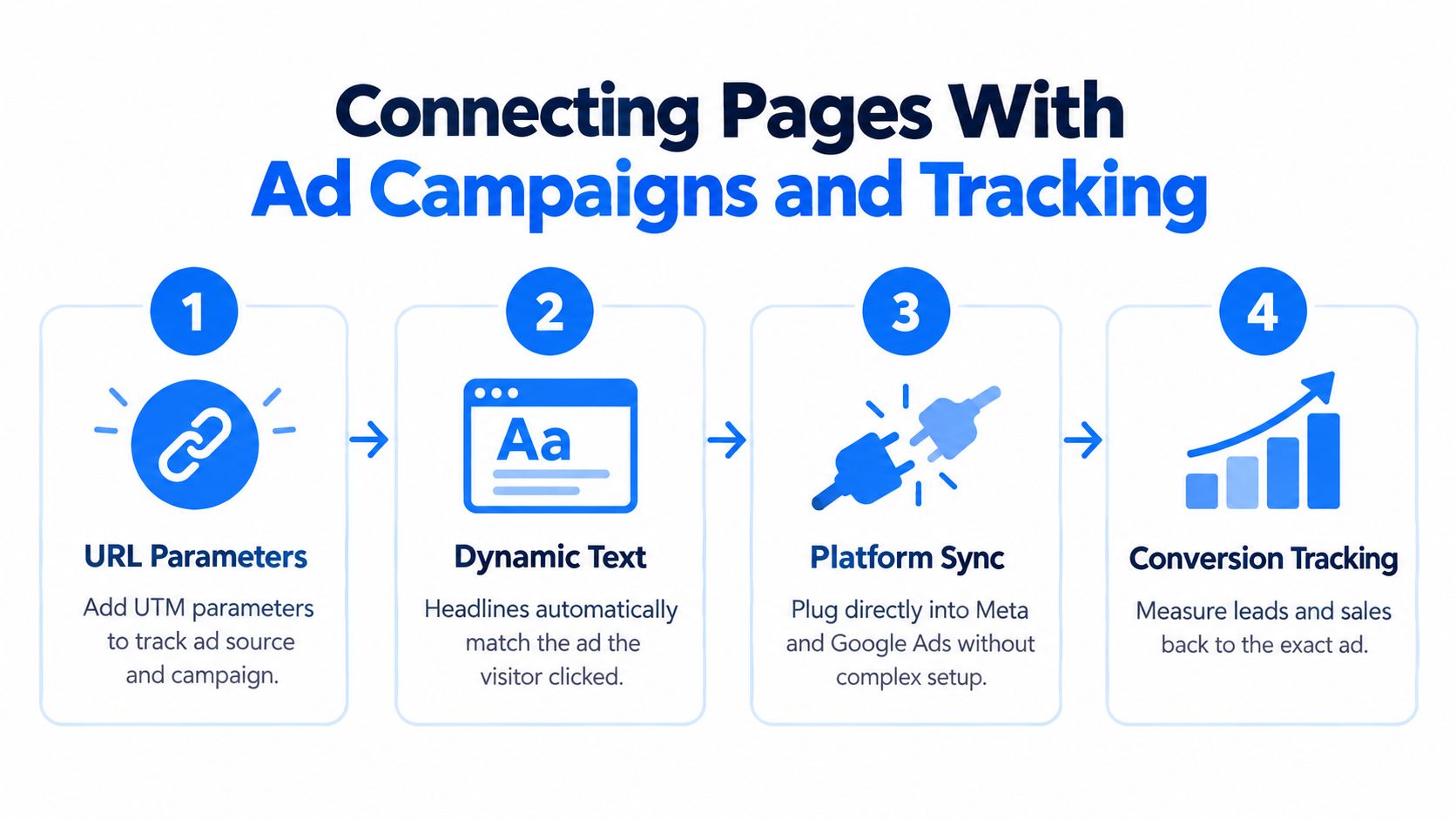
An ad click only becomes useful if the page and the tracking stack agree on what happened. That starts with the URL. When someone clicks from Meta or Google, the link should carry campaign information so the landing page knows where that visitor came from and can adjust the message accordingly.
How the page and the ad should talk to each other
The simplest version is URL parameters plus dynamic text replacement. If the visitor clicked a specific service ad, the page can echo that service in the headline and hero copy. That makes the click feel like a continuation of the ad, not a reset.
Then come the tracking tools. Meta Pixel and Google Tag help record page activity, while server-side and client-side tracking give you two views of the same lead path. Client-side tracking is like a receipt at the front door, it sees what the browser reports. Server-side tracking is like a receipt copied from the office, it confirms the action from the business system as well. Used together, they give a more complete record.
The difference matters because lead tracking isn't just about visits. It's about whether the click became a form fill, a booked job, or a qualified opportunity. That's also why the landing page needs to connect to a CRM or booking system, not just collect an email address and hope for the best.
Retargeting and offline conversion feedback
Good builders also help preserve UTMs, fire conversion events, and feed data back to the ad platform. That means the system can remember the source of the lead and use offline conversion feedback when a job books later. The ad platform then learns from outcomes, not just surface clicks.
For a deeper look at that side of the stack, see Benji Ads' ad tracking software guide.
Best Practices That Lift Real Conversion Rates
A local visitor often decides in seconds whether to stay or leave. A landing page should make that choice easy by matching the ad, loading fast, and showing proof before doubt creeps in. The 2026 benchmark data shows why speed matters so much. Pages around 1 second loading time convert around 3.05% or higher, while pages in the 4 to 6 second range drop to roughly 1.08% to 1.7% (CartFlows landing page statistics).
The page should behave like the ad promise
If the ad says “emergency leak repair,” the landing page should say something very close above the fold. The headline, visual, and offer need to feel like one message, not a reset. A plumber who sends emergency traffic to a general services banner makes the visitor do the translation work, and that usually lowers conversions.
The broader conversion picture supports that. One 2026 benchmark model weighted technical speed at only 7% of the total conversion score, while messaging, trust, CTA clarity, structure, and differentiation made up the remaining 93% (Roast.page page speed conversion data). Speed helps, but speed with weak messaging still leaves money on the table.
What to check before you publish
Use this as a working checklist.
- Page Speed: Keep the page lean, with compressed images and minimal scripts, because load time still changes conversion behavior.
- Message Match: Make the headline and offer mirror the ad promise exactly.
- Trust Signals: Put reviews, licensing, guarantees, and real photos near the main CTA.
- Single CTA: Give the visitor one primary action, not a menu of competing choices.
- Mobile First: Design for thumb scrolling, short forms, and fast load on phones.
Those items belong together because they solve the same problem from different angles. Speed reduces friction, message match reduces confusion, and trust reduces hesitation. If one is missing, the others do not fully carry the page.
Practical rule: if the visitor has to hunt for the number, the form, or the next step, the page is doing too much and converting too little.
The strongest landing pages also match form length to buyer intent. A high-intent visitor does not need a long story, just enough proof to feel safe and enough clarity to click. For a deeper look at why response speed decides whether leads go cold, see the guide to speed to lead.
Common Misconceptions About AI-Generated Pages
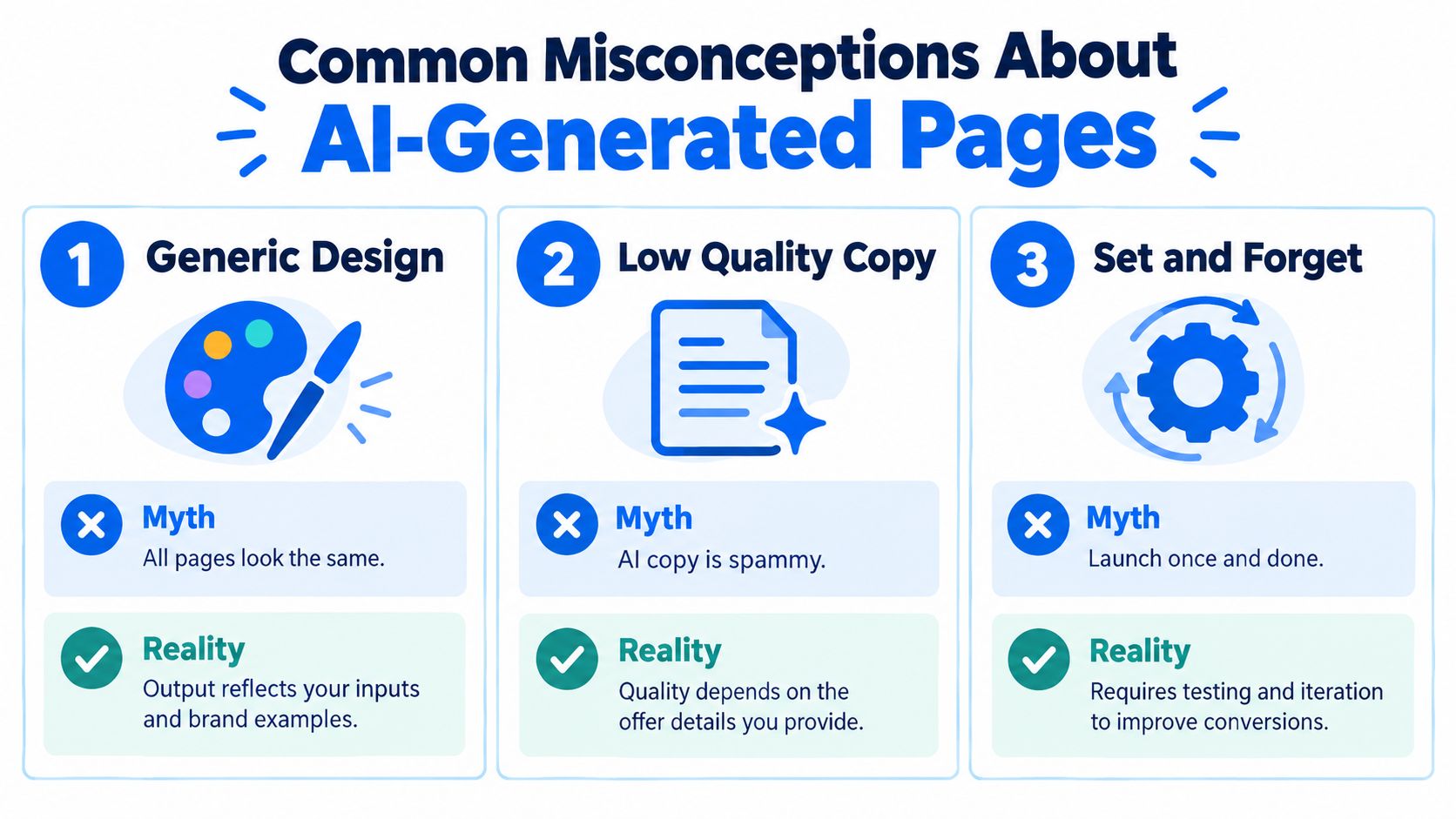
A lot of people assume AI-built pages are generic by default. They're not. The output still depends on the inputs, so a vague brief creates a vague page, and a detailed brief with a clear offer, audience, and proof points creates something much more usable.
Another myth is that AI removes strategy. It doesn't. Human judgment still decides the offer, the audience segment, the compliance language, and the order of the page. AI can assemble the draft, but it can't decide whether the page is selling the right thing to the right person.
The part people get wrong about testing
Some owners also assume AI pages can't be tested properly. That's backwards. Headlines, hero images, CTA copy, and form structures can be swapped manually or through automated experiments, which makes the page easier to improve over time.
What AI really changes is production speed. It helps a marketer get from idea to live page faster, then spend more time on the parts that matter most, like lead quality, source attribution, and whether the booking flow works.
Putting It All Together With the Right Workflow
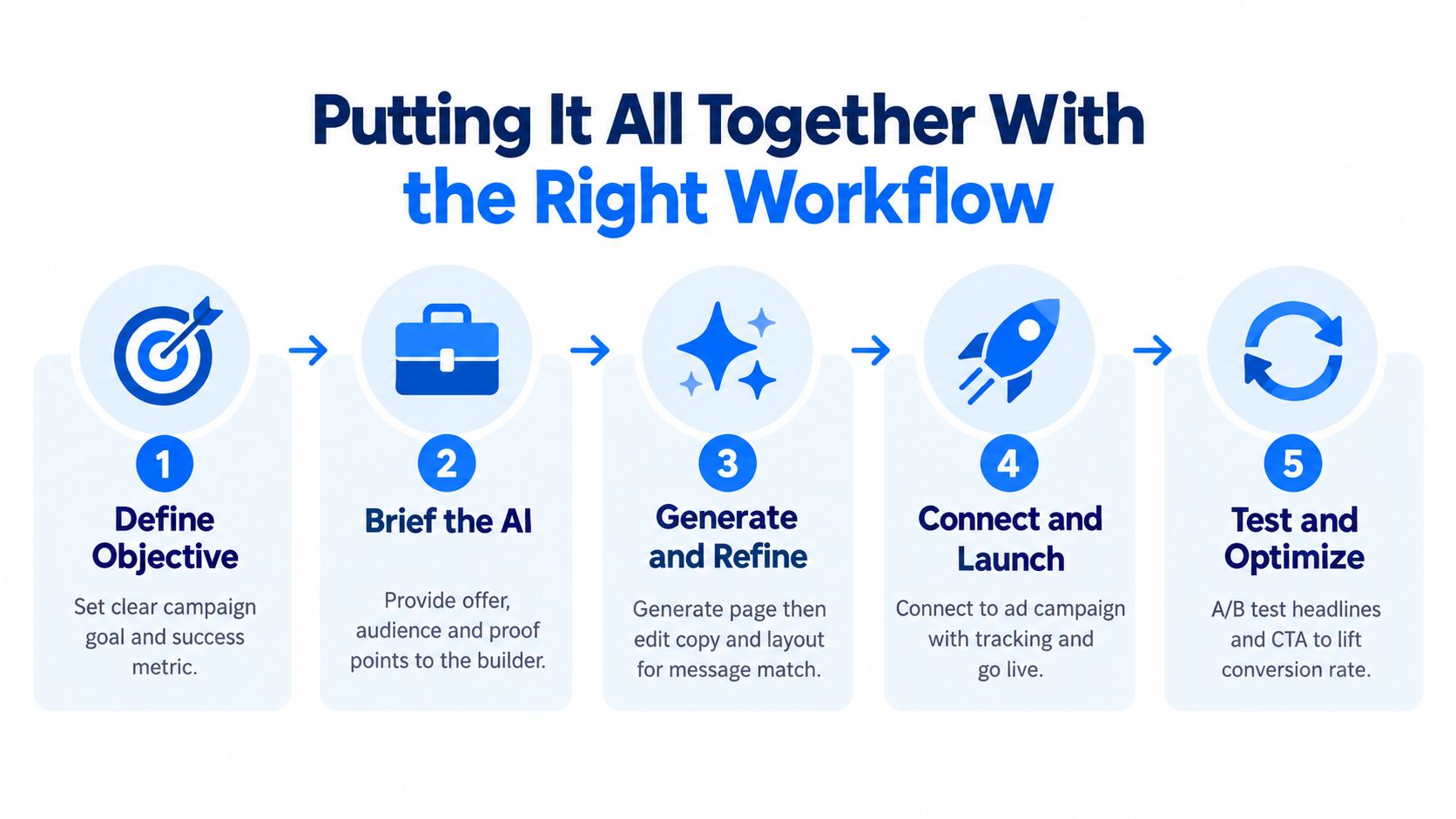
The cleanest workflow starts before the page exists. Define the campaign objective, then write a brief that names the offer, audience, location, proof points, and the action you want the visitor to take. If the builder supports it, feed in your naming conventions and UTM structure at the same time so attribution survives the trip through the ad platform, the page, and the CRM.
Then generate the page, edit for message match, connect tracking, and launch. Once leads start coming in, review both conversion data and lead quality, not just form fills. If the page is producing clicks but weak leads, the brief needs a reset, not just a headline tweak.
A practical loop to keep using
- Define the objective so the page has one job.
- Brief the AI with the offer, audience, and proof.
- Generate and refine the page for message match.
- Connect and launch with tracking and ad accounts.
- Test and optimize using conversion and booking feedback.
That loop works because it treats the landing page as part of the ad-to-booking stack, not as a standalone design output. The businesses that keep improving are the ones that feed real outcomes back into the next page version.
If you want a system built around that full flow, benjiads automates ad creation, landing pages, server- and client-side tracking, and lead follow-up for local service businesses. It's built for owners who want the page, the ads, and the follow-up to work together instead of living in separate tools.
- ai landing page builder
- landing page tools
- conversion optimization
- ai marketing
- local service ads
Done for you
Ads that text you customers.
- ✓ Ads created for you
- ✓ Every lead texts your phone
- ✓ 3 days free · $29.90/mo
748+ local businesses run ads with benjiads