facebook ads for plumbers 14 min read
Facebook Ads for Plumbers That Book More Jobs
Learn facebook ads for plumbers step by step — targeting, creatives, offers, funnels and SMS follow-up to turn clicks into booked jobs.
On this page
- Why Facebook Ads Work for Plumbing Businesses Right Now
- Setting Up Campaigns That Target Homeowners Ready to Book
- Choosing the Right Funnel for Every Plumbing Job
- Creating Offers and Creatives That Convert Local Homeowners
- Tracking Performance and Following Up by Text to Book More Jobs
- Your Next Booked Jobs Start With This Checklist
A homeowner sees water spreading across the utility-room floor, opens Facebook while looking for a local recommendation, and submits a form from your ad. Your office gets the lead, but nobody responds quickly. By the time someone calls back, the homeowner has already contacted another plumber.
That scenario captures the opportunity and the risk behind Facebook Ads for plumbers. Meta can put a service-specific offer in front of nearby homeowners, but clicks and form fills don't pay for trucks, labor, or parts. Booked jobs do. The campaign, funnel, tracking, and follow-up all have to work together.
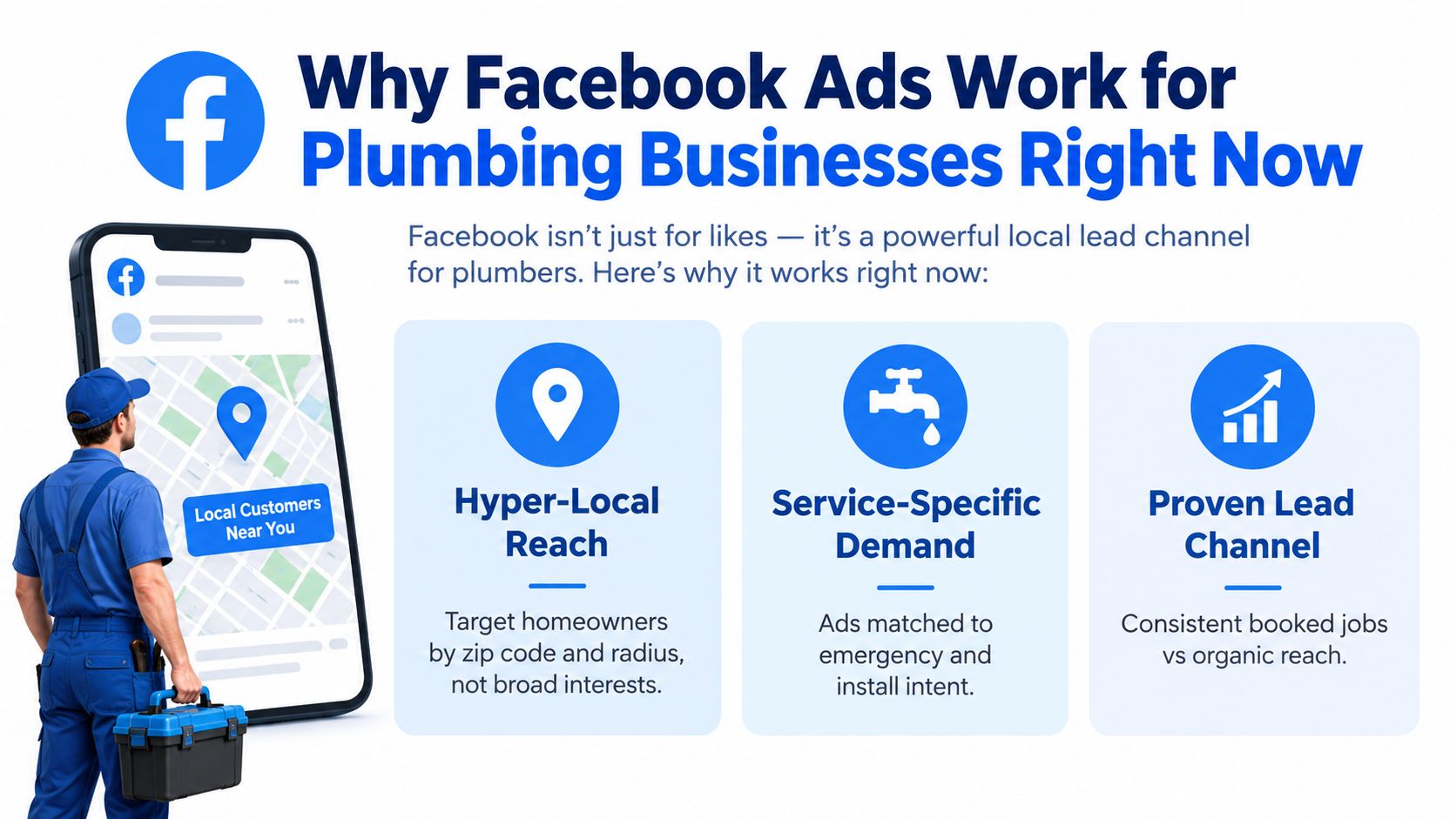
Why Facebook Ads Work for Plumbing Businesses Right Now
Facebook ads aren't a digital phone book. They interrupt homeowners while they're researching a planned upgrade, noticing a recurring problem, or deciding which local company looks trustworthy. That makes the channel especially useful for services such as water heater replacement, repiping, drain cleaning, sewer inspections, and maintenance offers.
Emergency plumbing requires a more careful expectation. Someone with a burst pipe may search Google first because the need is immediate. Meta still has a role, but it often works better for creating demand before the emergency, promoting nearby service availability, and retargeting people who visited your site or engaged with your content. The practical distinction between search intent and social interruption is covered clearly in this comparison of Google Ads versus Meta Ads.
The economics depend on what happens after the lead
A 2026 Meta benchmark places local services at a $9 to $14 CPM, 2.0% to 3.2% CTR, $0.45 to $1.00 CPC, and $25 to $120 CPL, with plumbing included among the local service categories. The same benchmark identifies a strong 25% to 55% lead-to-booked-job rate when follow-up is in place. See the 2026 Meta advertising benchmarks by business type for the full local-services context.
Those ranges are wide because plumbing campaigns aren't selling one uniform product. A drain-cleaning lead and a repipe inquiry have different values, urgency levels, qualification requirements, and acceptable acquisition costs. A campaign that looks expensive at the lead level may work well if it produces profitable booked work, while a cheap campaign can waste money when the phone number is wrong or the lead never answers.
Plumbing also benefits from demand that continues through the year. Burst pipes, clogged drains, sewer problems, and water-heater failures don't follow the same seasonal pattern as many heating and cooling services. Historical trade benchmarks place plumbing CPL around $20 to $45 in many markets, with major metros around $18 to $28 and mega cities around $24 to $35, as summarized in this metro-area Facebook lead cost benchmark.
Practical rule: Judge Meta by cost per qualified, booked job. Treat impressions, clicks, and raw leads as diagnostic signals, not the final result.
Setting Up Campaigns That Target Homeowners Ready to Book
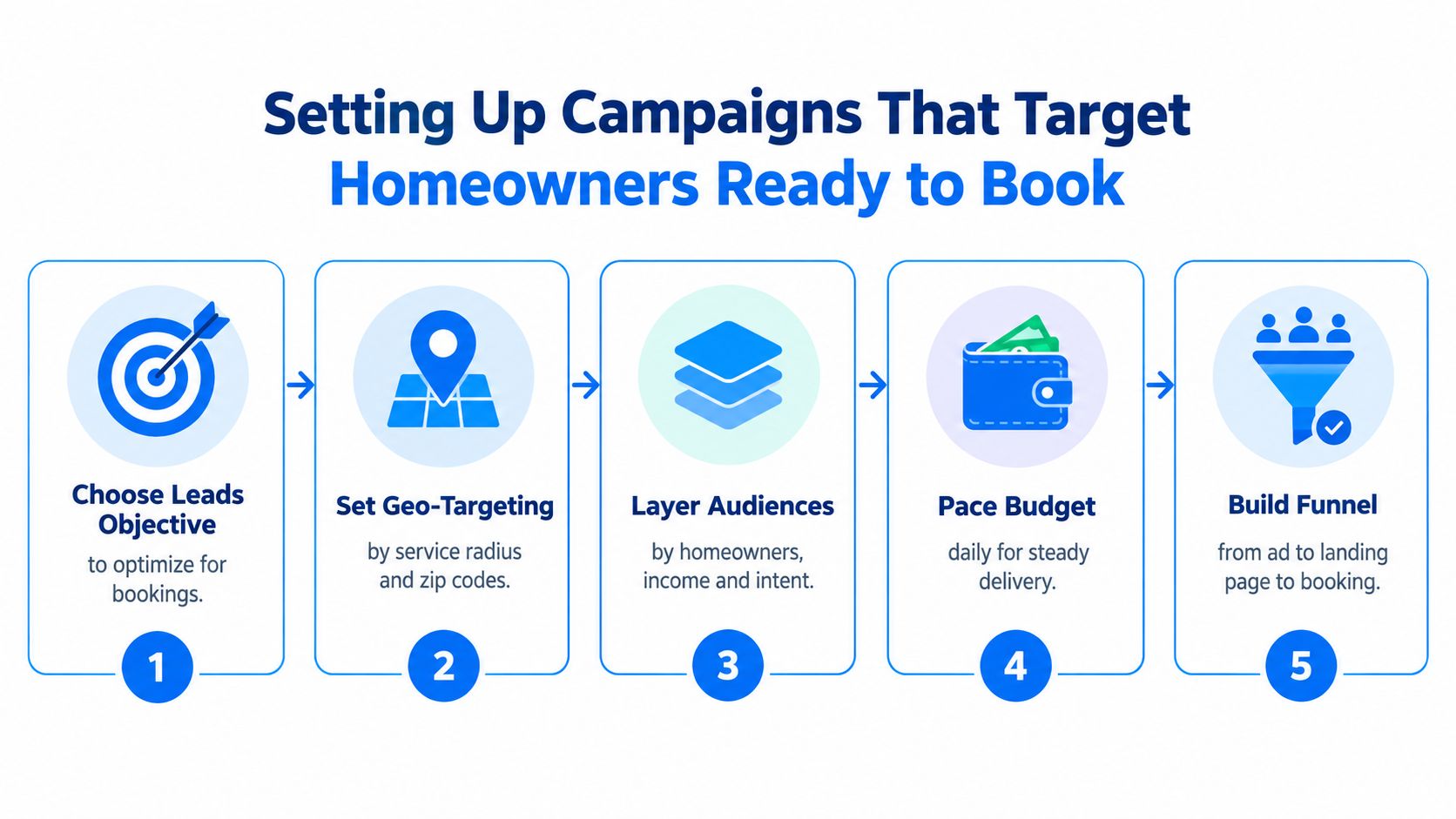
Start with the business outcome, not the audience menu. If the goal is a scheduled plumbing appointment, choose a Leads objective and build the campaign around the action your office can handle reliably. A traffic objective may produce visitors, but it doesn't tell Meta that a completed form, qualified call, or booked appointment matters more than a page view.
Keep the service area honest. Use the radius your technicians can serve profitably, then review the towns and ZIP codes generating inquiries. A broad audience inside a sensible service area usually gives Meta more room to find likely converters than a maze of narrow interests. Modern local campaigns tend to perform better when the account supplies clean conversion data instead of forcing prospects into excessive audience layers.
Build around one service and one action
Don't combine emergency drain work, tankless installation, repiping, and general brand messaging in one ad set. Each service needs its own promise, creative, qualification question, and destination. A homeowner looking for a water-heater quote shouldn't land on a page dominated by drain-cleaning copy.
Useful campaign inputs include:
- Service definition: Choose one problem or job category for the campaign.
- Geography: Set the service radius and exclude areas your team won't visit.
- Conversion path: Decide whether the ad should produce a call, instant form, or website conversion.
- Qualification: Ask only what dispatch or sales needs to know, such as service type, urgency, and location.
- Budget pacing: Use a daily budget that can run consistently long enough to reveal lead quality rather than making irregular bursts of spend.
- Approval control: Review every ad, offer, audience setting, and destination before launch.
Broader targeting doesn't mean careless targeting. Exclude existing customers where the platform and your data allow it, use local creative, and feed qualified outcomes back into the account. If you use templates or AI-assisted campaign creation, keep a human approval step so the final copy reflects your licensing, service area, availability, and actual offer.
A campaign should also have a complete path from ad to appointment. The ad earns attention, the form or page captures intent, your CRM routes the inquiry, and the office responds. Remove any one of those links and the campaign can look active while the schedule stays empty.
Review the structure with your team before spending. The office needs to know which leads belong to which service, who receives them, and what happens when a homeowner submits outside business hours.
Choosing the Right Funnel for Every Plumbing Job
The destination should match the homeowner's decision. An instant form removes friction and suits a straightforward request. A landing page gives you room to explain a complex, expensive project. A phone call is strongest when the person wants immediate conversation and your office can answer consistently.
Recent plumbing advertiser data shows a split worth paying attention to. Only 10% used Facebook lead forms, while 54% sent traffic to websites and 24% used call-now ads, according to this 2026 plumbing Meta advertising research. Those figures describe observed channel usage, not a universal prescription. The right choice depends on urgency, job value, and how well your team handles each route.
| Job Type | Recommended Funnel | Why It Works |
|---|---|---|
| Drain cleaning | Instant form or call-now ad | The homeowner usually wants a quick response and needs little education before requesting service. |
| Water heater repair | Instant form with qualification | A short form can identify the issue, location, and urgency without sending the visitor through a broad website. |
| Water heater replacement | Dedicated landing page | The page can explain replacement options, financing if genuinely available, warranty details, and the consultation process. |
| Sewer camera inspection | Landing page or call-now ad | The homeowner may need reassurance about the inspection, diagnostic process, and next step. |
| Whole-home repiping | Dedicated landing page | A high-ticket project needs proof, process details, service-area relevance, and a clear consultation offer. |
| Tankless installation | Landing page | The visitor may compare equipment, installation requirements, and long-term benefits before contacting you. |
Forms are not automatically low quality
Instant forms can work well when the offer is narrow and the questions qualify intent. Ask for the service needed, whether the situation is urgent, and the property location. A form that asks for excessive information creates friction, while a form with no useful qualification creates dispatch problems.
Website funnels can produce stronger context for planned work, but only if the page loads quickly and continues the exact promise made in the ad. A water-heater ad that sends visitors to a generic homepage forces them to search for the service they thought they were clicking to book.
For plumbers who need to create focused destinations without building every page from scratch, an AI landing-page builder can help structure a service-specific flow. The tool doesn't replace offer judgment, compliance review, or conversion tracking. It reduces the production bottleneck.
Call-now ads deserve operational discipline. If nobody answers, the campaign pays to create a moment of urgency that your business misses. Route calls properly, display the service area clearly, and give callers a reason to choose your company rather than continuing their search.
Creating Offers and Creatives That Convert Local Homeowners
Generic copy such as “We handle all your plumbing needs” gives homeowners no reason to stop scrolling. A stronger ad identifies one local problem, presents one service, and makes the next action obvious. The offer doesn't need to be complicated, but it must be specific enough for the homeowner to understand what happens after the click.
For an emergency-oriented campaign, lead with availability and response rather than a vague company introduction. For drain cleaning, the offer might center on an assessment or a clearly defined service request. For water heaters, the creative can focus on inconsistent hot water, replacement planning, or an evaluation. For repiping and tankless projects, use education and consultation because the homeowner may need confidence before requesting a quote.
Make the message local and believable
Use the city, neighborhood, or service area naturally in the headline and opening line. Show real technicians, real equipment, real job conditions, and recognizable local context. A smartphone video explaining a failed water heater can build more trust than a polished stock image, provided the footage is clear and the business performs the service.
A practical creative brief includes:
- Problem: Name the symptom the homeowner recognizes.
- Offer: State the service or next step without making an unapproved promise.
- Proof: Show the technician, process, completed work, review language approved for use, or relevant credentials.
- Location: Mention the communities your team serves.
- Action: Use a direct instruction such as request an assessment, call the office, or schedule service.
Don't put several services in one image and several offers in one caption. When the creative tries to serve every possible homeowner, it usually gives none of them a compelling reason to respond.
Refresh before fatigue becomes expensive
Local audiences see the same ads repeatedly, especially when the service area is compact. A 2026 local-business benchmark models a creative lifespan of about 14 days, so plan a refresh cycle rather than waiting for performance to collapse. The Meta local-business benchmark also models CPC around $1.00 to $6.00, landing-page conversion around 5.0% to 12.0%, and CPL near $41 in a generic local-business context.
Refresh the angle, not just the button color. Swap a technician demonstration for a before-and-after, change the opening problem, test a customer-focused explanation, or adapt the offer to a different job stage. AI can generate several trade-specific concepts quickly, but someone from the plumbing business should approve factual details, claims, imagery, and availability before anything runs.
One clear offer per ad makes performance easier to interpret. If the cost rises, you'll have a reasonable place to investigate instead of guessing which part of a complicated message failed.
Tracking Performance and Following Up by Text to Book More Jobs
A lead isn't a win when it enters a spreadsheet. It becomes valuable when your team can identify the service, reach the homeowner, qualify the request, and schedule the next action. That requires tracking both the marketing event and the operational outcome.
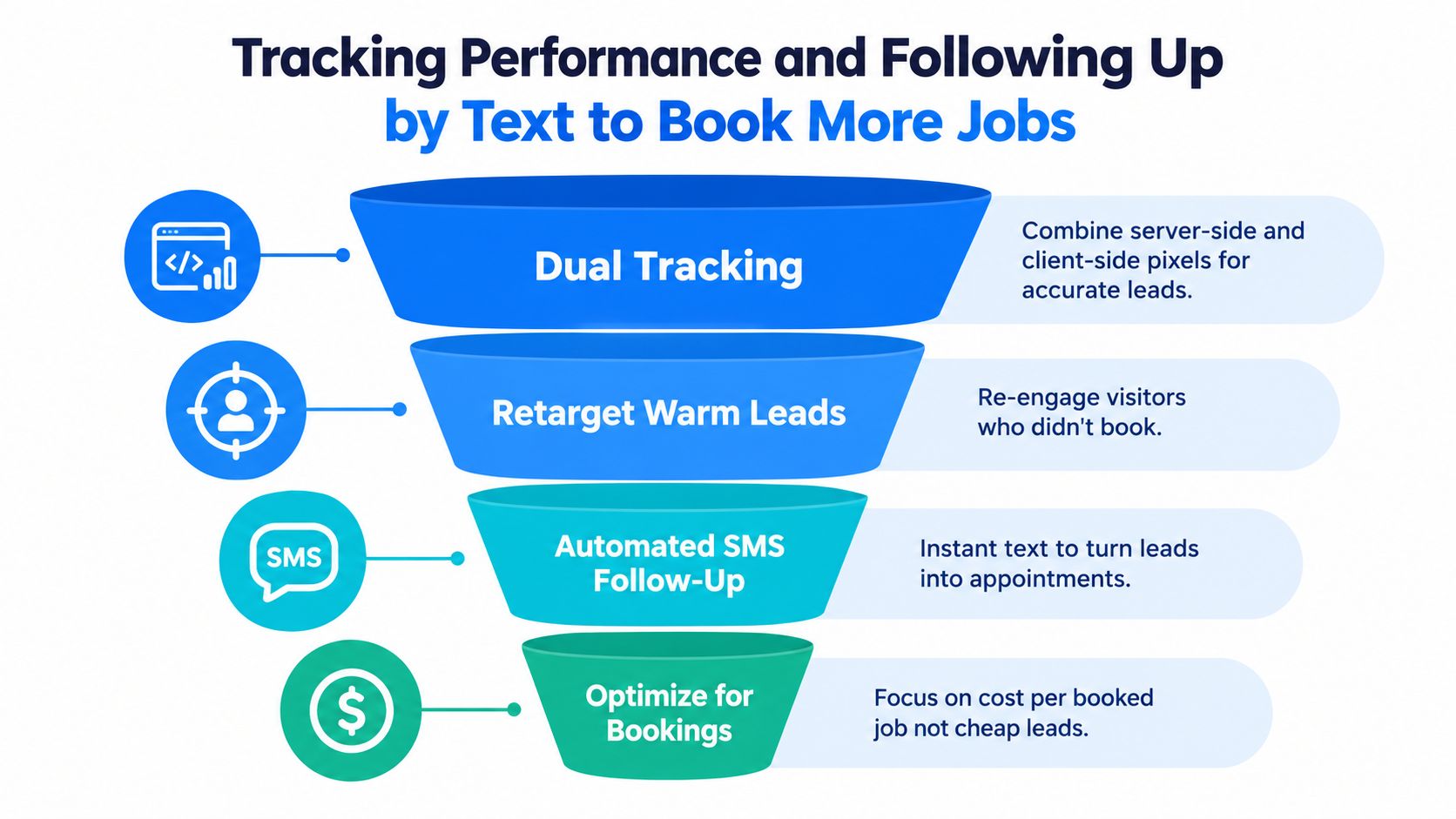
Use client-side tracking through the Meta Pixel where appropriate, and supplement it with server-side signals from your CRM or lead system. Browser-based data can be incomplete, while server-side events can help connect qualified leads and bookings back to campaign activity. The goal isn't to collect every possible event. It's to send reliable signals that distinguish a form submission from a real plumbing opportunity.
Diagnose the leak after the click
A local-service benchmark shows how quickly the funnel can become expensive. It models CPC between $1.00 and $6.00, landing-page conversion between 5.0% and 12.0%, and CPL near $41. Those values are benchmarks, not promises, and your account still needs measurement by service and booked outcome.
Check these points in order:
- Page speed: A June 2026 sample of 180 US plumbing advertisers reported mobile LCPs ranging from 2.5 seconds to 37.7 seconds, according to this plumbing advertiser performance analysis. A slow page can waste paid traffic before the visitor sees the offer.
- Tracking coverage: The same analysis found that several active advertisers lacked Meta Pixel or relied on CAPI only. Verify that form starts, completed submissions, calls, and booked jobs are represented in your reporting.
- Lead quality: Separate valid service-area inquiries from spam, wrong numbers, existing customers, and requests for services you don't provide.
- Booking outcome: Report cost per qualified lead and cost per booked job, not just platform-reported CPL.
Around 60% of form fills never answer the callback in one plumbing advertising benchmark, which is why a cheap CPL can conceal weak revenue. See this Facebook Ads guide for plumbers for the cited lead-quality pattern and the operational implications.
Text first, then call
Send an immediate text confirming receipt, identifying the company, and asking a simple qualifying question. The message should make it easy to reply, not force the homeowner to repeat the entire request. Follow with a call from the office and route unanswered leads into a clear sequence rather than letting them disappear.
Retarget visitors and form openers who didn't complete the action, but change the message. A homeowner who ignored an emergency-style ad may respond to a proof-focused creative, a technician video, or a clearer explanation of what the appointment includes.
The speed-to-lead guidance is useful here because response timing is an operating process, not merely an ad setting. Assign ownership, set alerts, and review missed contacts alongside campaign performance. A campaign manager can't fix a lead that sits untouched in an inbox.
Measure the handoff: Every weekly report should answer which service generated the inquiry, whether the lead was reachable, whether it booked, and what the booked job cost to acquire.
Your Next Booked Jobs Start With This Checklist
The campaign is ready when the plumbing offer, destination, tracking, and office workflow agree with one another. A polished ad cannot compensate for a slow page. A low CPL cannot compensate for unanswered calls. A strong landing page cannot rescue an offer that tries to sell every service at once.
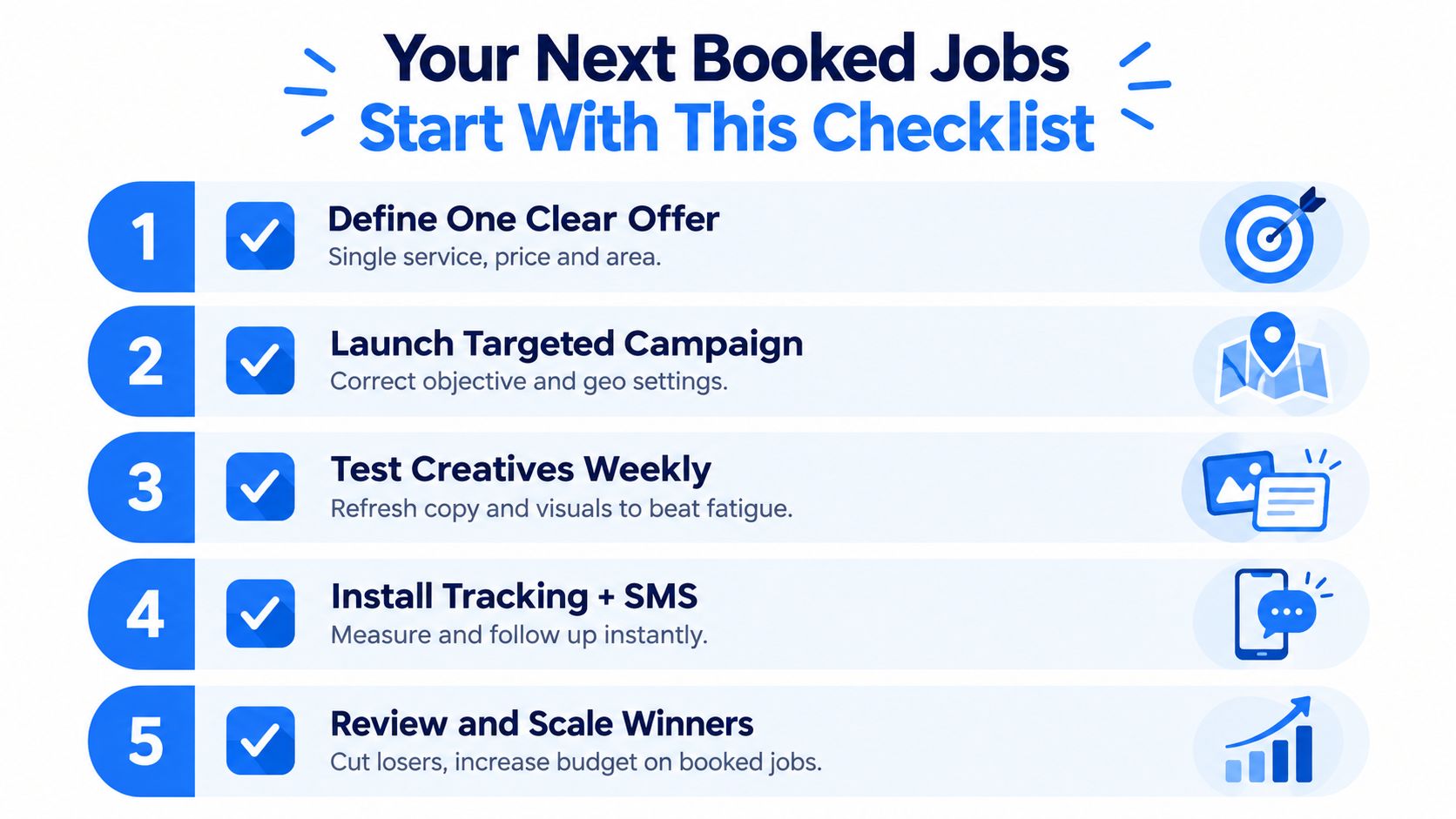
Approve the fundamentals before launch
Use this review as a final operating checklist:
- Define one clear offer: Select one service, one homeowner problem, one service area, and one next action.
- Choose the funnel: Use an instant form for low-friction inquiries, a landing page for considered projects, or a call path your office can answer.
- Launch with disciplined targeting: Keep the geography profitable and avoid audience restrictions that prevent the platform from learning.
- Test fresh creative: Rotate local visuals, technician explanations, proof, and problem-led copy before fatigue consumes the audience.
- Install complete tracking: Connect page events, forms, calls, qualified leads, and bookings so reporting reflects business outcomes.
- Automate the first response: Send a text promptly, notify the right employee, and maintain a call process for unanswered inquiries.
- Review booked jobs: Cut ads that create noise, improve the weak stage of the funnel, and increase investment only when the downstream result supports it.
Know what healthy reporting sounds like
A useful report doesn't say only that reach increased or clicks were inexpensive. It says which campaign produced qualified drain-cleaning inquiries, how many homeowners responded, which jobs booked, and what the acquisition cost looked like after follow-up.
Give each service enough consistency to reveal patterns, then make controlled changes. Don't replace the offer, audience, landing page, and follow-up sequence at the same time. If you change everything together, you won't know what improved or what created the problem.
Tools can reduce the manual work across creative production, campaign setup, landing flows, tracking, retargeting, and text follow-up. benjiads is one option that combines those functions for local-service advertisers and keeps an approval step before campaigns run. The platform's value depends on accurate business information and disciplined review, just like any other advertising system.
Start with the service that has a clear margin and a reliable fulfillment process. Build the funnel around that job, connect the lead to the office, and measure the appointment rather than celebrating the form.
If you want a plumbing campaign built around service-specific offers, local Meta and Google advertising, tracked funnels, and automated text follow-up, visit benjiads. Review and approve the campaigns before they launch, then use booked-job reporting to see where your budget is producing real opportunities.
- facebook ads for plumbers
- plumber lead generation
- plumbing marketing
- meta ads targeting
- lead follow up
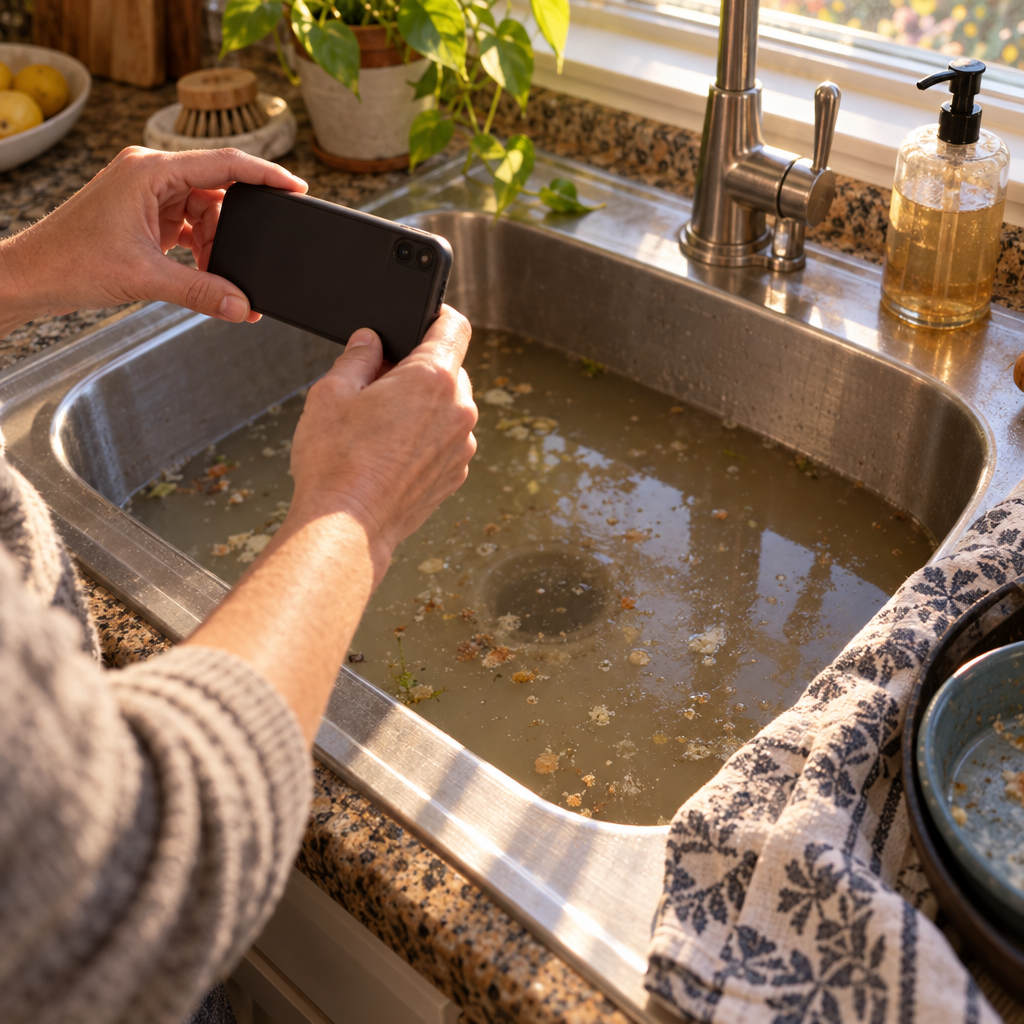
GET A CLOGGED SINK QUOTE BY TEXT
Get a clogged sink quote by text
Free estimates
Ads created · live on FB & IG
For plumbers
Your plumber ads, live in 2 minutes.
- ✓ Ads created for you
- ✓ Every lead texts your phone
- ✓ 3 days free · $29.90/mo
748+ local businesses run ads with benjiads