local service ads 15 min read
Local Service Ads vs Google Ads: A Practical Comparison
Local service ads vs Google Ads explained side by side. Compare coverage, pricing, lead handling, and intent to choose the right channel for your business.
On this page
- The Choice Most Local Businesses Get Wrong
- What Each Channel Actually Is
- Side-by-Side Comparison of the Core Differences
- Pricing, Lead Quality, and What the Benchmarks Hide
- When Local Service Ads Are the Clear Winner
- When Standard Google Ads Pull Ahead
- Tracking and Follow-Up That Make Either Channel Pay
- The Decision Rule to Walk Away With
A local contractor usually reaches this decision after a frustrating morning. The phone is quiet, the Google Ads dashboard shows clicks, and a separate Local Services tile promises leads from people already looking for a nearby provider. The obvious question is, “Which one costs less?” The useful question is different: Do you want to pay Google for attention, or for a customer contact?
That distinction changes how you set budgets, judge lead quality, train your team, and calculate profit. Local Service Ads and Google Search Ads can both produce work, but they charge for different moments in the buying journey. Compare them only by cost per lead and you'll make the wrong call for your business.
The Choice Most Local Businesses Get Wrong
A plumbing owner gets a call from a Local Service Ad during a slow morning. The homeowner searched for help, saw the company profile, and contacted the business through Google. The owner pays for that valid lead, then the office checks the service area, confirms the customer is serious, and decides whether the team can schedule the work.
A Google Search campaign creates a different buying path. Someone searches a keyword, clicks an ad, reaches a landing page, and may call, submit a form, browse another page, or leave. The advertiser pays for the click whatever happens afterward. Standard Search campaigns use cost-per-click billing, while industry documentation of the early Local Services Ads model describes charging advertisers for valid leads in this overview of the early Local Services Ads model.
The invoice arrives at a different point in the customer journey. That difference affects how you set budgets and judge performance.
Operator rule: Never compare a paid click with a booked job. Compare both channels at the furthest reliable point in your sales funnel.
A roofing company selling inspections, repairs, and replacement projects may need the control of Search Ads. It may want to separate campaigns by service, location, and search intent, then send each prospect to a specific page. An emergency electrician may gain more from a profile that puts the phone number and reviews in front of someone who needs help immediately. A franchise may require granular control by city, while an owner-operator may prefer a simpler lead flow.
The decision is a buying-model decision first and a channel decision second. Evaluate both channels using the same downstream measures: cost per valid contact, contact rate, booked-job rate, average ticket, and profit after fulfillment. Vendor benchmarks can provide context, but they do not settle the decision. Your own sales process shows whether either channel produces profitable work, and whether the channel deserves more budget.
What Each Channel Actually Is
Local Service Ads are a pay-per-lead product for eligible local providers. Google verifies the business and may show trust signals such as Google Guarantee, Google Screened, or License Verified badges, depending on the category and business. The placement usually appears in a dedicated local-results unit, where service areas, reviews, business details, calls, messages, and profile information influence whether a prospect contacts you.
The program began as Home Service Ads in 2015, with limited categories and markets. Google expanded it gradually, reaching dozens of service verticals by 2018 and becoming available in more locations. Eligibility still depends on category, service area, verification, and other Google requirements. Check the Local Service Ads category guide before building your acquisition plan around the channel.
LSAs work best when the customer already knows the service they need and wants a local provider now. The profile does much of the selling. Reviews, proximity, business details, and response speed can matter as much as the ad placement itself.
Google Search Ads are auction-based pay-per-click campaigns. You select keywords, create ad assets, send visitors to a landing page, and pay when someone clicks. Search Ads can capture direct service searches, branded searches, problem searches, comparison searches, and broader research intent. A click remains only a visit until the prospect calls, submits a form, or books an appointment.
For a first-time advertiser, the clean mental model is simple. LSAs sell access to customer contacts. Search Ads sell access to search traffic. That distinction changes how you build campaigns. LSA management centers on eligibility, profile quality, lead screening, and fast response. Search management centers on query selection, message alignment, landing pages, conversion tracking, and budget control.
Local Service Ads vs Google Ads at a glance
| Dimension | Local Service Ads | Google Ads (Search) |
|---|---|---|
| Buying model | Pay for each valid customer lead received | Pay for clicks on the ad |
| Primary action | Phone call, message, or booked appointment | Click to a website, call asset, or landing page |
| Eligibility | Limited to eligible service categories and geographic markets | Broadly available to businesses that meet Google Ads policies |
| Trust signals | May include Google Guarantee, Google Screened, or License Verified badges | Ad assets and landing page establish most of the trust |
| Targeting control | Service category, service area, profile information, and Google matching | Keywords, match types, location, schedule, audiences, ads, and landing pages |
| Creative control | Limited profile and service presentation | Extensive ad copy, offer, landing-page, and testing control |
| Budget controls | Average weekly budget, monthly spending cap, and available lead-price controls | Campaign budgets, bids, bidding strategies, and keyword-level controls |
| Best fit | Urgent, geographically constrained services with clear customer demand | Businesses needing reach, message control, market testing, or complex conversion paths |
| Main risk | Limited volume, disputed leads, missed calls, and weak profile management | Paying for clicks that do not become contacts or customers |
Side-by-Side Comparison of the Core Differences
The first difference is what triggers the charge. LSA billing generally starts when a prospect contacts the business through an eligible lead action. Search billing starts earlier, when the prospect clicks. That makes Search Ads more flexible, but it also puts more responsibility on the advertiser to filter irrelevant traffic and convert the visit.
The second difference is where the channel can work. LSAs are tied to approved categories and service areas. They're powerful when a customer is searching for a defined local service, but they aren't a universal advertising layer. Standard Search campaigns can cover more query types and let an advertiser build separate campaigns for services, cities, brands, emergencies, and higher-funnel questions.
The third is control over the message. LSA advertisers work within a profile-led format built around business information, reviews, service areas, verification, calls, and messages. Search advertisers can test offers, headlines, landing pages, calls to action, negative keywords, audience signals, schedules, devices, and conversion actions.
Core differences between Local Service Ads and Google Ads
| Criterion | Local Service Ads | Google Ads (Search) |
|---|---|---|
| Pricing | Cost per valid lead, with prices affected by location, job type, lead type, and bidding mode | Primarily cost per click, with auction conditions affecting the price |
| Lead handling | Google generates calls, messages, or appointments and provides lead-management and dispute processes | The advertiser manages the website, forms, call assets, tracking, qualification, and follow-up |
| Geographic reach | Built for eligible local providers and defined service areas | Can target tightly by location and expand across markets with campaign controls |
| Query control | No conventional keyword-level bidding or standard keyword management | Keyword, match-type, negative-keyword, ad, and landing-page control |
| Trust presentation | Verification and badge signals can appear with the local provider profile | Trust depends largely on ad messaging, extensions, reviews, brand, and landing page |
| Intent | Strong fit for direct service searches where the customer wants a provider | Can capture direct demand as well as research, comparison, branded, and problem-based searches |
| Lead quality risk | A paid lead isn't guaranteed to be exclusive, qualified, or converted | A paid click isn't guaranteed to become a contact, qualified lead, or customer |
| Scaling | Constrained by category, location, profile eligibility, and available demand | Can scale by service, keyword group, city, budget, offer, and funnel stage |
| Optimization focus | Valid-lead rate, contact rate, booked-job rate, and cost per booked customer | Click quality, conversion rate, qualified-lead rate, booked-job rate, and revenue |
An LSA lead can still be poor. A caller may be outside the service area, looking for a service you don't offer, calling by mistake, or contacting multiple providers. Search traffic can also be excellent when a tightly matched query sends a ready buyer to a strong landing page.
The difference is not that one channel has intent and the other doesn't. Both can reach high-intent customers. They give you different control over how that intent becomes a sale. The raw acquisition number matters only after you attach it to contact quality and close rate.
Pricing, Lead Quality, and What the Benchmarks Hide
A cost-per-lead number looks decisive until you ask what the platform counted as a lead. An LSA lead may be a Google-generated call or message. A Search Ads conversion may be a form submission, a phone call, or another tracked action on a website. Those events aren't automatically equivalent.
Google states that LSA lead prices vary by factors such as location, job type, lead type, and bidding mode. A home-services benchmark cited by Cube Creative reported an average blended cost per lead of $53 for LSAs and $104 for standard Google Search Ads in its dataset, with recent LSA benchmarks commonly ranging from roughly $53 to $63 across home-service categories. The same home-services LSA benchmark reported electrical leads near $39 and plumbing leads around $57 to $69.
Those figures are useful baselines, not promises. Competition, seasonality, service type, response speed, landing-page quality, and qualification rules can move the actual economics. A lower platform CPL can still produce a worse result if your staff misses calls or your technicians close poorly.
The lead definition is the real comparison
| Dimension | Local Service Ads | Google Search Ads |
|---|---|---|
| Paid event | Valid customer contact generated through the LSA system | Click on an ad |
| What comes next | The business qualifies the contact and tries to book the work | The visitor must still call, submit a form, or complete another tracked action |
| Quality control | Profile, category, service-area, verification, and lead-dispute processes | Keywords, negative keywords, ad copy, landing pages, audiences, and conversion settings |
| Common waste | Invalid, duplicate, out-of-area, irrelevant, or unanswered contacts | Irrelevant clicks, weak landing-page visits, accidental clicks, untracked calls, and low-intent searches |
| Best financial metric | Cost per booked customer and revenue or margin per booked job | Cost per qualified lead, cost per booked customer, and revenue or margin per booked job |
| Capacity constraint | Lead flow may be limited by category, market, and profile demand | Spend can increase, but poor traffic can scale waste just as quickly |
A contractor should calculate booked-job cost from the bottom up. Start with platform spend, subtract refunded or disputed leads where applicable, count the leads your team contacted, then count appointments and completed jobs. Divide spend by completed jobs. After that, compare average ticket and gross margin by source.
This prevents the apples-to-oranges trap. LSAs generally begin closer to the contact event, while Search Ads begin at the traffic event. LSAs may offer less volume and less control, but the advertiser avoids paying for every non-converting visit. Search Ads may supply more reach and testing opportunities, but the advertiser must pay for the work of turning a click into a conversation.
The right optimization target follows the buying model. LSAs should be managed around valid leads, contact rate, booking rate, disputes, and cost per booked customer. Search Ads should be managed around qualified traffic, conversion quality, landing-page performance, booked work, and profit. Never let a cheap click or cheap lead end the analysis.
When Local Service Ads Are the Clear Winner
LSAs should be the default starting point for a business that fits the product instead of forcing every local company into a Search campaign. The strongest candidate is a licensed or verified trade operating in a defined metro area, with a small team that can answer calls and schedule work quickly. The business must also be willing to complete Google's verification requirements, including applicable background or license checks.
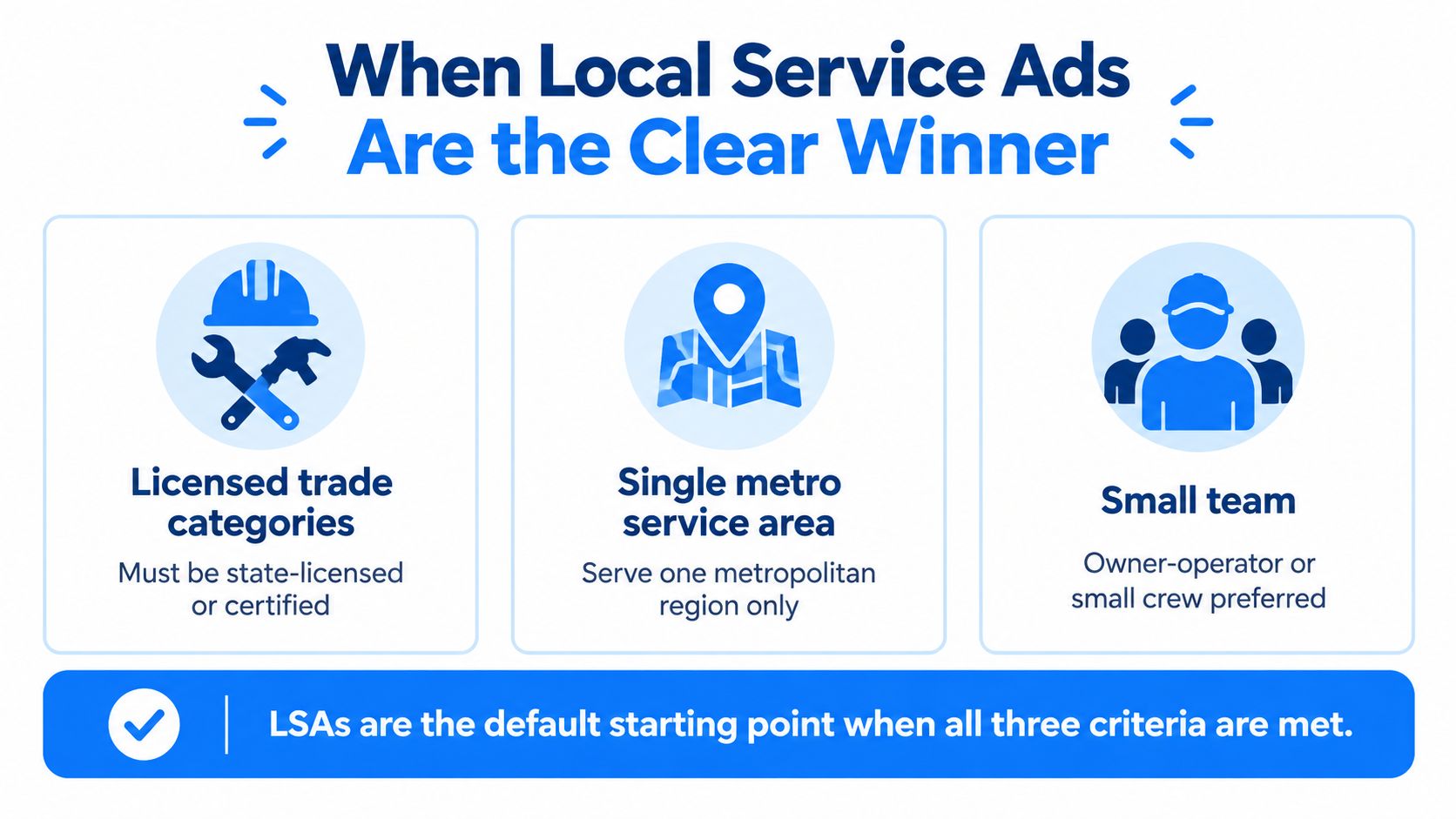
That profile matters because LSA compresses several trust tasks into one local-results experience. A customer can see the provider's business information, reviews, service area, and available verification signal before deciding whether to call or message. For an emergency plumber or electrician, that is often more useful than sending the prospect through a multi-step website funnel.
Best starting point: Choose LSAs first when your customers already know the service they need, your team can handle direct inquiries, and your business passes the program's eligibility requirements.
The operational burden is also lower than a carefully managed Search account. You don't need to build a large keyword structure, write multiple ad variations, or create a landing page for every service before generating demand. You do need a complete profile, accurate service areas, strong reviews, reliable scheduling, and a process for disputing invalid leads.
The trade-off is real. You can't use LSAs as a substitute for a broad market-expansion strategy. Category eligibility and geography limit where the product can run, lead volume may not match your desired growth rate, and the profile format gives you less control over ad copy and landing-page persuasion. A large company with several branches may also need more granular budget and message control than LSAs provide.
The best LSA operator treats the product as a high-intent lead intake channel, not passive advertising. Calls must be answered, messages need a fast reply, and every contact needs a status in the CRM. If your business fits the category, market, trust, and capacity profile, LSAs often provide the shortest route from local search to a conversation.
When Standard Google Ads Pull Ahead
Search Ads win when the business needs control that LSAs deliberately withhold. That includes companies outside eligible LSA categories, brands operating across several locations, service providers testing a new market, and businesses selling offers that need a carefully written explanation before a customer calls.
A multi-location franchise may want separate campaigns for each city, service, budget, schedule, and landing page. A home-improvement company may need different pages for repairs, installations, financing, warranties, and premium upgrades. Search Ads can organize those paths around keywords and conversion actions. LSAs usually can't express that level of segmentation inside the local profile format.
Search also makes more sense when the customer has a longer consideration cycle. A buyer comparing major renovations or commercial projects may search for options, review credentials, compare pricing approaches, and read educational content before making contact. A focused Search campaign can meet that buyer with a service-specific page rather than relying on a short profile and a call button.
The flexibility creates work. You need to control match types, add negative keywords, test ad copy, monitor search terms, adjust location settings, evaluate devices and schedules, and verify that calls and forms are recorded correctly. A conversion-tuned site helps, but it doesn't protect an unmanaged campaign from irrelevant traffic.
Read this guide to Google Ads for local businesses before expanding beyond a basic campaign structure. The practical standard is simple: don't scale Search Ads until you know which queries produce qualified conversations and which landing pages produce booked work.
Search Ads are also the logical expansion layer after LSA demand reaches your operational limit. If your team can answer every LSA call and still has profitable capacity, Search can open adjacent services, new locations, higher-value projects, and demand that doesn't fit a narrow LSA category. Running both channels blindly is a budget leak. Running Search to solve a specific capacity or coverage problem is growth.
Tracking and Follow-Up That Make Either Channel Pay
The channel doesn't close the job. Your tracking and response process do. Set up both channels so every inquiry receives a source, campaign, service, location, contact status, appointment status, revenue value, and final outcome. A lead that appears as “converted” in a platform report but never becomes a job should not receive the same weight as a profitable customer.
Use distinct tracking paths for LSA contacts and Search conversions. Call-tracking numbers should identify source and campaign while forwarding to the same office line, and after-hours calls should retain their original attribution when staff return them. Form submissions need source parameters preserved from the first visit through the CRM record. Messages need a clear owner, not a shared inbox that nobody checks.
The first-month operating checklist
- Separate the sources: Create distinct labels for LSA calls, LSA messages, Search calls, Search forms, repeat customers, and organic inquiries.
- Record the outcome: Mark each inquiry as invalid, contacted, qualified, booked, completed, lost, or refunded where relevant.
- Track response speed: Review missed calls, delayed form replies, and unanswered messages as operational failures, not merely marketing results.
- Import revenue: Connect completed-job value and gross margin to the original source instead of stopping at a form-fill event.
- Review capacity: Pause or reduce a source that generates more demand than the team can answer, unless the business has a plan to add capacity.
The response standard should be aggressive. Answer inbound calls immediately whenever possible, reply to forms quickly, and handle messages within the same business day. Speed matters because local-service buyers often contact several providers, and a technically correct attribution model can't recover a customer your team never reached.
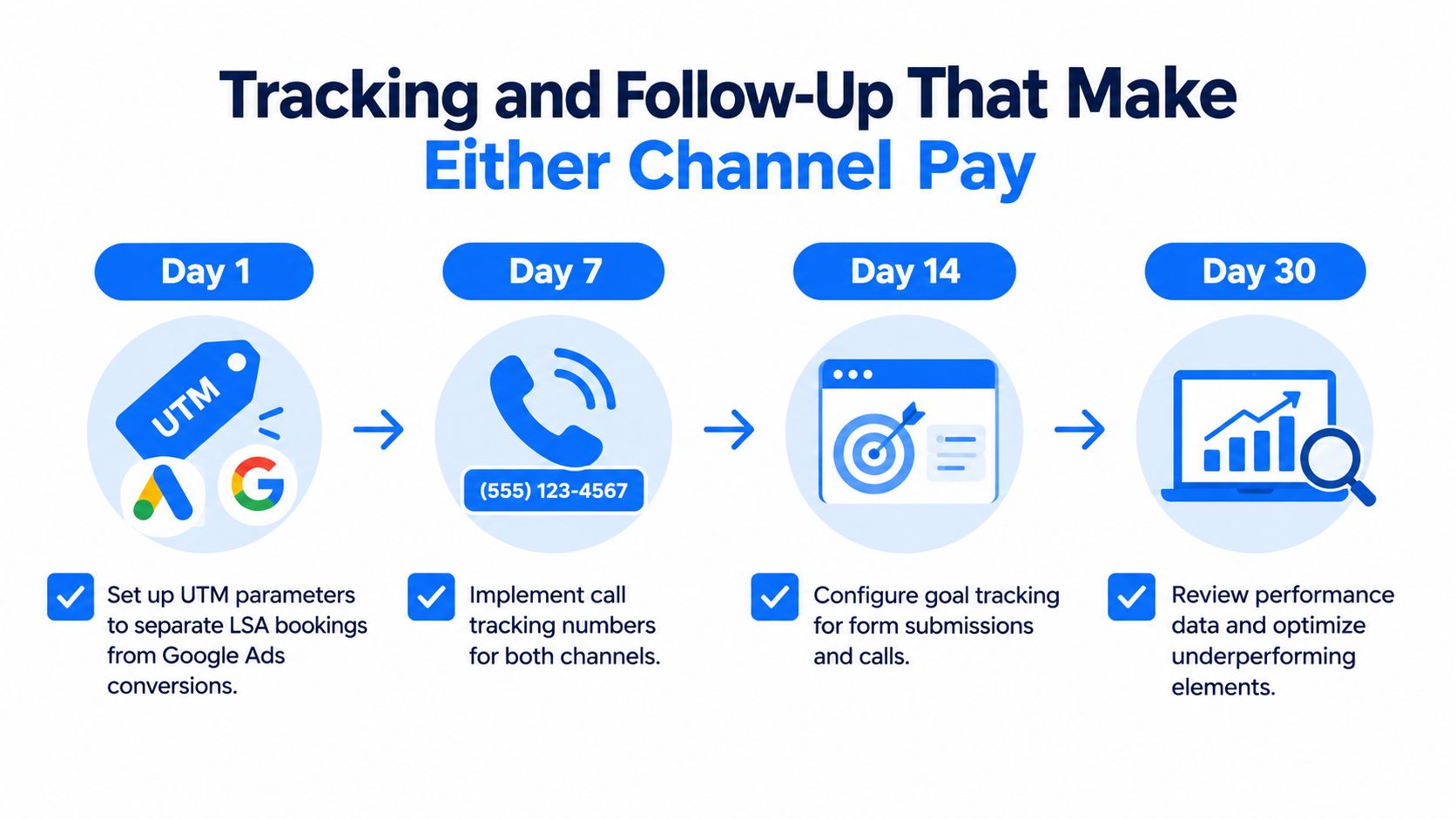
Avoid two common measurement errors. Do not classify LSA chats as paid clicks in a Search report, and do not allow a CRM to attribute every subsequent reservation to organic traffic merely because the customer returned through the website. A dual-tracking setup similar to the one detailed in this conversion tracking software guide can help align platform events with actual phone and CRM results.
Once a week, compare both channels on the same page: spend, valid leads, contacted leads, booked appointments, completed jobs, close rate, average ticket, revenue, and gross margin. Cost per booked customer is the decision metric. CPL and CPC explain the path, but they don't pay the invoice.
The Decision Rule to Walk Away With
If your business belongs to an LSA-eligible category, operates in a defined metro service area, can pass Google's background and license checks, and books most of its work from inbound phone calls, start with Local Service Ads and use standard Google Ads as the expansion layer when LSA demand plateaus or your business adds services that LSAs don't cover; if any of those conditions fail, or if you sell higher-ticket projects with a longer consideration cycle, start with standard Google Ads and a tight geographic radius, then judge the campaign by qualified leads, booked jobs, revenue, and margin rather than clicks alone.
BenjiAds helps local service businesses prepare campaigns, landing funnels, conversion tracking, and SMS-based lead follow-up, with approval controls before campaigns run. If you want to compare Google Ads or LSA demand against the downstream numbers that matter, visit benjiads and review how the platform fits your acquisition process.
- local service ads
- google ads
- lead generation
- local services
- ppc comparison
Done for you
Ads that text you customers.
- ✓ Ads created for you
- ✓ Every lead texts your phone
- ✓ Free to use, no credit card
748+ local businesses run ads with benjiads