ai tools for marketing 19 min read
10 AI Tools for Marketing Workflows in 2026
Compare 10 ai tools for marketing across creative, ads, analytics, SEO, landing pages, and lead follow-up to choose the right workflow stack.
On this page
- 1. benjiads
- 2. HubSpot Marketing Hub and Content Hub
- 3. Jasper
- 4. Copy.ai
- 5. AdCreative.ai
- 6. Unbounce Smart Traffic and AI Landing Pages
- 7. Madgicx
- 8. ManyChat
- 9. Semrush for SEO and AI Search Visibility
- 10. Birdeye with BirdAI
- Top 10 AI Marketing Tools Comparison
- Build the Smallest Stack That Closes the Loop
A local service business rarely needs more marketing output. It needs the right work to happen in the right order. The team needs fresh campaign creative, a landing page that turns clicks into enquiries, attribution that connects spend to real outcomes, and fast lead response. Meanwhile, the owner is answering calls, managing jobs, and trying to avoid operating several specialized platforms.
That's why the best AI tools for marketing shouldn't be judged as interchangeable copy generators. A creative platform, landing-page builder, ad optimizer, CRM, and lead-response tool solve different problems. The practical question is where each one fits, what it replaces, how much implementation it demands, how much control it gives you, and where it falls short for local-service advertising.
This list organizes ten tools by the marketing job they perform, from creative production and campaign execution to conversion, measurement, reputation, and follow-up. benjiads sits alongside the specialists as the end-to-end option worth examining, but it isn't the universal winner. The right choice depends on whether your bottleneck is content, paid media, search visibility, CRM operations, or the gap between a lead clicking an ad and booking.
1. benjiads
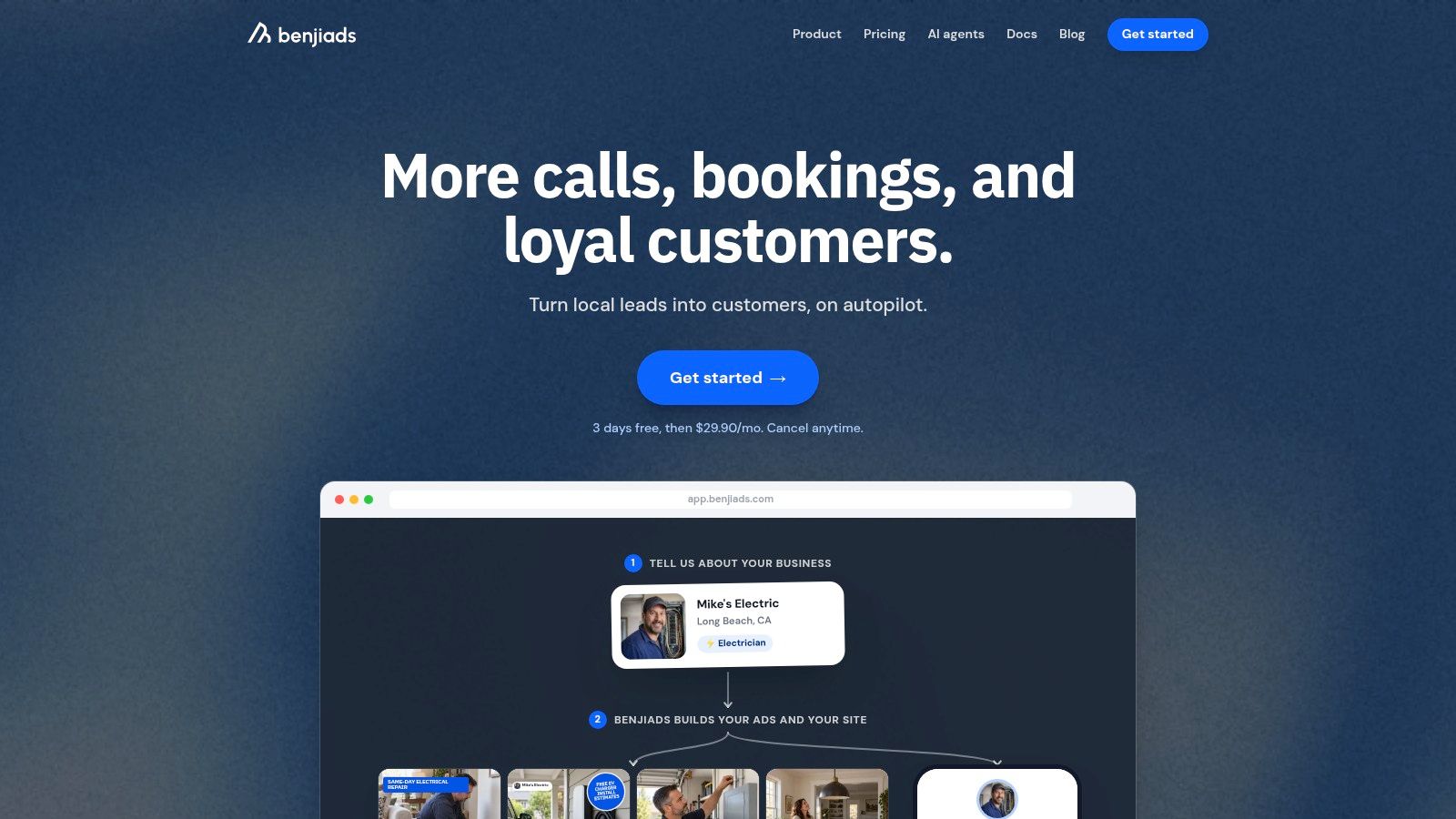
benjiads targets a common local advertising bottleneck: too many handoffs between creative, campaign setup, tracking, conversion, and lead response. A business may need ad copy and visuals, audience settings, landing flows, campaign configuration, measurement, retargeting, and follow-up before one enquiry becomes a booked job. benjiads brings those tasks into an approval-first workflow for electricians, plumbers, HVAC companies, landscaping businesses, cleaners, dentists, photographers, and similar service businesses.
The setup begins with a short questionnaire. Its AI generates trade-specific creative and copy, builds funnels and landing flows, prepares campaigns for Meta and Google, and connects server-side with client-side tracking. You approve the work before launch. After the click, retargeting and automated SMS follow-up continue the process rather than leaving a new lead waiting in a form inbox.
Where benjiads earns its place
The useful distinction is workflow coverage. Content tools can produce assets, and ad platforms can run campaigns, but the business still has to connect campaign structure, conversion signals, reporting, retargeting, and follow-up. benjiads puts those jobs in one product, reducing the number of separate systems a local team must configure and maintain.
Using server-side and client-side signals can provide a fuller view of ad interactions, leads, and bookings than depending on one browser event. Its reporting uses plain-English summaries and emphasizes outcomes such as bookings and cost per lead, so an owner does not have to interpret every advertising metric before deciding what to change.
Practical rule: Keep human approval at the launch point, then automate the repetitive work that follows it.
benjiads reports that managed accounts spend more than $100K per week through its verified business-partner activity, with an average local cost per phone-verified lead of around $7. The company also states that results vary by trade, area, and competition, so these figures are reported averages rather than promises for a particular market. The offer includes a 3-day free trial, followed by $29.90 per month plus a flat 10% of ad spend. New accounts receive the first $30 of ads, according to the benjiads platform information.
Trade-offs to understand
The main benefit is faster setup with fewer handoffs. The compromise is reduced control compared with configuring every setting in Ads Manager or commissioning a highly customized agency campaign. Businesses with strict compliance needs, several product lines, or detailed brand direction may need a broader platform or specialist agency.
For a local operator, benjiads fits when the priority is an approved campaign workflow that connects creative, paid media, conversion tracking, reporting, retargeting, and lead follow-up without assembling each layer separately.
2. HubSpot Marketing Hub and Content Hub
HubSpot Marketing Hub and Content Hub make sense when the marketing problem extends beyond getting local leads. The platform combines content operations, email automation, advertising, CRM data, attribution, permissions, and governance. Its AI features support content creation, email work, AI agents, and answer-engine optimization, while the connected CRM gives teams a shared record of contacts and activity.
For a growing business, that breadth can replace several disconnected systems. You can manage remarketing audiences, sync conversion events to advertising platforms, segment contacts using CRM data, and give different team members controlled access. That's valuable when sales, marketing, and customer service all need the same customer history.
What HubSpot handles well
HubSpot's advantage is coordination across a broad customer journey. A content team can create assets, a marketing team can build campaigns, and a sales team can work the resulting leads without exporting data between unrelated platforms. Governance features also matter for organizations where approval, permissions, and reporting standards need to be consistent.
The platform is a particularly strong choice for a company that has outgrown campaign-by-campaign lead handling and wants CRM-centered operations. Its automated marketing platform guidance is useful context when comparing broad automation suites with more specialized local advertising systems.
Where it becomes heavy
HubSpot requires more implementation discipline than a local-service advertising product. You'll need to define lifecycle stages, properties, workflows, ownership rules, attribution requirements, and reporting conventions. The total cost can also become difficult to forecast because onboarding, seats, hubs, and usage-related concepts may all affect the commercial structure.
HubSpot is powerful, but power creates administration. If the immediate need is to launch trade-specific ads and respond to leads quickly, its breadth may be more system than the business needs. If the business needs a durable CRM and marketing operating system, the complexity is easier to justify.
3. Jasper
Jasper is a strong fit for teams that need consistent, brand-safe marketing content across campaigns and channels. It's less about producing one clever paragraph and more about creating a repeatable content operation. Canvas supports multi-step production, while Brand Voices, Knowledge assets, and Audience profiles help keep outputs aligned with approved language and customer context.
That distinction matters for organizations where inconsistency creates risk. A local franchise group, healthcare marketer, or multi-language team may need more than a general-purpose chatbot. Jasper can support campaign assets, localization, research workflows, and structured content production while giving marketing leaders more control over the inputs behind the output.
The workflow advantage
Jasper works best when you establish the brand system before asking it to generate. Feed it approved positioning, product information, audience details, prohibited claims, and examples of the desired voice. Then use Canvas to move from campaign brief to variations, rather than prompting each asset from scratch.
Its Agents and governance capabilities can support more complex workflows, though access to heavier features and credits depends on the plan. That means Jasper can replace scattered prompting and manual rewriting, but it won't replace your media-buying or attribution stack.
Brand consistency is a workflow decision, not a prompting trick.
The main limitation is scope. Jasper can help produce the ad copy, landing-page language, email drafts, and localized variants, but another tool still needs to launch the campaign, track qualified leads, and optimize spend. For a local service business running a limited number of offers, that extra layer may be unnecessary. For a larger team managing many campaigns and contributors, the control can be worth the investment.
4. Copy.ai
Copy.ai has moved beyond the basic AI copywriter category. Its current strength is repeatable go-to-market workflows, where teams turn recurring marketing or sales processes into templates, automations, and specialized Copy Agents. It supports multiple model backends, including OpenAI, Anthropic, and Gemini, which gives teams flexibility when different tasks perform better with different models.
The practical use case is codification. Instead of asking a marketer to remember how to create an outbound sequence, research an account, summarize a call, or adapt a campaign for a segment, Copy.ai can structure the process so the same steps happen repeatedly.
Best use cases and constraints
Copy.ai is useful for outbound, campaign briefing, lead enrichment, content repurposing, and internal marketing operations. Brand Voice helps maintain consistency, while projects keep work organized by client, product, or campaign. A small team can start with simple workflows, then add automation as it learns which processes repeat often enough to justify formalization.
The trade-off is its credit model. Chat usage and workflow credits are treated separately, and advanced automation can consume credits faster than casual drafting. You'll need to test real workflows before deciding whether the plan matches your volume.
Copy.ai also isn't an ad optimizer, landing-page system, or analytics suite. It can prepare the work that feeds those systems, but it won't tell you which local campaign generated a booked job or follow up with a missed lead unless you connect it to other software.
For a service business, Copy.ai is most valuable when the team already has a defined process for proposals, outreach, or content production. It's less useful if the problem is that campaigns, tracking, and lead response are disconnected.
5. AdCreative.ai
AdCreative.ai focuses on the visual and copy variations needed for paid campaigns. It generates ad creatives, headlines, and variations for channels such as Meta, Google, and display, with platform integrations and access to iStock imagery. Competitor insights and creative analysis add context beyond simple image generation.
This is a practical tool for a team that has traffic and media buying in place but keeps running out of creative concepts. You can produce multiple formats and sizes quickly, then hand those assets to the person managing the campaigns. It replaces a portion of the initial design and copy process, not the entire paid-media workflow.
Where it saves time
AdCreative.ai is strongest during the testing and iteration phase. A marketer can take one offer, create several visual directions, adapt the message to different placements, and maintain a larger creative queue without sending every variation to a designer. That helps prevent a campaign from relying on one tired image or one headline.
The credit-based structure is the main operational consideration. Pricing and billing cadence can be confusing because terms vary by plan and billing period, so confirm exactly what generations, formats, integrations, and unused credits include before committing.
The tool also doesn't manage media buying or end-to-end attribution. It won't solve poor targeting, weak landing pages, broken conversion events, or slow lead response. Those problems sit downstream from creative production.
AdCreative.ai makes sense when creative volume is the bottleneck. If a local business wants someone or something to manage the complete path from offer creation to booked appointment, it will need to pair this tool with an ad platform, tracking system, funnel builder, and follow-up process.
6. Unbounce Smart Traffic and AI Landing Pages
Unbounce addresses the page between the advertisement and the enquiry. Its AI-assisted landing-page tools help marketers create and refine pages, while Smart Traffic routes visitors toward the variant most likely to convert. A/B/n testing, popups, and sticky bars extend the conversion toolkit beyond a single static page.
That makes Unbounce useful when paid traffic is arriving but the landing page isn't doing enough with it. The platform can reduce development bottlenecks for marketers who need to publish offer-specific pages without waiting for a full website release.
The conversion layer
A local service business might create separate pages for emergency plumbing, seasonal HVAC maintenance, or commercial cleaning. Each page can match the ad promise, feature a clear call to action, and use forms or call-focused conversion paths appropriate to the service. Smart Traffic can then direct visitors to different versions based on predicted fit.
The strength is controlled experimentation. You can test page language, layouts, calls to action, and lead-capture elements without rebuilding the entire site. The AI landing-page builder comparison provides a useful local-advertising perspective on why landing pages should be evaluated as part of the lead path, not as isolated design projects.
Unbounce's limitation is equally clear. It's primarily a conversion layer. It doesn't buy the ads, replace a CRM, provide complete lead follow-up, or automatically explain which booked jobs came from which campaign. Pricing and some feature access may also require a sign-in or direct conversation, so budget planning needs care.
Use Unbounce when the page is your bottleneck. Don't add it merely because it has AI. If your business lacks campaign structure and follow-up, a better landing page alone won't close the loop.
7. Madgicx
Madgicx is aimed at teams that already manage paid media but want more automation and analysis than native Ads Manager provides. It supports creative performance analysis, automated audiences, testing, and paid-media management across Meta and Google. Multiple-account support makes it more relevant to agencies and teams managing several advertising properties.
The platform sits closer to campaign execution than creative-generation tools. It can help identify which ads and audiences deserve attention, reduce repetitive optimization work, and centralize parts of a paid-media operation.
Who should use it
Madgicx is a reasonable choice for an experienced advertiser who understands campaign structure and wants an automation layer. It can speed up audience testing, creative analysis, and account oversight, especially when the team has multiple campaigns to monitor.
The platform isn't a substitute for clear conversion definitions. Before automating decisions, make sure the account distinguishes meaningful outcomes from cheap but unqualified actions. A local business should care about genuine enquiries, qualified calls, and booked work, not merely low-cost clicks.
Pricing is spend-tiered and billing terms can vary, so review the plan carefully. Some users have also reported surprise charges or refund friction during trials, which means the billing experience deserves the same scrutiny as the feature set.
Madgicx remains focused on paid media. You'll need complementary funnel, tracking, CRM, and follow-up tools. For a deeper explanation of the measurement layer that paid campaigns need, see this guide to ad tracking software.
8. ManyChat
ManyChat turns social interactions into conversations. It supports Instagram DMs, Facebook Messenger, WhatsApp, TikTok, Telegram, SMS, and email, with visual flow building and AI-assisted replies. Comment-to-DM automations are particularly useful for moving someone from a public social interaction into a private lead-capture conversation.
For local businesses, the use case is immediate. A person comments on a service post, asks whether a provider serves their area, or sends a direct message about availability. ManyChat can answer common questions, collect details, and direct the person toward a quote or booking step.
Conversation is not the same as conversion
ManyChat works well when social engagement is already happening. Its templates and visual builder make it easier to create FAQ flows, qualification prompts, and handoffs without coding. AI reply assistance can help maintain a consistent tone, but responses still need review for accuracy, especially when customers ask about prices, service areas, safety, or appointment availability.
The new pricing model and contact-based billing introduce additional cost variables. WhatsApp carrier and API fees from Meta may apply separately, so a business should calculate the cost of its actual conversation volume rather than relying on the headline plan.
ManyChat is best for social and messaging funnels. It isn't an ad manager or a full CRM replacement, and it doesn't independently solve attribution across Google, Meta, phone calls, and bookings.
Use it when customers naturally start conversations in social channels. If your primary acquisition path is a paid search click followed by a phone call, a platform with integrated campaign tracking and SMS follow-up may be a closer operational fit.
9. Semrush for SEO and AI Search Visibility
Semrush is the strongest specialist on this list for search research and visibility. Its traditional SEO suite covers site audits, rank tracking, content, and competitive research, while newer capabilities monitor brand and keyword presence in AI answer engines such as ChatGPT, Gemini, and Perplexity.
That expanded view matters because a business can rank well in conventional search while still lacking visibility when prospective customers ask an AI system for recommendations. Semrush helps teams investigate the prompts, topics, competitors, and sentiment associated with that visibility.
How local teams can apply it
A local service company can use Semrush to identify service questions, inspect competitor pages, find technical issues, and monitor whether its brand appears for relevant search themes. The output should inform pages, FAQs, service-area content, and reputation work. It shouldn't become an excuse to publish large volumes of generic AI-written pages.
Semrush's dataset and competitive tooling are useful for marketers who need evidence before choosing topics or diagnosing organic performance. It also scales from individual users to larger teams, though reporting options, user access, and add-ons can increase the total cost.
The limitation is workflow position. Semrush doesn't buy ads, build a conversion funnel, manage appointments, or respond to leads. It helps create demand and measure search presence, but another system must handle the commercial handoff.
For a local business with strong paid acquisition but weak organic visibility, Semrush can complement the advertising stack. It's less urgent when the immediate constraint is unanswered leads or poorly tracked campaigns.
10. Birdeye with BirdAI
Birdeye is designed for local reputation, listings, messaging, social content, and web chat. BirdAI can draft review replies, summarize feedback and conversations, support chatbot interactions, and suggest social content. The product is particularly relevant to multi-location businesses that need consistent customer communication across many profiles.
Reviews are part of the conversion environment, even when they aren't managed inside the advertising platform. A prospect may click an ad, visit a local profile, read recent feedback, and then decide whether to call. Birdeye helps the business keep that reputation layer active and organized.
Where it fits in the stack
Birdeye's local focus is its clearest advantage. Teams can manage listings, reviews, and messaging in one system instead of asking each location to respond manually across different channels. AI-generated drafts reduce response time, while summaries can help operators identify recurring complaints or service themes.
Human review remains important. A draft response should be checked for accuracy, privacy, tone, and whether it accidentally reveals customer information. Automated replies are useful for routine interactions, but sensitive complaints need an accountable person.
Pricing is gated and typically requires contact with sales, and contract terms may create friction for smaller operators. Birdeye also isn't a media-buying platform, so it needs to pair with an advertising, funnel, and attribution system.
Choose it when reputation and multi-location communication are the main operational problems. If the business needs to generate and launch local campaigns, track bookings, and follow up with fresh leads, Birdeye handles only part of that journey.
Top 10 AI Marketing Tools Comparison
benjiads 🏆
- Core features
- AI ad creatives & copy, Meta/Google campaign launch, funnels, server+client tracking, SMS follow-up
- Quality (★)
- ★★★★★
- Value (💰)
- 💰 $29.90/mo + 10% ad spend; 3‑day free + $30 ad credit
- Target audience (👥)
- 👥 Local service trades (plumbers, HVAC, electricians, dentists, etc.)
- Unique selling points (✨)
- ✨ End-to-end automation, trade-specific templates, approval-first workflow, fast activation, built-in SMS follow-up
HubSpot Marketing Hub + Content Hub
- Core features
- Ads + CRM, content/AEO, workflows, governance & seats
- Quality (★)
- ★★★★★
- Value (💰)
- 💰 Higher TCO; tiered/seat pricing + onboarding fees
- Target audience (👥)
- 👥 Growing teams to enterprise needing unified marketing/CRM
- Unique selling points (✨)
- ✨ Deep all-in-one stack, strong ecosystem & governance
Jasper
- Core features
- Brand-safe content studio, multistep canvases, agents & APIs
- Quality (★)
- ★★★★
- Value (💰)
- 💰 Mid-range; seat/usage pricing (Business for advanced features)
- Target audience (👥)
- 👥 Marketing teams needing on‑brand scale & localization
- Unique selling points (✨)
- ✨ Strong brand controls, workflow agents for content ops
Copy.ai
- Core features
- Chat-style generation, workflows/agents, multi-model support
- Quality (★)
- ★★★★
- Value (💰)
- 💰 Affordable entry; workflow credits for scale
- Target audience (👥)
- 👥 SMBs & GTM teams templating repeatable content
- Unique selling points (✨)
- ✨ Cheap way to codify GTM content workflows and automations
AdCreative.ai
- Core features
- Mass creative generation, headlines, platform integrations
- Quality (★)
- ★★★★
- Value (💰)
- 💰 Credit-based plans; mid-priced for volume creators
- Target audience (👥)
- 👥 Small teams needing many ad variants quickly
- Unique selling points (✨)
- ✨ Rapid creative concepting + competitor insights
Unbounce (Smart Traffic + AI)
- Core features
- AI landing pages, Smart Traffic routing, A/B/n testing
- Quality (★)
- ★★★★
- Value (💰)
- 💰 Mid; some features gated / premium
- Target audience (👥)
- 👥 Marketers focused on CRO from paid traffic
- Unique selling points (✨)
- ✨ AI routing to best-converting page variant, fast CRO lift
Madgicx
- Core features
- AI media buying, creative analysis, automated audiences
- Quality (★)
- ★★★★
- Value (💰)
- 💰 Spend-tiered pricing; confirm billing terms
- Target audience (👥)
- 👥 Teams managing multiple paid accounts seeking automation
- Unique selling points (✨)
- ✨ Centralized optimization beyond native Ads Manager
ManyChat
- Core features
- Conversational flows, comment-to-DM, multi-channel (SMS/WA)
- Quality (★)
- ★★★★
- Value (💰)
- 💰 Contact-based (2026 model) + platform fees
- Target audience (👥)
- 👥 Social-first businesses converting DMs to leads
- Unique selling points (✨)
- ✨ Fast social→conversation funnels with AI replies
Semrush
- Core features
- SEO suite, AI search visibility, rank & site audits
- Quality (★)
- ★★★★
- Value (💰)
- 💰 Add-ons/users increase cost; tiered plans
- Target audience (👥)
- 👥 SEO/content teams & competitive researchers
- Unique selling points (✨)
- ✨ Deep SEO dataset + early AI-visibility tracking
Birdeye (BirdAI)
- Core features
- Reviews, listings, messaging, AI review replies & chat
- Quality (★)
- ★★★★
- Value (💰)
- 💰 Gated enterprise pricing (contact sales)
- Target audience (👥)
- 👥 Multi-location local businesses managing reputation
- Unique selling points (✨)
- ✨ Purpose-built local reputation & multi-location messaging
Build the Smallest Stack That Closes the Loop
Tool selection should begin with the bottleneck, not the most impressive feature page. If the team can't produce enough campaign assets, Jasper, Copy.ai, and AdCreative.ai address creative production in different ways. Jasper is the better choice for governed, brand-controlled content operations. Copy.ai suits repeatable go-to-market workflows. AdCreative.ai is more focused on producing paid-social and display variations at speed.
If the landing page loses otherwise valuable traffic, Unbounce provides the conversion layer. It helps teams create variants, test page experiences, and route visitors toward stronger options. It still needs accurate tracking and a reliable lead-response process around it.
For media teams that already know how to manage campaigns, Madgicx adds automation and analysis across paid channels. Semrush is the specialist for SEO research and visibility across traditional search and AI answer engines. ManyChat is the better fit when prospects begin in social DMs or comment-driven conversations, while Birdeye serves businesses whose main challenge is reviews, listings, messaging, and multi-location reputation.
HubSpot is the broad CRM-centered option. It can unify content, automation, ads, customer data, permissions, and reporting, but the implementation and pricing structure demand more operational maturity. A local business should choose it because it needs a connected CRM system, not because it contains many features.
benjiads is the more focused choice when a local service business wants creative generation, campaign launch, funnels, tracking, retargeting, and SMS follow-up in one approval-first workflow. Its value comes from reducing handoffs between specialized tools. That makes it particularly relevant when the owner doesn't want to become a media buyer, conversion specialist, tracking administrator, and lead-response manager at the same time.
Use this selection checklist before committing:
- Channel ownership: Decide whether your team, an agency, or the software will manage Meta, Google, search, social messaging, and follow-up.
- Attribution requirements: Confirm that the tool can connect clicks with qualified leads, phone calls, bookings, and downstream outcomes.
- Lead-response speed: Map what happens immediately after a form submission, missed call, DM, or chat interaction.
- Desired control: Choose between granular manual control, guided automation, and approval-first execution.
- Team capacity: Count the people who'll configure campaigns, review creative, maintain integrations, and interpret reports.
- Pricing complexity: Include software fees, ad-spend charges, seats, credits, onboarding, message fees, usage limits, and contract terms.
The right stack isn't the one that generates the most copy, images, or dashboards. It's the one that gives the business a clear path from offer to ad, ad to lead, lead to conversation, and conversation to booked work. By 2026, generative AI had moved into mainstream marketing operations. One industry summary reported that 87% of marketers used generative AI in at least one workflow, up from 51% in 2024, while another reported 91% actively using AI at work, up from 63% the year before. Those figures are documented in this 2026 AI marketing adoption summary.
The next advantage won't come from adding another disconnected generator. It will come from choosing a workflow that preserves human approval where judgment matters and automates the operational steps that cause leads to stall.
benjiads combines AI-generated local-service creative, Meta and Google campaign launch, funnels, server- and client-side tracking, retargeting, plain-English reporting, and automated SMS follow-up in one approval-first workflow. If your business wants fewer disconnected marketing tools and a clearer path from ad spend to qualified leads, visit benjiads and start the free trial.
- ai tools for marketing
- marketing automation
- AI advertising tools
- lead follow-up
- marketing analytics
Done for you
Ads that text you customers.
- ✓ Ads created for you
- ✓ Every lead texts your phone
- ✓ 3 days free · $29.90/mo
748+ local businesses run ads with benjiads