small business seo 18 min read
Small Business SEO: A Guide to Getting More Local Leads
Our complete guide to small business SEO covers local search, your website, reviews, and how to track leads. Start getting found by local customers today.
On this page
- Your Guide to Small Business SEO
- Why SEO Is Your Best Local Marketing Investment
- The Local SEO Foundation Your Google Business Profile
- Optimizing Your Website for Local Customers
- Essential Technical SEO Without the Headache
- Building Trust with Online Reviews and Reputation
- Measuring SEO Success with Leads and Bookings
You've finished a difficult job, your customer is satisfied, and you know your service area better than any national chain. Yet when nearby customers search for the service you provide, competitors appear first, their phones ring, and your business is nowhere in sight. That gap is frustrating because it usually isn't caused by poor workmanship. It's caused by weak or incomplete visibility at the exact moment a customer needs help.
Small business SEO gives you a practical way to close that gap. It isn't a collection of mysterious tricks or a race to collect meaningless rankings. It's the process of making your business easy to find, easy to trust, and easy to contact when someone is comparing local providers. The useful question isn't “How do I get more traffic?” It's “How do I turn local searches into calls, enquiries, and booked jobs?”
Your Guide to Small Business SEO
A homeowner with a leaking pipe rarely begins by browsing a marketing channel. They search for a plumber, check the map results, look at reviews, visit a website, and decide who seems available and credible. The same pattern applies to electricians, dentists, landscapers, auto-repair shops, cleaners, and other local providers.
Google-derived research reports that 76% of people who search for something nearby on a smartphone visit a related business within 24 hours, while 28% of local searches result in a purchase (Biziq's local SEO statistics). Those actions may happen through a phone call, a map listing, a message, a direction request, or a website form. Your SEO should support all of them.
The work becomes manageable when you treat it as a sequence rather than one enormous project:
- Make the business identifiable: Use accurate business details, categories, services, locations, and operating hours.
- Match pages to real demand: Create useful pages for the services and areas you serve.
- Remove conversion friction: Put the phone number, enquiry form, availability information, and next step where customers can find them.
- Build confidence: Earn legitimate reviews, show evidence of completed work, and respond to customer feedback.
- Measure commercial actions: Track calls, forms, messages, qualified enquiries, and booked work instead of relying on rankings alone.
A good starting point is a practical overview of beginner SEO strategies, especially if you're handling the first improvements yourself. You don't need to rebuild everything at once. Fix inaccurate listings, clarify your most profitable service, improve the corresponding page, and establish a reliable way to record every lead.
SEO works best when it becomes part of your operating system. The person answering the phone, requesting reviews, updating opening hours, and recording job outcomes all contribute to search performance. Visibility gets attention, but the business wins the customer through relevance, trust, and a fast response.
Why SEO Is Your Best Local Marketing Investment
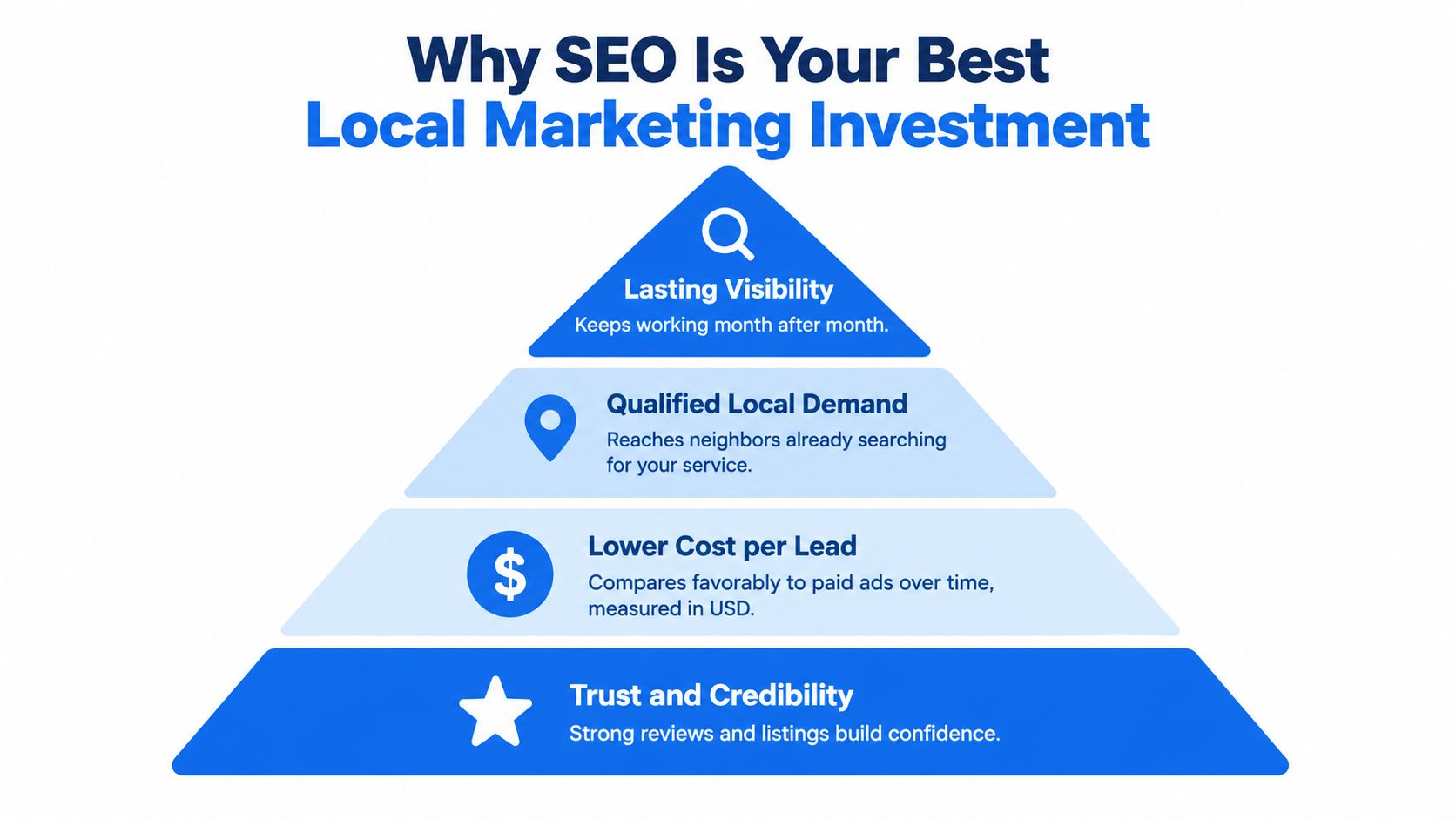
Local SEO earns its place in a marketing budget because it reaches customers with a defined problem and a local context. Someone searching for “emergency electrician” or “dentist near me” isn't passively consuming content. They're often evaluating who can help, where that provider operates, and how quickly they can make contact.
A Google representative cited in 2018 reported that 46% of Google searches were local in intent, meaning users were seeking products, services, businesses, or information relevant to a particular place (BrightLocal's local SEO statistics). For a service business, that makes location a commercial signal, not a decorative detail.
Search captures demand instead of interrupting it
Paid advertising can put an offer in front of a potential customer who wasn't actively looking for it. Social media can keep your brand familiar. SEO serves a different purpose. It helps your business appear when a person has already expressed a need through a search.
That difference affects the quality of the enquiry. A visitor who reaches your page after searching for a specific service has already supplied useful context. Your job is to confirm that you provide the service, operate in the right area, and offer a clear way to proceed.
SEO also gives you an asset you control. A social profile is more like rented space. A Google Business Profile can change how customers discover you, but your website remains the place where you explain your services, show proof, answer questions, and capture enquiries in a format you own.
Practical rule: Build every SEO asset around the next customer action. A page that attracts visitors but makes calling difficult is incomplete.
The trade-off is patience versus durability
SEO usually takes more time and consistent maintenance than turning on an advertisement. That's the trade-off. Paid campaigns can create visibility quickly, but they stop producing that visibility when the budget stops. SEO requires foundational work, content improvements, review management, and technical upkeep, but those improvements can continue supporting discovery after publication.
That doesn't make SEO a replacement for every other channel. A contractor with empty appointment slots may need paid acquisition while organic visibility develops. The stronger approach is often complementary: paid campaigns create immediate reach, while SEO builds a reliable discovery layer and gives prospects a credible place to research the business.
Judge the investment by customer value
A ranking isn't revenue. A session isn't a booked job. The commercial case for SEO becomes clear when you connect each activity to a measurable stage:
| SEO activity | Business outcome to monitor |
|---|---|
| Accurate local listing | Calls, messages, direction requests |
| Service page improvement | Qualified enquiries for that service |
| Review workflow | Customer confidence and conversion quality |
| Faster mobile experience | Completed visits and forms |
| Local content | New service questions and assisted enquiries |
A successful campaign may improve visibility first, then generate more calls, then produce better-qualified work. Record those stages separately. If a page attracts traffic but no relevant enquiries, improve its offer and contact path before celebrating the traffic.
The Local SEO Foundation Your Google Business Profile
Your Google Business Profile often acts like a second homepage. Customers may see your business name, category, service area, hours, photos, reviews, telephone number, and directions before they ever visit your website. An incomplete profile creates doubt at the moment a customer is deciding whom to contact.

Complete the profile with operational accuracy
Start with the information customers use to decide whether you're a real fit. Choose the most accurate primary category, add relevant secondary categories where appropriate, list your services in plain customer language, and define the areas you serve. Keep the business name, address, telephone number, website, hours, and holiday hours consistent with reality.
For service-area businesses, don't use a location merely because it has attractive search demand. If you don't operate there, the mismatch can create poor leads and customer dissatisfaction. A smaller, accurate service area is more useful than a broad claim that your team can't support.
Add photographs that help a prospect assess the business. Useful examples include branded vehicles, staff, equipment, completed work, premises, and clear before-and-after evidence where appropriate. Photos shouldn't be generic stock images. They should reduce uncertainty about who will arrive and what standard of work customers can expect.
For additional practical guidance, review these Google Business Profile optimisation tips. You can also use this Google My Business page guide to review the profile's role in your wider local presence.
Treat listings as a consistency exercise
Google isn't the only place where customers encounter your business. Industry directories, local platforms, map services, trade associations, and social profiles can all reinforce or contradict your identity. Search for your business name and inspect the listings that appear.
Use one approved business record as the source of truth. Check:
- Business identity: Confirm the same name and phone number wherever the business appears.
- Location details: Correct outdated addresses, duplicate profiles, and inconsistent service-area information.
- Opening information: Update hours when your schedule changes, including seasonal arrangements.
- Website destinations: Send customers to the relevant page, not an old domain or broken URL.
- Business description: Explain the services and areas you cover without stuffing repetitive keywords.
Build a profile that supports action
A profile isn't finished when every field has text. It's finished when a customer can understand your offer and take the next step without guessing. Review your listing from a phone and ask whether the main service is obvious, whether the call button works, and whether the hours match the times someone might need help.
Use Google's performance data as a source of questions, not as a vanity scoreboard. If customers request directions but don't contact you, the listing may be attracting interest without communicating the offer. If calls arrive outside your operating hours, revise the profile and your voicemail so the customer receives a useful next step.
Your foundational checklist is straightforward: claim the profile, verify every field, add authentic visual proof, keep listings consistent, and inspect the actions customers take. That foundation supports every page and review strategy that follows.
Optimizing Your Website for Local Customers
Your website should answer the questions a customer has before they call. A service business doesn't need a maze of articles. It needs clear pages that connect a problem to a service, a service to a location, and a location to an easy next step.

Give every important service a useful page
A single homepage that lists every service forces customers and search engines to interpret a crowded message. Create a dedicated page for each meaningful service, such as emergency plumbing, boiler repair, electrical inspections, or maintenance.
A strong service page should include:
- A specific title and heading: State the service in customer language.
- A direct opening: Explain who the service helps and what problem it solves.
- Service details: Describe the work, common symptoms, preparation, limitations, and likely next steps.
- Local relevance: Mention the service area naturally, including meaningful local context where it helps customers.
- Proof: Add real testimonials, qualifications, project photographs, guarantees, or process details that you can substantiate.
- Conversion options: Display a telephone number, enquiry form, and clear invitation to request an assessment or appointment.
Avoid writing a page by repeating the same city and service phrase in every paragraph. That approach makes the copy uncomfortable to read and doesn't create useful evidence of expertise. Explain the job in the way a customer would explain it to a technician.
Create location pages with a reason to exist
A page titled “Plumber in [City]” should contain more than a swapped city name. Explain the services offered in that area, the neighborhoods or communities you cover where relevant, typical access considerations, response expectations only when you can support them operationally, and the easiest way to contact the team.
Use unique details from actual operations. A contractor may understand local housing stock, parking constraints, weather-related issues, commercial districts, or council requirements. Those details make the page more useful and help a customer decide whether the business understands their situation.
Internal links should guide people from a location page to the relevant service pages and back to the contact route. Keep the navigation natural. A visitor reading about a service in a particular area should be able to see related services without returning to the homepage and starting again.
For broader guidance on turning a website into a clearer customer-facing asset, consult this resource on small business website design.
Write for the decision, not just the query
Search terms are useful for identifying demand, but the page must help a human choose. Include the information that removes hesitation: who performs the work, what happens after contact, whether the business serves the customer's area, and how the customer can prepare.
A well-structured page is like a tidy service counter. The customer sees the right offer, the relevant evidence, and the next step without moving through unnecessary clutter. Check every page on a phone, tap every contact button, and submit every form yourself. Technical polish has little value if a real enquiry disappears into an unmonitored inbox.
Essential Technical SEO Without the Headache
Technical SEO is the foundation beneath your digital storefront. Customers don't see the crawl instructions, page structure, or structured data directly, but those elements help search systems access and interpret the information you present.
Use structured data to clarify the business
For a local-service business, implement LocalBusiness structured data on the page describing the specific location. Use the most specific valid subtype available, such as Electrician or Dentist, rather than relying only on the generic LocalBusiness type (Google's LocalBusiness structured data documentation).
Include the business name, address, telephone number, URL, opening hours, and departments where relevant. The information in the markup must agree with the visible page. Structured data isn't a shortcut to rankings or a guarantee of enhanced search features. It helps search systems interpret the relationship between the business, its location, services, and operating details.
Validate the markup with Google's Rich Results Test. Use URL Inspection to check how Google renders the page, confirm that important pages aren't blocked by robots.txt, noindex, or authentication, and submit a sitemap after significant deployment work.
Fix the obstacles customers feel
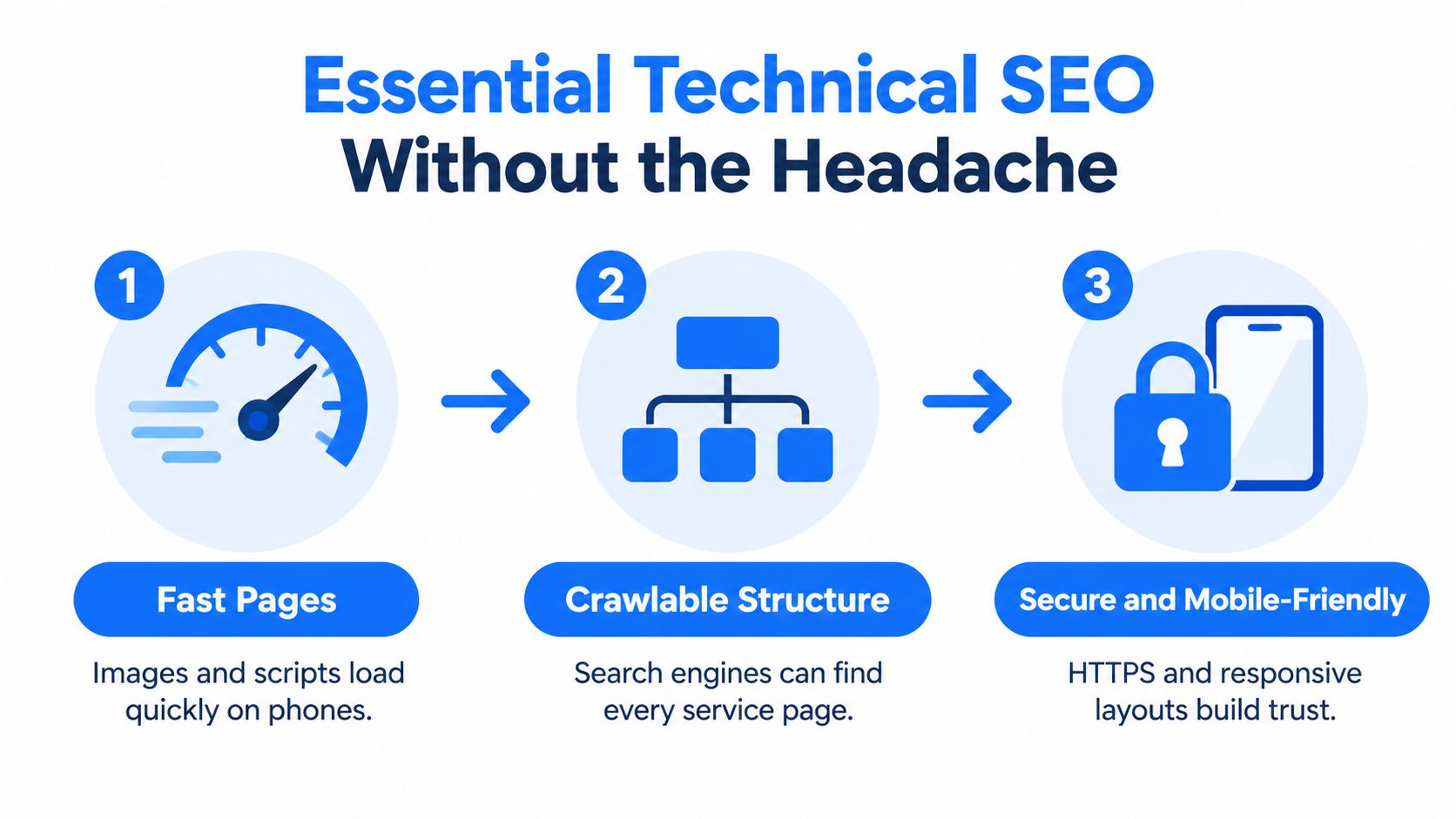
Mobile usability and speed are practical conversion issues. A customer looking for urgent help may leave if the page is difficult to read, the phone button is hard to tap, or an oversized image delays the useful content.
Ask your developer to compress large images, remove unnecessary scripts, limit intrusive pop-ups, and test the site on real phones. Don't judge performance only from the office computer. Test pages using a mobile connection and complete the same action a customer would complete, such as calling, submitting a form, or finding the service area.
Give search engines a route through the site
Organize the website so important service and location pages are reachable through normal links. Use descriptive page titles, readable URLs, logical headings, and an XML sitemap. Repair broken internal links and redirect old URLs when a page has moved.
Security matters too. Use HTTPS and keep the content management system, plugins, and forms maintained. You don't need to become a developer to manage these basics. You need a repeatable inspection process and a clear escalation point for issues that affect crawling or lead capture.
Technical SEO doesn't need to be elaborate. It needs to prevent search engines and customers from getting lost.
Building Trust with Online Reviews and Reputation
Reviews influence both discovery and conversion because they provide evidence from people who have already hired you. They also expose operational weaknesses. A business with accurate services but unanswered complaints may still lose the customer who is comparing providers late at night.
BrightLocal's survey of 1,026 US adults found that 83% used Google to read local-business reviews, 74% checked at least two review sites before deciding, and 89% expected owners to respond to both positive and negative reviews (BrightLocal's 2025 local consumer review survey). Customers don't always research in one place, so reputation management should cover the platforms where your audience looks.
Ask at the right operational moment
Request feedback after a completed service interaction, when the customer has had a reasonable opportunity to assess the work. A text or email can link directly to the appropriate review destination, explain that honest feedback is welcome, and make the process easy.
Avoid buying reviews, fabricating customer experiences, or asking staff to review the business as customers. Those shortcuts create a misleading reputation and can undermine trust when the wording doesn't match genuine customer experience.
A practical workflow looks like this:
- Close the job: Confirm that the work is complete and the customer understands any follow-up requirements.
- Request feedback: Send a simple, respectful request through the customer's preferred channel.
- Monitor platforms: Check Google and other relevant review sites consistently.
- Respond publicly: Thank customers for positive feedback and address criticism without exposing private details.
- Resolve privately: Move service recovery into a direct conversation while keeping the public response calm and useful.
Businesses looking to improve the request process can review this guide on how to get more Google reviews. The aim isn't to manufacture praise. It's to create a reliable opportunity for real customers to describe the quality of work they received.
Treat negative reviews as service information
A negative review deserves more than a defensive reply. Check the job record, identify what happened, and respond in a way that shows future readers you take the concern seriously. Don't argue about private details in public or reveal customer information.
A useful response can acknowledge the concern, apologise where appropriate, explain that you're reviewing the matter, and provide a direct contact route. The public reply won't satisfy everyone, but it shows prospective customers how the business behaves when something goes wrong.
Review SEO is therefore a distributed trust system. Keep the business identity consistent, invite authentic feedback, respond to both sentiment types, and feed recurring complaints back into training and service processes. Search visibility may bring the customer to the comparison stage. Reputation helps determine whether they call.
Measuring SEO Success with Leads and Bookings
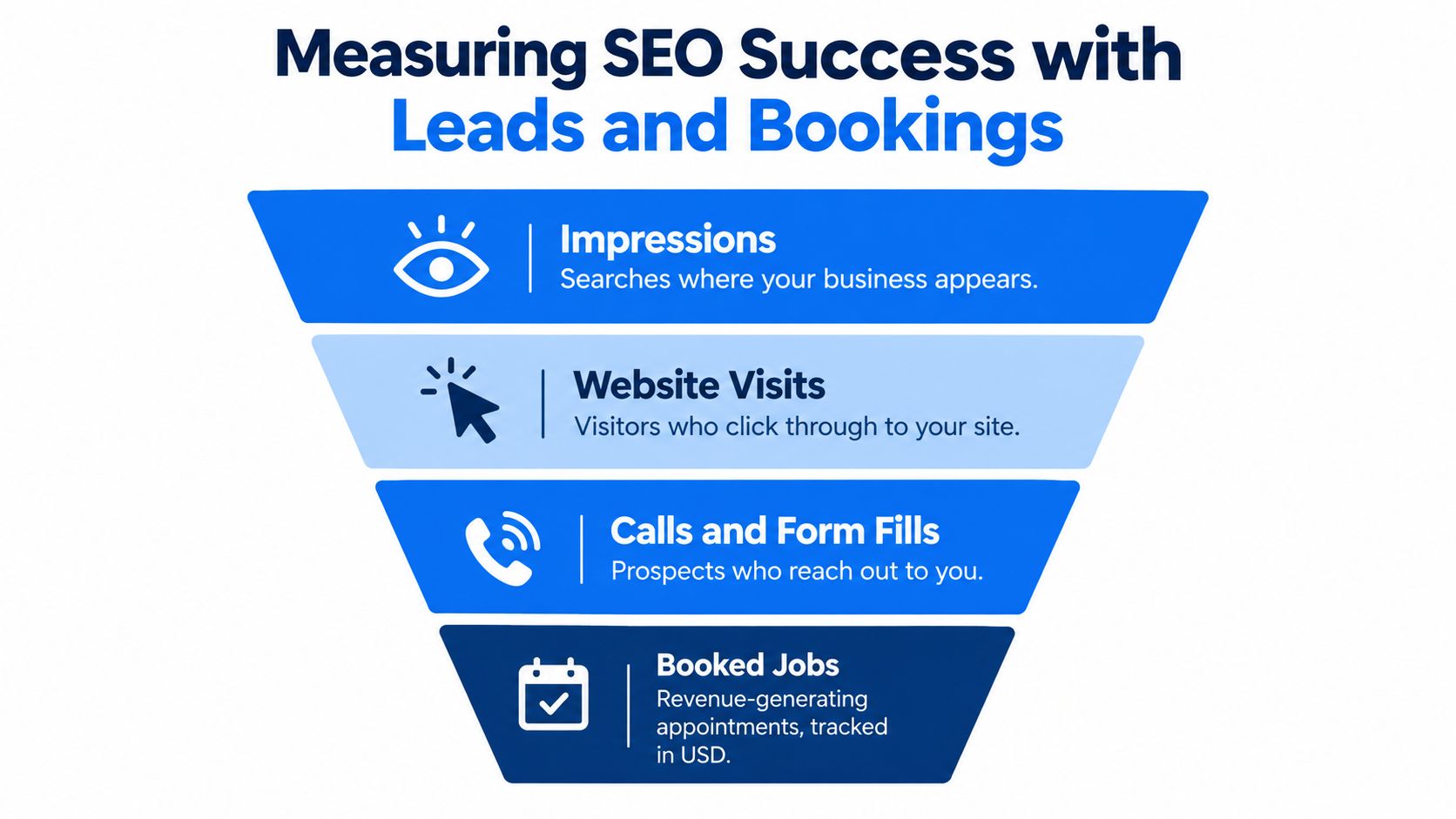
A ranking report can look impressive while the schedule remains empty. For a local business, SEO measurement should follow the customer from discovery to trust, contact, qualification, and booked work. Website sessions are useful context, but they're not the final score.
Track the full local search journey
Start with discovery signals such as search impressions, map visibility, profile views, and the queries that bring people to your pages. Then separate visits from actions. Record calls, contact forms, messages, direction requests, appointment requests, and quote enquiries.
The important distinction is lead quality. A hundred irrelevant enquiries can create more work than a smaller number of customers who need the service, live in the right area, and can book within your capacity. Add a simple qualification field to your CRM or job system so staff can record service type, location, source, outcome, and booked status.
The 2025 consumer study cited by Rio SEO reported that 53% of respondents would abandon a business because of inaccurate listings, while 59% expected a response within 24 hours (Rio SEO's local search consumer behavior study). That makes listing accuracy and response handling part of SEO performance, not separate administrative concerns.
Build a measurement sheet your team will actually use
You don't need an elaborate dashboard to start. A shared spreadsheet or CRM view can connect search activity to revenue-generating outcomes.
| Funnel stage | What to record | Why it matters |
|---|---|---|
| Discovery | Search visibility and profile interactions | Shows whether customers can find the business |
| Trust | Reviews, responses, and listing accuracy | Shows whether the business looks credible |
| Contact | Calls, forms, messages, and direction requests | Shows whether visibility creates enquiries |
| Qualification | Service, area, urgency, and fit | Separates useful leads from noise |
| Outcome | Quoted, booked, completed, or lost | Connects SEO to operational revenue |
Use unique phone numbers or call tracking where appropriate, with a clear privacy process. Configure forms to record the source and landing page. Ask callers how they found the business, but don't treat that answer as perfect attribution. Customers may see a map listing, search the company again, and then call directly.
Review the numbers alongside missed calls and response times. If enquiries rise but bookings don't, the problem may be slow follow-up, poor qualification, weak pricing communication, or limited availability rather than insufficient SEO.
Measure decisions, not vanity milestones
A first-page ranking can matter when it generates relevant actions. It doesn't matter much when it targets a broad phrase that produces no work. Likewise, a content page can be valuable if it assists a later booking, even when the customer doesn't convert during the first visit.
For contractors, the useful monthly conversation is practical:
- Which services generated qualified enquiries?
- Which areas produced profitable work?
- Which pages or listings assisted those enquiries?
- How quickly did the team respond?
- How many enquiries became booked and completed jobs?
- Which recurring customer questions deserve a clearer page?
If you're comparing SEO with other acquisition channels, use the same outcome definitions for each. A campaign should show not only the number of leads, but also whether those leads matched your service area, reached a real person, and became worthwhile jobs. For further guidance on connecting marketing activity to enquiries, see this resource on small business lead generation.
SEO becomes a business asset when every improvement has an operational destination. Accurate listings should create confident calls. Useful pages should create qualified enquiries. Faster forms should reduce abandoned contacts. Review responses should strengthen trust. Your final report should make it clear how search visibility contributed to conversations and booked work, not merely how many people passed through the website.
BenjiAds helps local service businesses connect advertising, landing pages, tracking, and SMS-based lead follow-up in one workflow, so SEO and paid acquisition can be judged by real enquiries and booked jobs. Visit benjiads to see how the platform can support lead capture, response handling, and clearer performance reporting.
- small business seo
- local seo
- seo for contractors
- google business profile
- lead generation
Done for you
Ads that text you customers.
- ✓ Ads created for you
- ✓ Every lead texts your phone
- ✓ Free to use, no credit card
748+ local businesses run ads with benjiads