retargeting display ads 10 min read
Retargeting Display Ads That Actually Convert
Learn how to set up retargeting display ads that drive real results. Covers audiences, creative sequencing, frequency caps, and measurement.
On this page
- Why Most Retargeting Display Ads Underperform
- Building Retargeting Audiences by Intent
- Sequencing Creative Across the Funnel
- Setting Frequency Caps That Prevent Burnout
- Measuring Incremental Conversions With a Holdout
- Adapting to a Cookie-Limited Measurement World
- Your 30-Day Retargeting Optimization Checklist
Most advice about retargeting display ads gets one thing wrong. It assumes the audience is the asset, when the actual variable is intent. If you treat every past visitor like the same person, you'll overpay for people who were already going to come back, then blame the media plan when the underlying problem is sloppy segmentation, weak suppression, and no incrementality test.
The better approach is a tiered retargeting system. Recent quote-page visitors, form starters, and booking-page abandoners deserve different ads, different caps, and different stop rules than someone who skimmed a blog post two weeks ago. That's how you get past platform vanity metrics and build campaigns that hold up when you compare them with a holdout.
Why Most Retargeting Display Ads Underperform
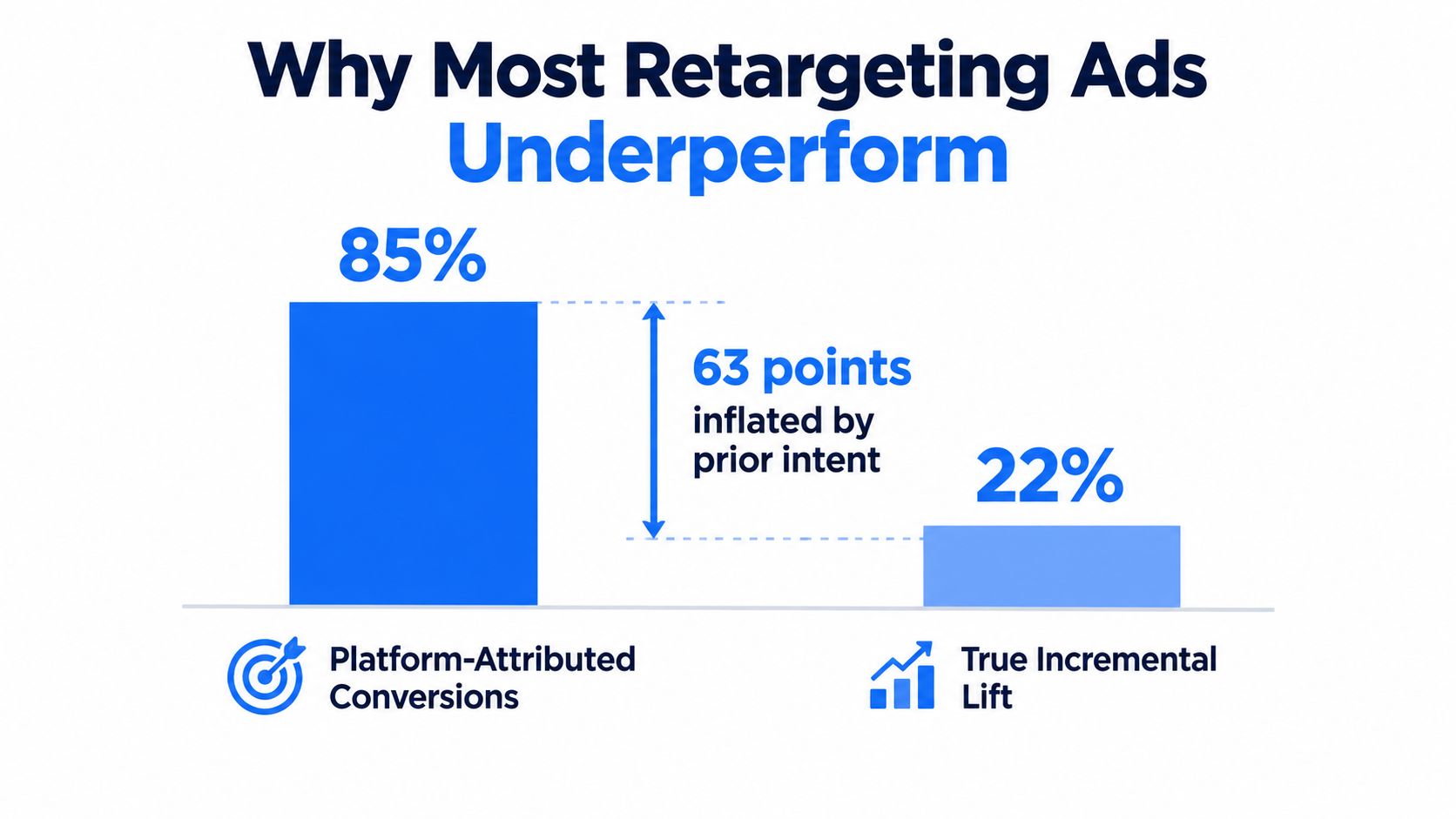
Retargeting gets over-credited because platforms are good at seeing what happened after an ad, and bad at proving the ad caused it. A randomized field experiment with BuildDirect found that turning retargeting on increased returning users by 14.6% over four weeks and that 33% of the first week's effect happened on the first day after exposure, which is a strong sign that recency matters more than most accounts admit (Stanford GSB study). The same body of research also found that later impressions were less effective as time passed from the original visit.
That means the default setup is usually backwards. Teams spend too long trying to “show ads to past visitors,” when the actual work is deciding which past visitors, how soon, and how often. In local services, this matters because a form view, quote request, missed call, or booking-page visit is not equal intent. A homeowner comparing remodeling options behaves very differently from someone who just bounced off a generic homepage.
Practical rule: If you can't separate high-intent users from low-intent users, you're not running retargeting display ads. You're running a broad reminder campaign and hoping attribution hides the waste.
The other mistake is trusting last-click stories. A large field experiment summarized by the American Marketing Association found that prospecting outperformed retargeting in that setting, which is exactly why retargeting display ads should be judged against incremental lift, not platform-reported conversions (AMA research insight). That doesn't make retargeting useless. It just means the campaign has to earn its keep with better measurement and tighter audience design.
Building Retargeting Audiences by Intent
Start with the tag, not the ad. Google's display retargeting guidance recommends a sitewide remarketing tag, conversion tracking on the final lead or purchase event, separate audience pools by intent, and an automatic exclusion audience for completed conversions (Google display performance guide). That structure matters because the audience itself is the control surface.
Split the audience before you write the ads
High-intent groups should include quote-page viewers, form starters, booking-page visitors, and anyone who hit a service or pricing page and stayed long enough to signal interest. Lower-intent groups can include homepage browsers, blog readers, and general service-page visitors who haven't shown clear purchase behavior. The two groups should not share the same membership window or bid weight.
For a plumber, that might mean separate pools for emergency-service page visitors, estimate form starters, and homepage visitors who never reached a contact step. For a dentist, it could mean new-patient page viewers, appointment-form abandoners, and research-heavy visitors reading service descriptions. For a landscaper, the strongest pool is often the quote-request path, not broad site traffic.
High-intent audiences need fast follow-up and shorter windows. Low-intent audiences need less pressure and more room to age out.
Track the events that matter to the business. Client-side tags are fine for page views and form starts, but phone-verified leads, booked jobs, and CRM status are better as first-party outcomes when you can pass them back into the ad account. That's why the final suppression rule is essential. The moment someone becomes a verified lead or booked job, they should leave every retargeting list immediately.
If you want a practical implementation example, the structure in this remarketing guide maps well to service businesses that need clean audience rules instead of a single catch-all pool.
Sequencing Creative Across the Funnel
A single retargeting ad set is usually a lazy ad account, not a simple one. Recent visitors need a reminder. Form abandoners need a reason to come back. Older visitors need lighter reinforcement, or they just tune out. The creative should match the decision stage, not the campaign name.
The most useful split is by message pressure. Recent high-intent visitors respond to reminders and proof. Abandoners respond to objection handling, like service guarantees, financing, fast response times, or reviews. Older audiences need brand reinforcement that keeps you familiar without feeling desperate. That's true for home service, cleaning, auto repair, and health practices alike.
Here's a simple way to structure it.
Audience Pool
- Creative Goal
- Example Hook
- When to Suppress
Recent quote-page or booking-page visitors
- Remind and convert
- “Still need the repair scheduled?”
- After verified lead or booked job
Form starters and abandoners
- Remove friction
- “Get a fast callback, no pressure”
- After form submission or confirmed callback
Older site visitors
- Stay familiar
- “Trusted local service when you need it”
- When membership window expires
Rotate at least three variants per segment. If every ad in a pool says the same thing, frequency turns into fatigue fast. A cleaner, a dentist, and an auto shop don't need identical imagery either. Short before-and-after visuals, technician photos, review snippets, and simple service proof all work better when they're tied to the user's original intent.
For teams producing lots of variants, an AI video creator can help turn one offer into multiple short formats without forcing the same static creative everywhere.
The same logic applies when you run retargeting on social placements. If you're also using Facebook retargeting ads, keep the message ladder intact. The ad should feel like a continuation of the user's visit, not a random reminder that shows up because the audience file exists.
Setting Frequency Caps That Prevent Burnout
Frequency capping should be tested, not assumed. Google defines it as limiting how many times a person sees a campaign in a chosen period, and that matters because local audiences are small enough that weak caps can burn through reach fast (Google frequency cap guidance). The problem is not just annoyance. It is wasted impressions, overlapping lists, and repeat exposure to people who were already likely to convert.
Start with a cap by intent
A sensible practitioner starting point is 1 to 2 impressions per user per day for mid-intent visitors and 3 to 5 for high-intent users. Low-intent audiences should get fewer weekly exposures. Test low, medium, and high caps while keeping the creative, bids, landing pages, and audience definitions constant. That is the only clean way to see whether extra frequency adds lift or only adds repetition.
The indicators that matter are not just clicks. Watch verified-lead rate, cost per verified lead, unsubscribe or complaint rate, and incremental conversions. If clicks rise while qualified leads stall, the cap is probably too loose or the creative has gone stale. If reach drops sharply and the same users keep seeing ads, overlapping audience lists are likely multiplying exposure behind the scenes.
What usually breaks frequency control: retargeting users after they submit a form, letting multiple lists overlap, and optimizing toward cheap clicks instead of qualified leads.
For local service campaigns, immediate suppression after a verified lead is the cleanest fix. If lead status comes from SMS or CRM confirmation, use that signal to stop ads the same day. That keeps you from paying to chase people who already converted, which is one of the fastest ways to waste budget in retargeting display ads.
Measuring Incremental Conversions With a Holdout
A holdout gives you the closest thing to causation in retargeting. Google's practitioner guidance recommends randomizing or geographically holding out roughly 10% of eligible users, while keeping creative, bids, landing pages, and audience windows constant, then comparing exposed users with the holdout group over a fixed period (Google display performance guide). That separates real lift from the people who were already on track to convert.
Use the right metrics
Judge the campaign by incremental cost per verified lead and incremental ROAS, not by platform-attributed ROAS alone. Treat view-through conversions and click-through conversions as separate signals, and never read either as proof of causation on its own.
The cleanest test keeps the setup boring. Same audience definitions, same creative, same bids, same landing page, same attribution window. Then compare treatment against holdout over the full test period and watch for diminishing returns before the account starts looking busy and expensive. Captapi's explanation of attribution is useful context here, especially if your team still reads last-click dashboards as if they were causal proof (how Captapi explains attribution).
If the holdout performs almost as well as the exposed group, the campaign is over-credited.
I like a simple review sequence after the test. First, compare lead quality. Second, compare verified lead cost. Third, compare booked-job rate if your CRM can pass it back. That order keeps you from optimizing retargeting display ads around empty form fills or cheap click traffic.
Adapting to a Cookie-Limited Measurement World
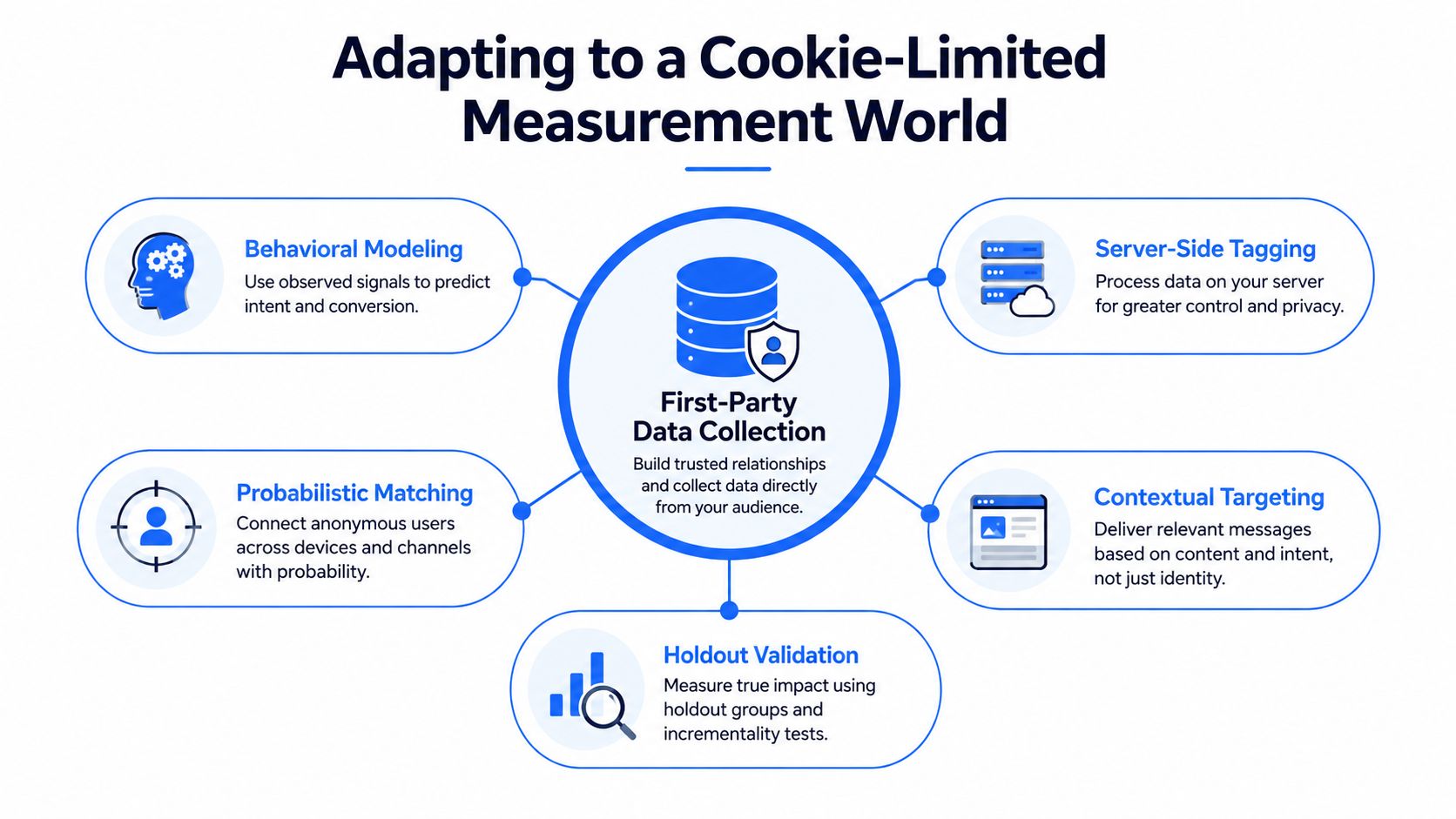
Retargeting measurement is getting less exact, not more. Chrome kept third-party cookies while giving users control over tracking settings, while Safari and Firefox apply stronger restrictions, so audience reach and attribution are uneven across browsers and devices (Invoca on tracking cookies). That means a retargeting audience is no longer a clean list of everyone who visited. It's a partially observed estimate.
First-party signals are the safer bet
A smaller audience with verified outcomes is more useful than a larger one built on uncertain attribution. That's why phone verification, tagged landing-page events, CRM status, and server-side conversion events matter more than ever. They tell you whether the ad supported a real lead, not just whether the platform logged an interaction.
The practical swap is straightforward. Replace generic view-through confidence with verified-lead status. Replace browser-dependent audience counts with server-side events where you can. Replace broad conversion reporting with a funnel that tells you whether the user booked, called, or never made it past the form.
A server-side setup helps here, and this guide to server-side tracking is a useful reference if your team is still relying on browser-only signals.
The contrarian lesson is simple. Retargeting doesn't need to see everyone to be valuable. It needs enough consented, first-party signal to decide who should keep seeing ads, who should be suppressed, and who has already done enough to leave the pool.
Your 30-Day Retargeting Optimization Checklist
Week one, rebuild your audiences around intent. Separate high-intent visitors from lower-intent traffic, add exclusion lists for verified leads, and make sure the final conversion event is the one the business cares about. If your current setup still mixes homepage readers with quote-page starters, fix that before changing bids.
Week two, launch sequenced creative. Recent visitors get reminders and proof. Abandoners get objection-handling. Older visitors get lighter reinforcement. If every group sees the same ad, the campaign is already leaking.
Week three, set frequency caps and test them. Keep the ads, landing pages, and audience windows constant while you compare low, medium, and high exposure cohorts. Watch verified-lead rate, cost per verified lead, complaint rate, and incremental conversions, not just CTR.
Week four, stand up a holdout and review the delta. Compare exposed users with the holdout group, then decide whether the campaign is genuinely incremental or just getting credit for likely demand. If the holdout is close to the treatment group, the answer is obvious, and the budget should be trimmed or redirected.
The most common mistakes are always the same. Overlapping lists, no verified-lead suppression, frequency that creeps too high, and creative that never changes by intent. Fix those, and retargeting display ads stop being a guess and start behaving like a controlled demand-capture channel.
If you want retargeting display ads built around intent tiers, verified-lead suppression, and cleaner incrementality, benjiads can help local service businesses run the ads and follow-up without living inside Ads Manager. It's built for contractors, clinics, and service teams that need real leads, not inflated attribution.
- retargeting display ads
- display retargeting
- ad frequency caps
- retargeting audiences
- retargeting measurement
Done for you
Ads that text you customers.
- ✓ Ads created for you
- ✓ Every lead texts your phone
- ✓ Free to use, no credit card
748+ local businesses run ads with benjiads