server side tracking 14 min read
Benefits of Server Side Tracking for Better Ad Attribution
Discover the key benefits of server side tracking for ad attribution, from recovering lost conversions to stronger data control and better optimization signals.
On this page
- Why Your Conversions Are Disappearing and What Server Side Tracking Does About It
- How Server Side Tracking Actually Works
- The Core Benefits of Server Side Tracking for Marketers
- How Server Side and Client Side Tracking Complement Each Other
- What Server Side Tracking Still Cannot Fix
- Implementing Server Side Tracking Without Overcomplicating It
- A Local Service Business Case for Dual Tracking
- Deciding Whether Server Side Tracking Is Worth It for You
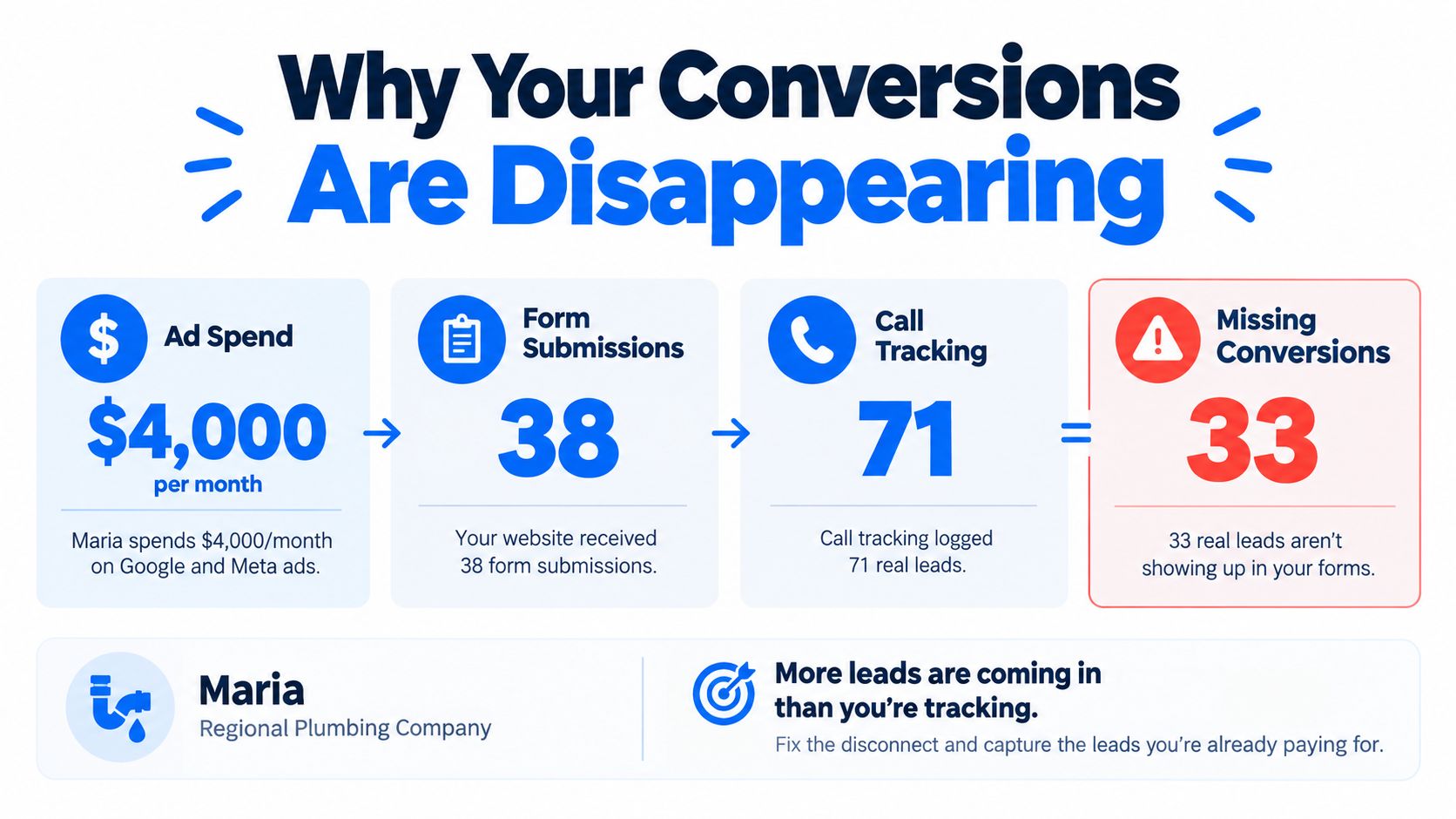
Maria owns a regional plumbing company. She spends $4,000 a month on Google and Meta ads, yet her dashboard shows only 38 form submissions while her call-tracking system records 71 qualified bookings. The campaigns appear to be generating fewer results than they really are, so the ad platforms receive less information than Maria does.
That gap creates a practical problem. If Google and Meta can't see qualified outcomes, their bidding systems may optimize toward clicks, low-quality forms, or incomplete signals instead of booked jobs. The benefits of server-side tracking begin with closing that measurement gap, but they don't end with sending more events. The larger shift is control over how conversion data is collected, checked, enriched, and shared.
Why Your Conversions Are Disappearing and What Server Side Tracking Does About It
Maria's reporting problem isn't unusual in shape. A person may click an ad, browse on a phone, return later on a laptop, call the business, and book after speaking with an employee. The browser pixel might record the click but miss the call, lose the identifier, or fail to send the final event because a browser restriction, ad blocker, network interruption, or consent choice stopped the request.
The historical move toward first-party and server-side collection accelerated as browser privacy changes made browser-based tracking less durable. Google introduced server-side Google Analytics in a first-party context through server-side Google Tag Manager in August 2020, a platform-level shift that moved measurement closer to infrastructure controlled by the business. Recent measurement research describes the trade-off clearly: server-side systems can extend reach, but matching remains imperfect. In the studied setup, Meta's systems matched roughly 34% to 51% of website visitors to user profiles, while matching accuracy for those matched profiles was about 60% to 65%.
That doesn't mean Maria should remove every browser pixel. It means she needs another route for confirmed outcomes. Server-side tracking receives an event through infrastructure the business controls, applies rules to it, and forwards an appropriate version to Google Ads, Meta, analytics tools, or a CRM.
Practical rule: Treat server-side tracking as a response to signal loss, not as a magical replacement for every existing tag.
For Maria, the useful event isn't just “someone submitted a form.” It might be “this lead answered the phone, confirmed a plumbing problem, and booked a visit.” A server-side setup can connect that outcome to the original marketing event when the required identifiers and consent are available. The report becomes more useful, and the platforms receive a stronger optimization signal.
How Server Side Tracking Actually Works
Server-side tracking is a conversion relay. Instead of sending every event directly from a visitor's browser to each vendor, the browser sends an event to a tracking endpoint. That endpoint runs on infrastructure controlled by the business or its technology partner, such as a cloud server, a server-side Google Tag Manager container, or a managed service.
The difference is easier to understand with a mailroom. Client-side pixels work like postcards sent from a customer's home. The message depends on local mailbox rules, browser settings, network access, and the postal route to each recipient. Server-side tracking gives the business a mailroom. Incoming messages arrive at one controlled location, where the team can sort, validate, enrich, and forward only the information each destination needs.
A typical flow looks like this:
- The browser records an action. A visitor views a page, submits a form, starts checkout, or completes another permitted action.
- The event reaches a server endpoint. The endpoint receives the request through the business's tracking infrastructure.
- The server processes the payload. Rules can remove unnecessary fields, apply consent conditions, preserve identifiers, and add context from a CRM or order system.
- The server forwards destination-specific events. Google Ads, Meta, GA4, or another platform receives the version designed for that platform.
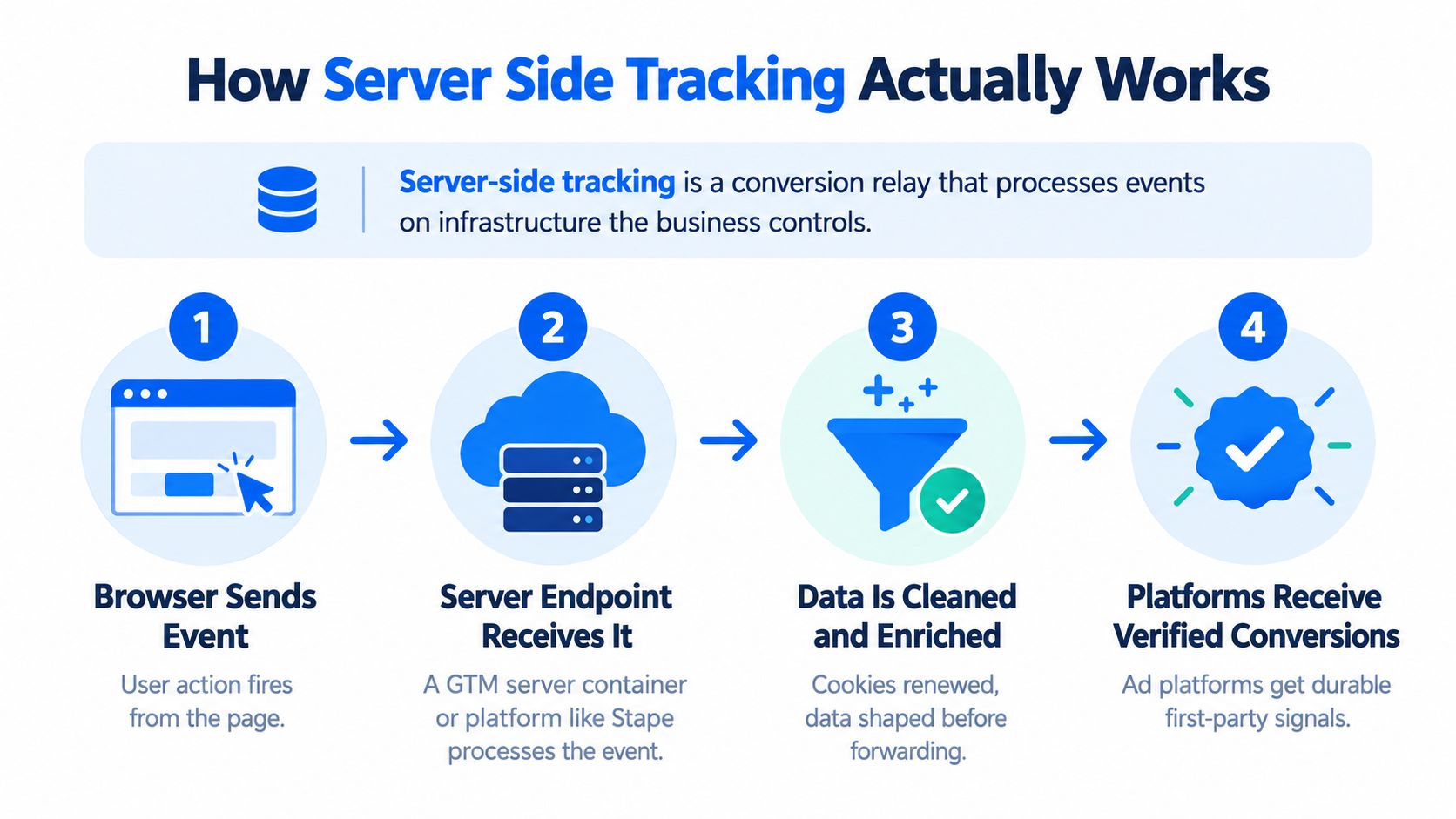
The server doesn't create evidence that never existed. It improves the path for evidence you already have. If a phone booking reaches the CRM with a usable lead identifier, the server may pass the qualified outcome to an ad platform. If the business has no record of an offline sale, server-side processing can't invent one.
For a concise technical introduction, see what server-side tracking means in practice. The important distinction is ownership. The browser still initiates many events, but the business gains a checkpoint before data reaches advertising vendors.
The Core Benefits of Server Side Tracking for Marketers
Server-side tracking matters when a reporting problem affects a business decision. The technical architecture is valuable because it can help recover events, improve the information attached to those events, and create a more deliberate data flow for ad platforms.
More complete conversion signals
A correct implementation can surface up to 46% more conversions tracked, according to Usercentrics' guidance on server-side attribution. The number isn't a promise for every account. Results depend on consent, identifiers, event design, platform rules, and the quality of the existing implementation.
The business impact is straightforward. If Meta or Google receives more reliable purchase, lead, or qualified-call events, its bidding systems have a larger dataset for optimization. A local advertiser may stop judging campaigns only by form completions and start evaluating the outcomes that actually create revenue.
Stronger first-party control
A browser-based setup gives many vendors direct access to the page and its surrounding browser context. A server-side route creates a controlled checkpoint. The business can decide which fields each destination receives, remove unnecessary data, and apply separate rules for analytics, advertising, and internal systems.
That control also makes the measurement system less dependent on any single browser behavior. Independent research on server-side tracking prevalence and detection reports adoption estimates ranging from 0.38% to 38% of visited sites, a 100x spread that reflects how unevenly defined and implemented the practice remains. The same research describes a ground-truth detection model recovering 401 of 403 domains, or 99.5% accuracy, compared with 129 of 403 domains, or 32% accuracy, for a baseline. For marketers, the lesson is governance. You need to know what your setup sends, not what a tag configuration appears to promise.
Richer events for better decisions
A server can receive context that a basic page tag doesn't know at the moment of the click. Depending on the systems connected and the applicable consent, the event may include an order identifier, customer value, lead status, or a qualified call outcome.
Tracking architecture guidance estimates that server-side methods can recover roughly 20% to 30% of conversion data missed by client-side methods. Enriched events can improve the inputs used in multi-touch attribution, conversion-lift analysis, and media mix modeling by reducing the risk that the funnel is undercounted.
| Benefit | Business outcome |
|---|---|
| More durable event delivery | Ad platforms can receive more of the conversions that already occurred |
| First-party processing | Marketing teams gain tighter control over fields, destinations, and consent rules |
| Enriched conversion payloads | Bidding can use qualified leads, order values, or offline outcomes instead of shallow actions |
| Centralized governance | Teams can audit and troubleshoot one controlled event flow |
| Reduced browser dependence | Reporting is less exposed to browser restrictions and ad-blocking interruptions |
The strongest result isn't automatically a higher return on ad spend. It's a more trustworthy optimization dataset. Better data can support better bidding and audience decisions, but it still needs sound campaign structure, meaningful conversion definitions, and disciplined analysis.
How Server Side and Client Side Tracking Complement Each Other
Client-side and server-side tracking observe different parts of the customer journey. Treating them as rivals creates unnecessary blind spots.
The browser is close to the visitor's behavior. It can observe session duration, scroll depth, clicks, form interactions, and other on-page actions that may never become a confirmed sale. The server is closer to the business outcome. It can process a purchase from an order system, a qualified lead from a CRM, or a call outcome that arrives after the visitor leaves the website.
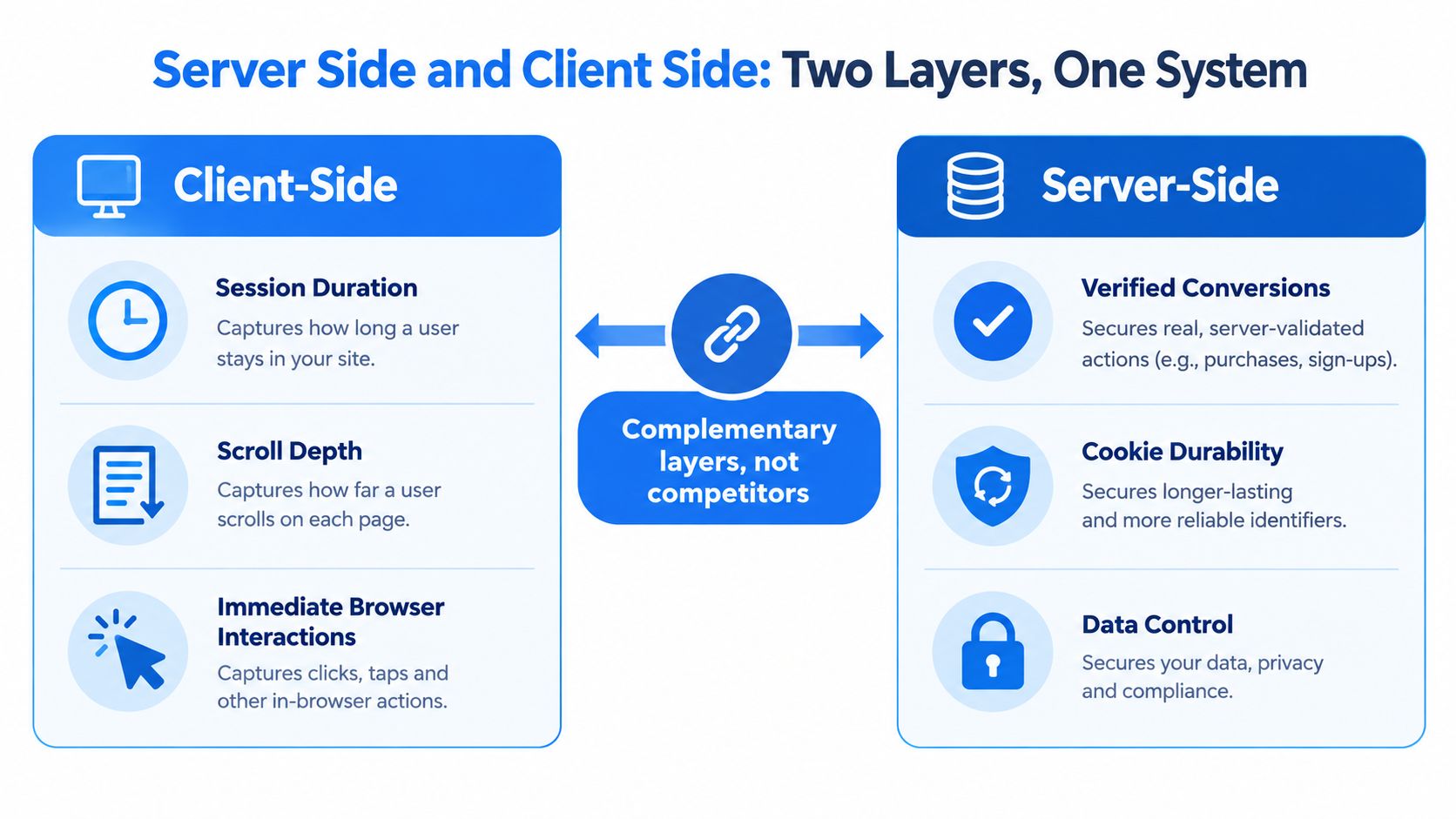
Consider a returning visitor. A first-party browser identifier may recognize the person when they come back to a landing page, while the server later receives the confirmed booking. Neither layer sees everything. The browser supplies behavioral context, and the server supplies a more durable route for business outcomes.
Give each layer a distinct job
Client-side tracking remains useful for immediate interaction signals:
- Engagement: Capture page interaction, scroll behavior, and form activity.
- Experience analysis: Help identify where visitors hesitate or abandon a journey.
- Fast feedback: Provide event data close to the moment an action occurs.
Server-side tracking handles events that require greater control:
- Confirmed outcomes: Receive purchases, qualified leads, and CRM-confirmed actions.
- Data shaping: Filter or enrich the payload before sending it to a platform.
- Offline continuity: Process a conversion that arrives after a call or sales conversation.
The two streams must share a deduplication key, such as a common event identifier, when they describe the same conversion. Without that key, Google or Meta may count the browser event and server event as two separate conversions. With it, the platform can recognize that both reports refer to one action.
The practical approach is to choose the primary signal according to the campaign goal. Use engagement events to understand the page experience, but use qualified bookings or completed sales as the optimization outcome when those records are available. A comparison of server-side and client-side tracking can help teams map those responsibilities before changing tags.
What Server Side Tracking Still Cannot Fix
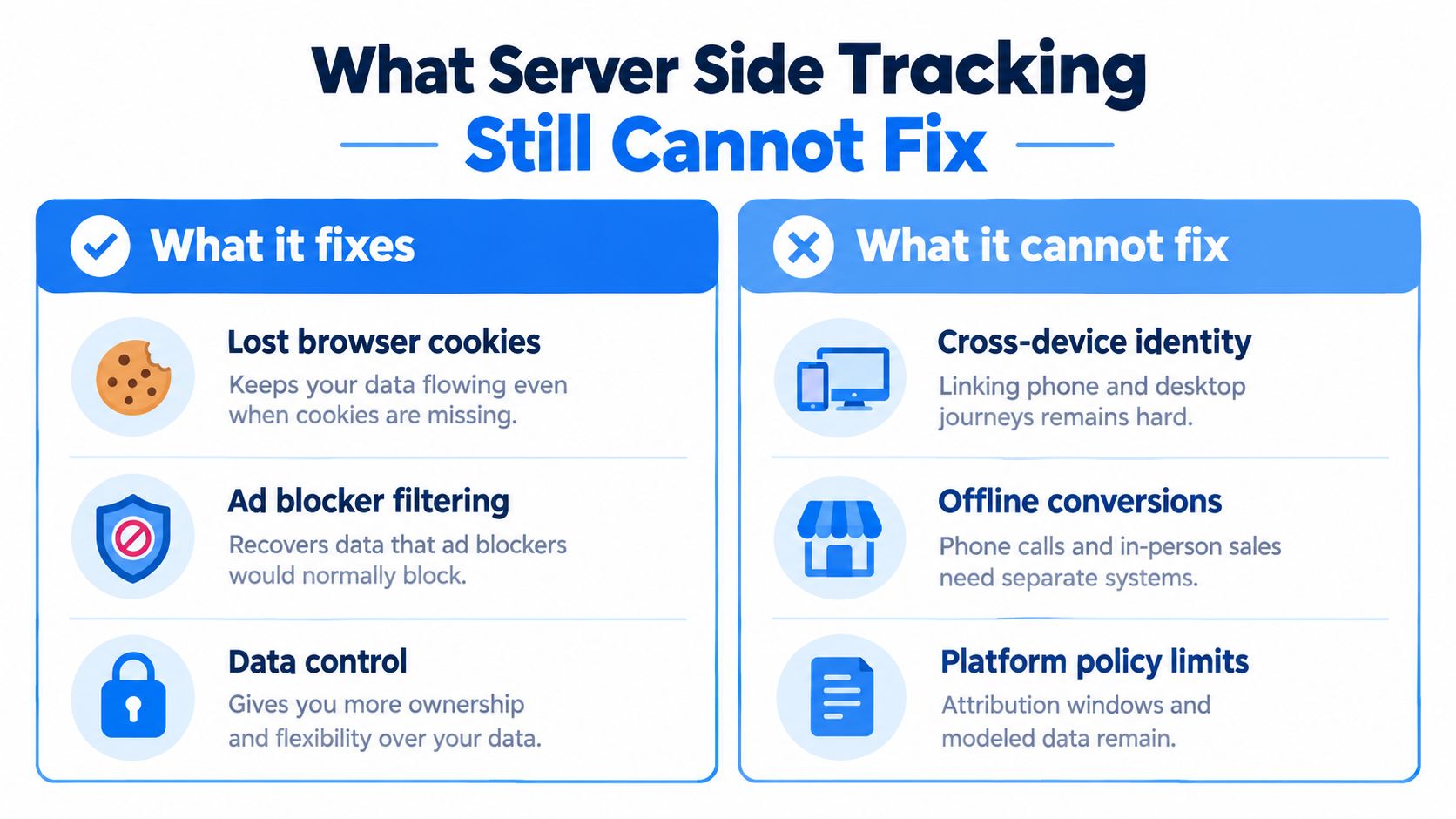
Server-side tracking improves the route that data takes. It doesn't restore perfect knowledge of the customer.
Cross-device identity remains difficult when a person researches on a phone and converts on an anonymous desktop session. Unless the systems have a lawful, reliable identifier that connects those journeys, the platform may use modeling or fail to connect them. A server can preserve an identifier more effectively, but it can't know that two anonymous sessions belong to one person just because both reached the same business.
Consent is another separate responsibility. Moving an event from a browser to a server doesn't make the event permissible by default. The server must receive and respect the visitor's consent state, and the business still needs appropriate privacy notices, consent controls, and data-handling rules.
The gaps remain real
- Offline events without system records: A cash sale or unlogged phone conversation remains invisible if nobody records it in a CRM, call platform, or sales system.
- Platform modeling: Walled gardens still apply their own attribution methods, conversion windows, and modeled reporting. Your server can't override those rules.
- Weak measurement design: A clean event pipeline can't fix a vague conversion definition, inconsistent naming, missing revenue values, or poorly configured goals.
- Privacy obligations: A first-party endpoint doesn't remove the need to collect, document, and enforce valid permission where required.
Recent guidance on server-side tracking limitations makes the central point: server-side tracking can reduce browser data loss, but it can't eliminate attribution gaps or make an implementation compliant on its own.
Keep your expectation realistic: Server-side tracking sharpens the signal. It doesn't recreate the pre-privacy web or reveal every customer's complete journey.
Implementing Server Side Tracking Without Overcomplicating It
Smaller advertisers shouldn't begin with a full rebuild. Start by deciding whether the expected improvement in measurement justifies hosting, implementation, consent work, and maintenance.
A custom server-side Google Tag Manager container gives a technical team maximum control, but it also demands more engineering attention. A managed option such as Stape or a hosted cloud deployment can reduce infrastructure work, while still requiring someone to define events, validate consent, and monitor delivery. Staying client-side may be sensible for a simple funnel with low conversion volume and little dependence on automated bidding.
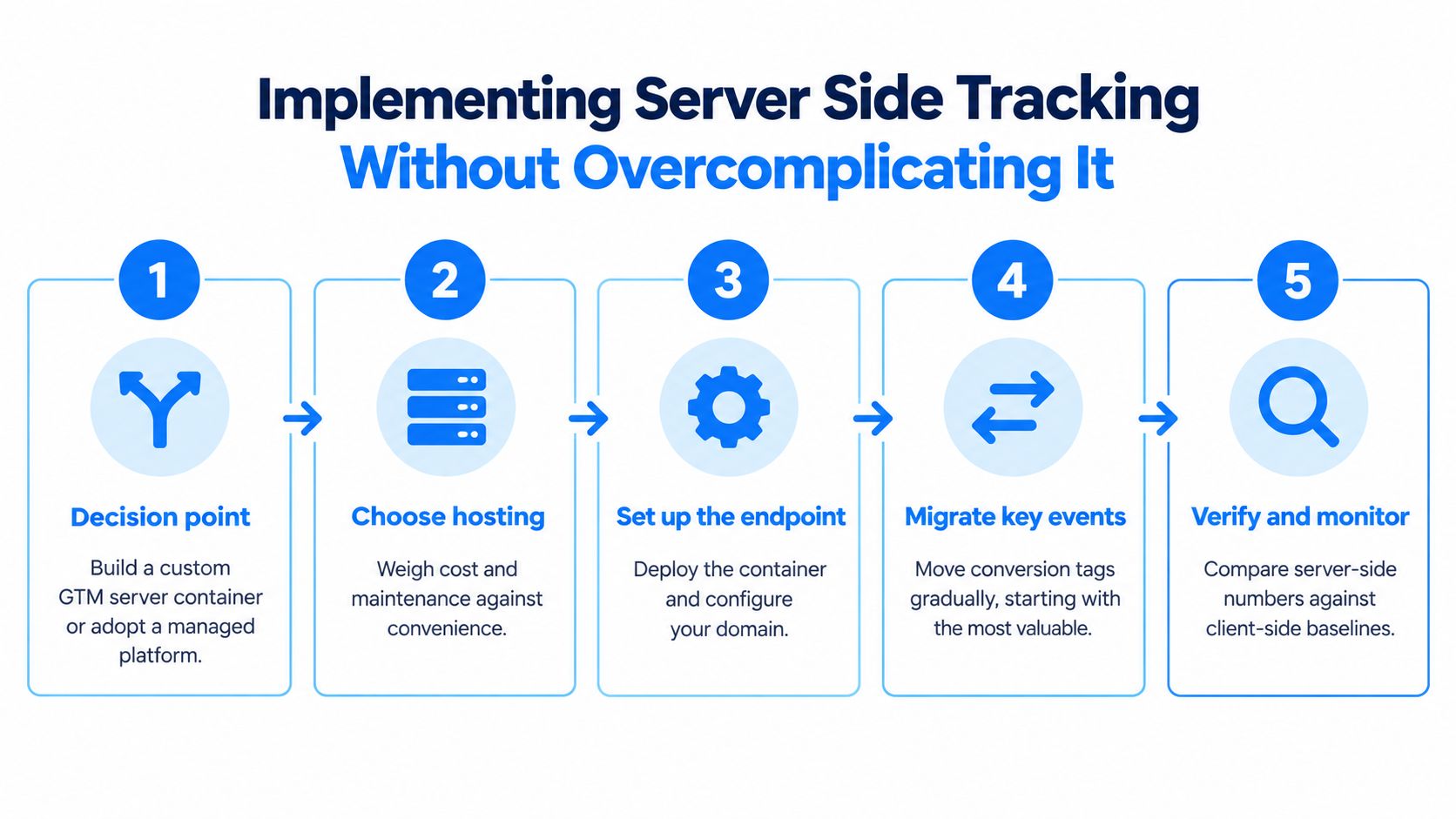
A gradual rollout keeps the business from losing its existing baseline:
- Audit the current events. Compare browser conversions with CRM records, call logs, booked jobs, and completed purchases.
- Choose bidding events. Separate meaningful outcomes from diagnostic actions. A qualified call may matter more than a generic form start.
- Select the hosting route. Compare engineering time, ongoing maintenance, hosting responsibility, and managed-service convenience.
- Route priority events first. Start with the conversions that influence budget allocation, not every interaction on the site.
- Validate deduplication and consent. Confirm that browser and server events share identifiers and that unconsented data isn't forwarded.
- Monitor the difference. Compare platform reporting with internal records, investigate gaps, and expand only when the first events are stable.
Common failures include broken first-party cookie behavior, request timeouts, inconsistent event names, missing identifiers, and server endpoints that remain vulnerable to blocking. A server pipeline can also create inflated results if the browser pixel and server event lack a shared deduplication key.
For teams comparing broader tracking tools and workflows, conversion tracking software options provide useful context. benjiads combines server-side and client-side conversion tracking with ad setup, hosted lead funnels, SMS-based follow-up, and reporting for local service businesses.
Incremental migration beats rip-and-replace. Keep the existing client-side layer while you prove that the server route records the same business outcome once, with better context.
A Local Service Business Case for Dual Tracking
Consider a regional HVAC company that already runs Google and Meta ads. Its team adds server-side conversion handling without removing the existing browser pixel, then sends qualified phone outcomes from its lead workflow when a technician appointment is confirmed.
During the first six weeks, the server stream isn't useful in isolation. It contains confirmed events that the browser misses, while the browser continues to provide page interactions and immediate engagement signals. Together, the streams give the platforms a broader view of the path from ad click to booked service.
The owner changes decisions as the records improve. A keyword that looked efficient under last-click reporting produces many initial forms but few qualified calls, so the team reduces its priority. Another campaign has fewer visible form completions but generates more confirmed phone bookings through the server event stream, so the owner reallocates budget toward it. Cross-channel reporting also reveals overlapping audiences, which leads the team to tighten landing-page targeting rather than paying to reach the same prospects repeatedly.
Learning changes gradually
Google's value-based bidding and Meta's optimization systems need consistent, well-defined outcomes. They don't become reliable because a server container was switched on. The team must keep event names stable, send usable identifiers, pass appropriate values, and give the platforms enough time to learn from the revised signal mix.
In this representative example, the owner judges the system over a sustained learning period rather than reacting to the first few reports. The key question isn't whether server-side reporting immediately makes every campaign look better. It's whether the business can now distinguish a click, a form, a qualified conversation, and a booked job.
That distinction changes budget management. The owner stops rewarding campaigns for producing cheap surface-level actions and starts comparing them against the outcomes the HVAC company can fulfill and profit from.
Deciding Whether Server Side Tracking Is Worth It for You
Server-side tracking is a stronger candidate when paid advertising drives meaningful business activity, platform reporting misses known conversions, and the company has access to technical support. It becomes more valuable when outcomes happen across forms, phone calls, CRMs, booking tools, and offline sales rather than inside one simple checkout.
Use these questions to make the decision:
- Conversion complexity: Do leads become qualified only after a call, appointment, or sales review?
- Reporting accuracy: Can your internal records show more outcomes than Google or Meta?
- Platform dependence: Do automated bidding and audience systems influence a significant share of your budget?
- Technical capacity: Can your team or implementation partner maintain consent, identifiers, deduplication, and event quality?
- Cost of missing data: Are budget decisions already changing because the reported numbers don't match reality?
A small advertiser with a short funnel and limited technical resources may not recover the implementation burden quickly. A local business with recurring lead volume, phone-based sales, and persistent attribution gaps has a clearer reason to pilot the approach.
Begin with an audit of browser events, call records, CRM outcomes, and platform conversions. Then test a focused Conversions API or server-side GTM implementation for the highest-value event, keep client-side tracking active, and judge the combined system over a multi-month learning period. Server-side tracking is a complement to measurement, not a replacement for sound analytics design.
BenjiAds helps local service businesses connect paid ads, landing funnels, SMS lead follow-up, and server-side plus client-side conversion tracking in one workflow. If your reports miss qualified calls or booked jobs, visit benjiads to review how the platform can support a clearer attribution process.
- server side tracking
- ad attribution
- conversion tracking
- first party data
- ad optimization
Done for you
Ads that text you customers.
- ✓ Ads created for you
- ✓ Every lead texts your phone
- ✓ Free to use, no credit card
748+ local businesses run ads with benjiads