marketing hvac company 15 min read
Marketing HVAC Company How to Get More Booked Jobs
Marketing HVAC company growth starts with local ads, seasonal offers and fast follow-up. Learn campaigns, funnels and tracking that turn clicks into booked
On this page
- Why Local Marketing Makes or Breaks Your HVAC Growth
- Build Your Local Foundation Before You Spend on Ads
- Create Seasonal Offers and Ad Campaigns That Convert
- Turn Clicks Into Booked Jobs With Funnels and Fast Follow-Up
- Track What Books Jobs and Spend Where It Counts
- Your HVAC Marketing Playbook and Next Steps
If you're running an HVAC company, you've probably lived this exact week. The phones felt quiet on Monday, then a hot afternoon hit and leads showed up in bursts, half from Google, a few from referrals, and several through forms nobody called back fast enough. By Friday, you spent money on ads, your office felt busy, but you still couldn't say which marketing produced booked jobs.
That's the problem with marketing an HVAC company. Most owners don't need more dashboards, more vague branding advice, or more "awareness." They need a system that turns local demand into scheduled work, then shows which channels deserve more budget.
The good news is that HVAC demand is large, local, and persistent. One industry projection values the global HVAC market at USD 215 billion in 2025 and projects USD 292.20 billion by 2031, which signals a category with a huge installed base and ongoing replacement demand, not a niche that disappears when one season cools off (global HVAC market projection). But that growth doesn't help if your spend goes to cheap leads, slow follow-up, and channels you can't tie back to revenue.
Why Local Marketing Makes or Breaks Your HVAC Growth
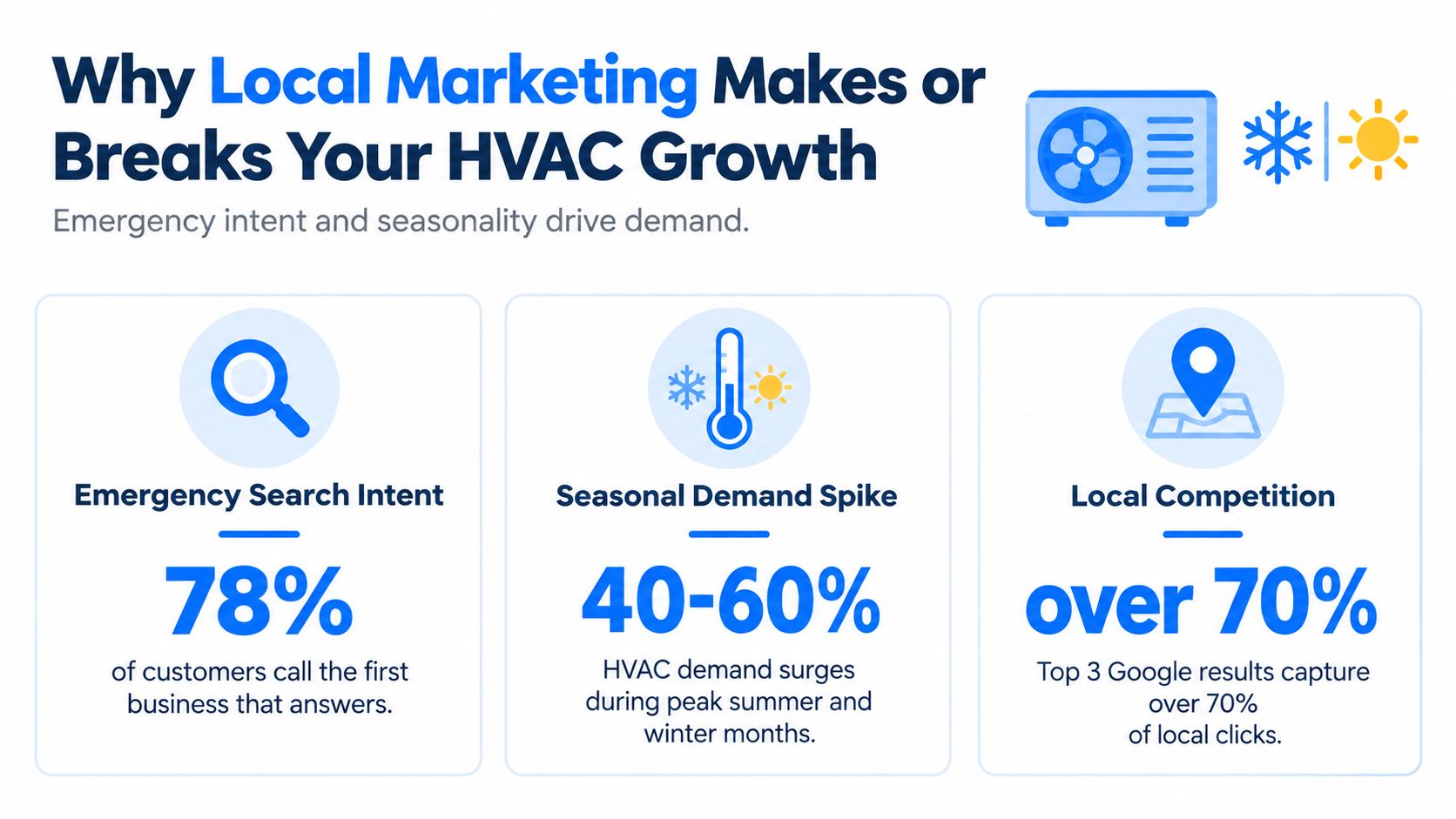
In HVAC, local marketing isn't a side project. It's the operating system behind how work gets booked.
A homeowner with no AC in the middle of a heat wave doesn't browse your brand story. They search, compare fast, and contact the company that looks credible and responds first. The same thing happens on furnace failures, no-heat calls, and urgent indoor air issues. In those moments, local intent beats broad branding.
The slow season exposes weak marketing fast
When demand softens, weak systems show up everywhere. You see generic ads running to broad service pages. Calls get missed at lunch. Estimates sit without follow-up. Owners think they have a lead problem when they really have a conversion problem.
Strong local marketing for an HVAC company does something simpler. It puts the business in front of people searching in the service area, offers the right seasonal message, and makes it easy to call, text, or book. That's what keeps the board moving in shoulder seasons and helps you capture urgent demand when weather swings hard.
Practical rule: Don't judge marketing by lead count alone. Judge it by whether the lead was in-area, reached quickly, and moved to a booked call.
Local demand is where the money is
This is why I treat marketing HVAC company growth as a local operations problem, not just an ad problem. Search intent is high. Competition is close. Service areas matter. Office responsiveness matters just as much as ad copy.
What works is usually boring and consistent:
- Tight geography: Run where your trucks already win, not everywhere you technically can serve.
- Offer match: Push repair urgency during peak weather and replacement or maintenance offers when demand is less frantic.
- Fast contact: If the lead comes in and nobody acts, the ad budget didn't fail. Your process did.
What doesn't work is also predictable:
- Generic awareness campaigns: They create activity without enough booking intent.
- Sending traffic to weak pages: A cluttered homepage is not a booking page.
- Chasing cheap leads: Cheap form fills often become expensive dead ends.
A lot of guides on marketing an HVAC company stop at "run Google Ads" or "post on social." That's too shallow for a contractor trying to protect margin. The channels matter, but the win comes from connecting local visibility, response speed, and booked-job tracking into one system.
Build Your Local Foundation Before You Spend on Ads
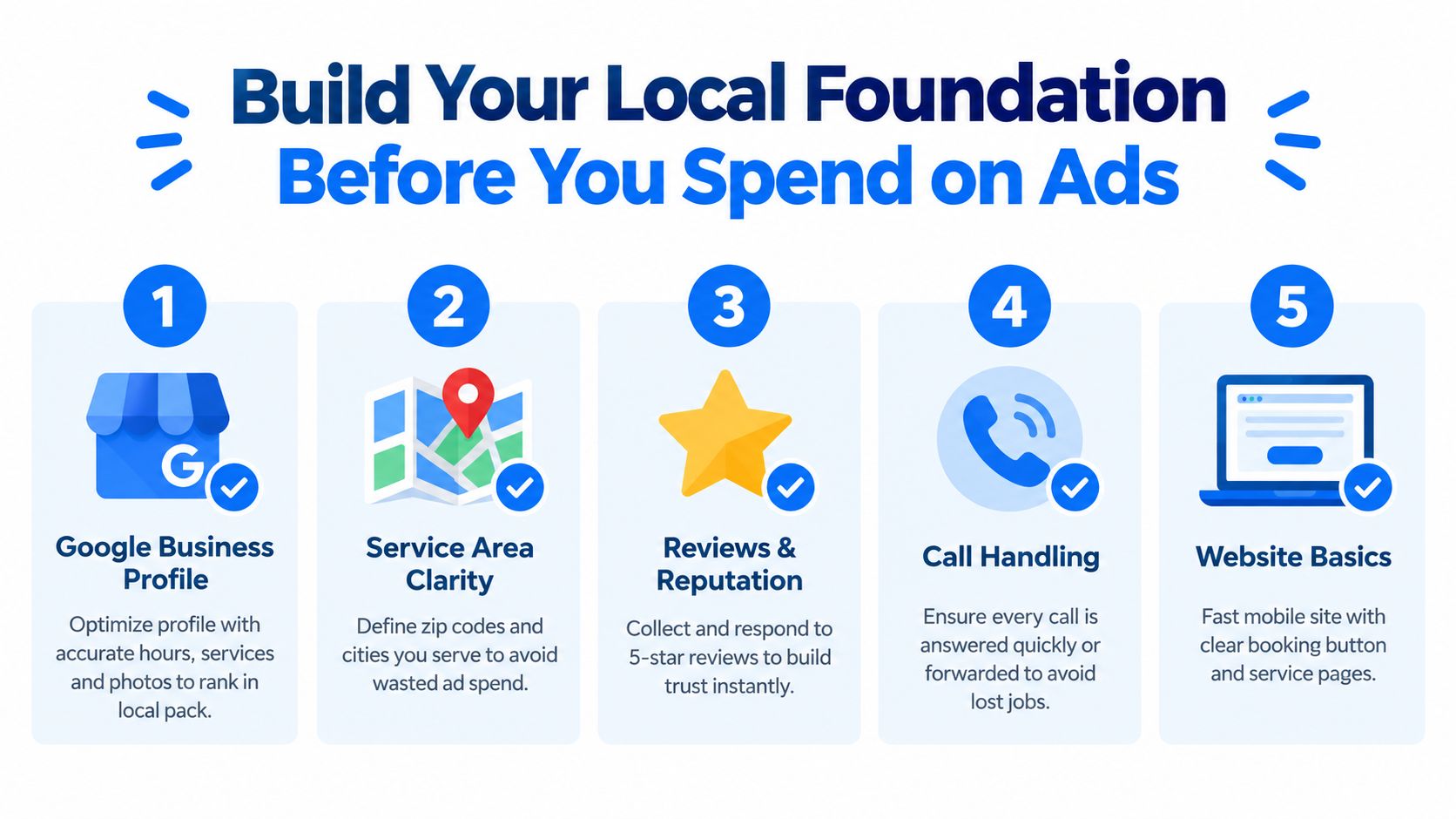
Ads magnify what's already true. If your local foundation is solid, paid traffic converts better. If the basics are sloppy, you just buy more chances to lose jobs.
Fix the front door first
Start with your Google Business Profile. Your hours, service categories, phone number, photos, and service area need to be accurate. If your listing sends mixed signals, you'll feel it everywhere else. It affects trust before a visitor even reaches your site.
Your website needs the same discipline. Mobile loads, click-to-call visibility, location relevance, and clear service pages matter more than clever design. If you want a useful model for simplifying a trade site around conversion, this guide to websites for electricians applies closely to HVAC too.
A clean local setup usually includes:
- Service pages by intent: Repair, replacement, maintenance, and indoor air quality shouldn't all live on one catch-all page.
- Service area clarity: Name the cities or zones you want. Broad targeting creates broad waste.
- Visible contact paths: Call buttons, short forms, and booking prompts should be obvious on mobile.
Reviews and call handling decide more than most owners think
I've seen plenty of HVAC companies obsess over ad settings while calls ring to voicemail. That's upside-down.
If your team misses calls, delays callbacks, or sounds unprepared on first contact, ad optimization won't save you. The first conversation books the job or sends it to the next contractor on the list.
The ad got the lead. Your call handling decides whether that lead ever becomes revenue.
Reviews work the same way. They aren't just reputation decoration. They help a buyer decide whether to contact you now or keep scrolling. Ask for reviews after completed work, respond to them, and make sure the tone matches the business you want to be known for.
Run a short pre-ad audit
Before spending harder on Google or Meta, check these points:
Google Business Profile accuracy
Make sure core business information matches your website and your real dispatch reality.Phone answering process
Test your own line. Call during lunch, after hours, and first thing in the morning.Form routing
Confirm where form submissions go, who gets alerted, and what happens if that person is busy.Landing page fit
Match the page to the offer. A furnace safety ad shouldn't dump traffic on an AC replacement page.Trust elements
Use real photos, review proof, service descriptions, and straightforward copy.
This part isn't glamorous, but it lowers waste. Better foundations usually mean cleaner traffic handling, stronger conversion rates, and fewer "bad lead" complaints that are really front-end failures.
Create Seasonal Offers and Ad Campaigns That Convert
The HVAC companies that waste the most on ads usually have the same flaw. They run one generic campaign all year and expect weather, urgency, and buyer intent to sort themselves out.
That doesn't work. HVAC buying behavior changes with the season, and your offers need to change with it.
Build offers around the reason someone acts now
A good seasonal campaign starts with the trigger, not the platform. In summer, that trigger may be no cooling, weak airflow, or a unit struggling in afternoon heat. In winter, it's no heat, safety concerns, or aging equipment making noise. In shoulder season, buyers are more open to maintenance, tune-ups, and replacement planning.
Here are the offer types I see convert cleanly:
- Urgent repair offers for peak heat or cold, written around same-day availability, diagnostics, or immediate help
- Tune-up and inspection offers during transition months, when homeowners aren't yet in panic mode
- Replacement campaigns built around comfort, reliability, and financing conversations rather than emergency language
The point isn't to sound clever. The point is to match the homeowner's moment.
Use channel intent properly
Benchmark data for 2026 shows Google Local Services Ads for HVAC averaged about USD 51 per lead, with booking rates near 44 percent, while Google Ads HVAC leads ranged roughly from USD 34 to USD 149 depending on campaign type and market conditions (HVAC paid media benchmarks). That's why high-intent search usually gets priority when the goal is booked jobs, not just top-of-funnel activity.
Google works best when demand already exists. Meta can still help, but usually as support for awareness, retargeting, or replacement offers that need more education. If you're trying to market an HVAC company with a limited budget, don't spread money across every channel just because a rep suggested it.
A practical build looks like this:
- Google Local Services Ads: emergency and high-intent local demand
- Google Search Ads: tighter control over service-specific keywords and landing pages
- Meta Ads: reminder offers, seasonal awareness, and retargeting support
This walkthrough is worth watching before you finalize campaign structure:
Creative approval matters more than most platforms admit
AI can help you move faster on ad copy and visuals, especially when you're producing localized variants for different services and seasons. But the owner or operator still needs to review the message before anything goes live.
That review should catch practical issues:
- Wrong service emphasis: pushing installs when your team needs repair volume
- Bad geography: ads reaching outside your profitable area
- Weak promise: vague comfort language instead of clear service intent
- Operational mismatch: same-day messaging when dispatch can't support it
One option in this category is benjiads, which automates creative generation, campaign launch on Google and Meta, lead funnels, tracking, and text follow-up while keeping an approval step before campaigns run. That's useful if you want software to handle production without handing strategy over to a traditional agency.
The best campaigns feel local, seasonal, and specific. The bad ones feel like they were written for every contractor in every city.
Turn Clicks Into Booked Jobs With Funnels and Fast Follow-Up
Most HVAC ad waste happens after the click.
A lead submits a form, gets no text, no call, and no clear next step. Or they call, hit a weak answering flow, and move on. Owners call these bad leads when it's harsher. The lead had intent. The handoff failed.
Your funnel needs to qualify and route, not just collect
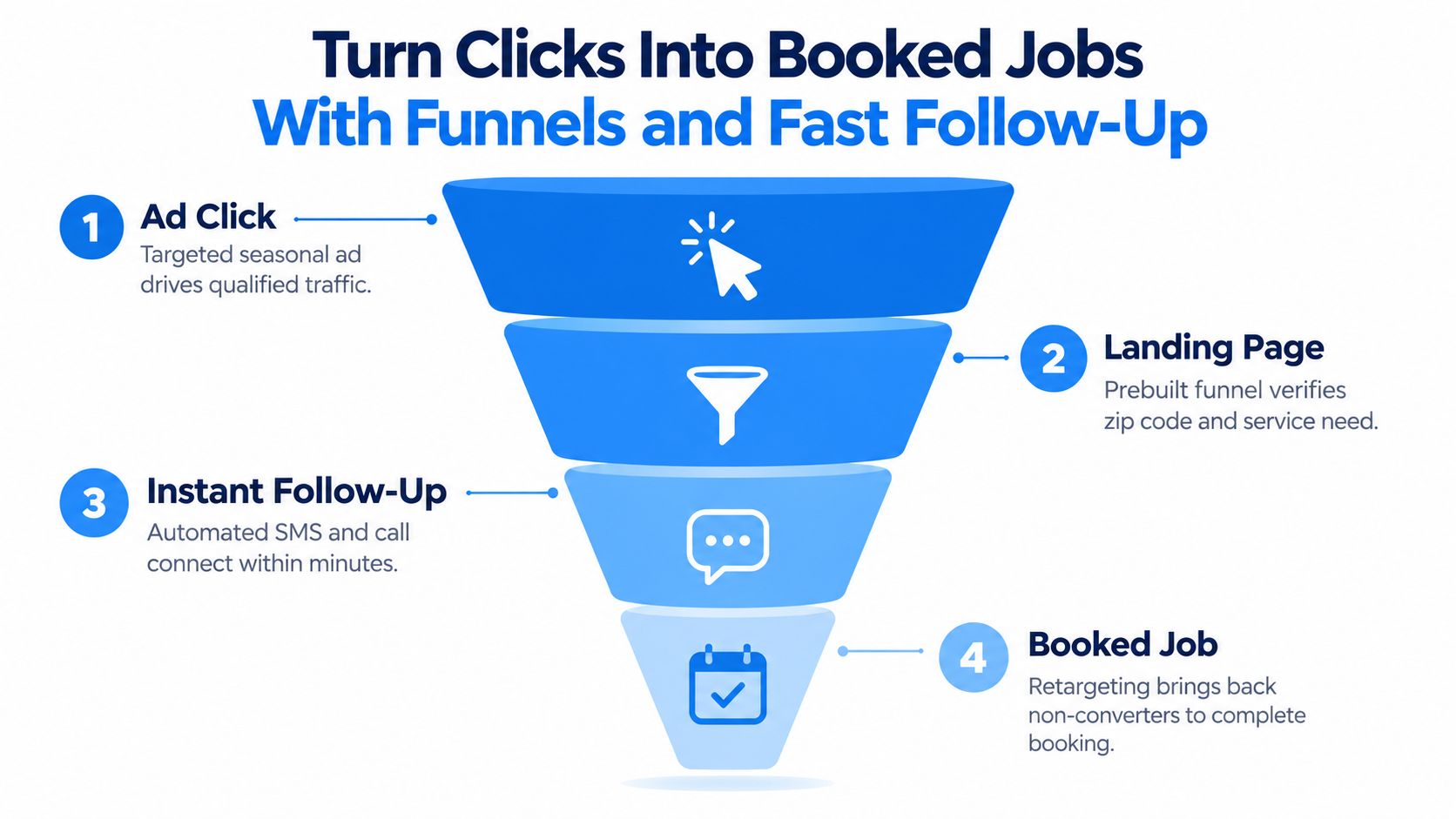
A landing page for HVAC shouldn't behave like a brochure. It should confirm service fit fast. Ask for the basics you need to act: location, service type, urgency, and best contact method. Anything beyond that should earn its place.
Good funnels usually do four things well:
Filter service area early
If someone is outside your dispatch zone, don't spend office time pretending otherwise.Match the offer to the ad
If the ad promised AC repair, the page should continue that conversation immediately.Reduce friction on mobile
Fewer fields, stronger buttons, and obvious click-to-call paths matter.Trigger follow-up instantly
The form completion should start the next action without waiting on a human to notice it.
For a deeper look at how local contractors structure this kind of response system, this guide on home service leads is a useful reference point.
Speed-to-lead is a revenue lever
A foundational MIT and InsideSales study found that responding within 5 minutes makes a business about 21x more likely to qualify the lead and about 100x more likely to make contact than waiting 30 minutes (lead response time study summary for contractors). That isn't a minor improvement. It's the difference between having a shot and barely participating.
In HVAC, speed matters even more because so many searches come from discomfort or urgency. Buyers don't admire your process from a distance. They contact the first company that feels available.
If your office only follows up during open hours and your forms come in all day, you're leaking booked jobs by design.
Automate the first touch, then hand off cleanly
A lot of contractors hesitate because they think automation means sounding robotic. It doesn't have to.
The smart move is to automate the first acknowledgment, then route to a human for the actual booking conversation. A fast SMS, immediate call alert, or task assignment closes the silence gap that kills hot leads.
A strong follow-up flow usually includes:
- Immediate text acknowledgment so the lead knows you received the request
- Rapid call attempt when the service type suggests urgency
- Multi-touch follow-up over the next few days for people who don't answer right away
- Retargeting ads for visitors who clicked but didn't convert on the first session
Retargeting works best as support, not rescue. If the front-end funnel and first response are weak, no amount of reminder ads will fix the underlying process.
Track What Books Jobs and Spend Where It Counts
Once campaigns are live, most HVAC companies look at the wrong scoreboard. They celebrate lead volume, argue over click costs, and never tie any of it back to jobs sold.
That creates fake confidence fast.
Cheap leads can be expensive jobs
Closed-loop HVAC marketing measurement should track the full chain from click to booked job, not just leads. At minimum, review cost per lead, cost per booked job, and revenue per channel monthly (closed-loop HVAC ROI measurement). If you don't connect ad activity to bookings and downstream revenue, you can optimize yourself into a pile of low-quality inquiries.
Contractors often misread channel performance. A source may generate lots of leads that look affordable at the top of the funnel, yet produce weak close rates and poor average tickets. Another source may look more expensive on the front end but drives better booked jobs.
A lead isn't the product. A booked and completed job is the product.
Channel Economics for HVAC Booked Jobs
Google Local Services Ads
- Avg Cost per Lead
- About USD 51
- Reported Close Rate
- Near 44 percent
- Best Use
- High-intent local demand, especially urgent service calls
Google Ads
- Avg Cost per Lead
- Roughly USD 34 to USD 149
- Reported Close Rate
- Varies by campaign and market conditions
- Best Use
- Service-specific search campaigns with tighter landing page control
Meta Ads
- Avg Cost per Lead
- Not stated in the verified data
- Reported Close Rate
- Reported lower than high-intent search in attribution analysis
- Best Use
- Support channel for awareness, retargeting, and longer-consideration offers
The practical lesson is simple. Fund the channels that produce booked jobs at an acceptable cost. Use support channels on purpose, not because you feel like you should "be everywhere."
Build reporting around decisions
You don't need enterprise complexity to do this well, but you do need discipline. Your tracking stack should connect ad clicks, calls, form fills, bookings, and eventual revenue. That usually means using both client-side and server-side signals so you aren't relying only on what ad platforms claim happened.
In monthly review, ask questions like these:
- Which channel produced booked jobs, not just inquiries
- Which service offers led to real revenue
- Which locations converted well enough to expand
- Which campaigns looked busy but stalled after the lead came in
Once you see the full path, budget decisions get easier. Search and LSA often carry the core load because the buyer intent is clearer. Social and retargeting can help, but they should earn budget by supporting bookings, not by generating attractive top-line lead counts.
Your HVAC Marketing Playbook and Next Steps
The HVAC companies that grow consistently usually don't have magical campaigns. They run a repeatable operating rhythm. They tighten the local foundation, launch seasonally relevant offers, respond fast, and review booked-job economics without excuses.
That rhythm matters more than chasing the latest tactic.
A weekly cadence that actually works
Use one short review block each week and one deeper review each month.
Weekly, look at operational issues first:
- Missed calls and slow responses: Check whether leads sat too long before first contact.
- Campaign fit: Make sure live ads still match current service priorities and crew capacity.
- Landing flow problems: Test forms, buttons, and mobile paths yourself.
- Lead quality notes: Pull comments from dispatch and sales, then compare them against actual booking outcomes.
Monthly, step back and review economics. Don't just ask whether marketing produced activity. Ask whether your spend produced work worth doing.
Where owners usually get stuck
Most breakdowns happen in one of three places.
The first is approval lag. Creative drafts, offers, or budget changes sit waiting while the season moves on. If your process uses AI-assisted campaign generation, owner sign-off still needs to happen quickly or the advantage disappears.
The second is manual follow-up drift. Recent HVAC-focused benchmarking reports average first reply time in manual workflows at 23 minutes versus about 1 minute 12 seconds for automated plus human-handoff systems. The same reporting says leads contacted within 1 minute close at 18.9% on average and within 5 minutes at 13.2% (HVAC lead text-back benchmarks). That gap is why office-only response habits cost real jobs.
The third is unclear pricing expectations. Whether you manage campaigns in-house, use a freelancer, or use software, the structure should be understandable. If a platform charges a monthly fee plus a flat percentage of ad spend, that should make reporting easier, not murkier. You should still know what was spent, what booked, and what came back.
The practical checklist
If you want a clean execution plan, keep it tight:
Audit your local presence
Fix Google Business Profile details, service pages, contact paths, and review hygiene.Launch one seasonal offer at a time
Don't stack too many messages. Pick the one your market needs now.Route every lead instantly
Use text, call alerts, and assignment rules so nobody wonders who owns the follow-up.Track bookings back to source
If a channel can't be evaluated against jobs, treat it carefully.Scale only after stability
Raise budget after booked-job cost is predictable, not after one good week.
If you want a simpler way to put that into motion, Benji Ads is one example of software built around ad creation, launch, tracking, and text follow-up for local service businesses. The important part isn't the tool by itself. It's having one system that keeps creative, campaigns, response speed, and reporting aligned.
Marketing an HVAC company gets easier when you stop treating it like isolated tactics. The work is connected. The ad creates the click. The funnel qualifies the lead. The follow-up wins the conversation. The tracking tells you whether to spend more or cut it.
If one part breaks, booked jobs drop.
If you're tired of paying for leads without a clean path to booked jobs, benjiads gives local service businesses one place to build ads, launch campaigns, track results, and follow up by text. It fits this HVAC workflow well because it connects creative, routing, and attribution instead of treating them as separate tools. Take a look at benjiads if you want a more controlled way to run and measure local growth.
- marketing hvac company
- hvac lead generation
- hvac advertising
- local hvac marketing
- hvac seo

GET A FURNACE REPAIR QUOTE
Get a furnace repair quote
Upfront pricing
Ads created · live on FB & IG
For hvac companies
Your HVAC company ads, live in 2 minutes.
- ✓ Ads created for you
- ✓ Every lead texts your phone
- ✓ 3 days free · $29.90/mo
748+ local businesses run ads with benjiads