
Home Service Leads That Actually Book More Jobs
Learn how to generate, qualify and convert home service leads with ads, funnels, SMS follow-up and tracking that turns clicks into booked jobs.
A homeowner submits a form after searching for an emergency plumber, a broken air conditioner, or an electrician nearby. Your team is finishing another job, the office phone is ringing, and the notification sits untouched. By the time someone calls back, the homeowner has already spoken with another contractor, or stopped answering altogether.
That pattern gets blamed on lead quality, rising ad costs, or a lack of demand. In practice, many businesses have a speed-to-booking problem. They generate interest, then lose it between the form submission and the first useful conversation. Home service leads aren't inventory to collect. They're time-sensitive buying opportunities that need a clear path from inquiry to appointment.
Table of Contents
- Why Most Home Service Leads Never Become Bookings
- Choosing the Right Lead Sources for Your Trade
- Building Ad Campaigns and Funnels That Generate Verified Leads
- Following Up Fast With SMS That Gets Replies and Bookings
- Tracking What Actually Drives Bookings and Lower Cost Per Lead
- Putting Your Home Service Lead System Into Action
Why Most Home Service Leads Never Become Bookings
A homeowner with a leaking pipe, failed furnace, clogged drain, or damaged roof is usually solving an immediate problem. Loyalty has little influence in that moment. They may submit a form to one contractor, call another, and book with the company that responds quickly and makes the next step clear.
Speed changes the odds. Research from MIT and InsideSales found that contacting a web lead within 5 minutes made a company 21 times more likely to qualify that lead than waiting 30 minutes. Harvard Business Review's lead-response research reported that firms replying within an hour were about 7 times more likely to qualify a lead than firms responding later. A 2026 home service lead-response benchmark reported a median first response of 42 minutes, only 12% of contractors consistently replying within five minutes, and 27% of inquiries receiving no response.
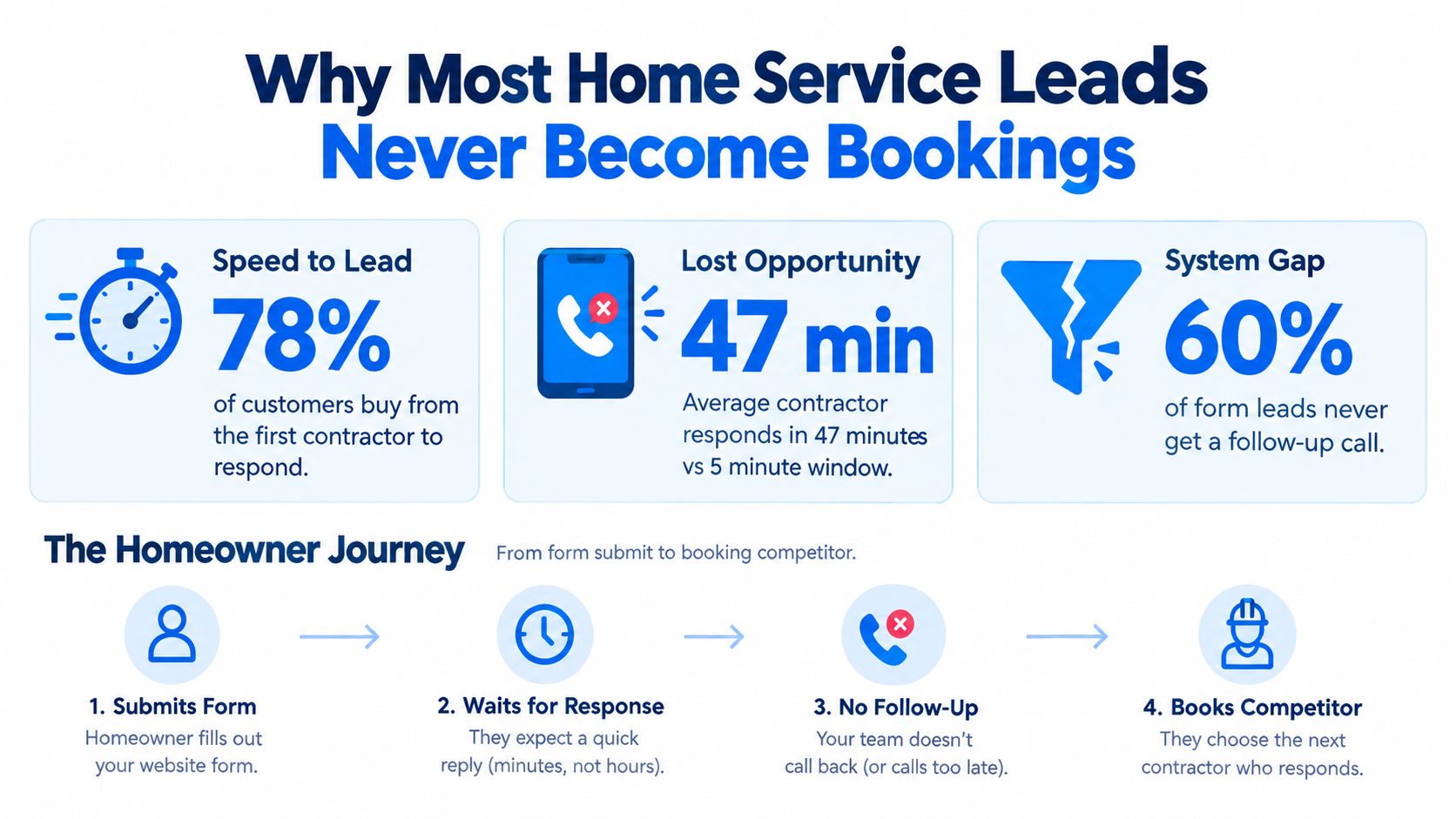
The three leaks inside the funnel
Slow response is the first leak. A dispatcher can plan to return every call, yet lunch breaks, after-hours inquiries, and technicians on the road create gaps. Lead routing, an immediate text, and a named owner for each inquiry provide coverage when the office cannot answer.
Weak qualification creates another leak. “Thanks, we'll be in touch” confirms receipt without identifying the job, checking timing, or guiding the homeowner toward an appointment. The business has replied, but the booking conversation has not started.
No follow-up gives the opportunity away. Homeowners get distracted, miss calls, or need time to compare estimates. If one unanswered call ends the process, the company never learns whether the lead was qualified or needed another contact attempt.
Practical rule: Treat every new inquiry as a live booking conversation until the homeowner books, declines, or clearly falls outside your service area.
More traffic will not repair these leaks. A working system connects four operating points: generate demand in channels suited to the trade, capture contactable information, respond quickly with a useful question, and measure booked work instead of form volume. That process protects the budget already spent on Google, Meta, referrals, and marketplace exposure. The priority is recovering more appointments from existing demand before paying for additional leads.
Choosing the Right Lead Sources for Your Trade
The best source depends on urgency, job value, service area, and close rate. A plumber handling emergency repairs can benefit from high-intent search, while a cleaner selling recurring service may have more time to educate a prospect through social content or referrals. A roofing company may need a stronger estimate process because a costly shared lead behaves differently from a quick-service inquiry.
Independent benchmark-style coverage reports that cost per lead can vary by more than 12 times across trades, with roofing more expensive than house cleaning, and conversion rates diverging by service type and urgency. The lesson isn't to find the cheapest lead. It's to find the source whose lead economics support a booked job.
| Channel | Intent level | Cost pattern | Best for |
|---|---|---|---|
| Google Search | High, especially for urgent queries | Payment is tied to competitive clicks and campaign settings | Plumbers, HVAC, electricians, and emergency services |
| Local Services Ads | High, with calls, messages, or bookings from search | Pay-per-lead structure requires careful screening and response coverage | Local trades with strong reviews and reliable phone handling |
| Meta ads | Mixed, often interruption-based discovery | Flexible audience and creative testing, but lead quality needs qualification | Maintenance plans, remodeling, cleaning, landscaping, and seasonal offers |
| Referrals | High trust and strong fit when the recommendation is relevant | Acquisition cost is operational rather than purely media-based | Every trade, particularly relationship-driven work |
| Marketplaces | Varies, from estimate-ready to comparison shopping | Shared leads can create immediate competition, while exclusive leads may cost more | Businesses with fast response, disciplined qualification, and capacity |
Google Search and Local Services Ads usually deserve attention first when someone is already looking for a solution. Your landing page, reviews, service-area clarity, and call handling still determine whether that intent becomes an appointment. For HVAC operators, a focused HVAC marketing approach should separate emergency repair, maintenance, replacement, and installation instead of sending every search to one generic page.
Meta can work well when the customer doesn't yet have a precise search query. A seasonal tune-up, lawn-care plan, exterior cleaning offer, or recurring cleaning service needs a clear reason to act and a low-friction form. The trade-off is that the prospect may be interested without being ready to schedule, so follow-up and qualification carry more weight.
Referrals and existing-customer outreach often produce better context because the homeowner already knows the business or arrives with a recommendation. Marketplaces can add volume, but shared inquiries create a race to respond and make price comparison easier. Don't judge either channel by leads alone. Track estimates, booked appointments, completed jobs, and the time your team spends pursuing each opportunity.
Homeowners also research through Google Business Profiles, directories, reviews, and AI-assisted discovery. Zero-click search and AI answers can reduce website visits while still influencing who gets considered, so consistent business information and a useful local presence matter even when the click never appears in analytics.
Building Ad Campaigns and Funnels That Generate Verified Leads
An ad campaign should be designed backward from the booking. Start with the service you can sell profitably, the neighborhoods you can serve reliably, and the customer problem that signals intent. Then build the creative, targeting, landing experience, verification step, and handoff as one connected path.
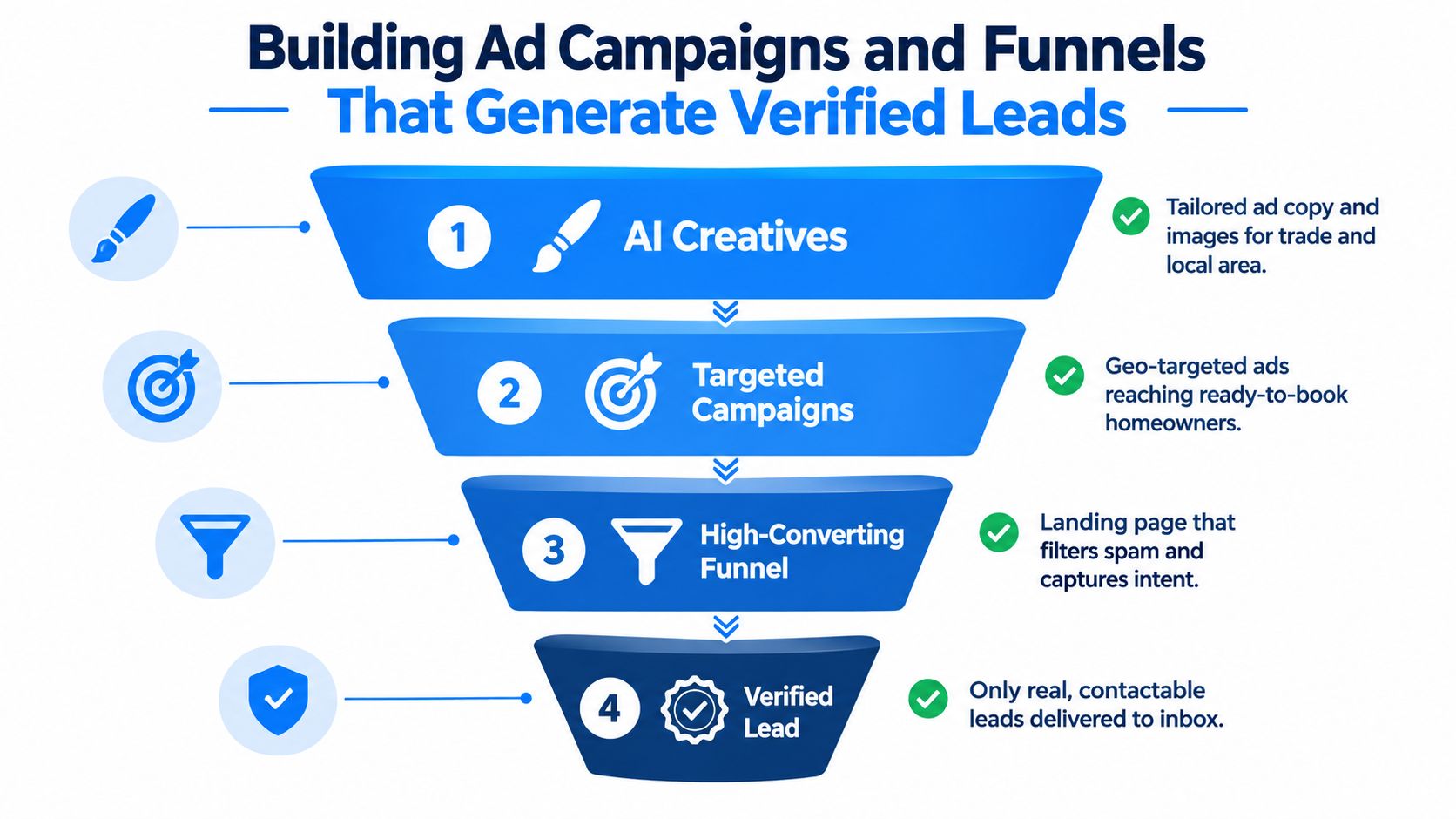
Start with one clear offer
A strong ad names the trade, location, problem, and next action. “AC not cooling in Phoenix?” is more useful than “Complete HVAC solutions.” A handyman campaign might focus on a defined group of tasks, while a pressure-washing campaign can lead with the visible result homeowners want.
AI can help create variations of headlines, images, and primary text, but approval should remain with the business owner. Review every concept for licensing claims, service-area accuracy, seasonal relevance, and promises the crew can keep. A polished creative that sends the wrong customer is still wasted spend.
Keep the click-to-lead path short
Use separate campaigns or ad groups for materially different services. Send emergency plumbing traffic to an emergency plumbing page, not a general homepage. The page should show the service area, phone number, trust signals, operating expectations, and one obvious form or call action.
Ask only for information needed to route and respond. A useful form might capture name, phone number, location, service needed, and preferred timing. Too many questions make the homeowner work before they've received help. Too few can create spam, wrong-area requests, and leads no one can act on.
For trade-specific execution, handyman marketing campaigns should distinguish small repair requests from larger renovation inquiries because the qualification path and scheduling requirements aren't identical.
Count verified leads, not empty submissions
A lead shouldn't count as valuable just because a form was completed. Verify the phone number where practical, confirm the service area, filter obvious spam, and pass the inquiry into the CRM or dispatch workflow with the original campaign and service details attached.
Retarget visitors who didn't submit, but change the message. The first ad can introduce the service. The second can answer a concern about availability, process, or trust. Retargeting shouldn't chase every visitor indefinitely. Give the prospect a useful reason to return and let the tracking system distinguish a new inquiry from an existing customer.
Following Up Fast With SMS That Gets Replies and Bookings
The first message has one job: start a conversation that feels relevant and easy to answer. It shouldn't read like an automated receipt, and it shouldn't demand a full project brief before anyone has acknowledged the homeowner.
The Lead Truffle home-service messaging research found that messages naming the specific job, asking one clear question, and avoiding an immediate request for contact details produced a 60.5% 24-hour reply rate, compared with 50.3% for other replies. That gives contractors a practical copy formula, not a reason to send longer texts.
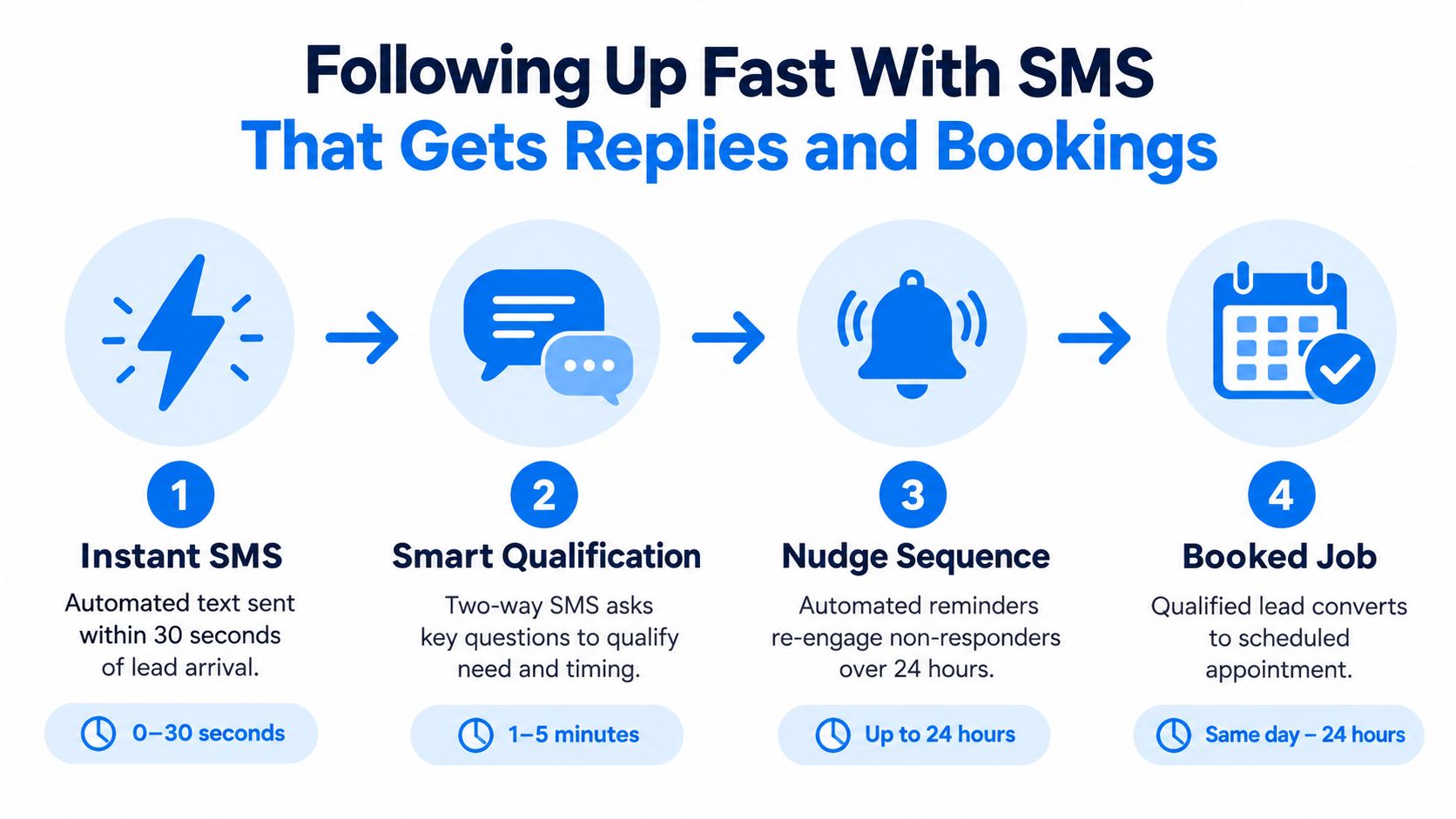
Use a job-specific opening
A first text might say:
Hi Sarah, this is Mike with Northside Plumbing. We received your request about the leaking water heater. Is the leak active right now, or are you looking to schedule a repair?
That message identifies the business, repeats the job, and asks one question. It gives the homeowner an easy response while helping the team determine urgency. Once the homeowner replies, ask the next useful question, such as location, access, or preferred timing. Don't conduct an entire intake interview by text when a booking link or phone conversation is the better next step.
Set clear expectations. If a technician will call shortly, say so. If the office is closed, explain when someone will respond and offer an emergency route if one exists. Clear SLA language reduces uncertainty, while a vague promise creates another reason to call someone else.
Build persistence into the first day
A practical sequence can include:
- Immediate confirmation: Send the first text as soon as the inquiry enters the system, then alert the assigned person.
- Human call attempt: Call while the homeowner is still engaged, and leave a short voicemail if there's no answer.
- Conversation prompt: If the lead hasn't replied, send a concise question tied to the requested service.
- Scheduling invitation: Offer a booking option once the need and service area are clear.
- Final same-day check: Close the loop politely and tell the homeowner how to continue.
The exact timing should reflect staffing, business hours, and emergency coverage. The principle is consistent: use automation for speed and persistence, then move qualified conversations to a human or scheduling workflow.
The home service statistics and follow-up benchmark summary reports that customers who reply after a first business response do so at a median of 11 minutes, with 36.5% replying within five minutes, 69.5% within an hour, and 88.3% within 24 hours. Those figures support text-first coverage, but they don't replace judgment. Stop messages when the person opts out, has booked, or is clearly not a fit, and follow applicable messaging rules.
Missed calls need their own recovery path. Send an immediate text acknowledging the call, identify the business, ask whether the homeowner still needs help, and provide the simplest next action. A missed-call response won't rescue every opportunity, but silence guarantees the caller must do all the work of trying again.
Tracking What Actually Drives Bookings and Lower Cost Per Lead
A campaign can show strong click volume while the phones stay quiet. Track the path from first interaction to booked appointment and completed job, then spend more on the sources that produce profitable work.
Browser events, including form submissions and button clicks, show what happened before a lead entered your operation. CRM updates, contact attempts, appointment status, job value, and revenue show what happened afterward. Connecting both views prevents the ad platform from rewarding forms that never become real conversations.

Read the report in business language
A weekly report should answer five practical questions:
- Acquisition: Which campaigns and services generated inquiries?
- Contact: How quickly did the team attempt contact, and did the homeowner respond?
- Qualification: How many inquiries matched the service area and job type?
- Booking: How many became scheduled appointments?
- Economics: What did each booked opportunity cost, and what did completed work produce?
Cost per lead helps identify changes in traffic efficiency. Cost per booking is closer to the decision that affects revenue. A cheap form submission becomes expensive when staff spend time chasing people who never answer. A costlier source can still work when it sends better-fit jobs and produces more completed work.
Track response time beside lead cost. A lead system that buys inquiries but responds slowly may waste more revenue than a higher acquisition cost would.
Use outcomes to refine spend
Separate campaigns by trade, service, geography, and intent wherever volume supports it. An emergency HVAC campaign should not optimize toward the same signal as a replacement campaign with a longer decision cycle. A cleaner selling recurring service also needs different qualification fields and follow-up language from a roofer arranging inspections.
The dataset covering 132,188 HVAC campaigns found that 88% of contractors took more than five minutes to respond. That gap makes response-time reporting an operating metric, not only a customer-service measure. If inquiries arrive but the median response is slow, fix lead routing, notifications, staffing, and automated acknowledgment before increasing ad spend.
Review source-level results each week, while avoiding decisions based on one noisy day. Pause audiences that repeatedly generate poor-fit inquiries. Improve the offer or message when people click but do not submit. Repair the booking handoff when verified leads fail to schedule.
The goal is a faster path from inquiry to booked work, not a larger lead count. Optimize each handoff, then judge the campaign by appointments, completed jobs, and cost per booking.
Putting Your Home Service Lead System Into Action
Start with the leak that costs the least to diagnose. Call your own business from a new number, submit a form, and send a message outside the office's busiest period. Record how long it takes to receive an acknowledgment, who owns the lead, what questions get asked, and whether a homeowner can schedule without repeated back-and-forth.
The operating sequence is straightforward:
- Choose the channel by trade economics: Match urgent services with high-intent search, and use education or seasonal offers where the customer needs more persuasion.
- Launch one focused offer: Keep the service, location, audience, and next action aligned.
- Verify the inquiry: Filter spam, confirm contactability, and capture the information the dispatcher needs.
- Respond immediately: Use an SMS acknowledgment, a human call attempt, and a clear owner for the next step.
- Follow up persistently: Continue within the first hour and through the first day without sending irrelevant messages.
- Measure booked work: Connect campaign data to appointments, completed jobs, and cost per booking.
Don't treat a 30-minute response as acceptable because it fits an internal workflow. The inbound lead-response benchmark reports that contacting a lead within five minutes instead of 30 minutes made a team about 100 times more likely to make contact and 21 times more likely to qualify the lead, with contact odds falling again between five and ten minutes.
A 2026 lead-response report also reported average follow-up times of 6.1 hours for plumbing, 8.4 hours for HVAC, and 14.7 hours for roofing, while faster contact performed better than delayed contact. Fix operations before scaling spend. Once qualified inquiries receive fast, consistent treatment and the booking data is reliable, increase investment in the sources that produce profitable work.
Benjiads combines AI-generated local-service advertising, approval-first campaign launches, verified lead funnels, tracking, retargeting, and automated SMS follow-up in one platform. If your home service leads are arriving but going cold before someone books, visit benjiads to see how the system can help your team turn response speed into more scheduled jobs.
Published via the Outrank tool
- home service leads
- lead generation
- home services marketing
- lead conversion
- local service ads