local advertising examples 19 min read
10 Local Advertising Examples: Trade Ads with Templates
Explore 10 local advertising examples from plumbing, HVAC, landscaping, and other trades, with templates, performance notes, and tactics you can copy.
On this page
- 1. Google Local Services Ads
- 2. Search Call-Only Ads and Call Extensions
- 3. Meta Instant Form Lead Ads
- 4. Radius-Targeted Social Ads
- 5. Click-to-Message Ads
- 6. Nextdoor Neighborhood Ads
- 7. Every Door Direct Mail
- 8. Vehicle Wraps and Yard Signs
- 9. Testimonial and Before-and-After Video Ads
- 10. SMS Missed-Call Text-Back and Lead Follow-Up
- 10 Local Advertising Tactics Compared
- Building a Local Ad Mix You Can Measure and Repeat
A plumber's phone rings at 9 p.m. with water running through a customer's ceiling. The homeowner searches for help, calls two businesses, and books the one that answers clearly and quickly. A landscaping customer has a different buying moment. They may notice an overgrown yard, see a neighbor's finished project, and request a quote days later. A dentist, cleaner, HVAC company, or electrician faces the same basic problem: the ad must appear in the right place, with the right promise, when the customer is ready to act.
The strongest local advertising examples match the format to that moment. Search ads capture urgent intent. Social campaigns create neighborhood awareness. Direct mail and vehicle signs build familiarity. Forms, messages, and SMS follow-up turn attention into an actual conversation. The ten examples below use plumbing, HVAC, landscaping, cleaning, dental, automotive, and other trade scenarios. Each includes a practical setup, copyable messaging, and the metric that proves whether the campaign is producing useful business rather than attractive but empty activity.
1. Google Local Services Ads
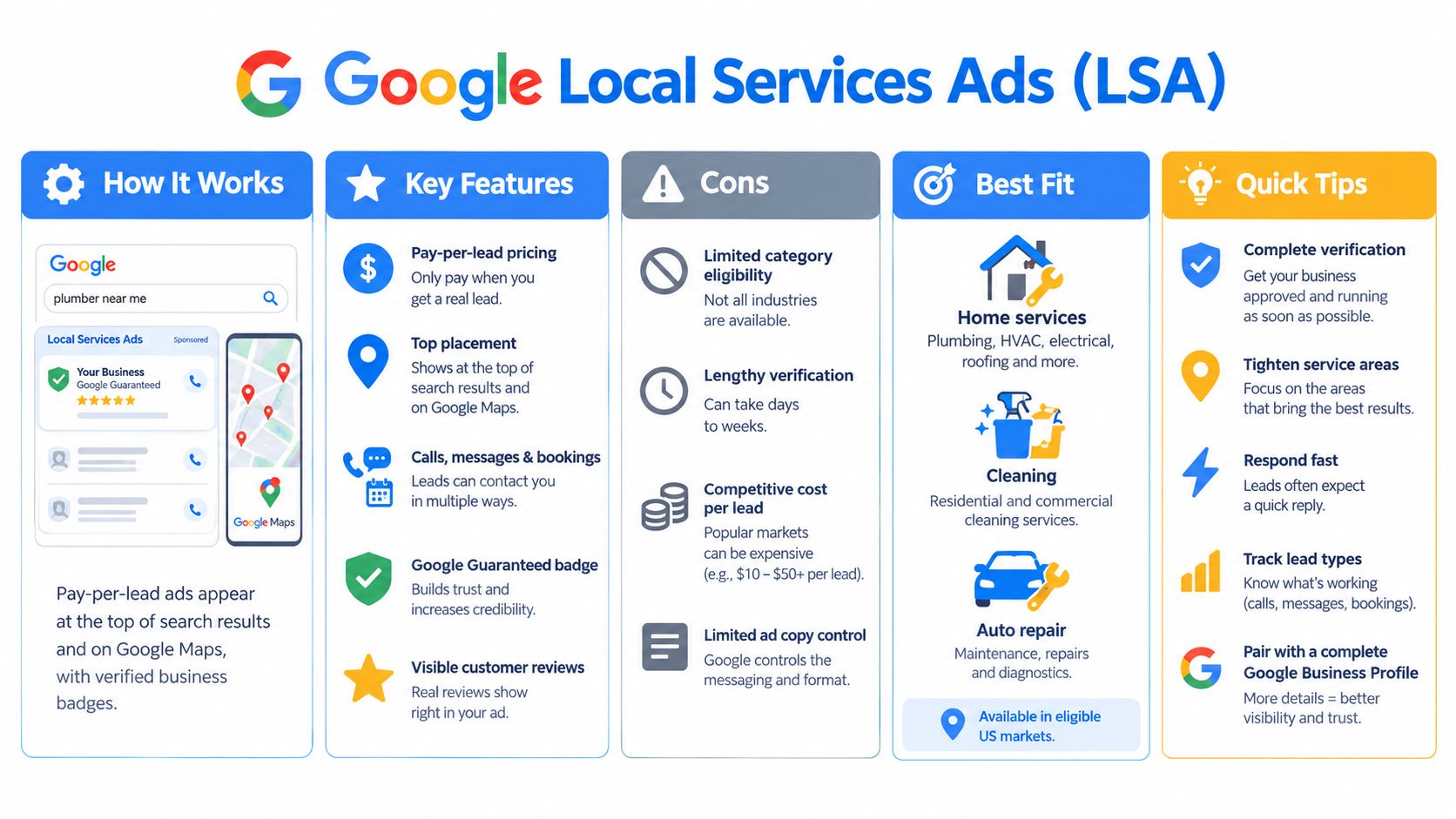
Google Local Services Ads put eligible local providers in a prominent position across Google Search and Google Maps. Instead of paying for every click, the business pays for qualifying calls, messages, or bookings generated through the ad. Verification for licensing, insurance, and background checks can support trust through badges such as Google Guaranteed or Google Screened.
For a plumber targeting “emergency plumber near me,” the buying moment is immediate. A visible profile with strong reviews, a clear service area, and a phone number gives the searcher a direct path to help. An HVAC company can use the same format during a period of heavy cooling demand, but it still needs to distinguish genuine service inquiries from requests outside its coverage area.
Setup that protects the budget
Complete verification before building expectations around lead volume. Define service areas tightly, because paying for inquiries from distant neighborhoods creates administrative work even when the platform considers them valid.
Use a complete guide to Local Services Ads categories to confirm category eligibility and avoid forcing one broad profile to represent unrelated services. Add accurate hours, current photos, service descriptions, and a Google Business Profile that supports the ad rather than contradicting it.
Practical rule: Treat every LSA inquiry as a sales conversation, not just a platform event. Record whether the lead was answered, qualified, booked, and completed.
Copy and measurement
Try: “Emergency Plumbing Help Today. Licensed Local Plumbers. Call Now.” Track calls and messages separately, then connect each lead to a booked job. Review quality, lead relevance, answer rate, and booked-job rate matter more than the number of inquiries alone. A call-tracking workflow such as SnapDial conversion optimization can help connect the initial call with the next action.
2. Search Call-Only Ads and Call Extensions
A customer with a locked-out car, failed furnace, or burst pipe often doesn't want to browse a long website. They want to speak with someone who can confirm availability, location, and likely next steps. Call-only search ads and call extensions fit that buying moment by making the phone the primary conversion path.
A 24-hour locksmith might schedule call-focused ads for overnight hours, provided somebody can answer. A towing company can attach a call button to standard search ads for “towing near me,” allowing customers to call without leaving the results page.
Build around answerable demand
Start with phrases that show immediate intent, such as “24-hour locksmith near me,” “same-day furnace repair,” or “local towing service.” Write the ad around the service and the response promise:
“Locked Out? Call a Local Locksmith Now. Fast Mobile Service.”
Use ad scheduling that matches staffing. An ad that promises immediate help while the phone goes to an unattended voicemail creates wasted spend and a poor first impression. Call reporting should distinguish short wrong-number calls from conversations that indicate a real service need.
The metric that matters
Measure qualified calls, call duration, appointments, and completed jobs. A low cost per call can hide irrelevant searches, price shoppers, or customers outside the service area. Add negative keywords for employment, training, parts, do-it-yourself instructions, and unrelated services. Review search terms frequently, especially after launching a new emergency campaign.
The trade-off is straightforward. Call-first ads can shorten the path to revenue, but they put pressure on the phone process. If nobody answers, the format loses much of its advantage.
3. Meta Instant Form Lead Ads
Meta lead ads on Facebook and Instagram let a prospect submit contact details through a form inside the app. The form can be pre-filled, which removes the friction of loading a separate landing page. This works well when the customer has a clear but non-emergency need, such as a roof inspection, dental consultation, cleaning estimate, or home improvement quote.
A roofing company could target homeowners near its office with “Request a Free Roof Inspection.” A dental clinic might ask for insurance status and preferred appointment time before staff follow up. Neither offer needs the customer to call immediately, but both need a reliable path from submitted form to real conversation.
Keep the form useful
A short form usually protects completion volume, while a small amount of qualification protects staff time. Ask only questions that change the next action:
- Service needed: Roof repair, replacement, inspection, or another option.
- Location: Confirm the prospect is inside the service area.
- Timing: Urgent, soon, or researching.
Add phone verification through an SMS step before treating a submission as a sales-ready lead. Route each form to a CRM or text workflow quickly. A lead that sits in an inbox becomes harder to contact, especially when the customer submits forms to several providers.
Offer-led creative
Test a specific offer against a generic contact form. “Book a Roof Inspection” gives the prospect a reason to submit details, while “Contact Us” leaves the value unclear. Measure verified leads, contact rate, qualified opportunities, booked appointments, and completed work. A form with more submissions isn't automatically better if the sales team spends its day filtering poor-fit inquiries.
4. Radius-Targeted Social Ads
A landscaping company with three service yards shouldn't show every ad to an entire metropolitan area. Radius-targeted campaigns limit delivery to people who can realistically become customers, then give the creative a neighborhood-specific reason to matter.
Run separate ad sets around each yard rather than combining all locations in one audience. A house cleaning business might promote a first-clean offer near its home base, while a lawn service uses separate ads for properties close to each crew location. The message can mention neighborhoods, nearby landmarks, or a defined service area.
Start narrow and learn
Begin with a practical service radius, then expand only when conversion data supports it. Exclude ZIP codes that produce out-of-area requests or poor-fit leads. The important comparison isn't reach alone. Compare qualified lead cost, booked estimates, travel time, and completed-job revenue across geographic groups.
Try this landscaping ad:
“Landscaping for [Neighborhood]. Request a Yard Design Visit From a Local Crew.”
The image should show a relevant project, not a generic stock garden. A cleaner can show a bright kitchen or a team preparing a home. The closer the creative feels to the customer's property and problem, the easier it is to understand the offer.
“A larger radius is only useful when the extra area produces profitable jobs.”
Prove local fit
Track each radius separately with distinct campaign names, forms, phone numbers, or landing-page parameters. Review whether a low-cost lead remains profitable after drive time, estimate time, discounts, and cancellations. Social targeting can create efficient awareness, but it shouldn't expand faster than operations can serve.
5. Click-to-Message Ads
Some customers prefer a conversation before they commit to a call or form. Click-to-message ads open Messenger or Instagram Direct and let prospects ask about price, availability, photos, appointment times, or service details. That makes the format useful for salons, photographers, cleaners, and businesses where a little context improves the booking decision.
A salon can run “Message Us to Book” creative with a quick path to its scheduling page. A photography studio can invite questions about packages before moving qualified prospects to a phone call or consultation. A customer who isn't ready to fill out a detailed form may still send a short message.
Design the first exchange
Set an instant welcome message that answers the obvious question and offers choices:
“Thanks for reaching out. Are you looking for a quote, availability, or service details?”
Add quick replies for common requests. A cleaning company might ask for property type and preferred timing. A photographer might ask about event date, location, and service category. Set a realistic response expectation in the auto-reply. Don't promise an immediate answer if the team only checks messages twice daily.
Use location-specific messaging where it helps the customer understand coverage. Guidance on adding a location on Facebook can support a clearer local presence.
Separate conversations from bookings
Track message starts, qualified conversations, phone or SMS handoffs, booking links clicked, and completed appointments. Message volume alone can be misleading because social users often ask questions without buying. The format works best when a named person owns the inbox and the business has a defined next step after qualification.
6. Nextdoor Neighborhood Ads
Nextdoor fits trades that depend on local trust and recommendations. A handyman, pest-control company, or home repair business can appear alongside neighborhood conversations where residents already ask for provider suggestions. The buying moment is often less urgent than a search for emergency plumbing, but trust can decide which contractor receives the first message.
A handyman might promote “Free Estimates for Neighbors” in selected communities. A pest-control business could use neighborhood-specific creative when residents begin reporting a seasonal problem. The ad should sound like a useful local introduction, not a national brand announcement.
Earn attention without forcing it
Use conversational copy and show actual local work. A before-and-after repair, a recognizable street, or a project description gives the ad credibility. Invite satisfied customers to review the business profile, and respond promptly when neighbors ask questions in recommendation threads.
A useful format is:
“Need a Small Repair in [Neighborhood]? We Handle Doors, Fixtures, and Punch-List Jobs. Message for an Estimate.”
Avoid exaggerated urgency when the service isn't urgent. Nextdoor users may react poorly to hard-sell language that interrupts a community discussion. The platform's strength is proximity and familiarity, so the business should behave like a responsive local provider.
Measure trust and revenue
Use a dedicated lead source in the CRM and ask every inquiry how they found the business. Track qualified conversations, estimates, booked work, reviews, and repeat referrals. Don't judge the channel only by impressions. A smaller flow of well-matched neighborhood requests can be more useful than broad exposure that creates long-distance or low-intent inquiries.
7. Every Door Direct Mail
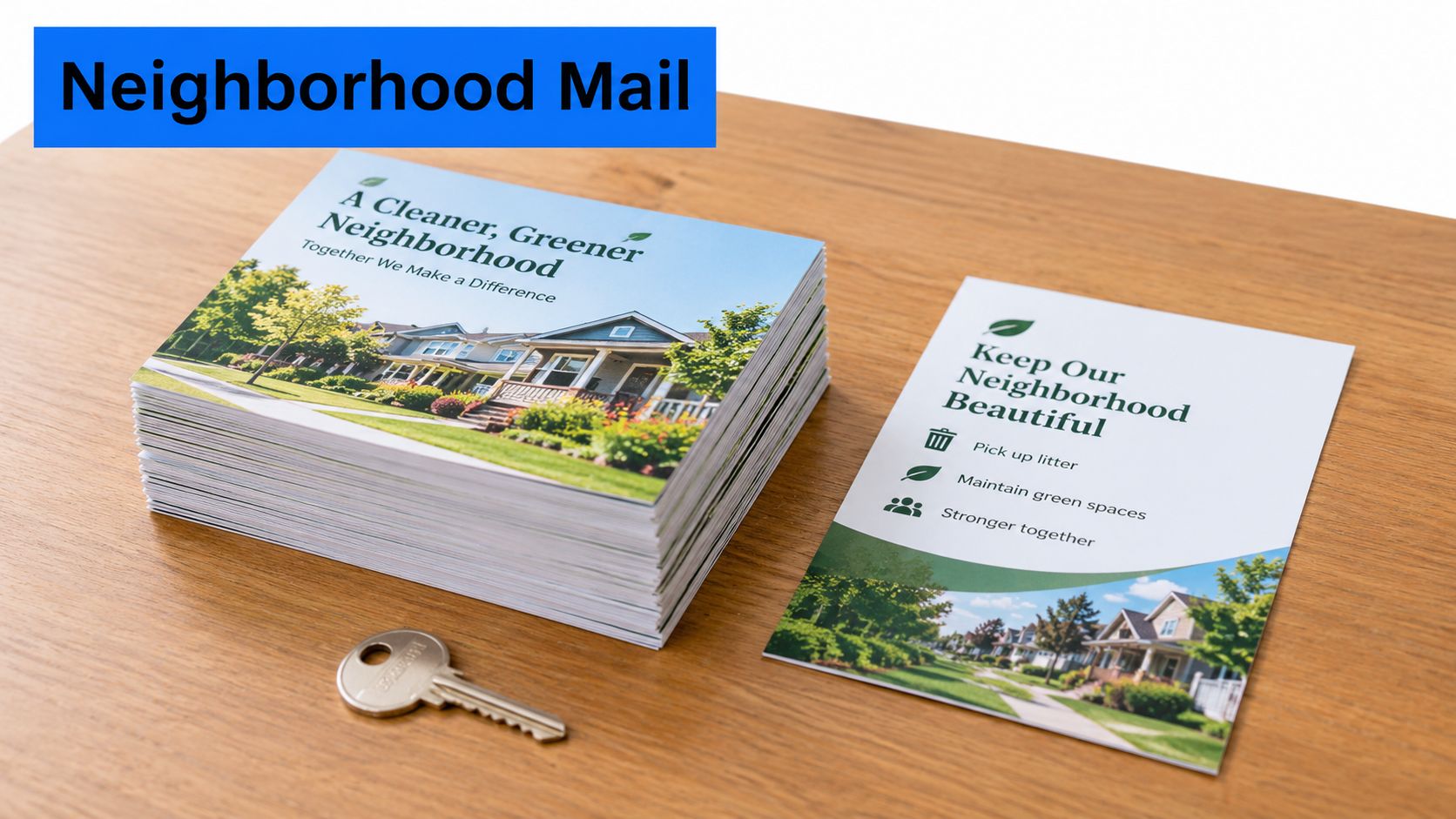
Every Door Direct Mail lets a business send postcards or flyers to every address on selected postal routes without maintaining an individual mailing list. That makes it useful for saturating a defined neighborhood, especially when a business has a simple offer and a service area close to the route.
A carpet cleaner can send a seasonal offer to routes near its office. A new HVAC company can introduce itself to a neighborhood before supporting the same area with digital ads. The physical piece creates familiarity, while the offer gives the recipient a reason to respond.
Make the card measurable
Use a dedicated phone number, QR code, or landing page. A postcard that says only “Call us for service” gives the business no reliable way to distinguish mail responses from normal demand.
A simple layout works well:
- Headline: “Local Carpet Cleaning for [Neighborhood].”
- Offer: State the specific service or promotion.
- Proof: Mention the trade, service area, or completed work.
- Action: Give one phone number and one tracked QR code.
Test routes with different offers before expanding distribution. One version might promote a first service, while another emphasizes recurring maintenance. Keep the design readable from a quick glance. Too many services, tiny text, and several competing calls to action weaken the response.
Judge the channel commercially
Record delivered routes, tracked responses, qualified leads, booked work, and revenue. Include material and labor costs when evaluating the campaign. EDDM can build recognition, but it lacks the immediate intent signals available in search. It works best when the offer is easy to understand and the business can answer responses promptly.
8. Vehicle Wraps and Yard Signs
A service vehicle becomes a local advertising asset every time it travels between jobs. Yard signs do something similar at a completed project, where neighbors can see evidence of the work in a relevant context. These formats suit plumbers, gardening contractors, roofers, painters, and other trades that operate visibly in residential areas.
A plumbing van might display “24/7 Emergency Service” and a large phone number. A landscaping crew can place a sign at a mowing or design project with a trackable QR code. The customer doesn't need to be actively searching when the ad appears. Familiarity builds through repeated exposure.
Prioritize readability
Keep the message short. A driver or neighbor should understand the trade, service, and action quickly. Use a phone number large enough to read at a distance, and test a short URL or QR code rather than filling the design with service categories.
Start with magnetic door signs if a full wrap feels too permanent. That allows the owner to assess whether the brand presentation works across different vehicles. Before placing yard signs in public areas, check local rules and obtain permission from the property owner.
Track assisted demand
Ask new callers how they heard about the business and record the answer consistently. Use a campaign-specific number or URL where practical. Vehicle advertising won't always generate a direct click, so measure branded searches, calls mentioning the vehicle, yard-sign inquiries, and jobs from nearby properties.
The trade-off is attribution. These ads can support recognition over time, but they shouldn't replace trackable search or lead campaigns when the business needs a clear cost-per-acquisition view.
9. Testimonial and Before-and-After Video Ads
A customer deciding whether to hire a roofer or cleaner wants evidence that the business can deliver the promised result. Short videos show the work, the change, and the people involved in a way a generic service claim can't. Authentic job-site footage often feels more credible for local services than polished production that could belong to any company.
A roofing contractor can open with a storm-damaged roof, then show the completed repair and a customer comment. A cleaning company can show a transformation from cluttered or neglected to finished, with the review displayed as captions. The first moments should communicate the result rather than begin with a logo animation.
Build the creative around proof
Get written permission before featuring a customer, home, voice, or recognizable property. Use captions because many social users watch without sound. A simple script works:
“Storm damage on this roof. We inspected the problem, completed the repair, and helped the homeowner restore the property. Call for a quote.”
Test testimonial videos against static project photos. Track qualified leads, not just video views or engagement. A video can receive attention from people outside the service area, while a less entertaining version may produce better local inquiries because it states the offer more clearly.
For production ideas, a Meta ad creator from ShortGenius can help turn project details into short-form concepts, but the footage still needs to reflect real work and a real service area.
Start with a result-led opening, add location and service context, then finish with one action: “Call for a free quote,” “Request an inspection,” or “Message to book.”
10. SMS Missed-Call Text-Back and Lead Follow-Up
An unanswered call is not a harmless missed opportunity. An electrician may be inside a customer's home, a plumber may be driving, and a dentist's receptionist may be helping another patient. A missed-call text-back keeps the conversation open while the business is unavailable.
The first message should be short and specific:
“Sorry we missed your call. Are you looking for electrical repair, an estimate, or emergency help? Reply here and we'll get back to you.”
For form leads, the business can confirm the request, ask one qualifying question, and offer the next step. A dental office might request the preferred appointment time. A service contractor might confirm the address and urgency before scheduling.
Set up the handoff
Keep the initial text personal rather than sending a long automated sequence. Respond to replies quickly during staffed hours, and make ownership clear so messages don't disappear between the office phone and field team. Include opt-out language and follow applicable messaging rules.
Use text message templates for local-service follow-up as a starting point, then adapt the wording to the trade and customer situation.
Measure recovered revenue
Track missed calls, delivered texts, replies, qualified leads, booked jobs, and completed work. Message volume is only an intermediate signal. A system that sends many texts but produces few appointments needs better qualification, timing, or staffing.
This format is especially valuable when the ad channel already works but the business loses inquiries through slow response. Before increasing media spend, confirm that every new lead receives a clear next action and that someone can take over when the customer replies.
10 Local Advertising Tactics Compared
Google Local Services Ads (LSA)
- Implementation Complexity 🔄
- Moderate 🔄, verification (licenses, background checks) and setup time
- Resource Requirements ⚡
- Medium ⚡, pay-per-lead budget; review management
- Expected Outcomes ⭐📊
- High ⭐, direct, high-intent leads; measurable lead volume 📊
- Ideal Use Cases 💡
- Home services, cleaning, auto repair in eligible markets
- Key Advantages
- Pay-per-lead pricing; Google Guaranteed/Screened badge; prime placement
Search Call-Only Ads & Call Extensions
- Implementation Complexity 🔄
- Low 🔄, simple setup; schedule & tracking required
- Resource Requirements ⚡
- Low–Medium ⚡, pay-per-call spend; staff to answer
- Expected Outcomes ⭐📊
- High ⭐ for urgent queries; instant contact metrics 📊
- Ideal Use Cases 💡
- Emergency or after-hours services (locksmiths, towing)
- Key Advantages
- Direct calls; minimal creative; clear call metrics
Meta Instant Form Lead Ads
- Implementation Complexity 🔄
- Low–Medium 🔄, build native forms; CRM/webhook integration
- Resource Requirements ⚡
- Medium ⚡, ad spend; lead routing and follow-up systems
- Expected Outcomes ⭐📊
- Medium ⭐, high volume, variable lead quality 📊
- Ideal Use Cases 💡
- Quote-based services (roofing, remodeling, healthcare consults)
- Key Advantages
- Low-friction, pre-filled forms; strong targeting; fast lead capture
Radius-Targeted Social Ads (Geofenced)
- Implementation Complexity 🔄
- Low 🔄, set radii and ad sets; monitor overlap
- Resource Requirements ⚡
- Medium ⚡, ongoing ad spend; localized creative
- Expected Outcomes ⭐📊
- Medium ⭐, reduced wasted impressions; better local CPL 📊
- Ideal Use Cases 💡
- Service businesses with defined territories (landscaping, cleaning)
- Key Advantages
- Limits wasted reach; neighborhood messaging; scalable rings
Click-to-Message Ads (Messenger / Insta Direct)
- Implementation Complexity 🔄
- Low–Medium 🔄, bot/quick-reply setup; inbox management
- Resource Requirements ⚡
- Medium ⚡, messaging tools; staff or automation
- Expected Outcomes ⭐📊
- Medium ⭐, conversational leads that require follow-up 📊
- Ideal Use Cases 💡
- Appointment/consultative services (salons, photographers)
- Key Advantages
- Low-barrier contact; automated qualification; conversation history
Nextdoor Neighborhood Ads
- Implementation Complexity 🔄
- Low 🔄, neighborhood targeting; community-sensitive creative
- Resource Requirements ⚡
- Low–Medium ⚡, ad budget; reputation management
- Expected Outcomes ⭐📊
- Medium ⭐, high local trust but smaller scale 📊
- Ideal Use Cases 💡
- Home service providers relying on neighborhood referrals
- Key Advantages
- Neighborhood targeting; verified users; less national competition
Every Door Direct Mail (EDDM)
- Implementation Complexity 🔄
- Medium 🔄, design, print, USPS routing and timing
- Resource Requirements ⚡
- Medium ⚡, printing & postage costs; lead-tracking tools
- Expected Outcomes ⭐📊
- Low–Medium ⭐, wide saturation; low/predictable response rates 📊
- Ideal Use Cases 💡
- Neighborhood-level campaigns (carpet, pest control, HVAC intro)
- Key Advantages
- Cost-effective area saturation; no mailing list needed; physical presence
Vehicle Wraps & Yard Signs
- Implementation Complexity 🔄
- Low–Medium 🔄, design, production, and local compliance
- Resource Requirements ⚡
- Medium–High ⚡, upfront wrap/sign costs; occasional maintenance
- Expected Outcomes ⭐📊
- Medium ⭐, continuous local impressions; limited direct tracking 📊
- Ideal Use Cases 💡
- Mobile crews and visible job sites (plumbing, landscaping)
- Key Advantages
- Ongoing local visibility; builds credibility; low recurring cost
Testimonial & Before-and-After Video Ads
- Implementation Complexity 🔄
- Low 🔄, phone-shot production; customer permission required
- Resource Requirements ⚡
- Low–Medium ⚡, filming time, basic editing, ad spend
- Expected Outcomes ⭐📊
- High ⭐, strong trust and engagement when authentic 📊
- Ideal Use Cases 💡
- Visual services (roofing, cleaning, auto detailing)
- Key Advantages
- Powerful social proof; reusable across platforms; low production cost
SMS Missed-Call Text-Back & Follow-Up
- Implementation Complexity 🔄
- Medium 🔄, integration with phone/CRM and compliance setup
- Resource Requirements ⚡
- Medium ⚡, SMS platform fees; staffing for replies
- Expected Outcomes ⭐📊
- High ⭐, recovers missed leads; speeds response; improves conversion 📊
- Ideal Use Cases 💡
- Any local service losing leads to missed calls (contractors, salons)
- Key Advantages
- Recovers lost leads; automates follow-up; two-way conversation records
Building a Local Ad Mix You Can Measure and Repeat
Start with the buying moment that already produces the clearest demand. For emergency plumbing, locksmith, towing, or HVAC repair, that may mean Local Services Ads and call-focused search campaigns. For landscaping, cleaning, roofing, and other considered services, radius-targeted social ads, testimonial creative, or a focused lead form may create the first useful conversation. Neighborhood platforms, direct mail, vehicle signs, and yard signs can strengthen recognition once the business knows which offer customers understand.
Don't spread a limited budget across every channel just because each format looks promising. A local campaign needs a defined service area, a specific offer, a response owner, and a way to connect the lead to revenue. Search terms, audience location, phone calls, messages, forms, and QR codes all create useful signals, but none proves success alone.
Track each format through the same commercial stages:
- Lead quality: Is the prospect inside the service area and asking for a service you provide?
- Response rate: Did somebody answer the call, text, form, or message promptly?
- Booking rate: Did the inquiry become an estimate, appointment, or scheduled job?
- Revenue: Did the booked work produce enough margin to justify the acquisition cost?
- Repeat value: Did the customer return, refer a neighbor, or buy maintenance later?
Local advertising has become a multi-channel market rather than a choice between a newspaper and a search ad. In the United States, local advertising was forecast to reach approximately $148.9 billion in 2024, with local online advertising projected to exceed $20.4 billion and targeted display expected to reach $27.2 billion, according to Borrell's 2024 local advertising outlook. Those figures show why owners encounter customers across search, social, display, streaming, television, listings, and offline media. They don't mean every business should use every channel.
A 2024 local advertiser survey reported that four in ten planned to try a media type they hadn't previously used, with SMS advertising and search-engine marketing among the leading choices, as detailed in the OAAA and Borrell local survey presentation. The practical implication is less about chasing novelty and more about connecting acquisition to follow-up. An ad can create demand, but a missed call, ignored form, or unanswered message can still lose the job.
BenjiAds can prepare trade-specific creative, campaign structures, landing funnels, conversion tracking, and SMS follow-up for local service businesses. Ads remain paused until the owner approves them, and reporting focuses on leads, cost per lead, and creative performance. A platform such as BenjiAds is most useful when the owner wants these pieces connected without managing every advertising tool separately.
For video creative and local campaigns, Klap's video marketing guide for small businesses offers another perspective on turning real service work into usable content. Whatever tools you choose, keep the operating system simple: match the channel to the buying moment, answer every viable inquiry, and move budget toward booked jobs rather than surface-level engagement.
BenjiAds helps local service businesses create trade-specific ads, landing funnels, tracking, and SMS lead follow-up in one workflow. It's built for owners who want to test local advertising examples such as radius campaigns, Meta lead ads, and message-based booking without managing every marketing tool manually. Visit benjiads to see how it can support your next campaign.
- local advertising examples
- local ad campaigns
- trade marketing
- home service ads
- lead generation ads
Done for you
Ads that text you customers.
- ✓ Ads created for you
- ✓ Every lead texts your phone
- ✓ Free to use, no credit card
748+ local businesses run ads with benjiads