lead generation software 19 min read
10 Lead Generation Software Platforms Compared
Compare 10 lead generation software platforms by use case, features, pricing model, trade-offs, and fit for local services, agencies, and marketing teams.

On this page
Choosing the most feature-rich platform first is usually the wrong move. In lead generation software, the question is where the lead journey breaks, acquisition, on-site capture, funnel conversion, messaging, social DMs, or full-stack follow-up, and how much manual work your team can realistically absorb. The market has moved toward connected systems because lead generation now spans campaign creation, landing pages, capture, nurturing, routing, and reporting inside one workflow, not five disconnected tools. Adoption reflects that shift, with broad use of marketing automation across companies worldwide and strong uptake in enterprise and mid-market teams, while the category itself keeps scaling fast (industry roundup).
The most useful comparison criteria are blunt ones, not marketing slogans. Trade fit, acquisition scope, follow-up depth, pricing mechanics, tracking quality, implementation effort, and limitations tell you far more than a feature checklist. Speed matters too, because response timing has long shaped lead conversion, and earlier research on web leads found that contacting prospects within 5 minutes dramatically outperformed slower follow-up, while a separate benchmark showed an average first response time of 42 hours across 2,241 U.S. firms (response-time research summary).
1. Benjiads
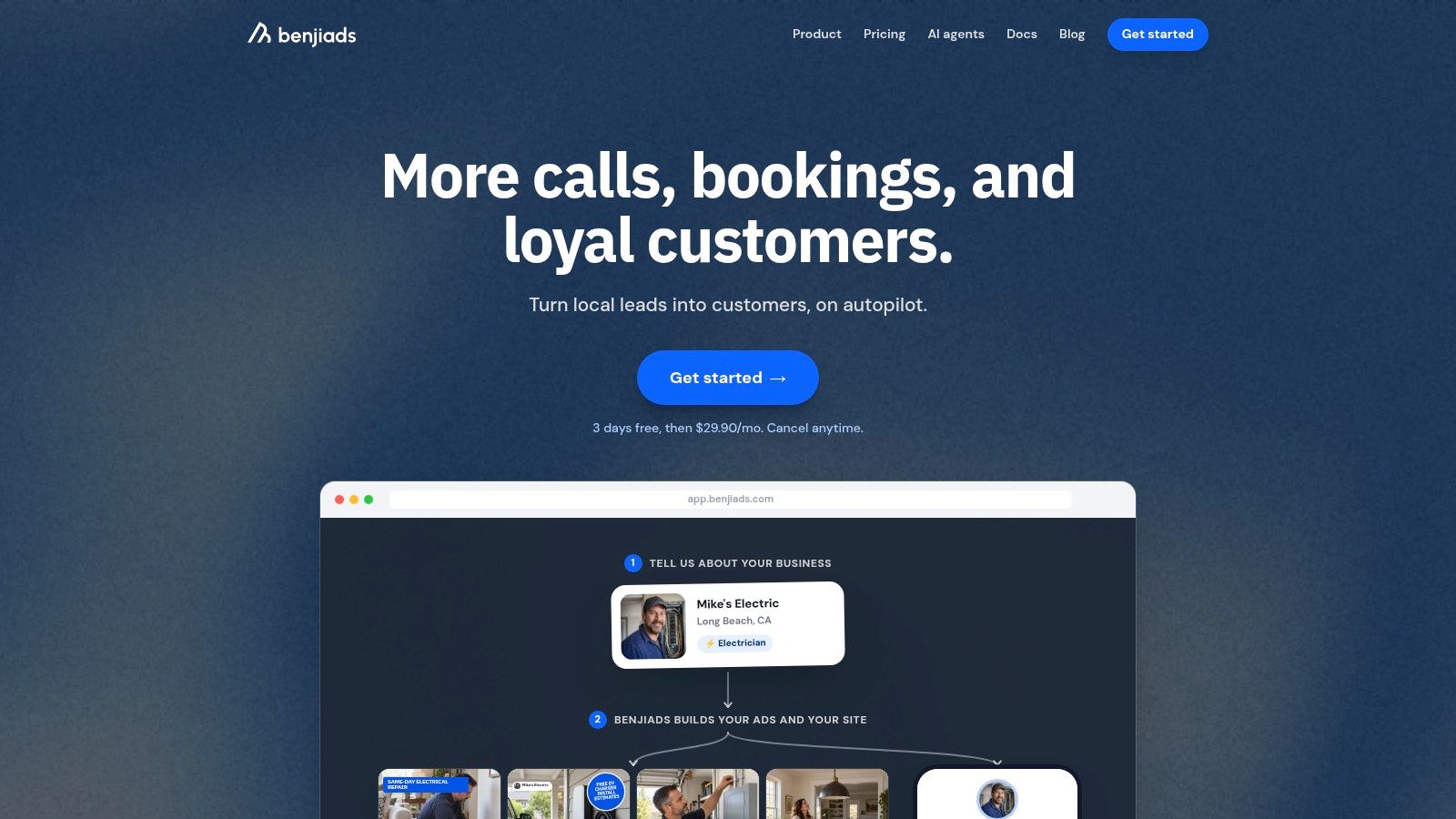
Benjiads is built for a narrower job than most lead generation software. It is strongest when a local service business needs paid traffic to turn into booked work, with ads, tracking, funnels, and SMS follow-up handled in one system instead of across separate tools. That matters for owners who want control without becoming the person who manages campaigns every day. The approval-first workflow is part of that design, since nothing goes live until the business owner signs off.
Why it stands out for local acquisition
Benjiads covers the parts that usually push trades to hire help or spend time inside ad platforms. It creates trade-specific creatives, builds campaigns for Meta and Google where applicable, sets up server-side and client-side tracking, deploys prebuilt funnels and retargeting, and follows up with leads by text in real time. The practical effect is simple, it reaches across acquisition and follow-up rather than stopping at the form fill.
Its pricing is unusually clear for this category, with 3 days free, then $29.90 per month plus a flat 10% of ad spend, with the first $30 of ads on benjiads per account. The platform also reports roughly $7 per phone-verified lead across its local campaigns, though actual CPL will vary by trade and market. That mix points to a product aimed at electricians, plumbers, HVAC, cleaners, dentists, photographers, and similar businesses that want agency-style execution without retainers. Visit benjiads if you want one system to handle both the ad side and the lead follow-up side.
Practical rule: if you need to know whether a lead source is producing booked revenue, not just form fills, benjiads is built around that question.
Best-fit users and limits
Benjiads combines creative generation, campaign management, attribution-grade tracking, retargeting, and automated SMS follow-up in one product. That reduces tool sprawl and gives owners a clearer view of what is driving booked jobs. It also fits teams that want plain-English reporting focused on bookings and cost per lead, not dashboards crowded with metrics that do not affect cash flow.
The trade-off is specialization. Benjiads is not trying to be a broad enterprise marketing suite, and it is not a human-led agency with a dedicated strategist on retainer. That is an advantage for local operators who value speed and simplicity, but a limit for buyers who need bespoke creative direction, multi-brand governance, or non-local ecommerce workflows.
2. HubSpot Marketing Hub
HubSpot Marketing Hub is the safer choice when governance, CRM discipline, and full-funnel reporting matter more than speed of setup. It covers forms, landing pages, ads, email, automation, and a connected CRM, so it's built for teams that want one standards-based system rather than a patchwork of tools. That broad scope fits organizations where marketing, sales, and operations all need visibility into the same lead record.
HubSpot Marketing Hub connects capture, nurture, and reporting in a way many teams can grow into. The internal comparison for readers who want a more automation-focused alternative is benjiads' view of automated marketing platforms, which is useful if you're weighing an all-in-one suite against a tighter acquisition-and-follow-up workflow.
Where it fits in the lead journey
HubSpot is strongest when the job is full-funnel conversion management. You can capture leads through forms, pop-ups, and landing pages, then move them through email and workflows inside a unified CRM. That makes it well suited to teams that care about lead source, lifecycle stage, and reporting hygiene.
Its ad management spans major channels, and its role and seat structure helps governance-minded teams keep access controlled as the organization grows. The downside is predictable but real. Professional and Enterprise tiers require onboarding, which adds cost, and the contact-tier and seat model can make the total bill rise faster than smaller teams expect.
Decision point: choose HubSpot when the main problem is fragmented records and inconsistent reporting, not when you just need more leads from one local market.
Pricing mechanics and implementation effort
HubSpot's pricing is less about one monthly number and more about how many seats, contacts, and add-ons you need. That matters because a platform that looks manageable at the start can become expensive once automation depth and governance are essential. Implementation is also more involved than lightweight builders, because the value comes from setting up the data model correctly.
For larger teams, that complexity is often worth it. For smaller local operators, it can be overkill unless they already have marketing operations support or a serious need for CRM structure.
3. HighLevel
HighLevel is the platform agencies reach for when they want to package funnels, messaging, CRM, and automation into one white-labelable system. It's built around local and service-based lead handling, with built-in SMS, voice, WhatsApp usage, AI add-ons, reputation tools, and agency mode for sub-accounts. If benjiads is about simplifying paid acquisition for a single local operator, HighLevel is about orchestrating multiple client accounts and workflows at once.
HighLevel is strongest when you're managing many moving parts across several businesses. The internal angle on faster response handling is worth pairing with benjiads' speed-to-lead guidance if you care about how quickly inquiries turn into conversations.
Best when follow-up is the product
HighLevel's biggest advantage is that it doesn't treat follow-up as an afterthought. Built-in phone and SMS tools, plus AI follow-up options, mean teams can compress the gap between inquiry and response without bolting on separate messaging software. That makes it attractive for agencies serving home services, clinics, and other local businesses where missed calls and slow replies kill conversion.
It also offers vertical snapshots, which reduce the time needed to stand up a specific industry workflow. That's useful, but it comes with a catch. The broader the feature surface, the more setup discipline you need, because a platform with this much flexibility can become messy fast if no one owns configuration.
Cost structure and operational trade-offs
HighLevel often looks aggressive on price compared with buying separate tools, but usage-based telecom and AI charges can add up. That means the sticker price isn't the whole story. The actual total cost depends on how much texting, calling, and automation you run through it each month.
It fits agencies that want rebilling and unlimited sub-accounts, and it also fits local-service operators who want a central communications hub. It's less appealing for teams that want minimal configuration or a narrow platform devoted only to acquisition.
4. ClickFunnels 2.0
ClickFunnels 2.0 is the funnel-first tool on this list. Its strength is turning traffic into leads and sales through templates for lead magnets, applications, webinars, membership offers, and checkout flows, all inside a workflow that's intentionally built around conversion. If the job is to launch fast and stay inside funnel logic, it's still one of the clearest options.
ClickFunnels suits teams that think in offers and landing paths rather than database architecture. For readers comparing funnel builders against more AI-assisted page generation, benjiads' landing page builder perspective is the relevant companion angle.
Conversion-first, not system-first
ClickFunnels is good at making one path to conversion feel obvious. The template library reduces setup friction, and built-in A/B testing helps teams iterate without needing a separate CRO stack. That's especially useful for SMBs and solopreneurs who need to move from idea to live funnel quickly.
The trade-off is flexibility. It's not the same thing as a full CRM or a broader CMS, so teams with complex data models or intricate internal routing will feel the limits. Costs can also rise if you hit plan boundaries or need more advanced functionality, which makes it more attractive as a focused funnel layer than as a long-term operating system.
A funnel builder should speed up launches, not force your whole lead process into a narrow template. ClickFunnels works when that template matches your motion.
Best-fit users and limitations
This is the right choice for businesses that live inside campaigns, webinars, lead magnets, and direct-response offers. It's less ideal for organizations that need governance across multiple teams or deep attribution across many lead sources. If your bottleneck is page-to-lead conversion, it's a strong contender. If your bottleneck is what happens after the form fill, it's only part of the answer.
5. Unbounce
Unbounce is a landing-page and conversion-optimization tool for teams that already have traffic and want better page performance without rebuilding their whole stack. Its core value is controlled testing. Smart Traffic, drag-and-drop pages, popups, sticky bars, and A/B testing make it a good fit for paid media teams that care about squeezing more conversions from existing clicks.
Unbounce is best understood as a conversion layer, not a full lead management system. It's the kind of tool you buy when the acquisition is already happening, but the page itself is leaking value.
Why performance teams like it
Unbounce is purpose-built for landing-page experiments. That matters because the job isn't just to publish pages, it's to learn which message, structure, or offer converts better under real traffic. Smart Traffic adds an automated routing layer that can send visitors to the variant most likely to convert, which is useful for advertisers who want speed without manually watching every test.
The platform's strengths are tightly aligned with paid acquisition. Dynamic text replacement and advanced triggers help match page copy to traffic source, and the testing tooling is deeper than many generalist builders. For marketers who already have CRM and nurture systems elsewhere, that narrow focus is a feature, not a flaw.
Where the limits show up
Unbounce doesn't try to replace your full marketing stack. You'll still need separate tools for CRM automation, pipeline reporting, and broader campaign orchestration. Pricing is also tied to traffic and plan tiers, and the higher tiers may require a sales conversation, which can complicate quick budgeting.
It's a strong choice for teams that want conversion rigor and can live with a specialized tool. If the primary challenge is lead follow-up, routing, or owner-level visibility into bookings, this won't be the only platform you need.
6. Leadpages
Leadpages is the pragmatic choice for small teams that want fast landing-page deployment without a heavy suite. It focuses on AI-assisted page generation, drag-and-drop editing, forms, A/B testing, and basic lead capture integrations, which keeps the learning curve lighter than more complex platforms. For local services and SMBs, that simplicity can matter more than an endless feature list.
Leadpages is built for speed to publish. If the job is to get a clean page live quickly, it does that well.
When simplicity wins
Leadpages works because it doesn't overcomplicate the page-building job. Teams can move from idea to on-brand landing page quickly, and the templates make it easier to avoid design paralysis. The AI credit model also gives users a practical way to accelerate page creation without starting from scratch every time.
That said, it's still a lighter platform. The automation layer is thinner than a full marketing suite, so you'll likely pair it with email or CRM tools if you want deeper follow-up. Higher-tier features can also be gated, which means the cheapest plan is not always the plan that fits your workflow.
Best fit and constraint
Leadpages is strongest for businesses that need a simple conversion surface and already have a separate follow-up engine. It's less compelling if you want advanced routing, complex lifecycle automation, or one system that handles the entire lead journey.
It's a good buy when the pain is page creation speed, not when the pain is everything that happens after the form submit.
7. OptinMonster
OptinMonster is the on-site capture specialist. It overlays popups, slide-ins, exit-intent prompts, geotargeting, and onsite retargeting on top of an existing website, which makes it ideal for extracting more leads from traffic you already own. If your site is getting visits but not enough form fills, this is one of the most direct tools you can use.
OptinMonster doesn't try to own your whole funnel. It tries to convert more of the visitors already on the page.
The on-site capture advantage
The platform's targeting rules are the main reason people buy it. Exit-intent, behavioral triggers, UTM conditions, geolocation, and device targeting let you tailor offers without touching code. That matters for teams that want control over who sees what, and when.
Gamified elements like a coupon wheel can make sense for consumer-facing businesses, but the value is broader than gimmicks. For many teams, the practical gain is turning passive traffic into a measurable lead stream without rebuilding the site. The impression-based usage model also fits businesses that care about usage instead of seat-heavy pricing.
Important limitations
OptinMonster is powerful, but overlays can hurt UX if they're abused. It also works best when paired with an email service provider or CRM, because the tool captures attention and contact data, it doesn't replace downstream lead management. Annual billing and renewal pricing can also make the first-year comparison look better than the long-term reality.
This is the right platform when your site traffic is decent and your capture rate is the bottleneck. It's not the right one when your follow-up process is weak or your lead routing is undefined.
8. Podium
Podium is a messaging-led lead capture platform built for local businesses that convert best by text, chat, and fast response. It centralizes calls, texts, webchat, Google Business Messages, and Facebook into one inbox, then layers on AI receptionist features and review generation. For home services, healthcare, and retail, that can change how much inbound intent turns into conversations.
Podium is less about traffic generation and more about turning every inbound contact into a response fast enough to matter.
Built around local buying behavior
Podium's strengths line up with how many local buyers behave. They call, they text, they message, and they leave reviews before they decide. That makes unified inboxes and automated review requests especially valuable, because they reduce the number of handoffs between inquiry and response.
The AI receptionist angle is relevant for teams that miss calls or need after-hours coverage. It doesn't solve every operations problem, but it can help a business avoid leaving prospects stranded during busy periods. The platform's fit is strongest when the organization is ready to adopt texting and review workflows as standard practice.
Limitations to keep in mind
Podium is quote-based, so pricing can feel less predictable than self-serve tools. It also works best when the team commits to the messaging workflow, because the platform's value depends on consistent use. If your staff still prefers email-first communication, you won't get the same return.
This is a good example of lead generation software that improves conversion quality more than raw acquisition volume. If the bottleneck is ignored messages or slow follow-up, Podium is often more relevant than another ad tool.
9. Birdeye
Birdeye is built for reputation-led lead generation, especially across multiple locations. It combines AI messaging agents, webchat, SMS, social DMs, review generation, listings management, and centralized messaging, which makes it attractive for businesses where trust signals and local visibility drive inquiry volume. Dental, legal, and med spa operators often fall into that pattern.
Birdeye is strongest when the lead journey starts with reputation and local discovery, then moves into conversation management.
Why multi-location teams care
Birdeye's value shows up when a business has many storefronts, offices, or service areas to keep aligned. Centralized messaging reduces fragmentation, and review and listings management help make the brand look consistent across locations. That matters because a multi-location business can't afford one branch to look weak while another branch is busy.
The AI messaging layer is also useful for qualifying inbound conversations before staff members step in. That's not just a convenience feature, it can materially improve response discipline across distributed teams. For reputation-sensitive categories, that discipline often determines whether the business looks trustworthy enough to get the inquiry in the first place.
Where it can be too much
Birdeye is quote-based and can be premium for small teams, so it's not usually the first buy for a simple single-location operation. It also depends on consistent review and messaging execution. If nobody owns those workflows, the platform won't create momentum on its own.
It's a strong fit for organizations that need centralized control over conversations and reputation, not for teams looking for a lightweight popup or funnel builder.
10. ManyChat
ManyChat is the social-DM capture specialist. It's officially aligned with Meta-supported channels and covers Instagram, Facebook Messenger, WhatsApp, and TikTok DMs, which makes it powerful for turning comments, story replies, and social engagement into leads. If social already drives inquiries, ManyChat helps you capture them without forcing people onto a landing page first.
ManyChat is best when the conversation starts inside social platforms, not on your website.
Social-led lead capture
Comment-to-DM flows are the standout use case. A post gets attention, a viewer comments, and the automation starts the conversation with links, questions, or qualification steps. That's a cleaner fit for creators, local businesses with active social audiences, and teams that can generate engagement but struggle to move it into a CRM.
The platform also supports a shared inbox and visual flow builder, which makes it easier for smaller teams to coordinate responses. Official partner status helps reduce account-policy risk on supported platforms, which is important because social automation can become fragile if you're not careful.
What it won't replace
ManyChat is not a full CRM. It can capture and route conversations, but pipeline reporting, owner-level attribution, and longer sales-cycle management usually need another system. Costs also scale with active contacts and channel usage, so the economics change as your audience grows.
That makes ManyChat a strong front door, not a complete operating system. It works best when social is already pulling weight in the lead journey.
Top 10 Lead Generation Tools Comparison
🏆 benjiads
- ✨ Core features
- AI-generated creatives & copy; auto-builds Meta/Google campaigns; server+client tracking; prebuilt funnels; SMS follow-up
- ★ UX & performance
- ★★★★☆, fast activation (minutes–hrs); plain-English reporting; avg ~$7/verified lead
- 💰 Value & pricing
- 💰 $29.90/mo + flat 10% ad spend; 3‑day trial; predictable vs retainers
- 👥 Target audience
- 👥 Local service trades (plumbers, electricians, HVAC, cleaners, dentists)
HubSpot Marketing Hub
- ✨ Core features
- Forms, landing pages, ads (multi-network), workflows & CRM integration
- ★ UX & performance
- ★★★★☆, mature full-funnel analytics; onboarding required for advanced tiers
- 💰 Value & pricing
- 💰 Tiered/seat & contact-tier pricing; can be costly as you scale
- 👥 Target audience
- 👥 SMBs → enterprises needing governance & CRM-led marketing
HighLevel (GoHighLevel)
- ✨ Core features
- Funnels, CRM, calendars, SMS/voice, AI employees, agency white-label
- ★ UX & performance
- ★★★★, built-in SMS/voice; strong agency features; more initial config
- 💰 Value & pricing
- 💰 Aggressive base pricing; telecom/AI usage fees can add up
- 👥 Target audience
- 👥 Agencies and local-services marketers needing end-to-end stack
ClickFunnels 2.0
- ✨ Core features
- Funnel-first pages, email CRM, memberships, A/B testing
- ★ UX & performance
- ★★★, very fast funnel deployment; deep template library; limited CRM flexibility
- 💰 Value & pricing
- 💰 Subscription tiers; costs rise if limits exceeded
- 👥 Target audience
- 👥 SMBs and solopreneurs focused on funnel conversions
Unbounce
- ✨ Core features
- Drag‑drop landing pages, Smart Traffic AI, unlimited A/B testing
- ★ UX & performance
- ★★★★, conversion-optimization focused; strong testing & routing
- 💰 Value & pricing
- 💰 Plan & traffic-tier pricing; higher tiers require larger budgets
- 👥 Target audience
- 👥 Teams driving paid traffic who need CRO rigor
Leadpages
- ✨ Core features
- AI page generation, drag‑drop builder, A/B testing, lead enrichment
- ★ UX & performance
- ★★★, very fast time‑to‑publish; practical templates
- 💰 Value & pricing
- 💰 Straightforward plans; AI credit model; lighter automation
- 👥 Target audience
- 👥 Local SMBs needing quick, on-brand landing pages
OptinMonster
- ✨ Core features
- Popups, exit-intent, geotargeting, onsite retargeting, gamified widgets
- ★ UX & performance
- ★★★, deep on-site targeting; integrates with most CMS/CRMs
- 💰 Value & pricing
- 💰 Impression/plan-based; annual billing (renewal price increases)
- 👥 Target audience
- 👥 Websites wanting to convert more existing traffic
Podium
- ✨ Core features
- Unified inbox (text, webchat, calls), AI receptionist, review generation
- ★ UX & performance
- ★★★★, built for text-first conversions; speeds response & reviews
- 💰 Value & pricing
- 💰 Quote-based pricing; value rises with adoption of texting/reviews
- 👥 Target audience
- 👥 Local businesses (home services, healthcare, retail) prioritizing messaging
Birdeye
- ✨ Core features
- Reviews & listings, centralized messaging, AI agents, mass texting
- ★ UX & performance
- ★★★★, strong for reputation-led growth across locations
- 💰 Value & pricing
- 💰 Quote-based; can be premium for small teams
- 👥 Target audience
- 👥 Multi-location & reputation-sensitive businesses (dental, legal, med spas)
ManyChat
- ✨ Core features
- Comment-to-DM, visual flow builder, IG/Facebook/WhatsApp/TikTok support
- ★ UX & performance
- ★★★, excellent for social DM lead capture; official platform partner
- 💰 Value & pricing
- 💰 Active-contact pricing; metered channel fees (SMS/WhatsApp)
- 👥 Target audience
- 👥 Social-driven businesses converting engagement into leads
Match the Platform to the Bottleneck
The cleanest way to choose lead generation software is to start with the bottleneck, not the brand name. If a local trade needs paid acquisition, tracking, funnels, retargeting, and SMS follow-up with minimal management, benjiads is the most direct fit because it handles the whole paid lead path in one approval-first workflow. If the problem is governed full-funnel CRM operations, HubSpot is the safer choice because it gives marketing, sales, and reporting a shared system of record. If you're an agency or a multi-account operator, HighLevel gives you the broadest capabilities for sub-accounts, messaging, and white-label-style deployment.
For funnel and landing-page priorities, ClickFunnels 2.0, Unbounce, and Leadpages split the job differently. ClickFunnels is best when the conversion path itself is the product, Unbounce is better when testing rigor matters, and Leadpages is the practical option when speed and simplicity matter more than depth. If your site already gets traffic and the problem is on-page conversion, OptinMonster is the on-site capture layer to inspect first. If response speed and reputation are doing most of the work, Podium and Birdeye are more relevant than another ad tool, with Podium better for messaging-heavy local businesses and Birdeye better for multi-location reputation systems.
ManyChat is the obvious pick when social DMs are the front door. It works best for teams that get engagement on Instagram, Facebook, WhatsApp, or TikTok and want that interest routed into a real conversation without landing-page friction. The pattern across all ten tools is the same, though. The right platform is the one that closes the gap in your lead journey, not the one that adds the most features.
Before you commit, compare the full cost, not just the monthly subscription. Ad spend, contacts, seats, usage fees, onboarding, and companion tools all change the actual bill, especially once the team grows. Then validate who owns implementation, how attribution is tracked, how fast leads are answered, and whether approvals and routing are controlled well enough to protect your brand and budget.
Benjiads exists for the teams that want paid lead generation handled with less noise and more accountability. It combines ad creation, campaign setup, tracking, retargeting, and SMS follow-up for local service businesses, while keeping owner approval in the loop before anything runs. If that's the kind of lead generation software you've been looking for, visit benjiads and see how the workflow fits your business.
- lead generation software
- lead generation tools
- marketing automation
- local service marketing
- CRM software
Done for you
Ads that text you customers.
- ✓ Ads created for you
- ✓ Every lead texts your phone
- ✓ Free to use, no credit card
748+ local businesses run ads with benjiads