facebook ads for dentists 10 min read
Facebook Ads for Dentists That Actually Book Patients
Learn how facebook ads for dentists turn clicks into booked patients with targeting, offers, creatives, funnels and fast follow-up that lowers cost per lead.
On this page
- Why Facebook Ads Feel Expensive for Dentists and How to Make Them Profitable
- Choosing Offers and Audiences That Fill Chairs
- Creating Ad Creatives and Copy That Earn Trust Locally
- Building a Funnel That Turns Clicks Into Verified Leads
- Following Up Fast and Tracking What Actually Books
- Your Launch Checklist and Next Steps to Keep Costs Down
Dentists are buying some of the most expensive clicks on Meta. A 2025 benchmark put dental lead campaigns at a $76.71 average cost per lead, with a 1.05% CTR, $9.78 CPC, and a 6.38% conversion rate for dentists and dental services (WebTonic benchmark). That changes the job completely. Facebook Ads for dentists are not about cheap traffic, they're about making pricey clicks turn into booked consultations.
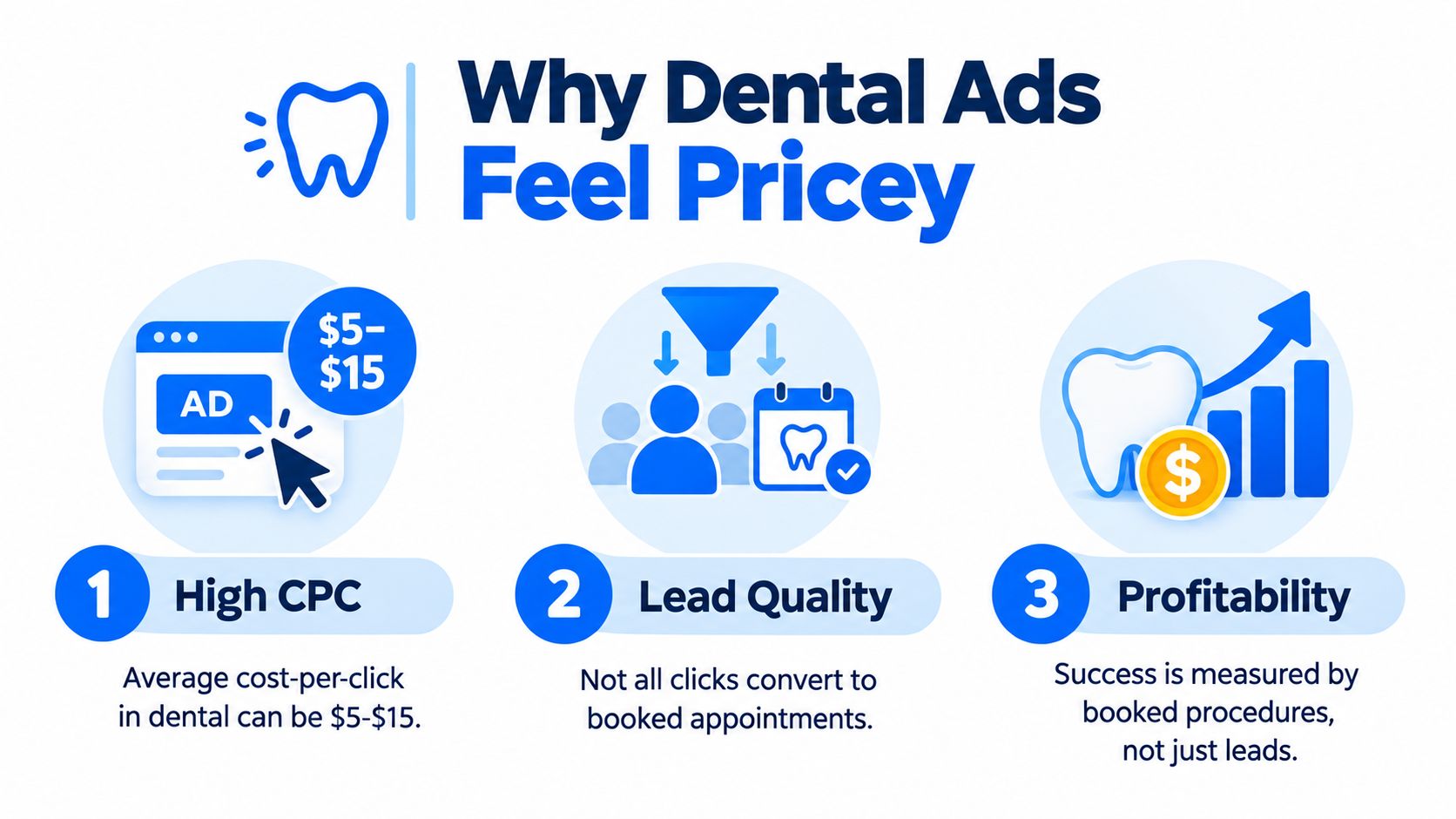
A lot of practices still judge Meta on CPC alone, then pull the plug before the front desk has a chance to work the lead. That's the wrong lens. Dental campaigns live or die on offer strength, creative quality, funnel friction, and speed-to-lead, not on whether the click looked cheap on paper.
If your clinic can turn expensive clicks into new-patient visits, the numbers can still work. If the team waits too long, uses vague offers, or sends traffic to a weak landing page, even a decent CPL turns into wasted spend. The right question is simple, how many leads become booked chairs?
Why Facebook Ads Feel Expensive for Dentists and How to Make Them Profitable
Dental sits at the expensive end of Meta's local-service auctions. That is why the earlier benchmark matters, and why this category demands sharper creative and cleaner operations than many others. The upside is in the same data set: dentists and dental services still showed a 6.38% conversion rate, so attention is available. The main challenge is turning that attention into actual patient intent.
I judge these campaigns on booked appointments, not cheap form fills. I have seen practices chase a lower CPC, then celebrate leads that never answer, never confirm, and never show. That kind of reporting flatters the dashboard and hurts the schedule.
Practical rule: A cheap lead that never books is still expensive.
A 2026 dental marketing summary says 40% of dental practices use Facebook Ads for local lead generation, and 25% report ROI within three months (Zipdo dental marketing statistics). That does not make the platform easy. It means the gap between average and profitable comes down to execution. The practices that win usually pair Meta with the right search channel timing, which is why how Meta compares with Google Ads for local intent is useful context for dentists deciding where each dollar should go.
The working equation is simple. Offer gets the click. Creative earns trust. Funnel filters and captures intent. Speed-to-lead turns that intent into a booking. When one piece slips, the economics fall apart fast.
Dental campaigns turn profitable only when offer strength, creative quality, funnel friction, and speed-to-lead all hold together. If the offer is vague, the ad looks generic, the landing page leaks, or the front desk waits too long, even a strong lead cost turns into wasted spend. That is why the question is not whether Facebook is cheap. The question is how many clicks become booked chairs.
Choosing Offers and Audiences That Fill Chairs
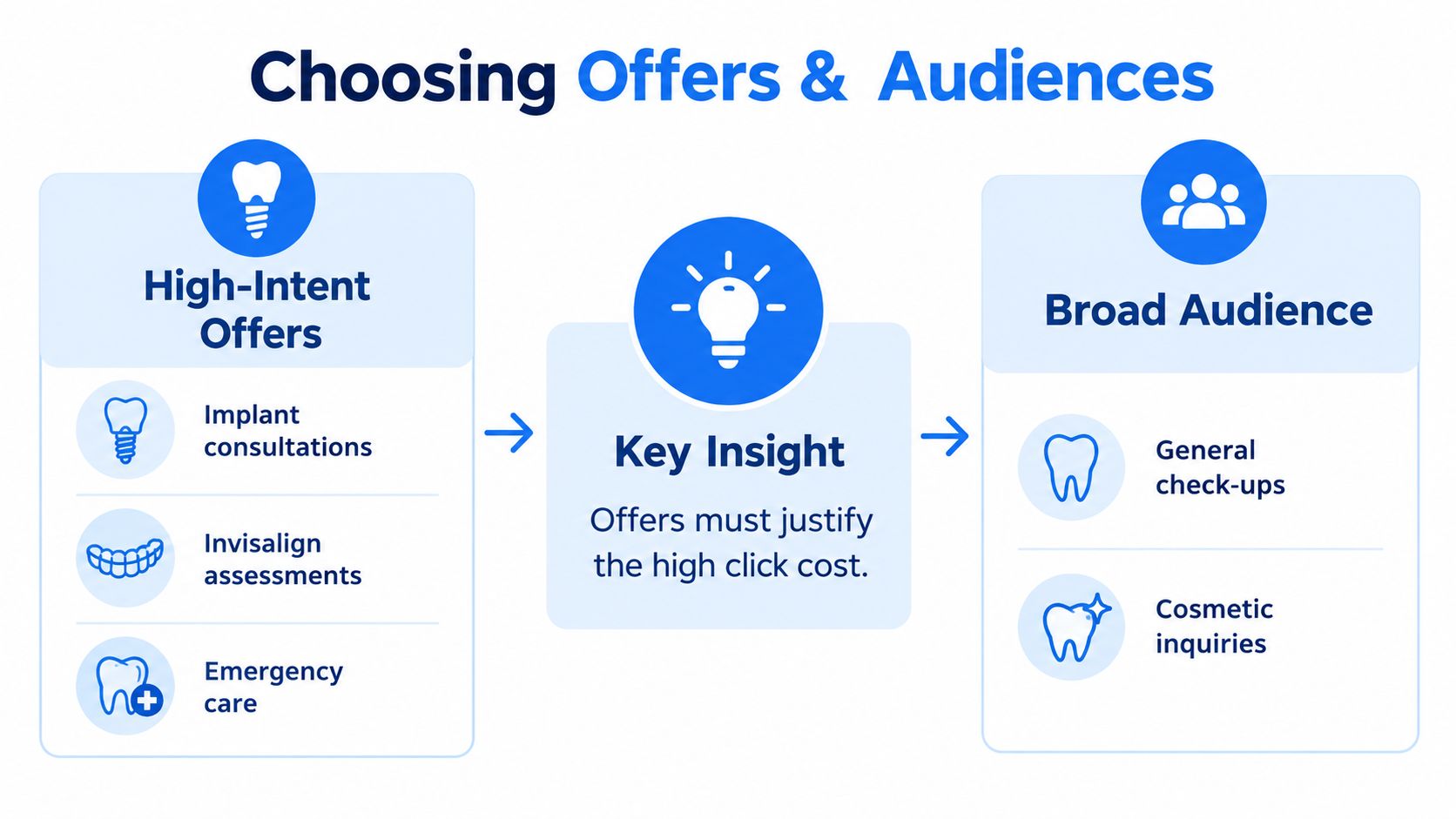
The offer has to justify the click cost, or the rest of the campaign is dead on arrival. Generic “new patient welcome” messaging rarely moves someone who's scrolling past a dozen other ads. High-intent offers do better because they give the prospect a specific reason to act now.
For most dental practices, the strongest offers are tied to a clear outcome or a clear next step. Implant consultations, Invisalign assessments, emergency appointments, and new-patient specials give people a decision they can make without needing to decode the ad. A vague cleaning promotion can still work, but only when the practice is targeting a broad, price-sensitive audience and can handle lower-intent volume.
Match the offer to the market
Urban practices usually need sharper positioning because competition is dense and people have more options. Suburban practices often benefit from broader radius targeting and a cleaner new-patient offer, especially when the office is known for convenience. In both cases, the offer should feel local, specific, and easy to understand in one glance.
Offers don't need to be flashy. They need to be believable and easy to book.
Audience choice is simpler than many assume. Geo-target around the practice first, then use creative to self-select the right prospect. Health-interest targeting is limited enough that broad audiences with strong messaging often outperform over-filtered ad sets. Lookalikes from patient lists can help once you have enough quality data, and exclusions matter when you're trying to avoid existing patients or employees.
A simple decision rule works well:
- High-intent services: Use a tighter audience, stronger urgency, and a consult-driven offer.
- General dentistry: Use a broader local radius and a straightforward new-patient or hygiene-oriented offer.
- Cosmetic services: Pair education with a clear next step, since people usually need more reassurance before they book.
One tactic gets used constantly and underperforms: blasting one ad to everyone in town with no service distinction. Separate campaigns by service line, keep the message aligned to the offer, and let the market tell you which segment is ready.
Creating Ad Creatives and Copy That Earn Trust Locally
Dental creative has to do two things fast. It has to stop the scroll, and it has to lower fear. People don't book a dentist because they're excited about ads. They book because something feels clear, safe, and worth the trip.
A friendly team video usually beats polished agency graphics because it feels like a real office, not an ad template. Dentist-led clips work especially well when they explain what a first visit looks like, who the service helps, or why the office makes the process easier. Face-led creative beats sterile tooth close-ups because people trust people.
A social media strategy for dentists often overlaps with paid media. The same authenticity that helps organic content also helps paid ads, especially when the audience is nervous, comparing offices, or hearing about a treatment for the first time.
What to show and what to say
Keep the visuals simple. Use the office, the team, a patient consultation setting, or a community-facing scene. If you use before-and-after content anywhere, make sure it fits your compliance rules, because many dental accounts get into trouble by trying to push results too hard.
Copy should sound like a local practice, not a national brand. Good patterns include:
- Clear outcome plus low-friction next step: “Book a consultation to discuss clearer, straighter teeth.”
- Price clarity where allowed: “Ask about our new-patient visit options.”
- Trust cue plus local relevance: “Meet the team that makes first visits feel straightforward.”
- Educational angle: “Learn whether implants, aligners, or whitening fits your goals.”
The best hooks are short and concrete. “Thinking about clear aligners?” works better than “Transform your smile.” “Need help with tooth pain?” beats a general “We care about your oral health.” The reason is simple. Specific hooks tell the right person to keep reading and tell everyone else to scroll past.
Dental ads don't need to look dramatic. They need to look believable enough that a hesitant patient will click.
Testing should stay structured. Run one concept at a time, change one variable at a time, and get owner approval before anything goes live. That keeps the practice from burning budget on creative nobody signed off on and gives you cleaner data on what earns trust.
Building a Funnel That Turns Clicks Into Verified Leads
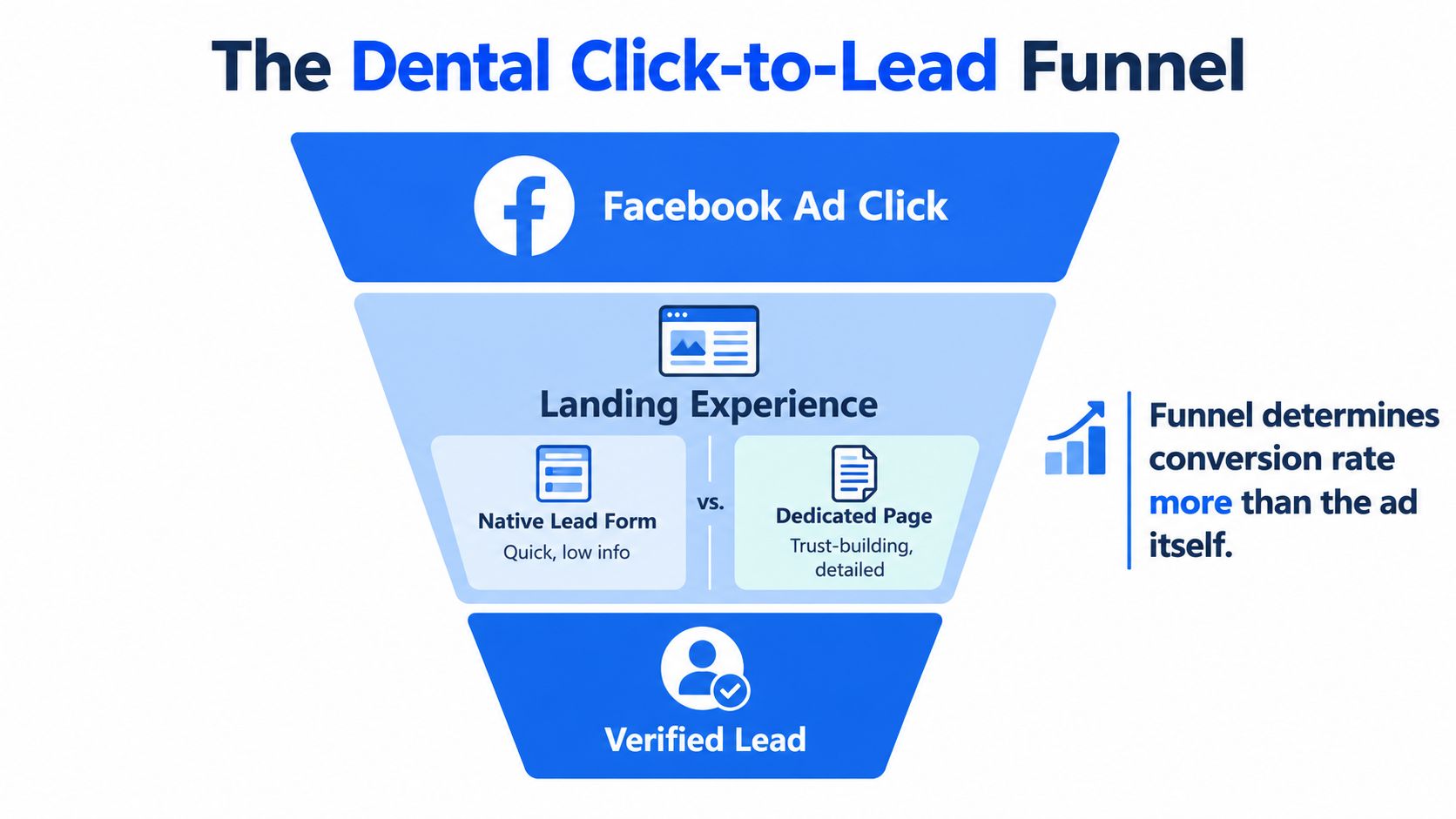
The funnel matters more than the ad because a strong click can still disappear in a weak handoff. That's why many dentists do better with a focused landing experience than with a homepage link. The ad starts the conversation, but the page has to finish the persuasion.
A lot of practices use native lead forms because they're low-friction and easy to launch. Others do better with a dedicated landing page because it gives them room to explain the offer, reduce anxiety, and filter out low-intent submissions. The right answer depends on how fast the office can respond and how much qualification it needs before booking.
Keep the page focused
A dental landing page should do a few things well, not everything badly. It should repeat the offer, explain who it's for, show the practice clearly, and make the form easy to finish. If the page feels like a brochure, it's too slow. If it feels like a trap, it's too aggressive.
The main trade-off is friction versus quality. Native forms capture more people because they're fast. Dedicated pages usually filter better because the prospect has to engage more before submitting. That's why the page choice should match the service and the front desk capacity, not just the media buyer's preference.
Use the thank-you page for the next action, not just a dead end. Confirmation, booking instructions, and a clear expectation for callback timing all help. Retargeting should then catch visitors who left before converting, especially those who spent time on the service page or started a form and abandoned it.
A practical tool many local service advertisers use is benjiads, which automates ad setup, landing flows, tracking, and lead follow-up for local businesses, including dental practices. That kind of setup matters when the gap between a click and a booking is where most of the money is won or lost.
Following Up Fast and Tracking What Actually Books
The fastest lead often wins the patient. If the office waits, the prospect has already moved on, called another practice, or decided to deal with the issue later. Dental lead handling lives or dies on response speed and clean attribution.
The workflow should start the moment the form is submitted. An instant SMS should confirm the request, set expectations, and ask a simple qualifying question. The front desk then calls and texts as soon as possible, not when the lead is cold. Many campaigns fail even when the ads are fine.
A useful operating rule is covered in speed-to-lead guidance for local businesses. The principle is simple, the office that responds first usually gets the conversation.
Track the path from click to booking
If you can't connect ad spend to booked appointments, you're flying blind. Meta can show clicks and leads, but the practice still needs a clean chain from source to CRM to booked visit to revenue. That usually means recording the original campaign, logging the lead in the CRM, and matching it back to the appointment outcome.
Watch these outcomes separately:
- Lead submission: the ad got attention.
- Verified lead: the office confirmed real intent.
- Booked appointment: the lead turned into chair time.
- Revenue attributed: the booking led to actual production.
That split matters because a campaign can look fine at the click level and still fail at the booking level. One creative may produce more leads, while another produces fewer but better ones. Without tracking both, the practice can't tell the difference.
If you only report lead count, you reward the wrong behavior.
A simple SMS sequence, a disciplined call cadence, and source-level tracking will tell you more than a vanity dashboard ever will. The goal isn't to prove that people clicked. The goal is to prove that people showed up and paid for care.
Your Launch Checklist and Next Steps to Keep Costs Down
Start with one service line, one offer, and one clear booking path. Don't launch five campaigns and hope the market sorts it out. Choose the case type the practice wants most, write one direct offer around it, and make sure the front desk can answer quickly.
Before spending heavily, check four things. The creative has to look local and trustworthy. The landing experience has to make it easy to inquire. The SMS and call follow-up have to happen fast. The reporting has to show booked appointments, not just leads.
A clean first-month checklist looks like this:
- Offer: Use one specific reason to click, not a generic brand message.
- Creative: Favor real people, office visuals, and plain-language hooks.
- Funnel: Send traffic to a page or form that fits the service and the team's capacity.
- Follow-up: Make sure someone is reaching out within minutes, not hours.
- Review cadence: Check which ad set drives verified leads and bookings, then cut the rest.
The practices that win with facebook ads for dentists usually do the boring things well. They answer quickly, they keep the message specific, and they don't confuse clicks with revenue. That's how a pricey platform can still produce profitable patient acquisition.
If you want this built without the usual trial-and-error, benjiads can handle the ad setup, landing flow, tracking, and SMS follow-up for local practices in one system. Visit benjiads to see how it fits a dental campaign that's designed to book patients, not just collect leads.
- facebook ads for dentists
- dental facebook advertising
- dentist lead generation
- dental marketing funnel
- local dental ads

NEW PATIENT APPOINTMENTS
New patient appointments
Text about your visit
Ads created · live on FB & IG
For dentists
Your dentist ads, live in 2 minutes.
- ✓ Ads created for you
- ✓ Every lead texts your phone
- ✓ 3 days free · $29.90/mo
748+ local businesses run ads with benjiads