ad management software 15 min read
Ad Management Software: A Practical Buyer's Guide
Compare ad management software features, pricing, and tradeoffs. Learn how automation stacks up against agencies and what local service businesses should
On this page
- What Ad Management Software Actually Does
- Software, Agency, or Hybrid Buying Models
- Automation vs Agency Tradeoffs Compared
- Trade-Specific Needs and Matchups
- Pricing Structures and Real Cost Per Lead
- Selection Checklist for Buyers
- When Software Wins and When an Agency Wins
- Decision Summary and Questions to Ask Vendors
You're probably looking at a pile of leads, a sluggish CRM, and a nagging question, why are clicks happening while booked jobs aren't? That gap is where ad management software either earns its keep or becomes another dashboard nobody opens. The right setup doesn't just launch ads, it helps you capture the lead, respond fast, and push that person toward a booked job before the opportunity goes cold.
Software
- Who Runs Campaigns
- Your team or owner-operator
- Typical Monthly Cost
- Flat tool fee plus ad spend
- Best Fit
- Operators who want direct control and quick changes
Agency
- Who Runs Campaigns
- A third party
- Typical Monthly Cost
- Retainer plus media spend
- Best Fit
- Shops that want hands-off execution and strategy
Hybrid
- Who Runs Campaigns
- Software plus a strategist
- Typical Monthly Cost
- Smaller retainer plus tool fees
- Best Fit
- Teams that want control without doing everything themselves
The market is large enough that this isn't a niche decision anymore. Ad management software has been estimated at USD 35.58 billion in 2025 and forecast to reach USD 88.08 billion by 2034, with a 10.6% compound annual growth rate, and Europe is cited at 27% of the market in the same source, which shows the category is broad, not narrow (Fortune Business Insights). That scale matters because the buyer isn't choosing whether software exists, the buyer is choosing how much control to keep over media, tracking, and follow-up.
The bigger mistake is shopping for dashboard polish instead of post-click reliability. If your leads hit voicemail, sit in a generic inbox, or die before anyone calls back, a beautiful interface won't save you.
What Ad Management Software Actually Does
Ad management software is the stack that helps you build campaigns, buy media, rotate creative, target audiences, pace budgets, and report results across places like Google, Meta, and local channels. In plain English, it's the system that keeps your paid traffic from becoming a mess of disconnected tabs and half-tracked conversions. The best platforms also help with the boring but critical part, moving a lead from click to contact to booked job.
The daily jobs it has to handle
A useful platform does more than “manage ads.” It supports the operator's day-to-day work: campaign setup, bid changes, geo targeting, creative swaps, conversion tracking, and budget controls. For local operators, the key question is whether the system can also connect the ad click to a real lead in the CRM and then to a booked appointment, because most platforms stop at the form fill.
Practical rule: if a tool only tells you who filled out a form, it's incomplete for service businesses. You need to know who answered, who got called back, and who booked.
That's why the post-click pipeline matters more than most feature pages admit. A campaign can look strong in-platform and still fail in practice if the lead lands too late or goes to the wrong person. The operator's job is to compare tools on lead capture quality, response speed, CRM integration, and reporting that ties spend to outcomes, not just clicks.
For local lead gen workflows, this is the category to study alongside local lead generation software. The overlap is obvious, but the buying decision is different. Lead-gen software is about getting a response, ad management software is about controlling the media that created the response in the first place.
Where the gap usually shows up
Most tools can launch. Fewer can close the loop cleanly. If you're running home services, cleaning, automotive, or appointment-based offers, the gap between a click and a booked job is where money gets lost.
That's why the strongest systems don't just surface spend and CTR. They make it easier to answer simple operational questions, like whether a lead was contacted fast enough, whether the form data reached the CRM, and whether the campaign should keep spending after hours. If the platform can't support that workflow, the feature list is noise.
Software, Agency, or Hybrid Buying Models
The market usually breaks into three lanes. Software-only means your team runs the campaigns inside a platform with little outside help. Agencies do the strategy, buildout, and optimization for you. Hybrids sit in the middle, where software handles the repetitive work and a human strategist steps in for judgment calls.
Software only
This model fits operators who want direct access and fast edits. You or your internal staff touch the account, write the copy, adjust bids, and inspect reports. The upside is control. The downside is that the buyer owns the process, which means the buyer also owns every mistake.
Agency led
An agency adds a layer between you and the ad accounts. That can be useful when you're overloaded, when multiple channels are involved, or when the offers are complex enough that creative strategy matters more than manual bid tweaks. The tradeoff is slower iteration, because every change now passes through another person and another queue.
Hybrid
Hybrid setups are popular for a reason. They let software do the launch, tracking, and pacing while a strategist helps with campaign logic, audits, and creative direction. That works best when the operator wants oversight without becoming the full-time media buyer.
A good hybrid should reduce friction, not add another layer of confusion. If you still have to chase reports and approvals in three places, you've bought complexity, not leverage.
The following models are the ones most local operators end up choosing between when they compare tools, retainers, and in-house effort. The cost is only part of it. The bigger question is who's responsible when leads slow down.
Software only
- Who Runs Campaigns
- Internal team or owner
- Typical Monthly Cost
- Tool fee plus ad spend
- Best Fit
- Hands-on operators
Agency
- Who Runs Campaigns
- Outside specialist team
- Typical Monthly Cost
- Retainer plus ad spend
- Best Fit
- Time-starved businesses
Hybrid
- Who Runs Campaigns
- Tool plus consultant or strategist
- Typical Monthly Cost
- Smaller retainer plus software
- Best Fit
- Mid-size teams needing support
For teams evaluating automation alongside agency support, the operational fit is often clearer after looking at an automated marketing platform in the context of their own workflow. If you already have someone to manage leads and approvals, software can be enough. If nobody owns follow-up, even a good platform won't fix that.
Automation vs Agency Tradeoffs Compared
Automation wins on direct control. An agency wins on delegated execution. That sounds simple until you compare the actual tradeoffs side by side, because the best choice depends on where the bottleneck sits in your business.
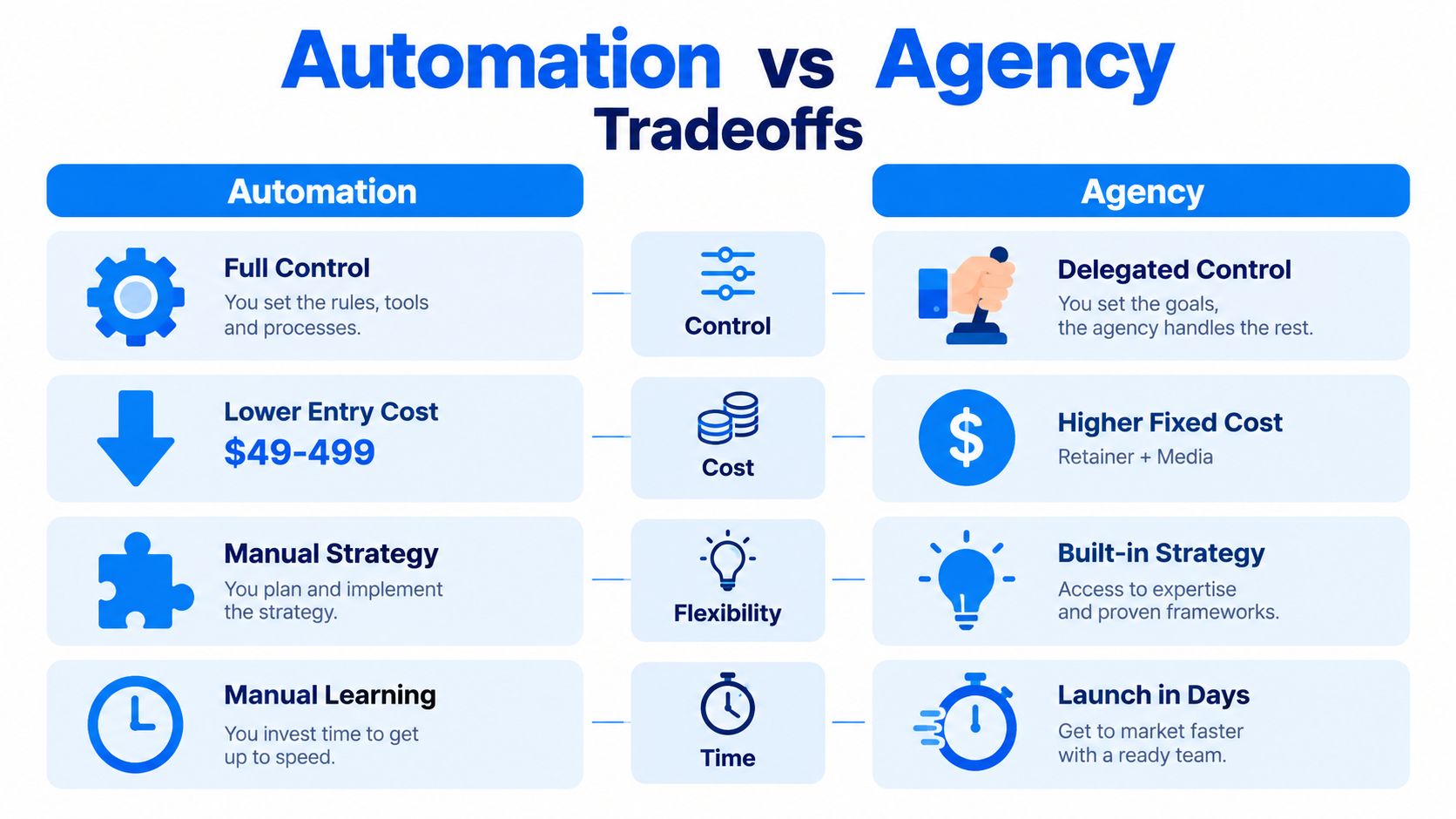
Cost, control, and speed-to-lead
Automation is usually a fixed tool cost plus ad spend. That makes budgeting easier and gives you direct access to the account. Agency pricing usually stacks a retainer on top of media, which means your cost base is higher but the execution burden drops.
The control difference is just as important. With software, you can change copy, budgets, and audiences fast. With an agency, those changes depend on the agency's workflow, which can slow creative swaps and budget shifts when the market moves. That lag is acceptable if your offer is complex, but it's expensive if your business depends on same-day response.
Speed-to-lead is where many people misread the problem. Software doesn't magically make leads faster, your process does. Agencies sometimes bundle call tracking, lead qualification, and follow-up workflow, which can help compress time-to-call, but the system only works if the team answers and routes leads well.
Reporting fidelity matters more than pretty charts
The cleanest software exposes raw data and lets you decide what matters. Agencies often interpret the data for you, which is helpful if you trust them and hate wrangling spreadsheets. It's also slower, because every interpretation step takes time and someone else owns the narrative.
That's why the right answer depends on the business model. Automation wins for repeatable offers, high lead volume, and tight margins. Agencies win when the offer is complex, the seasonality is messy, or the owner can't keep up with creative and follow-up. Hybrids exist because many shops need both direct control and human judgment.
The independent ranking criteria used across the market reflect this reality, because the most useful tools are judged less on raw feature breadth and more on reporting quality, traceability, ease, and value (WorldMetrics). That's the right lens. If a platform can't explain what happened to the lead, the rest is decoration.
This is also where automated marketing platform thinking becomes practical. Automation only helps if it shortens the path from click to contact. If it doesn't, you've bought speed inside the ad account while the rest of the business stays slow.
Trade-Specific Needs and Matchups
Generic comparisons fail because each trade stresses a different part of the stack. A roofing company, a cleaning business, a dental practice, and an event vendor don't need the same thing from ad software. They all buy traffic, but they lose money in different places.
Home services and emergency work
Home services need 24/7 call tracking, missed-call text-back, and time-of-day bidding that can react when the phone stops ringing during the day or spikes at night. Emergency offers also need fast budget shifts and tight keyword control. If the software doesn't help with call routing and after-hours response, it's missing the point.
Cleaning, lawn care, automotive, health, and events
Cleaning and lawn care care more about lead quality and scheduling than about raw click volume. They need form-to-CRM handoff, property details, and route-friendly intake. Automotive shops usually need click-to-call paths and service-specific landing pages, while health and wellness businesses need careful form handling, consent language, and clean exclusions on sensitive retargeting.
Event-driven businesses are different again. They live or die by booking windows and inventory dates, so the tool needs to respect seasonal budget swings and availability. A campaign that keeps spending after the calendar is full is just wasting money.
Home services
- Primary Lead Type
- Calls and urgent forms
- Critical Ad Features
- Call tracking, missed-call text-back, time-of-day bidding
- Nice-to-Have Integrations
- CRM, answering service
Cleaning and lawn care
- Primary Lead Type
- Forms and quotes
- Critical Ad Features
- Form-CRM sync, geo targeting, budget pacing
- Nice-to-Have Integrations
- Scheduling, route planning
Automotive
- Primary Lead Type
- Calls and service requests
- Critical Ad Features
- Click-to-call, landing pages, device targeting
- Nice-to-Have Integrations
- Booking system, shop CRM
Health and wellness
- Primary Lead Type
- Forms and consultations
- Critical Ad Features
- Consent handling, audience suppression, clean lead routing
- Nice-to-Have Integrations
- Intake forms, scheduling
Events
- Primary Lead Type
- Bookings and date-based inquiries
- Critical Ad Features
- Seasonal budget control, availability targeting, campaign pauses
- Nice-to-Have Integrations
- Calendar, inventory system
A recent industry comparison argues that platform selection should be judged on budget minimums, walled-garden access, CTV and display strength, and measurement complexity, which is exactly why trade fit matters more than generic feature lists (admanage.ai). That's the part buyers should internalize. A platform can be excellent in one vertical and clumsy in another.
The same logic applies to smaller operators who are mainly chasing niche creative insight. Some small-business guidance points out that competitor research is still weak in native ad libraries, which is why the question “what ads are working in my niche?” remains poorly answered for local advertisers (adlibrary.com). That gap matters most when you're spending cautiously and every bad creative cycle hurts.
Pricing Structures and Real Cost Per Lead
Software and agencies charge on different axes, and mixing them up leads to bad decisions. Software usually looks cheap up front because it's a flat fee, but the hidden cost is your time. Agencies look expensive because the retainer is visible, but they may bundle the labor you'd otherwise have to do yourself.
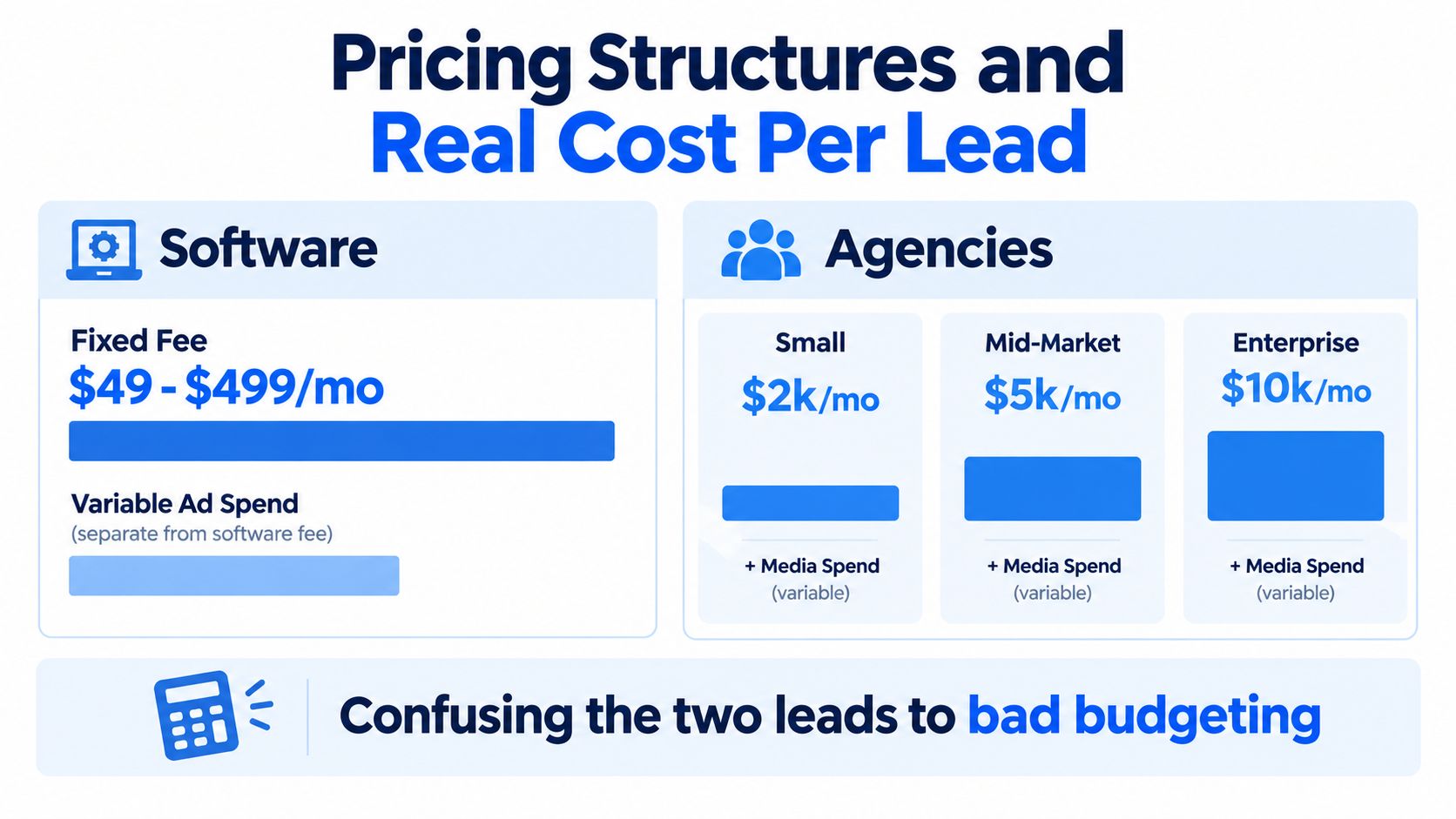
What to count
The clean budget includes ad spend, management fees, call tracking, CRM seats, and your own time. For SMB software, flat monthly fees often sit in a modest range, while agencies usually add a management percentage or a monthly minimum. The exact numbers vary by vendor, but the structure doesn't.
Budgeting rule: stop asking what the platform costs and start asking what one qualified lead costs after tracking, follow-up, and labor.
If you track phone-verified leads, the math gets easier. At a $7 cost per phone-verified lead and a 30% close rate, every booked job costs roughly $23 in media before overhead, which is the number that should guide your budget, not platform vanity metrics. That's a much better benchmark for service work than looking at clicks alone.
For support costs, call tracking can add another line item, and CRM seats usually do too. None of that is exotic, but buyers forget it when they compare a flat software fee to a retainer that appears to “include everything.” The key question is which structure gets you to booked jobs with less waste.
If you're evaluating lead tracking seriously, it helps to understand how attribution and call paths work in a proper ad tracking software setup. Otherwise, you'll keep undercounting the leads that did turn into revenue. And once that happens, every pricing comparison is distorted.
Selection Checklist for Buyers
Don't sit through demos and let the vendor drive. Score the platform against the capabilities that matter to a local business, then compare two or three options on the same sheet. If a vendor can't answer these clearly, move on.
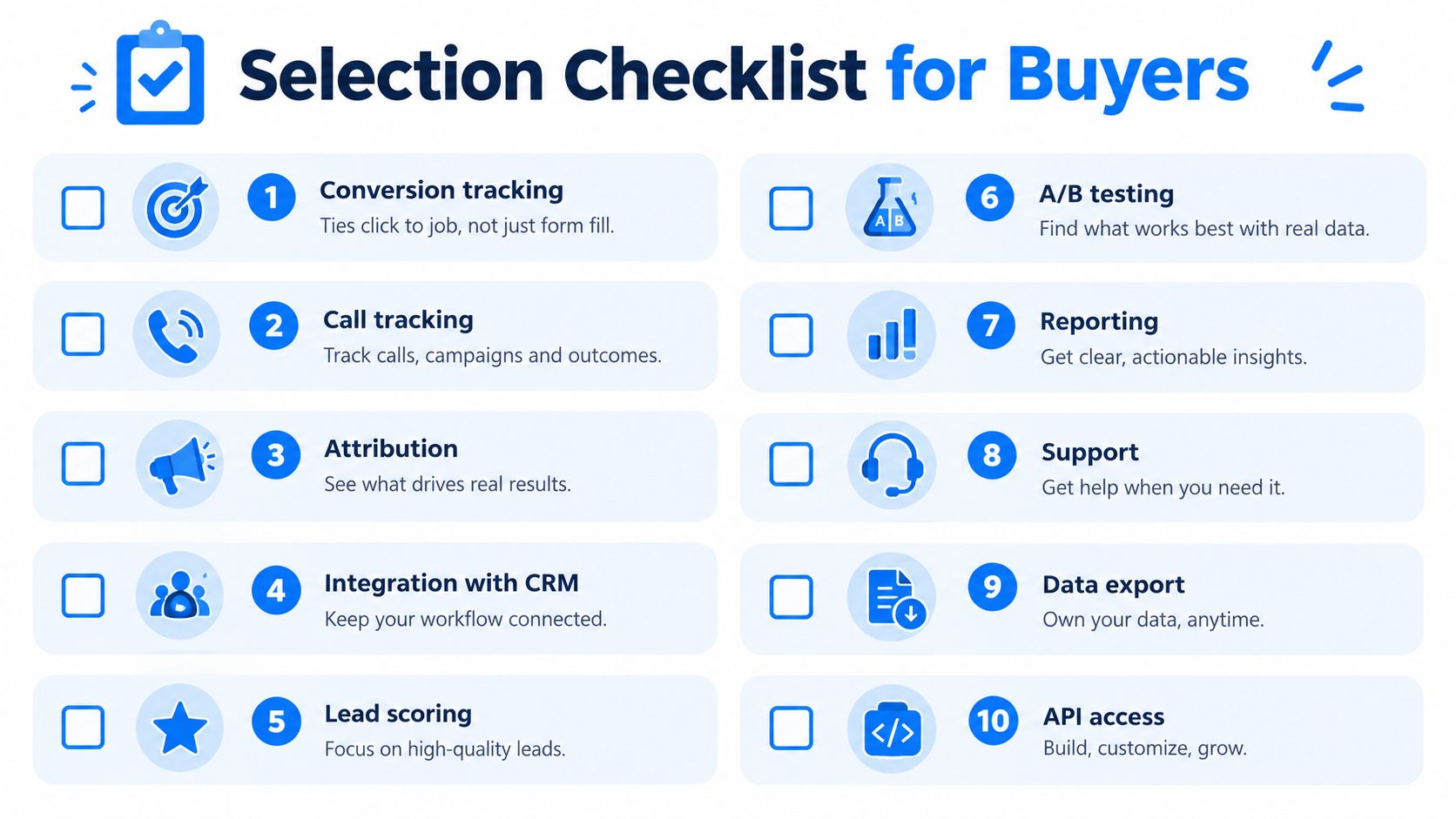
What to score
- Conversion tracking: Does it tie ad click to booked job, not just form fill?
- Call tracking: Can it record, transcribe, and attribute calls?
- Bid controls: Can it adjust bids by time of day and device?
- Lead handoff: Does it send form data into the CRM without manual work?
- Suppression: Can it exclude existing customers or past leads?
- Approvals: Is there a workflow for ad copy and budget changes?
- Support SLA: Is support response time documented?
What to ask about the plumbing underneath
- Native integrations: Does it connect directly, or does it rely on Zapier-style workarounds?
- Data ownership: Can you export raw data if you leave?
- Reporting depth: Does the report show revenue, or only clicks and spend?
- Speed-to-lead: What automation exists for immediate follow-up?
For service businesses, give extra weight to response speed. A five-minute delay can turn a warm lead cold, and no dashboard can compensate for that. If the system doesn't help you answer and route leads quickly, it's not solving the core issue.
When Software Wins and When an Agency Wins
Software wins when the business is small, the offer is repeatable, and the owner wants direct control. If you're a solo operator or a small crew with a working CRM, you can usually manage campaigns yourself and react the same day when lead flow changes. That's especially true when the main bottleneck is bid discipline and lead routing, not creative complexity.
Where agencies pull ahead
Agencies make more sense when the business has multiple service lines, seasonal swings, or a team that can't keep up with creative production and account maintenance. They're also more defensible when the buyer wants someone else to manage landing pages, call routing, and reporting interpretation. The fee is higher, but so is the chance that the work gets done.
Where hybrids are the honest answer
Hybrids fit the messy middle. A software layer handles bidding and reporting, while a strategist or agency handles audits, copy refreshes, and offer testing. That's usually the right fit for businesses that aren't big enough to need a full retainer, but aren't simple enough to run on autopilot either.
| Business Profile | Best Fit | Why It Wins |
|---|---|---|
| Solo operator with one main offer | Software | Fast control, lower overhead, simple workflow |
| Small crew with a working CRM | Software or hybrid | Enough structure to self-manage, but support helps |
| Multi-location service business | Hybrid | Needs speed and consistency without full in-house staffing |
| Complex or seasonal business | Agency | Creative and pacing need active management |
| Time-strapped owner with no marketing staff | Agency | Delegation matters more than direct control |
A separate local-marketing view also makes the post-click point clearly, because response speed and follow-up often matter more than incremental changes in CPC or CTR (LeadsOrbit). That's the rule I'd use. If your bottleneck is speed-to-lead and bid discipline, choose software. If your bottleneck is creative production and offer testing, choose an agency.
Decision Summary and Questions to Ask Vendors
The best vendor conversation is a disqualifier, not a sales pitch. Ask the questions that expose ownership, attribution, and workflow before you sign anything. If the answers are vague, the relationship will be vague too.
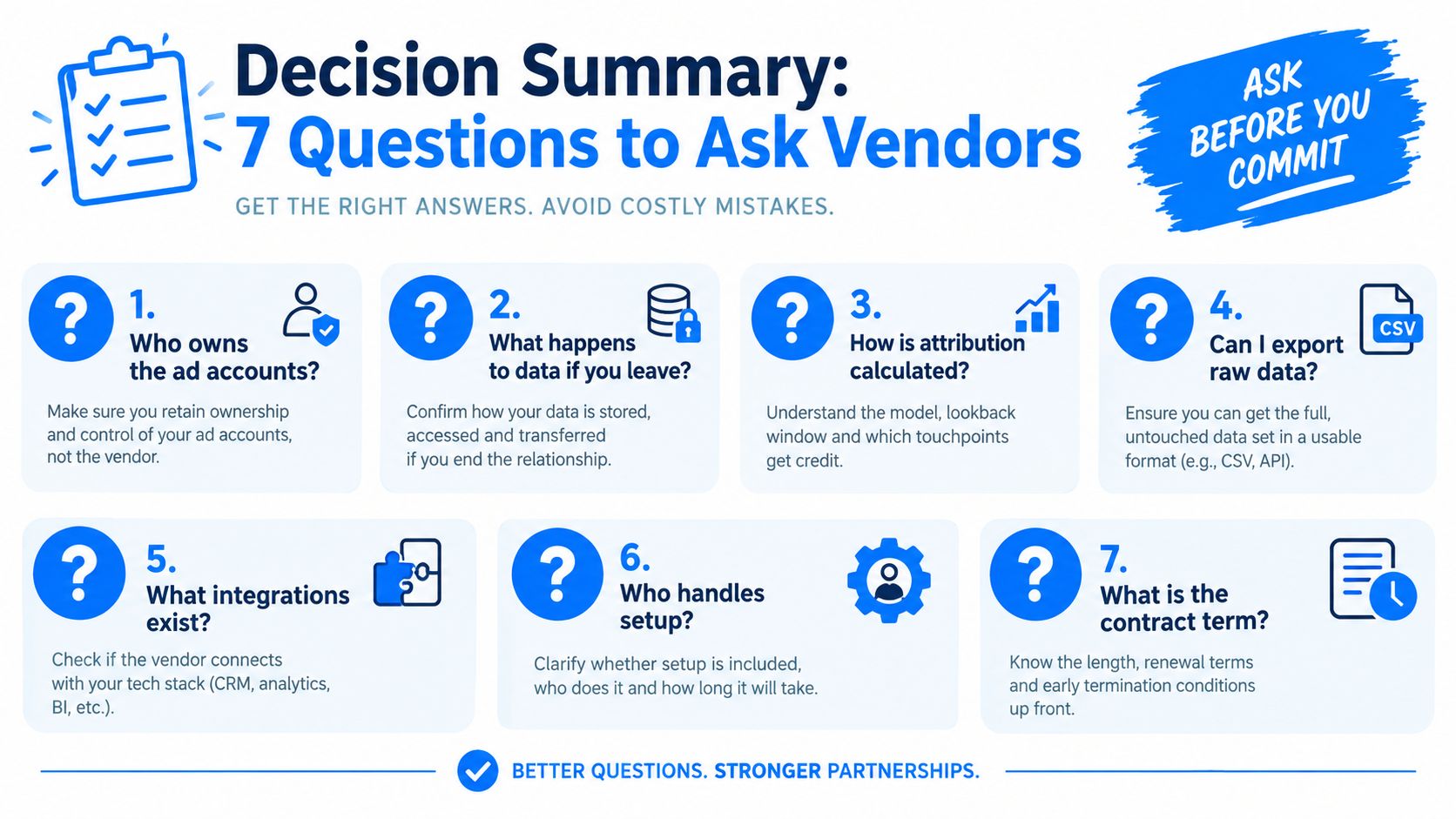
Seven disqualifying questions
- Who owns the ad accounts?
- What happens to data if you leave?
- How is attribution calculated?
- Can I export raw data?
- What integrations exist?
- Who handles setup?
- What is the contract term?
Four scoping questions
- Minimum commitment: What's the shortest term that still makes sense?
- Kill clauses: How do I exit if performance stalls?
- Onboarding timeline: How long until campaigns are live?
- CPL expectations: What's realistic for my trade?
The whole decision comes back to the same thing, the post-click pipeline. The cheapest software and the priciest agency both fail if the lead lands in voicemail or sits in a slow form flow. Score vendors on response time and booked-job tracking before you score them on dashboard polish.
BenjiAds builds and manages paid advertising and lead follow-up for local service businesses, with campaign setup, tracking, landing funnels, and SMS-based response built into the workflow. If you want a system that keeps the focus on leads, speed, and booked jobs instead of busywork, visit benjiads and see how it fits your operation.
- ad management software
- ad automation
- campaign management
- agency vs software
- local service ads
Done for you
Ads that text you customers.
- ✓ Ads created for you
- ✓ Every lead texts your phone
- ✓ Free to use, no credit card
748+ local businesses run ads with benjiads