Source: https://benjiads.com/blog/squirrel-netting-for-fruit-trees
Publisher: benjiads, https://benjiads.com
Published: 2026-10-06
Updated: 2026-10-06
Cite as: benjiads, "Squirrel Netting for Fruit Trees: A Complete Guide", benjiads.com/blog/squirrel-netting-for-fruit-trees
Reuse: you may quote this article with attribution and a link to the source.
# Squirrel Netting for Fruit Trees: A Complete Guide
Learn how to install squirrel netting for fruit trees and keep your harvest safe from pests. Discover tips, materials, and best practices for effective
You've covered the tree, tied the net around the trunk, and still find half-eaten fruit on the ground the next morning. The problem may not be your timing or your tree. It may be that the material you bought is **bird netting**, while the barrier you need is a complete squirrel-exclusion system.
Squirrels don't approach fruit trees from one direction. They climb trunks, run along fences, launch from branches, and drop in from roofs. Effective **squirrel netting for fruit trees** therefore depends on more than mesh. The mesh must be suitable, the canopy needs support, the lower edge must be sealed, and nearby launch points need attention.
## Table of Contents
- [Why Squirrels Outsmart Standard Bird Netting](#why-squirrels-outsmart-standard-bird-netting)
- [The barrier has to block two routes](#the-barrier-has-to-block-two-routes)
- [Choosing the Right Mesh and Support System](#choosing-the-right-mesh-and-support-system)
- [Match the structure to the tree](#match-the-structure-to-the-tree)
- [Building a Supported Enclosure That Stays Secure](#building-a-supported-enclosure-that-stays-secure)
- [Build from the top down](#build-from-the-top-down)
- [Eliminating Access Routes Before Netting](#eliminating-access-routes-before-netting)
- [Use layers when the tree is isolated](#use-layers-when-the-tree-is-isolated)
- [Daily Inspection and Seasonal Maintenance Routines](#daily-inspection-and-seasonal-maintenance-routines)
- [Use a short repeatable checklist](#use-a-short-repeatable-checklist)
- [Deciding Between Netting, Trunk Guards, and Cluster Bags](#deciding-between-netting-trunk-guards-and-cluster-bags)
## Why Squirrels Outsmart Standard Bird Netting
Late in the season, a loosely covered tree can look protected from the ground. The net is visible, the fruit is inside, and the edges appear tied. Then a squirrel finds the weak point. It pushes where the mesh rests against a peach, chews a thin strand, or slips beneath an opening around the trunk. Once inside, it can feed without much difficulty.
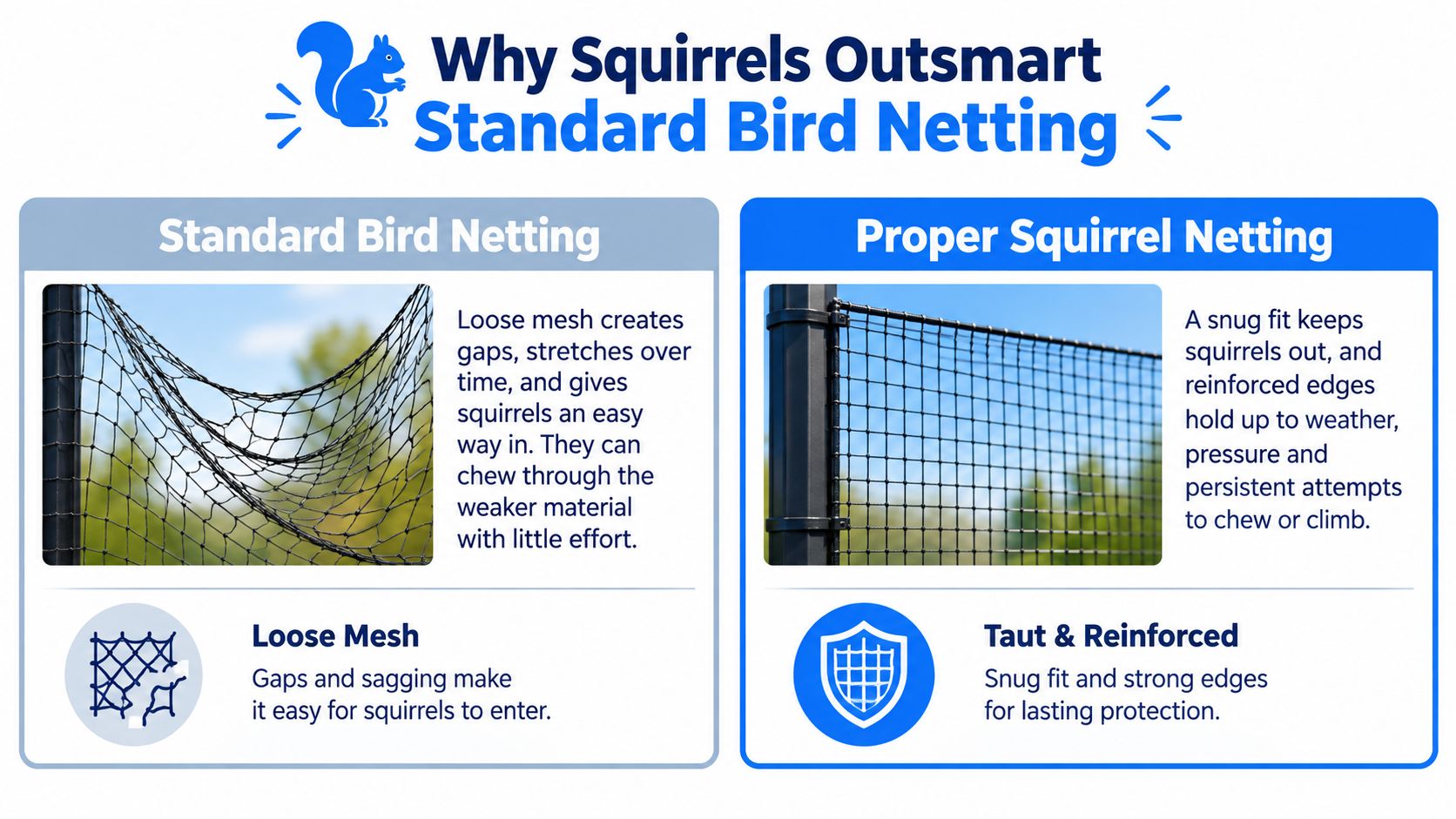
The common mistake is treating every garden net as the same product. Standard bird netting is often designed to discourage birds from reaching fruit, not to withstand a determined climbing mammal. Under pressure, lightweight mesh can stretch, sag, or tear. If ripening fruit presses against it, the squirrel may be able to reach the fruit through the mesh or chew directly through the material. Guidance from University of Wisconsin Extension on tree-squirrel exclusion makes the broader point clearly: whole-tree netting can work, but it's difficult, and squirrels can exploit nearby trees, buildings, and utility lines.
### The barrier has to block two routes
A canopy cover only handles access from above. A squirrel can still climb the trunk, enter from below, or jump from a nearby structure. The [University of Nebraska review of exclusionary wildlife-management methods](https://digitalcommons.unl.edu/cgi/viewcontent.cgi?article=1058&context=vpc14) describes the underlying approach as mechanical exclusion, using barriers such as metal flashing and related shields to prevent animals from climbing mature trees and reaching valuable plant material.
That gives you a useful design test:
- **Can the squirrel reach the canopy from the ground?** If so, add a trunk skirt, baffle, or other climbing barrier.
- **Can it jump into the net from above or beside the tree?** Prune or remove the route.
- **Can it push underneath the net?** Anchor the perimeter continuously.
- **Can the material touch fruit?** Add a frame or poles to create space.
| Feature | Standard Bird Netting | Squirrel-Resistant Netting |
|---|---|---|
| Primary purpose | Discourages birds from reaching fruit | Creates a sealed physical barrier |
| Mesh behavior | May stretch or sag under contact | Should remain taut and durable |
| Canopy contact | Often draped directly over branches | Supported away from fruit |
| Lower edge | Frequently tied at a few points | Gathered or anchored around the full perimeter |
| Access control | Focuses on the canopy | Blocks climbing, jumping, pushing, and chewing routes |
Netting is also seasonal rather than a repellent. Install it after pollination while fruit is still small and unripe, before squirrels establish a feeding pattern. For many trees, practical horticultural guidance places that period around the post-thinning stage in **May or June**, as described in the Nebraska review above.
## Choosing the Right Mesh and Support System
Mesh selection should follow the animal pressure and the tree's shape, not the label on the first roll at the garden center. A fine, durable enclosure may be appropriate where you need to exclude small mammals and birds, while a squirrel-focused seasonal cover can use a more open mesh if the edges are sealed and the material stays off the fruit.
For an orchard-style enclosure intended to exclude small mammals and birds, [Queensland Government fruit-tree netting guidance](https://www.qld.gov.au/environment/plants-animals/animals/living-with/bats/flying-foxes/managing-impacts-of-flying-foxes/netting-fruit-trees) specifies an aperture below **5 by 5 millimeters when stretched** and strands at least **500 microns thick**. That fine mesh can interfere with pollinating insects during flowering, so it belongs on the tree after pollination, not during bloom.
For seasonal squirrel protection where insect exclusion isn't the main objective, extension and supplier guidance commonly identifies approximately **0.5-inch mesh** as a practical compromise. The mesh still needs to be durable, tensioned, and closed at the base. A study of non-lethal wildlife-management methods reported complete protection of loquat trees using nylon netting and concluded that nylon nets and aluminum guards could protect fruit and vegetables when installed effectively. The field evaluation of non-lethal squirrel management supports the important distinction between the material and the installation.
### Match the structure to the tree
Loose netting works poorly on broad, irregular canopies because every branch becomes a contact point. Fruit pulls the mesh inward, wind shifts it, and squirrels gain a stable place to chew. A frame made from PVC, timber, or sturdy stakes keeps the cover above the canopy and gives you a cleaner perimeter to seal.
| Tree Size | Recommended Mesh | Support Method | Best For |
|---|---|---|---|
| Small tree or selected branches | Fine durable mesh or individual fruit bags | Small frame, sleeves, or bags | Protecting special fruit with limited material |
| Medium backyard tree | Approximately 0.5-inch squirrel-focused mesh | Poles or a simple perimeter frame | Seasonal protection during ripening |
| Large canopy or high pressure | Fine mesh below 5 by 5 millimeters when stretched, where appropriate | Supported enclosure with weighted or pegged edges | Broader exclusion where wildlife and access routes require control |
Individual bags reduce the protected area and can be easier to inspect on a small tree. A full enclosure makes more sense when the canopy carries too much fruit to protect individually or when squirrels are approaching from several directions. In both cases, the principle remains the same: **mesh size can't compensate for an open edge or an accessible launch point**.
## Building a Supported Enclosure That Stays Secure
A supported enclosure succeeds because it prevents the net from becoming part of the access route. When mesh lies directly on fruit, a squirrel can use the fruit and branches for support. When the net hangs from a frame with controlled slack, the animal has fewer stable contact points and the fruit remains out of reach.
Start by measuring the canopy at its widest points, including branches that may move in wind. Make the frame larger than the canopy footprint. PVC hoops, timber rectangles, and well-anchored stakes can all work, provided the structure won't collapse onto the fruit. Leave enough material to reach the ground or trunk without pulling branches inward.
### Build from the top down
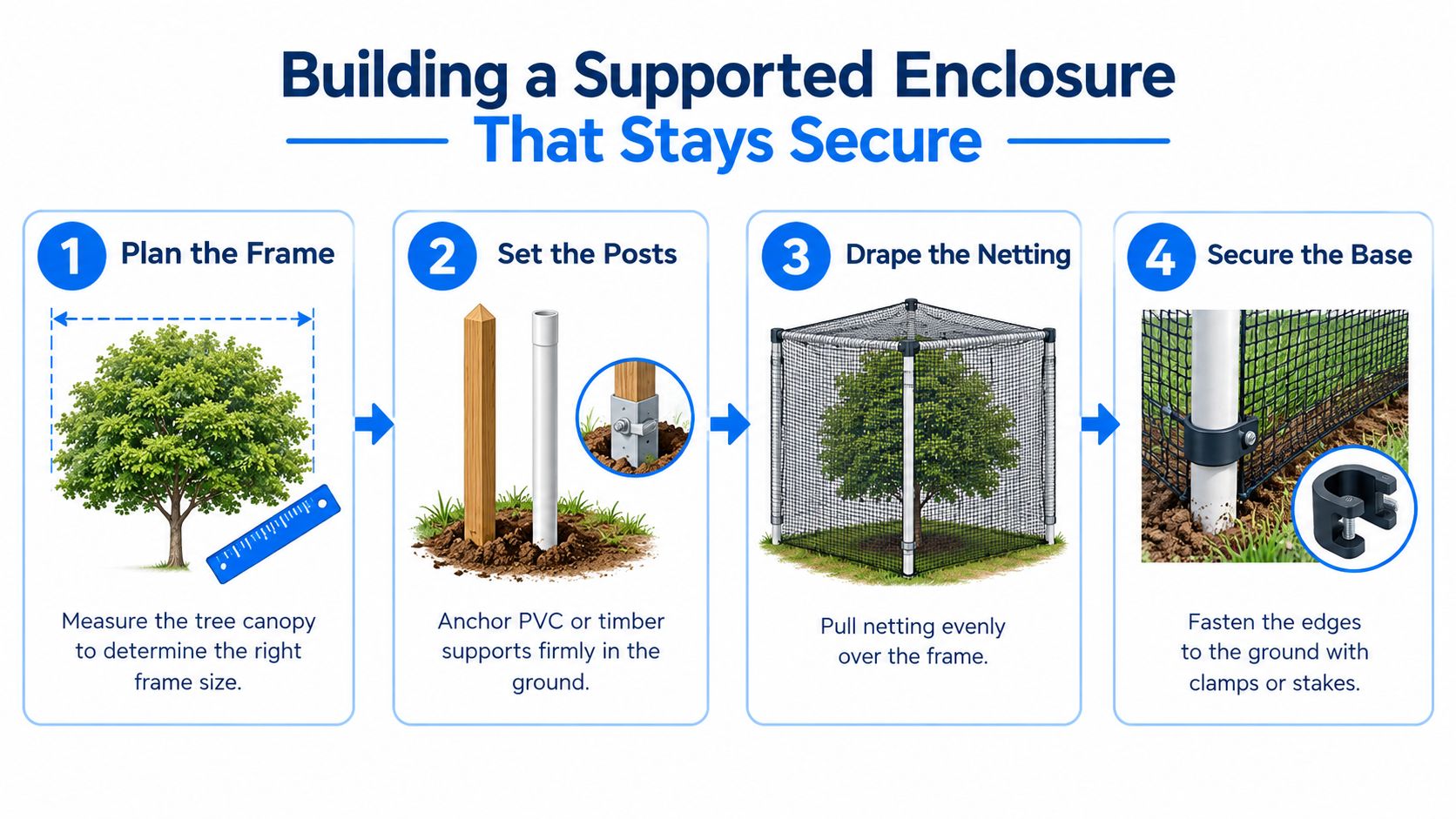
1. **Plan the frame.** Mark the canopy outline and identify the trunk, low branches, nearby fence lines, and roof edges. The frame needs room to stand clear of the foliage and enough width for the net to descend without leaving a side gap.
2. **Set the supports.** Drive stakes securely into the soil or assemble the PVC or timber frame before handling the net. Check each support after pushing against it. If it moves easily by hand, wind or a climbing squirrel can move it farther.
3. **Drape the netting evenly.** Start at the crown and work downward. Let the material fall around the frame instead of throwing it over one side and dragging it across branches. Keep the surface reasonably smooth, but don't pull so tightly that growing stems or moving branches become constricted.
4. **Seal the base.** Gather the lower edge tightly around the trunk if the enclosure is trunk-based, or extend it to the soil and secure it with clips, drawstrings, staples, weights, or pegs. Walk around the entire perimeter and close every opening.
Don't tie expanding stems tightly to the mesh. Tight ties can girdle branches as they grow, and they make later adjustment difficult. Clips and drawstrings allow you to open the enclosure for harvesting while keeping the edge controlled. Weight or peg the perimeter at regular intervals rather than relying on a few convenient corners.
> **Practical rule:** If you can slide your hand under the lower edge without moving an anchor, a squirrel can probably find that opening too.
The Queensland guidance recommends building a box, teepee, or perimeter frame, then tensioning knitted netting over it and weighting or pegging the edges. That approach is more laborious than draping a cover directly over the branches, but it prevents sagging contact and makes inspections much easier.
A supported enclosure also helps after rain and wind. Loose mesh tends to collect against branches and fruit, while a frame gives you clear points to reset. Inspect the trunk transition carefully. A gap where the net meets the bark is one of the most common failure points because a squirrel doesn't need to breach the canopy if it can enter below it.
## Eliminating Access Routes Before Netting
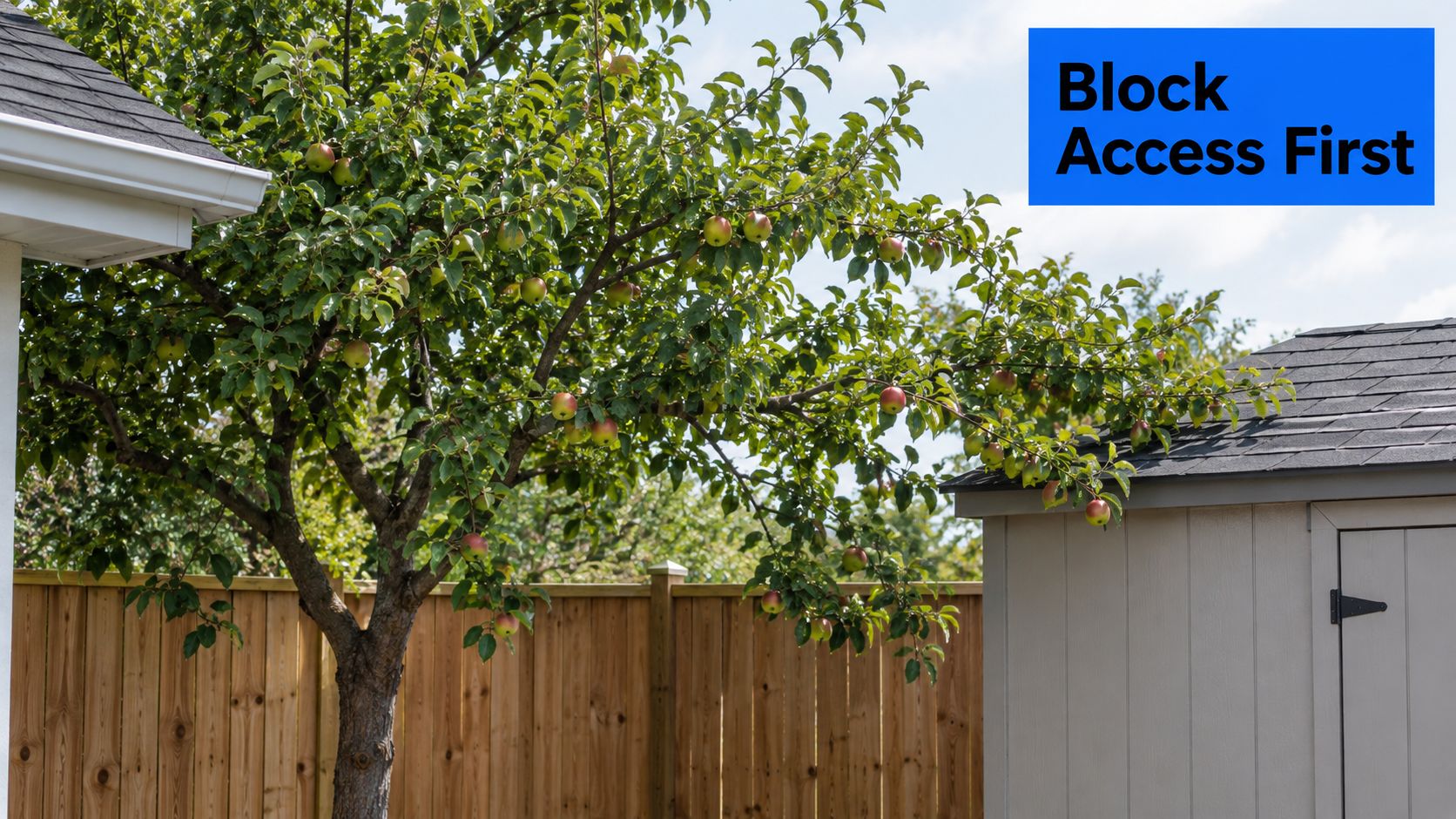
A netted tree can still be reachable if a branch, fence, shed, roof, or neighboring tree provides a launch point. Squirrels don't need to climb the protected trunk when they can jump into the enclosure from above or from the side. Before installing the cover, stand several steps away and map every route that leads toward the canopy.
Prune branches that overhang the enclosure and remove dead wood that could fall onto the net. Don't make aggressive cuts to create an arbitrary gap. The practical aim is to remove usable approaches while preserving the tree's structure and health. Where a branch belongs to a neighboring tree or crosses a property boundary, focus on the net's frame and perimeter instead of cutting without permission.
### Use layers when the tree is isolated
A standalone tree is easier to protect than one surrounded by squirrel highways. If the canopy is separated from nearby branches, fences, roofs, and other launch points, combine the enclosure with a **metallic trunk skirt or baffle** to block climbing access. The trunk barrier is a second line of defense, not a substitute for sealing the canopy.
Utah State University Extension describes full-tree netting during fruit ripening as a temporary measure rather than a guaranteed permanent barrier, particularly where alternative food is scarce. Its [guidance on temporary squirrel exclusion](https://extension.usu.edu/planthealth/files/up-newsletter/2020/UtahPestsNews-summer20.pdf) recommends removing overhead access routes, supporting the net on poles or a frame, draping from the crown downward, and securing the lower edge around the trunk or soil.
A baffle alone is a poor choice when squirrels can jump around it. It becomes more useful when the trunk is isolated and the canopy cover handles the upper route. The same logic applies to pruning. Clearing one branch won't help if a fence or shed remains within easy reach.
Netting should go on after pollination and before fruit begins to ripen. Remove it after the protected harvest period rather than leaving a seasonal barrier in place indefinitely. That reduces unnecessary wildlife exposure and gives you an opportunity to prune, inspect, and repair the system before the next fruiting cycle.
## Daily Inspection and Seasonal Maintenance Routines
The most reliable installation is still a maintenance job. Check the netting every day while it's in use, especially during active ripening and after strong wind. A small tear at the edge can become an entrance, and a loose section can entangle a bird or other non-target animal even when no squirrel has entered.
A useful inspection starts at the perimeter, not the canopy. Walk the full base and look for lifted staples, shifted weights, loosened drawstrings, and bark gaps. Then inspect the mesh surface for chew marks, pulled strands, branch contact, and places where fruit has pushed against the cover.
### Use a short repeatable checklist
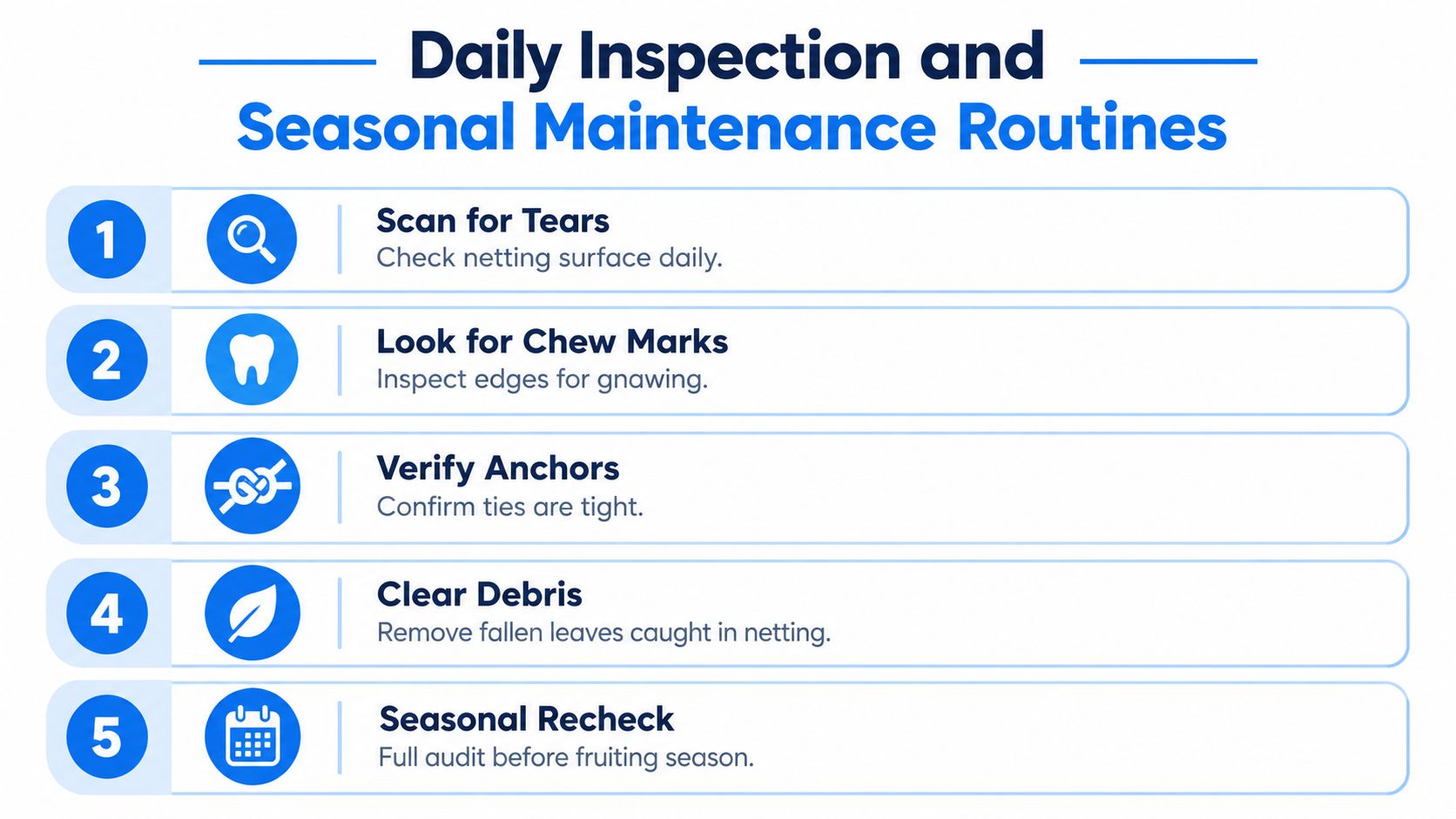
- **Scan for tears:** Follow the net from crown to base and repair damaged areas before reopening the enclosure.
- **Look for chew marks:** Gnawing near corners, anchors, and trunk transitions signals that the squirrel has found pressure on the barrier.
- **Verify anchors:** Reset clips, pegs, weights, and drawstrings after wind or branch movement.
- **Clear debris:** Remove fallen leaves and broken twigs caught in the mesh so they don't pull the cover downward.
- **Recheck the season:** Before the next fruiting period, inspect the stored net, frame joints, and access routes around the tree.
After a storm, don't just tighten the most obvious corner. Check whether the frame has shifted, whether the net is resting on fruit, and whether a branch has opened a side route. Redistribute the material before replacing anchors so tension remains even across the enclosure.
Wildlife safety needs a direct response. If you find a bird or other animal entangled, don't pull blindly on the mesh or leave it struggling while you finish another task. Keep people and pets away, reduce additional movement, and contact a local wildlife rehabilitator or animal-control service for guidance if the animal can't be freed safely. Damaged netting should stay open only long enough for the repair, then be secured or removed.
Once harvesting ends, remove the net carefully and inspect it before storage. Clean away leaves and plant debris, allow the material to dry, and store it where rodents can't chew through it. Roll or fold it without sharp bends that could weaken strands, and label the matching frame pieces so next season's installation doesn't become a search through tangled materials.
## Deciding Between Netting, Trunk Guards, and Cluster Bags
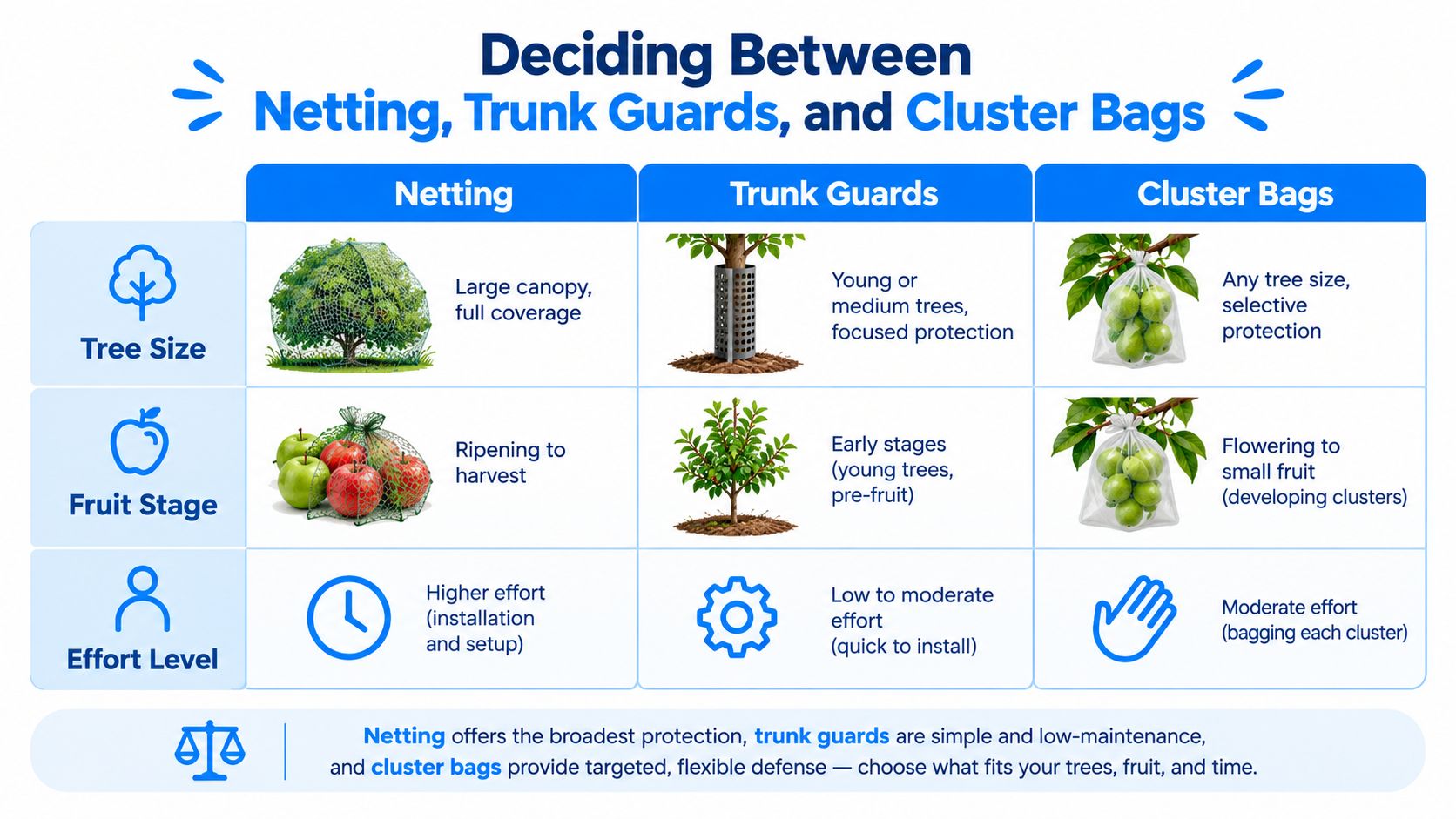
The right protection depends on the tree's size, the squirrel's route, and how much maintenance you can realistically provide. Whole-tree netting offers broad coverage, but it takes a frame, careful sealing, and regular checks. Cluster bags are more manageable on small trees or for fruit you particularly want to save, though a determined squirrel may chew through an individual bag.
Trunk guards work best when the tree is isolated and squirrels can't jump into the canopy from a nearby structure. They're less useful when branches, fences, roofs, or neighboring trees provide alternate routes. A full enclosure is usually the more dependable choice when access comes from several directions.
| Situation | Best starting option | Main limitation |
|---|---|---|
| Small tree with selected fruit | Cluster bags or a compact framed cover | More individual handling |
| Isolated tree with a clear trunk | Trunk guard combined with canopy protection | Fails if squirrels can jump around it |
| Medium tree with manageable canopy | Supported whole-tree netting | Requires a sealed perimeter |
| Large or complicated canopy | Framed enclosure and route pruning | Greater setup and inspection effort |
Don't choose based on the word “netting” alone. Choose based on whether the system blocks the route the squirrel is using. Install after pollination, keep the material away from fruit, close the base, inspect daily, and remove it when protection is no longer needed.
---
BenjiAds helps local service businesses build and manage ads, landing funnels, tracking, and SMS lead follow-up without handing everything to an agency. If your gardening, landscaping, or outdoor-service business needs a more dependable way to turn local interest into conversations, visit [benjiads](https://benjiads.com) and review the platform before your next campaign.