Source: https://benjiads.com/blog/social-media-dentists
Publisher: benjiads, https://benjiads.com
Published: 2026-09-18
Updated: 2026-09-18
Cite as: benjiads, "Social Media Dentists Guide to Growing Your Practice", benjiads.com/blog/social-media-dentists
Reuse: you may quote this article with attribution and a link to the source.
# Social Media Dentists Guide to Growing Your Practice
Practical guide for social media dentists covering content calendars, engagement tactics and simple ad ideas to attract and retain more patients.
Your schedule is soft, but your social pages look busy. The practice posts staff introductions, oral-health tips, and polished graphics. People react, a few leave comments, and the follower count slowly rises. Yet when you ask where the next new-patient booking came from, nobody can give you a confident answer.
That gap is where many social media dentists lose momentum. Social should support a measurable acquisition process, not operate as a gallery of disconnected posts. The practices that get value from it connect four pieces: a discoverable profile, useful content, fast engagement, and a clear path from inquiry to consultation.
## Table of Contents
- [Why Social Media Matters for Modern Dental Practices](#why-social-media-matters-for-modern-dental-practices)
- [Setting Up Your Practice Profiles for Trust and Discovery](#setting-up-your-practice-profiles-for-trust-and-discovery)
- [Start with the practice brand](#start-with-the-practice-brand)
- [Complete the conversion details](#complete-the-conversion-details)
- [Building a Content Calendar That Patients Actually Follow](#building-a-content-calendar-that-patients-actually-follow)
- [Give each post a patient-facing purpose](#give-each-post-a-patient-facing-purpose)
- [Build a calendar your team can maintain](#build-a-calendar-your-team-can-maintain)
- [Turning Likes Into Loyal Patients With Smart Engagement](#turning-likes-into-loyal-patients-with-smart-engagement)
- [Use a simple response decision](#use-a-simple-response-decision)
- [Simple Ad Ideas and Follow Up That Fill Your Schedule](#simple-ad-ideas-and-follow-up-that-fill-your-schedule)
- [Keep the first campaign easy to understand](#keep-the-first-campaign-easy-to-understand)
- [Connect the click to the conversation](#connect-the-click-to-the-conversation)
- [Growing Safely While Measuring What Works](#growing-safely-while-measuring-what-works)
- [Run a weekly review](#run-a-weekly-review)
## Why Social Media Matters for Modern Dental Practices
A prospective patient sees a dental post during a lunch break, checks the practice page, and sends a question. If the reply arrives hours later, the booking opportunity may already be gone. Social media earns its place in dental marketing when it shortens that path from attention to consultation.
The channel is established, not experimental. A **2018 survey of 532 dentists found that more than 55% had social-media accounts for their practices**, with Facebook the dominant platform, according to the [Journal of Medical Internet Research study](https://www.jmir.org/2018/6/e10109/). A separate practice survey reported social-media use in **52% of dental practices**, mainly for marketing, patient communication, and improving online presence.
The role has since broadened beyond promotional posts. A **2022 study reported that 62.3% of dentists used social media in practice**, while WhatsApp was the most common platform among users at **83.3%**. Dentists also used social channels to learn dentistry-related information and discuss cases professionally, as documented in the [2022 dental-practice study](https://jcdr.net/article_fulltext.asp?issn=0973-709x&year=2022&month=June&volume=16&issue=6&page=ZC61-ZC65&id=16533).
Posting more does not repair a weak patient journey. A post may attract attention, yet the profile lacks a booking route. A prospective patient may ask about treatment, then wait for a front-desk response. Existing patients may provide engagement while people actively searching for care receive no clear next action.
> **Practical rule:** Treat every social post as one part of a patient journey, not as the final marketing product.
Use Facebook first when building distribution. A large survey found that **91% of social-media-using dental practices used it for marketing** ([survey findings](https://pmc.ncbi.nlm.nih.gov/articles/PMC11723565/)). Instagram can support visual education and cosmetic dentistry, while WhatsApp or Messenger can handle direct questions where appropriate. Choose channels according to patient behavior, then connect each post to a consultation-ready response process. Track inquiries, qualified conversations, and bookings, not applause alone. Set clear boundaries around diagnosis, patient privacy, and case discussion before content goes live.
## Setting Up Your Practice Profiles for Trust and Discovery
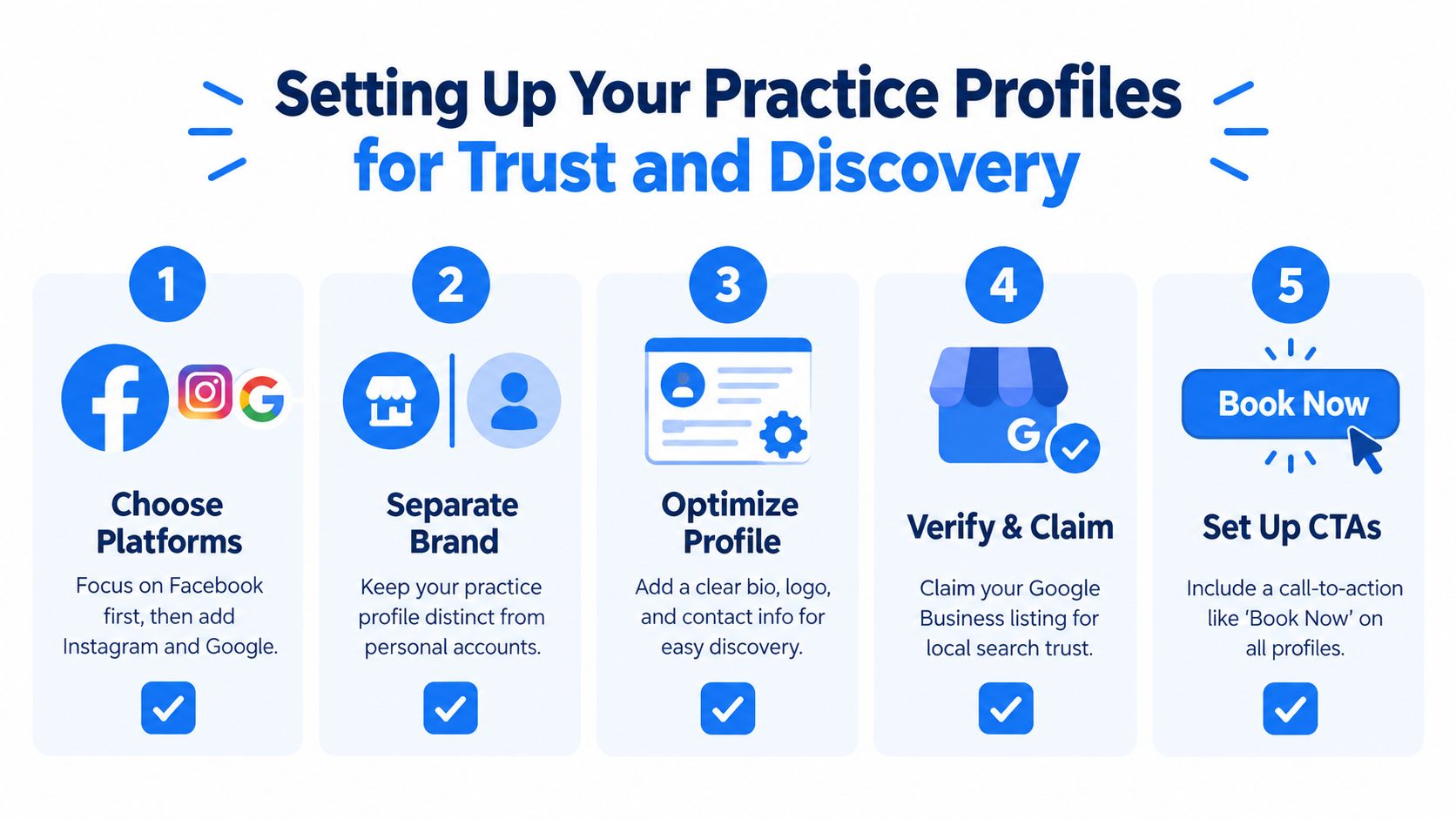
A practice profile should answer a prospective patient's basic questions before they contact you. Who are you, where are you located, what do you provide, when are you open, and how can someone request an appointment? If visitors need to hunt for those answers, content quality won't rescue the profile.
### Start with the practice brand
Create a dedicated practice page rather than using a dentist's personal account as the primary business presence. A personal profile can build familiarity, but the practice needs its own name, logo, contact details, service list, reviews, administrators, and advertising permissions. Keep the username close to the practice name and location, without adding confusing abbreviations.
Begin with Facebook, then add Instagram when your team can maintain it. Claim and complete your Google Business Profile as part of the wider discovery system, but keep social profiles consistent with the information patients see elsewhere. A mismatched phone number or outdated office hour creates avoidable friction.
### Complete the conversion details
Use a plain-language bio that identifies your services and location. Add a direct phone number, website, booking destination, emergency instructions if relevant, accessibility details, and an obvious call to action such as **Book Now**. Make sure the link works on a mobile phone and leads to a real scheduling or inquiry flow, not a generic homepage with no next step.
Use recent photographs of the team and office. Stock imagery can fill a gap, but it shouldn't replace evidence that patients will meet real people in a real setting. For broader support with [dental marketing services](https://benjiads.com/dental-marketing), keep the same practice voice across profile copy, content, landing pages, and responses.
Don't publish patient names, faces, treatment details, appointment information, or identifiable stories without documented permission. Also restrict account access to trained staff, use a review process, and remove former employees promptly. Profile hygiene isn't glamorous, but it often determines whether a profile visit becomes a message.
## Building a Content Calendar That Patients Actually Follow
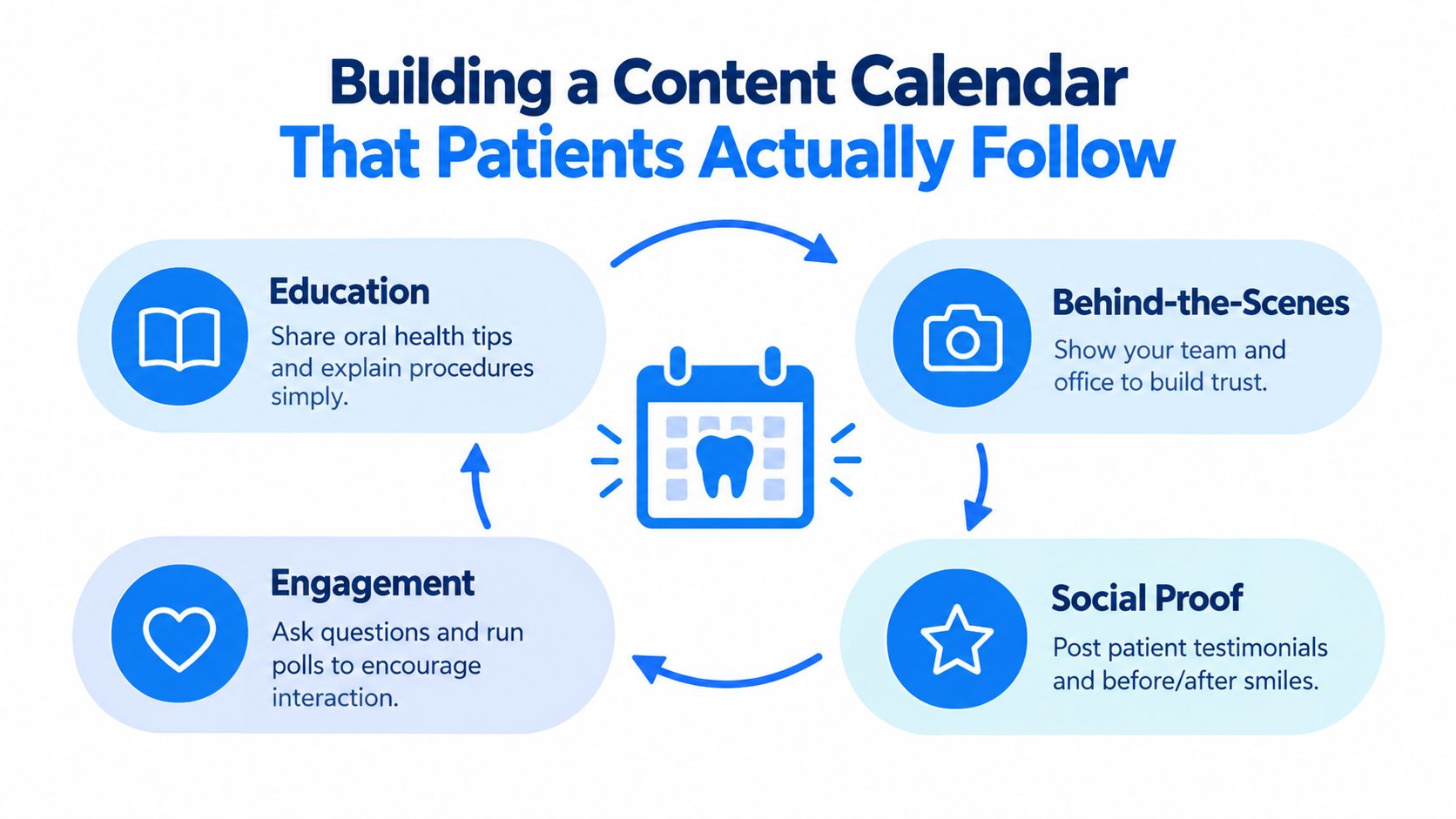
A sustainable calendar gives your team repeatable decisions instead of a blank screen every Monday. Use four pillars, but give each a different job. Education earns attention, behind-the-scenes content reduces uncertainty, social proof supports selection, and engagement reveals what people want to know.
### Give each post a patient-facing purpose
**Education** should answer questions patients already ask at reception. Explain sensitivity, retainers, fillings, gum health, sedation, or what a first consultation involves. Use a short video, a carousel, or a simple caption. Avoid diagnosing someone in public, and frame clinical information as general education rather than personal advice.
**Behind the scenes** makes the practice less intimidating. Show the reception area, sterilization procedures, staff introductions, a team huddle, or how the office welcomes nervous patients. The strongest version isn't a staged group photo. It's a small, specific moment that shows how the team behaves.
**Social proof** can include reviews, patient stories, or treatment outcomes, but only with appropriate written consent. If you can't obtain consent, share anonymized educational themes instead. Never let the desire for a compelling transformation override privacy.
**Engagement** should invite a useful response. Ask which procedure people want explained, run a general oral-health poll, or collect questions for a live Q&A. Don't use comments as a substitute for clinical assessment.
### Build a calendar your team can maintain
A practical weekly pattern might rotate an educational explanation, a human team post, a patient-safe proof point, and an engagement prompt. The exact frequency matters less than continuity and quality. Batch topics during a staff meeting, record several short answers during one quiet period, and turn one clinical explanation into a video, caption, story question, and website FAQ.
Use a reliable caption formula:
1. Open with the patient question.
2. Give one clear explanation.
3. State what the reader should do next.
4. Invite a low-risk response or consultation.
For example, a post about tooth sensitivity can explain common causes, suggest discussing persistent symptoms with a dentist, and invite readers to send a general question or use the booking link. Pair polished visuals with real practice photography when possible. If your team needs a consistent visual process, [dental photography marketing](https://benjiads.com/photography-marketing) can help turn clinical expertise and office culture into usable assets.
## Turning Likes Into Loyal Patients With Smart Engagement
A patient may watch a treatment video during a lunch break, then return days later to compare practices. A reaction takes seconds. A consultation request needs trust, timing, and a clear next step. One [patient behavior research](https://pdfs.semanticscholar.org/d3fd/7a8b76176f3344a7859909008cc18d5783bb.pdf) study found that **41.4% of respondents had interacted with a dental practice's social media, while only 7.2% actively followed that practice**. Reach and engagement therefore measure attention, not a durable patient relationship.
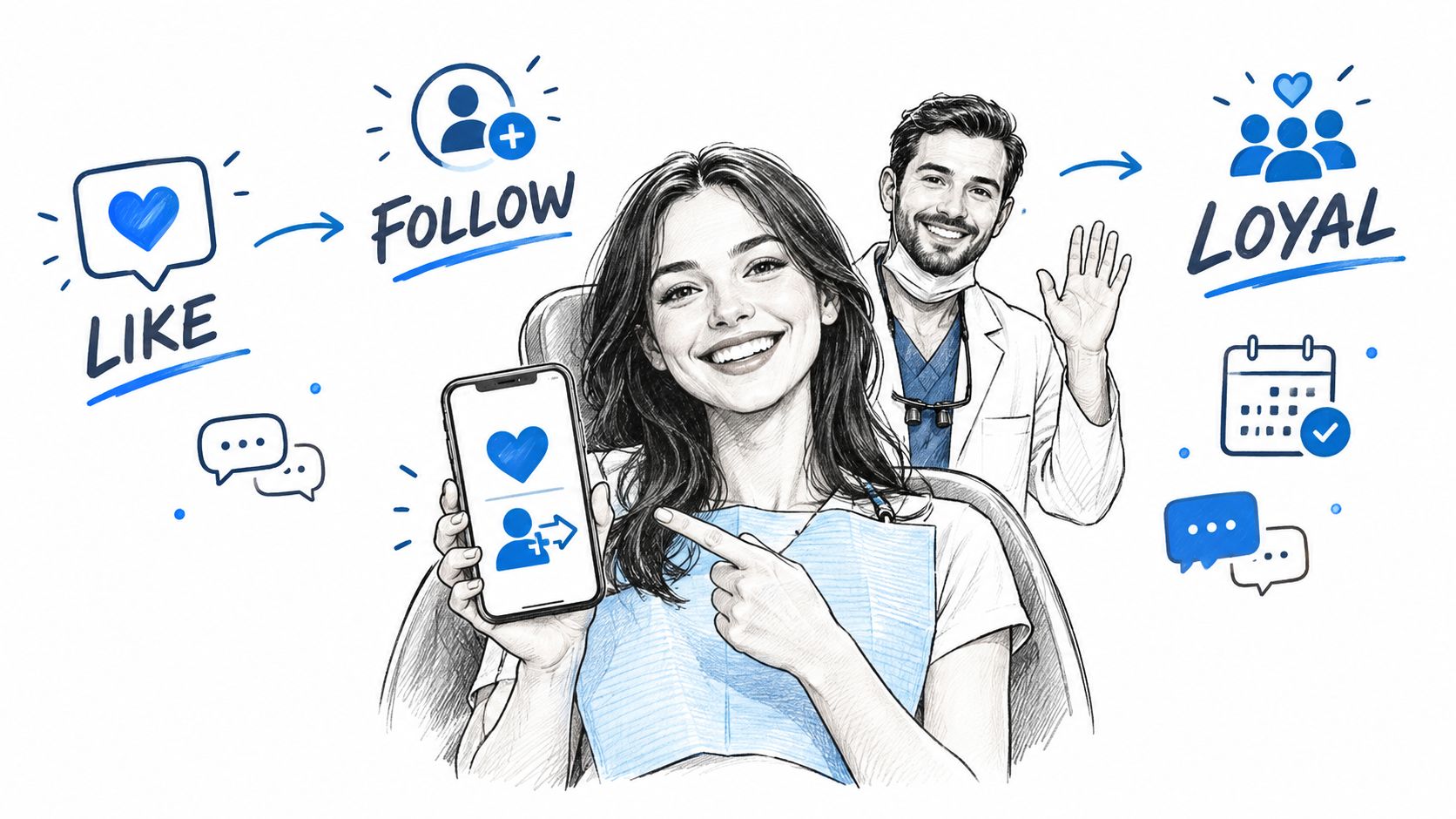
Patients comparing providers behave differently from casual browsers. The same research found that people who had recently switched providers were more likely to say social media influenced their dental choice. Facebook-first distribution can put a practice in front of local prospects, but the profile, response process, and booking route must support that interest.
### Use a simple response decision
Public comments suit general education. Move personal details, symptoms, insurance questions, and appointment coordination into a private, approved channel. Give the front desk a written workflow so staff can make that decision consistently.
| Patient action | Appropriate response | Next step |
|---|---|---|
| General question about a procedure | Give a brief educational answer | Invite a private message or consultation |
| Symptom or treatment question | Avoid diagnosis in public | Move to a secure, approved channel |
| Booking request | Confirm the preferred contact route | Send the scheduling link or call promptly |
| Negative comment | Stay calm and general | Invite direct contact without discussing care |
Assign message ownership. The person responding should know which questions they can answer, which need a clinician, and when to stop typing and request an appointment. WhatsApp may support direct communication, and the **2022 study** identified it as the most commonly used platform among surveyed dental social-media users. Convenience still requires privacy controls, approved access, and clear professional boundaries.
The aim is to identify intent, not force every interaction into a sale. Questions about cost, availability, anxiety, or a particular service can signal readiness for a consultation. Track those conversations separately from likes, then compare them with consultation requests and completed appointments.
Use short educational videos to demonstrate what a responsive patient journey feels like. Connect each meaningful interaction to a consultation-ready workflow, with a clear owner and measurable next step.
## Simple Ad Ideas and Follow Up That Fill Your Schedule
Paid social works best after the basic patient journey is ready. An advertisement can create attention, but it can't repair a confusing profile, a broken booking link, or slow follow-up. Start with one service and one clear audience near the practice rather than promoting every treatment at once.
### Keep the first campaign easy to understand
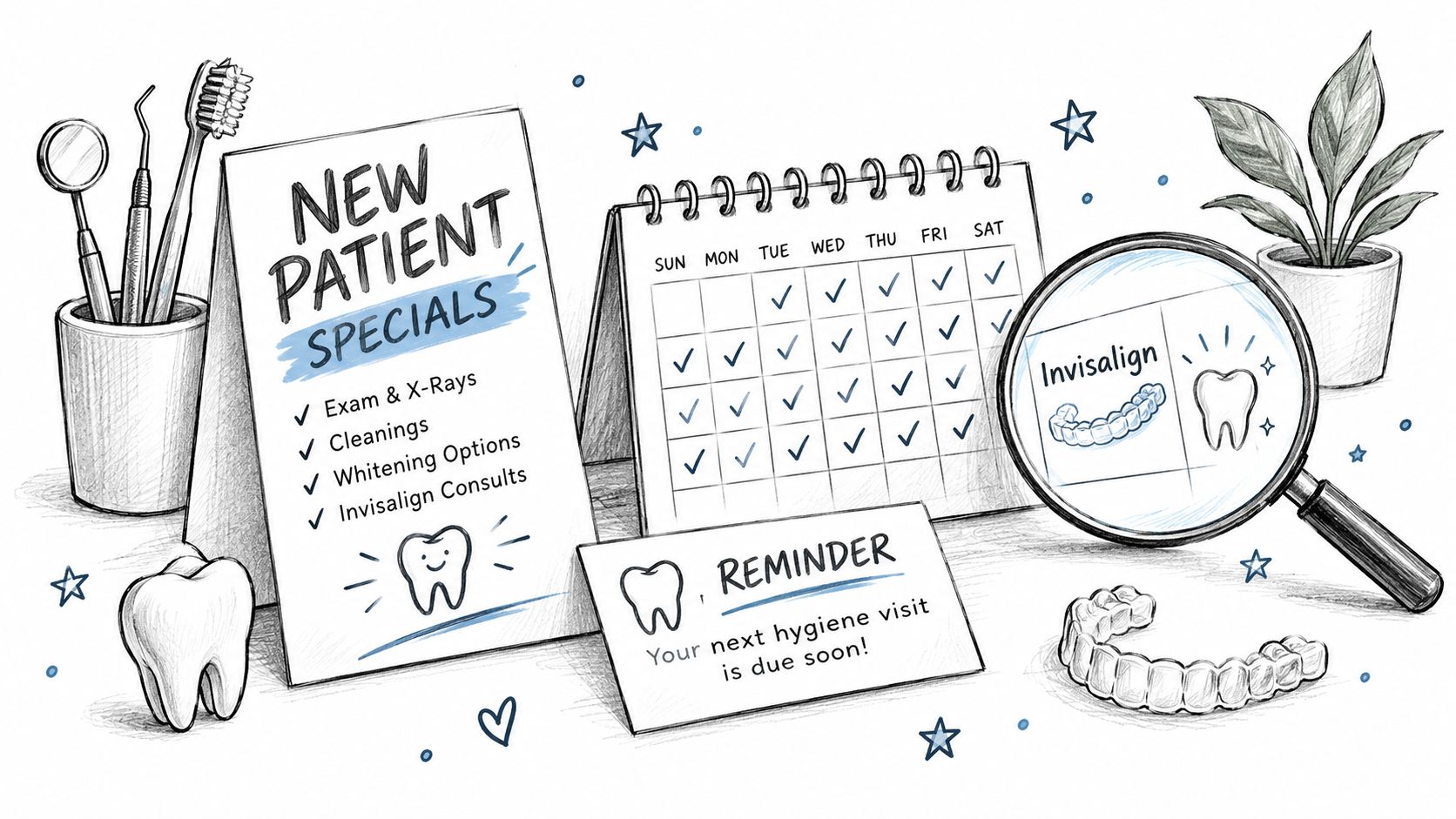
A new-patient consultation offer can work when the terms are clear and clinically appropriate. Other starting points include hygiene appointment reminders, whitening consultations, orthodontic consultations, or educational campaigns for a service people routinely research. Use local targeting, a dedicated landing page, one offer, and one call to action.
Have the dentist or practice owner approve the creative before launch. Check claims, imagery, pricing language, eligibility, disclaimers, and whether the message promises an outcome the practice can't guarantee. A calm explanation of patient benefit usually works better than aggressive urgency.
### Connect the click to the conversation
Use a form or landing flow that asks only for information the team needs to respond. Send each inquiry into a tracked system, alert the right staff member, and follow up through an approved channel. Automated text can acknowledge the request and ask a simple qualifying question, while the team handles clinical or sensitive matters personally.
Retarget people who visited the landing page or engaged with the content but didn't complete the inquiry. Don't show the same message repeatedly. Change the angle, answer a common objection, or invite a low-commitment consultation.
Tracking should connect the ad click to the inquiry, scheduled appointment, and eventual outcome where your systems allow it. Client-side signals can help explain immediate activity, while server-side signals can improve visibility when browser tracking is incomplete. Review **cost per lead**, lead quality, and booked consultations together. A cheap lead that never answers is not a strong result.
For a broader view of how lead systems connect advertising with follow-up, see this [lead-generation workflow resource](https://benjiads.com/blog/home-service-leads). The principle applies to dental practices too, provided the messaging, consent, and patient-data handling fit healthcare requirements.
## Growing Safely While Measuring What Works
Growth without governance creates avoidable risk. Obtain written consent before using a patient's image, testimonial, treatment story, or before-and-after result. Remove identifying details unless the patient has specifically authorized their use, and never discuss clinical information in a public reply.
The research gap is important. A **2026 evidence map reported that dentistry social-media research grew 412% from 2015 to 2024, while only 7% of studies evaluated formal training** ([evidence map and governance research](https://bmcoralhealth.biomedcentral.com/articles/10.1186/s12903-021-01390-w)). Adoption is moving faster than structured instruction, so each practice needs its own approval rules, consent process, escalation path, and access controls.
### Run a weekly review
Use one short meeting to ask:
- Which posts generated meaningful questions?
- Which messages became consultation requests?
- Which campaigns produced qualified leads and booked appointments?
- Which content should pause because consent, accuracy, or tone is uncertain?
- Which unanswered questions deserve a new educational post?
Measure profile actions, direct inquiries, consultations, bookings, and cost per lead. Keep follower counts and reactions as context, not the scoreboard. A small, relevant audience with a functioning booking path is more useful than a large passive audience.
In the next seven days, complete the practice profiles, add the booking route, choose four content pillars, prepare a small batch of posts, define the public-versus-private response rules, and establish one weekly measurement routine. That turns social media dentistry from passive posting into a controlled acquisition loop.
---
Benjiads helps local practices create and approve Meta and Google campaigns, connect clicks to leads and bookings with server- and client-side tracking, and follow up with prospects by text. Visit [benjiads](https://benjiads.com) to see how an approval-first advertising and follow-up system can support your dental practice's social acquisition workflow.