Source: https://benjiads.com/blog/remarketing-ads-google
Publisher: benjiads, https://benjiads.com
Published: 2026-09-28
Updated: 2026-09-28
Cite as: benjiads, "Remarketing Ads Google: The Complete 2026 Playbook", benjiads.com/blog/remarketing-ads-google
Reuse: you may quote this article with attribution and a link to the source.
# Remarketing Ads Google: The Complete 2026 Playbook
Remarketing Ads Google. Build Google remarketing ads that convert. Learn Display and RLSA setup, audience segmentation, messaging, and measurement strategies
Most advice about **remarketing ads Google** is stuck in a stale world where cookies behave, audience lists stay clean, and setup is the hard part. That world is gone. In 2026, the advantage comes from **audience governance**, not from flipping on a campaign and hoping the platform does the rest.
Google's remarketing system has grown from simple site re-engagement into a multi-surface network across Search, YouTube, Gmail, Discover, and display. That matters because the old “all visitors” mindset wastes spend fast. If your lists are sloppy, your consent signals are broken, or your exclusions are weak, you're paying to reach the wrong people at the wrong time.
## Table of Contents
- [The Evolution of Google Remarketing in 2026](#the-evolution-of-google-remarketing-in-2026)
- [The old mental model is too small](#the-old-mental-model-is-too-small)
- [Choosing Between Display Remarketing and RLSA](#choosing-between-display-remarketing-and-rlsa)
- [The decision comes down to intent](#the-decision-comes-down-to-intent)
- [Building High-Quality Audience Lists](#building-high-quality-audience-lists)
- [Start with behavior, not assumptions](#start-with-behavior-not-assumptions)
- [Build lists by business model](#build-lists-by-business-model)
- [Crafting Compelling Ad Creative and Messaging](#crafting-compelling-ad-creative-and-messaging)
- [Match the offer to the segment](#match-the-offer-to-the-segment)
- [Measuring Performance and Optimizing Campaigns](#measuring-performance-and-optimizing-campaigns)
- [Read the account like a buyer, not a dashboard](#read-the-account-like-a-buyer-not-a-dashboard)
- [Navigating Privacy Changes and Consent Mode](#navigating-privacy-changes-and-consent-mode)
- [Stop depending on broad cookie logic](#stop-depending-on-broad-cookie-logic)
- [Use a privacy-first operating model](#use-a-privacy-first-operating-model)
## The Evolution of Google Remarketing in 2026
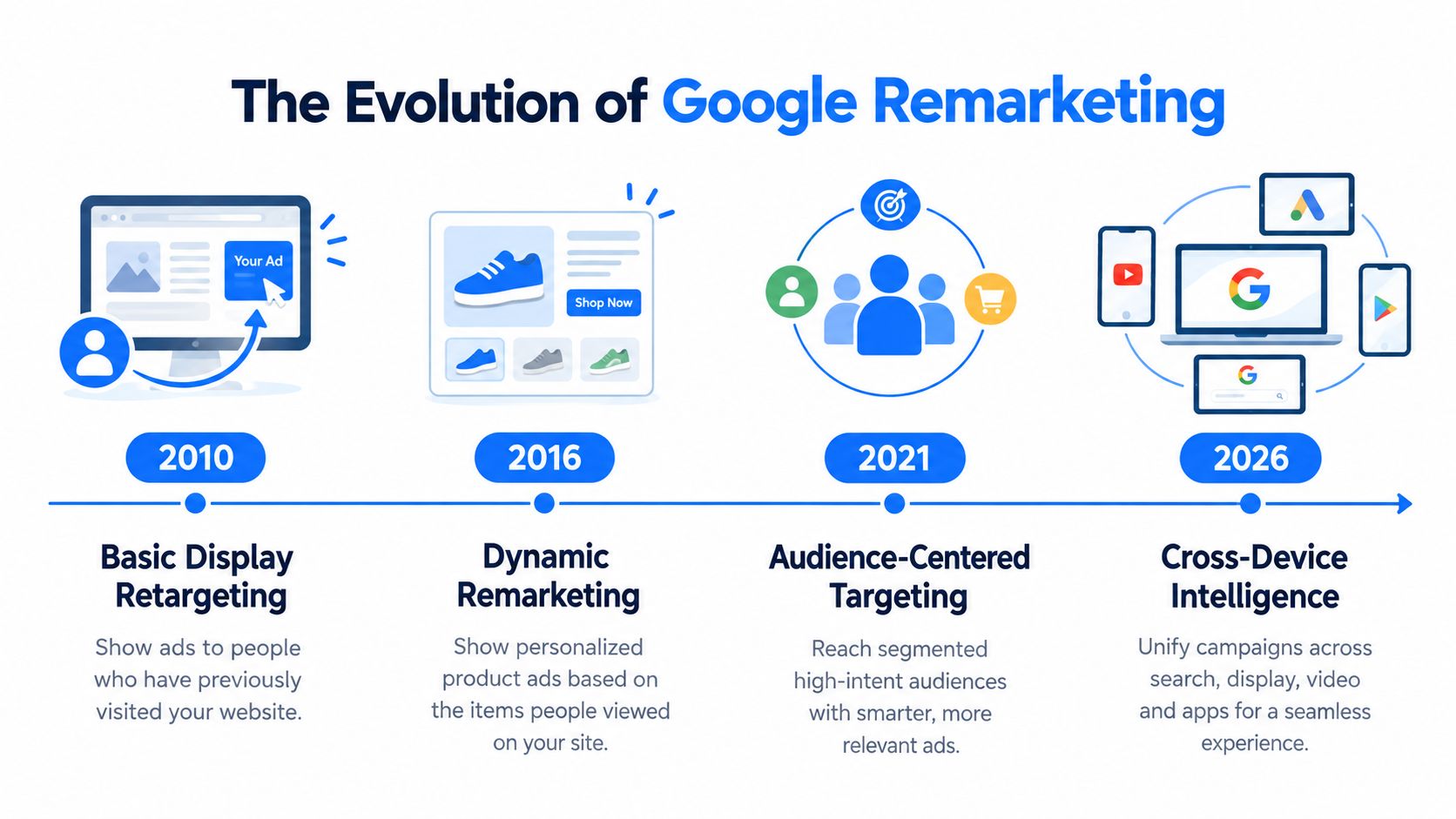
Google didn't build remarketing as a single feature, it layered it into an ecosystem. It started with remarketing in 2009, expanded to YouTube in 2010, added cross-device remarketing in 2013, dynamic remarketing in 2015, RLSA in 2017, and Gmail and Discover placements in 2020, turning a basic display tactic into something much broader as documented in Google remarketing history. That evolution matters because the channel is no longer just about following site visitors around the web.
### The old mental model is too small
The old model assumed one visit, one tag, one banner. That's not how Google works now. Remarketing has become a system for reaching people across devices and surfaces, which means your audience logic has to be stronger than your creative.
> **Practical rule:** if you still think of remarketing as “show the same ad to past visitors,” you're already behind.
A lot of teams misread performance. They compare a weak list against a weak placement and blame the channel. The underlying issue is usually poor segmentation, weak exclusions, or a consent setup that starves the audience pool.
The shift toward privacy-first data makes the change even sharper. Tools and workflows that used to depend on broad cookie behavior now depend more on your first-party data, consent state, and how cleanly your audience segments are managed. For a broader operational stack around campaign automation, [BenjiAds tools for marketing](https://benjiads.com/blog/ai-tools-for-marketing) show how teams are trying to reduce manual overhead, but the platform logic still has to be sound first.
## Choosing Between Display Remarketing and RLSA
Display remarketing and RLSA solve different problems. Display brings people back with visual inventory. RLSA catches them when they return to search with intent. Force one channel to do the other's job, and you get weak results plus messy reporting.
Use display when you need repeated exposure after a visit, especially for products or services people compare over time. Use RLSA when the search query itself shows urgency. That matters more for local service businesses, where a fresh search usually beats another banner impression. Google remarketing works best when the channel matches the user's intent, not when media buyers try to make every audience fit one setup.
### The decision comes down to intent
Ecommerce teams usually get more value from display because it keeps offers visible after the browse session ends. Search-led businesses, including local lead gen and service brands, usually get more from RLSA because the user is already back in market. That is the difference that matters. A remarketing budget gets wasted fast when the team keeps buying impressions for people who have no real path to conversion.
| Feature | Display Remarketing | RLSA |
|---|---|---|
| Primary role | Re-engagement through visual inventory | Search-time re-entry and bid adjustment |
| Best fit | Ecommerce, broader brand recall | High-intent searchers, local services, lead gen |
| Strength | Keeps your brand visible after site visits | Reaches users when they are actively searching |
| Weakness | Can get noisy fast without caps and exclusions | Depends on enough qualified search volume |
| Common mistake | Using broad lists with weak creative | Treating it like a standalone campaign |
Local businesses should usually start with RLSA if search demand exists. Ecommerce brands should start with display, then add RLSA for high-value audiences and branded search terms. The right mix depends on where intent shows up, not on which channel sounds more advanced.
A simple rule beats the usual clutter. Use display for reminders. Use RLSA for return searches. When teams ignore that split, they end up paying for reach they do not need and search coverage they never fully use.
## Building High-Quality Audience Lists
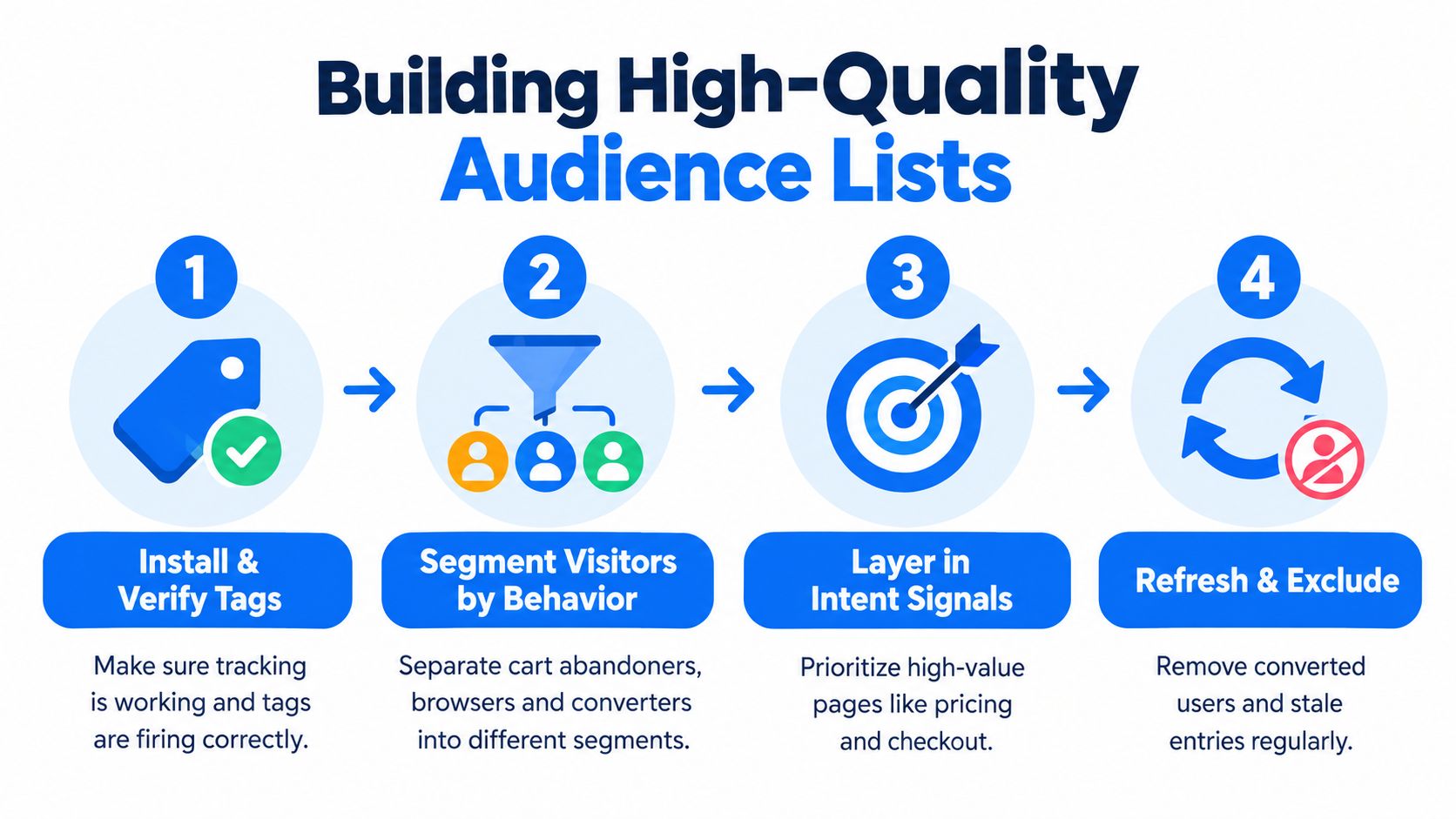
Bad lists waste money fast. The usual mistake is still one catch-all audience, then the team wonders why the ads feel generic. Build segments around intent and purchase stage, not around one broad visitor pool [as noted in this setup guidance](https://itforce.ua/en/blog/google-ads-remarketing/).
### Start with behavior, not assumptions
Separate people who visited pricing pages, people who read service details, and people who reached checkout but stopped. Those are different signals, and they should not get the same treatment. A homepage bounce is weak intent. A comparison-page visitor is closer to buying.
> **Practical rule:** the more money a page can make for you, the more aggressively it deserves its own audience segment.
Exclusions matter just as much. Stop serving ads to converters, cap frequency before fatigue sets in, and check consent settings before blaming performance. Too many teams run one list across every campaign, forget to exclude buyers, let delivery get noisy, and break EEA audience collection through poor consent setup, which can leave lists empty and waste spend.
### Build lists by business model
Local service businesses should prioritize high-intent pages such as service pages, quote forms, and contact-start pages. Retailers should split product viewers, cart abandoners, and past purchasers. A service brand does not need the same segmentation logic as a catalog store, and pretending otherwise sends budget into low-value traffic.
For local businesses and non-retail offers, the best audience is usually tied to a specific action that shows buying intent. A user who requested a callback, opened a pricing page, or started a quote is worth more than a broad site visitor. That is where list hygiene pays off. Tight segments let you write sharper ads, set stronger bids, and avoid paying to reintroduce your brand to people who were never close to converting.
The strongest lists are often the smallest ones that still have enough volume to work. That sounds plain, but it separates campaigns that stay relevant from campaigns that keep paying for attention they do not need.
## Crafting Compelling Ad Creative and Messaging
Creative wins or loses remarketing because the audience already knows you. That means the bar is higher, not lower. If your message is generic, you're paying to remind people that you're forgettable.
A clean creative approach starts with the user's last meaningful action. Someone who viewed a service page doesn't need a full brand story. They need a reason to come back, and they need it fast.
For ecommerce, dynamic ads are useful because they can reflect the specific product someone viewed. For local services, dynamic product logic usually isn't the point. You're better off using a blunt, useful message like a return offer, a trust signal, or a reminder tied to the exact service category the user explored.
If someone visited a dentist's whitening page and never booked, a straight reminder with a booking prompt beats a vague brand slogan. If a homeowner checked a plumber's emergency service page and left, urgency matters more than polish. If a landscaping lead already requested a quote once, a proof-driven ad with testimonials or a seasonal re-engagement offer usually makes more sense than another broad promise.
### Match the offer to the segment
A lapsed customer needs a different angle from a new browser. A cart abandoner may respond to simplicity, while a lead who already submitted a form may need reassurance and a faster next step. That's the point most ad accounts miss, they use one creative set and wonder why response fades.
The formats matter too. Short, clear copy beats clever copy in remarketing. The audience doesn't need persuasion from scratch, they need a nudge that removes friction.
## Measuring Performance and Optimizing Campaigns
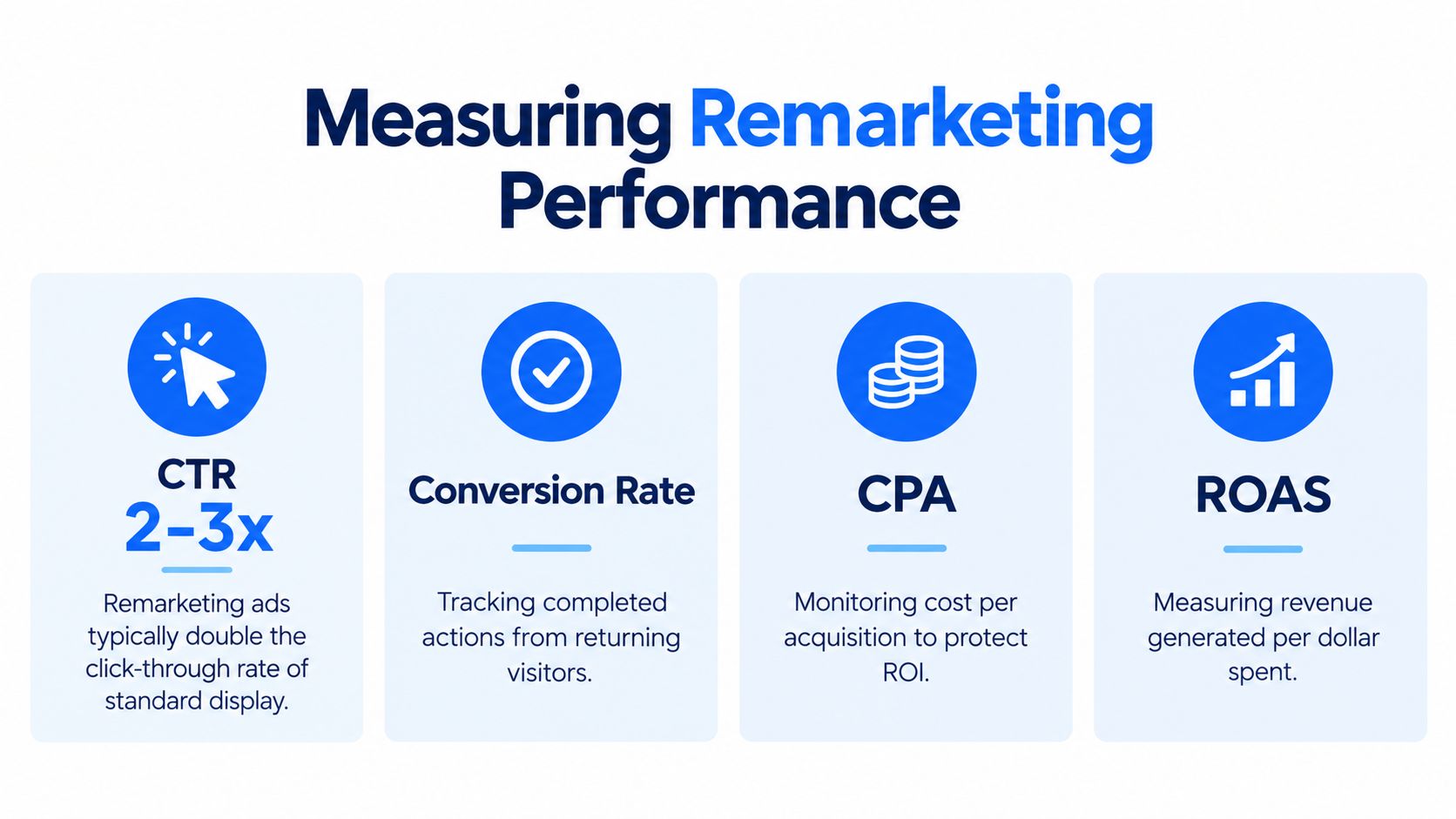
Clicks alone hide bad remarketing. You are not buying attention, you are buying recovered demand. Judge the account by **CTR**, **conversion rate**, **CPA**, and **ROAS**, then ignore vanity impressions.
Use benchmarks as a sanity check, not a target to chase. [Gitnux benchmark data](https://gitnux.org/remarketing-statistics/) and [2026 retargeting benchmark data](https://searchlab.nl/en/statistics/retargeting-statistics-2026) show that remarketing usually outperforms standard display on response, but the actual job is spotting where your own account slips below normal. If your CTR looks fine and your CPA is still ugly, the problem is not the ad alone.
### Read the account like a buyer, not a dashboard
Low CTR usually points to stale creative or a list that has gone cold. Weak conversion rate usually points to the landing page, the offer, or the wrong audience window. A high CTR with a bad CPA usually means the ad is doing the baiting and the landing page is doing the bleeding.
That is why [ad tracking software and reporting discipline](https://benjiads.com/blog/ad-tracking-software) matter. If you cannot see which audience segment, placement, or message converted, you are guessing with spend.
Keep the optimization sequence tight. Change one layer at a time, audience first, then creative, then bid logic. If you rewrite the offer, the ad, and the audience filters in the same week, you learn nothing and waste the next budget cycle.
A/B testing should be narrow and disciplined. Test audience windows, exclusions, and message framing, then leave everything else alone. That is how you find waste fast and stop paying for lists that look active but convert like junk.
## Navigating Privacy Changes and Consent Mode
The biggest mistake in 2026 is still pretending the privacy shift is a technical footnote. It isn't. Consent Mode, first-party data, and modeled measurement now shape whether your remarketing audience is healthy at all, and Google has moved more control over ad data collection and personalization into Consent Mode signals [as described in this privacy guidance](https://braidr.ai/blog/google-is-changing-how-it-governs-advertising-data-collection-heres-what-your-team-needs-to-know/).
Many “how to set up remarketing” pieces fall apart here. The setup might look correct, but the list can still be shallow, suppressed, or inconsistent across markets. Google's help pages now frame remarketing more around “your data” and simplified audience management, which is useful, but it also hides the operational reality that consent loss changes what you can reach.
### Stop depending on broad cookie logic
Third-party cookie dependency is the wrong center of gravity now. You need to treat first-party data as the core asset and consent as a gating condition, not an afterthought. That means list quality depends on who opted in, what signals were retained, and how your measurement stack recovers from missing identifiers.
Recent guidance also shows dynamic remarketing is limited to Display, Performance Max, and App campaigns, and it requires specific tagging plus a feed, which makes it a weak default for smaller advertisers who don't have clean catalogs or easy item-level data [privacy and retargeting guidance](https://www.auditsocials.com/blog/privacy-sandbox-shutdown-2026-retargeting-measurement-compliance-topics-protected-audience-third-party-cookies). For local businesses and many non-retail offers, a simpler high-intent re-engagement flow is often the smarter move.
### Use a privacy-first operating model
That means three things. First, collect and organize your own audience data with consent built in. Second, use modeled measurement where direct observation is incomplete. Third, build campaigns that can still work when personalization is thinner than you'd like.
If you need better data plumbing, [server-side tracking](https://benjiads.com/blog/what-is-server-side-tracking) is part of the answer, but it won't rescue a bad strategy. It only helps if your lists are sensible and your follow-up is tight.
The right mindset is blunt. The question is no longer “Can I retarget everyone?” The question is “Which signals do I still own, which users have consented, and which re-engagement flow can still win under privacy limits?”
---
If you want help turning this into a cleaner, privacy-safe acquisition system, [benjiads](https://benjiads.com) builds ads, landing pages, tracking, and follow-up for local service businesses. It's a practical fit when you need remarketing logic, lead capture, and response workflows to work together instead of living in separate tools.