Source: https://benjiads.com/blog/meta-advertising-examples
Publisher: benjiads, https://benjiads.com
Published: 2026-10-01
Updated: 2026-10-01
Cite as: benjiads, "8 Meta Advertising Examples for Local Services", benjiads.com/blog/meta-advertising-examples
Reuse: you may quote this article with attribution and a link to the source.
# 8 Meta Advertising Examples for Local Services
Explore 8 meta advertising examples for local service businesses, with strategic analysis, creative tactics, funnel ideas, and actionable takeaways.
The best Meta ad for a local service business isn't a universal format. An emergency electrician needs immediate contact, while a dental practice may need trust before someone books. A landscaping company might need to show a transformation, and an HVAC contractor may need to recover visitors who already viewed a service page. Treating every campaign as a contest between clicks and impressions misses the actual acquisition path.
The useful question is not which format gets the most engagement. It's whether the format matches **audience intent, creative structure, conversion friction, lead quality, follow-up speed, and booked-job potential**. Meta's scale makes that distinction more important. In Q2 2026, Meta reported **$59.36 billion in advertising revenue**, with average ad prices up **12%** and impressions up **14%**, as detailed in this [Meta advertising statistics overview](https://adsuploader.com/blog/meta-ads-statistics). Instagram also passed **3 billion monthly active users** in September 2025, expanding the audience beyond Facebook.
The examples below follow the local-service path from attention to qualification, phone verification, SMS follow-up, and booking. BenjiAds is relevant because it connects automated creative production, landing funnels, dual tracking, approval controls, and SMS follow-up without requiring owners to manage every advertising tool manually.
## Table of Contents
- [1. Lead Generation Ads](#1-lead-generation-ads)
- [Match the form to the service](#match-the-form-to-the-service)
- [2. Carousel Ads](#2-carousel-ads)
- [Build separate conversion paths](#build-separate-conversion-paths)
- [3. Video Ads](#3-video-ads)
- [Turn proof into qualification](#turn-proof-into-qualification)
- [4. Collection Ads](#4-collection-ads)
- [Use the tiles as a service filter](#use-the-tiles-as-a-service-filter)
- [5. Instant Experience Ads](#5-instant-experience-ads)
- [Add depth without adding confusion](#add-depth-without-adding-confusion)
- [6. Dynamic Product Ads](#6-dynamic-product-ads)
- [Retarget intent, not just traffic](#retarget-intent-not-just-traffic)
- [7. Messenger Ads and Click-to-Messenger](#7-messenger-ads-and-click-to-messenger)
- [Make response speed part of the offer](#make-response-speed-part-of-the-offer)
- [8. Stories Ads and Reels Ads](#8-stories-ads-and-reels-ads)
- [Design for the swipe decision](#design-for-the-swipe-decision)
- [8 Meta Ad Formats Comparison](#8-meta-ad-formats-comparison)
- [Turn the Winning Format Into a Repeatable Local Funnel](#turn-the-winning-format-into-a-repeatable-local-funnel)
- [Measure the complete path](#measure-the-complete-path)
## 1. Lead Generation Ads
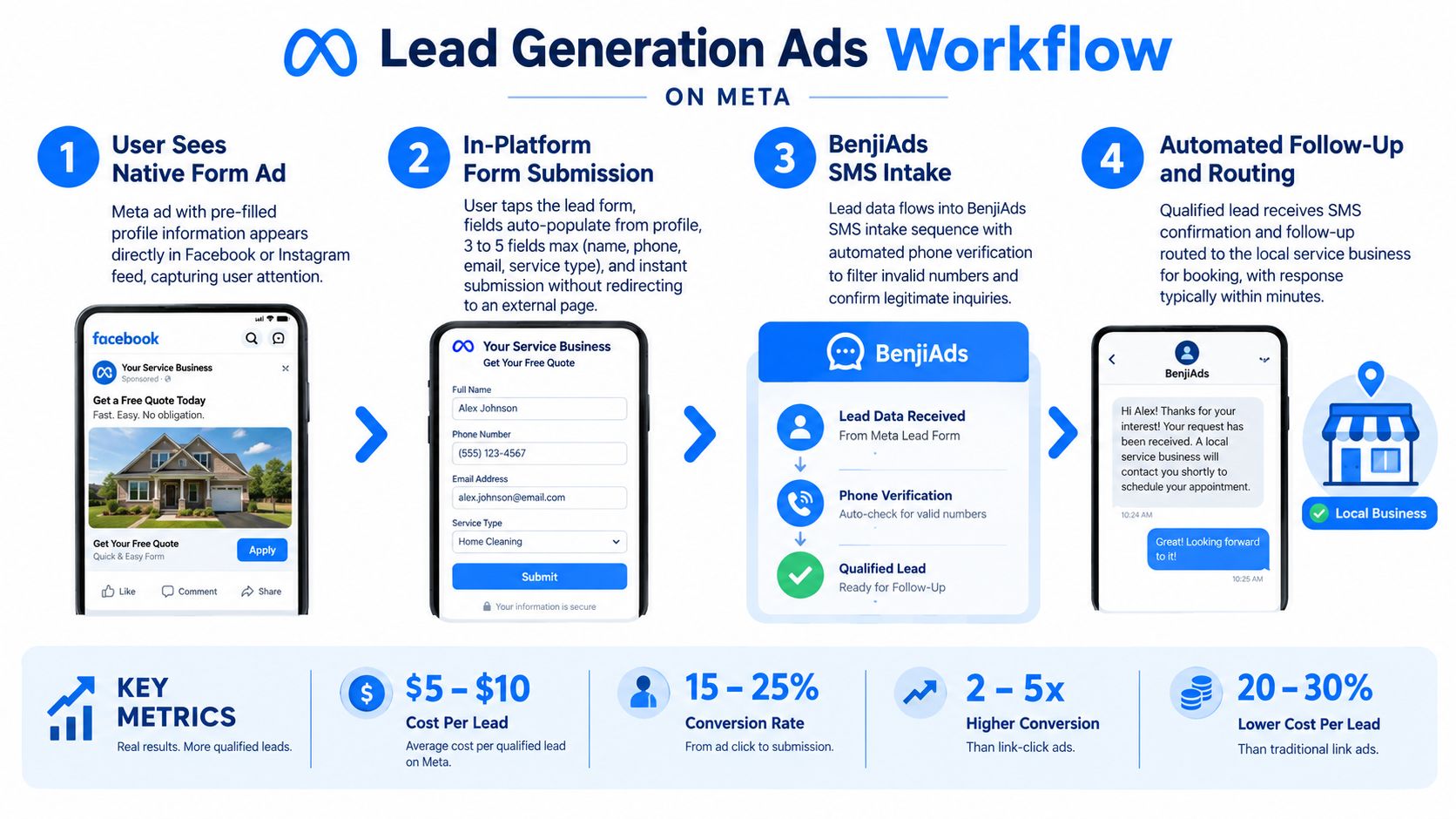
Native lead generation ads remove the landing-page step. A person sees an offer in Facebook or Instagram, taps the call to action, and submits contact information through a form without leaving the platform. That makes the format particularly useful when the prospect already understands the problem and wants a quick response.
An emergency electrician advertising Sunday availability can ask for the service needed, location, and preferred contact method. A plumbing company can separate urgent repair requests from planned installation inquiries. A dental practice can collect appointment interest, while a landscaping company can capture seasonal requests before a prospect is ready to discuss the full scope of work.
The conversion path is short, but short forms can create weak leads if the business doesn't qualify them afterward. BenjiAds can route submitted leads into SMS intake, use phone verification to filter invalid contact details, and continue the conversation with automated follow-up. That changes the form from a simple data collection tool into the first step of a sales process. Businesses can also find practical guidance on [small-business lead generation](https://benjiads.com/blog/small-business-lead-generation).
### Match the form to the service
Use a service-specific form rather than forcing every prospect through the same intake. “Roof repair” and “new roof installation” imply different urgency, budgets, and follow-up questions. A form for an urgent plumbing issue should prioritize rapid contact, while a form for recurring lawn care can ask about property needs and timing.
The thank-you screen matters too. It should explain what happens next, such as a text confirmation or a phone call from the business. A promise the team can't keep will damage lead quality more than a longer form would.
> **Practical rule:** Native forms work best when the business can respond quickly and verify the phone number before treating the submission as a genuine opportunity.
The main trade-off is intent. Meta can optimize for completed leads, but a completed form isn't the same as a booked job. Local operators should compare cost per **verified lead**, contact rate, and booked-job quality rather than judging the campaign by form volume alone.
## 2. Carousel Ads
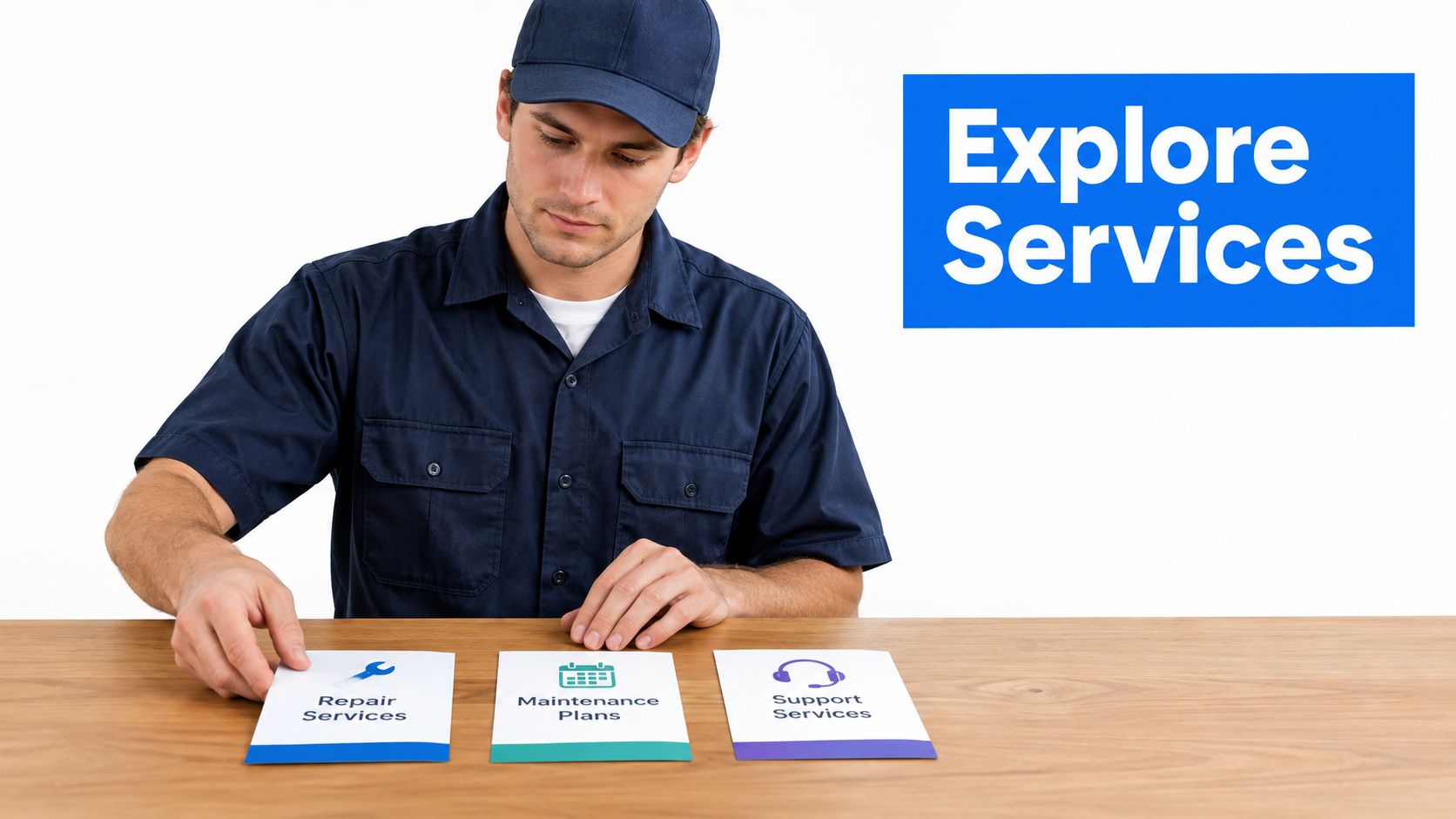
Carousel ads suit businesses with several services, customer problems, or proof points that don't belong in one static image. Each card can present a separate offer, allowing a plumbing company to show emergency repair, maintenance, and installation in one ad. A cleaning company can use the cards to distinguish residential cleaning, commercial work, and vehicle detailing.
The format gives the prospect a controlled way to self-select. Someone looking for an HVAC repair can tap that card, while another person interested in a new system can choose installation. This creates a more relevant conversion path than sending every visitor to a generic “services” page.
A strong carousel starts with the service most likely to matter to the audience. The first card receives the initial attention, so placing the highest-priority offer later assumes that every user will swipe. Use consistent branding across the cards, but let the imagery reflect the specific service. Before-and-after photography can support cleaning and landscaping, while technician imagery may build more trust for electrical or automotive work.
### Build separate conversion paths
Each card should lead to a matching form, landing page, or phone action. A card about emergency furnace repair shouldn't send users to a page dominated by installation content. Card-level tracking can show which service attracts high-intent prospects, but the business still needs to verify whether those prospects answer the phone and accept an appointment.
Keep the message direct. “Twenty-four-hour emergency service” communicates more than a vague promise such as “quality solutions.” Pricing can help when the business has a clear starting point, but it shouldn't appear if the final price depends heavily on an inspection.
> A carousel earns its place when service breadth is the problem. It becomes clutter when every card says almost the same thing.
For a local business with multiple customer segments, this format can reduce the distance between the ad and the right offer. Its weakness is operational. More cards create more destinations, more messages to maintain, and more opportunities for an outdated offer or broken form to undermine the campaign.
## 3. Video Ads
Video is valuable when the service is difficult to evaluate from a still image. A plumber can show a technician explaining an emergency response process. A dental practice can show a patient discussing the experience, subject to appropriate consent and compliance. A landscaping company can document a yard transformation, while an HVAC contractor can demonstrate careful diagnostic work.
The best local-service videos answer a concern quickly. Is the company available? Does the technician appear competent? Can the viewer see the result? Does the business understand the problem? Those questions are more important than cinematic production. A clear phone-shot demonstration can outperform a polished video if it makes the next step obvious.
Open with the problem or outcome rather than the company history. Text overlays and captions help people understand the message when sound isn't available. The final frame should direct the viewer to one action, such as requesting a quote, calling the business, or starting a Messenger conversation.
### Turn proof into qualification
A testimonial can attract attention, but it doesn't qualify the lead by itself. The landing form or conversation should still identify the service, location, urgency, and preferred contact method. An HVAC video about energy efficiency may bring in homeowners who want general information rather than immediate work, so the follow-up path should distinguish an audit request from a repair request.
BenjiAds can combine brand elements, testimonials, and service highlights into creative variations. The important benefit isn't just producing more videos. It's testing different customer problems and service angles while keeping the conversion event and follow-up promise clear.
> **Creative test:** Change the opening problem, proof point, or offer. Don't change all three at once if you want to understand why one version produces better verified leads.
The format's trade-off is production dependency. A business needs usable footage, permissions, and a clear process for refreshing stale claims. Video can create strong recall, but a memorable ad with no immediate response system may produce attention without appointments.
## 4. Collection Ads
Collection ads combine a prominent cover image or video with service tiles beneath it. For a multi-service plumber, the cover can show a branded vehicle or technician at work, while the tiles guide prospects toward emergency repair, maintenance, installation, or water-heater work. A dental practice can separate cleaning, cosmetic services, implants, and orthodontics.
This structure helps a local business present itself as a credible service provider without forcing the prospect to click through a broad website first. The cover establishes trust and the tiles create a simple choice. Each choice should lead to a service-specific landing page or lead form, not a generic home page.
### Use the tiles as a service filter
A cleaning company might use tiles for residential, commercial, carpet, and move-in or move-out cleaning. An auto repair shop could feature oil changes, brake service, tire rotation, and diagnostics. These aren't just categories. They are signals about what the prospect expects to buy, which lets the next form ask more relevant questions.
Refresh seasonal imagery and offers when the service mix changes. Spring landscaping creative shouldn't remain the main visual when the business is promoting winter preparation. The tile image should make the service recognizable without requiring the user to read a long description.
The collection format is stronger than a single-service ad when discovery is the main challenge. It is less suitable when one urgent offer needs immediate action, because several choices can slow the decision. A local operator should choose between breadth and speed based on the customer's situation.
> **Conversion principle:** Every tile should answer two questions before the click. “Is this the service I need?” and “What happens after I select it?”
A business can use the cover to establish trust, the tiles to qualify interest, and SMS follow-up to confirm the requested service. That sequence turns a visual storefront into a path toward a verified conversation.
## 5. Instant Experience Ads
Instant Experiences open a full-screen, mobile-first environment inside Meta. They can combine images, video, text, and calls to action without immediately sending the prospect to an external website. This makes them useful when a local business needs to explain a service before asking for contact information.
An emergency electrician could present availability, a customer testimonial, and a call or quote option in one experience. A landscaping company could show the stages of a yard transformation. An HVAC contractor could explain a comfort problem before presenting a free assessment request. A dental practice could use a gallery and trust information to reduce hesitation around a new-patient inquiry.
The experience should reveal the strongest reason to continue early. Availability, credentials, proof, or a clearly defined offer belongs near the opening rather than hidden after several screens. A call action may suit an urgent electrical or plumbing problem, while a lead form may fit a planned dental or landscaping inquiry.
### Add depth without adding confusion
An Instant Experience can support more context than a native form, but every additional interaction creates another opportunity for abandonment. Use a simple narrative: problem, proof, solution, action. The final form should state how the business will follow up, whether by phone or text.
BenjiAds can build mobile landing experiences and connect captured leads with SMS follow-up. That connection matters because a polished in-app experience doesn't solve the response problem. The business still needs to verify the number, confirm the request, and move the prospect toward a scheduled conversation.
The format also has a measurement trade-off. More interactions can reveal what prospects care about, but reporting must connect those interactions to verified leads and bookings. An experience that receives strong engagement but weak phone responses may be educating the wrong audience or presenting an offer with insufficient urgency.
The visual story should support the service decision, not replace it. A dental gallery needs a clear appointment path. A technician video needs a way to request help. A branded vehicle needs an offer that explains why the viewer should contact this business now.
## 6. Dynamic Product Ads
Dynamic Product Ads can apply the catalog logic of ecommerce to local services. Instead of showing every visitor the same message, the campaign can surface a relevant service based on the person's earlier behavior. Someone who viewed furnace repair content should see a repair-focused follow-up, not a general HVAC introduction.
An HVAC contractor can use one message for visitors who viewed repair pages and another for people researching installation. A plumbing company can retarget someone who clicked an emergency-repair ad but didn't submit. A lawn-care business can adjust the service promoted according to seasonal interest and previous site behavior.
The quality of the service catalog determines the quality of the experience. Each entry needs a clear name, accurate description, current imagery, and a working destination. Seasonal services require particular attention because an outdated catalog can send a prospect toward an offer the business no longer prioritizes.
### Retarget intent, not just traffic
Create meaningful audience distinctions. A visitor who read a general service page has different intent from someone who viewed pricing or started a form. The latter may need reassurance, a phone option, or a direct booking prompt rather than another introductory message.
A fallback ad protects the campaign when a service match isn't available. Conversion tracking should record form submissions and meaningful downstream actions, not only page views. BenjiAds can synchronize service information with Meta campaigns and connect retargeting with the broader funnel. Businesses exploring this approach can also review [retargeting ads on Facebook](https://benjiads.com/blog/retargeting-ads-on-facebook).
> Retargeting works best when the second message resolves the hesitation that stopped the first conversion.
The trade-off is audience size and repetition. Local services naturally have narrower pools than national ecommerce brands, so frequency and message fatigue require attention. A DPA should complement prospecting creative, not become the only source of demand. Its strongest role is recovering interested visitors and directing them to a service-specific action.
## 7. Messenger Ads and Click-to-Messenger
Messenger ads open a two-way conversation instead of a static form. This fits services where qualification matters before a quote or appointment can be offered. An emergency plumber can ask what happened and when help is needed. A dental practice can collect appointment preferences. A lawn-care company can ask about property needs before moving the conversation to a quote.
The first automated exchange should be short. Ask the problem, establish the desired next step, and offer a route to call or continue by text. A complicated bot can make an urgent prospect feel trapped. A simple flow can collect enough context for a human to take over.
### Make response speed part of the offer
A promise such as “we'll message you soon” only works if the business has staff or automation ready to support it. Messenger leads often expect a conversation, not a delayed email. BenjiAds can connect Messenger intake with SMS follow-up, allowing the business to confirm details, send reminders, and continue booking outside the initial chat.
The transition should feel natural. Explain why the prospect is being asked to continue by text and confirm the phone number before sending the next step. Phone verification helps separate genuine inquiries from incomplete or invalid submissions, while the conversation history gives the team context for the call.
Businesses can use [Facebook Ads automation tools](https://benjiads.com/blog/facebook-ads-automation-tool) to reduce manual campaign work, but automation shouldn't remove human judgment from objections, unusual service requests, or urgent safety issues.
A Messenger campaign is not successful merely because the bot receives replies. Measure whether conversations become verified contacts, completed appointments, and jobs that fit the service area. The format's strength is qualification. Its weakness is operational dependency. If nobody monitors the handoff, a promising conversation can become a missed opportunity.
## 8. Stories Ads and Reels Ads
Stories and Reels put local-service ads in vertical, full-screen placements where viewers decide quickly whether to continue. That speed suits visual proof and urgent availability messages. An electrician can show a rapid-response promise, a landscaping company can document a transformation, and a dental practice can present a focused booking prompt. Each example earns attention through a different service signal, but attention only matters if the next action fits the buyer's urgency.
The opening frame should identify the problem, outcome, or available appointment immediately. Use readable text overlays and one clear action, such as starting a chat, calling, requesting a quote, or booking. Vertical framing matters because horizontal footage can appear small and disconnected from the placement. The first seconds should also qualify the viewer where possible, using service area, job type, or response availability to reduce unsuitable inquiries.
Meta's delivery environment increasingly depends on automated systems and creative variation. One 2026 industry analysis reported that Single Image usage fell by **more than 8% year over year**, static Carousel usage fell by **7%**, and Collection Ads rose to **39% of surveyed advertisers**, up **nearly 15% year over year**, according to this [Meta advertising trends analysis](https://www.fluency.inc/blog/2026-trends-and-performance-benchmarks-google-ads-meta-ads). These figures support a practical testing decision: retain static assets when they communicate the offer well, while adding varied vertical assets that give delivery systems more relevant matches for different viewers.
### Design for the swipe decision
Stories and Reels can generate attention without generating intent. A satisfying lawn transformation may attract viewers who have no immediate need for service. Match the CTA and conversion path to the problem. An HVAC education angle may lead to a quote request or chat, while an emergency repair should favor a direct call and a fast phone-verification step.
Reels accounted for about **half of time spent on Instagram** in one 2026 roundup, per the same benchmark analysis cited above. Because both figures come from one source, treat them as directional context rather than a performance target. Placement attention still needs to become a verified contact, an SMS follow-up, and a booked opportunity.
Use brand-consistent colors, current testimonials, and creative variations built around distinct customer problems. BenjiAds can generate Stories and Reels creative from brand assets and service information, while approval controls let the business review ads before launch. The trade-off is speed versus depth. These placements are strong for attention and visual proof, but they often require a form or phone action, confirmation by SMS, and timely staff follow-up to turn fast viewing into a qualified sales conversation and a booked job.
## 8 Meta Ad Formats Comparison
| Ad Format | Implementation Complexity 🔄 | Resource Requirements ⚡ | Expected Effectiveness ⭐ | Ideal Use Cases 💡 | Key Advantages & Impact 📊 |
|---|---:|---:|---:|---|---|
| Lead Generation Ads | Moderate 🔄🔄, in-platform forms, Meta approval needed | Low–Moderate ⚡⚡, simple creatives, form setup | ⭐⭐⭐⭐, high conversion (2–5x link ads) | Time-sensitive local services (emergency, appointments) | Low CPL ($5–$10), instant capture, seamless SMS intake |
| Carousel Ads | Moderate–High 🔄🔄🔄, multiple card setup & testing | High ⚡⚡⚡, several images/videos per card | ⭐⭐⭐, strong engagement, modular testing | Multi-service offerings, before/after showcases | Rich storytelling, per-card performance tracking, reduced fatigue |
| Video Ads (In-Stream / In-Feed) | Moderate 🔄🔄, production or auto-generation | High ⚡⚡⚡, video assets, captions, edits | ⭐⭐⭐⭐⭐, highest recall & engagement | Testimonials, transformations, brand recall campaigns | Improved recall (up to +80%), strong completion metrics, lower CPL vs static |
| Collection Ads | Moderate 🔄🔄, catalog & tile configuration | Moderate–High ⚡⚡⚡, polished tile imagery, feed | ⭐⭐⭐, good browse-to-click behavior | Businesses with 4+ distinct services or tiers | Instant in-app storefront, higher CTR, clear service preference insights |
| Instant Experience Ads (Fullscreen) | High 🔄🔄🔄, multi-screen design & builder learning | High ⚡⚡⚡, mixed media (images, video, interactive) | ⭐⭐⭐⭐, higher conversion vs external links | Mobile-first storytelling, trust-building promos | Near-instant load, rich storytelling, in-app forms + SMS follow-up |
| Dynamic Product Ads (DPA) | High 🔄🔄🔄, catalog + pixel infrastructure | Moderate ⚡⚡, catalog maintenance, tracking | ⭐⭐⭐⭐, highly relevant retargeting, strong ROAS | Retargeting, seasonal/variable services, catalog-driven offers | Automated personalization, lower CPL (20–40%), scalable optimization |
| Messenger Ads / Click-to-Messenger | Moderate 🔄🔄, bot/agent flows & handoff logic | Moderate ⚡⚡, chat management or bot setup, 24‑hr capability | ⭐⭐⭐⭐, high intent, higher conversion rates | Urgent inquiries, qualification-first workflows, bookings | Real-time qualification, personal engagement, seamless SMS transition |
| Stories Ads & Reels Ads | Moderate 🔄🔄, vertical-first creative & short hooks | Moderate–High ⚡⚡⚡, vertical video production, quick variants | ⭐⭐⭐, excellent awareness, variable lead quality | Mobile-native awareness, younger demographics, quick CTAs | High mobile performance, lower CPM, fast creative iteration |
## Turn the Winning Format Into a Repeatable Local Funnel
The eight formats solve different local-service problems. **Native lead forms** fit urgent, low-friction capture when the prospect already knows what help is needed. **Carousels and collections** fit service breadth, because they let people choose between distinct offers. **Video, Stories, and Reels** fit visual proof, demonstrations, testimonials, and rapid attention. **Instant Experiences** fit mobile storytelling when the business needs more context before asking for contact information. **Messenger** fits qualification through conversation. **Dynamic Product Ads** fit behavior-based retargeting when a visitor has already shown interest in a particular service.
That classification is more useful than a universal ranking. A lead form may be the right answer for a Sunday-night electrical emergency and the wrong answer for a complex cosmetic dental decision. A Reel may create efficient awareness for a landscaping transformation, while a collection ad may produce a clearer path for an auto repair shop with several service categories.
Start testing with one audience, one offer, one conversion path, and one follow-up promise. Keep the business question narrow. For example, test whether a plumbing emergency offer produces more **verified phone contacts** through a native form or a Messenger conversation. Don't compare a lead form optimized for volume against a landing page optimized for booked consultations and then treat the cheaper lead as the winner.
### Measure the complete path
Meta performance data can create false confidence when the team stops at clicks or form submissions. A 24-month real-estate study across **nine accounts** analyzed about **$234,437** in normalized spend, **45.0 million impressions**, **404,794 clicks**, **252,438 link clicks**, and **5,240 Meta-attributed leads**. The study reported a blended cost per lead of about **$43.31**, while lead-objective campaigns produced **5,229 leads**, or **99.8%** of the total, as documented in this [real-estate Meta Ads study](https://mta.digital/en/case-studies-category/meta-ads-en/). Its more important lesson is that engagement metrics can move independently from lead economics. CTR rose **86.7%**, while blended CPL worsened **30.5%**.
A separate 2026 benchmark covering more than **40,000 brands** reported median Meta ROAS of **1.88**, median CVR of **1.53%**, and median CTR of **2.39%** for its stated period. The figures appear in this [2026 Meta Ads benchmark report](https://www.democratandchronicle.com/press-release/story/242524/6-dimensions-publishes-24-month-real-estate-meta-ads-study-across-9-accounts/), but global medians shouldn't replace vertical-specific measurement.
Track the sequence that matters to the owner:
- **Ad response:** Did the creative attract the right local audience?
- **Qualification:** Did the person request a relevant service?
- **Verification:** Can the business reach the person by phone or SMS?
- **Follow-up:** Did the team respond within the promised window?
- **Booking:** Did the verified lead schedule a real conversation or appointment?
- **Job quality:** Did the opportunity fit the service area, capacity, and commercial value?
Approval controls, conversion tracking, phone verification, rapid SMS follow-up, and daily reporting determine whether inexpensive leads become real opportunities. BenjiAds can connect automated Meta creative and campaign preparation with landing funnels, dual tracking, SMS intake, and approval-based launch, giving local operators a way to manage the full path rather than only the ad impression.
Choose the format that matches the customer's decision, then build the follow-up around the promise made in the creative. Visit [benjiads](https://benjiads.com) to review how its software creates and manages Meta ads, local lead funnels, phone-verified SMS intake, tracking, approval workflows, and daily performance reporting. Use the platform to prepare a focused campaign, approve the assets yourself, and judge the result by verified leads and booked jobs rather than engagement alone.
---
BenjiAds helps local service businesses generate Meta ad creative, prepare Facebook and Instagram campaigns, build trade-branded landing funnels, and follow up with leads through SMS and phone verification. Visit [benjiads](https://benjiads.com) to connect the format, funnel, tracking, and response process in one approval-controlled workflow.