Source: https://benjiads.com/blog/marketing-for-electrical-contractors
Publisher: benjiads, https://benjiads.com
Published: 2026-10-08
Updated: 2026-10-08
Cite as: benjiads, "Marketing for Electrical Contractors: A Tactical Guide", benjiads.com/blog/marketing-for-electrical-contractors
Reuse: you may quote this article with attribution and a link to the source.
# Marketing for Electrical Contractors: A Tactical Guide
Tactical marketing for electrical contractors. Learn how to drive leads with paid campaigns, optimize proposals, and build follow-up systems that book jobs.
Most advice about **marketing for electrical contractors** starts in the wrong place. It tells you to rank higher, collect more reviews, or buy more clicks, as if traffic automatically turns into profitable work. It doesn't. A lead can sit unanswered while a technician is driving, a proposal can disappear in an inbox, and a cheap inquiry can consume more time than it ever returns.
The contractors who make digital acquisition pay attention to the middle mile. They connect search demand to a qualified conversation, a clear proposal, a booked appointment, and a completed job with acceptable margin. That requires marketing, dispatch, estimating, and follow-up to operate as one system.
## Table of Contents
- [Beyond the Click](#beyond-the-click)
- [Visibility creates an obligation](#visibility-creates-an-obligation)
- [Campaign Architecture for Intent](#campaign-architecture-for-intent)
- [Build separate paths](#build-separate-paths)
- [Landing Pages That Convert Browsers to Buyers](#landing-pages-that-convert-browsers-to-buyers)
- [Match the page to the promise](#match-the-page-to-the-promise)
- [Test the handoff, not just the headline](#test-the-handoff-not-just-the-headline)
- [The Critical First Five Minutes](#the-critical-first-five-minutes)
- [Create a response protocol](#create-a-response-protocol)
- [Follow up without becoming noise](#follow-up-without-becoming-noise)
- [Tracking Profit, Not Just Leads](#tracking-profit-not-just-leads)
- [Build one source of truth](#build-one-source-of-truth)
- [Let margin make the decision](#let-margin-make-the-decision)
- [Building Trust Through Compliance and Safety](#building-trust-through-compliance-and-safety)
- [Put evidence beside the offer](#put-evidence-beside-the-offer)
## Beyond the Click
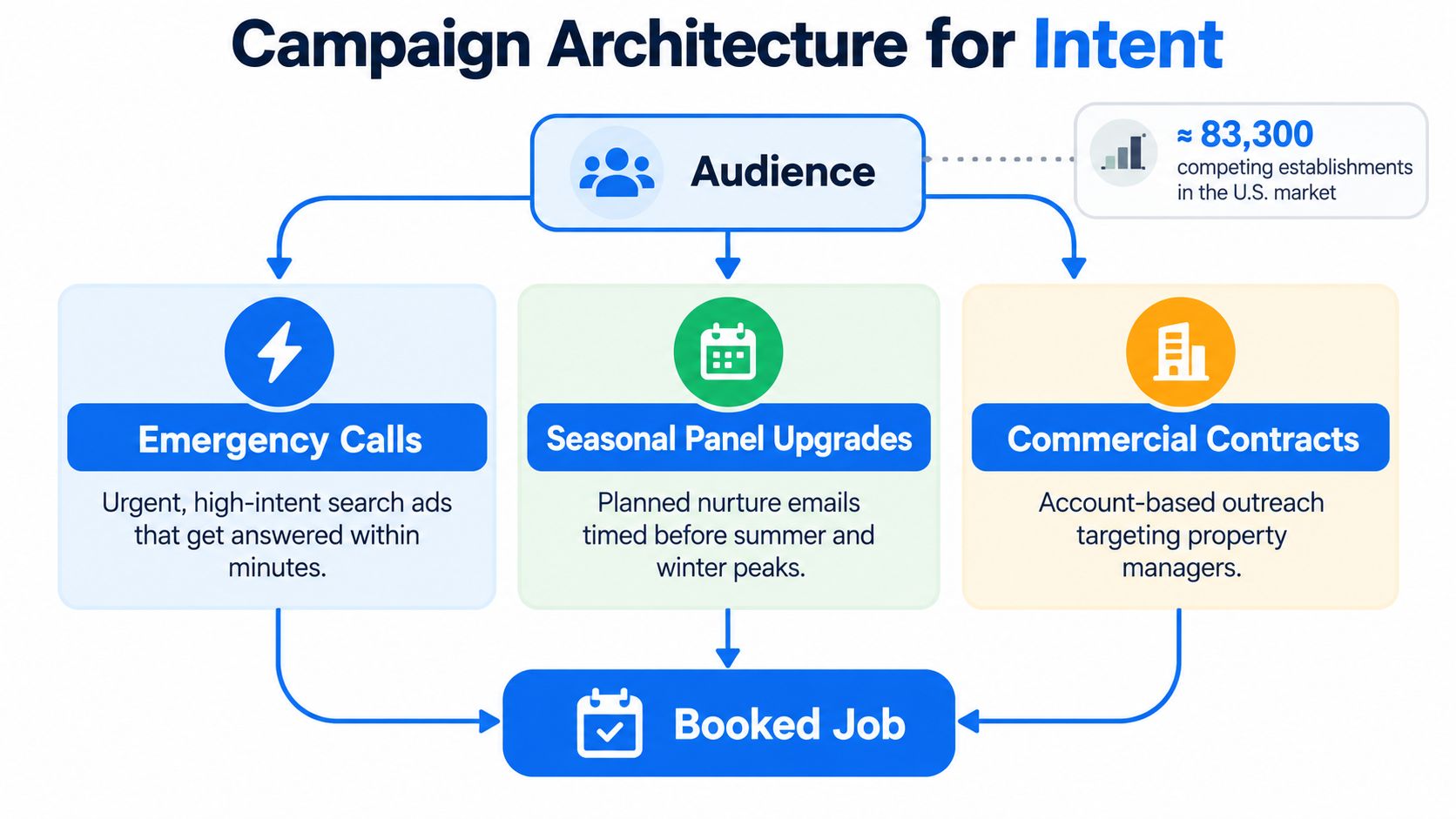
Visibility is now the entry fee, not the advantage. The U.S. electrical contracting market includes approximately **83,300 establishments, 1.02 million workers, and about $336.3 billion in annual revenue**, according to [Census-based industry estimates for electrical contractors and other wiring-installation contractors](https://vantainsights.com/reports/23821-electrical-contractors-other-wiring-installation-contractors). A market that large and fragmented gives customers plenty of alternatives, especially when they search by city, neighborhood, or service type.
That changes the marketing question. It isn't a matter of, "How do we get more people to visit our website?" It's, "What happens after a nearby customer calls, submits a form, or asks for an estimate?"

### Visibility creates an obligation
A campaign creates demand your business must be able to handle. If emergency calls go to voicemail, if the office can't identify the service area, or if proposals take days to reach the customer, additional traffic can expose operational weaknesses rather than solve them.
A useful acquisition chain looks like this:
1. **Capture intent:** Show up when someone searches for an urgent repair, panel upgrade, rewiring, lighting, or EV-related work.
2. **Convert the visit:** Send each intent group to a focused page with a clear phone path and a short qualification form.
3. **Verify the opportunity:** Confirm the phone number, location, service need, urgency, and fit.
4. **Respond and schedule:** Put a real person in control of the next step, especially for safety-critical requests.
5. **Measure the job:** Connect the source to the booked appointment, proposal, revenue, and margin.
> **Practical rule:** A lead isn't a marketing win until someone has verified it and the business has a credible path to a profitable job.
This is why a contractor should document response ownership before increasing ad spend. Decide who handles missed calls, who reviews forms, who sends proposals, and who follows up when a customer says they need to think about it. Tools such as [Recepta.ai for Electrical Trade Businesses](https://www.recepta.ai/industries/electrical-contractors) can be evaluated alongside your existing scheduling and communication process, but software won't fix unclear responsibility.
Track **qualified calls, verified inquiries, booked estimates, completed jobs, revenue, and gross-margin return**. Impressions and clicks help diagnose the top of the funnel, but they don't tell you whether a campaign filled the schedule with suitable work. A smaller campaign that produces panel upgrades in your service area can be more valuable than a larger campaign that generates vague requests from outside it.
## Campaign Architecture for Intent
A single campaign for “electrician” usually hides too much. An emergency caller, a homeowner planning a panel upgrade, and a property manager seeking a commercial partner aren't comparing the same things. Their urgency, questions, budget logic, and acceptable response time differ.
Start by separating campaigns around **service intent and buying behavior**, not only around keyword volume.
### Build separate paths
**Emergency calls** need direct language, local coverage, and a fast human response. The ad and landing page should make it obvious what kinds of urgent problems you handle, where you work, and how the customer reaches dispatch. Don't bury the phone number below a long company history.
**Planned residential work** deserves a different conversation. Panel upgrades, rewiring, lighting projects, generator work, and EV charger installations often require photos, site details, equipment questions, and a proposal. Ask for the information that helps an estimator decide whether a site visit is appropriate, but keep the first form short enough to complete on a phone.
**Commercial contracts** require account-level thinking. Property managers and facility teams may care about service coverage, documentation, scheduling coordination, safety procedures, and the ability to handle recurring work. A generic residential discount won't persuade them.
Use campaign settings and tracking that preserve these distinctions. Every form and phone call should carry the campaign, service category, location, and outcome into the CRM or job-management system. Mark a submission as spam, outside service area, unqualified, estimate requested, booked, completed, or lost. Platform conversions alone won't show which opportunities deserve more budget.
| Intent | Primary message | Conversion path |
|---|---|---|
| Emergency | Immediate contact and clear service boundaries | Phone call to live intake |
| Planned upgrade | Assessment, scope, and transparent proposal process | Short form or scheduled consultation |
| Commercial | Capability, documentation, and account fit | Qualified inquiry to estimator |
For additional creative prompts and channel ideas, [Pipeline On's ad ideas for electricians](https://pipelineon.com/blog/electrical-contractor-advertising-ideas/) can supplement your planning. Keep the ideas subordinate to your operational capacity. Don't advertise services you can't schedule reliably or promote response promises your team can't meet.
The same principle applies to Google Ads setup. Match each ad group to a specific service and destination rather than sending every visitor to the homepage. BenjiAds' guide to [setting up a Google Ads campaign](https://benjiads.com/blog/how-to-set-up-a-google-ads-campaign) is useful as a setup reference, but the important decision is still yours: define the customer intent and the profitable outcome before choosing the campaign settings.
## Landing Pages That Convert Browsers to Buyers
The landing page shouldn't make the visitor work out whether you can solve the problem. It should confirm three things quickly: **you serve the area, you handle the specific work, and contacting you is easy**.
Historical contractor-marketing research reported that **58% of consumers searched online for electrical providers**, while nearly **52% of searches came from smartphones**, as documented in this [contractor marketing guide](https://leaptodigital.com/wp-content/uploads/2021/04/2021-Contractors-Guide-to-Marketing-v1-2.pdf). Those figures are historical baselines, not a current market census, but they support a practical design decision. Your mobile page must make calling, messaging, and submitting a request straightforward.
### Match the page to the promise
A page for an emergency electrician shouldn't open with a broad list of every service you offer. Lead with the urgent problem, the service area, and the next action. A page for a panel upgrade can explain assessment steps, common project variables, documentation, and what happens after the inquiry.
Use one dominant conversion path. You can include a phone button and a short form, but both should support the same next step. Multiple competing buttons, elaborate menus, and unrelated offers create uncertainty at the moment the customer is trying to choose a contractor.
A strong page typically includes:
- **Specific headline:** Name the service and territory instead of using “Full-Service Electrical Solutions.”
- **Relevant proof:** Show real project photos, clear testimonials, and credentials that apply to the advertised work.
- **Short intake form:** Ask for name, phone, service location, problem type, and urgency. Avoid turning the first contact into an exhaustive estimate request.
- **Visible service boundaries:** State the communities or commercial areas you cover.
- **Expectation setting:** Explain whether the next step is a call, site assessment, quote review, or appointment window.
Trust signals should answer risk questions, not decorate the page. A license reference, insurance detail, safety process, or explanation of permit coordination is more useful than a row of generic badges. Only publish claims your business can verify and maintain.
### Test the handoff, not just the headline
A/B testing a headline can help, but it won't rescue a broken intake process. Test one meaningful change at a time, then inspect what happens after submission. Did the caller reach a person? Was the address in range? Did the team send a proposal? Did the customer book?
The page also needs to work for technicians and office staff. If a form produces incomplete information, a salesperson must spend time recovering basic facts. If a phone call doesn't capture source and service type, the campaign may look weak because the business lost attribution.
For broader principles on layout, contact paths, and usability, see this guide to [small-business website design](https://benjiads.com/blog/small-business-website-design). Apply those principles to the electrical buying situation, where clarity and reassurance matter more than clever visual effects.
## The Critical First Five Minutes
Lead response is where many electrical businesses lose the return they paid to create. The customer may be dealing with a tripping breaker, loss of power, sparking equipment, or a planned project they're comparing with other contractors. A silent inbox gives that opportunity to someone else.
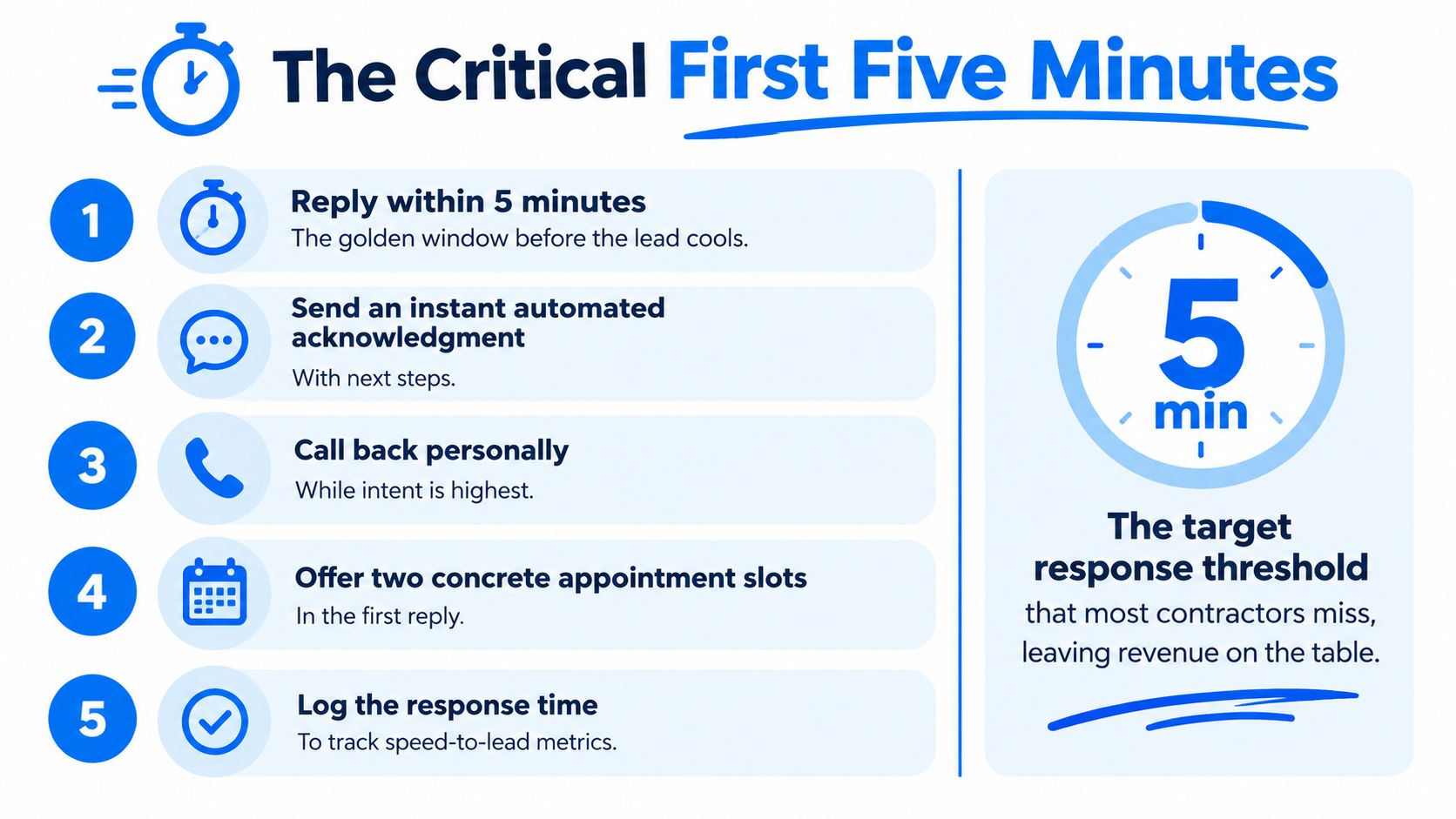
A contractor benchmark reported that responding to a website inquiry within **60 seconds can increase conversion by 391%**, while the median contractor response time was **five minutes**, according to [reported electrical-services landing-page statistics](https://www.webtonic.io/blog/electrical-services-landing-page-statistics). Treat that as benchmark evidence, not a guaranteed result for every market. The operational lesson is sound: response speed belongs in the marketing plan.
### Create a response protocol
The first response should be fast, useful, and controlled. Automation can acknowledge the request, but it shouldn't pretend to diagnose an electrical fault or promise an arrival time nobody has confirmed.
1. **Capture and verify:** Confirm the phone number and service location. Suppress duplicates and flag requests outside the service area.
2. **Acknowledge immediately:** Send an SMS stating that the request was received and explain what happens next.
3. **Ask two useful questions:** Identify the problem type and urgency. For example, distinguish a planned lighting project from smoke, sparking, or a complete outage.
4. **Call personally:** A dispatcher, owner, or designated employee should call while the customer is still available.
5. **Offer concrete options:** Give the earliest realistic appointment window or route emergency intent to the on-call person.
6. **Log the outcome:** Record response time, contact status, qualification, booking, and source.
> **Human handoff matters:** An automated text can confirm receipt. It can't replace judgment when a customer reports a safety risk.
Set ownership by shift and service category. If technicians are driving, the office or on-call dispatcher needs permission and tools to handle new inquiries. If nobody is available after hours, state the actual availability instead of implying round-the-clock service.
### Follow up without becoming noise
Unresponsive leads need a measured sequence, not an endless blast. Try different useful prompts, such as asking whether the project is still active, offering a call window, or requesting a photo for a planned assessment. Stop messages after a reply or opt-out, and make the human handoff obvious.
The right dashboard shows more than speed. Track:
- **Median first-response time:** How quickly the business acts.
- **Contact rate:** Whether staff reach the person.
- **Qualified-lead rate:** Whether the request fits service, location, and urgency.
- **Booking rate:** Whether qualified opportunities become appointments.
- **Show rate and revenue per lead:** Whether the acquired work contributes value.
For implementation ideas around response timing, [BenjiAds' speed-to-lead guide](https://benjiads.com/blog/speed-to-lead) can sit alongside your phone system, CRM, and scheduling procedures. The technology is secondary to the rule that every inquiry has an owner and a next action.
## Tracking Profit, Not Just Leads
Cost per lead is easy to report and easy to misuse. It rewards volume even when forms are incomplete, callers are outside the territory, or prospects never accept an estimate. A contractor should treat CPL as a diagnostic measure, not the final decision metric.
A 2025 benchmark summarized from LocaliQ data covering **3,211 U.S. home-service search campaigns** reported a median click-through rate of **6.37%**, average cost per click of **$7.85**, conversion rate of **7.33%**, and cost per lead of **$90.92**. For electrical campaigns, the reported figures were approximately **9.08% conversion, $12.18 CPC, and $93.69 CPL**, as detailed in [home-service lead cost benchmarks](https://www.nowbookedmarketing.com/blog/home-service-lead-cost-benchmarks-search-ads-2025). These figures vary by geography, competition, season, and service mix, so use them as reference points rather than promises.
### Build one source of truth
Connect advertising data to the job record. Capture the campaign and keyword or audience source at inquiry, then update the record as the opportunity moves through qualification, estimate, booking, completion, and payment.
A useful reporting chain looks like this:
| Stage | Question to answer |
|---|---|
| Inquiry | Did a real person contact the business? |
| Qualification | Does the request fit location, service, and capacity? |
| Estimate | Did the customer receive a clear proposal? |
| Booking | Did the opportunity become scheduled work? |
| Completion | Was the job completed and paid? |
| Margin | Did the work justify acquisition and delivery costs? |
Use client-side and server-side conversion tracking where your systems support it. Client-side events help advertising platforms understand page and form behavior. Server-side or CRM-confirmed events help correct for incomplete browser signals and identify the outcomes that matter, such as qualified opportunities and booked jobs.
### Let margin make the decision
A **$94 lead can outperform a $20 lead** when it produces better booking rates, average tickets, and contribution margin, as the benchmark discussion explains. The inexpensive lead may represent a vague request, a distant address, or a customer seeking work you don't perform. The higher-cost lead may be a well-scoped commercial inquiry that turns into profitable scheduled work.
Review performance using a rolling **30-day baseline**, then compare campaigns by qualified-booking cost, revenue, and margin. Don't blend branded, emergency, planned residential, and commercial traffic into one report. Each has a different sales cycle and operational burden, so budget decisions need the same segmentation used in campaign setup.
## Building Trust Through Compliance and Safety
Reviews help a customer shortlist an electrical contractor, but they don't prove that the contractor is qualified for a particular job. In safety-critical work, the marketing must make competence verifiable.
Consumer research indicates that **97% of consumers read local-business reviews and 85% are more likely to choose businesses with positive reviews**, according to [coverage of marketing for electricians in the United States](https://madeforbuilders.com/en-US/blog/marketing-for-electricians-usa-complete-guide/). Those figures explain why review collection matters. They don't justify treating review volume as a substitute for licensing, insurance, safe work practices, or accurate service claims.
### Put evidence beside the offer
For each major service, review the claims on your ads, landing pages, proposals, and profile:
- **Licensing:** Display applicable license information accurately and avoid implying universal coverage across jurisdictions.
- **Insurance:** State relevant insurance information only when current and verified.
- **Permits and inspections:** Explain when the project may require coordination, and clarify who handles each step.
- **Service boundaries:** Identify where the team works and where it doesn't.
- **Technical scope:** Separate emergency repairs, panel upgrades, EV chargers, generators, rewiring, and commercial work rather than presenting one vague capability list.
- **Documentation:** Use real project photos, itemized proposals, and clear exclusions where they affect scope.
Avoid unsupported promises such as guaranteed compliance, instant arrival, or an outcome that depends on an inspection or utility decision. A customer who understands the process is less likely to feel misled when the job requires additional work or approval.
The same discipline applies to reviews. Ask for feedback after completed work, respond professionally to criticism, and never edit the customer's experience into a claim the business can't substantiate. Your marketing should make the safest next step obvious, not pressure someone into an unsuitable service.
---
benjiads combines ad creation, campaign setup, landing funnels, conversion tracking, and SMS-based lead follow-up for local service businesses, including electrical contractors. Visit [benjiads](https://benjiads.com) to see how you can connect paid acquisition with verified inquiries and faster proposal handling, then decide whether that workflow fits your team.