Source: https://benjiads.com/blog/local-business-internet-marketing
Publisher: benjiads, https://benjiads.com
Published: 2026-10-12
Updated: 2026-10-12
Cite as: benjiads, "Local Business Internet Marketing: A Practical Guide", benjiads.com/blog/local-business-internet-marketing
Reuse: you may quote this article with attribution and a link to the source.
# Local Business Internet Marketing: A Practical Guide
Master local business internet marketing with proven paid, organic, and SMS strategies that deliver verified leads without wasting your budget.
**76%** of people who do a local search on a smartphone visit a related physical business within **24 hours**, and **28%** of those searches lead to a purchase. That turns local business internet marketing into a near-immediate revenue system, not a slow branding exercise.
Most plumbers, electricians, cleaners, and dentists don't lose because they lack traffic. They lose because the click doesn't connect to a fast page, a clear offer, and a fast reply. The businesses that win treat every search, ad, and message as the start of a short decision cycle, not a content project.
## Table of Contents
- [Why Local Internet Marketing Is Different From General Marketing](#why-local-internet-marketing-is-different-from-general-marketing)
- [The real job is to shorten the path to contact](#the-real-job-is-to-shorten-the-path-to-contact)
- [Generic marketing metrics can mislead local operators](#generic-marketing-metrics-can-mislead-local-operators)
- [The Three Core Channels Local Businesses Should Master](#the-three-core-channels-local-businesses-should-master)
- [Paid ads capture urgent demand](#paid-ads-capture-urgent-demand)
- [Organic visibility builds trust over time](#organic-visibility-builds-trust-over-time)
- [Direct follow-up turns interest into work](#direct-follow-up-turns-interest-into-work)
- [Organic Visibility Versus Paid Advertising for Local Growth](#organic-visibility-versus-paid-advertising-for-local-growth)
- [What organic does well](#what-organic-does-well)
- [What paid does well](#what-paid-does-well)
- [Setting Up Mobile-First Landing Pages That Convert Quickly](#setting-up-mobile-first-landing-pages-that-convert-quickly)
- [Speed beats decoration](#speed-beats-decoration)
- [Make the page match the search intent](#make-the-page-match-the-search-intent)
- [Automated Follow-Up Strategies That Actually Book Jobs](#automated-follow-up-strategies-that-actually-book-jobs)
- [Speed to lead changes the math](#speed-to-lead-changes-the-math)
- [Build the first reply around confirmation](#build-the-first-reply-around-confirmation)
- [Use staff alerts and timestamps](#use-staff-alerts-and-timestamps)
- [Adapting to AI Search and Inaccurate Listing Risks](#adapting-to-ai-search-and-inaccurate-listing-risks)
- [Consistency now matters across every surface](#consistency-now-matters-across-every-surface)
- [Accuracy beats volume when trust is fragile](#accuracy-beats-volume-when-trust-is-fragile)
- [Tracking the Metrics That Reflect Real Local Business Growth](#tracking-the-metrics-that-reflect-real-local-business-growth)
- [Measure the handoff, not just the click](#measure-the-handoff-not-just-the-click)
- [Treat consistency and response time as the edge](#treat-consistency-and-response-time-as-the-edge)
## Why Local Internet Marketing Is Different From General Marketing
Local business internet marketing works on compressed intent. A homeowner searching for an electrician or a same-day cleaner usually isn't browsing for entertainment, they're trying to solve a problem now. That's why the **76% visit rate** and **28% purchase rate** matter so much, because they show how quickly local discovery can turn into offline action when the fit is right, as summarized in [Google-reported local search statistics](https://searchlab.nl/en/statistics/local-seo-statistics-2026).
### The real job is to shorten the path to contact
A local search doesn't need a long nurture sequence. It needs a phone number that's obvious, hours that are correct, a landing page that opens quickly, and enough proof to remove doubt. If those pieces aren't in place, the user moves to the next provider without much friction.
That's why a lot of generic digital advice misses the mark. Broad awareness campaigns can be useful for brands with long buying cycles, but local service companies need measurable conversations, booked appointments, and completed jobs. If the traffic doesn't reach a call, form, text, or map click, it's usually just expensive noise.
> **Practical rule:** if the next step isn't visible in the first screen on mobile, the campaign is already leaking value.
For a simple checklist on tightening the front end of your lead flow, [actionable tips to boost leads and reach](https://clipcreator.ai/blog/digital-marketing-tips-for-small-business) is a useful reference. The right takeaway is not “get more content,” it's “make discovery easier to convert.”
### Generic marketing metrics can mislead local operators
Impressions and engagement can look healthy while the business stays flat. A post can get attention, but if the user can't verify the service area or reach the office quickly, the visit never becomes a lead. Local marketing has to be judged by proximity to revenue, not by how busy the dashboard looks.
The best local campaigns feel almost unglamorous. They focus on service names, neighborhoods, response time, and proof. That's boring compared with big-brand storytelling, but it's what moves a plumber's calendar or a cleaner's route.
## The Three Core Channels Local Businesses Should Master
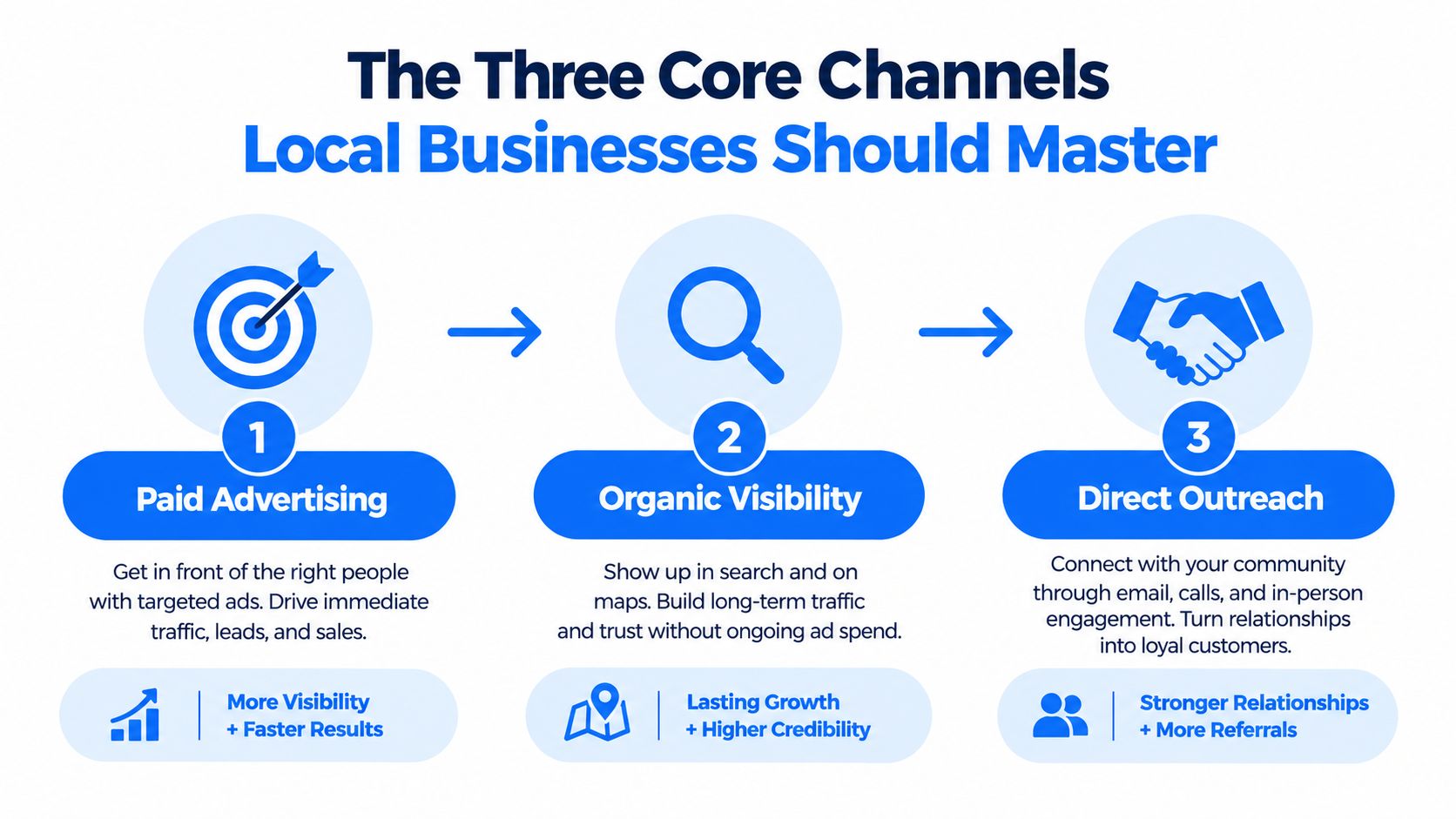
The three channels that matter most for local service businesses are paid advertising, organic visibility, and direct follow-up. They do different jobs, but they only create value when they feed the same lead flow. If one part works and the others fail, the whole system underperforms.
### Paid ads capture urgent demand
Paid search and social ads are the fastest way to get in front of people who need help now. They're especially useful for emergency or high-intent services, because the user already has a problem and is comparing options. For a local operator, that means ads should be built around a service, a location, and a simple contact action.
### Organic visibility builds trust over time
Organic visibility is the long game. It comes from accurate listings, service pages, reviews, and content that helps search engines understand who you are and where you work. If you want a practical framework for that side of the mix, the [guide to answer engine optimization](https://ogtool.com/blog/aeo-vs-seo-what-actually-changed-in-search-and-what-still-converts-in-2026) is useful because it reflects how search behavior is shifting without pretending SEO is dead.
### Direct follow-up turns interest into work
A click or form fill is not a booked job. The lead still has to be contacted, qualified, and scheduled. That's why direct outreach sits at the center of the system, not at the end of it.
If you want a wider view of channel selection, [this overview of the online advertising platform](https://benjiads.com/blog/online-advertising-platform) is worth a look because it shows how paid traffic connects to lead capture. The core idea is simple, ads bring attention, organic visibility creates confidence, and follow-up collects the revenue.
> A lead funnel is only as good as the slowest handoff in it.
## Organic Visibility Versus Paid Advertising for Local Growth
Organic and paid aren't rivals. They solve different problems, and local businesses usually need both if they want steady work instead of random spikes. The mistake is expecting one channel to behave like the other.
### What organic does well
Organic visibility compounds when the business keeps its listings accurate, earns reviews, and publishes pages that match real services and service areas. It's slower to build, but once it's working, it can keep producing qualified traffic without paying for every click. That makes it valuable for businesses that want lower dependence on media spend.
### What paid does well
Paid campaigns are better when speed matters. They can bring in inquiries faster, test offers faster, and show which message gets the strongest response. That's why local operators with seasonal demand or urgent service categories often start here.
For home services operators comparing budget allocation, [reviewing home services ad spend](https://notfair.co/google-ads-audit/home-services) can help frame the trade-off between volume and efficiency. The useful question isn't which channel is “better,” it's which one fits the business's cash flow, urgency, and internal capacity.
| Factor | Organic visibility | Paid advertising |
|---|---|---|
| Time to results | Slower | Faster |
| Control over volume | Lower | Higher |
| Ongoing effort | Consistent maintenance | Active management |
| Best use case | Trust and long-term demand | Immediate lead generation |
If you're trying to decide where to start, use urgency as the filter. If the phones need to ring this week, paid usually deserves priority. If the business needs durable visibility and can wait for momentum, organic becomes the base layer.
[Small business SEO guidance](https://benjiads.com/blog/small-business-seo) matters here because local SEO is not a side project. It's the inventory of trust that makes paid clicks more believable and cheaper to convert.
## Setting Up Mobile-First Landing Pages That Convert Quickly

Local traffic is impatient traffic. People tap an ad or listing on a phone, scan the page, and decide almost immediately whether the business feels ready. If the site loads slowly or hides the phone number, the visit is wasted.
### Speed beats decoration
Google's mobile-speed review reports that **53%** of users leave when a page takes more than three seconds to load, and faster loading can improve conversion rates by up to **27%**, according to [Google's mobile site speed playbook](https://www.thinkwithgoogle.com/_qs/documents/4290/c676a_Google_MobileSiteSpeed_Playbook_v2.1_digital_4JWkGQT.pdf). That means a pretty page with heavy scripts can lose money while a simpler page books jobs.
For a local service landing page, the priorities are straightforward. Keep the page light, compress images, strip unnecessary plugins, and put the contact path where the thumb can reach it.
- **Phone number first:** make the call option obvious without scrolling.
- **Short form second:** ask only for what's needed to start contact.
- **Service and location clarity:** say exactly what you do and where you do it.
- **Fast load path:** remove anything that delays the first meaningful view.
> If a prospect has to hunt for the next step, the page is failing its job.
### Make the page match the search intent
A person who searched for drain cleaning doesn't want a homepage full of brand copy. They want drain cleaning, a clear service area, a reason to trust the company, and a simple way to respond. The more closely the page matches the query, the less effort the user has to spend interpreting it.
That match matters even more when the click came from a mobile ad or map result. The page should feel like a direct continuation of the search, not a detour into brand storytelling. That's how you protect paid spend and give organic traffic a fair shot at converting.
## Automated Follow-Up Strategies That Actually Book Jobs
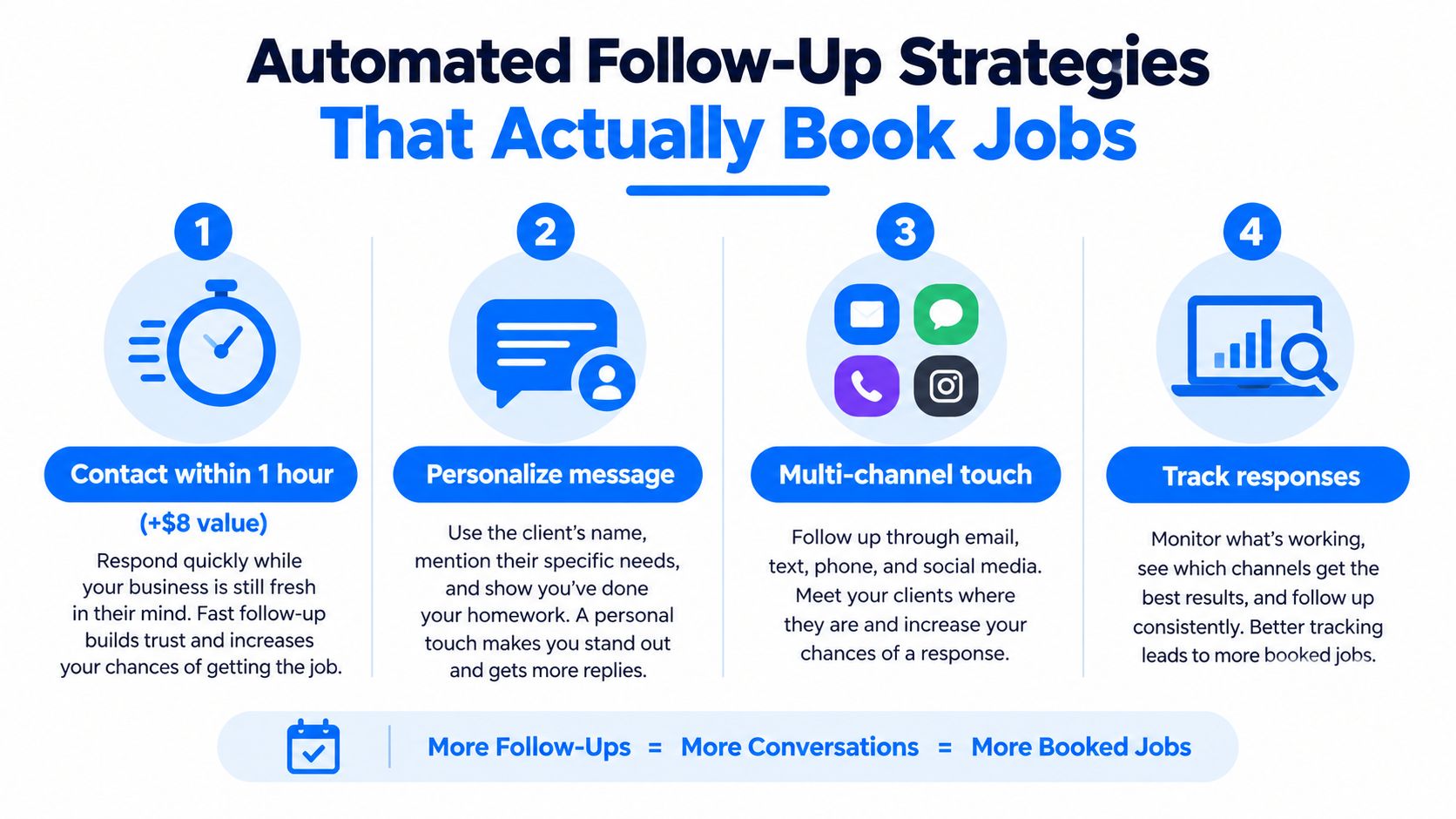
Most local businesses don't have a lead problem. They have a response problem. The lead arrives, then gets delayed, forgotten, or mishandled while the owner is on a ladder, in a truck, or on another job.
### Speed to lead changes the math
Research from a Harvard Business Review study of **2,241 companies** found that firms contacting leads within one hour were nearly **seven times** more likely to qualify them, while contacting within five minutes produced approximately **21 times** higher qualification odds than waiting 30 minutes, as summarized in [speed-to-lead research](https://christopholivierconsulting.com/speed-to-lead-statistics/). That's not a subtle effect. It means the first response often decides whether the inquiry becomes a real conversation.
### Build the first reply around confirmation
An automated SMS acknowledgment should go out immediately after a verified submission. It should confirm the business name, restate the requested service or location, and offer a simple reply path. A short message such as “Reply 1 to book, 2 to ask a question” is better than a vague thank-you page that disappears after the click.
### Use staff alerts and timestamps
Automation should not replace human follow-up, it should trigger it. Staff need an alert, a retry rule if the first attempt fails, and timestamps that record inquiry, message delivery, reply, and handoff. That way, the team can see where the drop-off happens instead of guessing.
[Lead nurturing automation guidance](https://benjiads.com/blog/lead-nurturing-automation) is useful if you're trying to connect fast text response with a longer booking workflow. The key is to measure the path from inquiry to booked job, not just the number of leads collected.
> A cheap lead that never gets answered is expensive in disguise.
Promotional texting also needs consent and proper opt-out handling. If your follow-up is sloppy, it can create legal risk as well as missed revenue, so the workflow has to be both fast and compliant.
## Adapting to AI Search and Inaccurate Listing Risks
Local discoverability is no longer limited to traditional search pages. People are clicking AI-generated overviews, checking social platforms, and comparing directory listings before they call. That makes accuracy a conversion asset, not an admin detail.
A **2025 U.S. consumer study** found that **60%** of consumers click on Google AI-generated overviews, **53%** may reject a business because its listings contain inaccurate information, and **85%** consider contact information and opening hours important when researching local businesses, according to [Rio SEO's consumer behavior study](https://www.rioseo.com/resources/white-paper/2025-local-search-consumer-behavior-study/).
### Consistency now matters across every surface
If the hours on the website differ from the hours in a profile, the prospect notices. If the phone number is buried or the service area is vague, trust drops quickly. That's especially true when discovery begins in an AI summary or on a social platform, where users expect the answer to be immediate and clean.
The practical fix is cross-channel consistency. Keep the same phone number, service area, hours, and core service descriptions across the website, profiles, and directories. Reviews and credentials should support the claim, not contradict it.
### Accuracy beats volume when trust is fragile
Some businesses still think the answer is more blog posts or more keywords. That's not the main issue anymore. If the facts are wrong or scattered, the prospect won't stay long enough to care how much content exists.
That's why local business internet marketing now includes information hygiene. Search, AI summaries, maps, and social discovery all pull from business facts that need to stay aligned. When those details drift, the funnel leaks before the first call.
## Tracking the Metrics That Reflect Real Local Business Growth
Cheap leads can look good and still fail the business. The metric that matters is one that separates traffic, lead quality, and booked work. If those stages get lumped together, the numbers hide the actual problem.
Start with cost per lead, but treat it as the first filter, not the finish line. A qualified conversation matters more, because many inquiries are wrong-fit, incomplete, or never answer the phone. Booked job is the result that pays the bills.
### Measure the handoff, not just the click
A campaign can generate clicks and forms while the office misses calls or delays replies. Tracking has to reach past the ad platform. Daily reporting should show which creative produced the lead, which source produced the conversation, and which inquiry turned into revenue.
Use that information to cut waste fast. If a channel brings in low-cost leads that never answer the phone, the problem may be the offer, the landing page, or follow-up speed. A good dashboard makes that visible before the budget is gone.
### Treat consistency and response time as the edge
Local businesses do not need perfect dashboards. They need honest ones. Accurate listings, fast pages, and quick replies work together, and that combination often beats a more expensive competitor that moves slowly.
[benjiads](https://benjiads.com) builds that system into one workflow. It brings local advertising, landing funnels, tracking, and SMS-based follow-up into the same setup, which is practical for owners who want paid acquisition to turn into booked jobs without managing every moving part themselves.
If you want local business internet marketing built around leads, speed, and booked work instead of vanity metrics, BenjiAds brings the ads, landing pages, tracking, and follow-up pieces into one workflow your team can close against.