Source: https://benjiads.com/blog/lawn-care-ads
Publisher: benjiads, https://benjiads.com
Published: 2026-09-27
Updated: 2026-09-27
Cite as: benjiads, "Lawn Care Ads: Strategies That Actually Book Jobs", benjiads.com/blog/lawn-care-ads
Reuse: you may quote this article with attribution and a link to the source.
# Lawn Care Ads: Strategies That Actually Book Jobs
Discover how to run profitable lawn care ads that capture seasonal demand. Learn creative strategies, budget tips, and automated follow-up flows
The worst lawn care ad problem isn't a bad headline. It's a truck that's already rolling, a phone that's ringing, and a lead that goes cold because nobody got back to the homeowner fast enough. If that sounds familiar, the fix isn't another burst of cheap clicks, it's a system that turns seasonal demand into booked work, recurring contracts, and a follow-up process your crew can keep up with.
## Table of Contents
- [The Economics and Seasonality of Lawn Care Advertising](#the-economics-and-seasonality-of-lawn-care-advertising)
- [What the economics really mean](#what-the-economics-really-mean)
- [Why seasonality changes the game](#why-seasonality-changes-the-game)
- [Building Funnels for High-Margin Recurring Contracts](#building-funnels-for-high-margin-recurring-contracts)
- [Segment by service intent](#segment-by-service-intent)
- [Qualify for value, not just volume](#qualify-for-value-not-just-volume)
- [Mastering Seasonal Budget Allocation and Bidding](#mastering-seasonal-budget-allocation-and-bidding)
- [Spend where intent is highest](#spend-where-intent-is-highest)
- [Protect the off-season without starving the system](#protect-the-off-season-without-starving-the-system)
- [Automating SMS Follow-Up to Secure the Booking](#automating-sms-follow-up-to-secure-the-booking)
- [Why text beats voicemail and email](#why-text-beats-voicemail-and-email)
- [Build the response flow before launch](#build-the-response-flow-before-launch)
- [Tracking Downstream Metrics and True Profitability](#tracking-downstream-metrics-and-true-profitability)
- [Track beyond the platform dashboard](#track-beyond-the-platform-dashboard)
- [Use a simple profitability lens](#use-a-simple-profitability-lens)
- [Avoiding the Most Expensive Campaign Pitfalls](#avoiding-the-most-expensive-campaign-pitfalls)
- [The mistakes that drain budget](#the-mistakes-that-drain-budget)
## The Economics and Seasonality of Lawn Care Advertising
A lot of owners treat advertising like a panic button. They spend when the pipeline feels thin, then cut back as soon as the schedule fills. That usually means they underinvest right when demand is building and overpay when competition is already tight.
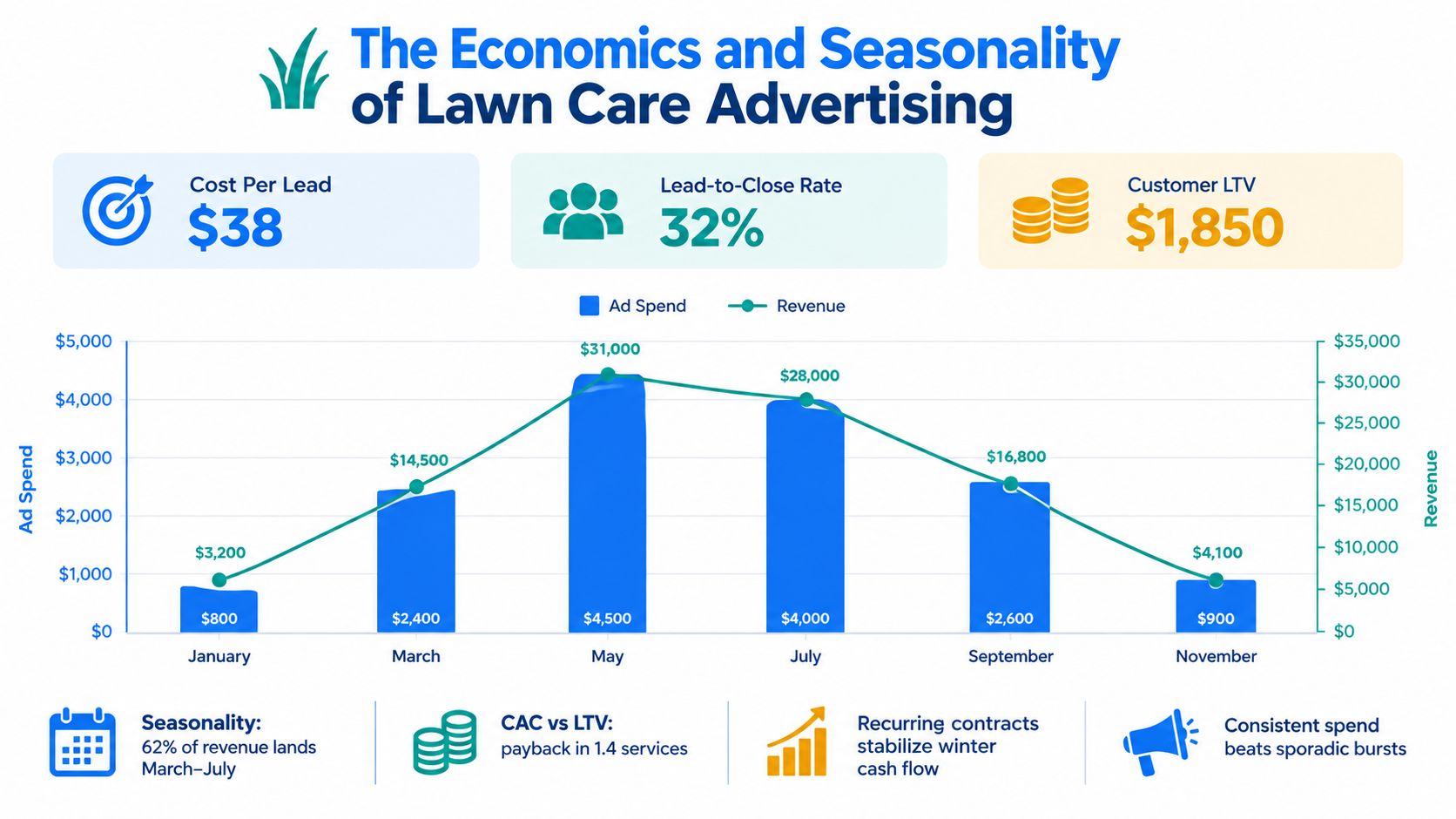
The seasonality is obvious once you look at search behavior and spend together. ServicePro benchmark data shows **“lawn care near me”** hitting **165,000 monthly searches in March**, while **“lawn mowing near me”** rises from **14,000 in February to 60,500 in March** and remains high through May. In the same benchmark set, average monthly paid spend was **$2,486.95**, average monthly leads were **26**, and average cost per lead was **$90** ([ServicePro benchmark data](https://servicepro.co/blog/lawn-care-marketing)). For a clean way to calculate your own numbers, use this [cost per lead formula guide](https://benjiads.com/blog/cost-per-lead-formula).
### What the economics really mean
A healthy lawn care ad program is not about chasing the cheapest click. It is about buying enough qualified demand during peak windows to keep trucks moving without burying the office in junk leads. The benchmark figures above show that paid acquisition should be treated as a regular operating expense, not a side test.
A company study of advertising spend backs that up. It found advertising averaged **5.6% of total sales**, larger firms spent **two to three times** the percentage of sales on advertising compared with small and medium firms, and the full sample averaged **$121,405.70** in advertising expenditures ([ASHS study](https://journals.ashs.org/downloadpdf/view/journals/hortsci/56/6/article-p695.pdf)). The practical lesson is straightforward. Companies that treat ads as a managed cost keep buying demand while everyone else hesitates.
> **Practical rule:** budget for the season you sell into, not the month you'd prefer to spend in.
### Why seasonality changes the game
Spring demand does more than raise volume. It changes how fast you need to answer. When March hits, the inbox fills, the phone starts ringing, and the businesses with a real response system collect the jobs everyone else is still trying to quote. Your ad calendar should follow local weather and service timing, not a generic monthly spend pattern.
The cleanest way to view lawn care ads is as a routed revenue system. Stay visible during peak search periods. Keep presence alive in the shoulder months. Do not mistake a quiet week for a reason to disappear.
The firms that win are not the ones with the prettiest campaigns. They are the ones that can hold demand, answer fast, and turn one season's acquisition into next season's recurring base.
## Building Funnels for High-Margin Recurring Contracts
A one-time mowing lead is cheap to attract and expensive to rely on. Recurring maintenance, seasonal plans, and add-on work create the route density that keeps crews busy, so the funnel has to be built around those accounts from the start.
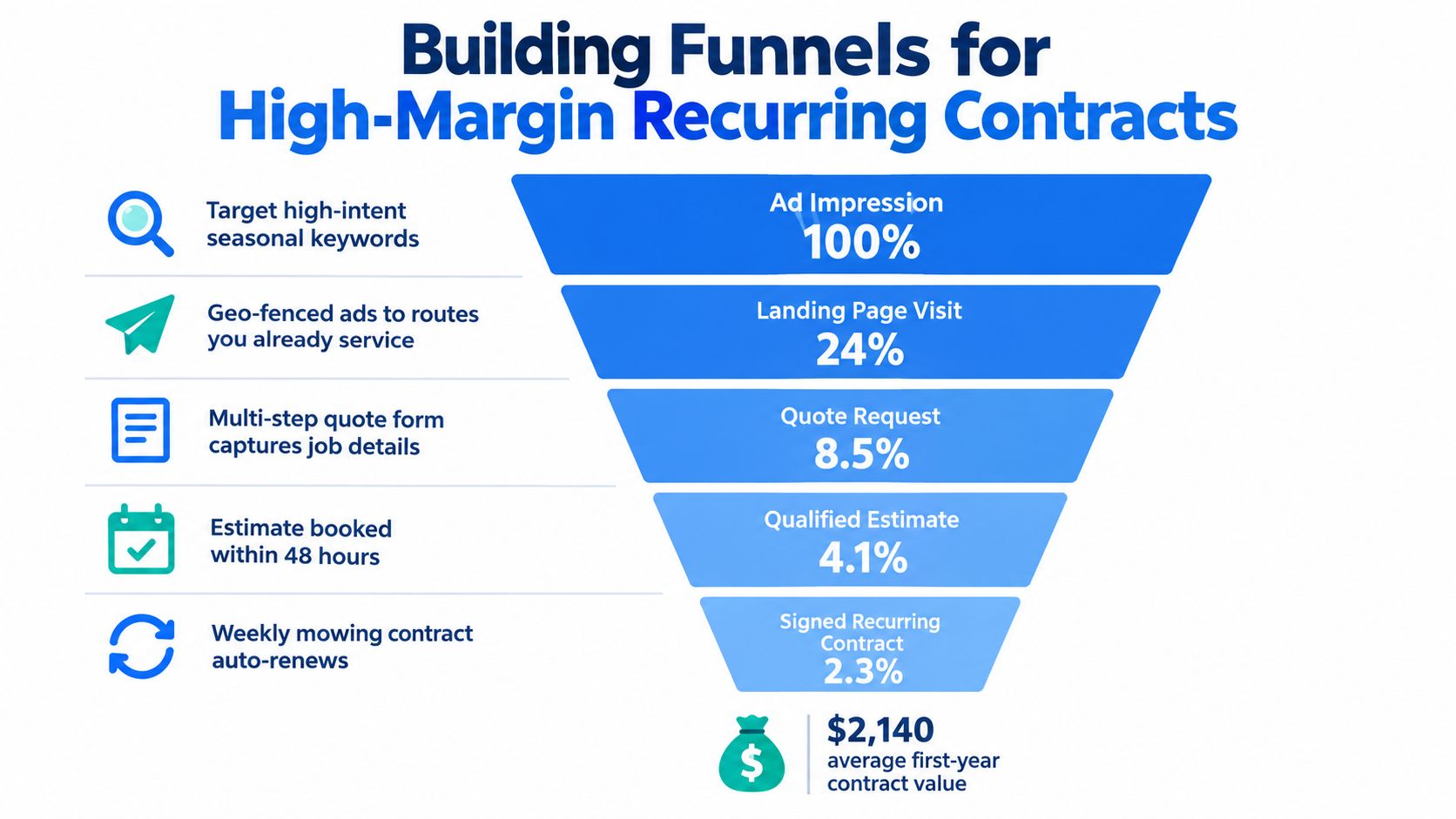
A recent landscaping marketing guide says **subscription and contract work made up about 66% of the U.S. lawn care market in 2025**, yet many ads still sell mowing alone instead of retention, seasonal plans, and add-ons ([Tofu landscaping guide](https://tofu.com/blog/landscaping-marketing-ideas)). That gap matters. An ad that promises only a cheap cut attracts shoppers who switch on price. An ad and landing page that frame the offer as an ongoing service relationship attract homeowners who value consistency and property care.
### Segment by service intent
Sending every lead to the same quote page is the first mistake. Mowing, fertilization, aeration, cleanup, and full-season maintenance are different buying intents, so they need separate ad groups, page copy, and forms. A homeowner looking for storm cleanup does not want the same message as someone comparing weekly service.
Service-specific pages do three jobs better than a homepage. They cut confusion, qualify intent faster, and make it clear what kind of account you want to win. In practice, that means tighter headlines, photos that match the exact service, and a form that asks for the job details your office needs before anyone calls back.
> **Good funnel rule:** if the customer cannot tell whether they are buying a recurring program or a one-time visit, the ad copy is too vague.
### Qualify for value, not just volume
A lead form should screen for route fit, service type, and timing. You do not need a long interrogation, but you do need enough structure to separate serious buyers from price shoppers. Keep the form short, then move the conversation into text or a quick estimate workflow that makes it easy to confirm scope and availability.
For automation, one practical setup is a trade-specific landing funnel with approved ad creative, localized messaging, and SMS intake tied to the exact service line being promoted. For a closer look at how an [automated marketing platform guide](https://benjiads.com/blog/automated-marketing-platform) can handle creative, funnels, tracking, and follow-up in one place, see the workflow breakdown there. Tools like [BenjiAds](https://benjiads.com) can automate the ad creative, funnel, tracking, and text follow-up for this kind of setup, which matters when the goal is a recurring contract, not a single mow.
The point is not more inquiries. It is more accounts that renew, add services, and keep revenue steady when the grass stops growing.
## Mastering Seasonal Budget Allocation and Bidding
A flat monthly budget looks tidy on paper and usually underperforms in practice. Lawn care demand rises and falls with weather, school calendars, and homeowner urgency, so spend has to follow the season instead of pretending every month behaves the same.
As noted earlier, larger firms tend to reinvest hardest when demand peaks. The takeaway is not to copy another company's budget line by line. It is to spend where the market is ready to buy, then tighten back down before wasted clicks start piling up.
### Spend where intent is highest
Budget pacing should start with the highest-intent searches. Terms tied to immediate service needs deserve the strongest support, while broader awareness spend stays secondary. Lawn care ads work best when they are tied to route-level service areas, because you are not just buying clicks, you are buying jobs a crew can service without burning time on the road.
The same logic applies to bidding. Broad reach creates noise, while radius-focused targeting and service-specific intent keep spend aligned with the neighborhoods and jobs you want. If you sell multiple service lines, do not let them compete inside one blended budget. Separate them by margin and booking behavior, then fund the line that brings in recurring value, not just a one-off mow.
### Protect the off-season without starving the system
The off-season should not be a full shutdown. A smaller always-on presence keeps remarketing, brand familiarity, and maintenance offers in motion, so you are not starting from zero when spring demand returns. It also gives you a live account history, which makes it easier to see whether a dip is seasonal or a sign the campaign needs work.
A simple rule usually beats a clever one. Put the most money behind the services with the highest close potential during the season they are naturally in demand, then taper with intent instead of turning the account off. That keeps the system fed, preserves learning, and gives you a better shot at booking the higher-value work that renews.
## Automating SMS Follow-Up to Secure the Booking
The biggest loss in lawn care ads usually happens after the form fill, not before it. A homeowner raises their hand, the phone rings, and if nobody answers quickly, the job goes to the next company that texts back first.
Home-services call benchmarks cited in industry coverage report that **phone leads convert at 46% once a rep answers**, which is why missed calls do real damage to booked revenue (Coalmarch benchmark report_0.pdf)). The point is simple. **Speed-to-lead guide** matters because response time changes the economics of the whole channel, and a slow reply breaks the chain between ad click and booked job. See this [speed-to-lead guide](https://benjiads.com/blog/speed-to-lead) for the response-time benchmarks.
### Why text beats voicemail and email
Email is too slow for most local service demand, and voicemail makes the prospect do the work later. SMS fits the way homeowners behave when they request a quote on their phone. It gives you a direct line to confirm address, service type, and timing without dragging the exchange into a long back-and-forth.
Automation helps here. An instant text can acknowledge the inquiry, ask one or two qualifying questions, and move the booking forward while the crew is still in the field. If the owner wants control, use an approval workflow so the ads and follow-up sequences are prepared in advance and only go live when approved.
### Build the response flow before launch
A usable follow-up flow is straightforward:
1. **Lead arrives.** The form or call lands in the CRM immediately.
2. **SMS goes out.** The first text confirms receipt and invites a reply.
3. **Qualification happens by text.** The system asks for service type, address, and timing.
4. **Estimate or booking is offered.** The next message points to the next step.
5. **No reply gets a reminder.** The follow-up keeps the conversation alive without manual chasing.
> **Operational truth:** the best ad account in the world can't recover a slow callback.
For lawn care owners who want the advertising and the follow-up to live in one system, [BenjiAds](https://benjiads.com) can run SMS-based intake with phone verification and automated follow-up sequences. That matters when the office is busy, the crew is out, and the lead needs a response before the competitor gets there.
## Tracking Downstream Metrics and True Profitability
A lawn care campaign can look healthy in Google Ads and still lose money once the phone starts ringing. If the landing page misses, the office is slow to answer, or the lead never turns into a booked visit, cheap clicks do not matter.
For lawn care and landscaping search ads, a recent benchmark reported a **4.85% conversion rate**, a **$4.67 cost per click**, and a **$84.24 cost per lead** ([Evergrow benchmark data](https://evergrowmarketing.com/2025-landscaping-and-lawn-care-google-ads-benchmarks/)). That mix means the job is not chasing traffic. It is building a system that turns paid interest into scheduled work, especially for recurring maintenance instead of one-off mowing requests.
### Track beyond the platform dashboard
The ad interface only shows platform-level activity. It does not show what the business collected. Dual tracking, with server-side and client-side conversion data together, gives ad platforms better signals and gives owners a clearer view of what is really profitable.
The useful metrics are the ones that connect media to revenue. Booked jobs, close rate, average job value, and downstream customer value tell you whether the account is producing work the crew can profitably complete. If a team only watches CTR or CPC, it can end up optimizing for cheap traffic that never becomes a truck roll.
### Use a simple profitability lens
Cost per booked job is the cleaner test. Start with cost per lead, then apply the close rate and the average value of the work. That tells you whether the campaign is paying back, and it should be checked by service line because recurring maintenance and one-time cleanup jobs do not behave the same way.
| Metric | Benchmark Value | How to act on it |
| --- | --- | --- |
| Conversion rate | **4.85%** | If it is far below this level, review the landing page, offer, and form friction before raising spend |
| Cost per click | **$4.67** | If CPC is acceptable but booked jobs stay weak, the problem is usually lead quality or response speed |
| Cost per lead | **$84.24** | If CPL is above this and close rate is under 20%, pause the ad group and fix qualification or follow-up |
Downstream visibility also matters outside the ad platform. Review velocity, map-pack ranking, and local visibility tend to improve when the acquisition engine is healthy and the business responds quickly. The strongest lawn care ads do more than produce leads. They feed the rest of the local marketing system with jobs that can turn into repeat revenue.
## Avoiding the Most Expensive Campaign Pitfalls
The most expensive mistakes in lawn care ads usually look harmless at first. The account is active, the budget is spending, and the reports show activity, but the jobs still are not profitable because the setup does not match how local service buyers choose a provider.
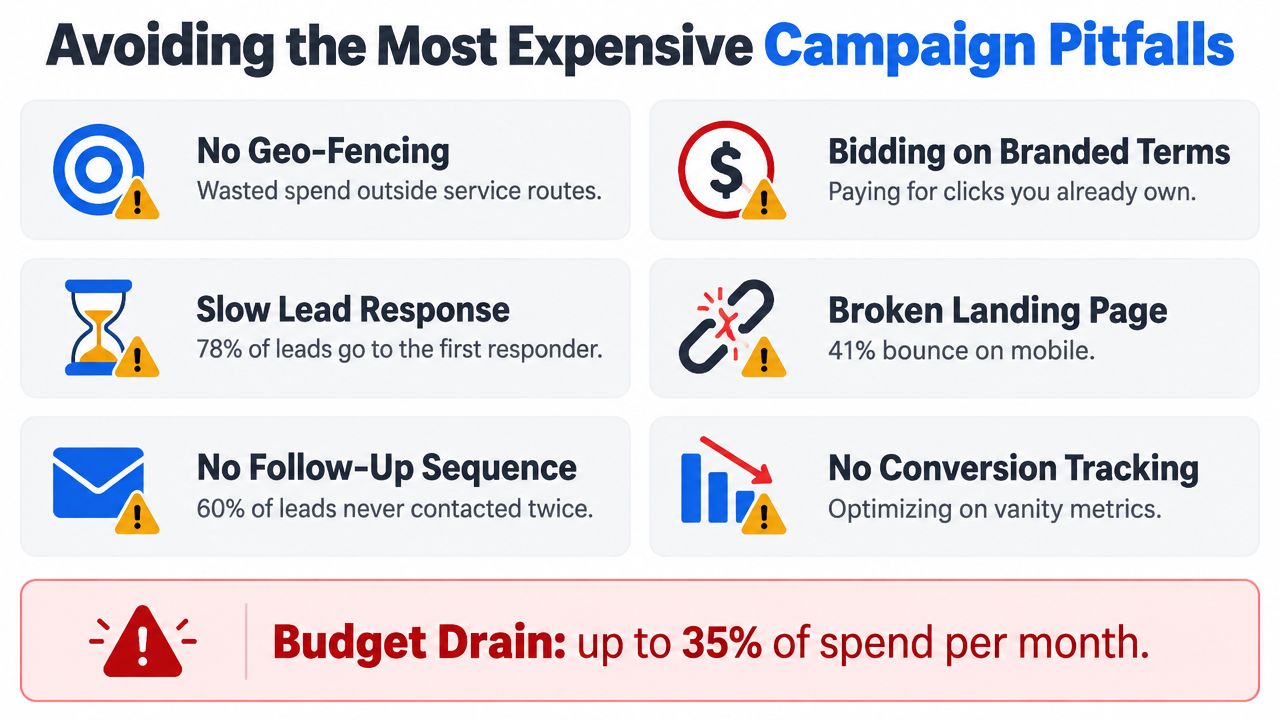
Tight intent beats broad reach in this category. Generic creative and wide geographic targeting waste money because they pull in people outside your routes or people who were never serious enough to book. As noted earlier, a lower CTR is not automatically a problem when search intent is strong, so do not cut a campaign just because it looks plain in the dashboard.
### The mistakes that drain budget
- **No geo-fencing,** which sends spend outside the routes you serve. Set a radius around your top three ZIP codes and exclude the rest, so crews are not chasing low-value leads.
- **Bidding on terms you already own,** which pays for demand that should have come through free brand search.
- **Slow lead response,** which lets faster competitors answer first. If calls and form fills sit untouched, good leads cool off before anyone speaks to them.
- **Broken mobile landing pages,** which waste clicks from homeowners on phones. If the page loads slowly or the form is hard to use, the ad budget pays for exits.
- **No follow-up sequence,** which leaves interested prospects uncontacted. A missed call or one text is not a system.
- **No conversion tracking,** which forces you to optimize on vanity metrics. You cannot protect profit if you do not know which campaigns turn into booked work.
> The campaign usually is not broken everywhere. It is broken at the point where the lead should have become a conversation.
The fix is operational, not cosmetic. Tight targeting, fast SMS follow-up, and clean tracking do more to protect your budget than constant creative tinkering. If you want lawn care ads to book jobs instead of just collect clicks, build the system around response speed, service fit, and recurring value.