Source: https://benjiads.com/blog/how-to-advertise-small-business-locally
Publisher: benjiads, https://benjiads.com
Published: 2026-10-04
Updated: 2026-10-04
Cite as: benjiads, "How to Advertise Small Business Locally in 2026", benjiads.com/blog/how-to-advertise-small-business-locally
Reuse: you may quote this article with attribution and a link to the source.
# How to Advertise Small Business Locally in 2026
Learn how to advertise small business locally with proven local SEO, Google and Meta ads, and lead follow-up tactics that turn clicks into real jobs.
You've got a website, a Facebook page, a Google Business Profile, and perhaps a few marketing subscriptions you barely use. Your calendar still has empty slots. Meanwhile, you're deciding whether to post again, boost a photo, launch Google Ads, offer a discount, rebuild the homepage, or call the agency that promised more leads.
The problem usually isn't a lack of advertising channels. It's a lack of sequence. Local advertising works when discovery, landing pages, tracking, and follow-up operate as one system, with every dollar judged by **booked jobs**, not impressions or cheap clicks.
## Table of Contents
- [Why Local Advertising Feels So Overwhelming Right Now](#why-local-advertising-feels-so-overwhelming-right-now)
- [The Local Advertising Funnel You Are Actually Trying to Build](#the-local-advertising-funnel-you-are-actually-trying-to-build)
- [Laying the Local SEO Foundation Before You Spend a Dollar](#laying-the-local-seo-foundation-before-you-spend-a-dollar)
- [Fix the Google Business Profile](#fix-the-google-business-profile)
- [Build consistent local references](#build-consistent-local-references)
- [Create a steady review process](#create-a-steady-review-process)
- [Running Google Search and Local Services Ads for High-Intent Demand](#running-google-search-and-local-services-ads-for-high-intent-demand)
- [Using Meta Ads to Fill the Local Awareness and Retargeting Gap](#using-meta-ads-to-fill-the-local-awareness-and-retargeting-gap)
- [Judge Meta by downstream quality](#judge-meta-by-downstream-quality)
- [Speed to Lead and Tracking Turn Clicks Into Booked Jobs](#speed-to-lead-and-tracking-turn-clicks-into-booked-jobs)
- [Track the source all the way through](#track-the-source-all-the-way-through)
- [Your First 30 Days and the Habits That Make It Work](#your-first-30-days-and-the-habits-that-make-it-work)
- [Week one](#week-one)
- [Week two](#week-two)
- [Week three](#week-three)
- [Week four](#week-four)
## Why Local Advertising Feels So Overwhelming Right Now
Small business owners face a crowded menu of options. Google Search captures active demand. Meta creates awareness and retargets visitors. Maps, directories, reviews, email, community groups, and local partnerships all influence whether someone trusts a business enough to call.
That variety becomes expensive when you treat every channel as a separate project. You can spend money on a polished ad while sending visitors to a vague homepage. You can generate leads and lose them in an unattended inbox. You can celebrate a low cost per click while your appointment book stays empty.
The first decision is therefore not “Which platform should I use?” It's “What must happen after someone responds?”
> **Practical rule:** Never add a channel until you know where its leads go, who contacts them, how quickly that happens, and which field records the outcome.
Local advertising has changed because small businesses are shifting money toward measurable digital channels. In 2026, **72% of SMB marketing budgets were reported to go toward digital channels**, while **24% planned to invest less in traditional media**, compared with **16% in 2025**, according to [BizIQ's local marketing statistics](https://biziq.com/blog/local-marketing-statistics/). The same source reported that **59% of SMBs ranked local SEO as a top priority**, and **41% spent less than $500 per month on advertising**.
That combination creates a clear operating constraint. You probably don't have enough budget to buy broad awareness and hope demand appears later. You need a narrow service area, a specific offer, a focused landing page, reliable tracking, and rapid contact.
Skip these first:
- **Boosting random Facebook posts:** A post can receive engagement without producing a qualified conversation.
- **Broad campaigns without exclusions:** Generic searches and irrelevant audiences consume small budgets quickly.
- **A website redesign before fixing conversion paths:** A prettier site won't rescue an unclear call to action.
- **Multiple subscriptions with overlapping features:** More tools often create more places for leads to disappear.
The practical plan is straightforward. Build the local foundation, capture high-intent demand, use Meta where it adds reach or retargeting, and measure the path from inquiry to booked work. The most important improvement may happen after the click, when a real person decides whether to answer.
## The Local Advertising Funnel You Are Actually Trying to Build
Local advertising isn't a collection of isolated tactics. It's a five-stage path:
1. **Local discovery**
2. **Click or call**
3. **Lead capture**
4. **Speed-to-lead follow-up**
5. **Booked job**
At the first stage, a potential customer finds you through Search, Maps, social media, a directory, or an AI-generated answer. If your profile is incomplete or your service area is unclear, discovery ends before the customer sees your offer.
At the second stage, the person clicks, calls, or sends a message. The ad must match the search intent, and the destination must make the next step obvious. A plumber advertising emergency repairs shouldn't send a searcher to a general page filled with unrelated services.
Lead capture is where interest becomes usable information. A short form should ask only for details needed to start the conversation. A phone call should reach a staffed number or trigger a clear callback process. If the form breaks on mobile, the funnel fails regardless of ad quality.
The fourth stage is follow-up. [Sales-response research summarized by Cirrus Insight](https://www.cirrusinsight.com/blog/sales-follow-up-statistics) reports that contacting a web lead within **5 minutes can make it about 21 times more likely to convert than waiting 30 minutes**. The same source says responding within an hour can make qualification about **7 times more likely** than waiting longer. Treat these as operating requirements, not inspirational benchmarks.
The final stage is a booked job. That is where you discover whether the campaign attracted a customer or merely generated activity. A lead that never answers, can't be served in your area, or won't book is not equivalent to revenue.
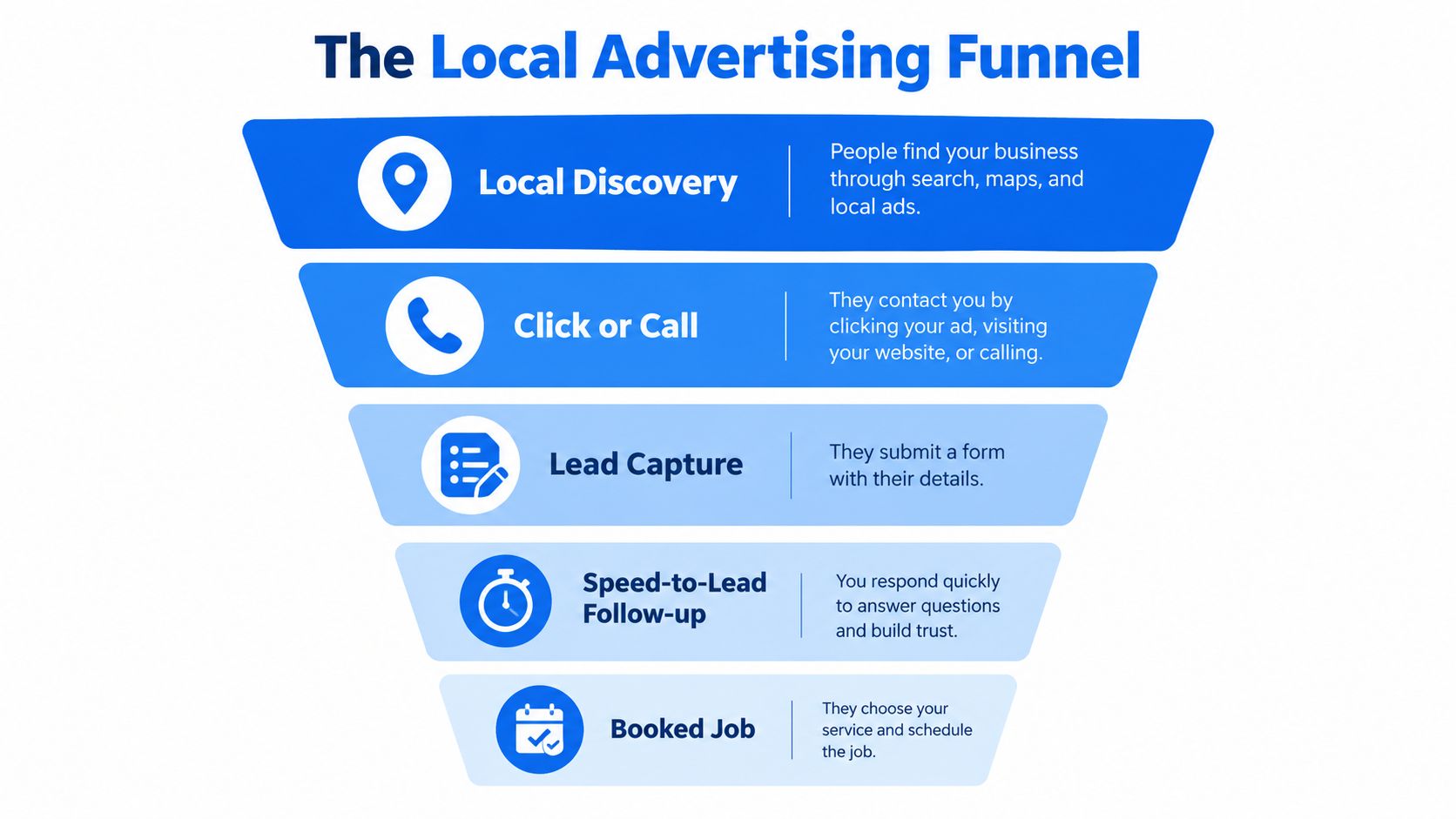
The budget data makes this discipline more important. When many SMBs spend modest amounts, wasted reach and broken follow-up hurt more than a missing impression. Local SEO feeds discovery, Google and Meta feed clicks and captures, and tracking plus response speed determine whether those clicks become appointments.
## Laying the Local SEO Foundation Before You Spend a Dollar
Start with the assets Google and customers already use to judge whether your business is real, relevant, and reachable. Paid advertising can create visibility, but it can't compensate for wrong hours, missing service information, weak reviews, or a phone number nobody answers.
### Fix the Google Business Profile
Claim and complete your Google Business Profile. Use the most accurate primary category, add relevant secondary categories, list your services, define service areas, verify hours, and upload current photos of the team, vehicles, workplace, or completed work.
Write the description for a local customer, not a search engine. Say what you do, where you do it, and what type of customer you serve. A heating contractor might mention installation, repair, and maintenance across named nearby communities, provided those areas fall within the service radius.
Keep the profile active. Add service updates, respond to questions, and replace outdated photos. A customer who sees current information has fewer reasons to hesitate before calling.
### Build consistent local references
List the business on reputable directories and local platforms that customers use. Check the business name, address, phone number, website, categories, and hours before publishing. Inconsistent details create friction for people and make it harder to maintain a reliable local presence.
Don't buy bulk citation packages that promise hundreds of low-quality listings. A smaller set of accurate, relevant references is more useful than a pile of abandoned pages. Look for local trade associations, chambers, neighborhood directories, supplier pages, and established platforms appropriate to your industry.
Your website should support the same foundation. Each core service deserves a clear page with the service, location, proof, and a direct contact action. Use [this small business website design guide](https://benjiads.com/blog/small-business-website-design) as a practical checklist, but don't turn design work into an excuse to delay basic information and conversion fixes.
### Create a steady review process
Ask satisfied customers for reviews after the work is complete, while the experience is still fresh. Give them a direct path and explain that honest feedback helps local customers choose a provider. Respond to every review, including negative ones, without arguing or revealing private details.
Steady review activity is more credible than a sudden burst followed by silence. Build the request into your completion process, invoice email, or follow-up text. If a customer complains, move the resolution conversation offline while leaving a concise, professional public response.
This foundation supports every later channel. Searchers compare your profile before calling. Social visitors check your credibility before submitting a form. A clear local presence won't guarantee a booking, but an incomplete one gives interested customers an easy reason to leave.

## Running Google Search and Local Services Ads for High-Intent Demand
Google Search should usually be the first paid channel for a service people actively request. Build campaigns around the exact problems you solve and the locations you serve. “Emergency water heater repair [city]” carries clearer intent than a broad term such as “home improvement.”
Use tightly related exact-match and phrase-match keyword groups. Give each group an ad that repeats the service and location, then send the click to a page dedicated to that service. Add negative keywords for jobs you don't perform, employment searches, training queries, free advice, and distant locations.
Geo-targeting deserves more attention than most owners give it. Set the campaign to reach people in your actual service area, not everyone interested in the area. Review the map regularly. A campaign that attracts calls from outside your operating radius is not efficient, even if the keyword and ad look relevant.
Adjust schedules around your ability to answer. If nobody handles calls overnight, don't pretend the campaign has round-the-clock service. Use call assets, a clear offer, and a landing page with one primary action. Test whether calls, forms, or booked estimates produce the strongest downstream result.
Local Services Ads can sit beside Search when your category is eligible and your business completes Google's screening and license requirements. They use pay-per-lead billing and can display trust signals such as the Google Guaranteed badge. Treat each LSA inquiry as a sales conversation that needs qualification, not as a guaranteed appointment.
| Factor | Google Search Ads | Local Services Ads (LSAs) |
|---|---|---|
| Best use | Capture searches for a defined service | Capture eligible local service inquiries |
| Control | Strong control over keywords, ads, pages, and schedules | More constrained campaign structure |
| Payment model | Usually pay per click | Pay per lead |
| Main strength | Intent-specific targeting and landing-page control | Prominent local placement and lead format |
| Main risk | Paying for irrelevant clicks | Paying for leads that still need qualification |
| Tracking focus | Search term, call, form, and booked job | Lead validity, response, and booked job |
Don't split a limited budget according to a generic formula. Allocate based on the job model. If every inquiry needs a detailed estimate, compare the channels by qualified conversations and scheduled appointments. If the service is urgent and a phone call can produce a booking quickly, give more weight to the source that generates reachable callers.
Review [the available Local Services Ads categories](https://benjiads.com/blog/local-service-ads-categories) before building a campaign. Then measure cost per booked job, not just the platform's reported lead count. A campaign with fewer leads can win if those leads answer, qualify, and buy.
## Using Meta Ads to Fill the Local Awareness and Retargeting Gap
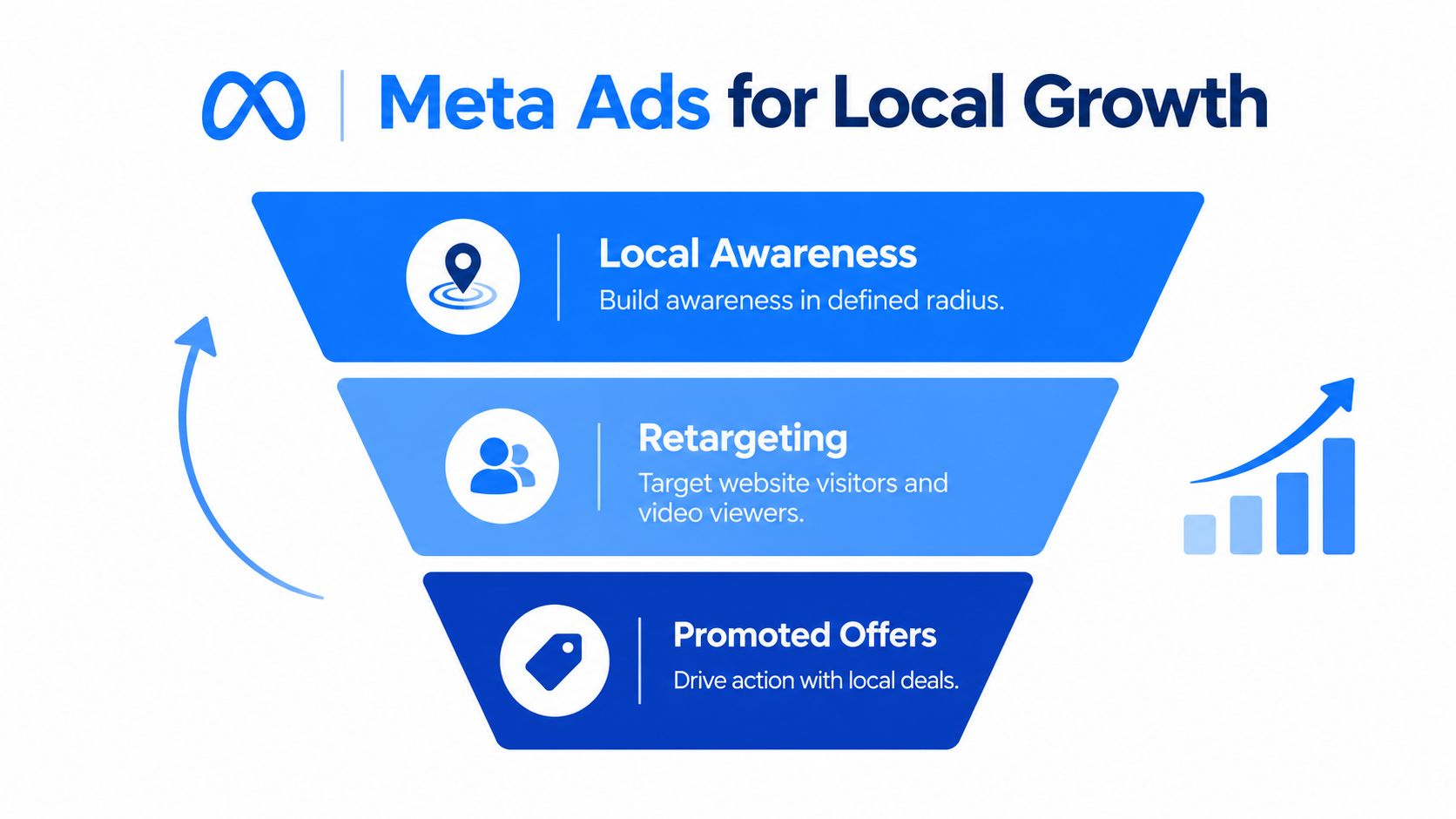
Meta earns its place when you need to create familiarity, promote a specific offer, or bring previous visitors back. It usually isn't a replacement for intent capture. A person searching for an emergency electrician is further along than someone watching a home-improvement video in their feed.
Set a defined radius around the service area first. Add audience signals only when they improve relevance, such as homeowner interests, age ranges that match the customer base, or local community behavior. Don't stack so many filters that delivery becomes erratic. Location and creative usually matter more than an elaborate audience theory.
Use creative that shows the work. A short before-and-after reel can demonstrate the result. An owner-on-camera explanation can remove uncertainty about process and pricing. A simple testimonial graphic can reinforce trust, provided the customer has approved its use and the statement is accurate.
Lead forms and Messenger ads reduce friction, but lower friction can also reduce intent. Ask qualifying questions that help separate a genuine service request from casual interest. For higher-consideration work, send the visitor to a focused landing page where the offer, service area, proof, and next step are visible together.
### Judge Meta by downstream quality
Compare Meta with Google using the same offer and the same business outcome. A [2026 local-business benchmark from Redclawey](https://redclawey.com/en/benchmarks/local-google/) reported median Google Ads performance at about **$18 CPA, 4.8% CTR, 5.6% conversion rate, and 6.5x ROAS**, while Meta was reported at about **$12 CPA, 2.4% CTR, 4.2% conversion rate, and 5.8x ROAS**. These figures are benchmarks, not promises for your market. They illustrate the structural difference: Google tends to capture stronger intent, while Meta can provide lower-cost reach and retargeting.
A cheaper Meta lead isn't automatically better. Track whether the person answers, fits the service area, accepts the job type, and books. Cut creatives that attract curiosity without conversations.
Build retargeting around useful reminders. Show a service explanation to site visitors, a proof-based creative to video viewers, or a time-sensitive offer to people who viewed a booking page but didn't submit. Exclude customers and booked leads when the campaign goal is acquisition. Otherwise, you'll pay to repeat an offer to people who already converted.
## Speed to Lead and Tracking Turn Clicks Into Booked Jobs
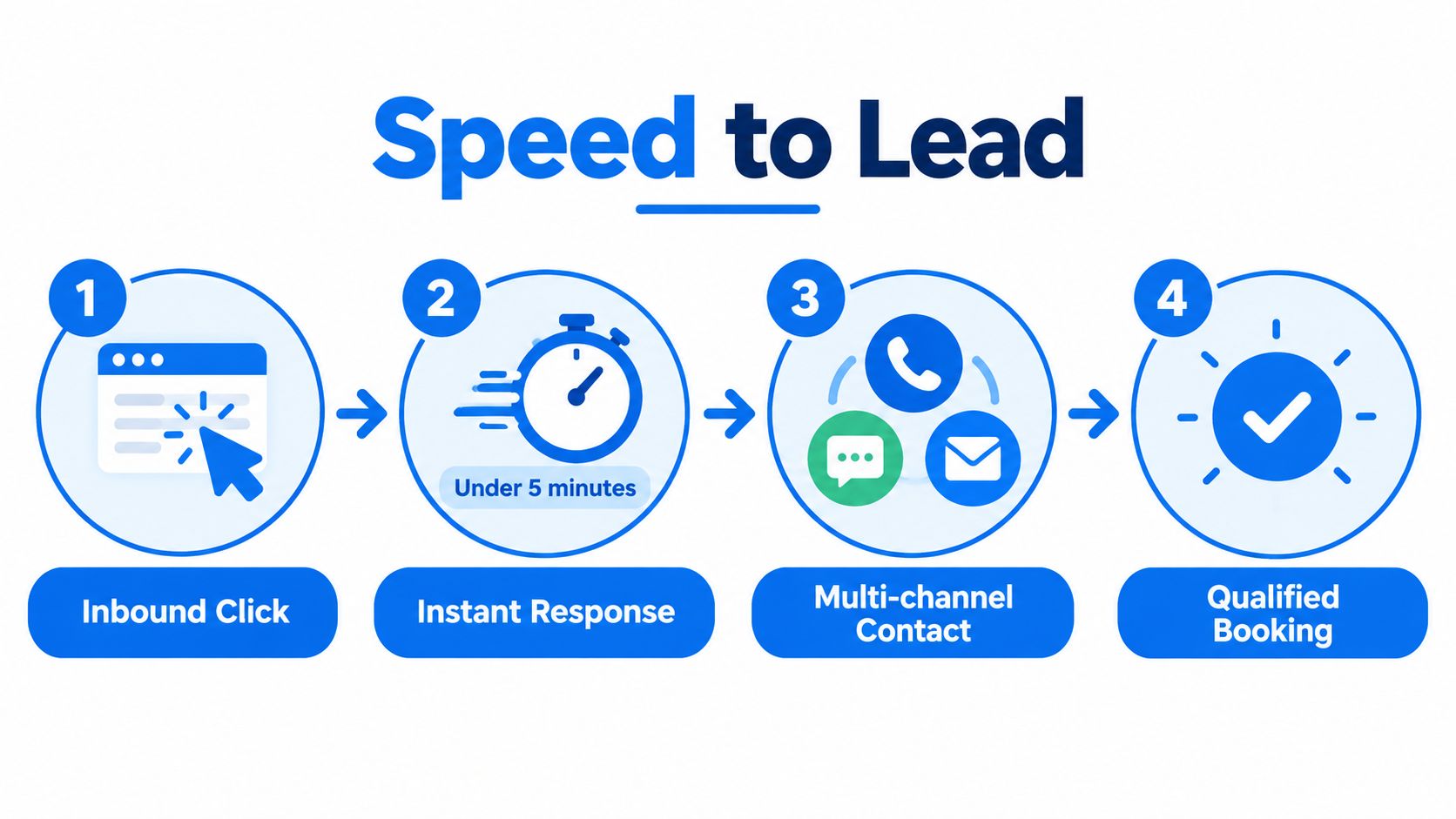
The cheapest click is worthless if the inquiry waits in an inbox. Local customers often contact multiple businesses, especially when the problem is urgent. The first professional response can determine which company gets the conversation.
Set a response standard of **under 5 minutes** for calls, texts, and form submissions, consistent with the sales-response evidence cited earlier. That means someone owns the queue, knows what to say, and can escalate when the first person can't answer. An automatic acknowledgment helps, but it doesn't replace a human conversation.
Use a short callback script:
- **Confirm the request:** Repeat the service and location so the customer knows you understood.
- **Qualify the job:** Ask only the questions needed to establish fit and urgency.
- **Offer the next action:** Give a realistic appointment, estimate, inspection, or consultation option.
- **Record the result:** Mark the lead as contacted, qualified, booked, lost, or needing follow-up.
### Track the source all the way through
Give each campaign a trackable phone number or a reliable call attribution method. Route form submissions into a CRM or a shared lead queue, and record the original source on every opportunity. The owner should be able to distinguish Google Search, LSAs, Meta, organic search, referrals, and offline sources without reconstructing the story from memory.
Review the funnel weekly:
| Metric | What it tells you |
|---|---|
| Leads | Whether the campaign creates inquiries |
| Contact rate | Whether the team reaches those inquiries |
| Qualified rate | Whether the source produces viable prospects |
| Booked jobs | Whether the funnel creates appointments |
| Cost per booked job | Whether the acquisition cost supports the business |
| Close rate by source | Which channels produce paying work |
| Average ticket by source | Whether lead quality matches the service model |
Don't optimize toward cost per lead in isolation. A campaign can produce inexpensive forms and still lose money if the team can't contact people or the jobs are too small. Measure revenue after the appointment, then use that evidence to adjust targeting and spend.
Follow-up continues after the first conversation. Send a review request after completed work, and create a simple win-back sequence for unconverted quotes. One polite reminder can reopen a conversation, but every message should be relevant, timely, and easy to answer. [This speed-to-lead resource](https://benjiads.com/blog/speed-to-lead) provides a useful framework for assigning ownership and reducing response delays.
## Your First 30 Days and the Habits That Make It Work
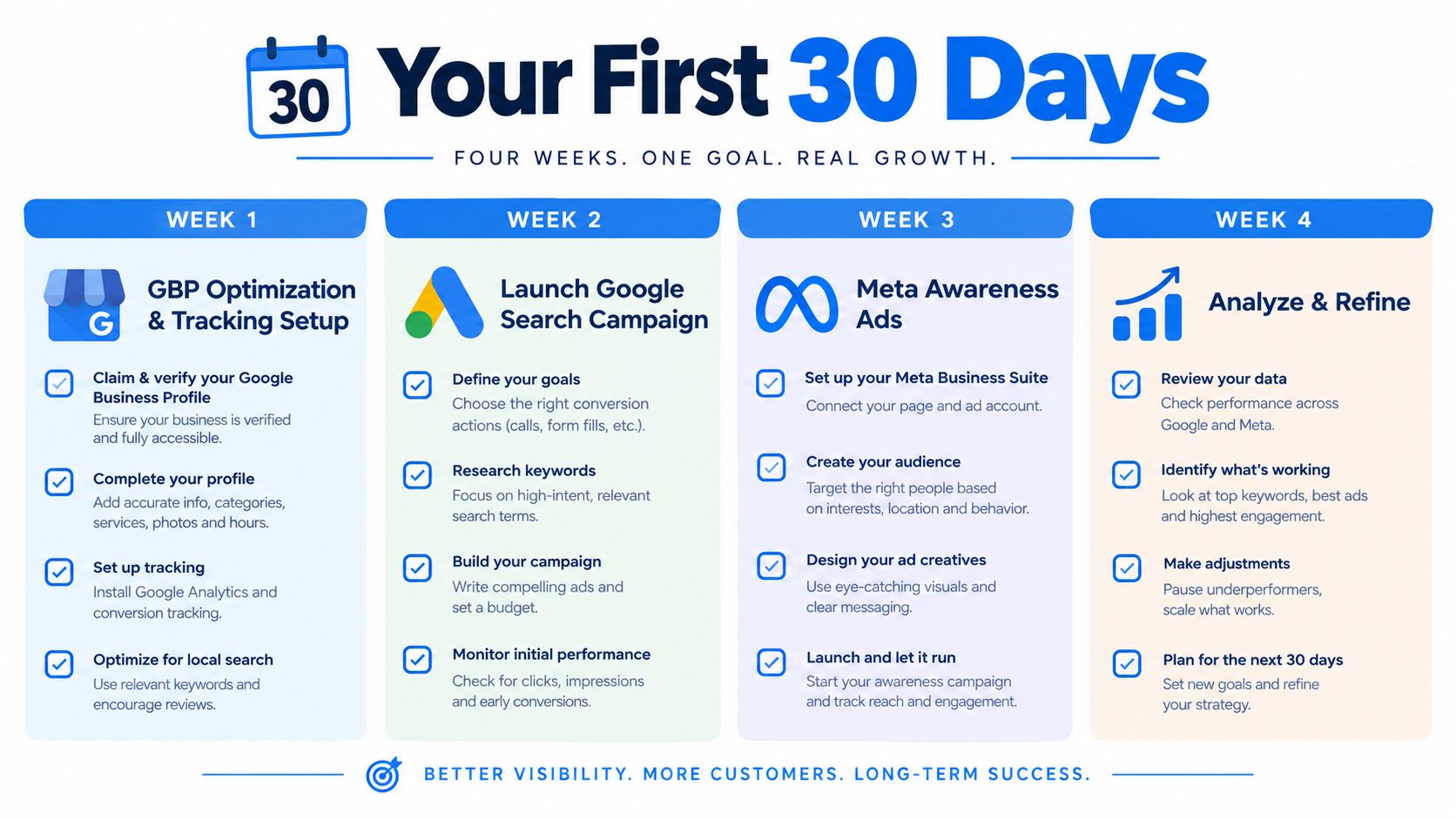
Treat the first month as an operating setup, not a race to launch every platform. Each week should remove one source of waste and produce clearer evidence about what turns local attention into work.
### Week one
Complete the Google Business Profile, check every local directory, and create the core service pages. Set up call tracking, form routing, source fields, and a response owner before spending on ads.
Write the qualification questions and callback script. Test every form and phone path from a mobile device. Submit a test lead and confirm that the right person receives it immediately.
### Week two
Launch a focused Google Search campaign around your strongest service and defined area. Use tightly related keywords, specific negative keywords, one clear offer, and a landing page that matches the ad.
Don't make daily changes based on a handful of clicks. Check search terms, location quality, call recordings where permitted, and whether inquiries fit the service. Fix obvious waste, then give the campaign enough consistency to reveal patterns.
### Week three
Add Meta only with a defined job. Start with a local awareness or retargeting campaign, not a collection of unrelated audiences. Test owner-led video, before-and-after proof, and a clear offer.
Route every Meta lead through the same qualification and response process as a Google lead. If Meta produces engagement but no useful conversations, change the creative or pause it. Don't defend a channel because its dashboard looks busy.
### Week four
Review leads, contact rate, qualified conversations, booked jobs, and cost per booked job by source. Cut audiences, keywords, placements, and creatives that create activity without revenue. Increase investment only where the business can verify both lead quality and follow-up capacity.
The recurring traps are predictable. Businesses spread money across too many channels, chase cheap clicks, fail to call back promptly, and report platform metrics that never connect to the booking calendar. Replace that behavior with one weekly review and three essential questions: **How many leads arrived, how many did we contact, and how many closed?**
Stop thinking of this as “running ads.” You're operating a local acquisition system. Every profile, ad, landing page, tracking field, and follow-up message should support the same outcome, a qualified customer who books.
---
BenjiAds builds and manages local Facebook and Instagram campaigns with trade-specific creative, landing pages, conversion tracking, and SMS-based lead follow-up. If you want a connected advertising and response system rather than another disconnected marketing tool, visit [benjiads](https://benjiads.com) and review how it can support your local acquisition process.