Source: https://benjiads.com/blog/google-ads-vs-meta-ads
Publisher: benjiads, https://benjiads.com
Published: 2026-09-21
Updated: 2026-09-21
Cite as: benjiads, "Google Ads vs Meta Ads for Local Services That Book Jobs", benjiads.com/blog/google-ads-vs-meta-ads
Reuse: you may quote this article with attribution and a link to the source.
# Google Ads vs Meta Ads for Local Services That Book Jobs
Google Ads vs Meta Ads for local services compared on intent, cost, targeting and creatives. See when to use each to drive more booked jobs.
You're probably in one of two spots right now.
Either your phone isn't ringing enough, and you need leads this week. Or you are getting leads, but too many of them turn into quote requests, missed calls, ghosted forms, and wasted ad spend. That's where most local service owners get stuck when they ask about **Google Ads vs Meta Ads**.
The wrong way to answer that question is to obsess over click price. The right way is to ask: **which channel gives you booked jobs, and how fast can your team respond when a lead comes in?**
A plumber with emergency calls, an HVAC company in peak season, and a dental clinic promoting implants should not make the same ad decision. Urgency matters. Search behavior matters. So does whether someone in your office calls back in five minutes or five hours.
Generic platform comparisons miss that local services live inside three constraints:
- **Geography matters.** You only serve certain ZIP codes, towns, or travel radiuses.
- **Timing matters.** Some buyers need help today. Others need to be convinced over days or weeks.
- **Follow-up matters.** A cheap lead is worthless if nobody answers, qualifies, and books it.
If you want the blunt version, here it is. **Google usually wins when intent is already there. Meta usually wins when you need to create demand, stay visible, or retarget people who didn't book on the first touch.** And if your sales process is slow, both platforms can look worse than they really are.
## Table of Contents
- [Introduction Why Local Services Face a Different Ads Choice](#introduction-why-local-services-face-a-different-ads-choice)
- [The local reality is urgency, not vanity metrics](#the-local-reality-is-urgency-not-vanity-metrics)
- [Booked jobs are the metric that matters](#booked-jobs-are-the-metric-that-matters)
- [How Google Ads and Meta Ads Work for Local Discovery](#how-google-ads-and-meta-ads-work-for-local-discovery)
- [Google puts you in front of active demand](#google-puts-you-in-front-of-active-demand)
- [Meta gets you in front of future demand](#meta-gets-you-in-front-of-future-demand)
- [Local discovery has two separate jobs](#local-discovery-has-two-separate-jobs)
- [Intent vs Interest Targeting Creatives and Funnels Compared](#intent-vs-interest-targeting-creatives-and-funnels-compared)
- [Targeting is explicit on Google and inferred on Meta](#targeting-is-explicit-on-google-and-inferred-on-meta)
- [Creative has a different job on each platform](#creative-has-a-different-job-on-each-platform)
- [Funnels break in different places](#funnels-break-in-different-places)
- [Cost and Conversion Reality Beyond Click Price](#cost-and-conversion-reality-beyond-click-price)
- [Meta usually buys cheaper traffic](#meta-usually-buys-cheaper-traffic)
- [Google often wins on downstream efficiency](#google-often-wins-on-downstream-efficiency)
- [The metric stack that actually matters](#the-metric-stack-that-actually-matters)
- [When to Choose Google Ads Meta Ads or Both for Local Services](#when-to-choose-google-ads-meta-ads-or-both-for-local-services)
- [Start with Google Ads when the buyer already knows what they need](#start-with-google-ads-when-the-buyer-already-knows-what-they-need)
- [Start with Meta Ads when the buyer needs persuasion](#start-with-meta-ads-when-the-buyer-needs-persuasion)
- [Use both when the buying path has more than one step](#use-both-when-the-buying-path-has-more-than-one-step)
- [Making Either Channel Convert With Tracking and Follow Up](#making-either-channel-convert-with-tracking-and-follow-up)
- [Speed-to-contact changes the winner](#speed-to-contact-changes-the-winner)
- [Build one tracking path from click to booking](#build-one-tracking-path-from-click-to-booking)
- [Follow-up should be operational, not optional](#follow-up-should-be-operational-not-optional)
- [Your Decision Framework and Next Steps for Local Growth](#your-decision-framework-and-next-steps-for-local-growth)
- [Start with Google if these are true](#start-with-google-if-these-are-true)
- [Start with Meta if these are true](#start-with-meta-if-these-are-true)
- [Run both if these are true](#run-both-if-these-are-true)
## Introduction Why Local Services Face a Different Ads Choice
A local business rarely has the luxury of “testing everything” for months.
Most owners start with a fixed budget and a simple goal. Get calls. Fill the schedule. Keep techs productive. That changes the entire Google Ads vs Meta Ads conversation, because local services don't buy ads for abstract awareness. They buy ads to turn attention into appointments, estimate requests, and paid work.
### The local reality is urgency, not vanity metrics
If someone searches for a dentist near them, a blocked drain, or same-day AC repair, they're already moving. They have a problem and want a solution now. That's a very different buyer than someone scrolling Instagram after dinner and seeing a remodeling ad.
Those buyers may both become customers, but they don't act the same way. One is raising a hand. The other is being interrupted.
> **Practical rule:** If the customer's problem has a clock on it, search usually beats social.
That's why broad advice like “Meta is cheaper” or “Google has better intent” isn't enough. For local services, the question is what happens after the click. Does the lead answer the phone? Does your front desk confirm the appointment? Does the estimator show up and close?
### Booked jobs are the metric that matters
I'd rather pay more for a lead that books than less for a lead that sits in your CRM until it dies.
That sounds obvious, but many local campaigns are still judged on clicks, forms, or platform-reported leads. That's how businesses end up scaling the wrong channel. They optimize for what the ad platform can easily count, not what the business bank account reflects.
Use this as the starting lens:
| Question | Google Ads | Meta Ads |
|---|---|---|
| Buyer mindset | Active search | Passive browsing |
| Best use | Capture existing demand | Create demand and retarget |
| Typical local strength | Calls, urgent jobs, near-term bookings | Awareness, offers, visual proof, longer consideration |
| Main risk | Higher click costs | Lower intent and slower conversion |
| What decides success | Keyword fit, landing page, call handling | Creative, offer, audience, follow-up |
A roofer after a storm, a chiropractor promoting a package, and a cleaning company trying to fill recurring slots may all use paid ads. They still shouldn't start in the same place.
## How Google Ads and Meta Ads Work for Local Discovery
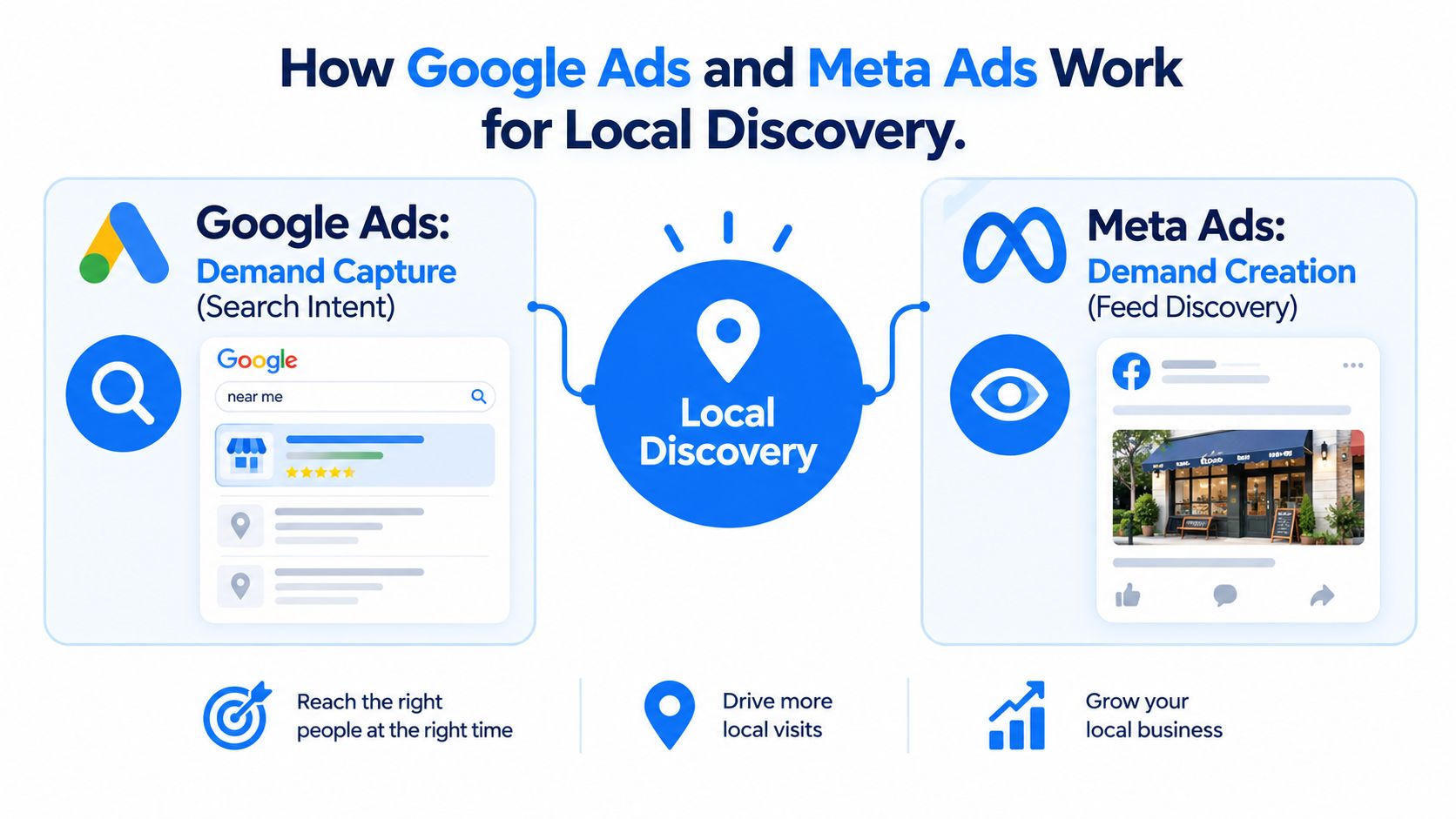
A homeowner with a leaking water heater opens Google. A homeowner who has been putting off a bathroom remodel opens Instagram. Both can become customers. They are discovered in completely different ways.
Google Ads shows up when someone goes looking. Meta Ads shows up while someone is scrolling, comparing, or half-aware of a problem. For local services, that difference matters because discovery is not just about getting seen. It is about how fast you can turn attention into a call, a reply, and a booked job.
### Google puts you in front of active demand
Google works best when the customer already knows they need help. They search for the service, the symptom, or the location. Your ad appears inside that decision moment.
For a local business, that usually means higher intent and less education. The person searching “emergency plumber near me” does not need a brand story. They need proof you serve the area, answer the phone, and can get there soon. Google is strong at putting your business in front of that buyer at the exact time they are ready to contact someone.
That is why local discovery on Google often starts with service keywords, map visibility, call assets, and landing pages built to get the lead to act fast. If you want a more detailed breakdown, this guide on [Google Ads for local businesses](https://benjiads.com/blog/google-ads-local) covers the search-first setup in more detail.
### Meta gets you in front of future demand
Meta works earlier in the buying cycle. People are not typing in a need. They are browsing Facebook or Instagram and noticing an offer, a before-and-after, a patient testimonial, or a seasonal promotion.
Meta's scale is massive. Meta reported broad global reach across its apps and ad products in its [Meta Q4 2023 earnings release](https://investor.fb.com/investor-news/press-release-details/2024/Meta-Reports-Fourth-Quarter-and-Full-Year-2023-Results/default.aspx). For local advertisers, that matters less as a headline number and more as a practical advantage. You can stay in front of people in your service area before they search, and you can bring them back after they visit your site or engage with your page.
### Local discovery has two separate jobs
Business owners often lump discovery into one bucket. That is a mistake. Local discovery has two jobs, and each platform handles a different one.
- **Capture demand:** show up when someone is already looking
- **Create demand:** stay visible until the need becomes urgent or clear
Google usually wins the first job. Meta usually wins the second.
That does not make one platform better. It changes what you should expect from each. Google often produces faster hand-raisers. Meta often produces cheaper attention, stronger retargeting pools, and more assisted conversions that happen later through search, direct traffic, or a phone call your ad platform will never fully credit.
For local services, the winner is rarely the platform with the lower click price. It is the platform that produces real conversations and booked work. If your service solves an immediate problem, Google usually leads. If your sale needs repetition, trust, visuals, or an offer people warm up to over time, Meta earns its place fast.
## Intent vs Interest Targeting Creatives and Funnels Compared
Google Ads and Meta Ads don't just target differently. They demand different messaging, different creative, and different funnel expectations.
If you run them the same way, one of them will underperform.
### Targeting is explicit on Google and inferred on Meta
On Google, targeting starts with what people type. Keywords, service areas, and urgency-heavy searches do most of the filtering. Your job is to show up for the right terms, write tight copy, and make it easy to call or request service.
On Meta, targeting is less direct. You're reaching people based on behavior, profile signals, platform activity, and your own data. They didn't ask for your service in that moment. Your ad has to create enough relevance to earn attention.
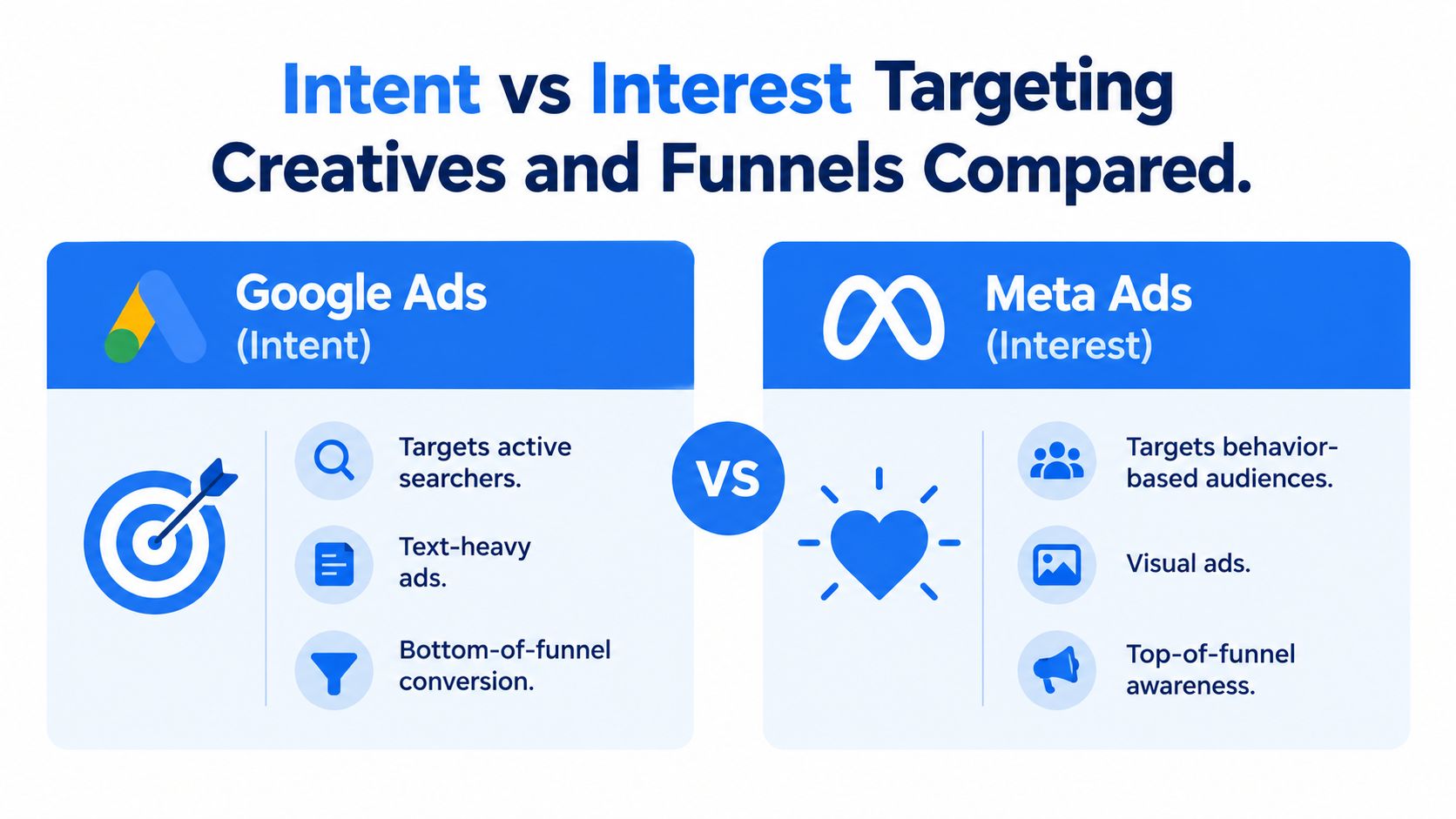
> Google targeting starts with a query. Meta targeting starts with a guess about future demand.
That's why poor creative gets punished harder on Meta. On Google, a strong keyword can carry a simple ad. On Meta, weak visuals and generic offers disappear into the feed.
### Creative has a different job on each platform
Google creative is mostly about clarity. You don't need cinematic genius. You need message match. If someone searches “emergency plumber near me,” your ad should sound like a business that handles emergencies, serves the area, and can answer now.
Meta creative has to interrupt. It has to stop the scroll, show proof, and move someone from mild interest to action. For local services, that usually means visual evidence, trust cues, before-and-after work, pain-point framing, or a specific offer.
Here's the practical split:
- **Google ads need**
- **Keyword alignment:** Match the searcher's problem.
- **Urgency-driven copy:** Same-day, nearby, available, book now.
- **Low-friction conversion:** Calls, short forms, clear booking path.
- **Meta ads need**
- **Visual proof:** Results, transformations, team, place, process.
- **Offer clarity:** Free consult, inspection, cleaning package, seasonal promo.
- **Nurture path:** Landing page, retargeting, text follow-up, repeat exposure.
### Funnels break in different places
Google funnels usually break at the click. Bad keyword choices, weak landing pages, or missed calls waste high-intent traffic fast.
Meta funnels usually break after the lead. You can generate interest and even forms, but if your team is slow or the offer is vague, a lot of those leads won't book.
> **What wins on Meta:** one strong offer, one clear next step, and fast follow-up.
If you're in home services, this matters even more because many offers are interruptive by nature. The buyer wasn't planning to request a quote at that exact moment. That's why the post-click system matters as much as the ad itself. If you want more context on that lead flow, this breakdown of [home service leads](https://benjiads.com/blog/home-service-leads) maps the gap between interest and actual booked work.
## Cost and Conversion Reality Beyond Click Price
Most Google Ads vs Meta Ads articles stop at cost per click. That's lazy analysis.
A local business doesn't deposit clicks. It deposits revenue from booked jobs. So the right comparison is not “which platform is cheaper to visit from.” It's “which platform gets from click to lead to booking to revenue with the least waste.”
### Meta usually buys cheaper traffic
For paid traffic benchmarks, Meta Ads are typically much cheaper on a click basis. One 2026 benchmark set reports Meta traffic CPC at about **$0.70** and lead-campaign CPC at about **$1.92**, while broader Google Search benchmarks were cited at roughly **$4.22 CPC**, according to [these PPC benchmark references](https://whatagraph.com/blog/articles/ppc-benchmarks).
That's real. Meta often gives you more traffic volume per dollar.
The mistake is assuming cheaper traffic means cheaper customers.
### Google often wins on downstream efficiency
For local service businesses, intent changes the math. Expert comparison data for service businesses shows Google Ads conversion rates on click-to-call or form actions around **15% to 25%**, versus **3% to 8%** on Meta Ads, according to this local service comparison of Google Ads and Meta Ads.
That gap makes sense. Search traffic arrives with a problem already in hand. Social traffic often arrives with curiosity, not urgency.
Use a simple lens:
| Metric | Google Ads | Meta Ads |
|---|---|---|
| Cost per click | Higher | Lower |
| User intent | Higher | Lower |
| Traffic volume per dollar | Lower | Higher |
| Click-to-lead efficiency for local urgent services | Stronger | Weaker |
| Lead quality without strong follow-up | More forgiving | Less forgiving |
### The metric stack that actually matters
Most local businesses should track performance in this order:
1. **Click to lead**
2. **Lead to booking**
3. **Booking to revenue**
If you only look at the first line, Meta can look amazing. If you only look at platform-attributed leads, Google can also look inflated. Neither view is enough.
Independent 2026 benchmark coverage points out that Google Search averages a much higher conversion rate than Meta for intent-led traffic, while Meta's cheaper clicks can underperform on downstream close rate unless strong follow-up and tracking are in place, according to [this benchmark discussion focused on lead quality and booking outcomes](https://theadspend.com/blog/google-ads-vs-meta-ads-2026).
> Cheap clicks create expensive illusions when the lead never books.
That's why I usually recommend local owners review call recordings, response times, and booked appointments before making a budget decision. The platform doesn't close the lead. Your process does.
## When to Choose Google Ads Meta Ads or Both for Local Services
If you want a clean recommendation, don't start with the platform. Start with the service.
The right channel depends on urgency, sales cycle, and how much proof the buyer needs before they commit.
### Start with Google Ads when the buyer already knows what they need
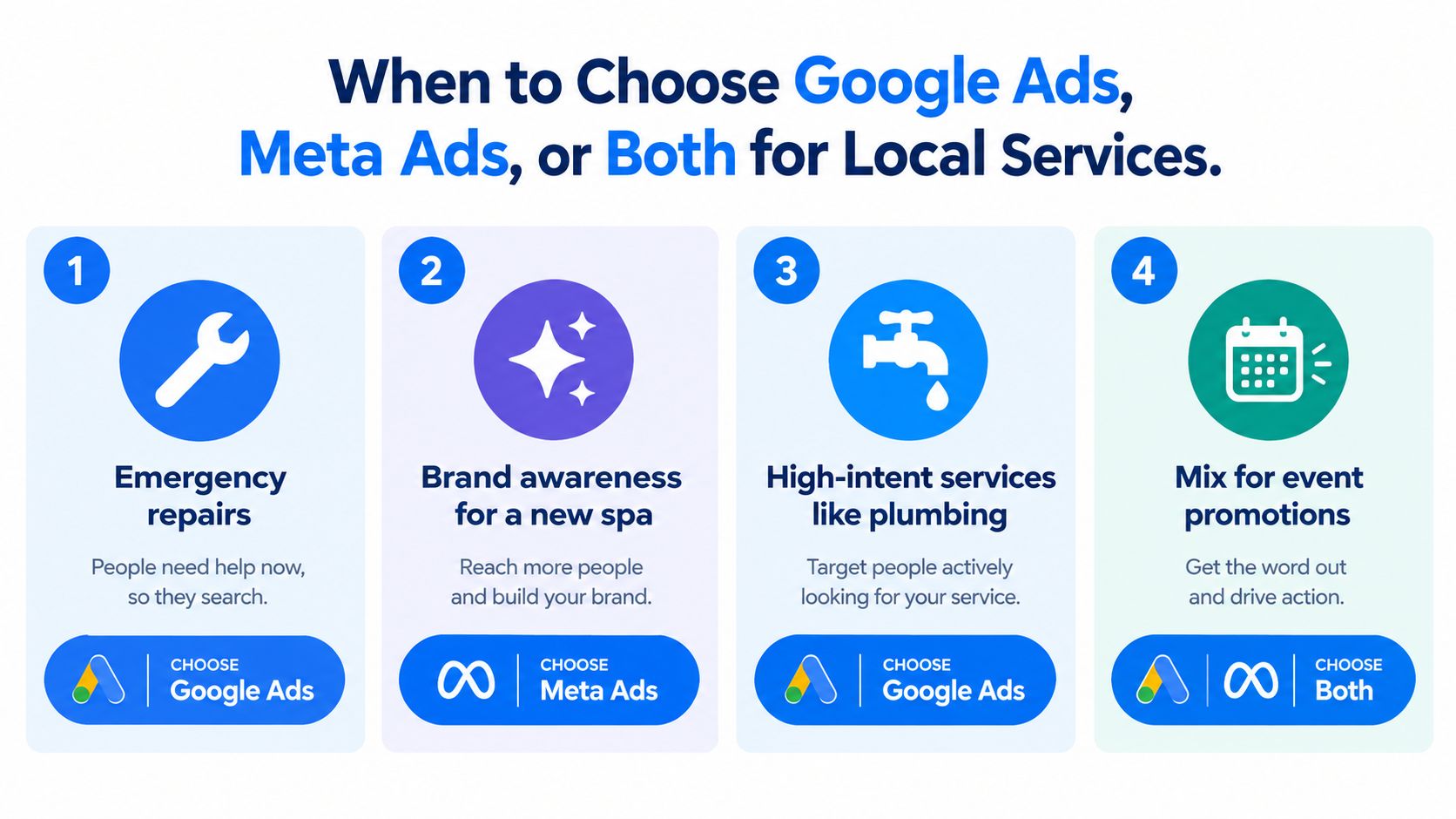
Choose Google first when the service is urgent, practical, and commonly searched.
Examples include emergency plumbing, AC repair, dental pain, same-day appointments, locksmiths, and any service where the buyer wants help now. Search captures that demand better because the person is already in motion.
Google is also the safer first choice when your team can answer calls quickly but doesn't have time to build lots of creative.
### Start with Meta Ads when the buyer needs persuasion
Choose Meta first when the service benefits from visuals, education, or repeated exposure.
That includes aesthetic treatments, elective dental services, remodeling, landscaping upgrades, recurring cleaning, wellness services, and seasonal promos. These offers often need proof, positioning, and reminder-based marketing more than immediate capture.
### Use both when the buying path has more than one step
A lot of local services eventually need both channels because buyers don't move in one straight line.
Someone may first see your clinic offer on Instagram, ignore it, search your brand later, read reviews, and book after a retargeting ad. Another buyer may click a Google ad, leave the page, and then convert after seeing your business again on Facebook.
Here's the practical map:
- **Google first**
- Emergency trades
- High-intent local searches
- Limited budgets needing near-term bookings
- Teams strong on phones, weaker on creative
- **Meta first**
- Visual services
- New offers that need education
- Neighborhood awareness campaigns
- Businesses with strong media assets and follow-up systems
- **Both together**
- Multi-step decisions
- Competitive markets
- Seasonal pushes where awareness and capture both matter
- Businesses that want retargeting across channels
Another factor is attribution pressure. Recent benchmark writeups note that Meta's performance depends more on modeled conversions, server-side signals, and creative quality, while Google Search remains more intent-driven. The same coverage also noted Meta lead costs rose about **20.94% year over year in 2026** and that advertisers are moving toward stronger feed-based formats like Collection ads, according to [this 2026 trends and benchmark summary for Google Ads and Meta Ads](https://www.fluency.inc/blog/2026-trends-and-performance-benchmarks-google-ads-meta-ads).
That's why “which platform is better” is the wrong question. Better for what? Immediate demand, demand creation, or retargeting support? Those are different jobs.
## Making Either Channel Convert With Tracking and Follow Up
A lot of local campaigns fail for boring reasons.
Nobody picked up the phone. The form went into a shared inbox. The front desk called the next day. Tracking counted a lead, but the office never confirmed whether it booked. Then the owner concludes the platform doesn't work.
The platform may not be the problem.
### Speed-to-contact changes the winner
If you run Meta without fast follow-up, you'll think Meta leads are weak. If you run Google and miss calls, you'll think search is overpriced.
For local services, the first response often decides whether the lead becomes an appointment. That means your marketing system has to include more than ads. It needs routing, qualification, reminders, and visibility into what happened after the first touch.
### Build one tracking path from click to booking
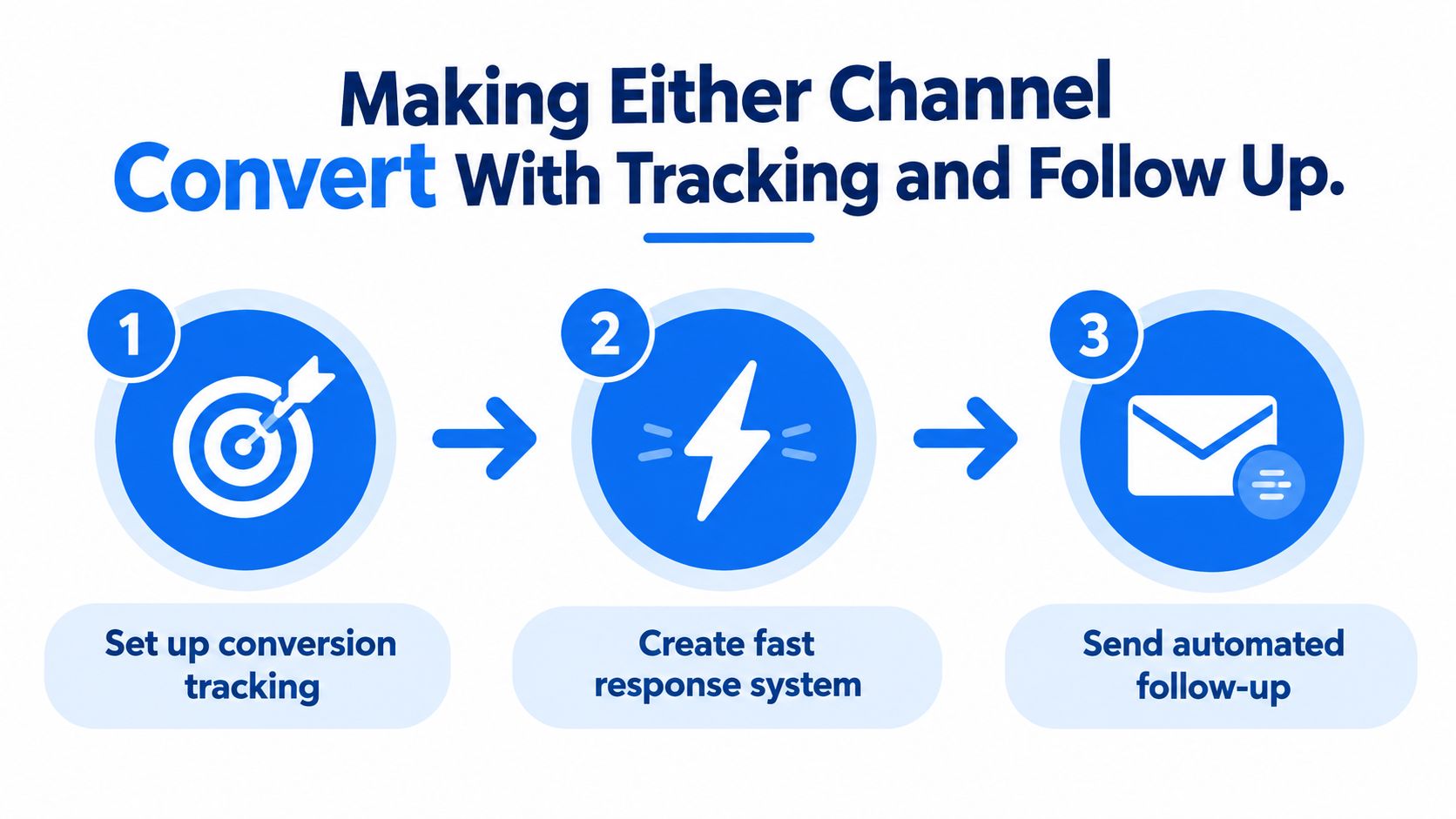
Here's the setup I recommend for either channel:
1. **Track the conversion point.** Don't stop at form submits. Track calls, qualified leads, booked appointments, and closed jobs where possible.
2. **Use both browser and server signals.** That reduces blind spots and gives ad platforms cleaner feedback.
3. **Connect follow-up to the lead source.** If Google leads book faster but Meta leads book later after texts and reminders, you need to see that clearly.
A practical implementation can be done with your CRM, call tracking, booking software, and event tracking tools. Some businesses also use an all-in-one workflow. For example, **benjiads** combines campaign launch on Google and Meta with prebuilt funnels, server-side and client-side tracking, retargeting, and automated text follow-up in one product.
### Follow-up should be operational, not optional
You need a default sequence for every inbound lead:
- **Immediate acknowledgment:** Confirm the request right away by call or text.
- **Qualification prompt:** Ask the one or two questions that determine fit and urgency.
- **Booking push:** Give a direct next step instead of “we'll get back to you.”
> The businesses that win paid ads usually aren't the ones with magical targeting. They're the ones that answer first and keep following up.
If you're tightening attribution, this explainer on [server-side vs client-side tracking](https://benjiads.com/blog/server-side-vs-client-side) is worth reviewing. It matters more now because privacy changes have made platform reporting less complete, especially on social.
## Your Decision Framework and Next Steps for Local Growth
Here's the framework I'd use if I were deciding where to put the next dollar.
### Start with Google if these are true
Your service solves an immediate problem. People already search for it. You need booked work soon, not just awareness. Your team can answer calls and convert inquiries quickly.
That's the cleanest use case for search.
### Start with Meta if these are true
Your offer needs visuals, explanation, or repeat exposure. You have decent creative assets or can produce them. Your team can follow up fast by text and phone, not just wait for inbound calls.
That's where Meta can build demand that search alone won't create.
### Run both if these are true
Your market is crowded, buyers compare options, and you want one channel to generate interest while the other catches active demand. In that setup, judge success by booked jobs, not platform vanity metrics.
Don't overcomplicate the first move. Pick the platform that matches buyer intent today. Set up tracking that shows what booked. Fix response time. Then expand.
If Google is producing qualified calls but volume is capped, layer Meta on top for awareness and retargeting. If Meta is generating interest but too few appointments, tighten the offer and shorten the follow-up path before you kill the channel.
The winner in Google Ads vs Meta Ads for local services usually isn't the platform with the prettiest dashboard. It's the one that fits your sales cycle and hands your team leads they can close.
---
If you want help running this without stitching together five tools and a part-time media buyer, [benjiads](https://benjiads.com) automates Google and Meta campaign launch, creative generation, tracking, retargeting, and text follow-up for local service businesses. It's built around the part most owners care about: which ads turn into real leads and booked jobs, with approval required before anything goes live.