Source: https://benjiads.com/blog/facebook-ads-for-contractors
Publisher: benjiads, https://benjiads.com
Published: 2026-09-29
Updated: 2026-09-29
Cite as: benjiads, "Facebook Ads for Contractors: A Complete How-To Guide", benjiads.com/blog/facebook-ads-for-contractors
Reuse: you may quote this article with attribution and a link to the source.
# Facebook Ads for Contractors: A Complete How-To Guide
Master Facebook ads for contractors with this step-by-step guide. Learn targeting, creatives, lead follow-up, and optimization
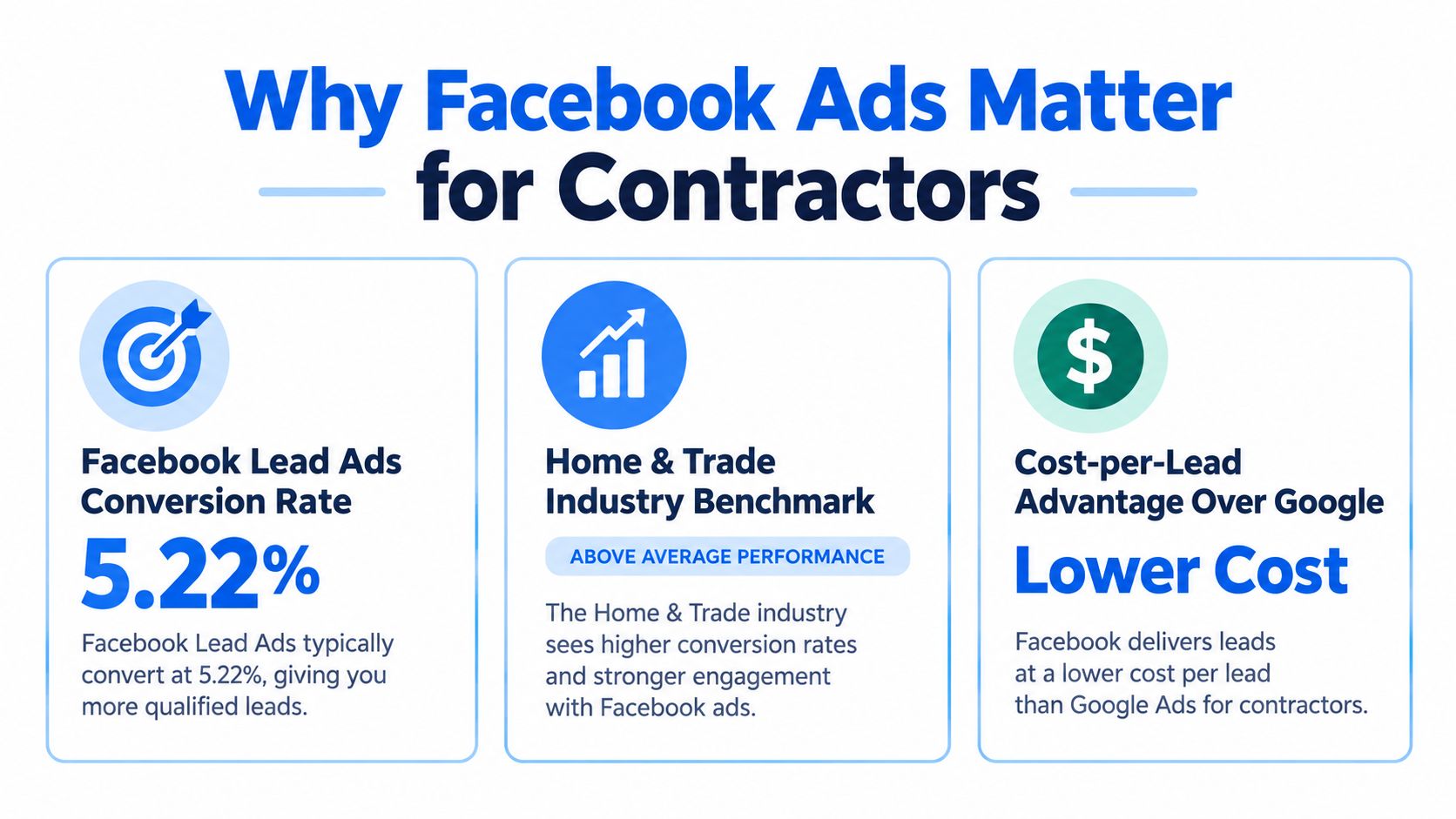
Facebook Lead Ads average a **5.22% conversion rate** in Home & Home Improvement, with a cost per lead around **$41** in that category. For contractors, that's useful because Facebook can buy cheaper lead volume than many search channels, but only if the follow-up system is tight.
Facebook ads matter for contractors because demand doesn't arrive in one neat stream. Some weeks are full of emergency calls, other weeks are slow, and plenty of homeowners aren't ready to buy the moment they see you. Meta is useful in those in-between moments, especially when you're trying to stay in front of homeowners before they search, compare, and choose.
## Table of Contents
- [Why Facebook Ads Actually Matter for Local Contractors](#why-facebook-ads-actually-matter-for-local-contractors)
- [What the numbers actually mean](#what-the-numbers-actually-mean)
- [Where Facebook fits in a contractor marketing mix](#where-facebook-fits-in-a-contractor-marketing-mix)
- [Building Facebook Campaigns for Trade-Specific Results](#building-facebook-campaigns-for-trade-specific-results)
- [Build around one offer at a time](#build-around-one-offer-at-a-time)
- [Use creative that looks like the work](#use-creative-that-looks-like-the-work)
- [Keep the setup practical](#keep-the-setup-practical)
- [Choosing Between Native Lead Forms and Custom Landing Pages](#choosing-between-native-lead-forms-and-custom-landing-pages)
- [When native forms make sense](#when-native-forms-make-sense)
- [When a landing page is the better move](#when-a-landing-page-is-the-better-move)
- [A simple decision rule](#a-simple-decision-rule)
- [Setting Up Lead Capture and Instant Follow-Up Systems](#setting-up-lead-capture-and-instant-follow-up-systems)
- [Capture the right details without slowing people down](#capture-the-right-details-without-slowing-people-down)
- [Automate the first response](#automate-the-first-response)
- [Qualify without creating friction](#qualify-without-creating-friction)
- [Using Software Automation Instead of Traditional Agencies](#using-software-automation-instead-of-traditional-agencies)
- [Why automation beats scattered handoffs](#why-automation-beats-scattered-handoffs)
- [What to look for in the stack](#what-to-look-for-in-the-stack)
- [Tracking Results and Optimizing Campaigns Over Time](#tracking-results-and-optimizing-campaigns-over-time)
- [Watch lead quality, not just lead count](#watch-lead-quality-not-just-lead-count)
- [Use tracking that feeds the platform better data](#use-tracking-that-feeds-the-platform-better-data)
- [When Facebook Ads Are Not the Right Channel](#when-facebook-ads-are-not-the-right-channel)
- [A simple trade-off](#a-simple-trade-off)
- [When to leave budget elsewhere](#when-to-leave-budget-elsewhere)
## Why Facebook Ads Actually Matter for Local Contractors
The basic mistake is thinking Facebook is just a place for attention, not a place for demand. Contractors who look only at the feed miss the actual purpose of the channel, which is to create affordable entry points into a sales process that can keep moving after the click. The benchmark data backs that up, because **Home & Home Improvement** sits at **5.22% conversion** and roughly **$41 per lead** in Facebook Lead Ads, while the all-industry average is **7.72% conversion** and **$27.66 CPL** [WordStream's 2025 Facebook Lead Ads benchmarks](https://constructionsnapshotforghl.com/blog/facebook-ads-for-contractors/).
### What the numbers actually mean
Those figures don't mean Facebook is cheap in every market or for every trade. They mean the channel can work when the offer is local, the creative is real, and the office is ready to answer fast. Local services benchmarks cited in 2026 put typical CTR around **2.0% to 3.2%**, CPC at **$0.45 to $1.00**, and cost per lead at **$25 to $120**, with a **25% to 55%** lead-to-booked-job range when follow-up is strong [local services benchmark summary](https://constructionsnapshotforghl.com/blog/facebook-ads-for-contractors/).
That spread explains why some contractors swear Facebook works and others say it wastes money. The difference is usually not the ad platform, it's the process behind the ad. The winners don't just buy clicks. They build a path from scroll to form fill to booked estimate.
> **Practical rule:** if you can't answer leads quickly and consistently, Facebook will look expensive even when the click costs are low.
### Where Facebook fits in a contractor marketing mix
Facebook is rarely the only channel that should be running. It's stronger for planned work, seasonal jobs, and visually convincing offers than for people who are already typing a urgent problem into search. That makes it valuable for contractors who need a steady source of prospects while search demand rises and falls.
The best use is often as a feeder channel. A homeowner sees your work, remembers your name, fills out a quick form later, then your team calls, texts, or follows up with proof and pricing context. That's a different job than Google Search, and it deserves a different setup.
## Building Facebook Campaigns for Trade-Specific Results
Start with a service, not with a generic "we do it all" message. A roofing contractor, plumber, lawn care professional, or electrician will usually get better response when the ad matches a single problem and a single service area. The platform gives you enough targeting tools to stay local, but the message still has to feel like it was written for one homeowner, not for every homeowner.

### Build around one offer at a time
The strongest campaigns usually follow a simple pattern. Pick one job type, one audience area, one proof point, and one call to action. If you try to promote drain cleaning, panel upgrades, roof replacements, and seasonal maintenance in the same campaign, the message gets muddy and the lead quality follows.
For example, a plumber can run one campaign for drain issues and another for water heater replacements. An electrician can separate safety inspections from panel replacements. A landscaping contractor can promote spring cleanups or weekly maintenance, but not both in one ad if the sales process is different.
That discipline matters because the ad is only the first filter. Your targeting should narrow the geography, but the copy should narrow the intent. When the offer feels specific, the lead usually feels more qualified.
### Use creative that looks like the work
Homeowners respond to proof, not jargon. A clean before-and-after photo, a short team video, or a simple project walkthrough does more than a generic logo graphic ever will. That's especially true for trades where the results are visible, like roofing, landscaping, remodeling, or exterior work.
> A contractor ad doesn't need to be clever. It needs to look like real work from a real crew.
### Keep the setup practical
Budget planning should match the pace of the trade. If the job cycle is longer, you can support a slower learning period. If the work is emergency-adjacent, the campaign should stay tight and the response process should be fast. For account structure, a clean campaign objective, a simple local audience, and a direct lead capture path are usually enough to start.
The internal setup is where many contractors get stuck, so keeping the system simple matters more than squeezing every possible targeting option out of the platform. For a trade-specific example of how this gets handled in practice, see the [plumber-focused campaign breakdown](https://benjiads.com/blog/facebook-ads-for-plumbers) and compare the structure to your own service mix.
## Choosing Between Native Lead Forms and Custom Landing Pages
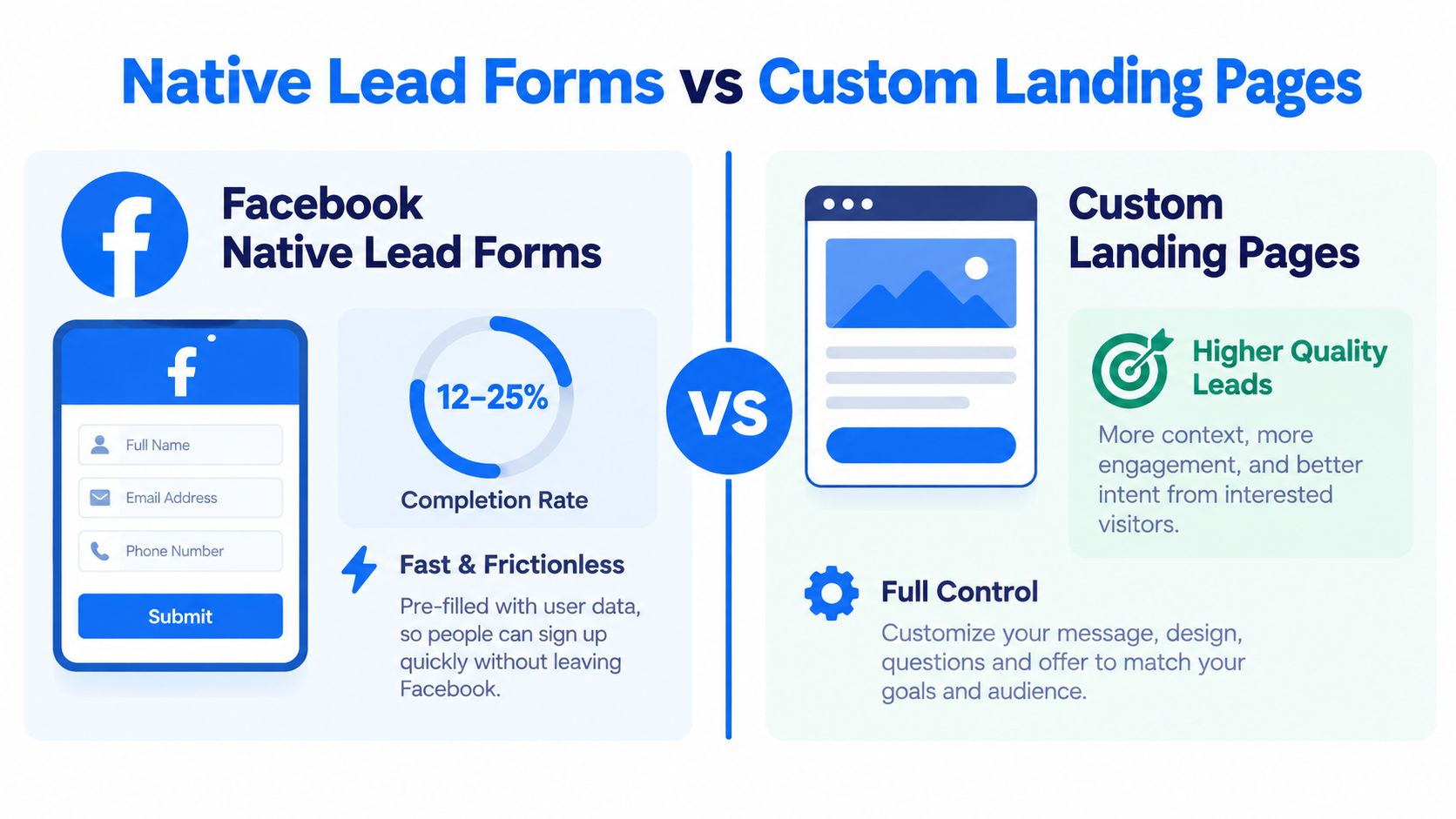
Lead entry is one of the biggest decisions in the whole setup. Native Facebook forms usually complete faster because they keep the user inside the app, and the benchmark data says they can complete at **12% to 25%** and may convert **25% to 35%** better than landing-page flows for home service contractors [conversion flow benchmark](https://transactional.net/facebook-ads-for-contractors/). That doesn't make them automatically better, it just means they remove friction.
### When native forms make sense
Native forms are usually the right move when speed matters more than depth. If you're running a replacement offer, seasonal promotion, or broad homeowner campaign, a short form can capture enough information to start the conversation. That works well when the office can respond fast and qualify later.
They're also useful when the ad itself does the heavy lifting. If the creative is clear, the service area is narrow, and the offer is easy to understand, the form can stay short without hurting lead quality too much. The risk is simple, though. Cheap leads can still underperform if no one answers them quickly or follows up with a real process.
### When a landing page is the better move
A branded landing page gives you more control over the story. That matters for higher-value jobs, jobs with more research involved, and services where trust needs more than a form field. It also gives you more room for proof, service details, and a better qualification flow before the lead hits your inbox.
For contractors, the choice often comes down to ticket size and sales friction. Lower-consideration jobs can start in a native form. Bigger jobs, replacement work, and offers that need explanation often belong on a page where the prospect can slow down and evaluate.
### A simple decision rule
- **Use native forms** when you need volume, the offer is easy to understand, and your team can respond fast.
- **Use landing pages** when the job is bigger, trust matters more, or you need more qualification before a callback.
- **Avoid both** if you can't follow up properly, because lead entry only helps when someone owns the next step.
The best contractors don't argue about forms versus pages in theory. They match the entry point to the service, then test what produces better booked work, not just more submissions. One practical resource that sits in this same problem space is [lead management software for contractors](https://benjiads.com/blog/lead-management-software), because the follow-up system matters as much as the form itself.
## Setting Up Lead Capture and Instant Follow-Up Systems
A lead that sits unanswered turns into wasted spend. Contractors lose money here more often than they admit, because the ad worked, the prospect clicked, and the office didn't move fast enough. The fix is to build capture and follow-up as one system, not as two separate tasks.
### Capture the right details without slowing people down
The form should ask only what you need to decide the next step. Name, phone, service type, and location are usually enough at the start. Extra questions can help qualify, but too many of them kill response rates and make the lead feel like homework.
The better approach is to verify the phone number, confirm the request immediately, and move the conversation to text or call as fast as possible. That makes the lead feel handled, which is exactly what people want when they're dealing with repairs, replacements, or home projects.
### Automate the first response
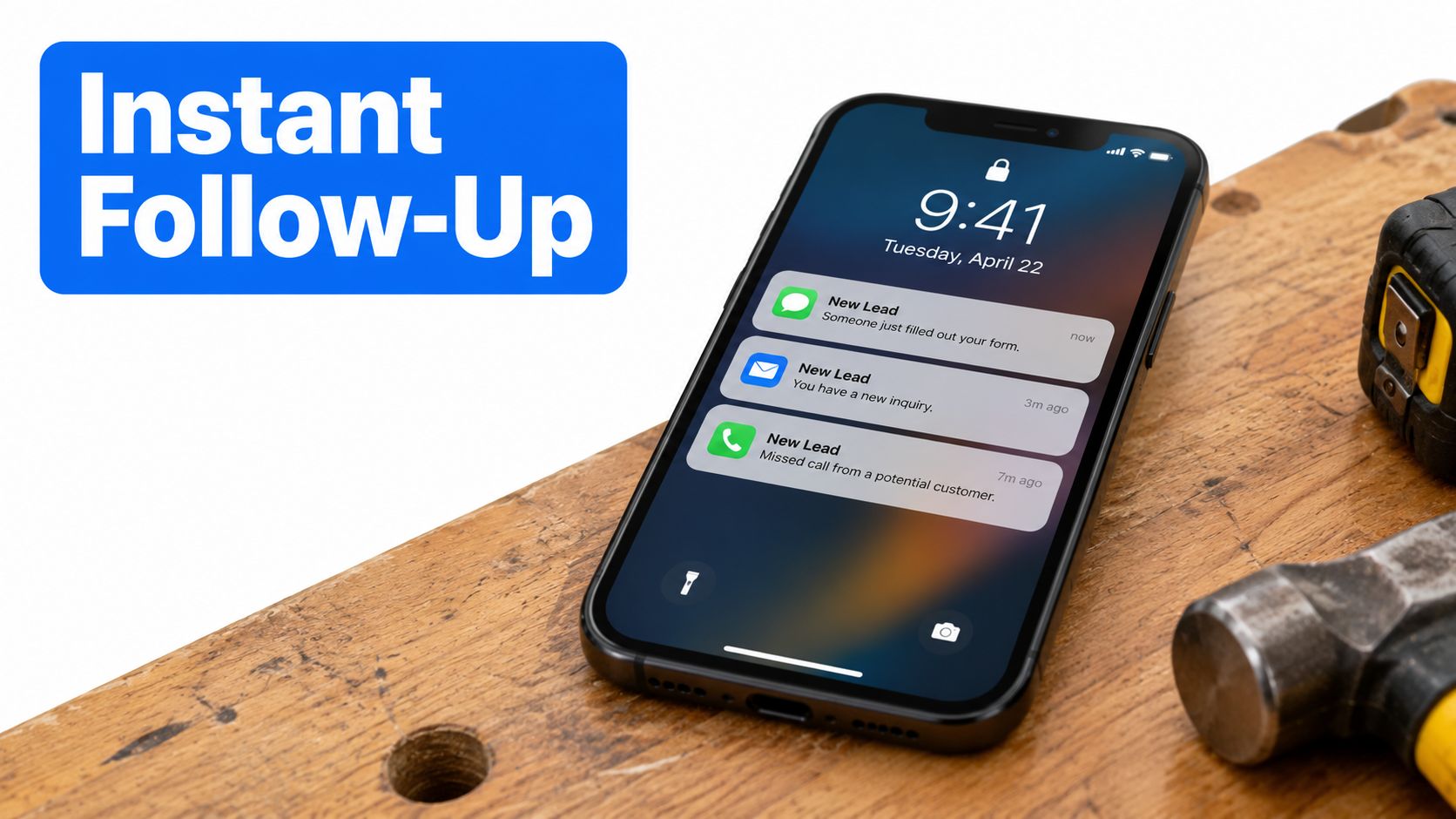
The first message should arrive right away. It should confirm receipt, restate the service, and tell the prospect what happens next. If someone fills out a form about a roof leak at 6 p.m., waiting until morning is a good way to lose the job to whoever called first.
A short sequence usually works better than one message. One confirmation, one qualification step, and one reminder if they don't reply can keep the prospect moving without a lot of manual effort. If your team uses [lead management software](https://benjiads.com/blog/lead-management-software), the point is to put the lead into a visible queue so nobody gets missed while the crew is on site.
> **Practical rule:** speed matters more than volume. A smaller number of leads answered fast usually beats a larger pile of forms nobody touched.
### Qualify without creating friction
Qualification belongs in the conversation, not just on the form. Ask whether the issue is urgent, whether they own the property, and whether they're ready to schedule. Those simple questions save hours of back-and-forth and help the office focus on the calls that are most likely to turn into booked work.
The goal isn't to sound like a gatekeeper. It's to keep good leads from cooling off. Contractors who treat follow-up as part of the ad system usually make better use of every dollar they spend, because the campaign doesn't end at the click.
## Using Software Automation Instead of Traditional Agencies
Manual management breaks down fast once a contractor is busy. Someone still has to write ads, build campaigns, track leads, and follow up with prospects. That workload pushes many owners to delay advertising or hand everything to an agency and lose visibility into what is happening.
A software-driven setup changes that workload. Tools can prepare creatives, set campaign structure, and hold ads for approval, so the owner keeps control without having to learn every part of Meta Ads Manager. That matters in contractor businesses, where the office is already juggling calls, estimates, crews, and schedule changes.
### Why automation beats scattered handoffs
Consistency is the main advantage. When the system handles repetitive steps, the owner does not need a media buyer on call just to keep the account moving. It also cuts down on half-finished setups, because the ad, landing page, tracking, and lead follow-up stay connected instead of sitting in separate tools.
For a closer look at how this works in practice, see this guide to [Facebook ads automation tools](https://benjiads.com/blog/facebook-ads-automation-tool).
BenjiAds takes this approach, preparing creatives and campaign structure, holding them for approval, and handling SMS follow-up. That keeps the owner involved without forcing them to run the account manually, and the fit depends on how hands-on they want to be.
### What to look for in the stack
- **Approval control** so campaigns stay paused until someone signs off.
- **Dual tracking** so server-side and client-side events both feed attribution.
- **Text-based lead delivery** so contact details do not get buried in a dashboard.
- **A simple billing model** that does not hide the management cost inside layers of retainers.
The difference from a traditional agency is transparency. You can see what is being built, approve it before it goes live, and keep follow-up tied to the same system. That is a cleaner setup for contractors who want growth without adding another layer of overhead.
## Tracking Results and Optimizing Campaigns Over Time
A good campaign can still drift if nobody watches the numbers. Contractors don't need a giant reporting stack, but they do need a weekly habit that catches weak ads before they burn budget. The important metrics are the ones that tell you whether the ad is creating leads you can work with.
### Watch lead quality, not just lead count
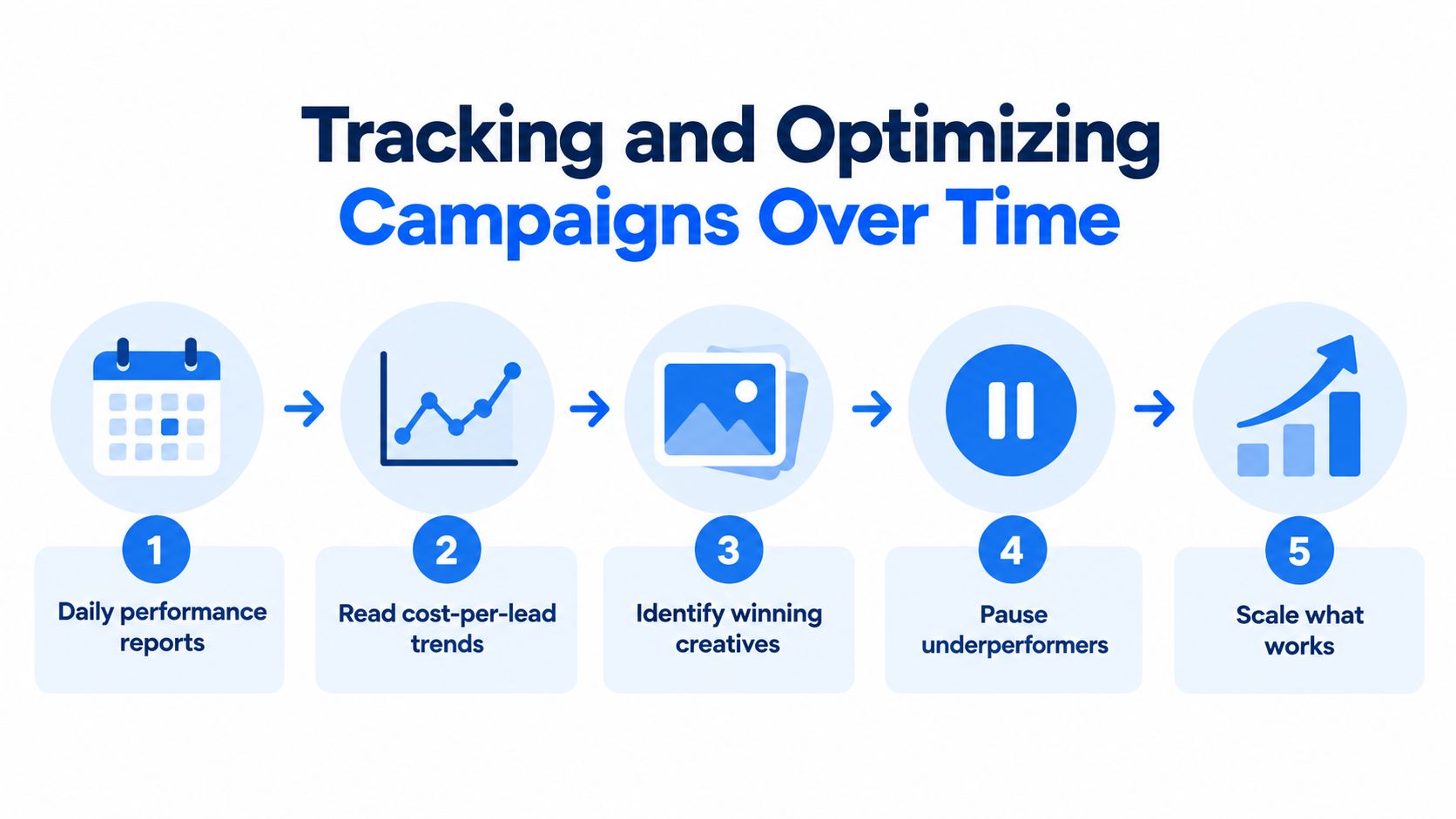
A cheap lead that never books is still expensive. That's why cost per lead should be read alongside response speed, qualification, and booked-job rate. If one ad sends a steady stream of junk and another sends fewer leads that answer the phone, the second one is usually the better ad.
Daily reporting helps here because it gives you a quick read on what changed. If one creative suddenly starts producing weaker results, you can pause it before the pattern gets too expensive. If another ad keeps attracting the right type of homeowner, it deserves more room.
### Use tracking that feeds the platform better data
Server-side and client-side conversion tracking both matter because they help the platform learn from real outcomes instead of just clicks. That's especially important when leads come through forms, landing pages, or text-based intake flows. Better tracking gives you cleaner attribution and a better chance of finding the audiences and creatives that produce booked work.
A simple weekly routine is enough for many contractors.
- **Check lead source quality** by asking which ads produced the leads that replied.
- **Pause obvious underperformers** instead of letting them run out of habit.
- **Keep the winners in rotation** so the account doesn't go stale too quickly.
- **Read the office feedback** because the sales team sees problems the dashboard won't show.
> The cleanest ad account is the one that gets reviewed before the budget gets wasted.
Optimization doesn't need to be fancy. It needs to be consistent, tied to booked work, and reviewed often enough that weak ads don't linger.
## When Facebook Ads Are Not the Right Channel
I've seen contractors blame Facebook for jobs that should've gone to search in the first place. A homeowner with a burst pipe, a broken furnace in the middle of winter, or a wiring problem that needs immediate attention usually isn't browsing social feeds to compare offers. They're searching, calling, and trying to solve the problem now.
That's where Meta gets misunderstood. It's not the best fit for every intent level, and forcing it into the wrong role wastes money. The channel shines more for planned, visual, or higher-consideration work, especially when the homeowner needs time to think, compare, or get comfortable with the company.
### A simple trade-off
If the job is urgent and the buyer already knows what they need, search usually fits better. If the job is more visual, seasonal, or replacement-oriented, Facebook can create interest earlier in the process and keep your company in the frame while the homeowner decides.
That's why skipping Meta can be smart. If a contractor can't respond quickly, doesn't have enough margin to absorb unclosed leads, or has no real photo or video proof, the channel can become noisy instead of profitable. The same 2026 guidance that praises Facebook for planned work also says it's worth skipping when the business can't support fast response and real proof of work contrarian channel fit guide.
### When to leave budget elsewhere
A contractor should think twice about Facebook if the business depends mostly on urgent, high-intent calls. It's also a poor fit when the team has no process for handling replies, or when the ad would be just another generic offer with no local credibility. In those cases, referral work, search, or direct response on a different channel can be a better use of money.
The practical takeaway is simple. Facebook ads for contractors are strongest as a demand-generation system, not a replacement for every other channel. Use them where homeowners need time, proof, and a reminder, and leave them out when the buyer is already ready to book.
---
If you want a contractor ad system that handles creative, campaign setup, tracking, and follow-up in one place, take a look at [benjiads](https://benjiads.com). It's built for local service businesses that want Facebook and Instagram ads without managing every moving part manually. Visit the site and see how the workflow fits your trade and your response process.