Source: https://benjiads.com/blog/example-of-a-description
Publisher: benjiads, https://benjiads.com
Published: 2026-10-10
Updated: 2026-10-10
Cite as: benjiads, "7 Example of a Description Types for Service Businesses", benjiads.com/blog/example-of-a-description
Reuse: you may quote this article with attribution and a link to the source.
# 7 Example of a Description Types for Service Businesses
Explore 7 example of a description formats for service businesses, with tone, length notes, and tactics you can apply to your own copy in 2026.
A homeowner with a burst pipe scrolls through three local service pages on a Friday evening. Within seconds, they choose the business whose first description makes the next step obvious: what it handles, where it works, and how quickly someone will respond. The other pages may look polished, but their vague introductions leave too much uncertainty.
That's why an **example of a description** should be treated as a working sales tool, not decoration. The right format depends on the job the page must perform. A homepage needs a compact product explanation. A feature section must connect capabilities to outcomes. A trade page needs local relevance, while a comparison page must clarify trade-offs.
Below are seven description types, each with a practical example, tone and length rules, and adaptation advice for a service business without an agency. BenjiAds' own product copy provides a useful reference because it connects advertising, landing pages, tracking, and SMS follow-up in one workflow.
## Table of Contents
- [1. Product Description for SaaS Platforms](#1-product-description-for-saas-platforms)
- [Make the value concrete without inventing proof](#make-the-value-concrete-without-inventing-proof)
- [2. Feature-Benefit Description for Marketing Materials](#2-feature-benefit-description-for-marketing-materials)
- [Use the customer's vocabulary](#use-the-customers-vocabulary)
- [3. Use-Case Description for Audience Segmentation](#3-use-case-description-for-audience-segmentation)
- [Adapt the format to the business model](#adapt-the-format-to-the-business-model)
- [4. Problem-Centric Description for Content Marketing](#4-problem-centric-description-for-content-marketing)
- [5. Comparative Description for Competitive Positioning](#5-comparative-description-for-competitive-positioning)
- [6. Data-Driven Description for Trust Building and Social Proof](#6-data-driven-description-for-trust-building-and-social-proof)
- [7. Narrative and Story-Based Description for Emotional Connection](#7-narrative-and-story-based-description-for-emotional-connection)
- [7 Description Types Compared](#7-description-types-compared)
- [Turn These Descriptions Into Copy You Can Test](#turn-these-descriptions-into-copy-you-can-test)
## 1. Product Description for SaaS Platforms
A SaaS product description should explain **who the product serves, what it changes, and how the change happens**. For a local service platform, the strongest version speaks to an owner who's busy answering calls, scheduling work, and managing technicians, not to a marketing specialist.
A useful example is:
> **BenjiAds helps local service businesses run paid advertising without managing every marketing tool themselves. It creates trade-specific ads, landing pages, tracking, and SMS lead follow-up, while keeping campaigns paused until the owner approves them.**
The tone is **direct, practical, and outcome-led**. Keep a homepage hero description to **two or three sentences**. Lead with the transformation, such as getting qualified inquiries by text, rather than opening with technical language like “AI-powered campaign orchestration.”
Stripe's “Payments infrastructure for the internet” illustrates the value of compression. HubSpot leads with ease of setup and accessibility before introducing more advanced CRM functions. Zapier emphasizes the result of connecting apps and automating workflows. The shared lesson is simple: a visitor should understand the product's job before reading its feature list.
### Make the value concrete without inventing proof
BenjiAds can describe its workflow with verifiable product details:
- **Creative production:** The platform generates ad copy and images designed for trades such as plumbing, electrical work, landscaping, and dentistry.
- **Campaign control:** Prebuilt Facebook and Instagram structures reduce configuration, while ads remain paused until approval.
- **Lead handling:** SMS and iMessage intake deliver contact details directly to the business.
- **Billing:** The platform uses wallet-based billing with a flat **20% management fee on ad spend and no subscription**, as described by [BenjiAds' automated marketing platform guide](https://benjiads.com/blog/automated-marketing-platform).
Don't add a performance promise unless you can support it with a current, defined source. A description earns trust when it states exactly what the platform does and leaves results to measured campaign data.

## 2. Feature-Benefit Description for Marketing Materials
A feature describes the product. A benefit explains why the customer should care. Service business owners usually don't need to know how a system is engineered, but they do need to know whether it will help them launch, answer, measure, or improve their advertising.
Use a **feature followed immediately by its operational consequence**:
- **Prebuilt campaign structures:** Start with prepared audiences, budgets, and campaign logic instead of building every setting from scratch.
- **SMS-based lead intake:** Receive inquiries in a familiar text environment, with phone verification helping distinguish reachable contacts from incomplete submissions.
- **Dual tracking:** Combine server-side and client-side conversion signals so reporting can connect advertising activity with later actions.
- **Approval workflow:** Review ads before they run, preserving the owner's control over the message and spend.
- **Daily reporting:** See leads, cost per lead, and creative performance in plain language.
The tone should be **specific and reassuring**. Organize the copy by the owner's workflow, not by engineering architecture. “Set up, launch, respond, measure” is easier to scan than “client-side, server-side, orchestration layer.”
### Use the customer's vocabulary
“Booked jobs,” “qualified calls,” “unanswered inquiries,” and “after-hours requests” are more useful than abstract conversion terminology. The description should also explain what the customer still controls. Approval-based advertising and no subscription reduce the fear that an automated system will spend money or publish claims without review.
A concise example might read:
> **BenjiAds prepares the ads, landing funnel, tracking, and follow-up. You approve the campaign, receive leads by text, and review performance without piecing together separate tools.**
That sentence works because it pairs capabilities with a clear owner experience. The [guide to what ad creative means](https://benjiads.com/blog/what-is-ad-creative) can support a deeper explanation of how copy and imagery contribute to campaign testing. For readers comparing paid-search formats, a separate explanation of [how responsive search ads work](https://adcrunch.dev/blog/responsive-search-ads/) can clarify why adaptable creative differs from a fixed message.

## 3. Use-Case Description for Audience Segmentation
A use-case description answers a question generic product copy can't: **what does this look like in my trade?** A plumber, dentist, groundskeeper, and auto repair shop may all need leads, but their urgency, scheduling patterns, and customer expectations differ.
For a plumber, the description could say:
> **Capture urgent plumbing inquiries after hours, confirm the customer by text, and keep the conversation active while your team decides whether the job fits its schedule.**
For a gardening professional, the emphasis shifts:
> **Build demand before the busy season with trade-specific campaigns, then direct inquiries into a clear intake and follow-up process as requests increase.**
The tone is **recognizable and trade-specific**, with a length of roughly **two to four sentences per audience**. Mention the actual job, customer concern, and next operational step. Avoid forcing every vertical into the same promise.
### Adapt the format to the business model
Emergency trades should foreground response and availability. Appointment-led businesses should explain reminders, intake, and scheduling. Seasonal businesses should describe preparation and timing without promising a particular volume of work. Health providers also need careful review of privacy, licensing, and claims before publishing.
Useful trade pages can answer:
- **What problem appears most often?** Missed emergency calls, empty appointment slots, seasonal demand, or unqualified inquiries.
- **What language signals relevance?** “Emergency call,” “new-patient appointment,” “maintenance visit,” or “spring cleanup.”
- **What must the visitor know next?** Service area, opening hours, contact method, and what happens after submission.
The importance of that last question extends beyond copywriting. [Local search research from BrightLocal](https://www.brightlocal.com/research/consumer-search-behavior/) reports that **85% of consumers consider contact information and opening hours important** when researching local businesses. That makes operational detail part of the description's persuasive work, not an optional footer.
For a trade-specific campaign, BenjiAds can combine a custom message with a hosted landing page, lead capture, phone verification, and SMS follow-up. A business can also use [remarketing ads on Google](https://benjiads.com/blog/remarketing-ads-google) to reconnect with visitors who needed more time before contacting the company.

## 4. Problem-Centric Description for Content Marketing
A service business usually loses the lead before it loses the sale. The visitor fills out a form after hours, the message lands in a crowded inbox, and a competitor replies first. A strong problem-centric description starts there, at the point where work slips through routine gaps, because that is the job this description type does on the page. It helps the reader recognize a specific failure before any product claim appears.
For a plumbing guide, the description can be as direct as this:
> **A homeowner submits a request after hours. Your team is finishing a job, the notification gets buried, and another plumber answers first. By the time someone checks the form, the opportunity may no longer be available.**
The reason this works is precision. The tone is **empathetic, diagnostic, and patient**. It does not blame the reader or rush to a pitch. It names the sequence, shows where attention breaks, and gives the reader enough detail to say, yes, that happens here. For content marketing, that usually means more room than a homepage gets. A blog intro or webinar summary can run longer, but the length still needs discipline. Each paragraph should do one job: show the situation, isolate the operational block, then point toward a practical fix.
Evidence matters because response speed is not just a feeling. A Harvard Business Review study summarized by [Callingly's lead-response analysis](https://callingly.com/blog/state-of-speed-to-lead) examined **2,241 U.S. companies** and found that **37% responded to web-generated leads within one hour**, while **24% took more than 24 hours and 23% never responded**. The same summary reports that contacting a responding lead within one hour made a meaningful conversation with a decision-maker approximately **seven times more likely** than waiting another hour, and about **60 times more likely** than waiting 24 hours.
That makes the copy task clearer. The description should explain the mechanism of loss, not just the frustration around it.
A useful structure is capture, delivery, verification, follow-up, measurement. An inquiry comes in. Contact details reach the business. The phone number is checked. SMS or phone follow-up starts quickly. The owner can then see whether the lead became a conversation or appointment. BenjiAds fits naturally into that chain as the worked example because its copy can describe the process in operational terms, rather than as vague convenience.
[Smartlead's lead-response-time research](https://www.smartlead.ai/blog/lead-response-time-and-ways-to-improve-it) also summarizes findings that contact within **five minutes** made qualification approximately **21 times more likely** than contact after 30 minutes. Use numbers like these carefully. If the page cannot define terms such as “qualified,” qualitative wording is more credible than false precision.
## 5. Comparative Description for Competitive Positioning
A visitor lands on the page deciding between three real options. Hire an agency, run ads alone, or use a tool that reduces the operating work. A comparative description works when it helps that person judge fit, not when it tries to make every alternative look weak.
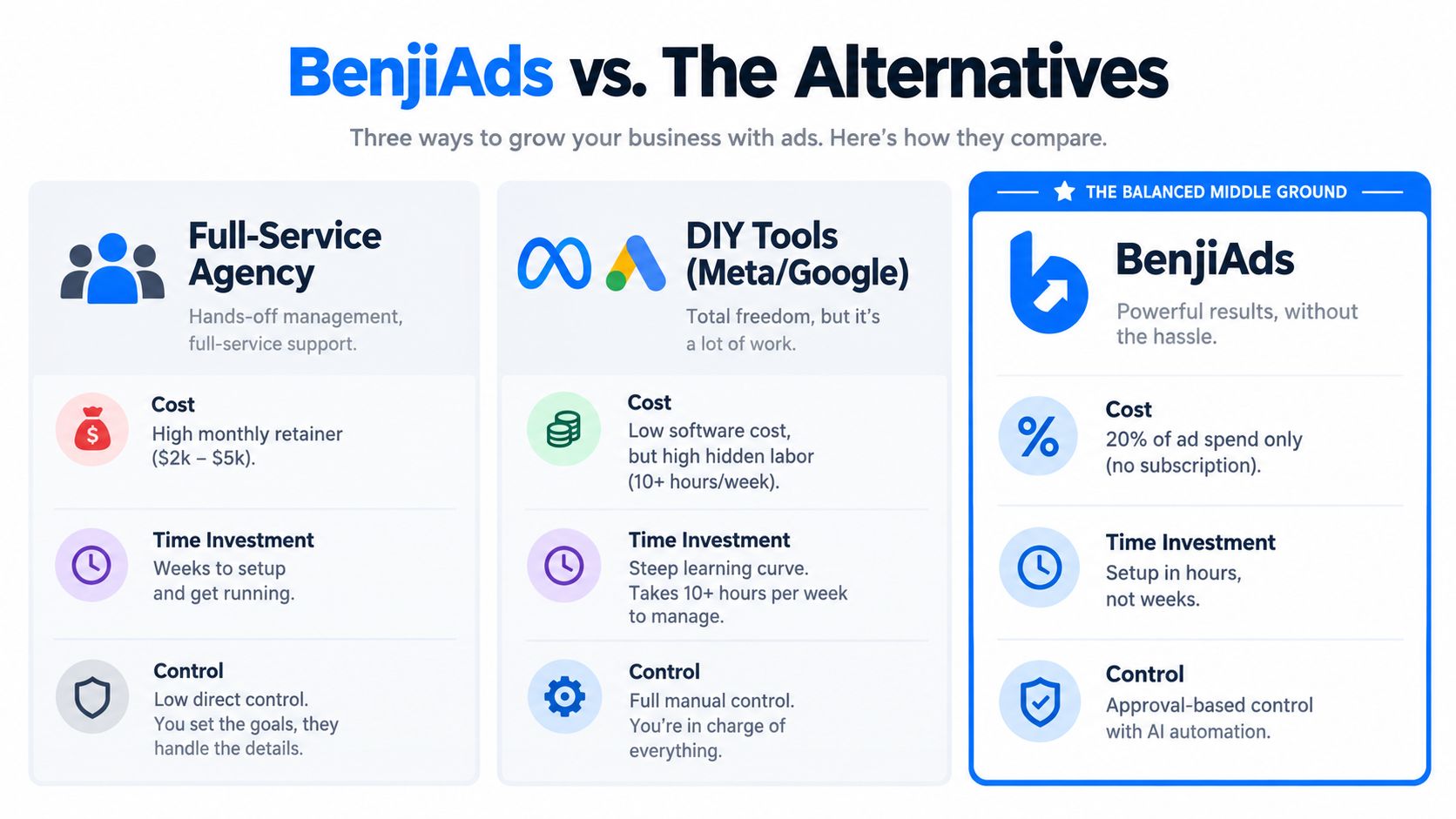
BenjiAds is a useful example because its copy sits in the middle of the market. It is not selling broad advisory work in the way a full-service agency does. It is also not asking an owner to build campaigns, pages, tracking, and follow-up from scratch inside a self-serve ad account. The job of the description is to define that middle position clearly, with enough detail that a service business can tell whether the trade-off matches its time, control needs, and tolerance for hands-on setup.
A concise version can do that in a few lines:
> **A full-service agency can handle strategy and day-to-day management. DIY ad tools give direct access but leave setup, tracking, and lead handling with the business. BenjiAds sits between those options, automating recurring execution while keeping ad approval with the owner.**
Why this works. It compares forms of work, not just categories of vendor. The tone should stay **transparent and decision-oriented**, because comparative copy loses credibility when it implies that one route suits everyone.
The most useful comparison usually answers five questions in plain language. Who builds the campaign, landing page, tracking, and follow-up. Who approves ads before launch. Who monitors lead delivery and creative changes. How the business sees the link between ad activity, inquiries, and booked work. How billing is structured.
BenjiAds' own product terms make that positioning more concrete. Its copy describes the service as software rather than an agency, says campaigns and the site can be prepared and kept paused at no cost, and states a flat **20% management fee on ad spend and no monthly plan**. Those terms clarify the operating model. They do not prove superior results.
That distinction matters. Comparative descriptions often fail when they compare prices while hiding response ownership. If one option produces inquiries that sit unanswered, lower cost does not automatically mean better performance. A stronger page shows where follow-up lives, who sees timestamps and replies, and which tasks remain with the business owner.
## 6. Data-Driven Description for Trust Building and Social Proof
A service owner lands on a results page and sees a low cost-per-lead number. The description either helps them judge it or pushes them toward a bad assumption. For this kind of copy, the job is not excitement. The job is to make the claim usable.
BenjiAds gives a practical example because its offer depends on operational clarity, not broad promises. If the page says the average cost per phone-verified lead is **around $7 across local campaigns**, that line works only if the reader can tell what counted as a lead, what counted as phone-verified, and where variation by trade and market starts to matter. Without those definitions, the number looks precise while saying very little.
Keep the tone **measured and auditable**. Keep the length tight unless the page also shows a methodology note. A short version can do the work:
> **BenjiAds reports an average cost per phone-verified lead around $7 across local campaigns. Results vary by trade and market, so review how a verified lead is defined, what spend is included, and how inquiries are tracked before using the figure in a forecast.**
That wording earns trust because it limits the claim. It also shows a service business how to adapt the same description style without an agency. State the number, define the event behind it, then state the condition that prevents overreading it.
A useful check is simple. Can a careful buyer reconstruct the calculation?
If not, the description needs more support. The minimum details are usually the action that creates a **lead**, the step that makes it **phone-verified**, whether cost includes media spend alone or fees too, how booked work is confirmed, and the reporting period. Those are not formatting extras. They determine whether two businesses are even describing the same outcome.
Social proof follows the same rule. A testimonial or performance summary carries more weight when the customer's trade, market, timeframe, and permission are clear. The [Polish guide to social proof](https://getpolish.app/blog/testimonial-persuasive-techniques) is useful here because it explains how evidence can persuade without turning into an unsupported promise.
Context helps, but only when it stays in its lane. The IAB and PwC state in the [2024 Internet Advertising Revenue Report](https://www.iab.com/news/digital-ad-revenue-2024/) that U.S. internet advertising revenue reached **$258.6 billion in 2024**, up **14.9% year over year**. That supports the scale of the ad market. It does not validate any single local campaign, and a reliable description makes that boundary explicit.
## 7. Narrative and Story-Based Description for Emotional Connection
A contractor closes out a service call, glances at the phone, and sees several new inquiries. The pressure in that moment is not abstract. It is operational. Which numbers are real, who needs a call back first, and what can wait until the crew is off the road?
That is why a narrative description works on a service page. It gives the reader a job to recognize, then shows how the offer fits into that job. BenjiAds' product copy is strongest when it stays close to that lived sequence instead of drifting into a broad brand story.
A publishable version can sound like this:
> **A local HVAC owner finishes a service call and checks the phone. Several inquiries arrived while the technician was on-site. The owner doesn't need another dashboard to study that evening. The immediate need is to know who reached out, whether the number is usable, and what response should happen next.**
The description succeeds because its tone is **human, specific, and restrained**. It names a real tension, keeps the scope narrow, and avoids the usual shortcuts that make service stories sound manufactured. If you have a real customer, use the customer. If you do not, use a realistic operating scenario and stop short of invented names, timelines, revenue figures, or quoted praise.

The emotional pull usually comes from routine details, not dramatic language.
A short version should stay with one tension and one shift. A longer case story can carry more weight if it follows the sequence cleanly: the trade and service area, the hesitation before trying the service, the workflow before adoption, what changed after setup, and the evidence that supports the result. That structure keeps the story readable while still doing the job on the page, helping a buyer judge fit.
Small operational beats also keep the promise honest. An owner may move from checking scattered channels between jobs to receiving leads by text and reviewing prepared ads, while still wanting approval over advertising. Then a different problem appears. Capacity. That turn matters because it shows where a positive outcome can stall. More inquiries only help when the business can answer quickly, serve the area, and protect work quality.
Use video the same way. A testimonial should show the speaker, caption the claim clearly, and match the written evidence.
The CTA should follow that discipline: **“Start by showing us your trade, service area, and preferred lead workflow.”** It invites action without implying the same result for every buyer.
## 7 Description Types Compared
| Description Type | Implementation Complexity 🔄 | Resource Requirements ⚡ | Expected Outcomes 📊⭐ | Ideal Use Cases 💡 | Key Advantages ⭐ |
|---|---:|---:|---|---|---|
| Product Description for SaaS Platforms | 🔄 Low–Medium, concise hero copy, needs messaging alignment | ⚡ Minimal, copywriter + A/B testing | 📊 Clear visitor understanding; ⭐ good CTR & immediate relevance | 💡 Homepage hero, landing pages, pitch decks | ⭐ Fast comprehension; specificity builds trust |
| Feature-Benefit Description for Marketing Materials | 🔄 Medium, map features to concrete benefits | ⚡ Medium, product experts + UX/writer time | 📊 Higher demo/sales conversion; ⭐ practical clarity | 💡 Product pages, sales decks, comparison pages | ⭐ Demonstrates direct value; aids sales conversations |
| Use-Case Description for Audience Segmentation | 🔄 High, trade-specific research and tailoring | ⚡ High, interviews, multiple landing pages, creatives | 📊 Strong relevance lift; ⭐ higher conversion by vertical | 💡 Targeted ad campaigns, vertical landing pages, sales collateral | ⭐ Deep personalization; better ad/landing performance |
| Problem-Centric Description for Content Marketing | 🔄 Medium, research + structured long-form narrative | ⚡ Medium, writers, data, distribution effort | 📊 Builds trust and organic traffic; ⭐ strong engagement | 💡 Blog posts, guides, webinars, educational content | ⭐ Authority-building; drives inbound leads |
| Comparative Description for Competitive Positioning | 🔄 Medium–High, accurate competitor analysis required | ⚡ Medium, research, design, regular updates | 📊 Clarifies decision-making; ⭐ reduces objections | 💡 Comparison pages, sales decks, landing pages | ⭐ Transparent positioning; highlights trade-offs |
| Data-Driven Description for Trust Building and Social Proof | 🔄 Medium, requires data collection and validation | ⚡ High, analytics, case studies, third-party validation | 📊 High credibility; ⭐ measurable ROI proof | 💡 Pricing page, case studies, sales decks, ads | ⭐ Quantified proof; supports ROI modeling |
| Narrative/Story-Based Description for Emotional Connection | 🔄 Medium, storytelling craft and sourcing real stories | ⚡ Medium, interviews, production (text/video) | 📊 High memorability and shareability; ⭐ emotional persuasion | 💡 Testimonials, case studies, hero stories, video ads | ⭐ Strong recall; humanizes brand and motivates action |
## Turn These Descriptions Into Copy You Can Test
Start with the page's job, not the format you happen to like. A homepage hero usually needs a concise product description. A feature section needs capability-to-benefit pairs. A trade landing page needs a use case with local and service-specific details. A pricing page benefits from a comparison, while a blog or webinar can earn attention through a problem-centric explanation.
Draft one version using the tone and length rules above. Then inspect every sentence for a separate claim. If it includes a number, check that number against its source and define what it measures. If it includes an average, state the relevant range or variation where the evidence provides one. If it names a customer, obtain permission and retain the original documentation behind the result.
> **Testing principle:** Change one meaningful element at a time, such as the opening promise, trade specificity, or next step, so you can understand what affected the response.
Test two versions with real prospects before applying a winner across the site. Ask whether they can identify the service, service area, contact method, and next action without explanation. Local descriptions often fail by omitting practical information. BrightLocal's research reports that **53% of consumers are unlikely to visit a business with incorrect listings**, while **59% expect a response within 24 hours**. Those findings support a broader conclusion: accuracy and responsiveness are part of the sales message.
AI-generated copy deserves the same discipline. A 2025 small-business survey found that **50% identified generic output as a top concern**, **44% worried about data privacy**, **39% said AI content can require substantial editing**, and **34% were uncomfortable trusting AI with important decisions**, according to the [Squarespace entrepreneurship report](https://www.squarespace.com/blog/entrepreneurship-report-2025). Review every service claim, address, opening hour, licensing statement, geographic promise, testimonial, and emergency offer before publication. Keep human approval in the workflow.
The U.S. small-business market makes this practical need especially broad. The Census Bureau reported **5.58 million U.S. firms with at least one employee and fewer than 500 employees in 2023**, alongside **30,427,808 nonemployer establishments**. Those nonemployer businesses generated nearly **$1.8 trillion in revenue**, and represented **78.4% of all U.S. establishments** in that year, according to the [Census Bureau's small-business data](https://www.census.gov/library/stories/2026/05/small-business-week.html). Owners in this fragmented market need descriptions that reduce uncertainty quickly, not copy that merely sounds polished.
Choose one page today, write the version that matches its job, and have a real prospect explain what they think the business offers. Their confusion will show you what the description still needs to say.
---
BenjiAds helps local service businesses create and manage advertising, landing funnels, tracking, and SMS-based lead follow-up without requiring an agency or a complex marketing stack. Visit [benjiads](https://benjiads.com) to see how an approval-based workflow can turn a clearer description into a more controlled path from ad to inquiry.