Source: https://benjiads.com/blog/digital-marketing-plumbers
Publisher: benjiads, https://benjiads.com
Published: 2026-10-14
Updated: 2026-10-14
Cite as: benjiads, "Digital Marketing Plumbers", benjiads.com/blog/digital-marketing-plumbers
Reuse: you may quote this article with attribution and a link to the source.
# Digital Marketing Plumbers
Digital marketing plumbers. Digital marketing for plumbers explained in a 2026 playbook covering local SEO, paid ads, SMS follow-up, and funnels that turn
A homeowner searches “emergency plumber near me” after water starts spreading across the floor. They're not browsing for inspiration. They want to know whether you serve their address, whether someone can answer, and whether the person arriving will handle the problem professionally. If your ad wins the click but the call goes unanswered, the marketing budget has paid to introduce that customer to a competitor.
That's the operating reality behind **digital marketing for plumbers**. Search visibility, paid traffic, landing pages, reviews, and SMS follow-up only create value when they move a qualified local inquiry into a booked job. The U.S. plumbing market includes approximately **$75.1 billion in revenue for plumbing-primary contractors with employees in 2022**, while a 2023 Census-based count identified **111,207 paid-employee establishments** across plumbing, heating, and air-conditioning contracting. [The Plumbing Brief summarizes these market figures](https://theplumbingbrief.com/plumbing-industry-statistics-2026/). Competition is fragmented, demand is geographically constrained, and the customer's patience varies sharply by situation.
## Table of Contents
- [Why Plumbing Marketing Is an Operations Problem](#why-plumbing-marketing-is-an-operations-problem)
- [The metric that exposes wasted spend](#the-metric-that-exposes-wasted-spend)
- [Locking Down Local SEO Before Spending on Ads](#locking-down-local-seo-before-spending-on-ads)
- [Start with the profile customers actually see](#start-with-the-profile-customers-actually-see)
- [Build pages around profitable local intent](#build-pages-around-profitable-local-intent)
- [Track actions that matter](#track-actions-that-matter)
- [Running Paid Search and Social for Plumbing Leads](#running-paid-search-and-social-for-plumbing-leads)
- [Search first for immediate intent](#search-first-for-immediate-intent)
- [Budget for learning, then judge the pipeline](#budget-for-learning-then-judge-the-pipeline)
- [Landing Pages and Funnels Built for Phone Calls](#landing-pages-and-funnels-built-for-phone-calls)
- [Build the page around the next decision](#build-the-page-around-the-next-decision)
- [Measure connected outcomes](#measure-connected-outcomes)
- [SMS Intake and Automated Follow-Up That Books Jobs](#sms-intake-and-automated-follow-up-that-books-jobs)
- [Separate emergency and routine workflows](#separate-emergency-and-routine-workflows)
- [Protect consent and the customer's actual number](#protect-consent-and-the-customers-actual-number)
- [Reputation as a Conversion Lever, Not a Vanity Counter](#reputation-as-a-conversion-lever-not-a-vanity-counter)
- [Ask at the moment of proof](#ask-at-the-moment-of-proof)
- [Respond without exposing private details](#respond-without-exposing-private-details)
- [A Weekly Marketing Routine Plumbers Can Stick To](#a-weekly-marketing-routine-plumbers-can-stick-to)
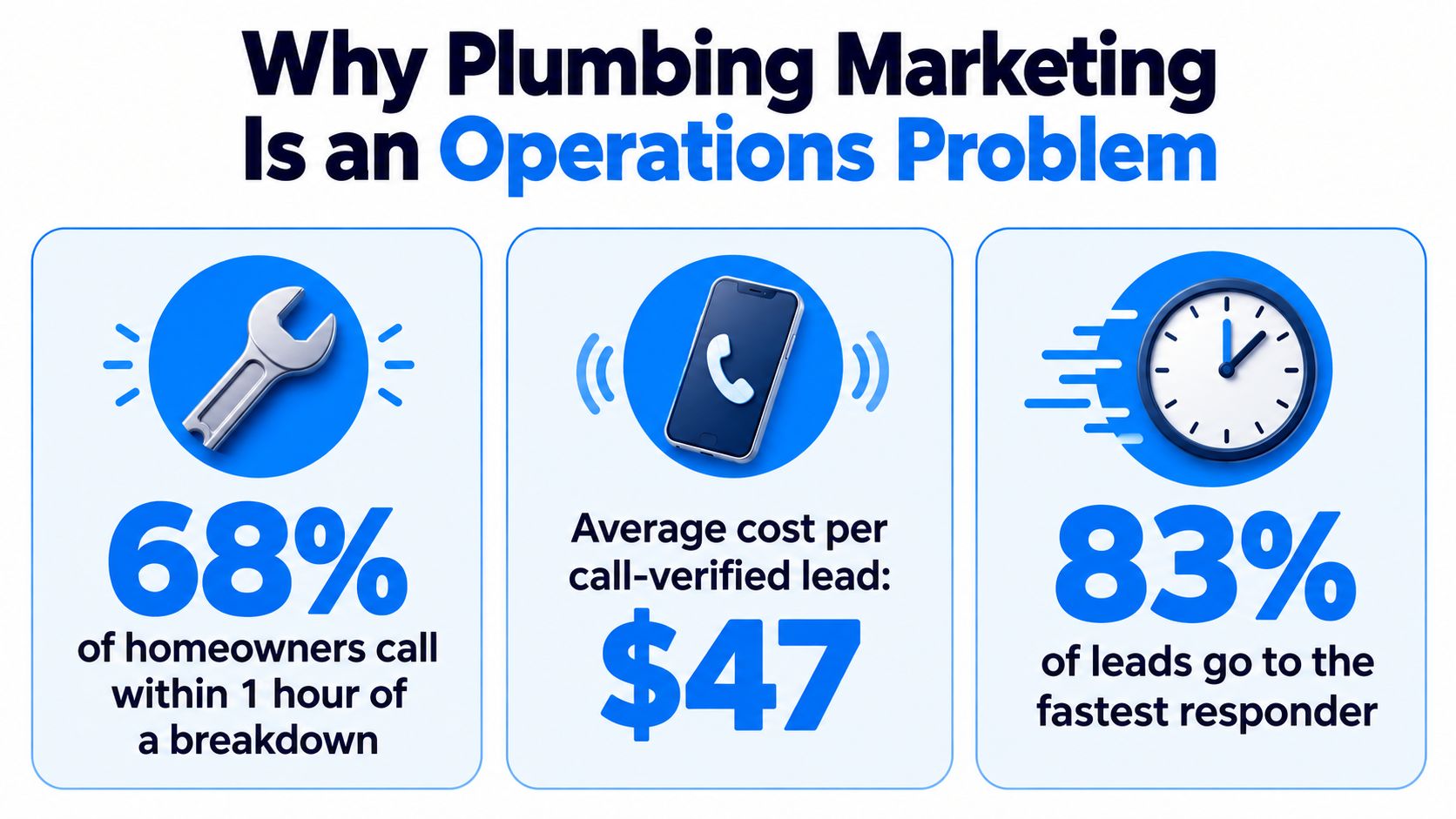
## Why Plumbing Marketing Is an Operations Problem
A drain-cleaning inquiry and a burst-pipe call shouldn't enter the same workflow. The first may tolerate a short qualification exchange and a scheduled appointment. The second needs immediate confirmation, service-area validation, clear instructions while the technician is dispatched, and a human who can take control before the customer calls the next company.
Online discovery compresses that decision. Industry research reports that **97% of homeowners search online for local home-service providers**, while **76% of people conducting local service searches visit or contact a business within 24 hours**. The same benchmark reports that **61% of mobile users are more likely to contact a home-service company when its website is mobile-friendly**, with about **60% of plumbing and HVAC service searches occurring on mobile devices**. [The local home-services search benchmark](https://seosandwitch.com/local-seo-for-home-services-statistics/) connects those behaviors to a practical requirement: the click must lead directly to a clear service page, a working phone number, and a fast response path.
### The metric that exposes wasted spend
Cost per lead is useful only when paired with **phone verification, service-area fit, response time, and booked-job rate**. A cheap form submission from outside the territory isn't a bargain. Neither is an emergency call that sits untouched while the dispatcher finishes another task.
> **Practical rule:** Treat every campaign as an intake system, not an advertising silo. Ask what happens after the click, who owns the lead, and how quickly the customer receives a useful answer.
A connected system looks like this:
- **Discovery:** Local SEO, Google Ads, Meta campaigns, reviews, and referrals create visibility.
- **Qualification:** The landing page confirms the service, location, urgency, and preferred contact method.
- **Response:** A call, SMS, or dispatcher workflow acknowledges the inquiry and sets expectations.
- **Booking:** The team records whether the lead became an appointment, estimate, or lost opportunity.
- **Feedback:** Job outcomes and authentic reviews improve future ads, pages, and local trust.
That's why plumbing operators should evaluate tools by how clearly they connect channel performance to booked work. Agencies comparing reporting and workflow capabilities may find this guide to [comparing SEO platforms for agencies](https://semdash.com/blog/seo-tools-for-digital-marketing) useful when deciding which data belongs in one operating view. The winning tactic isn't always the one producing the most clicks. It's the one your office can answer, qualify, schedule, and measure without creating avoidable leakage.
## Locking Down Local SEO Before Spending on Ads
Paid traffic magnifies whatever is already present. If your Google Business Profile lists vague services, your website hides the phone number, or your service area conflicts across directories, advertising can send more people into a confusing experience. Fix the local foundation first.
### Start with the profile customers actually see
Claim and verify the Google Business Profile, then make the listing match your actual operation. Use the most accurate primary category available, add relevant secondary services, specify the communities your technicians cover, and publish hours that reflect actual call handling. If emergency coverage changes outside office hours, explain the process rather than implying that a technician is always available.
Add photos that reduce uncertainty: branded vehicles, technicians in uniform, completed water-heater work, drain equipment, and the office or shop where appropriate. Customers want evidence that the business exists, serves their area, and performs the job advertised. Keep the business name, phone number, address or service-area configuration, and website consistent everywhere.
For a practical walkthrough of the profile itself, use this guide to [optimizing a Google Business Profile for a plumbing business](https://benjiads.com/blog/google-my-business-page). Don't spend the afternoon chasing every obscure directory before the core listing, phone tracking, and service pages work properly.
### Build pages around profitable local intent
A single “plumbing services” page forces emergency callers, water-heater shoppers, and maintenance customers into the same conversation. Create focused pages for meaningful services and locations you can support operationally. A water-heater repair page should explain the warning signs, service area, call path, and what happens after contact. A drain-cleaning page should answer common questions without turning into a generic article.
Use city pages carefully. A page should contain genuine local information, relevant service details, technician coverage, and a useful next step. Copying one template across every nearby town produces a larger website, not necessarily a more trustworthy one.
### Track actions that matter
Install call tracking that preserves the original source and records whether the call connected. Track form submissions, click-to-call taps, and qualified conversations, but don't let a low-value micro-conversion define success. Connect those events to the CRM or dispatch record so the marketing report can distinguish a missed call, a wrong-number inquiry, a valid lead, and a booked job.
A useful afternoon checklist includes:
- **Profile accuracy:** Confirm categories, hours, service areas, phone number, photos, and website.
- **Local consistency:** Compare business details across major directories and industry profiles.
- **Service alignment:** Match each important paid or organic query to a focused page.
- **Contact paths:** Test phone links and forms on a mobile device.
- **Attribution:** Verify that calls and forms retain source and campaign information.
Local SEO is a compounding asset because a well-organized profile and site can support both organic discovery and paid conversion. It also gives SMS follow-up a cleaner starting point. The more clearly the customer sees what you do and where you work, the fewer messages your dispatcher must spend correcting basic misunderstandings.
## Running Paid Search and Social for Plumbing Leads
Paid campaigns should mirror the way customers describe the problem, not the way a marketing platform organizes ad groups. “Emergency plumber,” “water heater repair,” “sewer line inspection,” and “drain cleaning” represent different urgency, economics, and qualification requirements. Put them into separate campaign or ad-group structures so the copy and landing page can match the request.
### Search first for immediate intent
Google Search is usually the clearest place to capture active demand. Build tightly themed groups around emergency repairs, routine repairs, installations, and commercial work. Use location settings that reflect where crews travel, then review the search-term report for irrelevant queries such as employment searches, DIY research, unrelated product searches, or locations outside the territory.
Ad copy should answer three questions quickly:
- **What do you handle?** Name the job, such as leak detection or water-heater repair.
- **Where do you work?** State the service area without implying coverage you can't deliver.
- **What happens next?** Explain the contact path, such as call intake, estimate request, or scheduling.
Broad social campaigns can play a different role. Facebook and Instagram are useful for local awareness, retargeting, seasonal maintenance offers, and visual proof of completed work. They usually require stronger interruption value than search because the user isn't necessarily seeking a plumber at that moment. Test a technician video, a before-and-after project, a problem-and-solution image, and a simple service-area message. Keep the landing destination specific.
For a channel-level comparison before allocating budget, review [Google Ads versus Meta Ads for local service businesses](https://benjiads.com/blog/google-ads-vs-meta-ads). The correct choice depends on intent, creative capacity, service urgency, and how reliably the team handles the resulting inquiries.
### Budget for learning, then judge the pipeline
Don't split a small budget across every service and audience at once. Start with the services that have clear demand, acceptable job economics, and dispatch capacity. Set geographic boundaries before launch, define excluded areas, and decide who checks spend and lead quality each day.
Early performance data needs context. A few calls can reveal a broken phone path, a poor keyword, or a mismatch between ad promise and landing page. They can't reliably prove that one creative or audience will outperform forever. Let the team inspect call recordings or lead notes, not just platform dashboards.
The critical comparison is **cost per booked job**, not cost per lead alone. A lead that never reaches a dispatcher has no customer value. A campaign with a higher lead cost may produce healthier jobs if the inquiries fit the service area, carry real phone numbers, and convert through a disciplined intake process. The advertising account reports acquisition. The dispatch system reports whether acquisition was worth buying.
## Landing Pages and Funnels Built for Phone Calls
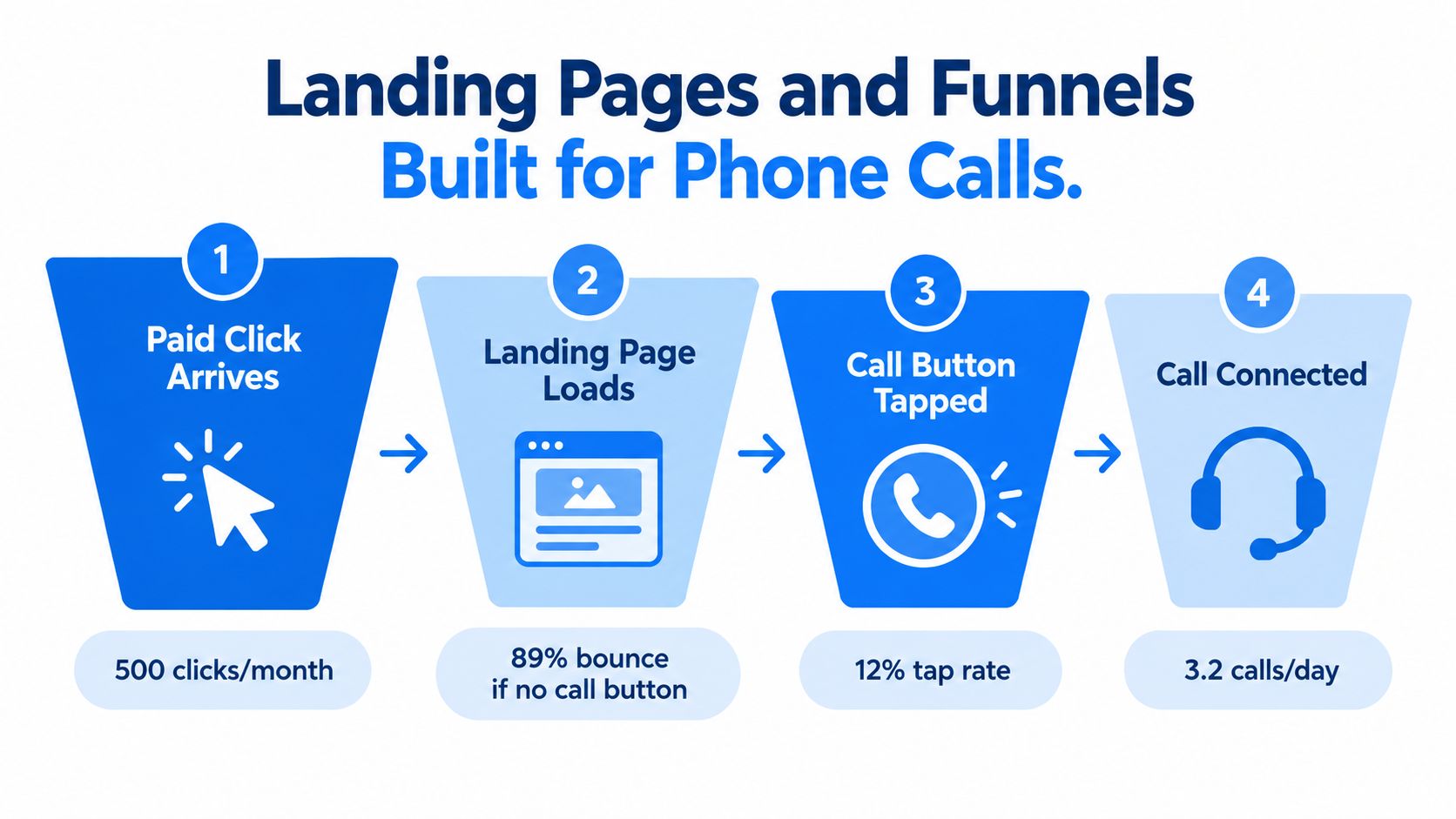
A plumbing homepage often tries to serve every customer at once. That creates navigation work at the exact moment a visitor wants reassurance and a phone number. Send a water-heater ad to a water-heater page. Send a drain-cleaning ad to a drain-cleaning page. The headline, service area, proof, and call-to-action should confirm the visitor made the right choice within seconds.
### Build the page around the next decision
Place the primary phone button near the top of the page and repeat it after the service explanation. Make the number clickable on mobile. Offer a short form for customers who can't call, with fields for name, phone, address or ZIP code, service needed, and urgency. Avoid turning a plumbing emergency into a long application.
Trust elements should support the specific job:
- **Service-area confirmation:** State the communities and ZIP codes the team covers.
- **Operational clarity:** Explain call handling, appointment windows, or estimate steps without promising what the business can't control.
- **Trade proof:** Show relevant completed work, technician identification, licensing information where applicable, and genuine reviews.
- **Problem guidance:** Give safe interim instructions when appropriate, such as locating the water shutoff, while making clear when professional help is needed.
A page can look polished and still fail if the phone link is broken, the form sends to an unmonitored inbox, or the ad promises same-day service that dispatch can't provide. Test every path from the customer's device and submit a real test lead before launch. For broader experimentation ideas, this resource on how to [boost landing page conversions](https://supgrowth.com/2026/07/05/landing-page-optimization/) offers useful context, but plumbing pages still need trade-specific judgment.
### Measure connected outcomes
Use client-side and server-side conversion events where your setup supports them. Record the landing-page visit, call-button tap, form submission, connected call, qualified lead, and booked appointment as separate stages. Then send the strongest reliable event back to the advertising platform so it doesn't optimize toward accidental taps or unqualified forms.
A controlled test changes one meaningful element at a time, such as the headline, proof block, form length, or call-to-action. Keep attribution parameters intact and document the start and end conditions. Guidance on [conversion funnel optimization for service businesses](https://benjiads.com/blog/conversion-funnel-optimization) is most useful when paired with actual call outcomes, not just page metrics.
The funnel is doing its job when the customer understands the service, confirms the territory, chooses a contact method, and reaches someone who can book the work. Every extra click should justify its existence.
## SMS Intake and Automated Follow-Up That Books Jobs
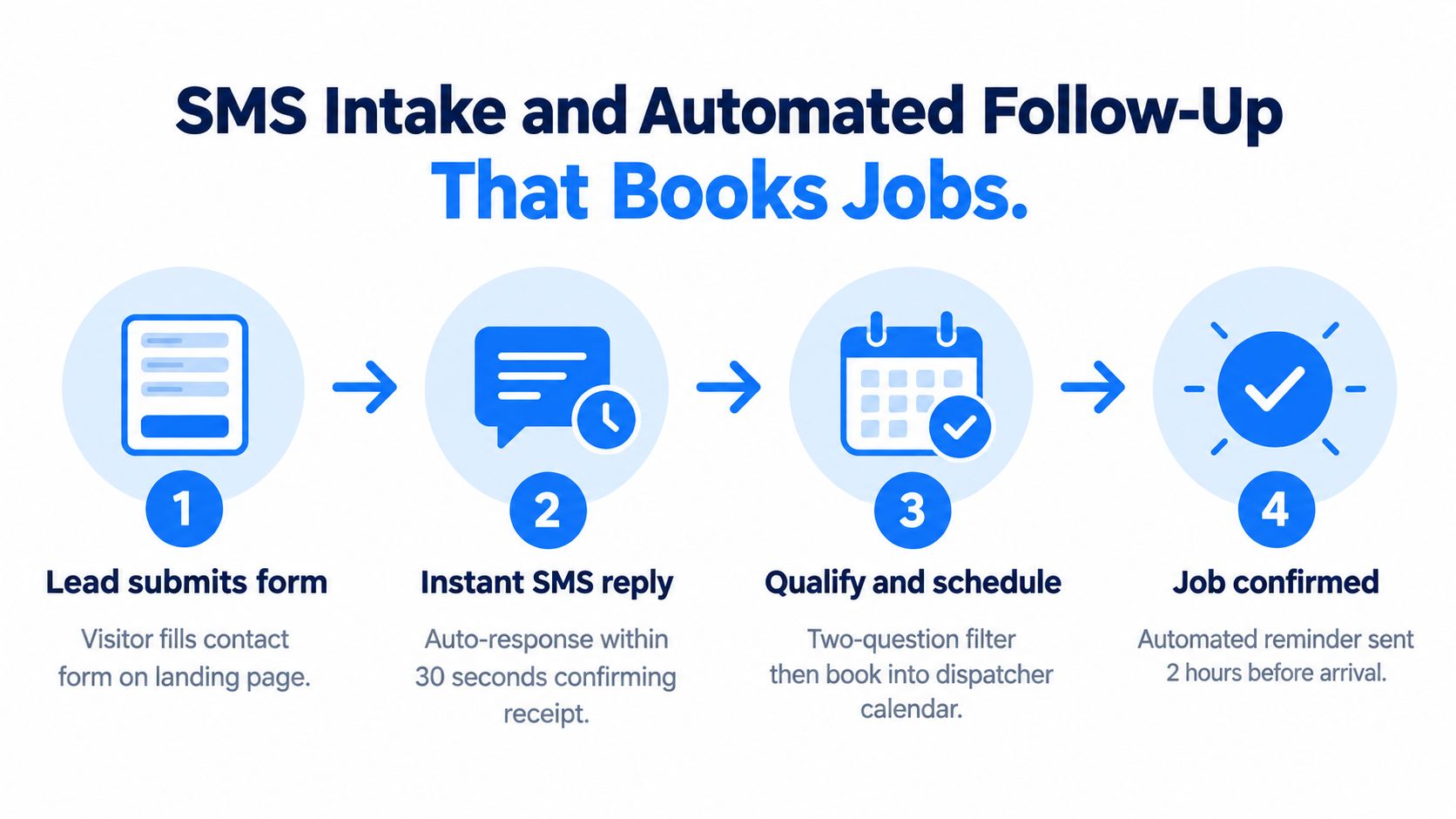
A form submission is not a booked appointment. It's permission to begin a conversation, subject to the customer's consent and the rules governing commercial messaging. The first automated message should acknowledge receipt, identify the business, confirm the requested service and area, and tell the customer what happens next.
Speed matters, but speed without useful information creates another failure point. Available local-search data reports that **59% of consumers expect a response within 24 hours and 20% expect one the same day**. The local lead-generation benchmark also highlights the operational gap between generating an inquiry and converting it. Set a response-service target by lead type and channel, then measure actual performance against it.
### Separate emergency and routine workflows
An emergency sequence should be short and escalation-heavy. A first message can confirm the request, ask whether the customer is inside the service area, provide a safe immediate instruction when relevant, and state that a dispatcher is being alerted. The human handoff should happen quickly, especially when the customer reports active flooding, no shutoff access, sewage backup, or another situation that requires judgment.
A routine maintenance sequence can allow more qualification. Ask what service is needed, whether the customer prefers a call or text, and what appointment window works. If the customer stops responding, send a restrained follow-up that makes the next step obvious. Don't keep texting indefinitely.
> **The automated message should reduce uncertainty, not pretend to be a dispatcher.**
### Protect consent and the customer's actual number
Use an intake form that captures the customer's real phone number and clearly explains that submitting the form may initiate contact. Include opt-out language where required, honor STOP requests, respect quiet hours and applicable messaging rules, and maintain records of consent and communication. An automation tool shouldn't hide the number behind a marketplace relay if the dispatcher needs to call or text directly.
Escalation rules should be explicit:
1. **Immediate acknowledgement:** Confirm receipt and service category.
2. **Qualification:** Ask only the questions needed to determine territory, urgency, and booking path.
3. **Human takeover:** Route emergency or ambiguous responses to a dispatcher.
4. **Scheduling:** Offer a real appointment window or a clear callback expectation.
5. **Reminder:** Confirm the booking and send an appropriate arrival reminder.
The team should track response time by source, lead type, weekday, and after-hours period. A single average hides the exact shifts where calls are lost. Review the automation whenever dispatch changes hours, adds a service area, or modifies emergency coverage.
## Reputation as a Conversion Lever, Not a Vanity Counter
A large review total doesn't automatically answer the customer's question today. Homeowners want evidence that the business recently handled a similar problem, serves their area, communicates clearly, and responds when something goes wrong. Recent local-search reporting says **75% of consumers read at least four reviews before choosing a business**, while other 2025 reporting summarized in the available research says **87% read local-business reviews and 73% focus only on reviews from the last month**. Thryv's plumbing marketing guidance provides the relevant context for treating reviews as an active conversion asset.
### Ask at the moment of proof
Request authentic feedback after the job is complete, when the customer understands the work and the experience is still fresh. Invite feedback from every customer through the same fair process rather than selectively pressuring only people likely to leave praise. Make the request specific without scripting the answer. A customer may naturally mention water-heater installation, fast leak detection, clear pricing, or arrival communication, and those details help future buyers.
A practical review routine routes new feedback to the right owner, alerts the team to negative comments, and records recurring themes. Tools such as [CapyScout on tracking customer reviews](https://www.capyscout.com/blog/google-review-monitoring-a-practical-setup-guide) can help businesses monitor activity, but the response still needs a person who understands the job.
### Respond without exposing private details
Reply to positive reviews with appreciation and a relevant service reference. For negative feedback, acknowledge the concern, avoid discussing customer information publicly, and invite the reviewer into a private resolution channel. Don't argue about the invoice, publish a technician's version of events, or imply that a customer is lying.
Use reviews as message research, not as copy to manufacture. If customers repeatedly praise clear arrival updates, make that process visible on the landing page. If they mention confusion about estimates, improve the estimate explanation. Never claim guaranteed arrival times, savings, licensing, or outcomes unless the business can substantiate the statement for the advertised service.
The right target is a steady, credible reputation that matches the job being advertised. Fresh, specific feedback and professional responses often provide more decision support than another generic “great service” comment added to an old profile.
## A Weekly Marketing Routine Plumbers Can Stick To
Marketing stays manageable when the owner and dispatcher review the same operating signals each week. On Monday, check cost per phone-verified lead, booked-job rate, unqualified inquiries, missed calls, and response-time outliers. Compare results by service and territory, then pause campaigns that generate volume without workable jobs.
Wednesday is for controlled adjustments. Review search terms, ad messages, landing-page questions, and form abandonment. Refresh one creative or headline at a time. Confirm that budget limits match technician capacity, then test every new phone or form path before sending traffic.
Friday covers reputation and follow-up. Respond to outstanding reviews, confirm that SMS follow-up is active, inspect unresolved leads, and flag estimates needing a human callback. The operating loop should connect local visibility, paid traffic, intake, booked work, completed jobs, and authentic reviews.
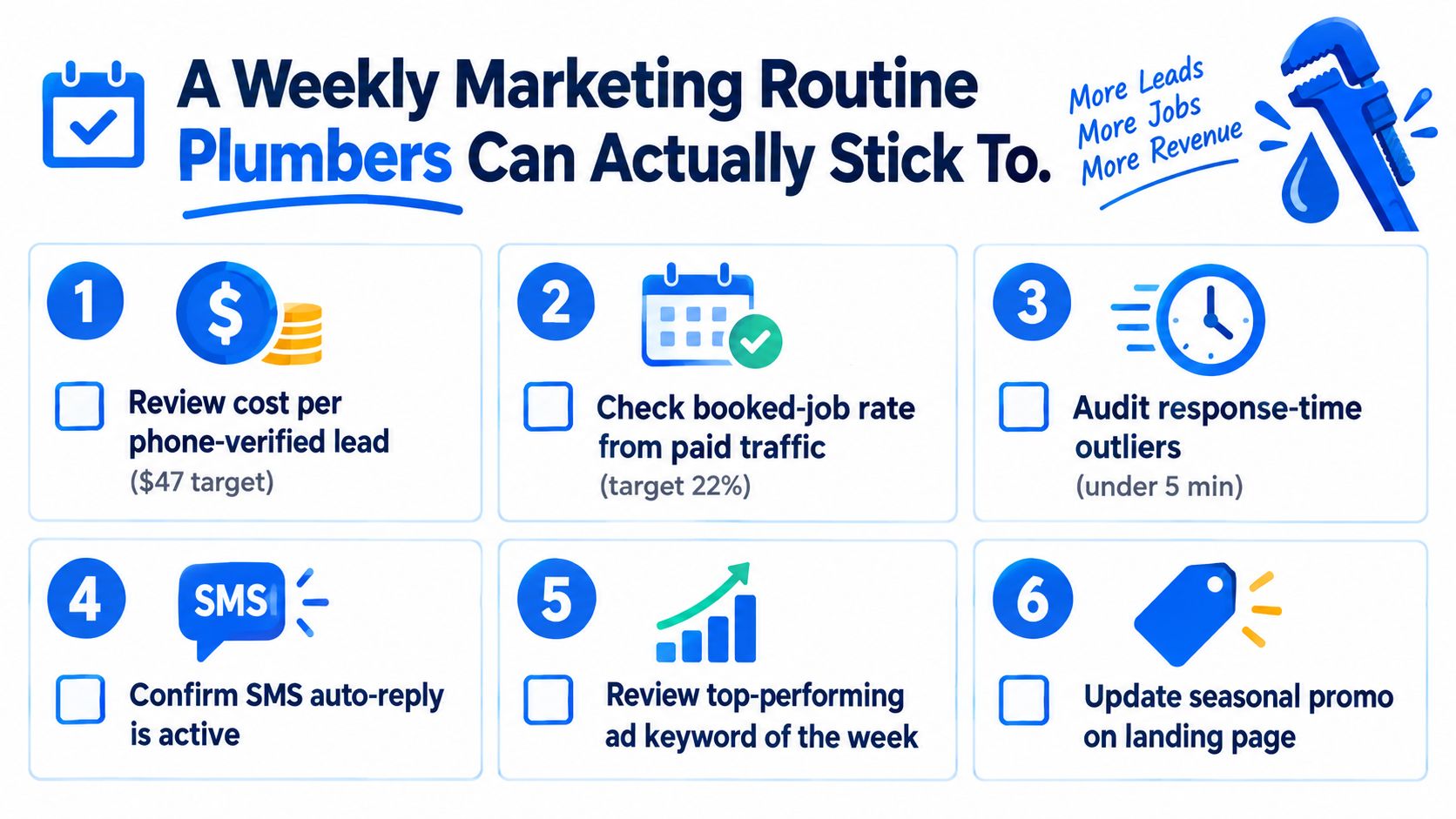
Track only numbers that change decisions. Review campaign economics and capacity in full each quarter, protect paused campaigns from accidental relaunches, and document who approves budget changes. Keep ownership clear so budget, follow-up, and dispatch decisions do not stall between reviews.
---
BenjiAds provides automated ad creation, campaign setup, trade-branded landing funnels, dual conversion tracking, phone-verified SMS intake, and follow-up for local service businesses. To connect plumbing ads with faster lead handling and clearer booked-job reporting, visit [benjiads](https://benjiads.com) and assess whether the platform fits your service area and dispatch workflow.