Source: https://benjiads.com/blog/conversion-funnel-optimization
Publisher: benjiads, https://benjiads.com
Published: 2026-09-30
Updated: 2026-09-30
Cite as: benjiads, "Conversion Funnel Optimization for Local Services", benjiads.com/blog/conversion-funnel-optimization
Reuse: you may quote this article with attribution and a link to the source.
# Conversion Funnel Optimization for Local Services
Master conversion funnel optimization for local services. Learn to fix mobile leaks, automate SMS follow-up, and run A/B tests that drive real revenue.
Most conversion funnel optimization advice starts in the wrong place. It tells you to rewrite the headline, change the button color, or add more testimonials while the mobile form rejects valid phone numbers, new leads sit unassigned, and returning visitors appear in analytics as unrelated strangers.
Those problems are less visible than a weak landing page, but they often cost local service businesses more revenue. A plumber, HVAC company, or yard care provider doesn't win because a visitor admired the page. The business wins when a qualified person can submit a form without friction, receives a useful response quickly, gets connected to the right employee, and remains attributable to the campaign that generated the inquiry.
## Table of Contents
- [The Hidden Friction Killing Local Service Funnels](#the-hidden-friction-killing-local-service-funnels)
- [Why top-of-funnel tweaks get too much attention](#why-top-of-funnel-tweaks-get-too-much-attention)
- [The revenue chain is longer than the landing page](#the-revenue-chain-is-longer-than-the-landing-page)
- [Diagnosing Funnel Leaks Beyond the First Click](#diagnosing-funnel-leaks-beyond-the-first-click)
- [A practical leak-finding sequence](#a-practical-leak-finding-sequence)
- [Mobile errors deserve their own report](#mobile-errors-deserve-their-own-report)
- [Designing High-Converting Landing Pages for Local Services](#designing-high-converting-landing-pages-for-local-services)
- [Build the page around the promised job](#build-the-page-around-the-promised-job)
- [Reduce friction without reducing useful information](#reduce-friction-without-reducing-useful-information)
- [Implementing Dual Tracking for Accurate Attribution](#implementing-dual-tracking-for-accurate-attribution)
- [Map the event contract first](#map-the-event-contract-first)
- [Keep measurement useful and compliant](#keep-measurement-useful-and-compliant)
- [Automating Speed-to-Lead Follow-Up Sequences](#automating-speed-to-lead-follow-up-sequences)
- [A reliable first-touch sequence](#a-reliable-first-touch-sequence)
- [Running Systematic A/B Tests to Scale Results](#running-systematic-ab-tests-to-scale-results)
- [Set a hypothesis worth testing](#set-a-hypothesis-worth-testing)
- [Use distribution benchmarks carefully](#use-distribution-benchmarks-carefully)
- [Declare winners at the business level](#declare-winners-at-the-business-level)
## The Hidden Friction Killing Local Service Funnels
A polished landing page can't rescue a broken operating system. If an ad promises emergency plumbing help and the page makes a homeowner search for the phone number, the message match has already failed. If the form submits but no one receives the alert, the business has paid for intent without creating a sales opportunity.
The most common mistake is treating conversion rate as a page-only metric. For local services, the meaningful path runs from ad impression to click, from click to completed inquiry, from inquiry to conversation, and from conversation to booked work. Each handoff introduces a potential failure.
### Why top-of-funnel tweaks get too much attention
Headlines matter, but they usually receive more attention because they're easy to edit. A marketer can produce several variations in an afternoon. Testing whether the right employee receives a verified lead immediately requires coordination between the landing page, CRM, text messaging system, ad platforms, and dispatch process.
That effort is less glamorous, but it addresses the moments when intent is highest. Fullstory's [2025 benchmark coverage of mobile experience failures](https://transcom.com/blog/customer-journey-mapping) reported that mobile exits caused by errors rose from 48 to 171 per 1,000 sessions, a **254% year-over-year increase**, while mobile bounce rate rose **54%**. The same source reported dead clicks at 929 per 1,000 sessions. Those figures point to a practical problem: visitors may be trying to act, but the interface isn't completing the action.
For a local business, a validation error can be more damaging than an unremarkable headline. A homeowner who mistypes a street number and receives no clear explanation may abandon the form. Someone who taps a button that appears to do nothing won't necessarily try again. The ad platform still records the click, so the business may blame traffic quality instead of the form.
> **Practical rule:** Don't optimize the promise before confirming that the promised action works on the device most prospects use.
### The revenue chain is longer than the landing page
A funnel should be judged by **qualified conversations and booked jobs**, not by clicks, impressions, or even raw form volume. A low-cost lead that can't be reached is not an efficient acquisition result. Neither is a page with a strong conversion rate that sends incomplete details to an unattended inbox.
The critical checks are mechanical:
- **Form behavior:** Confirm that valid phone numbers, addresses, service selections, and free-text descriptions pass validation on common mobile browsers.
- **Lead routing:** Send each inquiry to a named owner, dispatcher, or sales queue instead of a shared inbox nobody monitors consistently.
- **Acknowledgement:** Confirm receipt immediately so the prospect knows the request reached the business.
- **Attribution continuity:** Preserve campaign, ad, landing-page, and session identifiers through the lead record and later sales outcome.
- **Human ownership:** Define who takes over when automation receives a reply, an urgent request, or a lead that fails verification.
A conversion funnel optimization program that ignores these handoffs is measuring the easiest event rather than the valuable one. The page still deserves testing, but it must be tested as part of a system that can turn intent into contact.
## Diagnosing Funnel Leaks Beyond the First Click
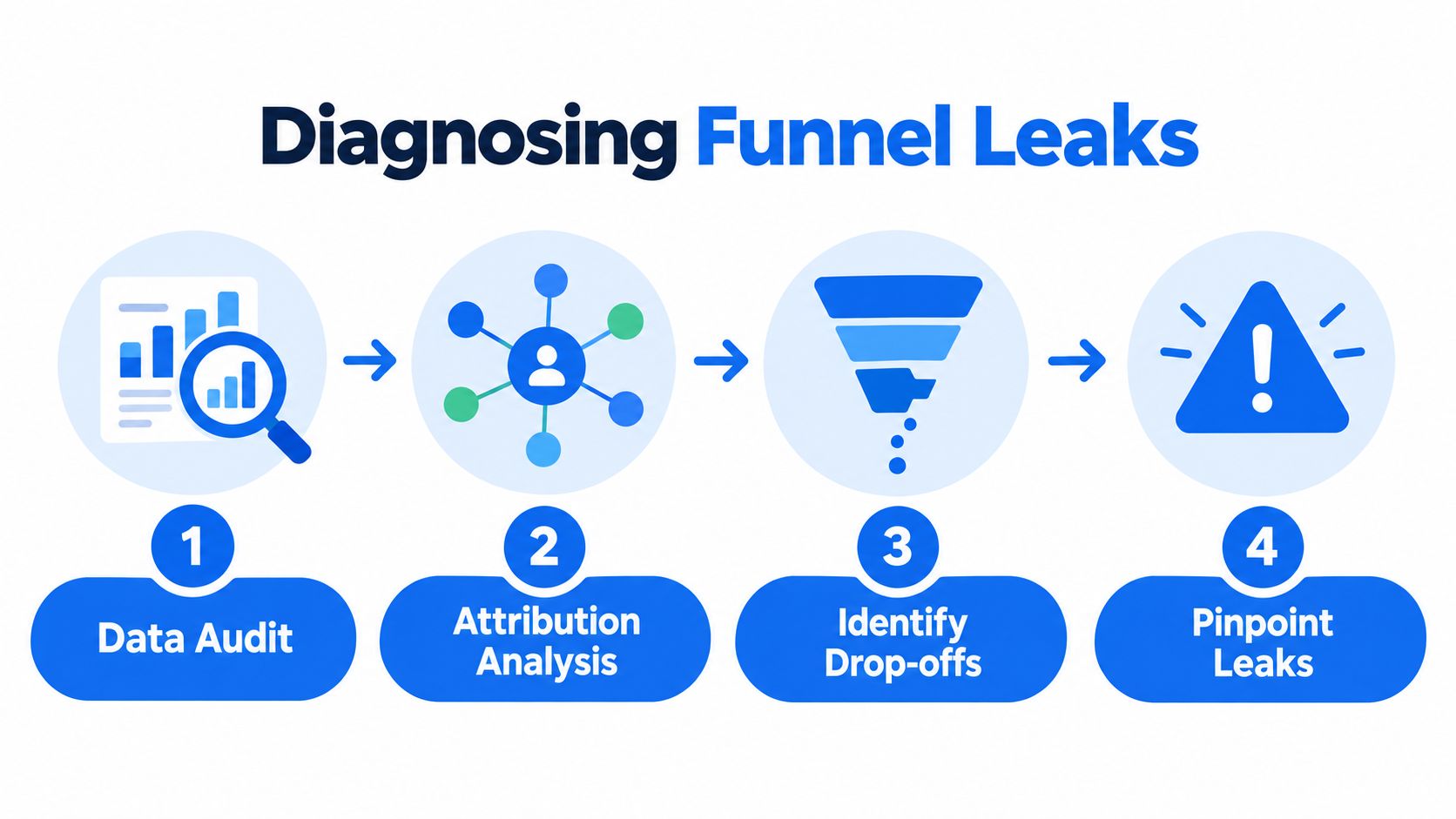
A funnel diagnosis should begin with an event map, not a redesign brief. List every step from the ad click to the business outcome, then verify that each event fires once, carries the right identifiers, and appears in the reporting system with a usable timestamp.
Start with separate paths for mobile and desktop, paid social and search, new visitors and returning visitors. A blended conversion rate can hide a broken mobile form or make a branded campaign look like a universal landing-page success. Segmenting the journey gives you a better question than “Why did conversions fall?” You can ask whether mobile visitors fail at validation, whether a particular ad produces incomplete leads, or whether leads from one source wait longer for contact.
### A practical leak-finding sequence
1. **Audit the raw events.** Check page views, form starts, field errors, submissions, phone verification, SMS replies, calls, appointments, and booked jobs. Look for duplicate submissions, missing source parameters, and events that fire after a visitor has already left.
2. **Replay the failure.** Use session recordings, browser testing, and real devices to reproduce taps, scrolling, keyboard behavior, error messages, and confirmation states. A dashboard can show a drop-off, but it can't always show that the submit button moved when the mobile keyboard opened.
3. **Separate intent from usability.** Compare form starts with completed submissions, then compare completed submissions with verified contacts. A high form-start rate with weak completion points toward friction. A healthy completion rate with poor contact rates points toward routing or follow-up.
4. **Trace the buyer across sessions.** Preserve click identifiers, landing-page parameters, phone numbers, and consent records so a later inquiry doesn't look like a new acquisition. Buyers often research, leave, return, compare providers, and convert after several visits.
### Mobile errors deserve their own report
Don't treat all abandoned forms as equivalent. A visitor who leaves after reading the offer behaves differently from one who completes every field but gets trapped by a validation error. Track the field name, error type, browser context, and whether the person tried again.
Useful error categories include an invalid phone format, an address that fails autocomplete, a required field hidden below the keyboard, a submission timeout, and a confirmation screen that never loads. Store the error event without storing unnecessary sensitive information, and review examples regularly with whoever maintains the landing page.
The buyer journey also isn't reliably linear. Conviva's [2026 funnel path analysis](https://www.shno.co/marketing-statistics/funnel-optimization-statistics) reported that only **33% of consumers** followed a straight-line path. It also reported conversion rates of **13% after one search loop, 16% after two loops, and 19% after three or more loops**, compared with the session average described in that source. The operational implication is clear: attribution and remarketing need to recognize returns, not erase them.
A useful diagnosis ends with one prioritized failure, an owner, and a verification plan. “Improve mobile UX” is too broad. “Fix the phone validation rule on the paid social form, then compare completed submissions and verified contacts by device” is actionable.
## Designing High-Converting Landing Pages for Local Services
A local-service landing page should answer four questions quickly: **What service is available, where is it available, what happens next, and why should the visitor trust this business?** Every element that doesn't help answer one of those questions deserves scrutiny.
The first rule is offer-message match. If the ad says “same-day furnace repair,” the page should lead with furnace repair, the relevant service area, and the next step for requesting help. Sending that visitor to a generic home page introduces navigation choices at exactly the moment the ad created specific intent.
### Build the page around the promised job
Use a direct headline, a short explanation of the service, and one primary action. The form should ask only for information needed to start a conversation, such as name, phone number, service type, and location. Ask for detailed photos, long descriptions, or scheduling preferences later unless the business genuinely needs them to qualify the request.
The page should make the handoff explicit. Tell the visitor whether the business will call, text, or confirm availability, and avoid promising a response time the team can't consistently meet. A clear expectation reduces uncertainty without adding decorative copy.
A practical structure looks like this:
- **Service-specific opening:** Name the problem and service rather than relying on a broad company slogan.
- **Local relevance:** Show the areas served and use authentic neighborhood or service-area context.
- **Proof near the decision:** Place relevant reviews, licensing information, insurance details, and recognizable guarantees close to the form.
- **Simple qualification:** Use concise fields and explain why a required detail is necessary.
- **Visible alternative contact:** Keep a tap-to-call option available for visitors who prefer the phone.
- **Useful confirmation:** After submission, confirm what was received and what the prospect should do if the issue is urgent.
Trust signals need to be specific. “Quality service” is a claim. A review that identifies the type of repair and the service area gives the visitor more context. A licensing badge should identify the relevant credential and link to verifiable information where appropriate. Never add generic badges just to fill space.
### Reduce friction without reducing useful information
Shorter forms aren't automatically better. Removing the service-area field may increase submissions while producing leads the business can't serve. The right question is whether each field improves routing, qualification, or the first conversation enough to justify its effort.
Use inline validation that explains the fix instead of displaying a generic error after submission. Preserve entered values when a field fails. Keep labels visible, make touch targets easy to use, and test the flow with the keyboard open. A visitor shouldn't have to guess whether a red message means the phone number is wrong, the area isn't served, or the system has stopped responding.
Page design tools can speed up production, but they don't replace testing. A platform such as [an AI landing page builder](https://benjiads.com/blog/ai-landing-page-builder) can help create a trade-specific starting point, while the team still needs to verify offer accuracy, service areas, form behavior, consent language, and follow-up ownership.
The strongest page is often less impressive visually than a brand site. It removes competing navigation, repeats the relevant service context, and makes the next action obvious. Before changing its colors, submit the form on a phone, inspect the lead record, reply to the confirmation text, and verify that the right person receives the inquiry.
## Implementing Dual Tracking for Accurate Attribution
A lead event that appears in the browser isn't necessarily a lead event that reaches the advertising platform. Browser restrictions, consent settings, blocked scripts, connection failures, and page transitions can interrupt client-side tracking. Local businesses that rely on a single pixel may undercount results and then make budget decisions using incomplete information.
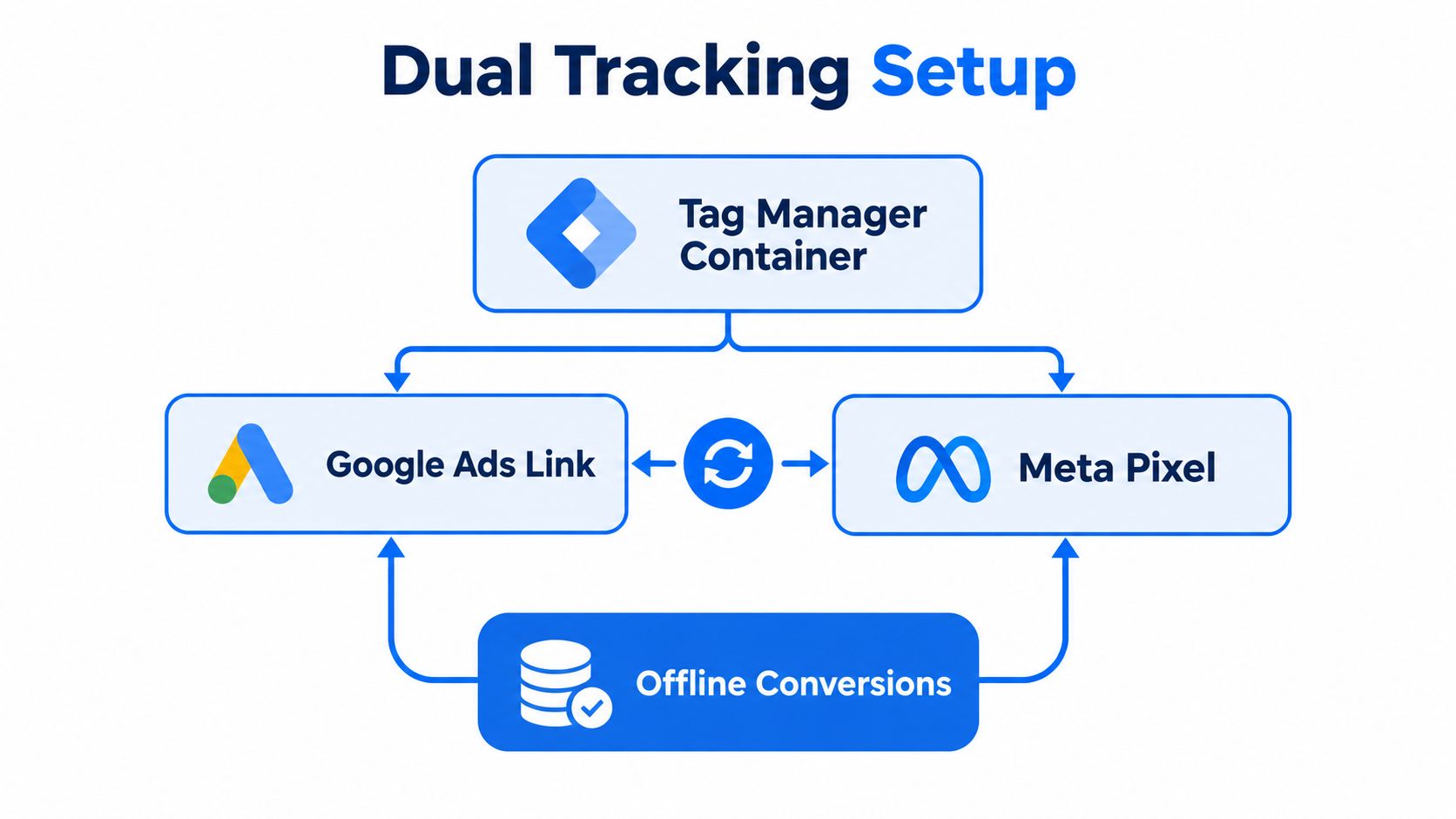
**Dual tracking** combines browser-based events with server-side events. The browser layer provides immediate feedback for analytics and ad interfaces. The server layer sends a conversion after the business system confirms the event, which gives the record a more reliable connection to the actual lead process.
### Map the event contract first
Before installing another tag, define the events and their meaning. A form submission, verified phone number, qualified inquiry, booked appointment, and completed job are different outcomes. If every event is labeled “lead,” the ad platform can't distinguish cheap activity from valuable demand.
For each event, document:
- **Event name:** Use a consistent name across the landing page, tag manager, analytics property, CRM, and ad platforms.
- **Trigger:** Specify the action that qualifies, such as a successful submission or confirmed phone verification.
- **Identifiers:** Preserve consented click IDs, campaign parameters, session information, and an internal lead ID.
- **Deduplication key:** Send the same event identifier through both browser and server channels so the platform doesn't count it twice.
- **Outcome value:** Pass downstream status when appropriate, subject to privacy and platform rules.
The client-side event should fire only after a genuine success state, not when someone clicks a submit button. The server-side event should come from the system that knows whether the submission was accepted, verified, or rejected. This distinction prevents inflated conversion counts from failed forms and accidental double submissions.
### Keep measurement useful and compliant
Server-side tracking isn't permission to collect everything. Send only the data required for attribution and optimization, obtain the required consent, and follow the policies of each advertising platform. Hashing and controlled data handling may be required for certain match methods, but implementation should be reviewed by the team responsible for privacy and compliance.
Test the setup in stages. Submit a controlled lead, confirm the browser event, confirm the server event, inspect the event ID, and check that the platform deduplicates the pair. Then test a validation failure, a duplicate submission, a rejected consent state, and a later offline outcome.
The [server-side versus client-side tracking comparison](https://benjiads.com/blog/server-side-vs-client-side) is useful for understanding the trade-off. Client-side tracking is fast to deploy and helpful for immediate diagnostics. Server-side tracking is more resilient and better suited to confirmed business outcomes, but it requires stronger data governance and reliable backend event handling.
Attribution should answer more than which ad generated a form fill. It should connect the source to contact status, booked work, and revenue where the business can do so lawfully and accurately. Otherwise, the campaign with the most noisy submissions may receive more budget than the campaign producing the best customers.
## Automating Speed-to-Lead Follow-Up Sequences
The form submission is not the conversion. It starts the most time-sensitive part of the funnel.
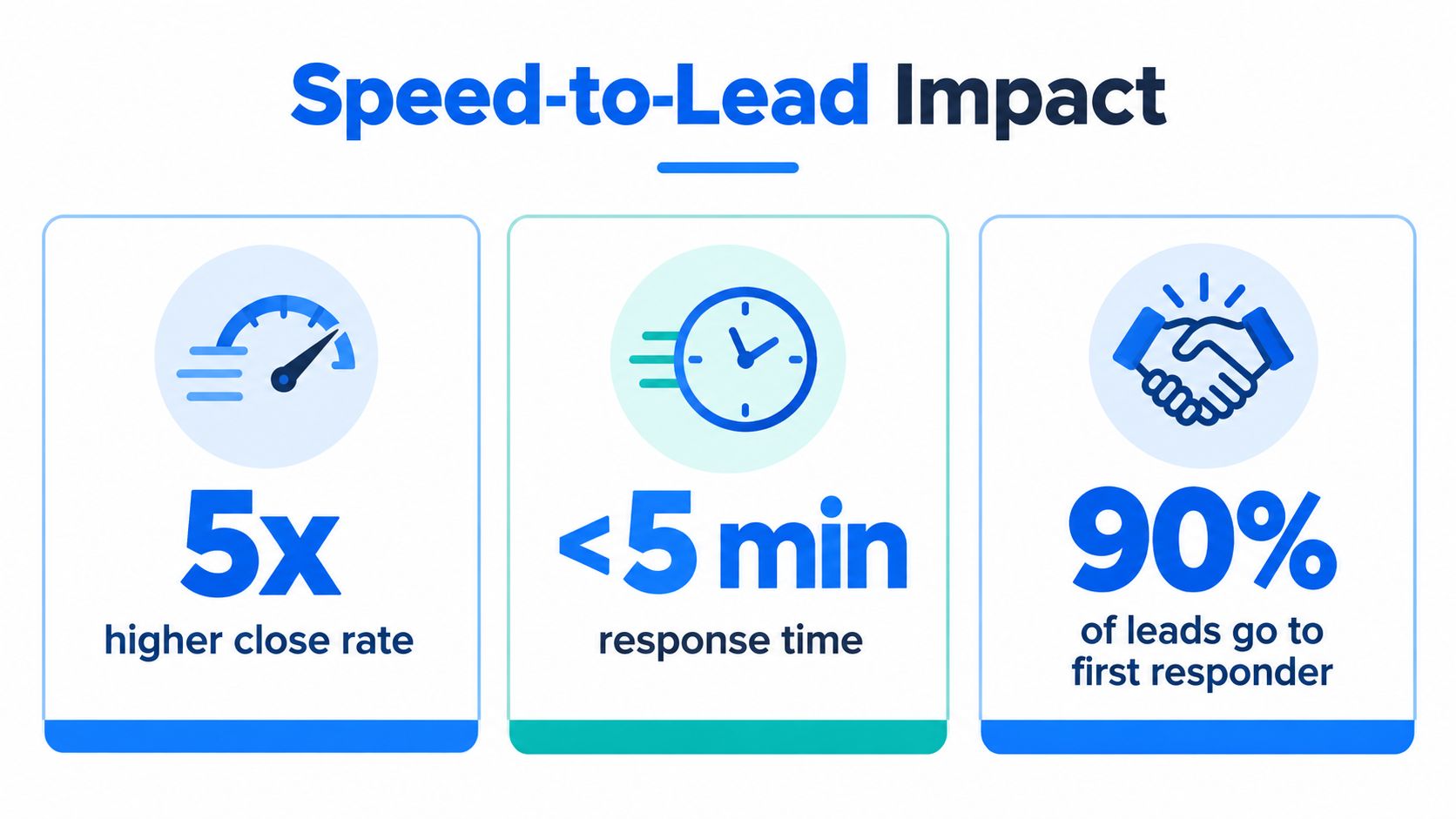
In a panel of **28,400 leads**, the median first-touch response time was **1 hour 42 minutes**, only **14.6%** received a response within five minutes, **12.4%** waited more than 24 hours, and **4.8%** received no reply, according to [lead response time analysis from Visionary Marketing](https://visionary-marketing.co.uk/blog/lead-response-time-statistics-2026). The same dataset reported end-to-end conversion of **11.4%** for responses within five minutes, **4.1%** for responses within one to four hours, and **0.6%** for responses after more than 24 hours.
Those figures make speed-to-lead a mathematical lever, not merely a sales preference. The business doesn't need to choose between automation and human service. Automation should acknowledge intent, verify the contact, collect useful context, and route the conversation while a human prepares to take over.
### A reliable first-touch sequence
The first message should identify the business, acknowledge the request, and set the next expectation. It shouldn't launch into a long sales pitch or ask the prospect to repeat information already supplied.
A practical sequence is:
1. **Immediate acknowledgement:** Confirm that the request was received and state the service context.
2. **Phone verification:** Ask the prospect to confirm the number or reply with a simple verification response, using consent-compliant messaging.
3. **Useful qualification:** Ask one focused question if it helps determine urgency, service type, or location.
4. **Human routing:** Send the lead to the employee or queue responsible for the relevant service area.
5. **Escalation:** Alert another owner if no human takes responsibility within the business's operating threshold.
6. **Conversation continuity:** Stop generic automation when the prospect replies, and preserve the full thread for the person taking over.
The message should also handle edge cases. If the visitor requests emergency service, the response should provide the correct urgent-contact instruction rather than placing them into a slow nurture sequence. If the service area doesn't match, the system should explain the limitation and offer the next available path instead of leaving the inquiry unanswered.
The sequence needs clear ownership rules. “Someone will call soon” isn't a process. Define who receives the alert, what happens outside business hours, how unanswered leads are escalated, and when follow-up stops. Track response time from accepted lead to first human attempt, not from the next morning when someone happens to open the inbox.
A response-time dashboard should show source, service type, verification status, first human action, booked outcome, and uncontacted status. That makes it possible to separate a traffic problem from an operations problem. If verified leads are arriving but staff contact them late, another headline test won't solve the loss.
The [speed-to-lead workflow guide](https://benjiads.com/blog/speed-to-lead) offers a useful framework for connecting immediate acknowledgement with human follow-up. The principle is simple: capture the prospect's intent while it exists, then let a person provide the judgment, empathy, and service detail that automation can't supply.
Don't confuse more messages with better follow-up. Repeated texts can create complaints and damage trust. A short, relevant sequence with a clear stop condition usually performs better operationally than an endless campaign that treats every inquiry as a nurture opportunity.
## Running Systematic A/B Tests to Scale Results
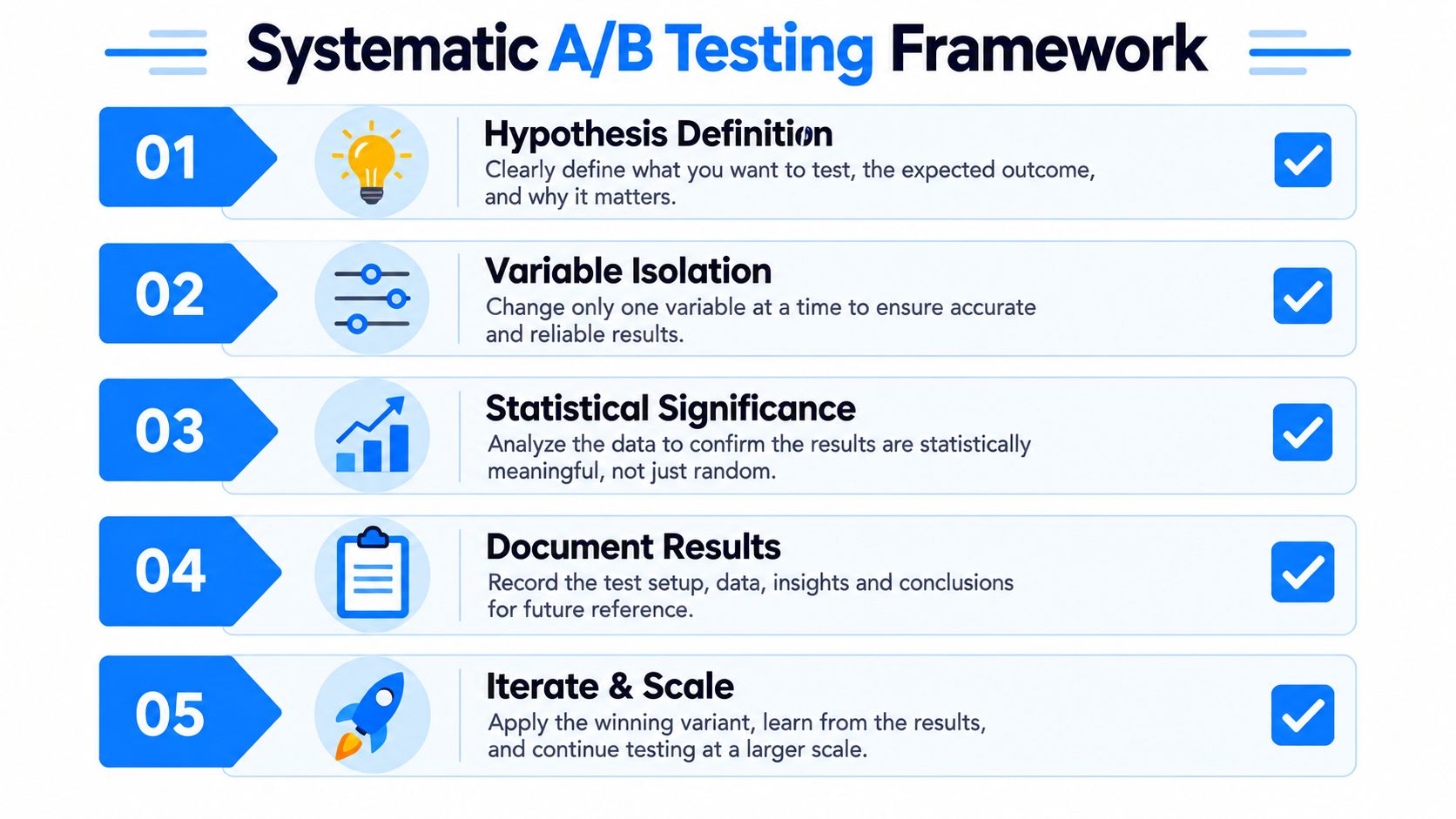
Testing becomes useful only after the funnel records reality. If mobile errors are counted as submissions, duplicate browser and server events inflate the baseline, or delayed leads are mixed with immediate leads, the test result can point in the wrong direction.
The starting point is a stable measurement definition. Choose the primary outcome before launching the experiment, such as verified lead, qualified conversation, booked appointment, or another business event. Use supporting metrics to explain movement, but don't declare a winner because a variation generated more clicks while producing weaker contacts.
### Set a hypothesis worth testing
A strong hypothesis identifies the friction, the proposed change, and the expected behavioral effect. For example, “If the page repeats the emergency repair offer above the form and removes unrelated navigation, more paid-search visitors will complete the service request because the page will match the intent created by the ad.”
That is stronger than “Test a new headline.” It tells the team what changed and why. It also prevents the common mistake of bundling several unrelated changes into one variation, which makes the result impossible to interpret.
Prioritize variables by likely business impact:
- **Offer and message:** Test whether the page clearly delivers what the ad promised.
- **Form structure:** Compare essential fields, field order, validation behavior, and the explanation of the next step.
- **Page path:** Test a focused landing page against a page with navigation or multiple service choices.
- **Trust placement:** Move relevant reviews, licensing information, and service-area proof closer to the decision point.
- **Follow-up handoff:** Test whether a clear acknowledgement and routing rule improves verified contact and booking outcomes.
Button color usually belongs near the bottom of the priority list. A broken form, unclear offer, or missing response process deserves attention first because it can affect the entire journey rather than a single visual interaction.
### Use distribution benchmarks carefully
The 2024 Unbounce dataset analyzed **464 million visitors** and reported a **6.6% median landing-page conversion rate across industries**, while the top 25% of pages converted at roughly **11.4% or higher**, as summarized by [the Unbounce benchmark data](https://www.involve.me/blog/landing-page-statistics). Those figures are useful reference points, not promises for a particular plumber, dentist, or landscaping business.
Use the median to frame a question, then establish the business's own baseline by traffic source, device, service, and geography. A branded search audience and a broad social audience shouldn't share one benchmark. Neither should an emergency service page and a planned maintenance page.
Run one material change at a time when possible. Keep the audience allocation and campaign conditions comparable, document the launch date, and avoid stopping the test because of an early fluctuation. If volume is limited, focus on directional learning, inspect lead quality manually, and avoid presenting a weak sample as certainty.
### Declare winners at the business level
A landing-page variation can increase form completion while lowering phone verification. A faster follow-up sequence can reduce raw cost per lead while increasing the workload for staff. A broader offer can generate more inquiries while sending more requests outside the service area.
Review the entire chain:
| Test question | Primary signal | Guardrail |
|---|---|---|
| Does the offer match the ad? | Qualified inquiries | Out-of-area requests |
| Does the form work better? | Completed verified leads | Error rate and incomplete records |
| Does routing improve? | Human contact and booking | Response workload |
| Does the page scale? | Cost-efficient qualified demand | Lead quality and service capacity |
The winning variation is the one that improves the defined business outcome without creating an unacceptable operational cost. Once a result is documented, roll it out carefully, keep the original record, and use the learning to form the next hypothesis.
That process turns conversion funnel optimization into a compounding discipline. Fix the mechanical failure, protect attribution, respond while intent is fresh, and test the largest remaining uncertainty. Vanity metrics can stay in the dashboard, but booked work should decide what happens next.
---
BenjiAds provides local service businesses with automated ad creative, campaign setup, landing funnels, dual conversion tracking, and SMS-based lead follow-up. Visit [benjiads](https://benjiads.com) to see how the platform can connect acquisition, attribution, and response handling in one workflow.