Source: https://benjiads.com/blog/automated-marketing-platform
Publisher: benjiads, https://benjiads.com
Published: 2026-09-20
Updated: 2026-09-20
Cite as: benjiads, "Automated Marketing Platform Explained for Local Services", benjiads.com/blog/automated-marketing-platform
Reuse: you may quote this article with attribution and a link to the source.
# Automated Marketing Platform Explained for Local Services
Learn how an automated marketing platform streamlines ads, follow-up and ROI tracking for local services. Workflows, channels and measurement explained.
You're probably doing some version of this right now.
A lead comes in while you're on a job. You miss the call, tell yourself you'll text back later, and then forget because an estimate runs long. That night you open Meta Ads or Google Ads, try to make sense of clicks and forms, and wonder which of those names were real buyers and which were just people price shopping. A week later, you've spent money, handled the work yourself, and still can't say with confidence what produced booked jobs.
That's the gap most local service owners feel. It's not a lack of effort. It's that marketing has turned into a chain of connected tasks: ad creative, launch, landing pages, tracking, retargeting, text follow-up, and reporting. If even one part breaks, leads leak out.
## Table of Contents
- [Introduction Why Local Services Need Automation Now](#introduction-why-local-services-need-automation-now)
- [Why this matters to a local owner](#why-this-matters-to-a-local-owner)
- [The promise is less chaos, not less control](#the-promise-is-less-chaos-not-less-control)
- [What an Automated Marketing Platform Really Does](#what-an-automated-marketing-platform-really-does)
- [The simple mental model](#the-simple-mental-model)
- [What gets automated and what stays human](#what-gets-automated-and-what-stays-human)
- [How this differs from agency-only or DIY marketing](#how-this-differs-from-agency-only-or-diy-marketing)
- [Inside Automation Workflows From Idea to Live Campaign](#inside-automation-workflows-from-idea-to-live-campaign)
- [From intake to assets](#from-intake-to-assets)
- [Approval-first is the part that keeps owners comfortable](#approval-first-is-the-part-that-keeps-owners-comfortable)
- [Why local templates beat blank-slate marketing](#why-local-templates-beat-blank-slate-marketing)
- [Omnichannel Capabilities That Keep Leads From Going Cold](#omnichannel-capabilities-that-keep-leads-from-going-cold)
- [Fragmented versus connected follow-up](#fragmented-versus-connected-follow-up)
- [Why timing across channels matters](#why-timing-across-channels-matters)
- [The operational gap most articles skip](#the-operational-gap-most-articles-skip)
- [Lead Qualification and Automated Follow Up That Books More Jobs](#lead-qualification-and-automated-follow-up-that-books-more-jobs)
- [Why speed changes lead quality](#why-speed-changes-lead-quality)
- [Good follow-up is not the same as an autoresponder](#good-follow-up-is-not-the-same-as-an-autoresponder)
- [What qualification should look like in plain language](#what-qualification-should-look-like-in-plain-language)
- [Measuring ROI When Signals Are Fragmented](#measuring-roi-when-signals-are-fragmented)
- [What signal loss actually means](#what-signal-loss-actually-means)
- [Server-side and client-side tracking in plain English](#server-side-and-client-side-tracking-in-plain-english)
- [A practical reporting framework for local businesses](#a-practical-reporting-framework-for-local-businesses)
- [Choosing Your Next Step With an Automated Marketing Platform](#choosing-your-next-step-with-an-automated-marketing-platform)
- [A simple decision checklist](#a-simple-decision-checklist)
- [What to prepare before you activate anything](#what-to-prepare-before-you-activate-anything)
## Introduction Why Local Services Need Automation Now
For a plumber, HVAC owner, electrician, cleaner, or gardener, marketing often lives in the leftover spaces of the day. You answer calls between jobs, post something when you remember, and check ad results after dinner. That worked when volume was low and platforms were simpler. It gets messy fast once you're trying to run paid campaigns and follow up consistently.

The bigger shift is that automation isn't some fringe experiment anymore. The global marketing automation market was estimated at **USD 6.65 billion in 2024**, with a projection of **USD 15.58 billion by 2030** and a projected **15.3% CAGR from 2025 to 2030**, according to [Grand View Research's marketing automation software market analysis](https://www.grandviewresearch.com/industry-analysis/marketing-automation-software-market). For a local service owner, that matters because it shows automated systems have moved into the mainstream operating model for handling campaigns, lead tracking, and follow-up.
### Why this matters to a local owner
Think of your shop like a service truck. You wouldn't carry ten loose tools rolling around the back and call that a system. You want a setup where the right tool is in the right place, ready when you need it. Marketing works the same way.
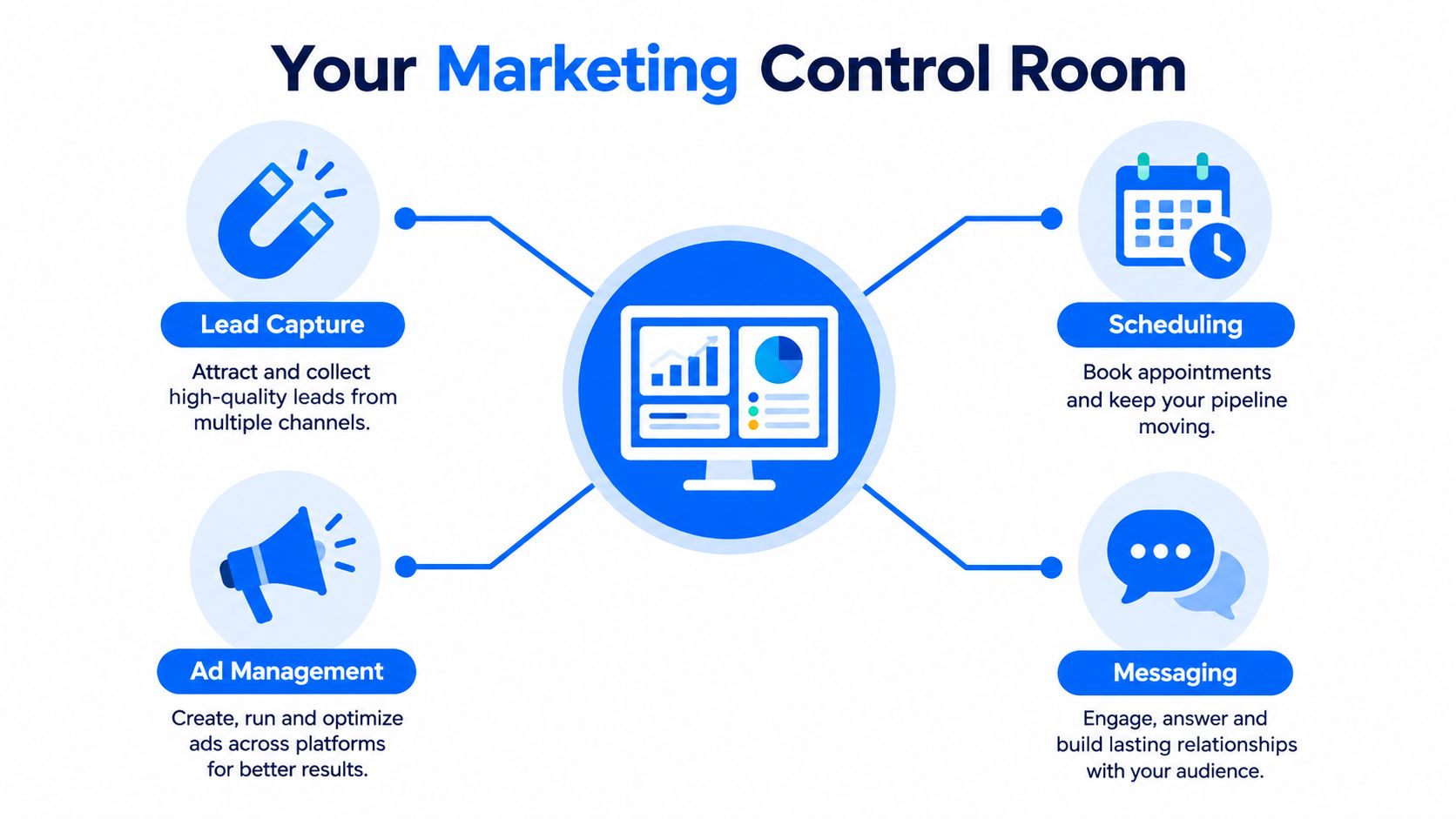
An automated marketing platform pulls together the tasks that usually live in separate apps, inboxes, and sticky notes:
- **Ad creation:** It helps generate images, copy, and offers for your service area and trade.
- **Campaign launch:** It pushes campaigns live on channels like Meta and Google.
- **Lead handling:** It collects form fills, calls, and other responses into one flow.
- **Follow-up:** It texts, qualifies, and routes leads before they go cold.
> **Practical rule:** If you can't respond fast and track what happened after the click, your marketing problem usually isn't traffic. It's operations.
### The promise is less chaos, not less control
Owners sometimes hear “automation” and think “I'm handing the wheel to software.” That's not the useful version. The useful version is an operating system that handles repetitive work while you stay in charge of budget, offers, approval, and service quality.
That distinction matters because adoption has broadened a lot. One industry summary reported **76% of businesses use some form of automation technology**, while **96% of marketers either already use or plan to use a marketing automation platform**, and another report noted **around 50% of companies were currently using marketing automation solutions**, according to [Seoprofy's marketing automation statistics roundup](https://seoprofy.com/blog/marketing-automation-statistics/). For local services, the takeaway is simple: buyers increasingly expect fast, organized follow-up, and businesses are using automation to meet that expectation.
## What an Automated Marketing Platform Really Does
Many picture software that sends a few automatic emails. That's too small.
A real **automated marketing platform** is closer to a control room. One screen doesn't do the work by itself. It coordinates the people, signals, and actions that keep a system moving. In local services, that means creative, ad delivery, lead capture, retargeting, follow-up, and reporting all need to connect.
### The simple mental model
Here's the easiest way to think about it.
A basic tool does one job. It might help you make an ad, or collect a form, or send a text. An automated marketing platform does the handoff between those jobs. That handoff is where most wasted spend happens.
Without a connected system, the flow often looks like this:
| Task | What happens manually |
|---|---|
| Creative | You write copy or wait on someone else |
| Launch | You log into ad accounts and build campaigns |
| Leads | Forms go to email, text, or a spreadsheet |
| Follow-up | Someone remembers to call or text later |
| Reporting | You try to match ad clicks to booked work |
With an automated platform, the goal is to turn those separate steps into one loop.
### What gets automated and what stays human
Readers often get confused. Automation doesn't mean the platform “owns” your business judgment. It means the repetitive parts move faster and more consistently.
What usually gets automated:
- **Repetitive setup:** Campaign structure, audience setup, and landing flow configuration.
- **Asset production:** Draft ad copy, image concepts, and service-specific campaign variations.
- **Trigger-based actions:** Retargeting non-converters, sending a text after a form fill, updating lead status.
- **Signal collection:** Gathering data from clicks, forms, and follow-up events.
What should still stay with you or your team:
- **Approval:** Nothing should run before you sign off.
- **Offer decisions:** Discount, financing, emergency service angle, maintenance plan, or premium positioning.
- **Operational fit:** Service areas, scheduling capacity, and lead quality rules.
- **Exception handling:** Odd jobs, bad leads, or edge cases that need a human.
> A strong platform doesn't replace owner judgment. It removes the repeated motions around it.
### How this differs from agency-only or DIY marketing
DIY usually means lower cash outlay up front and higher time cost later. Agency-only management can reduce your workload, but it can also leave you dependent on handoffs, ticket queues, and reports you don't fully control.
An automated platform sits in the middle. It's software first. It automates work that a media buyer, coordinator, or follow-up rep might otherwise do by hand. If you're comparing options, don't just ask, “Does it use AI?” Ask, “Does it connect creation, launch, tracking, and follow-up into one system I can operate?”
That's the operationalization gap. Plenty of businesses are using AI in small ways, but far fewer have turned those outputs into a dependable loop that launches, measures, and recovers leads without breaking.
## Inside Automation Workflows From Idea to Live Campaign
Most local owners don't need more dashboards. They need to know what happens between “I want more service calls” and “the campaign is live.”
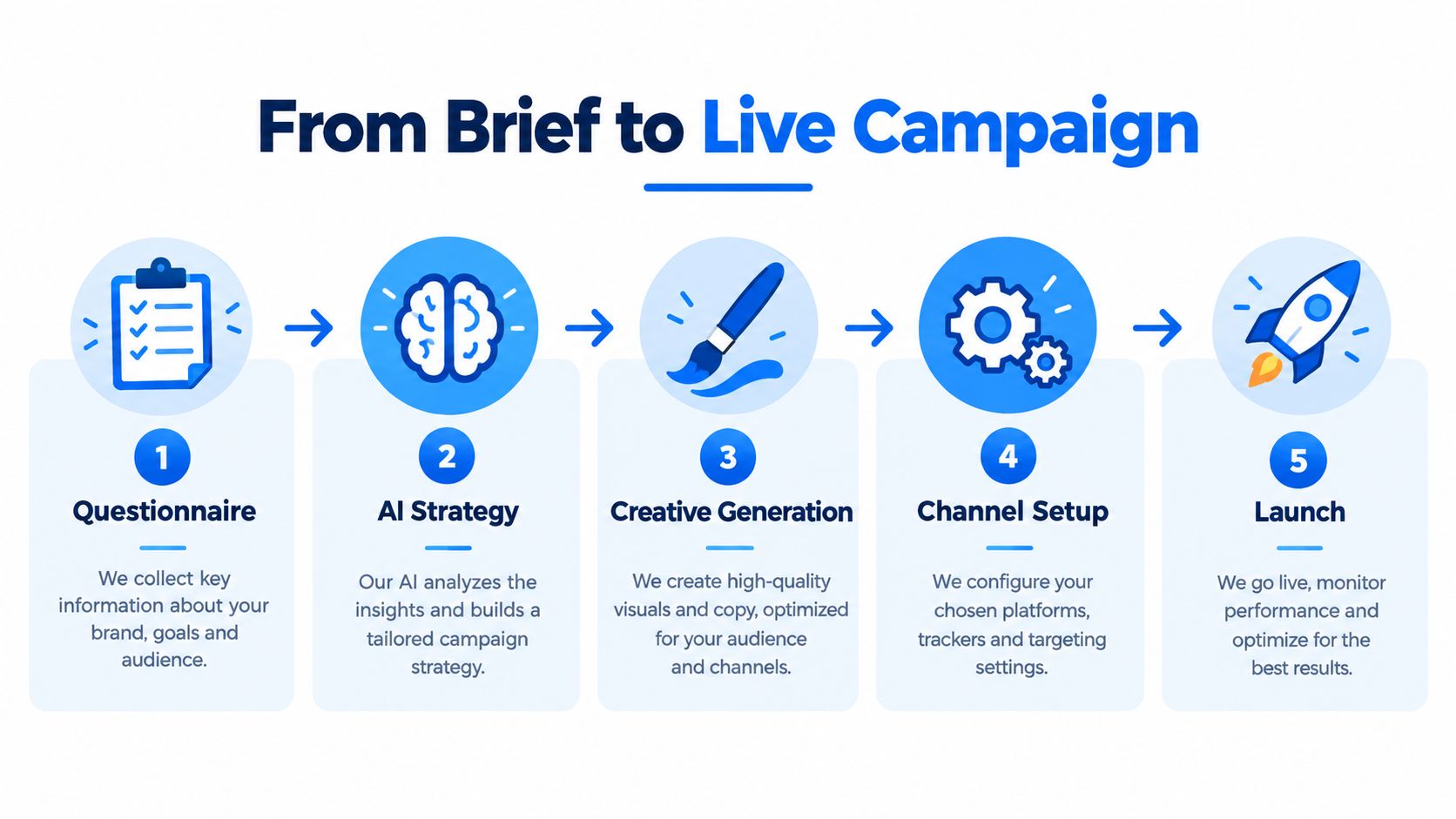
The practical version starts with a short intake. You answer questions about your trade, service area, job type, pricing angle, seasonality, and what kind of leads you want. That intake replaces a lot of the back-and-forth that usually drags out campaign setup.
### From intake to assets
Once the platform has the basics, it can start assembling the pieces.
A heating contractor and a junk removal company shouldn't get the same ads. The offer, images, language, and landing flow need to reflect the job. Trade-specific templates matter because they shorten setup without making everything look generic.
A common workflow looks like this:
1. **Questionnaire first.** The owner gives the platform usable inputs: trade, city, service radius, priority services, and booking goals.
2. **Strategy draft next.** The system maps those inputs into campaign angles, audience choices, and funnel logic.
3. **Creative generation.** Ads, copy, and images are prepared for review.
4. **Channel setup.** Meta and Google campaign structures, budgets, and destinations are configured.
5. **Approval and launch.** The owner reviews, approves, and then the campaign goes live.
### Approval-first is the part that keeps owners comfortable
This is one of the biggest differences between useful automation and reckless automation.
A lot of owners are open to speed. They're not open to surprise. Approval-first workflow solves that. The system does the assembly work, but you still check the offer, look at the ad, and confirm the setup before anything spends money.
That's why “fast activation” only matters when paired with control. Software can move from questionnaire to live campaigns quickly, but only if the process is built around clear approval points.
For a practical example of how campaign thinking changes by trade, this guide on [marketing for HVAC companies](https://benjiads.com/blog/marketing-hvac-company) is useful because it shows how service-specific offers and seasonality shape the setup.
A short demo helps make the workflow concrete:
### Why local templates beat blank-slate marketing
A blank campaign builder sounds flexible until you're the one staring at twenty settings after a long workday.
Templates reduce decision fatigue. They don't remove customization. They remove the need to rebuild the same structure over and over. A plumbing ad can still highlight emergency service, drain issues, water heater installs, or financing. The template just makes sure the bones of the campaign are already there.
- **For electricians:** The workflow may emphasize estimate requests, panel upgrades, or same-week scheduling.
- **For cleaners:** The flow often needs clearer qualification around home size, frequency, or commercial scope.
- **For landscapers:** Seasonality and service bundling usually shape the ad message and follow-up path.
The owner's job isn't to become a full-time media buyer. It's to provide business truth, review what's generated, and approve the launch.
## Omnichannel Capabilities That Keep Leads From Going Cold
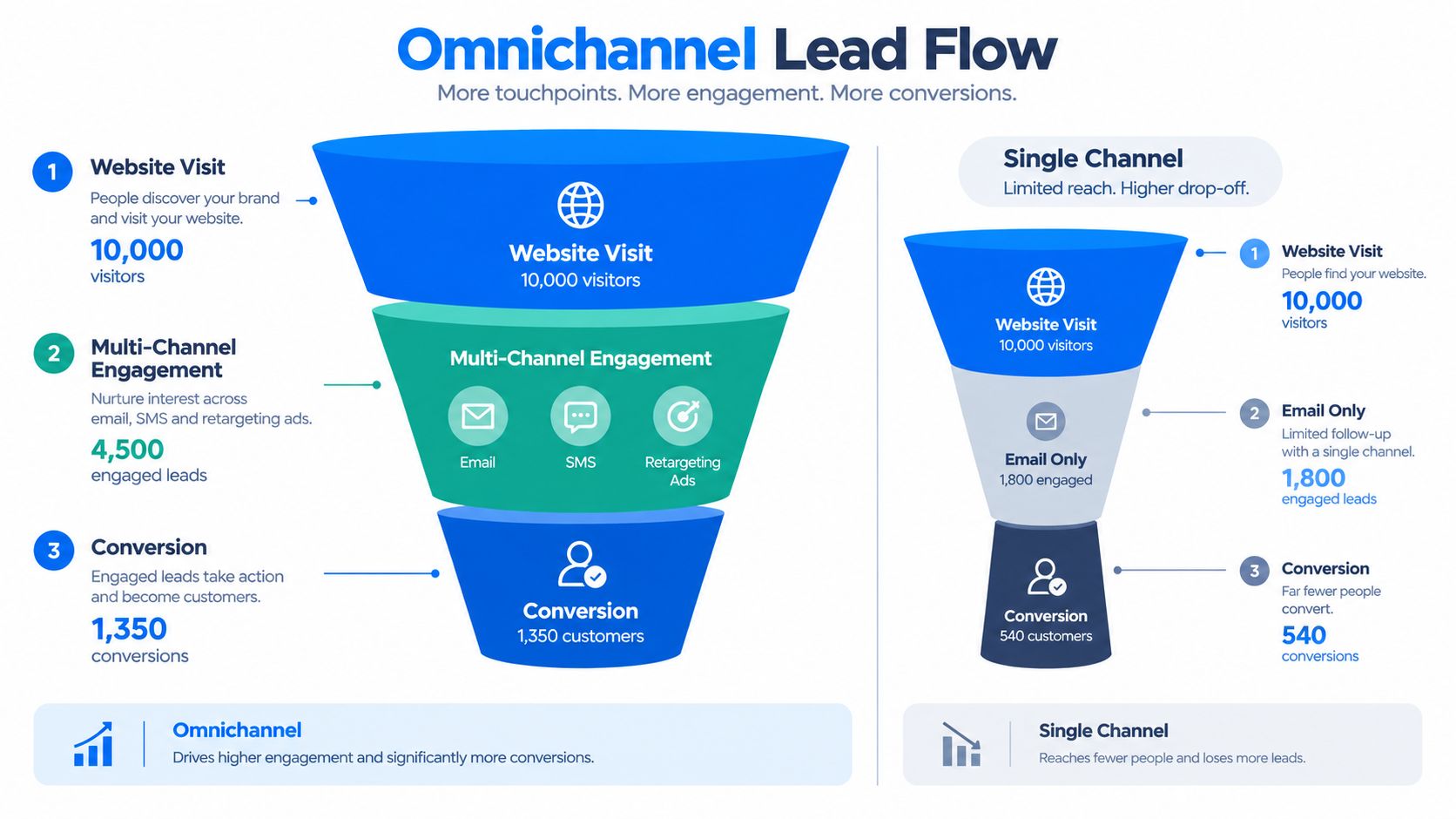
Single-channel marketing usually feels fine at first because each piece works in isolation. The ad gets clicks. The website gets traffic. The phone rings sometimes. But isolated tools create silent drop-off points.
A coordinated system treats every touchpoint as part of the same conversation. Someone clicks an ad, visits a landing page, leaves without filling the form, sees a retargeting ad later, returns, submits a lead, and gets a text quickly. That sequence is one journey, not five separate tactics.
### Fragmented versus connected follow-up
Here's the difference in plain terms.
| Approach | What the lead experiences |
|---|---|
| Single channel | One ad, one visit, then silence if they don't convert |
| Connected system | Ad, landing page, retargeting, and text follow-up working together |
A homeowner looking for AC repair may click while at work and not have time to fill out a form. If your only move was that first ad, the lead disappears. If your system retargets them later with a stronger service message and then follows with instant text once they submit, you've extended the window where they can become a booking.
### Why timing across channels matters
Local service leads don't always convert in a straight line. A pressure washing customer may browse on a weekend, compare options, and come back after talking to a spouse. A dental patient may click an ad but only respond when prompted with a simple next step later.
That's why retargeting and follow-up aren't “extra features.” They're recovery systems.
- **Retargeting catches hesitation:** It gives non-converters another chance to act after the first visit.
- **Text follow-up catches delay:** It keeps momentum after the lead finally raises a hand.
- **Plain routing catches confusion:** It helps move the prospect toward the next real step, like scheduling or qualification.
> If your ad platform says the click happened, but your phone never rang, the missing piece is often the handoff after interest, not the ad itself.
### The operational gap most articles skip
A lot of content about AI marketing jumps from “make an ad” to “get results” and skips the hard middle. That middle is where systems usually fail.
One 2026 report found **35% of small businesses use AI tools, but only 11% have automated core workflows**, according to [Sapt's analysis of AI and automation in small-business marketing](https://sapt.ai/insights/small-business-marketing-waste-ai-automation-2026). That gap is the story. It means many owners can generate content, but far fewer have linked creative, launch, measurement, and follow-up into a dependable operating loop.
For local services, omnichannel capability only matters if the channels talk to each other.
## Lead Qualification and Automated Follow Up That Books More Jobs
The moment a lead arrives is where a lot of ad spend gets wasted.
Not because the campaign failed. Because nobody followed up fast enough, or the only response was a generic autoresponder that didn't move the conversation forward. A fresh lead doesn't need a brochure. They need a next step.
### Why speed changes lead quality
Owners often think of qualification as something that happens later on the phone. In practice, qualification starts the second the lead comes in. A quick text can confirm whether the person still needs help, what job they want done, where they're located, and whether they're ready to schedule.
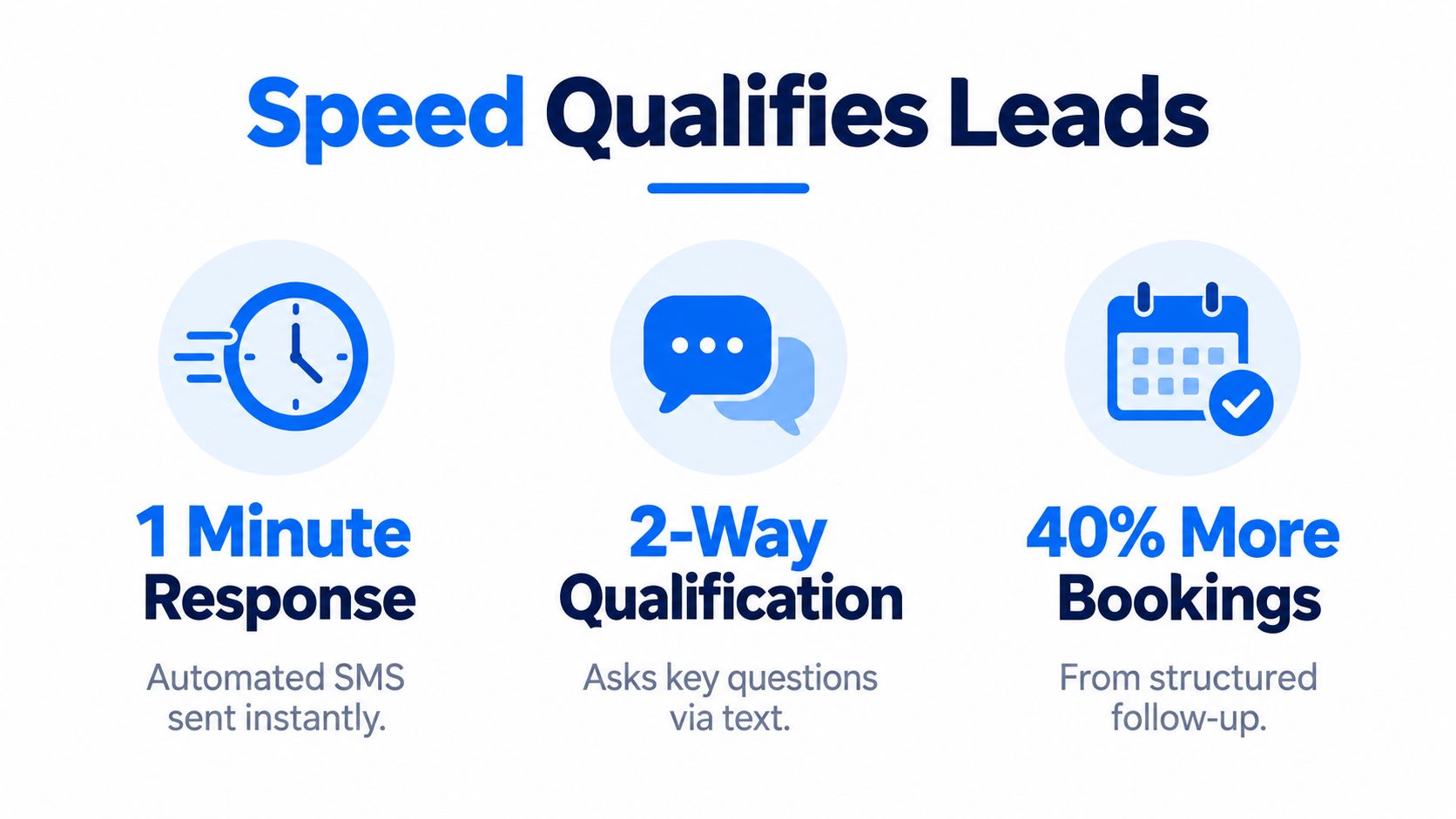
The decay in response rates is steep. One 2025 SMS benchmark reported **9.3% response on the first follow-up**, then **4.8%**, **2.9%**, and **1.5%** on later follow-ups, according to [Worldmetrics follow-up sales statistics](https://worldmetrics.org/follow-up-sales-statistics/). Separate 2026 summaries cited there also report **roughly 98% open rates for SMS versus about 20% for email**. For local services, the lesson is simple: the first follow-up carries the most weight.
### Good follow-up is not the same as an autoresponder
A weak autoresponder says, “Thanks, we'll be in touch.”
A stronger automated sequence does more:
- **It confirms intent:** “Are you still looking for a quote today?”
- **It asks useful questions:** Job type, urgency, location, or preferred timing.
- **It routes correctly:** High-intent leads can move toward booking. Poor-fit leads can be filtered out.
- **It keeps the thread alive:** If they don't answer immediately, the system can continue follow-up without your staff chasing every message by hand.
Software like **benjiads** fits as one option for local businesses. It combines ad generation, campaign launch on Meta and Google, server- and client-side tracking, and automated SMS follow-up into one approval-based workflow rather than treating those as separate tools.
### What qualification should look like in plain language
A plumber doesn't need to know “lead scoring logic.” They need to know whether the inquiry is worth dispatching or scheduling.
Good qualification often answers questions like:
| Question | Why it matters |
|---|---|
| What service do they need? | Helps route to the right offer or estimator |
| Where are they located? | Filters out leads outside your service area |
| How soon do they need help? | Separates emergency intent from later research |
| Are they responsive by text? | Tells you whether SMS can carry the booking forward |
If you want a broader look at what counts as a workable inquiry in home services, this piece on [home service leads](https://benjiads.com/blog/home-service-leads) is a useful reference.
> **Field test:** If your reporting shows leads but your calendar stays light, inspect the first ten minutes after form submission. That's usually where the leak is.
The goal isn't more messages. It's better momentum.
## Measuring ROI When Signals Are Fragmented
This is the hardest question in local service marketing: how do you know the ads produced bookings when the click happened on one device, the form was submitted later, and the customer finally replied by text?
Owners get frustrated here for a good reason. Marketing reports often look precise while hiding major gaps. A platform may claim credit for a conversion, but that doesn't automatically tell you the whole customer journey or whether the ad caused the sale.
### What signal loss actually means
Years ago, it was easier to follow a click from ad to form to sale. Today, browsers, privacy controls, device switching, and blocked scripts interrupt that chain. Data gets dropped. Events arrive incomplete. Different platforms count the same lead in different ways.
That's why measurement has become a buying issue, not just a reporting issue. One 2026 source noted that **multi-touch attribution adoption rose to 47% from 31% in 2023**, while **marketing mix modeling increased from 9% to 26%**, and also reported that **only 9% of marketers run fully automated customer journeys**. The same source identified **data quality at 52%** and **integration at 40%** as the biggest blockers, according to [Loudscale's 2026 guide on marketing automation, CRM, and personalization](https://loudscale.com/guides/marketing-automation-crm-personalization-2026/).
### Server-side and client-side tracking in plain English
Client-side tracking is the old familiar version. A script in the browser fires when someone lands, clicks, or submits a form. It's useful, but it's also vulnerable to browser limits and blockers.
Server-side tracking adds a second layer. Event collection and validation happen on infrastructure the advertiser controls before the event is routed onward. According to [Usercentrics' guide to server-side tracking attribution](https://usercentrics.com/guides/server-side-tagging/server-side-tracking-attribution/), that setup allows events to be enriched, anonymized, filtered, deduplicated, and sent to ad or analytics platforms before browser interference gets in the way.
That can improve attribution fidelity. It does **not** automatically prove causal lift. Platforms still decide which events they accept and how they credit them.
> Better tracking improves the quality of the evidence. It doesn't remove the need for judgment.
### A practical reporting framework for local businesses
If you run a local service business, don't start with channel vanity metrics. Start with operational outcomes.
Use reports to answer questions like these:
- **Are booked jobs rising from paid traffic?**
- **Which campaigns are producing verified leads, not just clicks?**
- **How quickly are leads receiving follow-up?**
- **Are certain services or areas producing better downstream outcomes?**
A good report for a local owner should feel more like dispatch logic than ad jargon. You want to connect spend to leads, leads to conversations, and conversations to booked work as clearly as possible. If the system can't show that chain in plain language, you don't really have measurement. You have activity logs.
## Choosing Your Next Step With an Automated Marketing Platform
The decision usually isn't “Should I use AI or not?” It's “Do I have a system that can turn interest into booked work without me babysitting every step?”
That's the better lens for evaluating an automated marketing platform. You're not just buying ad creation. You're choosing how creative, launch, tracking, and follow-up will operate together.
### A simple decision checklist
Ask yourself these questions:
- **Time pressure:** Are you or your staff spending too much time building campaigns, chasing leads, or patching tools together?
- **Creative bottleneck:** Do ads stall because nobody has time to write copy, build variations, or refresh offers?
- **Tracking clarity:** Can you tell which campaigns are producing verified leads and booked jobs?
- **Follow-up speed:** Do fresh leads get contacted fast enough to keep momentum?
- **Control preference:** Do you want automation to do the setup while you still approve what runs?
If several of those are pain points, a connected platform is probably worth serious consideration.
### What to prepare before you activate anything
You don't need a giant marketing overhaul. You do need clean inputs.
Have these ready:
- **Your core services:** What you most want to sell first.
- **Your service area:** Cities, ZIPs, or radius boundaries.
- **Your lead rules:** What counts as a good lead and what should be filtered.
- **Your follow-up path:** Who handles texts, calls, estimates, and booking.
- **Your offer reality:** Financing, urgency, seasonality, and capacity.
If your website itself needs work before ads scale, reviewing examples of [websites for electricians](https://benjiads.com/blog/websites-for-electricians) can help sharpen what a better conversion path looks like.
The strongest next step is usually a focused pilot. Start with one service, one market, and one booking goal. Then judge the system by operational truth: Did it help you launch faster, follow up better, and understand what produced booked jobs?
---
If you want a system built for that exact loop, [benjiads](https://benjiads.com) offers software for local service businesses that generates ads, launches campaigns on Meta and Google, tracks outcomes with server- and client-side signals, and follows up with leads by text after owner approval. It's designed for businesses that don't need more disconnected tools. They need a tighter path from click to conversation to booking.