Source: https://benjiads.com/blog/ai-ad-creative-generator
Publisher: benjiads, https://benjiads.com
Published: 2026-10-02
Updated: 2026-10-02
Cite as: benjiads, "AI Ad Creative Generator Guide for Local Service Ads", benjiads.com/blog/ai-ad-creative-generator
Reuse: you may quote this article with attribution and a link to the source.
# AI Ad Creative Generator Guide for Local Service Ads
Learn what an AI ad creative generator does, how local services benefit, and how approval-first workflows keep campaigns on-brand and on budget.
Monday morning arrives before the phones do. A plumbing owner is staring at a paused campaign, a thin pipeline, and a folder of yesterday's job photos that still aren't ads. The business needs fresh creative before lunch, but nobody has time to become a prompt engineer, inspect every claim, and wonder whether a generated technician photo just invented a license badge.
That's the practical promise of an **AI ad creative generator**. It can turn a service brief into copy, images, and video variations quickly. The practical danger is giving it permission to publish before a human checks the offer, service area, brand voice, and platform requirements. For local businesses, the winning model is simple: automate production, keep approval in human hands, and let performance data decide what gets made next.
## Table of Contents
- [The Monday Morning an AI Ad Creative Generator Solves](#the-monday-morning-an-ai-ad-creative-generator-solves)
- [What an AI Ad Creative Generator Actually Does](#what-an-ai-ad-creative-generator-actually-does)
- [Three trade examples](#three-trade-examples)
- [Why Local Service Businesses Benefit the Most](#why-local-service-businesses-benefit-the-most)
- [Where the efficiency comes from](#where-the-efficiency-comes-from)
- [An Approval-First Workflow From Intake to Live Ads](#an-approval-first-workflow-from-intake-to-live-ads)
- [Start with a signed brief](#start-with-a-signed-brief)
- [Review before approval](#review-before-approval)
- [Close the loop with evidence](#close-the-loop-with-evidence)
- [Generate-and-Publish vs Intelligence-Plus-Generation](#generate-and-publish-vs-intelligence-plus-generation)
- [Risks Local Services Often Underestimate](#risks-local-services-often-underestimate)
- [Compliance and credibility](#compliance-and-credibility)
- [Best Practices That Make the Output Actually Perform](#best-practices-that-make-the-output-actually-perform)
- [Make testing readable](#make-testing-readable)
- [Choosing the Right AI Ad Creative Generator for Your Business](#choosing-the-right-ai-ad-creative-generator-for-your-business)
## The Monday Morning an AI Ad Creative Generator Solves
Marco owns a three-truck plumbing company in Phoenix. He starts Monday with a dispatch invoice problem, two technicians out sick, and a Google Ads dashboard showing that last week's ads have stopped pulling their weight. The phones need to ring tomorrow, yet the campaign folder contains a few old truck photos, a customer review, and no approved replacement creative.
An AI ad creative generator can take that raw material and turn it into a working first draft. Marco can provide the service, locations, seasonal priority, offer, phone number, approved claims, and a few real job photos. The system can then propose headlines about water heater repair, descriptions built around same-day availability, a social image using the company's actual truck, and a short vertical video script for inspection bookings.
That doesn't mean Marco should press publish. The generator doesn't know whether the company serves every suburb it mentions, whether a technician is licensed for a specific service, or whether “same-day” is accurate during a busy week. It can also produce a polished-looking image that feels wrong to customers who recognize the neighborhood and expect a real local business.
> **Practical rule:** Let software create options. Let a person approve promises.
The rest of the operating model follows that rule. A structured brief prevents vague output. A review checklist catches false claims. An approval queue keeps ads paused until the owner or marketing lead signs off. Performance reporting then shows which messages deserve another round, instead of rewarding the team for generating a large pile of near-duplicates.
Creative production has become easier than creative selection. Reporting on the current market describes a split between simple generate-and-publish products and platforms that combine generation with performance intelligence and feedback loops in [coverage of AI ad testing and selection](https://www.wftv.com/news/local/ai-can-create-more-ads-testing-them-is-still-hard-part/5H7RSIR4LVCVFI5XNJYZN2FO7I/). For Marco, the question isn't how many ads the tool can make. It's which ads are safe, credible, and worth putting in front of Phoenix homeowners.
## What an AI Ad Creative Generator Actually Does
Strip away the vendor language and the product is straightforward. An AI ad creative generator uses inputs such as **service type, location, offer, audience, brand assets, and platform format** to produce advertising materials. Those materials may include search headlines, social copy, static images, short videos, voiceovers, captions, or alternate calls to action.
It isn't the same as full marketing automation. A broader advertising system may handle bidding, audience targeting, placements, landing pages, lead routing, and reporting. A creative generator focuses on the message and the asset. Some products connect directly to ad accounts, but that integration doesn't remove the need for review.
### Three trade examples
A roofer might upload approved customer reviews, service descriptions, roof photographs, and a storm-damage offer. The generator can suggest a batch of responsive search ad headlines, but a human still needs to remove unsupported claims, verify the service area, and make sure the language doesn't imply that every inspection qualifies for insurance coverage.
A dental clinic can provide one approved team photograph, its colors, logo, and a description of a cleaning or implant consultation. The tool can create display variations for different placements. The clinic should replace generic smiles with real staff or patient-approved imagery where possible, check every health-related promise, and confirm that the call to action reflects the actual booking process.
An HVAC company can provide product shots, a script brief, and footage from a real installation. The generator can assemble a vertical video with captions and a voiceover. A human should check technical accuracy, pronunciation of the business name, contact details, and whether the final cut looks like a local service ad rather than a generic appliance commercial.
| Asset Type | Typical Inputs | What AI Generates | Human Edit Still Required | Local Service Example |
|---|---|---|---|---|
| Search copy | Service, location, offer, reviews, approved claims | Headlines, descriptions, calls to action | Accuracy, character limits, licensing language, offer terms | Roofer creating repair ad variations |
| Static image | Logo, colors, real photos, service details | Layouts, text overlays, backgrounds, resized formats | Photo choice, legibility, brand consistency, factual claims | Dentist adapting one team photo |
| Short video | Script, product shots, job footage, voice preferences | Storyboard, scenes, captions, voiceover, music | Technical review, pacing, pronunciation, consent | HVAC installation video |
| Social copy | Audience, pain point, proof, destination page | Primary text, headlines, hooks, captions | Tone, local relevance, platform suitability | Plumber promoting water heater service |
The generator replaces repetitive drafting and resizing. It doesn't replace the owner's knowledge of the business, a clinician's judgment, a licensed contractor's technical review, or a marketer's responsibility for the account.
## Why Local Service Businesses Benefit the Most
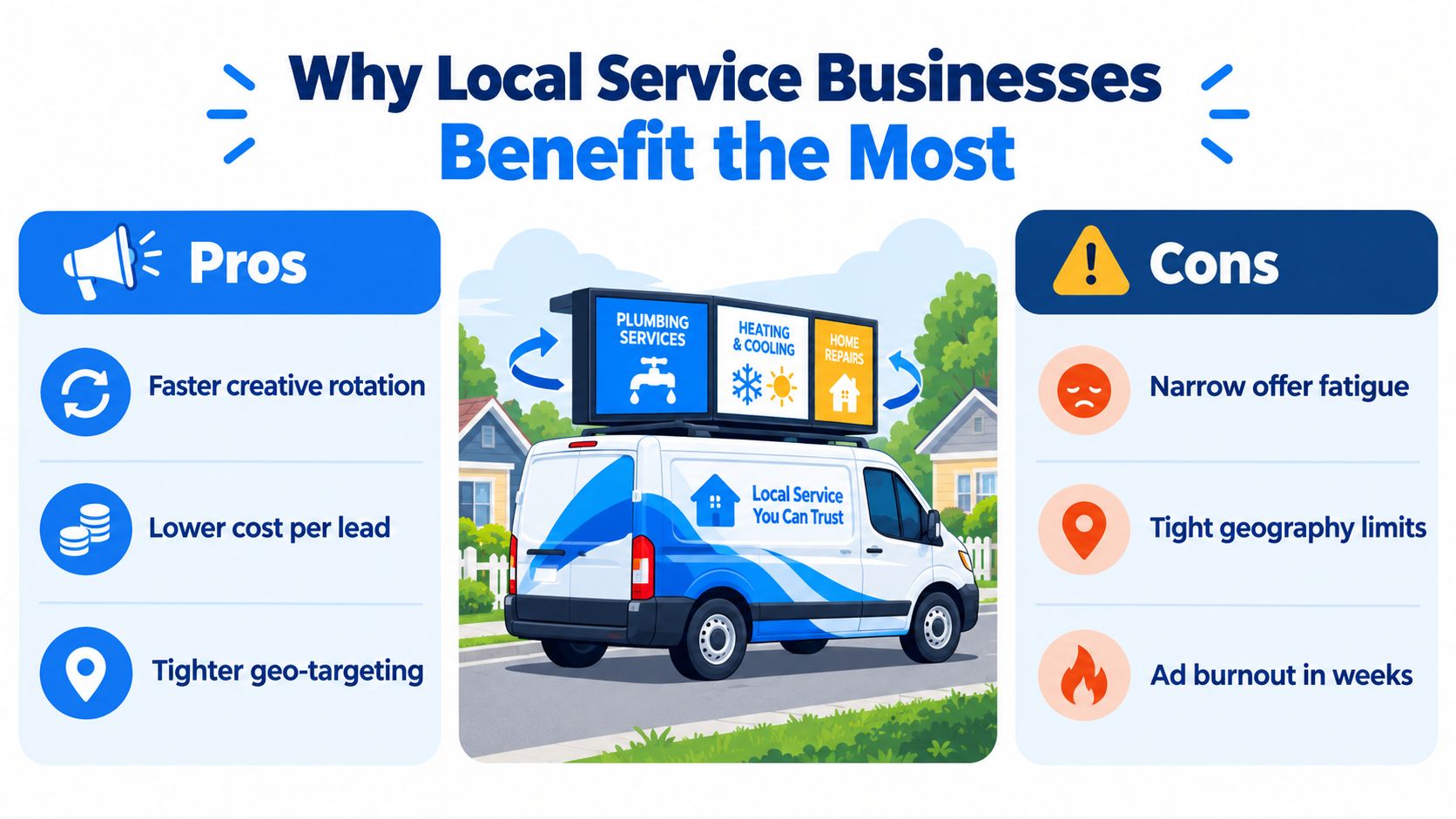
Local service businesses have a useful constraint: the message usually needs to be about a specific service, in a specific place, for a specific reason to call. That makes repeatable creative systems more valuable than broad brand experimentation. A plumber can rotate messages around burst pipes, water heaters, drain cleaning, and emergency response without rebuilding the entire campaign from scratch.
Speed is the first advantage. One real job photo can support several legitimate creative directions, such as the problem, the proof, the service process, and the next step. The tool handles resizing and first drafts, while the operator decides whether each angle represents the business accurately.
Volume is useful only when the variants differ in a meaningful way. Changing a headline from “Fast Water Heater Repair” to “Quick Water Heater Repair” creates little learning. Testing emergency intent against maintenance planning, or a customer review against a technician explanation, gives the campaign more useful alternatives.
### Where the efficiency comes from
Trade-specific templates also matter. A dental practice needs a different vocabulary and proof structure from a landscaper. A roof replacement ad often needs project evidence and service-area clarity. A generator that remembers those distinctions can reduce the amount of rewriting required before review.
Faster refreshes can protect the account from stale messaging, but don't assume that AI itself automatically lowers lead costs. A large study of generative AI advertising analyzed more than **300,000 ads**, over **500 million impressions**, and an estimated **3 million click-throughs**. Across the full dataset, AI-generated ads averaged a **0.76% click-through rate**, compared with **0.65%** for human-made ads, but matched sibling ads from the same advertiser, campaign, and day performed statistically equivalently, as reported by [WARC's analysis of generative AI ads](https://www.warc.com/content/feed/genai-ads-perform-as-well-or-better-than-those-made-by-people/11301). The lesson is operational, not magical: execution, context, offer quality, and selection still decide the outcome.
A local operator also gets a tighter feedback loop. A strong hook can become a new search headline, landing-page section, or follow-up message. A weak concept can be archived rather than repeatedly polished. That said, brand-defining campaigns, sensitive health claims, and heavily regulated services deserve more human direction and fewer automatic transformations.
## An Approval-First Workflow From Intake to Live Ads
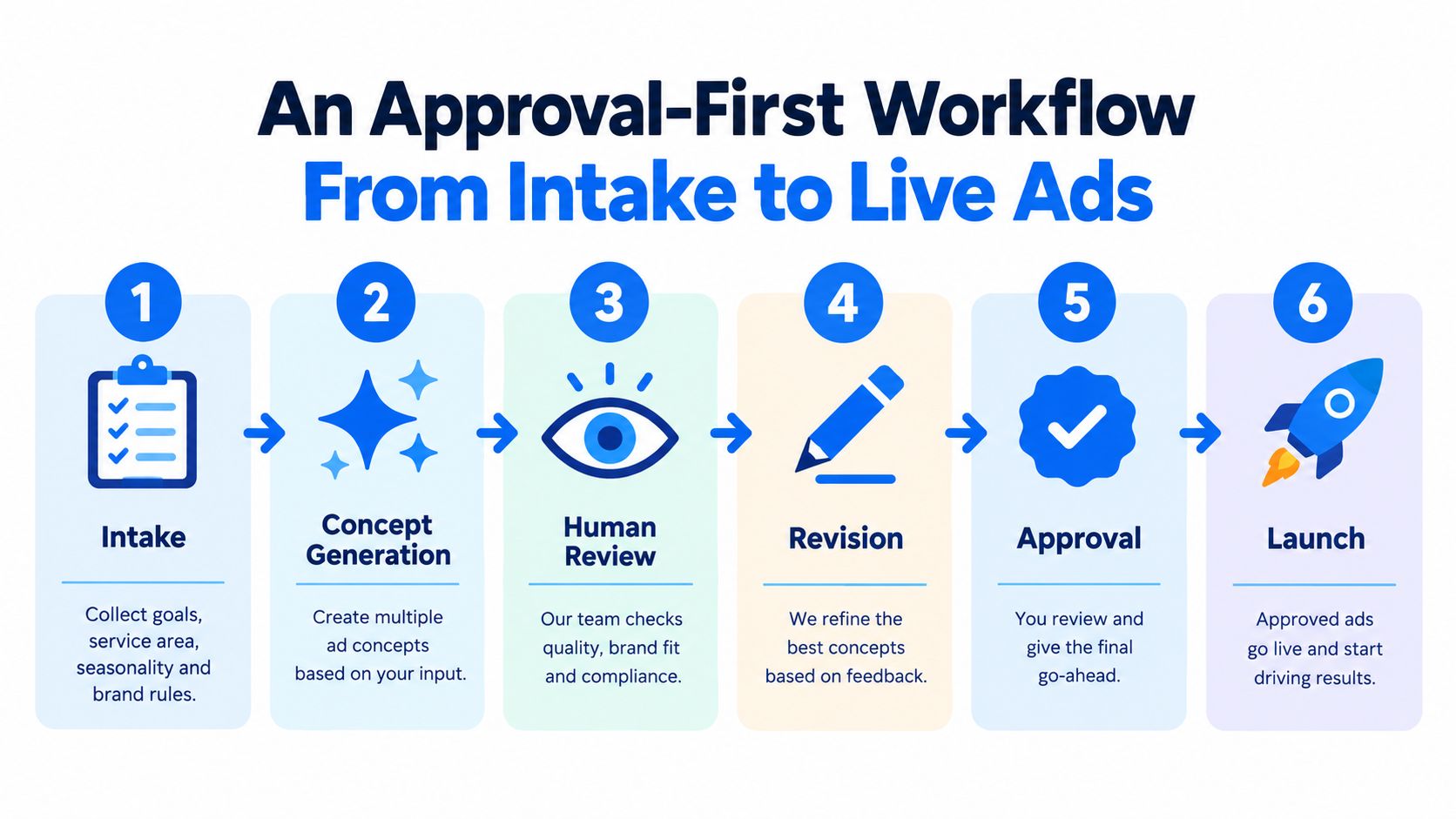
An approval-first pipeline should be visible, repeatable, and impossible to bypass by accident. The generator can work quickly in the background, but every live ad must have a named owner and a recorded approval.
### Start with a signed brief
**Stage one is intake.** Record the business goal, priority service, service area, audience, seasonality, destination page, offer terms, phone number, approved proof, prohibited claims, brand colors, and image rules. The owner or marketing lead signs this brief before generation begins. A vague instruction such as “make ads for plumbing” produces vague work. “Book Phoenix water heater inspections, use real technician photos, don't promise a fixed arrival time, and send users to the booking page” gives the system usable boundaries.
**Stage two is generation.** Ask for distinct concepts, not cosmetic variations. One concept can lead with urgency, another with prevention, and another with proof from a customer review. Require the tool to label the angle, asset type, audience, offer, and source material for every draft.
### Review before approval
**Stage three is internal review.** A reviewer checks the business name, contact details, service area, pricing language, license or credential references, testimonials, image rights, and destination URL. The reviewer also asks whether a real customer would understand what happens after clicking.
**Stage four is revision and approval.** Send errors back with specific instructions, then route the corrected version to the owner or appointed marketing lead. The person with authority over the business promise must approve each variant, or approve a clearly defined batch where every item follows the same locked brief.
> **No creative should move from “generated” to “live” without a named human approval.**
**Stage five is scheduling and launch.** Use naming conventions tied to the brief, such as service, audience, angle, format, and date. Keep the campaign paused until the final go-live check confirms budget, geography, placements, tracking, and the approved asset. A separate [guide to Facebook Ads automation](https://benjiads.com/blog/facebook-ads-automation-tool) can help teams think through the relationship between creative preparation and campaign operations.
### Close the loop with evidence
**Stage six is post-launch optimization.** Review leads, booked calls, qualified opportunities, and creative-level delivery. Don't feed every metric back into the generator without judgment. A high click rate with poor lead quality may indicate an attractive but misleading hook. A modest click rate with strong booked-job quality may deserve a new version.
Use the workflow as a queue, not a one-time checklist. Archive rejected claims and approved language in the brand memory layer so the same mistake doesn't return in the next batch.
## Generate-and-Publish vs Intelligence-Plus-Generation
The market presents local operators with two different operating models.
**Generate-and-publish tools** prioritize speed. They create assets, connect to an ad account, and may launch with limited human intervention. That can suit a large testing team with a dedicated media buyer, clear legal review, and enough volume to tolerate occasional weak drafts.
**Intelligence-plus-generation platforms** add performance context, audience signals, brand memory, and an approval queue. They don't treat every new asset as equally valuable. They use results and business rules to shape the next brief, while keeping the final decision with the operator.
The distinction matters more for a dentist, plumber, roofer, or HVAC company than it does for a national retailer. A local business has a concentrated reputation, a narrow service area, and a smaller margin for an inaccurate offer. A synthetic image or incorrect service claim can undermine trust in the same neighborhood where the company needs referrals.
| Capability | Generate-and-Publish | Intelligence-Plus-Generation |
|---|---|---|
| Main priority | Fast asset deployment | Controlled learning and asset deployment |
| Human review | Optional or limited | Built into the approval queue |
| Brand memory | Often basic or prompt-dependent | Stores approved language, visuals, and rules |
| Performance input | May arrive after launch | Shapes the next generation brief |
| Local service fit | Useful for high-volume teams | Better suited to owner-controlled campaigns |
| Failure mode | Fast publication of a bad draft | Slower launch when review capacity is limited |
Approval-first systems sit closer to the second category. They borrow the production speed of automated generators but refuse to treat publication as a default outcome. That balance is the right starting point when the business owner still controls the promise, budget, and reputation.
## Risks Local Services Often Underestimate
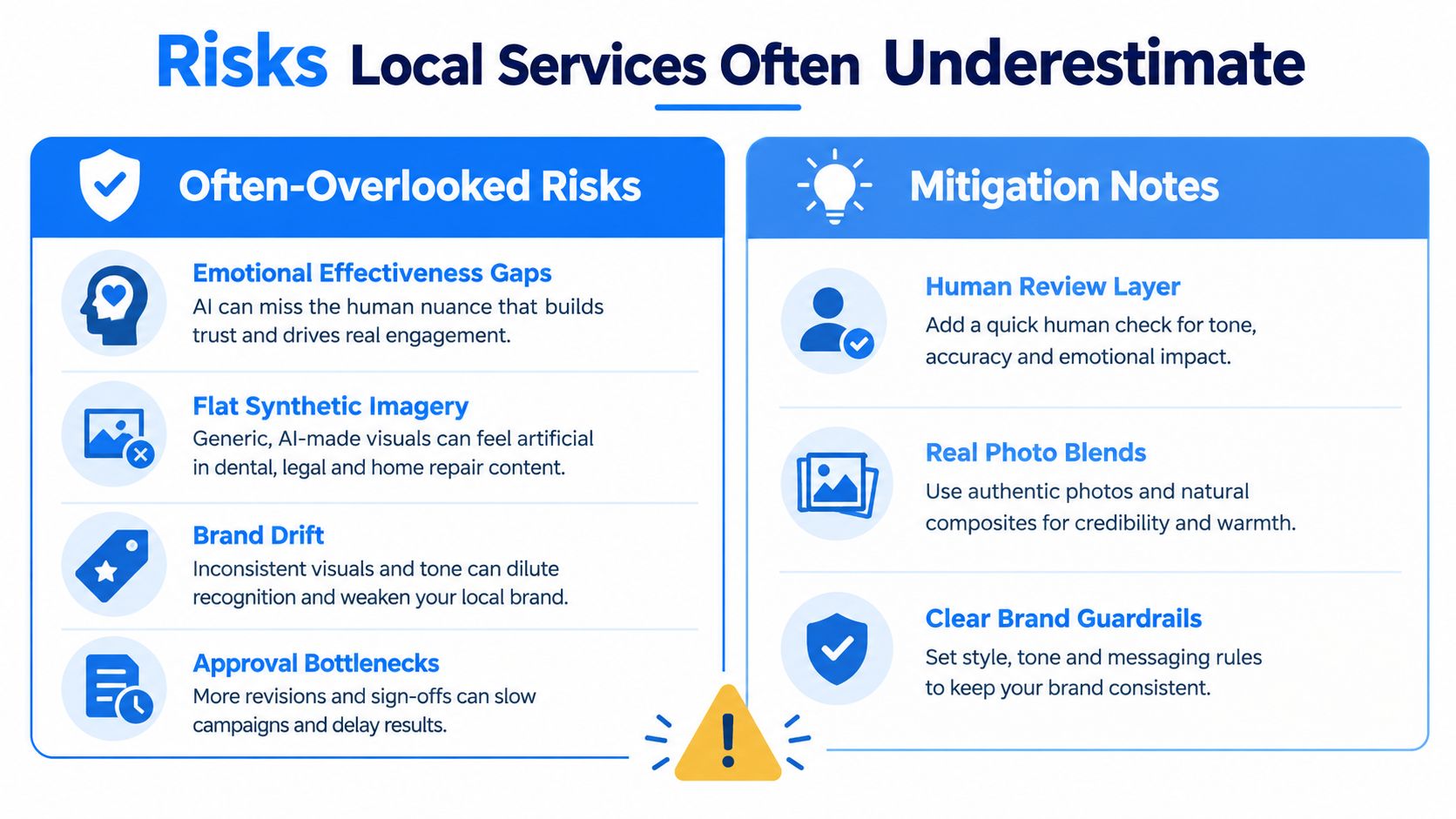
The first risk is emotional flatness. A generated image can be technically clean and still fail to convey the trust a homeowner wants from a plumber or the reassurance a patient expects from a dental practice. Real technicians, actual vehicles, neighborhood context, and credible before-and-after evidence often carry more persuasive weight than a perfect synthetic scene.
Research is not consistent on whether AI creative wins by default. Kantar's 2024 Media Reactions study found that **41% of consumers** said AI-generated ads bothered them, compared with **29% of marketers**, while its analysis also found that more than **40% of ads with AI use** reached the top tier for branded cut-through, as described in [Kantar's advertising and media analysis](https://www.kantar.com/north-america/inspiration/advertising-media/rethinking-ai-generated-advertising). A separate Ipsos study comparing **20 ads** shown to **3,000 U.S. consumers** found human-made ads were **14% stronger on short-term effectiveness** and **17% stronger on long-term effectiveness** than AI-generated ads, according to [Ipsos research on AI advertising](https://www.ipsos.com/en-us/ai-ads-are-good-enough-and-thats-problem). These findings support a human review layer, especially when the ad depends on emotion and trust.
### Compliance and credibility
Disclosure is another operational risk. Research from NYU Stern found fully AI-generated ads increased click-through rates by up to **19%** versus human-expert-created ads in its tested context, while disclosing AI use reduced click-through rates by **31.5%**, as reported in the [Ipsos PDF summarizing the research](https://www.ipsos.com/sites/default/files/ct/publication/documents/2026-05/Ipsos_SU_POV-AI_Ads_Just_Good_Enough.pdf). Treat that as a deployment signal, not a universal forecast. The visible quality of the asset, the audience, the disclosure treatment, and the brand category all matter.
Platform rules also change. An industry guide reports that Meta expanded Advantage+ Creative with AI-generated backgrounds, AI dubbing, and persona-based image generation, and says disclosure is required for ads containing AI-generated or AI-modified content beginning in March 2026. It also describes generative tools moving inside Meta and Google ad platforms in [its guide to AI ad creative tools](https://resources.rework.com/tools/ai-tools/best-ai-ad-creative-tools-2026). Assign someone to check current requirements before launch.
Other risks are less visible:
- **Near-duplicate fatigue:** Dozens of lightly edited variants can compete without adding useful learning.
- **Brand drift:** Without an approved memory layer, colors, offers, and service descriptions change across campaigns.
- **Approval bottlenecks:** If one owner reviews everything without a queue or deadline, faster generation creates a larger backlog.
- **Unverified proof:** Generated testimonials, invented credentials, and altered job imagery can create legal and trust problems.
## Best Practices That Make the Output Actually Perform
Start with creative direction, not a generic prompt. Tell the system who the customer is, what problem they face, what proof the company can use, what action matters, and what the ad must never imply. “Create a plumbing ad” is an instruction to decorate. “Write a calm, direct ad for homeowners with a leaking water heater, use the technician's real installation photo, emphasize inspection before replacement, and avoid guaranteed arrival language” is a brief.
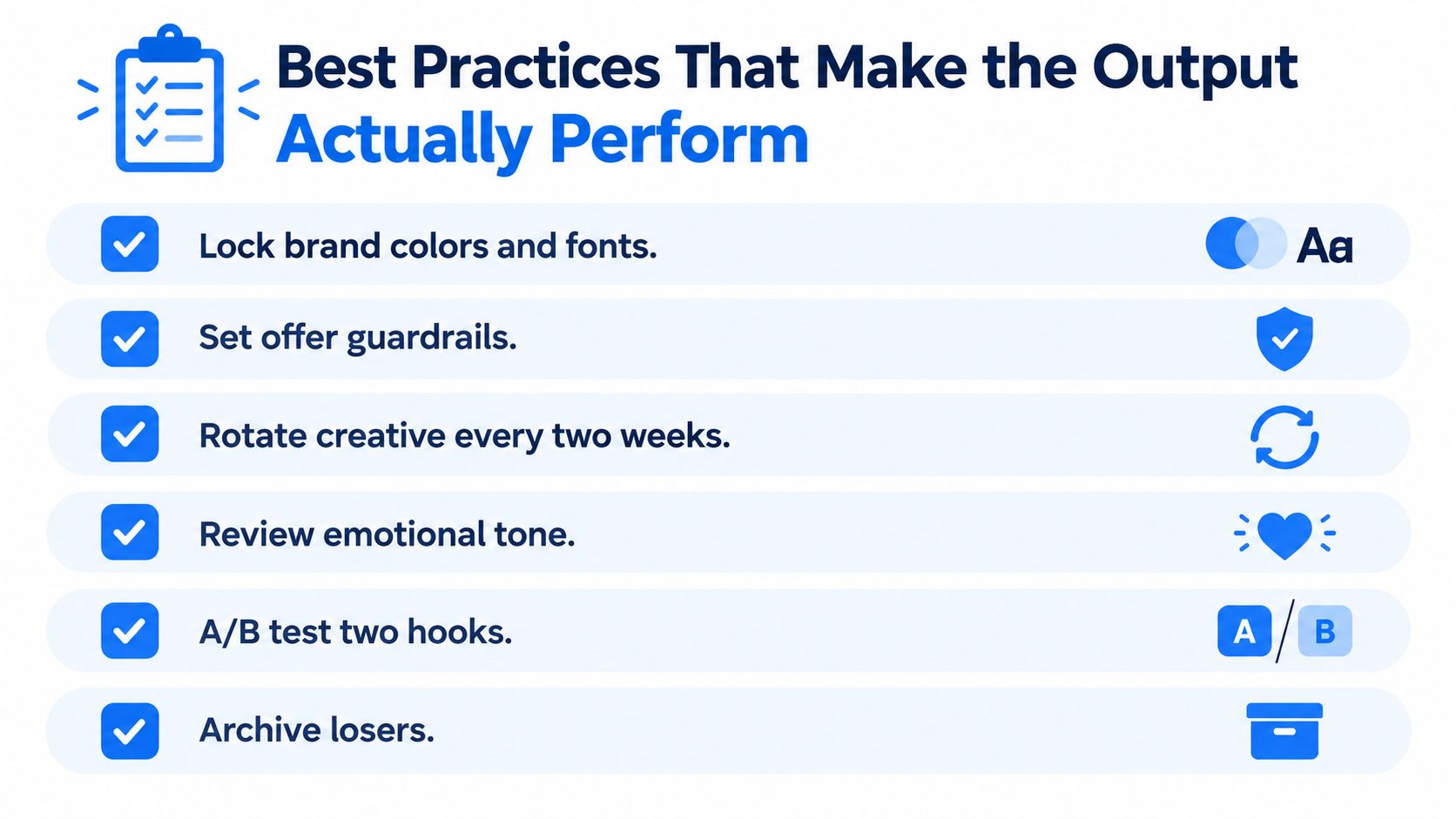
Lock the brand memory before producing variants. Store the logo, colors, fonts, approved service-area phrasing, license information, offer terms, preferred calls to action, blocked claims, and examples of acceptable tone. Require every draft to draw from that library instead of relying on a fresh prompt.
### Make testing readable
Test a small number of meaningful differences at a time. One week might compare an urgency hook with a prevention hook for the same service and audience. Another round might compare a customer review with a technician-led explanation. If every variable changes together, the result can't guide the next brief.
Use real assets wherever the business has them. A real truck, technician, office, completed job, or approved customer image gives local advertising a sense of place. Synthetic elements can support the composition, but they shouldn't replace the proof that makes the business credible.
A practical review checklist includes:
- **Offer guardrails:** Confirm the terms, dates, exclusions, and destination page.
- **Local accuracy:** Check neighborhoods, service areas, phone details, and hours.
- **Human tone:** Remove exaggerated urgency, awkward phrasing, and generic promises.
- **Visual proof:** Prefer real job and team imagery unless a synthetic asset has a clear purpose.
- **Platform fit:** Check dimensions, text legibility, captions, disclosures, and landing-page continuity.
- **Decision tracking:** Record why a creative was approved, revised, or rejected.
For a wider library of examples, compare the patterns in [Meta advertising examples for local campaigns](https://benjiads.com/blog/meta-advertising-examples), then adapt the principle rather than copying the wording.
Approval governance needs an owner and a clock. The owner can review drafts at a fixed time each day, while the marketing lead handles routine checks. Automatic approval should be limited to low-risk changes inside a locked template, such as resizing an already approved asset. New offers, testimonials, claims, or generated people should always require explicit sign-off.
Report back to booked jobs, not just clicks. A creative that brings cheap inquiries but poor-fit callers isn't a winner. Connect the asset name to lead quality, sales outcome, and customer feedback so the generator learns what the business actually values.
## Choosing the Right AI Ad Creative Generator for Your Business
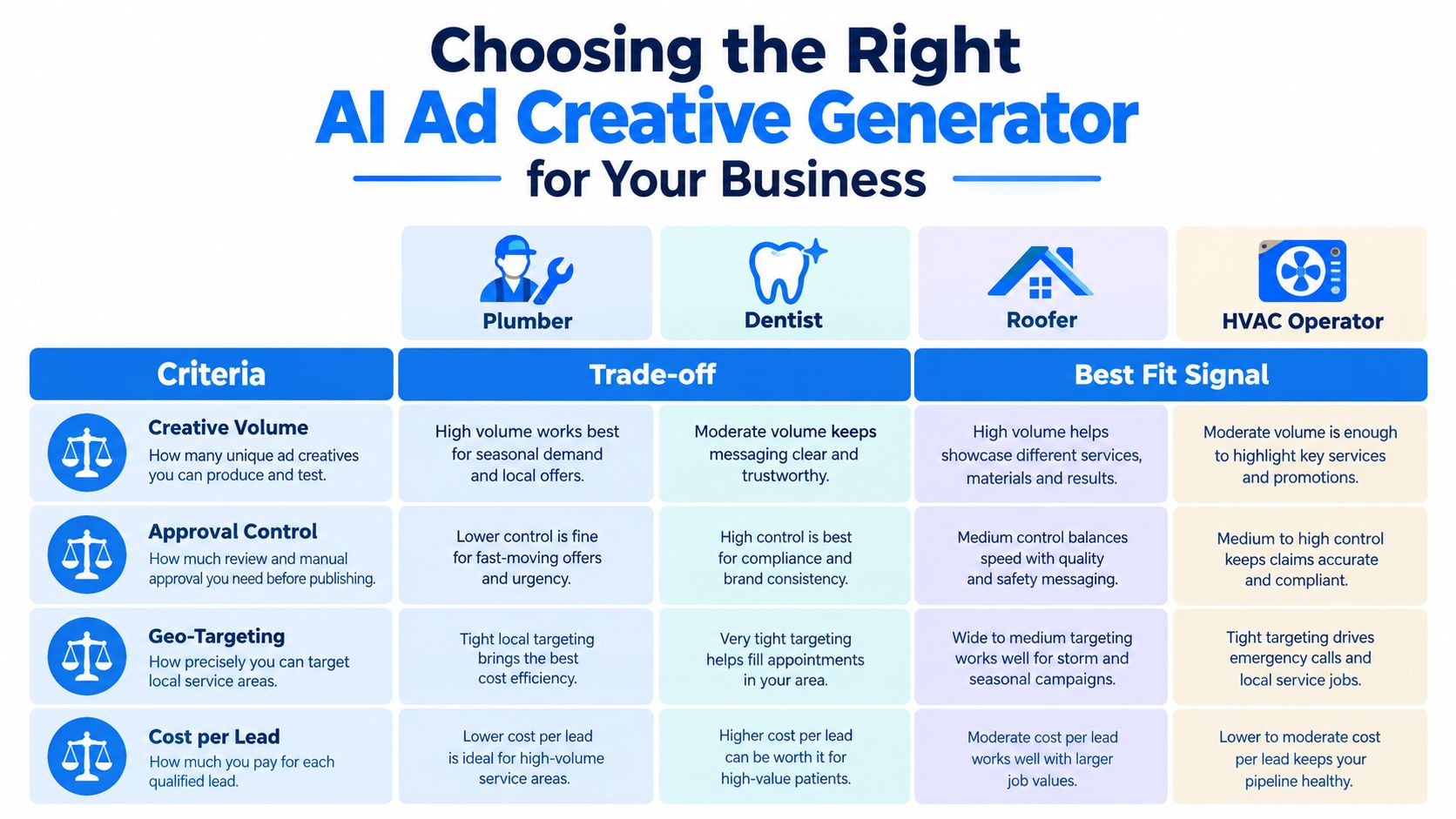
Choose the operating model before choosing the software. A plumber needs control over service areas and emergency language. A dentist needs careful review of health claims and imagery. A roofer needs reliable handling of project photos and proof. An HVAC operator needs technical accuracy and seasonal flexibility.
Score each tool against five questions:
1. **Can you control the inputs?** Check whether you can lock offers, claims, locations, images, colors, and calls to action.
2. **Is approval mandatory before launch?** A draft queue is useful only if the campaign stays paused until someone approves it.
3. **Can it use local evidence?** Look for support for reviews, real photos, service areas, seasonal priorities, and lead destinations.
4. **Does it support compliance review?** Regulated or sensitive categories need clear disclosure controls and an audit trail.
5. **Does the cost model match your operation?** Assess how the tool behaves as you add services, locations, formats, and reviewers.
Don't buy on output count alone. The market's harder problem is deciding which variants deserve testing and scaling, so performance feedback and selection controls should carry as much weight as generation speed.
For a broader view of how creative generation fits alongside acquisition and follow-up, review these [AI lead generation tools](https://benjiads.com/blog/ai-lead-generation-tools). The minimum bar is clear: the generator should produce useful trade-specific drafts, preserve approved brand rules, show what changed, collect human approval, and connect results to business outcomes. BenjiAds is one example of a software platform that prepares trade-specific ad creative and copy, builds campaign and landing-page components, supports lead follow-up, and keeps campaigns paused until the business approves them.
---
BenjiAds prepares local-service ad creative, campaign setup, landing funnels, tracking, and SMS-based lead follow-up in one approval-first workflow. Visit [benjiads](https://benjiads.com) to review how it can help you launch controlled campaigns without handing your budget or brand over to an automatic publisher.