Source: https://benjiads.com/blog/advertising-for-roofing
Publisher: benjiads, https://benjiads.com
Published: 2026-10-07
Updated: 2026-10-07
Cite as: benjiads, "Advertising for Roofing That Books Real Jobs", benjiads.com/blog/advertising-for-roofing
Reuse: you may quote this article with attribution and a link to the source.
# Advertising for Roofing That Books Real Jobs
Learn advertising for roofing that actually works: seasonal offers, geo-targeting, creative examples, budgets, and follow-up that turns leads into booked
You checked the ad dashboard before breakfast. Clicks are coming in, the spend is leaving your account, and a few form submissions have arrived. But the calendar still has open inspection slots, your estimator isn't seeing enough qualified homeowners, and nobody can tell you which campaign produced the last signed job.
That isn't usually a traffic problem. It's a **post-click operations problem**. Roofing advertising works only when the ad, landing page, response process, inspection booking, estimate, and contract operate as one system. A cheap form fill that nobody reaches is not a lead. It's an expense with a name attached.
## Table of Contents
- [Why Most Roofing Ad Budgets Die After the Click](#why-most-roofing-ad-budgets-die-after-the-click)
- [Build for the phone in the homeowner's hand](#build-for-the-phone-in-the-homeowners-hand)
- [What the Roofing Market Rewards in Advertising](#what-the-roofing-market-rewards-in-advertising)
- [Treat geography as a buying signal](#treat-geography-as-a-buying-signal)
- [Choosing Channels Where Homeowners Actually Look](#choosing-channels-where-homeowners-actually-look)
- [Make paid advertising feel like a referral](#make-paid-advertising-feel-like-a-referral)
- [Separate urgency from planning](#separate-urgency-from-planning)
- [Timing Your Campaigns Around Seasons and Storms](#timing-your-campaigns-around-seasons-and-storms)
- [Use a campaign map instead of a single budget pool](#use-a-campaign-map-instead-of-a-single-budget-pool)
- [Budget with planning benchmarks, not wishful thinking](#budget-with-planning-benchmarks-not-wishful-thinking)
- [Ad Creative and Landing Pages That Earn the Click](#ad-creative-and-landing-pages-that-earn-the-click)
- [Give every page one job](#give-every-page-one-job)
- [Use proof and price context carefully](#use-proof-and-price-context-carefully)
- [Follow-Up Speed That Turns Leads Into Inspections](#follow-up-speed-that-turns-leads-into-inspections)
- [Install the five-minute workflow](#install-the-five-minute-workflow)
- [Measure conversations, not automated activity](#measure-conversations-not-automated-activity)
- [Budgets, Metrics, and Knowing When to Pause an Ad](#budgets-metrics-and-knowing-when-to-pause-an-ad)
## Why Most Roofing Ad Budgets Die After the Click
A homeowner clicks an ad for a roof inspection, reaches your page, and submits a request. Your office is handling another call, the notification lands in an unattended inbox, and the homeowner contacts a competitor before anyone verifies the phone number. The campaign appears to have generated a lead, but the calendar remains open.
Roofing advertising is a connected operating system. The ad must make a specific promise, the landing page must support it, and the response process must turn interest into a real conversation. From there, the homeowner needs a clear path to a booked inspection, estimate, and signed job. Every break in that handoff converts paid attention into wasted spend.
Set up the funnel in this order:
1. **Ad:** Match the message to a specific service and location.
2. **Landing page:** Confirm the promise, show the service area, and remove doubt.
3. **Response:** Verify the phone number and contact the homeowner quickly.
4. **Inspection:** Offer a clear appointment instead of an open-ended conversation.
5. **Revenue:** Connect the campaign to estimates, signed work, and margin.
The cost of the click makes these handoffs more important. A [2025 home-services search benchmark](https://adwave.com/resources/roofing-company-advertising-getting-more-leads) reports an average Roofing & Gutters cost per click of **$10.70**, compared with **$7.85** across home services overall, an average roofing lead cost of **$228.15**, **64%** of homeowners beginning their roofer search on mobile, and **88%** of mobile local-service searches resulting in a call or visit within 24 hours.
### Build for the phone in the homeowner's hand
Your landing page must load cleanly on a phone, keep the call button visible, and make the next action obvious. A storm-damage prospect should reach the storm-damage offer immediately, see whether you serve the property, and choose between calling and requesting an inspection. A long questionnaire creates delay before your team has established trust.
Verify every submitted phone number. Call promptly, record whether the contact was genuine, and mark the outcome in the CRM or tracking sheet. A form count cannot distinguish a homeowner ready for an inspection from a typo, duplicate, spam entry, or unreachable contact.
> **Operator's rule:** Judge every ad by booked inspections and completed work, not by impressions, clicks, or form volume.
Track the chain from ad to verified contact, booked inspection, estimate, signed work, and margin. If your reporting stops at leads, you cannot tell whether the campaign deserves more budget or needs to be paused. You are paying for attention without measuring whether your sales process converts it.
## What the Roofing Market Rewards in Advertising
Roofing demand doesn't behave like demand for a frequently purchased consumer product. Homeowners usually act after an identifiable event, such as a leak, storm damage, an aging roof, or a property transaction. Your campaigns should therefore target moments of need, not just broad homeowner audiences.
The market is large enough to support disciplined specialization. A [U.S. roofing-market estimate](https://www.mordorintelligence.com/industry-reports/united-states-roofing-market) places industry revenue at approximately **$32.66 billion in 2025**, rising to **$34.66 billion in 2026**. The source reports that reroofing and replacement represented **63.5% of U.S. roofing revenue in 2025**, while residential roofing accounted for **58%** of the market.
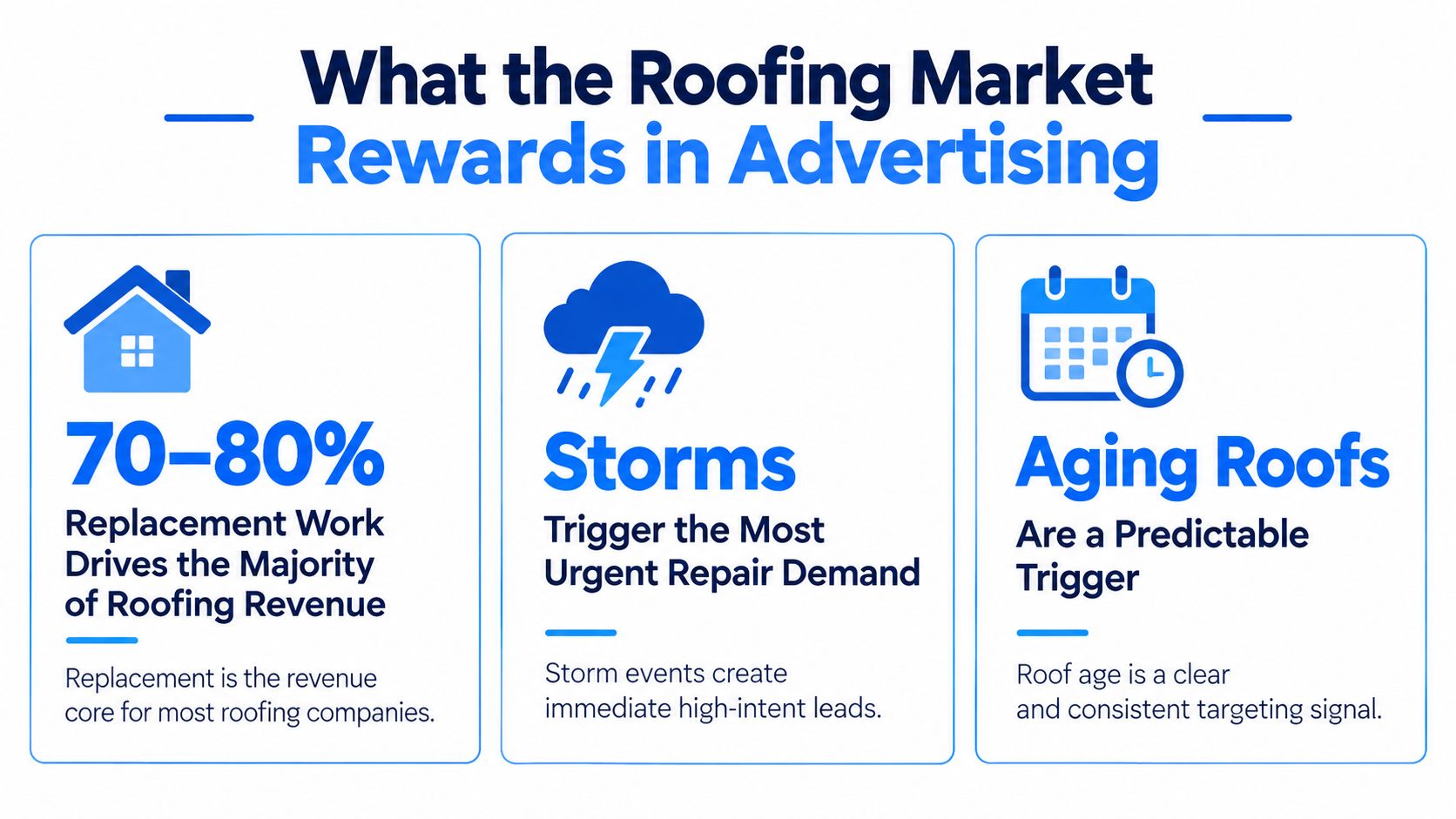
Those figures point to a practical allocation decision. Replacement is the revenue core, but urgent repair and inspection campaigns create the entry point for many homeowners. A campaign built only around “roofing company” is too vague. A stronger structure separates the problem:
- **Emergency repair:** Capture active leaks, exposed areas, and immediate damage.
- **Storm damage:** Reach affected neighborhoods while homeowners are assessing risk.
- **Roof inspection:** Offer a lower-friction evaluation for uncertain homeowners.
- **Replacement:** Address planned projects with material, warranty, process, and pricing context.
- **Commercial roofing:** Speak to property managers and building owners separately from residential buyers.
### Treat geography as a buying signal
A homeowner with storm damage doesn't need a national brand story. They need to know whether you work in their neighborhood, whether you can inspect the property, and whether your team understands the local situation. Use location-specific ad groups and landing pages rather than sending every visitor to a generic homepage.
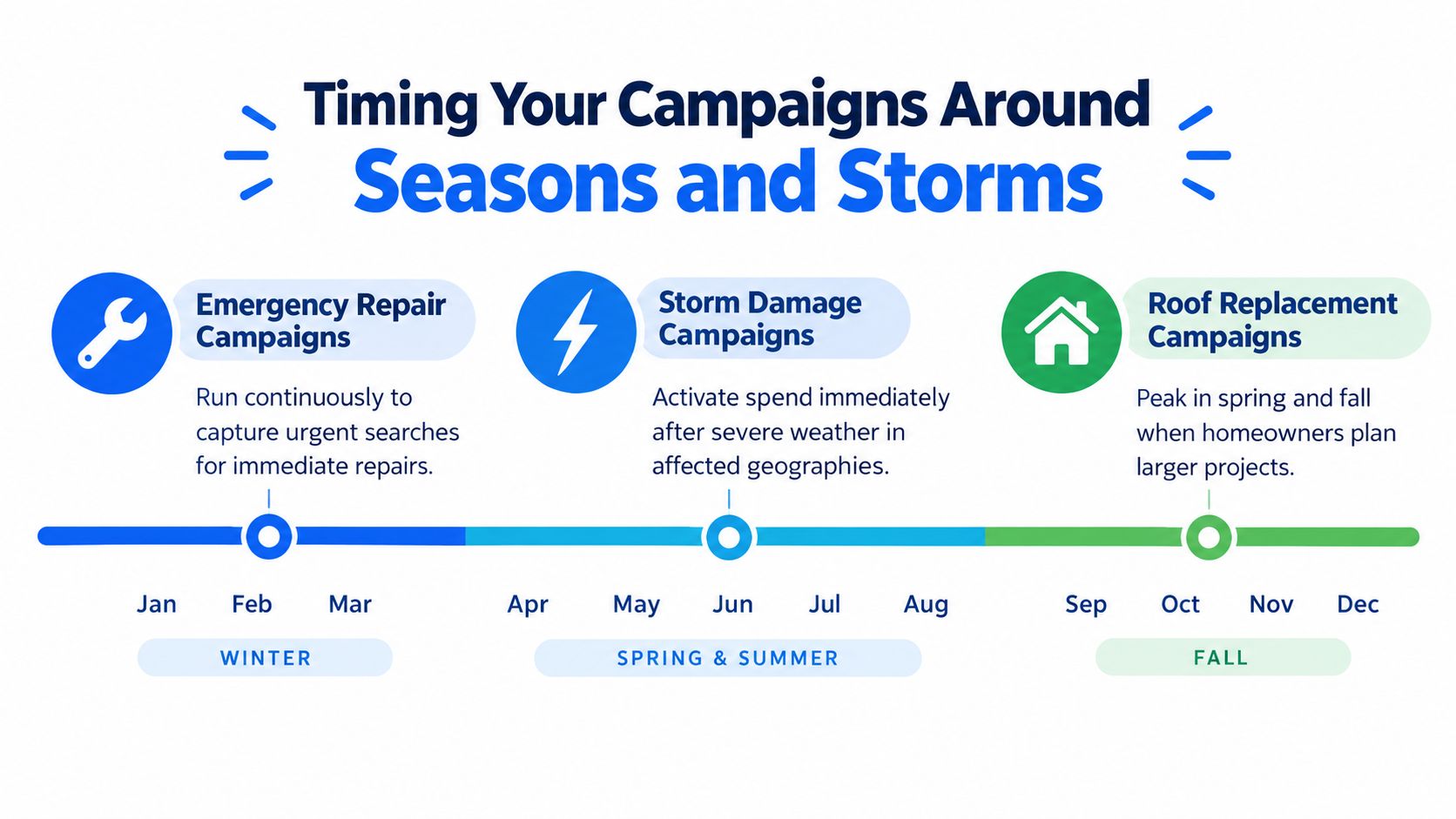
Seasonal and weather triggers also belong in the campaign architecture. Keep emergency coverage available for urgent searches, prepare storm campaigns before severe weather, and promote inspections when homeowners are likely to plan larger work. The ad should identify the trigger and offer the next action.
Material specialization matters too. The market source reports that asphalt shingles represented **58.6% of revenue in 2025**, while single-ply membranes were forecast to grow at **7.69% annually through 2031** in that analysis. That supports separate messaging for residential shingle replacement and commercial membrane work. A commercial buyer shouldn't land on a page written for a homeowner worried about missing shingles.
Broad awareness has a role, but it shouldn't consume the budget before high-intent demand is covered. Start with the service, location, and event most likely to produce a profitable inspection. Then expand only after the follow-up and measurement systems can handle additional volume.
## Choosing Channels Where Homeowners Actually Look
Most roofing contractors overvalue the channels they enjoy using. Contractors identify social media as their most-used promotional channel at **70%**, but only **25% of homeowners say social media is how they find roofers**, according to the [contractor and homeowner report](https://www.myclearopinioninsightshub.com/reports/roofing-contractor-and-homeowner-report). The same report says **79% of homeowners first seek word-of-mouth recommendations**, while **62% use internet search**.
That mismatch doesn't mean social advertising is useless. It means social ads must do more than display a truck, a smiling crew, and a generic before-and-after photo. Search captures an existing problem. Social has to create enough trust and relevance for a homeowner to take action.
### Make paid advertising feel like a referral
A referral transfers confidence from someone the homeowner already trusts. Your ad can't pretend to be a personal recommendation, but it can provide the evidence a referral normally carries:
- **Local proof:** Name the neighborhood or service area when the campaign serves it.
- **Real work:** Use photographs from your own completed projects, not generic roof imagery.
- **Customer evidence:** Show verified reviews and make the review source clear.
- **Credentials:** Display licensing and insurance information where applicable.
- **Process clarity:** Explain who inspects, who performs the work, and what happens after the inspection.
- **Warranty boundaries:** State what the warranty covers and who administers it.
This is **trust transfer**, not social reach. A homeowner should understand why your company is credible before submitting a phone number.
Use high-intent search for active problems such as emergency repair, storm damage, and roof replacement. Use social when you have a clear geographic reason, strong local proof, a useful inspection offer, or a retargeting audience that already knows the company. If social produces attention but not verified conversations or booked inspections, reduce it until the evidence improves.
For campaign setup, use a structure that separates service, audience, location, offer, and landing page. This [guide to setting up a Google Ads campaign](https://benjiads.com/blog/how-to-set-up-a-google-ads-campaign) is useful for translating that structure into an actual account.
### Separate urgency from planning
Emergency prospects want reassurance and immediate contact. Their page should prioritize the phone number, service area, active-response availability, and a short qualification path. A planned replacement prospect needs project photographs, material options, pricing context, process details, and a reason to schedule an inspection now.
Don't send both audiences to the same page and expect the same follow-up. A homeowner with water entering the house needs a fast call. Someone comparing replacement options may accept a scheduled consultation and a more detailed information sequence.
Your channel decision should be simple:
> **Buy search demand first. Add social spend only when it carries referral-quality proof or supports a specific local event.**
## Timing Your Campaigns Around Seasons and Storms
A roofing account shouldn't have one campaign called “Roofing Leads.” That structure hides intent, mixes lead quality, and makes it impossible to know which service deserves more budget.
Build campaigns by **service and geography**, then adjust them around weather and planning seasons. Each campaign needs one offer, one audience, one promise, and one destination page.
### Use a campaign map instead of a single budget pool
**Emergency repair** should stay available continuously if your company can respond. Target active-problem searches and make the page direct: describe the response area, show the phone number, and let the homeowner request immediate help.
**Storm damage** requires readiness before the weather arrives. Prepare ad copy, landing pages, geographic targets, call scripts, and SMS messages in advance. When a storm affects a defined area, activate the campaign there instead of spreading spend across an entire region. The offer can focus on a roof inspection, but don't imply that every property has damage or promise insurance outcomes you can't control.
**Replacement** campaigns suit homeowners who are planning a larger project. Use project photos, material information, warranty explanations, and a consultation offer. Seasonal timing can support pre-winter inspections, spring planning, or periods when homeowners typically schedule exterior work in your market.
**Inspection** campaigns serve uncertain prospects. The homeowner may notice an aging roof or minor signs of damage but isn't ready to request replacement. A clear inspection offer gives that person a safe next step without forcing a premature sales decision.
### Budget with planning benchmarks, not wishful thinking
A [WebFX roofing benchmark](https://www.webfx.com/blog/home-services/roofing-marketing-benchmarks/) reports a **5.58% conversion rate**, approximately **$350 cost per lead**, **$25 to $50 cost per click**, and a roughly **30-day sales cycle**. Treat those as planning benchmarks, not promises. Season, market competition, service mix, lead quality, landing-page performance, and sales execution can move actual results substantially.
The sales-cycle point matters. A replacement lead may not become revenue immediately, even when the campaign is working. If you pause an ad before inspections become estimates and contracts, you may cut a profitable source because you measured it too early.
Track each campaign separately:
| Campaign | Audience | Offer | Landing page | Follow-up |
|---|---|---|---|---|
| Emergency repair | Active problem | Rapid assessment | Emergency page | Immediate call |
| Storm damage | Affected geography | Post-storm inspection | Storm page | Fast SMS and call |
| Replacement | Planned project | Consultation or inspection | Replacement page | Scheduled nurture |
| Inspection | Uncertain homeowner | Roof evaluation | Inspection page | Appointment options |
Don't raise spend because a storm created more clicks. Raise it when your team can verify the contacts, answer quickly, book inspections, and serve the affected area without damaging customer experience.
## Ad Creative and Landing Pages That Earn the Click
The ad earns attention. The landing page earns confidence. The follow-up earns the appointment.
A storm-damage ad might say that your team is serving a named neighborhood after a recent weather event and offer a roof inspection. A replacement ad can show a real completed project, explain the materials used, and provide useful pricing context. An emergency ad should lead with the problem you solve and how quickly someone can respond.
### Give every page one job
A landing page should not function as a miniature version of your entire website. Give it one primary conversion action, such as calling, requesting an inspection, or selecting an appointment window.
Include the details that remove risk:
- **Service area:** State the cities or neighborhoods you cover.
- **Proof of work:** Use project photographs with enough context to establish authenticity.
- **Credentials:** Display licensing and insurance information clearly.
- **Reviews:** Include relevant customer feedback and identify the review source.
- **Process:** Explain what happens after the form or call.
- **Qualification:** Ask for roof type, property location, damage status, and desired timing.
- **Contact verification:** Require a usable phone number and confirm it before treating the lead as qualified.
The page shouldn't make claims the crew can't keep. “Same-day response” means your operation can support that response. “Free inspection” should explain what the inspection includes and what it doesn't include.
### Use proof and price context carefully
Roofing survey reporting says **67% of homeowners consider online reviews very or extremely important**, and **78% are more likely to call a roofer when pricing is shown online**, according to [reported roofing survey findings](https://wifitalents.com/marketing-in-the-roofing-industry-statistics/). That doesn't mean you should publish a misleading low price. It means hiding every pricing signal creates avoidable uncertainty.
Use a range only when you can explain what changes the final price. Clarify that roof size, material, pitch, access, damage, and project scope affect the estimate. A homeowner who understands the pricing framework is more likely to have a useful conversation than one who submits a form expecting an unrealistic number.
For a practical explanation of how the visual and written components work together, see this guide to [ad creative](https://benjiads.com/blog/what-is-ad-creative).
A short video can also demonstrate inspection quality, introduce the team, or explain what homeowners should expect. Keep it tied to the page's promise rather than adding video for decoration.
The form should collect enough information to route the lead, but not so much that a stressed homeowner abandons it. Ask only what the estimator needs to decide urgency, service fit, location, and the next appointment step.
## Follow-Up Speed That Turns Leads Into Inspections
Lead handling determines whether roofing ad spend produces inspections or dead form fills. An owner can buy a valid inquiry, then lose it because nobody verifies the phone number, calls while the homeowner is available, or owns the next step. An automated email is not a completed response.
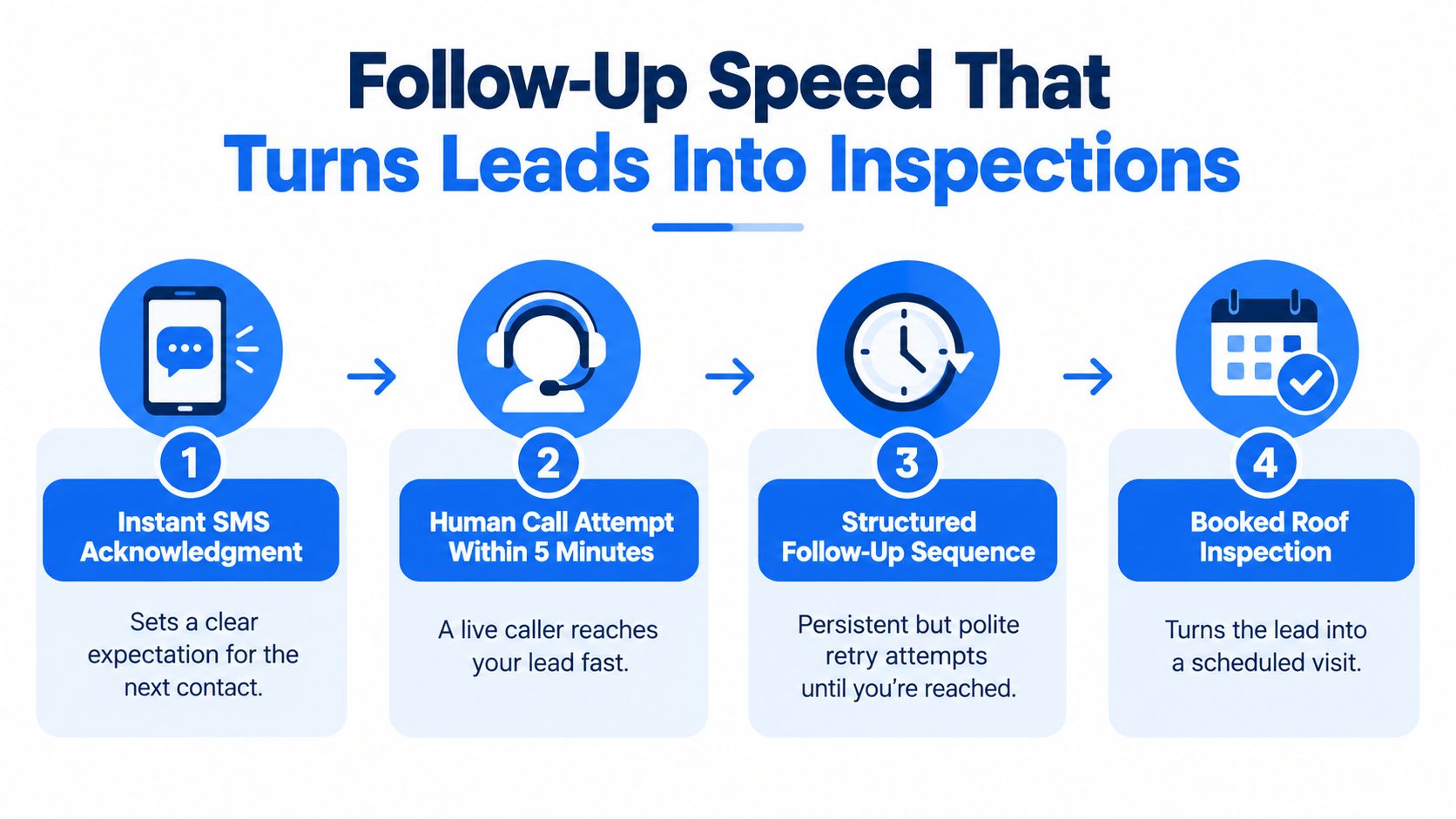
A real response starts a conversation and moves the homeowner toward a scheduled inspection. [Lead-response benchmark reporting](https://pipelineon.com/blog/lead-response-time-home-service/) states that contractors responding within five minutes are **21 times more likely to qualify a lead** than those waiting 30 minutes. Use that benchmark operationally: after the first call, verify the phone by SMS, then offer two inspection windows immediately.
### Install the five-minute workflow
Use this sequence for every form submission and inbound call. See this [speed-to-lead workflow for roofing teams](https://benjiads.com/blog/speed-to-lead) for the full SMS and call sequence.
1. **Immediate acknowledgment:** Send an SMS confirming receipt, naming the company, and stating when the next contact will happen.
2. **Human call within five minutes:** Call from a monitored business number. Confirm the service area, property type, phone number, and whether the issue is active or urgent.
3. **Text fallback:** If the homeowner does not answer, send a concise message with two available inspection windows.
4. **Permission-based persistence:** Follow up across several days, then stop or change cadence when the prospect replies.
5. **CRM reporting:** Record response latency, verified contact, conversation, booked inspection, estimate, and final outcome.
A useful first message is direct: “Thanks for contacting [company] about your roof. Are you dealing with an active leak or checking for damage? We can call shortly, or you can choose an inspection window.”
Do not call repeatedly without context. Give the homeowner a clear way to say the issue is resolved, the timing changed, or further contact is unwanted. The sequence should feel like competent service, not pressure.
### Measure conversations, not automated activity
An SMS delivery report is not a booked inspection. A form completion is not a qualified opportunity, and a reply is not revenue.
Track whether the phone number is valid, whether a conversation starts, whether the homeowner selects an inspection time, and whether the appointment takes place. If automation generates replies without appointments, change the qualification and scheduling process instead of celebrating reply rate.
Test the workflow against a control period. Compare booked-inspection rate, cost per booked inspection, and revenue per advertising dollar. A faster response can raise headline lead costs while producing more completed inspections, making it the better economic choice.
## Budgets, Metrics, and Knowing When to Pause an Ad
Set a starting budget from your service capacity, acceptable acquisition cost, and planning benchmarks, not from a competitor's boast. Keep enough runway to observe the sales cycle, then judge campaigns on verified opportunities and revenue.
Track the entire path from impression to contract:
| Metric | What It Tells You | Act On It? |
|---|---|---|
| Impressions | Whether the platform is delivering reach | Only if delivery is missing |
| Click-through rate | Whether the message earns attention | Improve creative or targeting |
| Landing-page conversion | Whether the page earns an inquiry | Fix offer, proof, or friction |
| Contact rate | Whether leads can be reached | Verify phones and improve follow-up |
| Inspection-booking rate | Whether conversations become appointments | Prioritize this operationally |
| Estimate rate | Whether inspections produce real opportunities | Review qualification and sales process |
| Close rate | Whether opportunities become contracts | Review sales execution and lead fit |
| Revenue per lead | Whether acquisition creates money | Use it for budget decisions |
Pause ad groups that generate volume but fail your qualification or booking thresholds. Shift spend toward campaigns producing completed inspections, issued estimates, and signed work, even when their headline cost per lead is higher.
Your checklist is short: separate services and locations, build one promise per page, verify every phone number, call within five minutes, offer appointment windows, and connect ad data to revenue. Then review the campaign by profit, not by the lowest CPL.
---
BenjiAds helps local contractors build approved ad campaigns, branded landing funnels, phone-verified SMS intake, automated follow-up, and conversion tracking in one system. If your roofing ads generate inquiries but your team loses them after the click, visit [benjiads](https://benjiads.com) and see how to turn paid traffic into a measurable inspection pipeline.