Source: https://benjiads.com/blog/advertising-for-plumbers
Publisher: benjiads, https://benjiads.com
Published: 2026-09-19
Updated: 2026-09-19
Cite as: benjiads, "Advertising for Plumbers That Books More Jobs Fast", benjiads.com/blog/advertising-for-plumbers
Reuse: you may quote this article with attribution and a link to the source.
# Advertising for Plumbers That Books More Jobs Fast
Advertising for plumbers made simple. Learn budgets, creatives, funnels and SMS follow-up to turn clicks into booked plumbing jobs.
You're probably in one of two spots right now.
Either you've spent money on Google Ads, got some calls, and still can't say which jobs came from advertising. Or you haven't started yet because every marketing pitch sounds the same: more clicks, more leads, more visibility. None of that matters if the phone isn't answered fast, the lead isn't qualified, and the job never gets booked.
That's the frame for **advertising for plumbers**. It isn't just ad buying. It's a capture system built around intent, response time, proof, and tracking. When a homeowner has water on the floor, they don't want branding. They want the first plumber who looks legitimate and responds immediately.
## Table of Contents
- [Why Most Plumbing Ads Fail Before the Phone Rings](#why-most-plumbing-ads-fail-before-the-phone-rings)
- [Response speed decides who gets the first conversation](#response-speed-decides-who-gets-the-first-conversation)
- [Generic ads lose at the click](#generic-ads-lose-at-the-click)
- [Choosing Where to Advertise and How Much to Spend](#choosing-where-to-advertise-and-how-much-to-spend)
- [The clearest channel split](#the-clearest-channel-split)
- [Plumbing Ad Channel Cost and Booking Comparison](#plumbing-ad-channel-cost-and-booking-comparison)
- [How to choose by job type](#how-to-choose-by-job-type)
- [Don't spread the budget too thin](#dont-spread-the-budget-too-thin)
- [Ad Creatives and Offers That Get Homeowners to Click](#ad-creatives-and-offers-that-get-homeowners-to-click)
- [Match the offer to the job](#match-the-offer-to-the-job)
- [Real field proof beats polished brand creative](#real-field-proof-beats-polished-brand-creative)
- [Copy that gets the right click](#copy-that-gets-the-right-click)
- [Building a Funnel and Tracking That Turns Clicks Into Booked Jobs](#building-a-funnel-and-tracking-that-turns-clicks-into-booked-jobs)
- [Build the path before buying more clicks](#build-the-path-before-buying-more-clicks)
- [Use Local Services Ads reporting the way Google designed it](#use-local-services-ads-reporting-the-way-google-designed-it)
- [Track bookings, not just lead events](#track-bookings-not-just-lead-events)
- [Follow Up in Minutes and Retargeting That Recovers Lost Leads](#follow-up-in-minutes-and-retargeting-that-recovers-lost-leads)
- [Speed decides whether the lead is still yours](#speed-decides-whether-the-lead-is-still-yours)
- [The follow-up flow that works in plumbing](#the-follow-up-flow-that-works-in-plumbing)
- [Retarget based on hesitation, not just page visits](#retarget-based-on-hesitation-not-just-page-visits)
- [Your Plumbing Advertising Playbook and Next Steps](#your-plumbing-advertising-playbook-and-next-steps)
- [What to do this week](#what-to-do-this-week)
- [What usually wastes budget](#what-usually-wastes-budget)
## Why Most Plumbing Ads Fail Before the Phone Rings
At 8:17 p.m., a homeowner has dirty water backing up into the kitchen sink. They search, tap a paid ad, back out, open a Local Services listing, and make a decision in seconds. They are screening for service area, credibility, and a fast path to contact.
Plumbing ads usually fail before the office ever speaks to that lead because the ad is only one piece of the system. The breakdown happens earlier. Wrong channel for the job type. Generic message. Weak landing experience. No proof. No routing between emergency and estimate traffic. No immediate text after the form comes in.
That is why two companies can buy the same clicks and get completely different results.
I see the same pattern across local campaigns. Shops blame Google Ads, lead quality, or bid costs when the issue is capture. An emergency drain backup and a planned water heater install should not hit the same path. One lead needs speed and a clear call button. The other needs proof, pricing context, and a reason to trust your crew enough to schedule.
### Response speed decides who gets the first conversation
If your campaign creates inquiries faster than your team can answer them, budget starts leaking immediately.
Analysts at [USTech Automations](https://ustechautomations.com/resources/blog/lead-followup-for-plumbing-companies-playbook-2026) found that service companies responding within 5 minutes convert at far higher rates than companies waiting 30 minutes, and that slow follow-up costs a meaningful share of paid leads. In practice, that usually means the same thing. The company that calls or texts first gets the first real shot at the job.
That makes advertising a routing problem as much as a media problem. A missed call, a form that sits in the inbox, or no auto-text confirmation can ruin a good campaign. If nobody verifies that call tracking, forms, and SMS alerts are working before spend goes live, the ad account can look active while booked jobs stay flat.
### Generic ads lose at the click
Message mismatch is the second budget killer.
“Trusted local plumber” does not say enough for a homeowner with sewage backing up in the tub. It also does not help much for someone comparing quotes on a tankless install. Good plumbing ads match the buying moment. The click should feel like the next obvious step, not a detour into a generic homepage.
Recent creative observations in the plumbing category note that simple field proof and jobsite footage often outperform polished brand-heavy creative for local service campaigns ([2026 plumber creative benchmark summary](https://dalyadvertising.com/blog/plumber-marketing)). That fits what books work. Homeowners respond to signs of competence they can verify fast.
Use the message that fits the job:
- **Emergency jobs:** fast response, open now, area served, direct call path
- **Repair jobs:** diagnosis, clean workmanship, reviews, clear next step
- **Install jobs:** product options, financing if offered, timeline, trust signals
The ad, the page, and the follow-up have to agree with each other. If the ad promises urgency but the page buries the phone number, conversion drops. If Search traffic lands on a page built for Local Services leads, qualification gets messy. If the lead comes in and no text goes out for ten minutes, another plumber is already on the way.
## Choosing Where to Advertise and How Much to Spend
Most plumbers don't need more channels. They need better channel selection.
If you advertise everywhere at once, each platform gets starved. Creative gets rushed. Tracking gets muddy. Results become impossible to interpret. Start with the channel that matches the job type you want more of, then expand only after you can verify booked work.
### The clearest channel split
For residential plumbing, **Google Local Services Ads** are often the lowest-friction starting point. Independent home-services reporting notes that Local Service Ads averaged **$57 per lead** with a **44.5% book rate** in one benchmark, while another recent industry summary cites a range around **$53 to $57 per lead** with book rates around **43.9% to 44.5%** ([plumber marketing statistics and channel benchmark](https://www.amraandelma.com/plumber-marketing-statistics/)).
By contrast, a 2026 plumbing Google Ads benchmark tracked **$14.6M** in non-branded spend across **524** contractors and **2,554** campaigns in the U.S. and found an average **cost per lead of $183** for plumbing search campaigns in Q1 2026. That same benchmark says the typical contractor in the dataset spent **$14,206 per month** on Google Ads across all trades, with about **40%** of that budget going to plumbing-specific campaigns ([2026 plumbing Google Ads benchmark](https://searchlightdigital.io/plumbing-google-ads-cost-per-lead/)).
That doesn't mean Search is bad. It means Search needs more discipline.
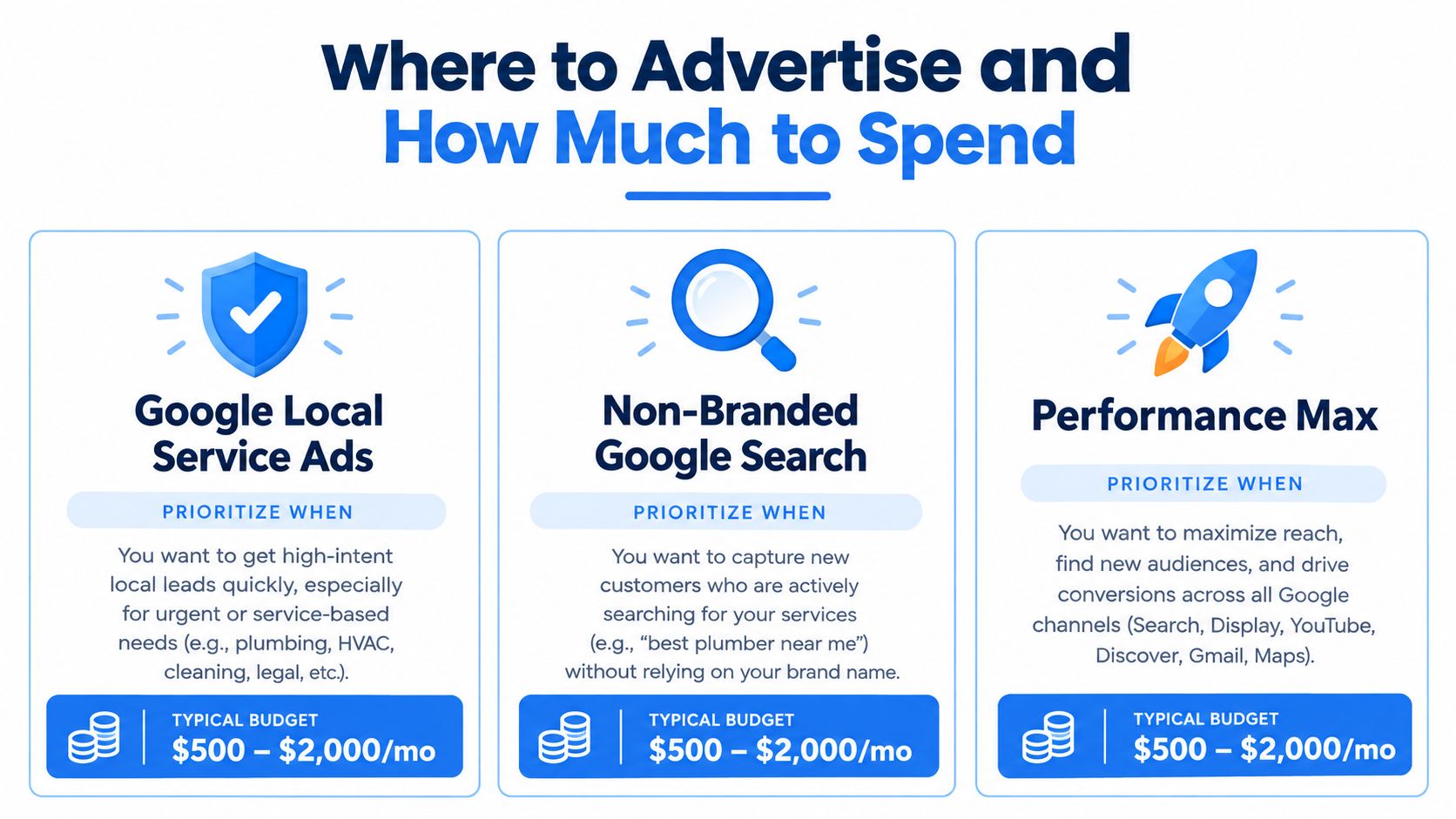
### Plumbing Ad Channel Cost and Booking Comparison
| Channel | Avg Cost Per Lead | Book Rate / Conversion Signal |
|---|---:|---|
| Google Local Services Ads | $53 to $57 | 43.9% to 44.5% book rate |
| Non-branded Google Search | $183 | 7.63% click-to-lead conversion in one plumbing benchmarked dataset |
| Performance Max | Qualitative only | Best treated as assisted demand capture, not a first reporting layer |
### How to choose by job type
Here's the practical split.
For **emergency residential work**, start with Local Services Ads first if your profile, reviews, coverage, and office responsiveness are in shape. The lead format is closer to the call. The homeowner often wants fast contact, not a long landing page.
For **high-intent non-branded search**, use Google Search when you want more control over service segmentation. Search is useful when you need separate campaigns for drain cleaning, leak detection, sewer work, and water heaters. It's also where you can control terms, negatives, and message more tightly.
For **Performance Max**, treat it carefully. It can support broader Google inventory and remarketing, but many plumbing shops launch it too early. If you don't already know which services, geographies, and messages book well, Performance Max can blur the picture instead of sharpening it.
> Run Search when you want control. Run Local Services Ads when you want simpler high-intent lead flow. Add broader automation only after the first two are telling the truth.
### Don't spread the budget too thin
A common mistake in advertising for plumbers is trying to “test” five services in three cities with one small monthly budget. That usually produces noise, not insight.
A better approach:
1. **Pick one primary channel**
Start with Local Services Ads or Search. Not both at full force on day one unless you already have strong lead handling and tracking.
2. **Choose two or three service lines**
Drain, emergency leak, and general plumbing usually behave differently from water heater installs. Keep them separate enough to judge.
3. **Concentrate by geography**
Put money where your crews can respond quickly and where your close rate is strongest.
4. **Judge bookings, not activity**
Clicks can look healthy while booked jobs stay flat.
If you want a broader view of plumbing channel strategy and local demand capture, this [plumbing marketing guide](https://benjiads.com/plumbing-marketing) is a useful companion read.
## Ad Creatives and Offers That Get Homeowners to Click
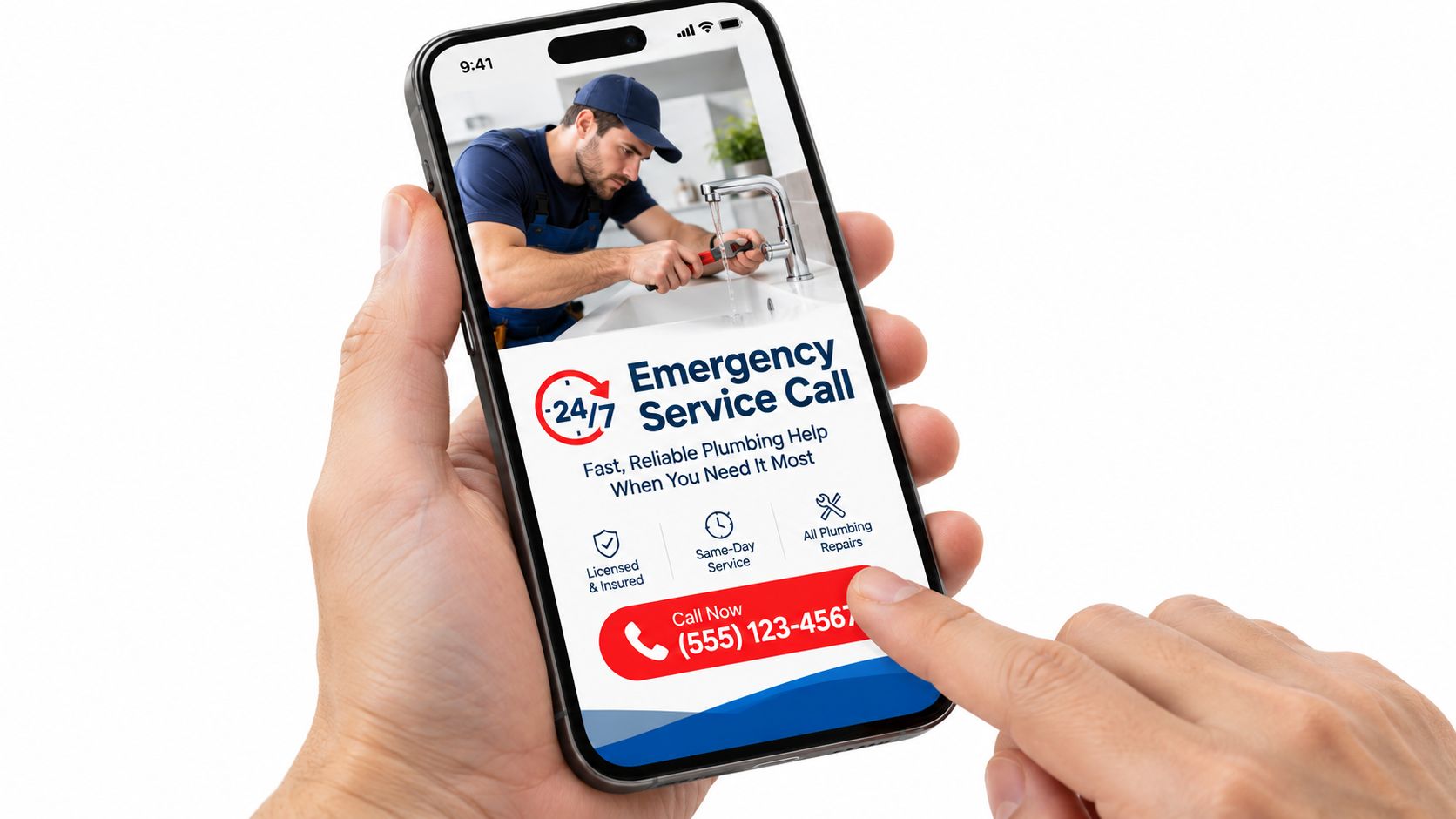
A homeowner with a backed-up kitchen sink is not comparing taglines. They are scanning for one fast answer to one specific problem, and the ad that wins usually names that problem plainly.
That is why broad plumbing copy burns budget. “Quality service,” “trusted pros,” and “fast and affordable” do not separate your shop from the next five ads on the page. Good creative makes the click feel safe. It shows the exact service, the area served, and a believable path to getting help now.
### Match the offer to the job
Different jobs need different promises.
Emergency ads should sell response. Planned install ads should sell confidence and clarity. Repair ads should show that your team can diagnose the issue correctly and fix it cleanly the first time. Shops that run one generic ad style across drain cleaning, water heaters, and repipes usually attract mixed lead quality and weaker conversion once the click turns into a call or form.
A practical split looks like this:
- **Emergency service ads**
Lead with availability, speed, and service area. Name the problem directly. Burst pipe, overflowing toilet, sewer backup, no hot water.
- **Repair-focused ads**
Show the issue and the fix. Use real examples like leak detection, drain clearing, angle stop replacement, or a failed disposal swap.
- **Install and replacement ads**
Focus on trust, workmanship, and what the homeowner is buying. New water heater install, repipe sections, fixture upgrades, code-compliant replacement, clean work in finished homes.
The offer matters as much as the image. For urgent work, “Call now” or “Text for fastest response” usually beats a discount. For considered jobs, a clear estimate offer, financing mention, or next-day on-site assessment can pull better clicks without training buyers to shop on price alone.
### Real field proof beats polished brand creative
In plumbing, proof usually outperforms polish.
Homeowners respond to ads that look like actual service calls. A phone-shot arrival clip, a technician explaining what failed, or a clear before-and-after photo often does more work than a branded video with music and graphics. The reason is simple. The creative answers the question in the homeowner's head: “Have these people handled my kind of problem before?”
Use visuals like these:
- **Truck arrival clips**
Short, local, believable
- **Technician explanation videos**
Ten to twenty seconds, plain language, one issue explained clearly
- **Before-and-after proof**
Backed-up tub drain, cleared line, tested flow
- **Clean install photos**
Straight piping, neat valve layout, tidy work area
Creative that usually misses:
- **Generic stock water imagery**
It looks interchangeable
- **Corporate brand videos**
Fine for a homepage, weak for high-intent ad traffic
- **Long captions with no service or area detail**
People skim, especially on mobile
If a homeowner cannot tell what was fixed in the first few seconds, the ad is too vague.
### Copy that gets the right click
Good plumbing ad copy sounds like the office and the field are on the same page. It should reflect how jobs are sold and scheduled.
Strong patterns include:
- **Problem-first headlines**
“Drain backing up in [city]?”
- **Service plus location**
“Water heater repair in [service area]”
- **Useful trust details**
“Same-day appointments when available”
- **Clear action**
“Call now” for urgent jobs. “Request an estimate” for planned work.
There is a trade-off here. Strong urgency lifts click-through rate, but if the landing path or office response does not match the promise, lead quality falls apart after the click. “24/7 emergency plumber” should only run if someone is picking up or texting back within minutes. Good ad creative is part of the capture system, not a standalone asset. The ad, the channel, the landing experience, and the speed to first response all need to agree.
If you use AI to draft ad variations, feed it real inputs. Give it actual service lines, neighborhoods, job notes, and photos from your crews. AI can help produce options faster. It cannot make fake-looking creative book more jobs.
## Building a Funnel and Tracking That Turns Clicks Into Booked Jobs
Traffic without verification is where plumbing ad spend disappears.
A lot of shops still judge campaigns by call volume alone. That's not enough. You need to know what happened after the click, after the call, and after the office tried to schedule the work. If you can't tie the ad to a verified lead and then to a booked job, you're optimizing blind.
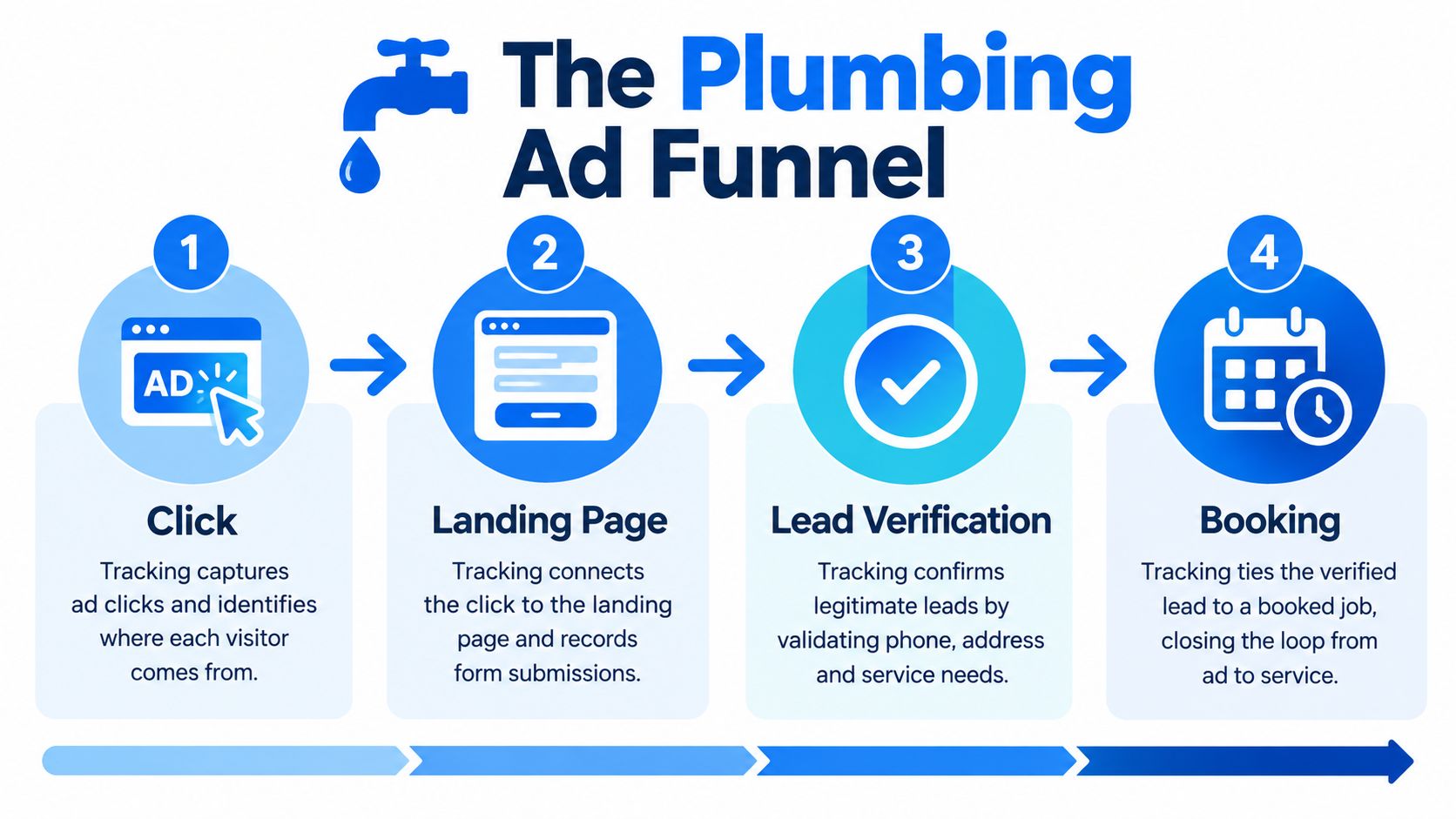
### Build the path before buying more clicks
A plumbing funnel doesn't need to be fancy. It needs to be tight.
For Search traffic, that usually means a focused landing flow with one service, one geography, one clear action, and minimal distractions. Don't send sewer line ad clicks to a generic homepage with ten menu choices and a hero image about “full-service plumbing solutions.” Send them to the exact service path.
The landing flow should do four jobs:
1. **Confirm the service**
The visitor should know immediately they're in the right place.
2. **Confirm the area**
Homeowners want to know you serve them.
3. **Make contact friction low**
Call buttons, short forms, and message options help.
4. **Filter obvious junk**
Basic qualification fields are useful if they don't slow down urgent leads.
For a deeper look at what makes home-service lead funnels hold together, this guide to [home service leads and conversion flow](https://benjiads.com/blog/home-service-leads) is worth reading.
### Use Local Services Ads reporting the way Google designed it
Google Local Services Ads already gives plumbers a better reporting framework than many use. Google's documentation says reporting includes **lead counts**, **lead categories**, and breakdowns by **call, message, and booking**. It also defines **phone lead responsiveness** as connected calls divided by total calls over the previous **90 days** ([Google Local Services Ads reporting documentation](https://support.google.com/localservices/answer/6226265?hl=en)).
That matters because it turns “we probably missed a few” into a measurable operating problem.
If you're running LSAs, review:
- **Charged leads**
Not just total leads
- **Lead type**
Calls, messages, and bookings behave differently
- **Service categories**
Some categories look busy but don't convert well
- **Responsiveness**
If answer performance is weak, fix operations before increasing spend
### Track bookings, not just lead events
For Google Search and other click-driven campaigns, the goal is to capture both client-side and server-side signals so the ad platform sees more than page visits. You want form submissions, calls, booked appointments, and downstream outcomes fed back cleanly.
You don't need complicated language to evaluate it. Ask simple questions:
| Funnel checkpoint | What to verify |
|---|---|
| Click | Did the right ad send the visitor to the right page |
| Lead | Was the inquiry real and serviceable |
| Contact | Did someone connect with the lead quickly |
| Booking | Did the inquiry become a scheduled job |
> Track the funnel in order. If you skip verification and jump straight to lead totals, weak campaigns can look healthy for months.
A lot of wasted spend comes from mixing everything together. Emergency call ads, quote-request forms, chat leads, and LSA bookings should not be blended into one vague success number. Segment first. Then optimize.
## Follow Up in Minutes and Retargeting That Recovers Lost Leads
A homeowner fills out your form for a leaking water heater at 7:12. Your ad did its job. If the first text goes out at 7:13 and the call attempt happens right after, you still have a real shot at the booking. If that lead sits in the inbox until 7:45, the budget was probably spent to help a competitor.
That is why follow-up belongs inside the advertising system, not outside it. Good plumbing campaigns do not end at the click, the call, or the form submission. They carry the lead into a fast response process that gives the office a chance to book the job while intent is still high.
### Speed decides whether the lead is still yours
Emergency and repair leads decay fast. Homeowners do not submit one request and wait patiently for a callback. They keep searching, they call the next company, or they book the first plumber who replies with a clear next step.
As noted earlier, fast response materially improves contact and booking rates. The exact number matters less than the operating standard. For inbound plumbing leads, sub-5-minute follow-up is the target. If the shop cannot do that during business hours, ad efficiency drops long before anyone notices it in the platform.
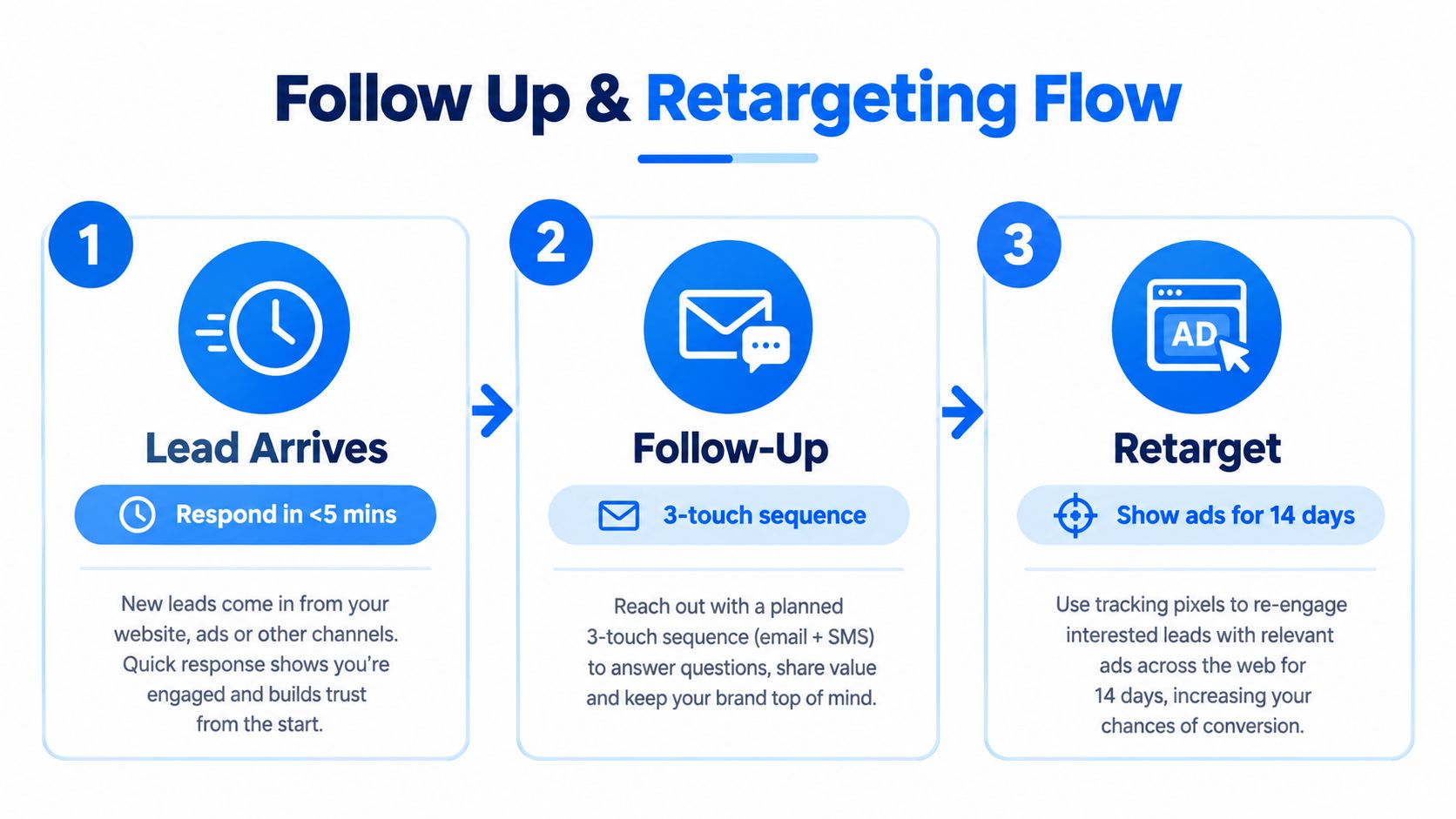
### The follow-up flow that works in plumbing
Keep it tight.
- **Instant SMS**
Confirm the request, identify the company, and ask one short qualifying question
- **Fast call attempt**
Best for emergency jobs, high-intent Search leads, and LSAs that need quick human contact
- **Second message if needed**
Send a short follow-up while the problem is still active, with a booking prompt or service-area check
Here is the practical version:
| Timing | Action |
|---|---|
| Right away | Auto-text confirms the inquiry and asks a simple next-step question |
| Within minutes | Office or dispatcher calls the lead |
| Later if no reply | Second text offers a booking path or confirms location and service need |
The trade-off is simple. A fully manual process gives the office more control over tone, but it is usually too slow. A basic automation plus fast human pickup is the better middle ground for plumbing. It protects speed without making the experience feel robotic.
### Retarget based on hesitation, not just page visits
Retargeting earns its keep on jobs with a longer decision cycle. Water heaters, repipes, sewer work, fixture installs, and quote-driven services all benefit from a second touch. A midnight drain emergency usually does not.
The mistake is showing the same generic ad again. Better retargeting answers the reason the lead stalled.
Use angles like these:
- **Proof**
Recent job photos, technician presence, trucks, and real customer language you have permission to use
- **Reassurance**
Explain what happens after contact, what areas you cover, and how scheduling works
- **Problem continuation**
Remind the homeowner that recurring leaks, drain backups, and aging water heaters rarely fix themselves
To see the process visually, this walkthrough is useful:
Measure this by source. LSA message leads, Search form fills, and call-only traffic do not behave the same way, and they should not be worked the same way either. Shops that separate follow-up by lead type usually find the leak fast. It is rarely the ad alone. It is the handoff between ad, funnel, and office response.
## Your Plumbing Advertising Playbook and Next Steps
The plumbers who win with advertising usually aren't the ones doing the most. They're the ones running a tighter system.
That means choosing the right channel for the job type, using creative that looks like real plumbing work, sending clicks into a focused funnel, and treating follow-up speed like part of fulfillment. If any one of those breaks, the whole machine gets expensive.
### What to do this week
Start with a short operating checklist.
- **Pick one primary acquisition channel**
If you need urgent residential calls, LSAs are often the cleanest starting point. If you need tighter control by service line, use Search.
- **Separate job types**
Emergency, repair, and install traffic shouldn't all hit the same message or landing path.
- **Approve better creative**
Use real field photos and short local proof. Skip generic stock-heavy ads.
- **Verify the funnel**
Test the form. Test the call route. Test the text response. Don't assume it works because it was set up.
- **Report on bookings and CPL**
Gross lead counts hide too much. Focus on what became booked work and what it cost.
### What usually wastes budget
The biggest traps are predictable.
One is overvaluing activity. Plenty of plumbing campaigns can generate clicks, calls, and forms that feel busy. Busy isn't booked. Another is underinvesting in response operations. Shops will spend heavily to create leads, then lose them because nobody texts back quickly or answers consistently.
A third problem is loss of owner control. Good systems let the business owner keep approval authority over campaigns, creative, and budget changes instead of handing over the wheel and hoping the reporting is honest.
> Good advertising for plumbers is simple to explain. The right homeowner sees the right offer, takes the easiest next step, gets a fast response, and books the job.
If you want a simpler way to operationalize that kind of system, start by reviewing your current ad path and your approval process side by side. Most owners don't need more complexity. They need fewer leaks between click and calendar. That's the standard to hold any provider or platform to, whether you manage it yourself or use software from [benjiads](https://benjiads.com/).
---
benjiads helps local service companies automate the parts of advertising that usually break first: creative production, campaign launch, tracking, retargeting, and text follow-up. If you want a faster way to run advertising for plumbers without giving up approval control, visit [benjiads](https://benjiads.com) and see how the system connects clicks to real booked jobs.